
EMBROIDERIES OF KUTCH
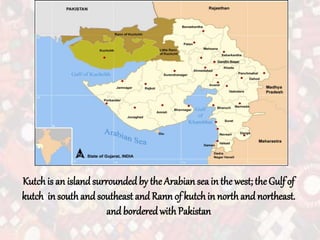
Kutchis an islandsurroundedby the Arabian seain the west; theGulf of
kutch in southand southeast and Rann of kutchin northand northeast.
and borderedwith Pakistan
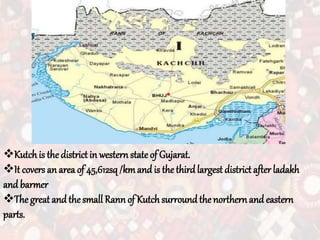
Kutchis the districtin western state of Gujarat.
It covers an area of 45,612sq/kmand is the thirdlargest district after ladakh
and barmer
The great and the small Rannof Kutchsurround the northernand eastern
parts.
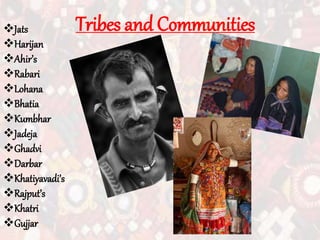
Tribes and CommunitiesJats
Harijan
Ahir’s
Rabari
Lohana
Bhatia
Kumbhar
Jadeja
Ghadvi
Darbar
Khatiyavadi’s
Rajput’s
Khatri
Gujjar
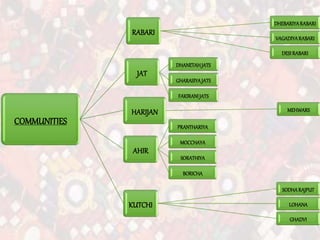
COMMUNITIES
RABARI
DHEBARIYARABARI
VAGADIYARABARI
DESIRABARI
JAT
DHANETAHJATS
GHARASIYAJATS
FAKIRANIJATS
HARIJAN MEHWARS
AHIR
PRANTHARIYA
MOCCHAYA
SORATHIYA
BORICHA
KUTCHI
SODHARAJPUT
LOHANA
GHADVI
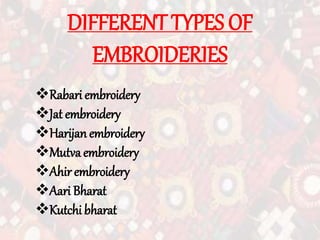
DIFFERENT TYPES OF
EMBROIDERIES
Rabari embroidery
Jat embroidery
Harijan embroidery
Mutva embroidery
Ahirembroidery
Aari Bharat
Kutchi bharat
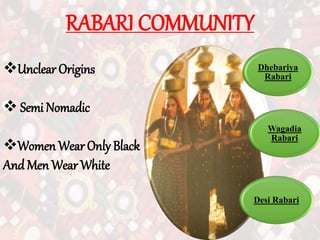
RABARI COMMUNITY
Unclear Origins
 Semi Nomadic
Women Wear Only Black
And Men Wear White
Dhebariya
Rabari
Wagadia
Rabari
Desi Rabari
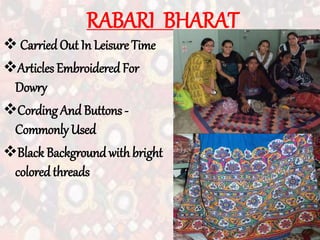
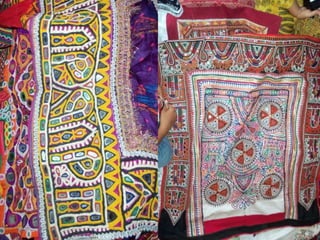
RABARI BHARAT
 CarriedOut In Leisure Time
Articles EmbroideredFor
Dowry
Cording And Buttons -
Commonly Used
Black Backgroundwith bright
coloredthreads
RABARI BHARAT
MOTIF
Paniyari, mango leaves,
scorpions, camels,
elephants andthe tree of
life, Temple motifs,
coconuts, parrots,
abstract designs.
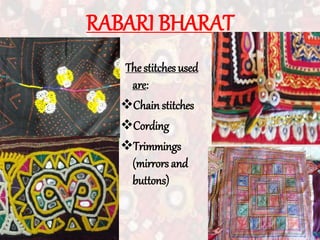
RABARI BHARAT
The stitches used
are:
Chain stitches
Cording
Trimmings
(mirrors and
buttons)
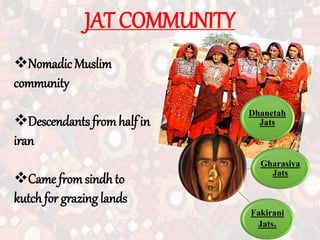
JAT COMMUNITY
Dhanetah
Jats
Gharasiya
Jats
Fakirani
Jats.
Nomadic Muslim
community
Descendants fromhalf in
iran
Came fromsindh to
kutch for grazing lands
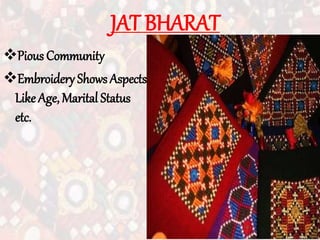
JAT BHARAT
Pious Community
Embroidery Shows Aspects
Like Age, Marital Status
etc.
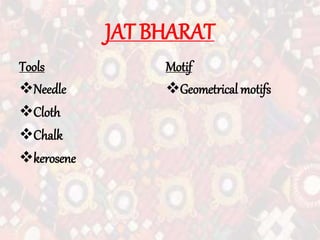
JAT BHARAT
Tools
Needle
Cloth
Chalk
kerosene
Motif
Geometrical motifs
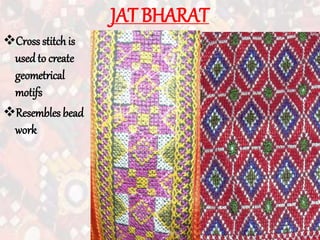
JAT BHARAT
Cross stitchis
usedto create
geometrical
motifs
Resembles bead
work
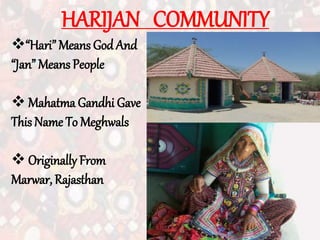
HARIJAN COMMUNITY
“Hari” Means God And
“Jan” Means People
 Mahatma Gandhi Gave
This Name To Meghwals
 Originally From
Marwar, Rajasthan
MUTWA BHARAT
Muslim Herders
Moved From Saudi Arabia 500 Years Back
Mutwa - The Most Tedious Embroidery
 Very Fine Stitches AndElaborate
Embroidery Inlaid With Small Mirrors
MUTWA BHARAT
Tools
Needle
Cottonor wool fabric,
Threads,Beadsor
mirrors.
Motifs
Geometric motifs,
five-petalled flowers,
creepers,
abstract designs.
MUTWA BHARAT
Tpyes Of Mutva :
Mukko,
Chakan,
Chopat,
 Katri
 Gotanv
Kambira
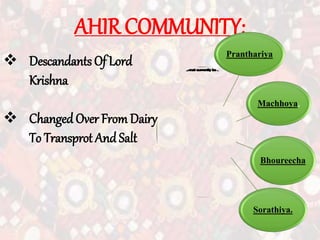
AHIR COMMUNITY:
Pranthariya
Machhoya,
Bhoureecha
Sorathiya.
 Descandants Of Lord
Krishna
 ChangedOver From Dairy
To Transprot And Salt
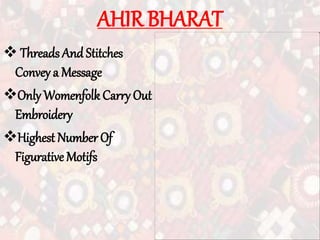
AHIR BHARAT
 Threads And Stitches
Convey a Message
Only Womenfolk Carry Out
Embroidery
Highest Number Of
Figurative Motifs
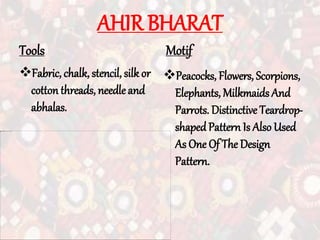
AHIR BHARAT
Tools
Fabric, chalk, stencil, silk or
cotton threads, needle and
abhalas.
Motif
Peacocks, Flowers, Scorpions,
Elephants, Milkmaids And
Parrots. Distinctive Teardrop-
shaped Pattern Is Also Used
As One Of The Design
Pattern.
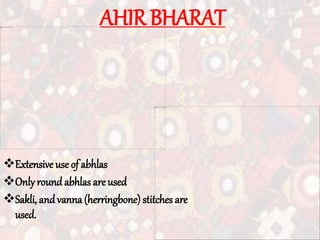
AHIR BHARAT
Extensive use of abhlas
Only round abhlasareused
Sakli, andvanna(herringbone) stitches are
used.
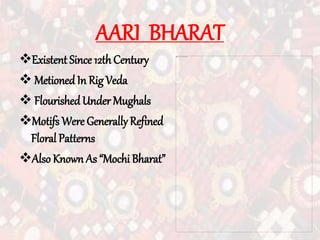
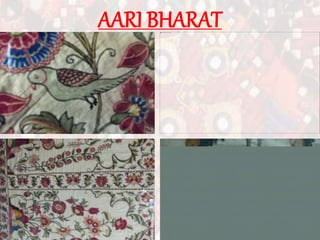
AARI BHARAT
Existent Since 12th Century
 Metioned In Rig Veda
 FlourishedUnder Mughals
Motifs Were Generally Refined
Floral Patterns
Also Known As “Mochi Bharat”
AARI BHARAT
 Aar a HookedNeedle Is
Used
 Very Time Consuming
 Filling Stitches Very
Elaborate
 Aari Has Become Extinct
Because Of Lack Of
Patronage
AARI BHARAT
Tools
Cloth, Hooked needle, silk
thread or zari thread or
cotton thread, and bamboo
frame.
Motif
Buttis, floral motifs,
peacocks, paisleys, patli,
bail, parrots, leaves, abstract
designs, gate way designs.
AARI BHARAT
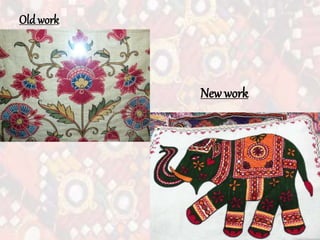
Old work
New work
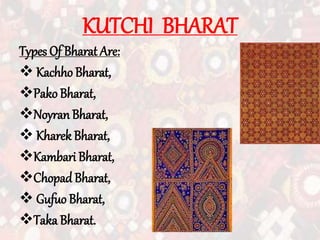
KUTCHI BHARAT
Types Of Bharat Are:
 Kachho Bharat,
Pako Bharat,
NoyranBharat,
 Kharek Bharat,
Kambari Bharat,
ChopadBharat,
 Gufuo Bharat,
Taka Bharat.
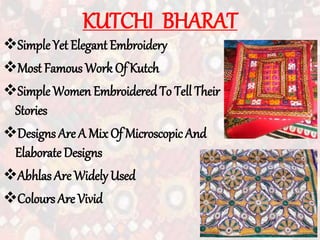
KUTCHI BHARAT
Simple Yet Elegant Embroidery
Most Famous Work Of Kutch
Simple Women EmbroideredTo Tell Their
Stories
Designs Are A Mix Of Microscopic And
Elaborate Designs
Abhlas Are Widely Used
Colours Are Vivid
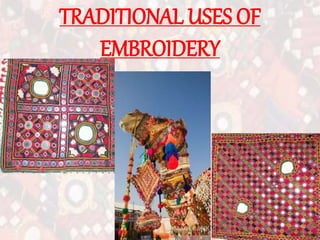
TRADITIONAL USES OF
EMBROIDERY
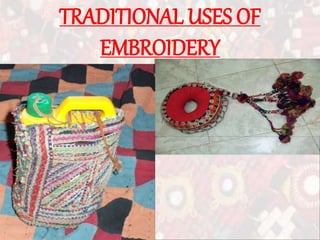
TRADITIONAL USES OF
EMBROIDERY
LIMITATIONS
 Language barrier
Unwilling to Change
Underpaid
Commercialization
Lack of lead time
Remotely settled
Communication gap
Unavailability of material
EXPERIENCE
 Traditional aari embroidery is already extinct and the other
communities are engaging in aariwork.
 The tribes are now embroidering for monetary gains.
The artisans are not being paid well.
 the artisans have now become alert about the scope of their
embroidery and they are now creating a platformfor themselves.
ACKNOWLEDGEMENT
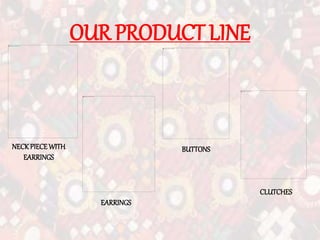
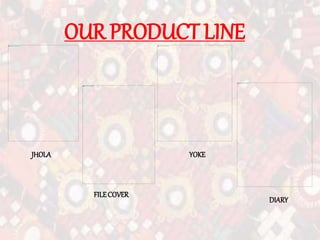
OUR PRODUCT LINE
NECKPIECEWITH
EARRINGS
EARRINGS
BUTTONS
CLUTCHES
OUR PRODUCT LINE
JHOLA
FILECOVER
YOKE
DIARY
OUR PRODUCT LINE
GARMENTS

Craft documentation presentation