Presentation On “Gota Patti”
ABOUT
• Gota Work (also known as Gota Patti Work, Gota-
Kinari work or Lappe ka Kaam) is a type of metal
embroidery originated in Rajasthan, India.
• Gota Patti is an appliqué work done on a base fabrics
for design embellishment .
• It is applied on to the edges of a fabric to create fancy
patterns and is popularly used in edging bridal Sarees
and Lehengas.
• In Rajasthan, Gota work is extensively done on
Dupattas and Ghagras. Outfits adorned with Gota
Work are popularly worn at auspicious functions.
GEOGRAPHICAL REGION
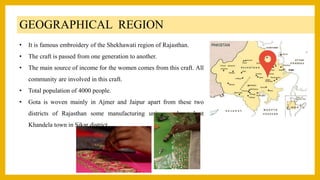
• It is famous embroidery of the Shekhawati region of Rajasthan.
• The craft is passed from one generation to another.
• The main source of income for the women comes from this craft. All
community are involved in this craft.
• Total population of 4000 people.
• Gota is woven mainly in Ajmer and Jaipur apart from these two
districts of Rajasthan some manufacturing units are located at
Khandela town in Sikar district.
HISTORY
• Gota embroidery found its origin in Rajasthan.
• It started prevailing during Mughals and Rujputana period
and was used to adorn almost everything.
• From clothes to bed spreads, to bags, and house related
upholstery, gota work was used as a common form of
embellishment.
• Gold and silver metallic wires were used for Gotta ribbon.
• The Gota Patti was cut according to natural motifs like
birds, human figures, animals and attached to cloth
decorated by gold and silver wire.
UNIQUENESS
• Gota patti used to adorn the royalty of
Jaipur
• Gota creates a rich and heavy look but is
light to wear.
• It is a spectacular embroidery involving
an array of techniques.
• It resembles with the Kundan and
Meenakari jewellery of Rajasthan.
• The motifs used on Gota are inspired
from the flora and fauna. Flowers,
leaves, birds and animals are some of the
popular motifs used in Gota.
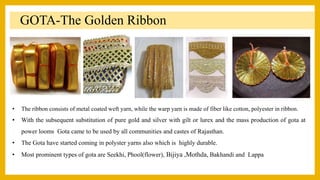
• The ribbon consists of metal coated weft yarn, while the warp yarn is made of fiber like cotton, polyester in ribbon.
• With the subsequent substitution of pure gold and silver with gilt or lurex and the mass production of gota at
power looms Gota came to be used by all communities and castes of Rajasthan.
• The Gota have started coming in polyster yarns also which is highly durable.
• Most prominent types of gota are Seekhi, Phool(flower), Bijiya ,Mothda, Bakhandi and Lappa
GOTA-The Golden Ribbon
• The leaf Patti is the local name of a leaf. The leafs are the most important part of motifs which are used
to create a motif and then a pattern. All the work is done around a leaf.
• The gota ribbons are cut into these leaves and the thread work is done around it.
PATTI
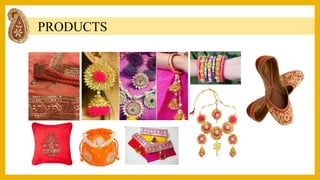
PRODUCTS
MATERIALS
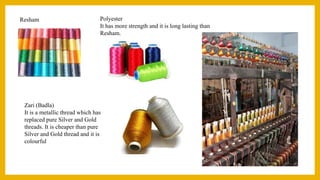
Resham Polyester
It has more strength and it is long lasting than
Resham.
Zari (Badla)
It is a metallic thread which has
replaced pure Silver and Gold
threads. It is cheaper than pure
Silver and Gold thread and it is
colourful
PROCESS
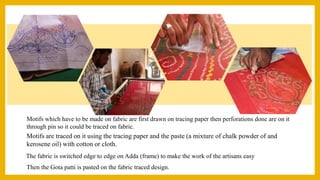
Motifs which have to be made on fabric are first drawn on tracing paper then perforations done are on it
through pin so it could be traced on fabric.
The fabric is switched edge to edge on Adda (frame) to make the work of the artisans easy
Motifs are traced on it using the tracing paper and the paste (a mixture of chalk powder of and
kerosene oil) with cotton or cloth.
Then the Gota patti is pasted on the fabric traced design.
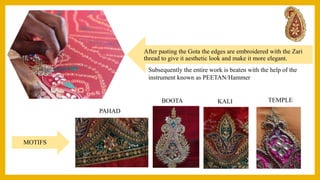
After pasting the Gota the edges are embroidered with the Zari
thread to give it aesthetic look and make it more elegant.
Subsequently the entire work is beaten with the help of the
instrument known as PEETAN/Hammer
PAHAD
KALI TEMPLEBOOTA
MOTIFS
THANK YOU

Presentation On “Gota Patti”

  • 1.
  • 2.
    ABOUT • Gota Work(also known as Gota Patti Work, Gota- Kinari work or Lappe ka Kaam) is a type of metal embroidery originated in Rajasthan, India. • Gota Patti is an appliqué work done on a base fabrics for design embellishment . • It is applied on to the edges of a fabric to create fancy patterns and is popularly used in edging bridal Sarees and Lehengas. • In Rajasthan, Gota work is extensively done on Dupattas and Ghagras. Outfits adorned with Gota Work are popularly worn at auspicious functions.
  • 3.
    GEOGRAPHICAL REGION • Itis famous embroidery of the Shekhawati region of Rajasthan. • The craft is passed from one generation to another. • The main source of income for the women comes from this craft. All community are involved in this craft. • Total population of 4000 people. • Gota is woven mainly in Ajmer and Jaipur apart from these two districts of Rajasthan some manufacturing units are located at Khandela town in Sikar district.
  • 4.
    HISTORY • Gota embroideryfound its origin in Rajasthan. • It started prevailing during Mughals and Rujputana period and was used to adorn almost everything. • From clothes to bed spreads, to bags, and house related upholstery, gota work was used as a common form of embellishment. • Gold and silver metallic wires were used for Gotta ribbon. • The Gota Patti was cut according to natural motifs like birds, human figures, animals and attached to cloth decorated by gold and silver wire.
  • 5.
    UNIQUENESS • Gota pattiused to adorn the royalty of Jaipur • Gota creates a rich and heavy look but is light to wear. • It is a spectacular embroidery involving an array of techniques. • It resembles with the Kundan and Meenakari jewellery of Rajasthan. • The motifs used on Gota are inspired from the flora and fauna. Flowers, leaves, birds and animals are some of the popular motifs used in Gota.
  • 6.
    • The ribbonconsists of metal coated weft yarn, while the warp yarn is made of fiber like cotton, polyester in ribbon. • With the subsequent substitution of pure gold and silver with gilt or lurex and the mass production of gota at power looms Gota came to be used by all communities and castes of Rajasthan. • The Gota have started coming in polyster yarns also which is highly durable. • Most prominent types of gota are Seekhi, Phool(flower), Bijiya ,Mothda, Bakhandi and Lappa GOTA-The Golden Ribbon
  • 7.
    • The leafPatti is the local name of a leaf. The leafs are the most important part of motifs which are used to create a motif and then a pattern. All the work is done around a leaf. • The gota ribbons are cut into these leaves and the thread work is done around it. PATTI
  • 8.
  • 9.
  • 10.
    Resham Polyester It hasmore strength and it is long lasting than Resham. Zari (Badla) It is a metallic thread which has replaced pure Silver and Gold threads. It is cheaper than pure Silver and Gold thread and it is colourful
  • 11.
  • 12.
    Motifs which haveto be made on fabric are first drawn on tracing paper then perforations done are on it through pin so it could be traced on fabric. The fabric is switched edge to edge on Adda (frame) to make the work of the artisans easy Motifs are traced on it using the tracing paper and the paste (a mixture of chalk powder of and kerosene oil) with cotton or cloth. Then the Gota patti is pasted on the fabric traced design.
  • 13.
    After pasting theGota the edges are embroidered with the Zari thread to give it aesthetic look and make it more elegant. Subsequently the entire work is beaten with the help of the instrument known as PEETAN/Hammer PAHAD KALI TEMPLEBOOTA MOTIFS
  • 14.