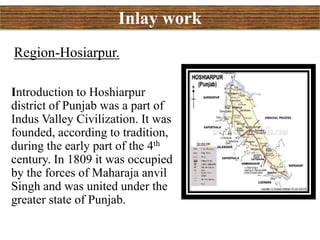
Summer project,2010CRAFT DOCUMENTATION(Punjab).Patiala. Amritsar .Nakodar.HoshiarpurNIIFT JALANDHARBATCH-2009-12A Presentation by:-Group “B”
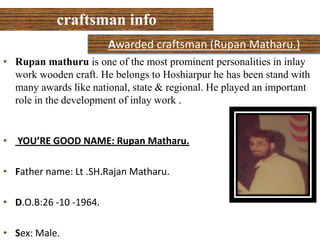
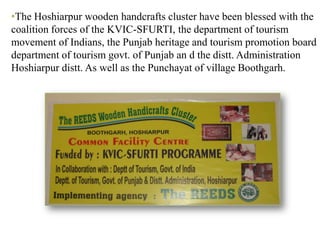
OUR SPECIAL THANKS GO TOThe REEDS Wooden HandicraftsCluster Hoshiarpur, Punjab.An Initiative of the KVIC-CFURTI Programme.An integral unit of the REEDS. (The rural Environmental Enterprises Development Society)Registered under the Societies Registration Act (1860).Committed to Skill Development for survival, Sustance and support.H.Q. :#1116, SECTOR 33-C, CHANDIGARH.Ph. : +91-172-4631116, 2605678JagmohanAngraMob. : 9815349297Cluster Development Executive.RUPAN MATHARUNational AwardeeSpecialist in:Inlay work in wooden.P.S HANDICRAFTMANUFACTURES& EXPORTERS WOODEN HANDICRAFTSVILL.Chhaunikallan, Ram Colony Camp Hoshiarpur (pb)Ph. +911882236280 (F) 9417043694 (M)E-mail:parminder-handicraft@yahoo.co.in, iccaindia@rediffmail.com
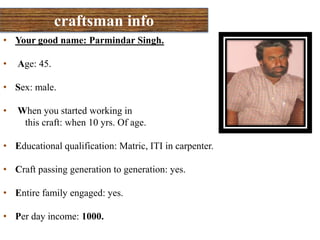
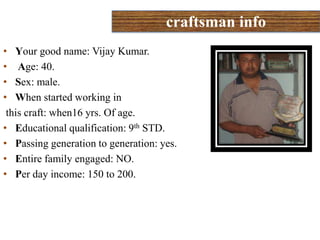
Par minder SinghManaging directorJHANKI DEVI (CRAFTMANS OF PHULKARI).TRIPURI(PATIALA)JUGAL KISHORE.PUNJABI JUTTIES CRAFTMANS, TOPKHANAMOR,PATIALAVIJAY KISHOREPUNJABI JUTTIE, TOPKHANAMOR, PATIALASANJAY RATHOREPARANDHI, PHULWALA CHOWK, PATIALA.BHAGWANTI DEVI.PHULKARI CRAFT, TRIPALI, PATIALASATISH KUMAR.PUNJABI JUTTIES CRAFT, TOPKHANAMOR, PATIALA.SOMA DEVI, GOUNS MOHALLA, NAKODHAR.(DURRIES MAKING)NARENDRA KUMAR, GOUNS MOHALLA, NAKODHAR.(DURRIES MAKING)RAJU KUMAR, KHADDI GRAM UDH0YOAG, NAKHODAR.(PANJA DURRIES)RAISH KHAN, KHADDI GRAM UDH0YOAG, NAKHODAR.(PANJA DURRIES)ARUN KUMAR, JANDIALA, AMRITSHAR, PUNJAB.(KESH WORK)BALDEV KRISHNA, REEDS, HOSHIARPUR (PUNJAB).(INLAY WORK)JOGINDAR SINGH, PAL, ADAMWAL, HOSHIARPUR, (PUNJAB).(INLAY WORK).SURENDAR NATH, ADAMWAL, HOSHIARPUR, (PUNJAB).(HATTHI SPECIALIST, INLAY WORK).VIJAY KUMAR, ADAMWAL, HOSHIARPUR, (PUNJAB).(INLAY WORK).HUZ MOHMOOD, KOT KHALSA, AMRITSAR (PUNJAB).(JALI WORK).SHANTI DEVI, KOT KHALSA, AMRITSAR(PUNJAB)(JALI WORK)SHARDA DEVI, KOT KHALSA, AMRITSAR,(PUNAJB)(JALI WORK)RAKESH KUMAR, KOT KHALSA, AMRITSAR,(PUNJAB)(JALI WORK)LAL CHAND, KOT KHALSA, AMRITSAR,(PUNJAB)(JALI WORK)MINAKSHI DEVI           (PUNJABI JUTTI)
Our Group representativesAbhijeet kumarAditya SinghKunal kumarNeeraj katariaNeha BhartiPardeep MahajanPuja KumariRajnikant SumanShipraPatrishaShalu chachanShweta
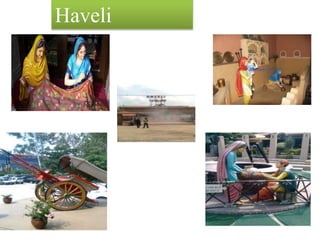
Haveli
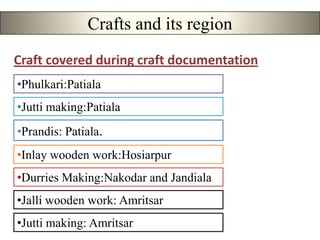
Crafts and its regionCraft covered during craft documentation Phulkari:Patiala
Jutti making:Patiala
Prandis: Patiala.

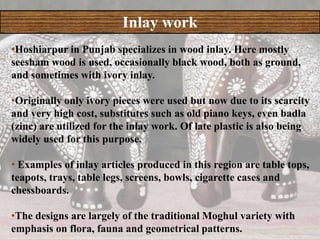
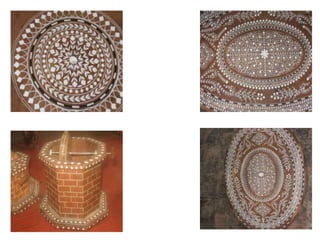
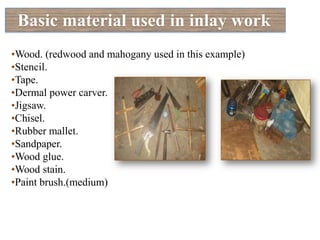
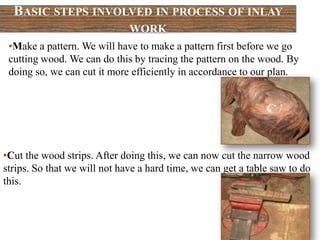
Inlay wooden work:Hosiarpur
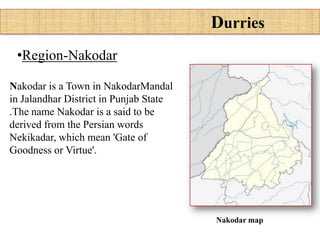
Durries Making:Nakodar and Jandiala
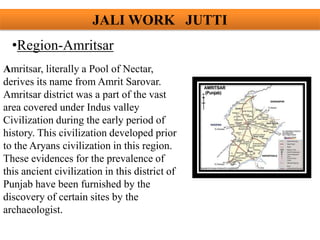
Jalli wooden work: Amritsar
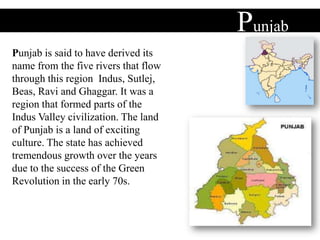
Jutti making: Amritsar                            PunjabPunjab is said to have derived its name from the five rivers that flow through this region  Indus, Sutlej, Beas, Ravi and Ghaggar. It was a region that formed parts of the Indus Valley civilization. The land of Punjab is a land of exciting culture. The state has achieved tremendous growth over the years due to the success of the Green Revolution in the early 70s.
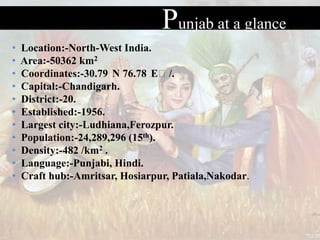
Punjab at a glance  Location:-North-West India.
  Area:-50362 km2
  Coordinates:-30.79°N 76.78°E /.
  Capital:-Chandigarh.
  District:-20.
  Established:-1956.
  Largest city:-Ludhiana,Ferozpur.
  Population:-24,289,296 (15th).
  Density:-482 /km2 .
  Language:-Punjabi, Hindi.
  Craft hub:-Amritsar, Hosiarpur, Patiala,Nakodar. 
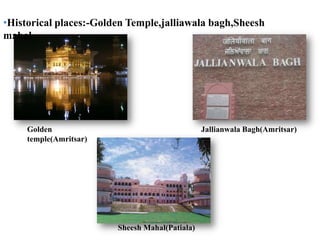
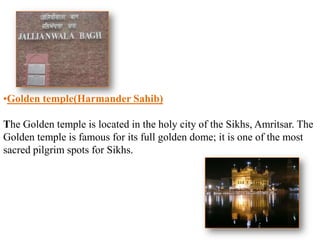
Historical places:-Golden Temple,jalliawala bagh,Sheesh mahal.Golden temple(Amritsar)Jallianwala Bagh(Amritsar)Sheesh Mahal(Patiala)
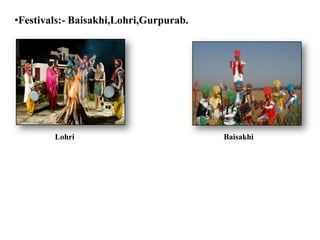
Festivals:- Baisakhi,Lohri,Gurpurab.LohriBaisakhi
History and religionThe three main religions in the area are Sikhism, Hinduism, and Islam. The region has been invaded and ruled by many different empires and races, including the Aryans, Persians, Greeks, Egyptians, Afghans, and Mongols. Around the time of the 15th Century, Guru Nanak Dev founded the Sikh religion, which quickly came to prominence in the region, and shortly afterwards, Maharaja Ranjit Singh reformed the Punjab into a secular and powerful state.
PATIALA(TRADITIONAL EMBROIDERY OF PUNJAB)PHULKARI
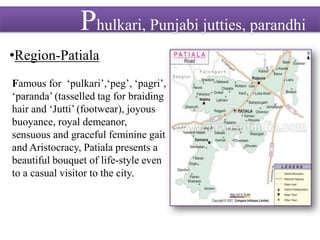
JANKI DEVI         Phulkari, Punjabi jutties, parandhi Region-PatialaFamous for  ‘pulkari’,‘peg’, ‘pagri’, ‘paranda’ (tasselled tag for braiding hair and ‘Jutti’ (footwear), joyous buoyance, royal demeanor, sensuous and graceful feminine gait and Aristocracy, Patiala presents a beautiful bouquet of life-style even to a casual visitor to the city.
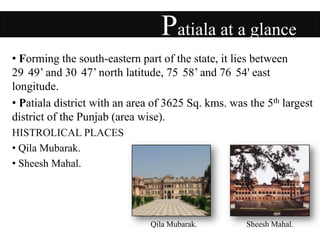
Patiala at a glance Forming the south-eastern part of the state, it lies between 29°49’ and 30°47’ north latitude, 75°58’ and 76°54' east longitude. 
 Patiala district with an area of 3625 Sq. kms. was the 5th largest district of the Punjab (area wise).HISTROLICAL PLACES Qila Mubarak.
 Sheesh Mahal.Sheesh Mahal.Qila Mubarak.
Craft in Patiala
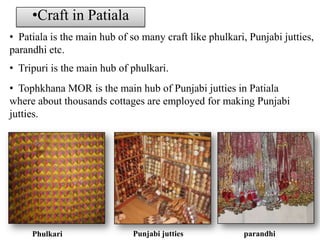
  Patiala is the main hub of so many craft like phulkari, Punjabi jutties, parandhi etc.
  Tripuri is the main hub of phulkari.
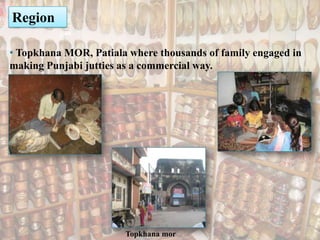
  Tophkhana MOR is the main hub of Punjabi jutties in Patiala where about thousands cottages are employed for making Punjabi jutties.PhulkariPunjabi juttiesparandhi
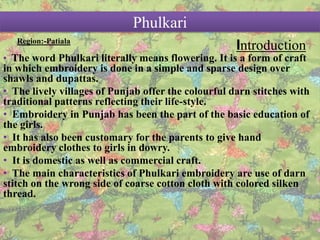
PhulkariIntroductionRegion:-PatialaThe word Phulkari literally means flowering. It is a form of craft in which embroidery is done in a simple and sparse design over shawls and dupattas.
  The lively villages of Punjab offer the colourful darn stitches with traditional patterns reflecting their life-style.
  Embroidery in Punjab has been the part of the basic education of the girls.
  It has also been customary for the parents to give hand embroidery clothes to girls in dowry.
  It is domestic as well as commercial craft.
  The main characteristics of Phulkari embroidery are use of darn stitch on the wrong side of coarse cotton cloth with colored silken thread. Origin
 Phulkari embroidery has been popular since the 15th century.
  Phulkari came from Iran where it is known as Gulkari some feel it came from central Asia along with Jat tribes who migrated to India and settled in Punjab, Haryana and Gujarat. There is reference of Phulkari in Vedas, Mahabharata, Guru Garanth Sahib and folk songs of Punjab.
Region
 It is done all over the Punjab (NORTHERN PUNJAB IN PAKISTHAN LIKE HAZARA AND CHAKWAL ALSO.) region and their adjacent state like Haryana.
 In Punjab, Patiala is the main hub of phulkari embroidery.
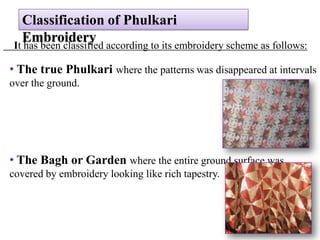
Tripali in Patiala is the main hub of phulkari where almost every house is engaged in phulkari craft in domestic as well as in commercial wayClassification of Phulkari Embroidery    It has been classified according to its embroidery scheme as follows: The true Phulkari where the patterns was disappeared at intervals over the ground.
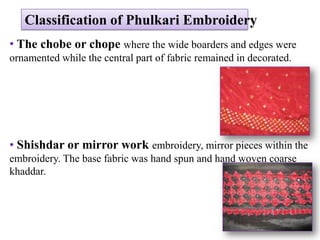
 The Bagh or Garden where the entire ground surface was covered by embroidery looking like rich tapestry.Classification of Phulkari Embroidery The chobe or chope where the wide boarders and edges were ornamented while the central part of fabric remained in decorated.
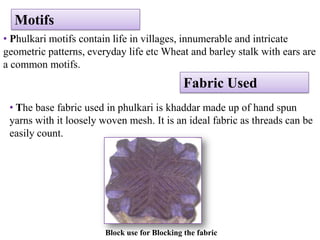
Shishdar or mirror work embroidery, mirror pieces within the embroidery. The base fabric was hand spun and hand woven coarse khaddar.     Motifs Phulkari motifs contain life in villages, innumerable and intricate geometric patterns, everyday life etc Wheat and barley stalk with ears are a common motifs. Fabric Used The base fabric used in phulkari is khaddar made up of hand spun yarns with it loosely woven mesh. It is an ideal fabric as threads can be easily count. Block use for Blocking the fabric
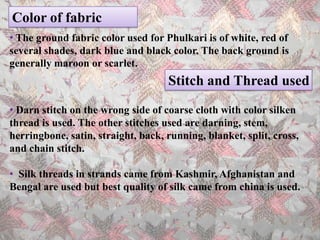
Color of fabric The ground fabric color used for Phulkari is of white, red of several shades, dark blue and black color. The back ground is generally maroon or scarlet.Stitch and Thread used Darn stitch on the wrong side of coarse cloth with color silken thread is used. The other stitches used are darning, stem, herringbone, satin, straight, back, running, blanket, split, cross, and chain stitch.
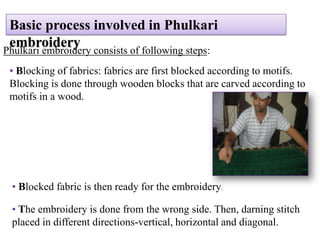
  Silk threads in strands came from Kashmir, Afghanistan and Bengal are used but best quality of silk came from china is used.Basic process involved in Phulkari embroideryPhulkari embroidery consists of following steps: Blocking of fabrics: fabrics are first blocked according to motifs. Blocking is done through wooden blocks that are carved according to motifs in a wood.
 Blocked fabric is then ready for the embroidery.
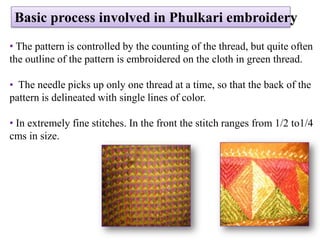
 The embroidery is done from the wrong side. Then, darning stitch placed in different directions-vertical, horizontal and diagonal. Basic process involved in Phulkari embroidery The pattern is controlled by the counting of the thread, but quite often the outline of the pattern is embroidered on the cloth in green thread.
  The needle picks up only one thread at a time, so that the back of the pattern is delineated with single lines of color.
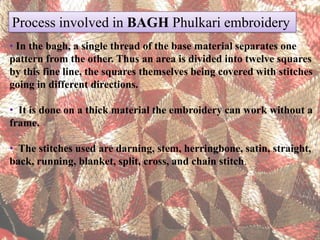
 In extremely fine stitches. In the front the stitch ranges from 1/2 to1/4 cms in size.Process involved in BAGH Phulkari embroidery In the bagh, a single thread of the base material separates one pattern from the other. Thus an area is divided into twelve squares by this fine line, the squares themselves being covered with stitches going in different directions.
  It is done on a thick material the embroidery can work without a frame.
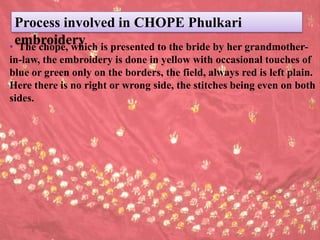
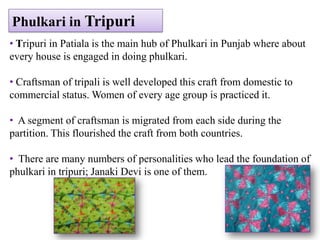
  The stitches used are darning, stem, herringbone, satin, straight, back, running, blanket, split, cross, and chain stitch.Process involved in CHOPE Phulkari embroidery  The chope, which is presented to the bride by her grandmother-in-law, the embroidery is done in yellow with occasional touches of blue or green only on the borders, the field, always red is left plain. Here there is no right or wrong side, the stitches being even on both sides.Phulkari in Tripuri Tripuri in Patiala is the main hub of Phulkari in Punjab where about every house is engaged in doing phulkari.
 Craftsman of tripali is well developed this craft from domestic to commercial status. Women of every age groupis practiced it.
  A segment of craftsman is migrated from each side during the partition. This flourished the craft from both countries.
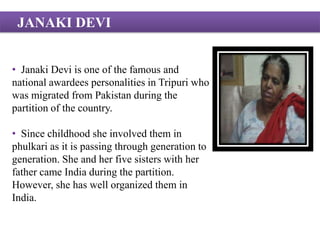
  There are many numbers of personalities who lead the foundation of phulkari in tripuri; Janaki Devi is one of them.    JANAKI DEVI  Janaki Devi is one of the famous and national awardees personalities in Tripuri who was migrated from Pakistan during the partition of the country.
  Since childhood she involved them in phulkari as it is passing through generation to generation. She and her five sisters with her father came India during the partition. However, she has well organized them in India.    JANAKI DEVIIn Tripuri she promoted the phulkari from domestic to commercial status.
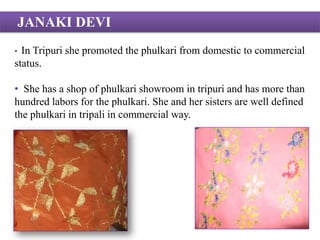
  She has a shop of phulkari showroom in tripuri and has more than hundred labors for the phulkari. She and her sisters are well defined the phulkari in tripali in commercial way.       JUTTI
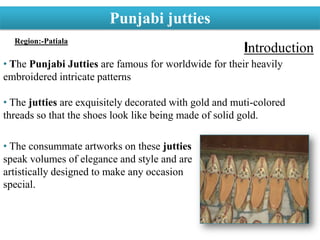
Punjabi juttiesRegion:-PatialaIntroduction The Punjabi Jutties are famous for worldwide for their heavily embroidered intricate patterns
The jutties are exquisitely decorated with gold and muti-colored threads so that the shoes look like being made of solid gold.
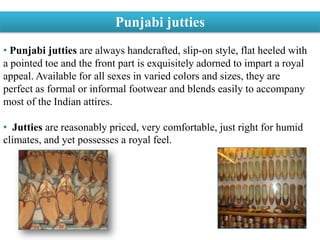
 The consummate artworks on these jutties speak volumes of elegance and style and are artistically designed to make any occasion special.Punjabi jutties Punjabi jutties are always handcrafted, slip-on style, flat heeled with a pointed toe and the front part is exquisitely adorned to impart a royal appeal. Available for all sexes in varied colors and sizes, they are perfect as formal or informal footwear and blends easily to accompany most of the Indian attires.
Jutties are reasonably priced, very comfortable, just right for humid climates, and yet possesses a royal feel.Region Topkhana MOR, Patiala where thousands of family engaged in making Punjabi jutties as a commercial way.Topkhana mor
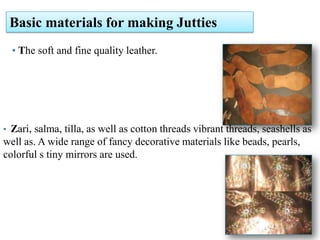
Basic materials for making Jutties The soft and fine quality leather.
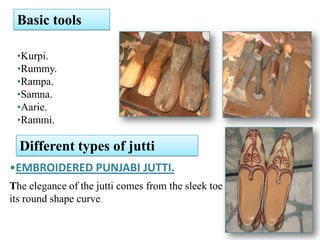
Zari, salma, tilla, as well as cotton threads vibrant threads, seashells as well as. A wide range of fancy decorative materials like beads, pearls, colorful s tiny mirrors are used.Basic toolsKurpi.
Rummy.
Rampa.
Samna.
Aarie.
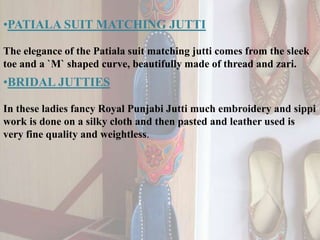
Rammi.Different types of juttiEMBROIDERED PUNJABI JUTTI.The elegance of the jutti comes from the sleek toe and its round shape curve.
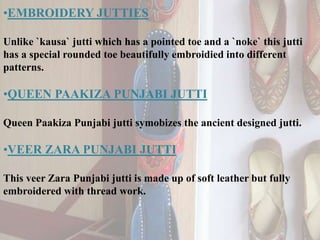
EMBROIDERY JUTTIESUnlike `kausa` jutti which has a pointed toe and a `noke` this jutti has a special rounded toe beautifully embroidied into different patterns.QUEEN PAAKIZA PUNJABI JUTTIQueen Paakiza Punjabi jutti symobizes the ancient designed jutti.VEER ZARA PUNJABI JUTTIThis veer Zara Punjabi jutti is made up of soft leather but fully embroidered with thread work.
PATIALA SUIT MATCHING JUTTIThe elegance of the Patiala suit matching jutti comes from the sleek toe and a `M` shaped curve, beautifully made of thread and zari.BRIDAL JUTTIESIn these ladies fancy Royal Punjabi Jutti much embroidery and sippi work is done on a silky cloth and then pasted and leather used is very fine quality and weightless.
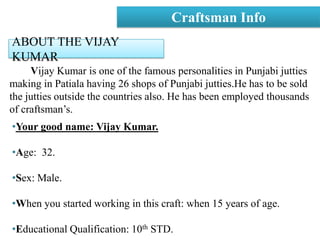
Craftsman InfoABOUT THE VIJAY KUMAR        Vijay Kumar is one of the famous personalities in Punjabi jutties making in Patiala having 26 shops of Punjabi jutties.He has to be sold the jutties outside the countries also. He has been employed thousands of craftsman’s.    Your good name: Vijay Kumar.
Age:  32.
Sex: Male.
When you started working in this craft: when 15 years of age.
Educational Qualification: 10th STD.Craft passing from generation to generation: yes
Is the entire family engaged in this craft: Yes.
Per day income: depend upon product sold.
Any govt. help: No.
Craft practised by any particular community: yes.
Seasonal craft: No.
Sustain entire family: Yes.
Product through brokers: no.
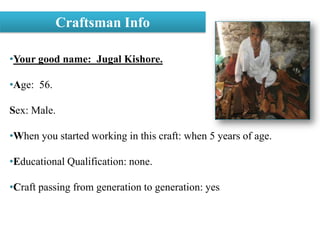
Other craftsman like Jugal Kishore worked on daily wages under the Vijay Kumar.Craftsman InfoYour good name:  Jugal Kishore.
Age:  56.Sex: Male.When you started working in this craft: when 5 years of age.
Educational Qualification: none.
Craft passing from generation to generation: yes.        Is the entire family engaged in this craft: Yes.
Per day income: 100
Any govt. help: No.
Craft practised by any particular community: yes.
Seasonal craft: No.
Sustain entire family: no.
Product through brokers: yes. PARANDIS
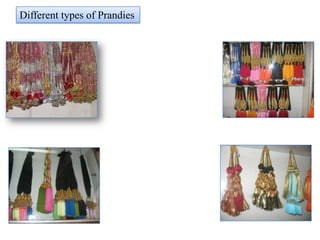
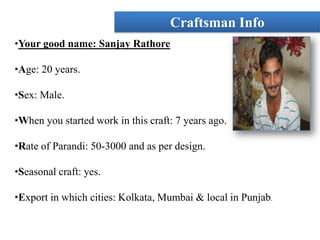
PARANDISIntroductionRegion:-PatialaThe colorful "Parandis" adds to the vibrant and dynamic character of the state of Punjab.
One of the traditional handicraft industries, the Parandi craftsmen displays the rich artistic skills of the people of the state. The attractive and beautiful parandis bear relics of the rich creative imagination of the people of the state of Punjab.
The traditional handicraft industry of Parandi has served the people with its beautiful artistic creations from the ancient times. The Parandi craftsmen require great deal of patience to make the "Parandis". The Parandi craftsmen eloquently decorate the Parandis with fine silk threads of various colours to make them look attractive.Different types of Prandies

Craft documentation

  • 1.
    Summer project,2010CRAFT DOCUMENTATION(Punjab).Patiala.Amritsar .Nakodar.HoshiarpurNIIFT JALANDHARBATCH-2009-12A Presentation by:-Group “B”
  • 2.
    OUR SPECIAL THANKSGO TOThe REEDS Wooden HandicraftsCluster Hoshiarpur, Punjab.An Initiative of the KVIC-CFURTI Programme.An integral unit of the REEDS. (The rural Environmental Enterprises Development Society)Registered under the Societies Registration Act (1860).Committed to Skill Development for survival, Sustance and support.H.Q. :#1116, SECTOR 33-C, CHANDIGARH.Ph. : +91-172-4631116, 2605678JagmohanAngraMob. : 9815349297Cluster Development Executive.RUPAN MATHARUNational AwardeeSpecialist in:Inlay work in wooden.P.S HANDICRAFTMANUFACTURES& EXPORTERS WOODEN HANDICRAFTSVILL.Chhaunikallan, Ram Colony Camp Hoshiarpur (pb)Ph. +911882236280 (F) 9417043694 (M)E-mail:parminder-handicraft@yahoo.co.in, iccaindia@rediffmail.com
  • 3.
    Par minder SinghManagingdirectorJHANKI DEVI (CRAFTMANS OF PHULKARI).TRIPURI(PATIALA)JUGAL KISHORE.PUNJABI JUTTIES CRAFTMANS, TOPKHANAMOR,PATIALAVIJAY KISHOREPUNJABI JUTTIE, TOPKHANAMOR, PATIALASANJAY RATHOREPARANDHI, PHULWALA CHOWK, PATIALA.BHAGWANTI DEVI.PHULKARI CRAFT, TRIPALI, PATIALASATISH KUMAR.PUNJABI JUTTIES CRAFT, TOPKHANAMOR, PATIALA.SOMA DEVI, GOUNS MOHALLA, NAKODHAR.(DURRIES MAKING)NARENDRA KUMAR, GOUNS MOHALLA, NAKODHAR.(DURRIES MAKING)RAJU KUMAR, KHADDI GRAM UDH0YOAG, NAKHODAR.(PANJA DURRIES)RAISH KHAN, KHADDI GRAM UDH0YOAG, NAKHODAR.(PANJA DURRIES)ARUN KUMAR, JANDIALA, AMRITSHAR, PUNJAB.(KESH WORK)BALDEV KRISHNA, REEDS, HOSHIARPUR (PUNJAB).(INLAY WORK)JOGINDAR SINGH, PAL, ADAMWAL, HOSHIARPUR, (PUNJAB).(INLAY WORK).SURENDAR NATH, ADAMWAL, HOSHIARPUR, (PUNJAB).(HATTHI SPECIALIST, INLAY WORK).VIJAY KUMAR, ADAMWAL, HOSHIARPUR, (PUNJAB).(INLAY WORK).HUZ MOHMOOD, KOT KHALSA, AMRITSAR (PUNJAB).(JALI WORK).SHANTI DEVI, KOT KHALSA, AMRITSAR(PUNJAB)(JALI WORK)SHARDA DEVI, KOT KHALSA, AMRITSAR,(PUNAJB)(JALI WORK)RAKESH KUMAR, KOT KHALSA, AMRITSAR,(PUNJAB)(JALI WORK)LAL CHAND, KOT KHALSA, AMRITSAR,(PUNJAB)(JALI WORK)MINAKSHI DEVI (PUNJABI JUTTI)
  • 4.
    Our Group representativesAbhijeetkumarAditya SinghKunal kumarNeeraj katariaNeha BhartiPardeep MahajanPuja KumariRajnikant SumanShipraPatrishaShalu chachanShweta
  • 5.
  • 6.
    Crafts and itsregionCraft covered during craft documentation Phulkari:Patiala
  • 7.
  • 8.
  • 9.
  • 10.
  • 11.
  • 12.
    Jutti making: Amritsar PunjabPunjab is said to have derived its name from the five rivers that flow through this region Indus, Sutlej, Beas, Ravi and Ghaggar. It was a region that formed parts of the Indus Valley civilization. The land of Punjab is a land of exciting culture. The state has achieved tremendous growth over the years due to the success of the Green Revolution in the early 70s.
  • 13.
    Punjab at aglance Location:-North-West India.
  • 14.
  • 15.
  • 16.
  • 17.
  • 18.
  • 19.
    Largestcity:-Ludhiana,Ferozpur.
  • 20.
  • 21.
  • 22.
  • 23.
    Crafthub:-Amritsar, Hosiarpur, Patiala,Nakodar. 
  • 24.
    Historical places:-Golden Temple,jalliawalabagh,Sheesh mahal.Golden temple(Amritsar)Jallianwala Bagh(Amritsar)Sheesh Mahal(Patiala)
  • 25.
  • 26.
    History and religionThethree main religions in the area are Sikhism, Hinduism, and Islam. The region has been invaded and ruled by many different empires and races, including the Aryans, Persians, Greeks, Egyptians, Afghans, and Mongols. Around the time of the 15th Century, Guru Nanak Dev founded the Sikh religion, which quickly came to prominence in the region, and shortly afterwards, Maharaja Ranjit Singh reformed the Punjab into a secular and powerful state.
  • 27.
  • 28.
    JANKI DEVI Phulkari, Punjabi jutties, parandhi Region-PatialaFamous for ‘pulkari’,‘peg’, ‘pagri’, ‘paranda’ (tasselled tag for braiding hair and ‘Jutti’ (footwear), joyous buoyance, royal demeanor, sensuous and graceful feminine gait and Aristocracy, Patiala presents a beautiful bouquet of life-style even to a casual visitor to the city.
  • 29.
    Patiala at aglance Forming the south-eastern part of the state, it lies between 29°49’ and 30°47’ north latitude, 75°58’ and 76°54' east longitude. 
  • 30.
    Patiala districtwith an area of 3625 Sq. kms. was the 5th largest district of the Punjab (area wise).HISTROLICAL PLACES Qila Mubarak.
  • 31.
    Sheesh Mahal.SheeshMahal.Qila Mubarak.
  • 32.
  • 33.
    Patialais the main hub of so many craft like phulkari, Punjabi jutties, parandhi etc.
  • 34.
    Tripuriis the main hub of phulkari.
  • 35.
    TophkhanaMOR is the main hub of Punjabi jutties in Patiala where about thousands cottages are employed for making Punjabi jutties.PhulkariPunjabi juttiesparandhi
  • 36.
    PhulkariIntroductionRegion:-PatialaThe word Phulkariliterally means flowering. It is a form of craft in which embroidery is done in a simple and sparse design over shawls and dupattas.
  • 37.
    Thelively villages of Punjab offer the colourful darn stitches with traditional patterns reflecting their life-style.
  • 38.
    Embroideryin Punjab has been the part of the basic education of the girls.
  • 39.
    Ithas also been customary for the parents to give hand embroidery clothes to girls in dowry.
  • 40.
    Itis domestic as well as commercial craft.
  • 41.
    Themain characteristics of Phulkari embroidery are use of darn stitch on the wrong side of coarse cotton cloth with colored silken thread. Origin
  • 42.
    Phulkari embroideryhas been popular since the 15th century.
  • 43.
    Phulkaricame from Iran where it is known as Gulkari some feel it came from central Asia along with Jat tribes who migrated to India and settled in Punjab, Haryana and Gujarat. There is reference of Phulkari in Vedas, Mahabharata, Guru Garanth Sahib and folk songs of Punjab.
  • 44.
  • 45.
    It isdone all over the Punjab (NORTHERN PUNJAB IN PAKISTHAN LIKE HAZARA AND CHAKWAL ALSO.) region and their adjacent state like Haryana.
  • 46.
    In Punjab,Patiala is the main hub of phulkari embroidery.
  • 47.
    Tripali in Patialais the main hub of phulkari where almost every house is engaged in phulkari craft in domestic as well as in commercial wayClassification of Phulkari Embroidery It has been classified according to its embroidery scheme as follows: The true Phulkari where the patterns was disappeared at intervals over the ground.
  • 48.
    The Baghor Garden where the entire ground surface was covered by embroidery looking like rich tapestry.Classification of Phulkari Embroidery The chobe or chope where the wide boarders and edges were ornamented while the central part of fabric remained in decorated.
  • 49.
    Shishdar or mirrorwork embroidery, mirror pieces within the embroidery. The base fabric was hand spun and hand woven coarse khaddar. Motifs Phulkari motifs contain life in villages, innumerable and intricate geometric patterns, everyday life etc Wheat and barley stalk with ears are a common motifs. Fabric Used The base fabric used in phulkari is khaddar made up of hand spun yarns with it loosely woven mesh. It is an ideal fabric as threads can be easily count. Block use for Blocking the fabric
  • 50.
    Color of fabricThe ground fabric color used for Phulkari is of white, red of several shades, dark blue and black color. The back ground is generally maroon or scarlet.Stitch and Thread used Darn stitch on the wrong side of coarse cloth with color silken thread is used. The other stitches used are darning, stem, herringbone, satin, straight, back, running, blanket, split, cross, and chain stitch.
  • 51.
    Silkthreads in strands came from Kashmir, Afghanistan and Bengal are used but best quality of silk came from china is used.Basic process involved in Phulkari embroideryPhulkari embroidery consists of following steps: Blocking of fabrics: fabrics are first blocked according to motifs. Blocking is done through wooden blocks that are carved according to motifs in a wood.
  • 52.
    Blocked fabricis then ready for the embroidery.
  • 53.
    The embroideryis done from the wrong side. Then, darning stitch placed in different directions-vertical, horizontal and diagonal. Basic process involved in Phulkari embroidery The pattern is controlled by the counting of the thread, but quite often the outline of the pattern is embroidered on the cloth in green thread.
  • 54.
    Theneedle picks up only one thread at a time, so that the back of the pattern is delineated with single lines of color.
  • 55.
    In extremelyfine stitches. In the front the stitch ranges from 1/2 to1/4 cms in size.Process involved in BAGH Phulkari embroidery In the bagh, a single thread of the base material separates one pattern from the other. Thus an area is divided into twelve squares by this fine line, the squares themselves being covered with stitches going in different directions.
  • 56.
    Itis done on a thick material the embroidery can work without a frame.
  • 57.
    Thestitches used are darning, stem, herringbone, satin, straight, back, running, blanket, split, cross, and chain stitch.Process involved in CHOPE Phulkari embroidery The chope, which is presented to the bride by her grandmother-in-law, the embroidery is done in yellow with occasional touches of blue or green only on the borders, the field, always red is left plain. Here there is no right or wrong side, the stitches being even on both sides.Phulkari in Tripuri Tripuri in Patiala is the main hub of Phulkari in Punjab where about every house is engaged in doing phulkari.
  • 58.
    Craftsman oftripali is well developed this craft from domestic to commercial status. Women of every age groupis practiced it.
  • 59.
    Asegment of craftsman is migrated from each side during the partition. This flourished the craft from both countries.
  • 60.
    Thereare many numbers of personalities who lead the foundation of phulkari in tripuri; Janaki Devi is one of them. JANAKI DEVI Janaki Devi is one of the famous and national awardees personalities in Tripuri who was migrated from Pakistan during the partition of the country.
  • 61.
    Sincechildhood she involved them in phulkari as it is passing through generation to generation. She and her five sisters with her father came India during the partition. However, she has well organized them in India. JANAKI DEVIIn Tripuri she promoted the phulkari from domestic to commercial status.
  • 62.
    Shehas a shop of phulkari showroom in tripuri and has more than hundred labors for the phulkari. She and her sisters are well defined the phulkari in tripali in commercial way. JUTTI
  • 63.
    Punjabi juttiesRegion:-PatialaIntroduction ThePunjabi Jutties are famous for worldwide for their heavily embroidered intricate patterns
  • 64.
    The jutties areexquisitely decorated with gold and muti-colored threads so that the shoes look like being made of solid gold.
  • 65.
    The consummateartworks on these jutties speak volumes of elegance and style and are artistically designed to make any occasion special.Punjabi jutties Punjabi jutties are always handcrafted, slip-on style, flat heeled with a pointed toe and the front part is exquisitely adorned to impart a royal appeal. Available for all sexes in varied colors and sizes, they are perfect as formal or informal footwear and blends easily to accompany most of the Indian attires.
  • 66.
    Jutties are reasonablypriced, very comfortable, just right for humid climates, and yet possesses a royal feel.Region Topkhana MOR, Patiala where thousands of family engaged in making Punjabi jutties as a commercial way.Topkhana mor
  • 67.
    Basic materials formaking Jutties The soft and fine quality leather.
  • 68.
    Zari, salma, tilla,as well as cotton threads vibrant threads, seashells as well as. A wide range of fancy decorative materials like beads, pearls, colorful s tiny mirrors are used.Basic toolsKurpi.
  • 69.
  • 70.
  • 71.
  • 72.
  • 73.
    Rammi.Different types ofjuttiEMBROIDERED PUNJABI JUTTI.The elegance of the jutti comes from the sleek toe and its round shape curve.
  • 74.
    EMBROIDERY JUTTIESUnlike `kausa`jutti which has a pointed toe and a `noke` this jutti has a special rounded toe beautifully embroidied into different patterns.QUEEN PAAKIZA PUNJABI JUTTIQueen Paakiza Punjabi jutti symobizes the ancient designed jutti.VEER ZARA PUNJABI JUTTIThis veer Zara Punjabi jutti is made up of soft leather but fully embroidered with thread work.
  • 75.
    PATIALA SUIT MATCHINGJUTTIThe elegance of the Patiala suit matching jutti comes from the sleek toe and a `M` shaped curve, beautifully made of thread and zari.BRIDAL JUTTIESIn these ladies fancy Royal Punjabi Jutti much embroidery and sippi work is done on a silky cloth and then pasted and leather used is very fine quality and weightless.
  • 76.
    Craftsman InfoABOUT THEVIJAY KUMAR Vijay Kumar is one of the famous personalities in Punjabi jutties making in Patiala having 26 shops of Punjabi jutties.He has to be sold the jutties outside the countries also. He has been employed thousands of craftsman’s. Your good name: Vijay Kumar.
  • 77.
  • 78.
  • 79.
    When you startedworking in this craft: when 15 years of age.
  • 80.
    Educational Qualification: 10thSTD.Craft passing from generation to generation: yes
  • 81.
    Is the entirefamily engaged in this craft: Yes.
  • 82.
    Per day income:depend upon product sold.
  • 83.
  • 84.
    Craft practised byany particular community: yes.
  • 85.
  • 86.
  • 87.
  • 88.
    Other craftsman likeJugal Kishore worked on daily wages under the Vijay Kumar.Craftsman InfoYour good name: Jugal Kishore.
  • 89.
    Age: 56.Sex:Male.When you started working in this craft: when 5 years of age.
  • 90.
  • 91.
    Craft passing fromgeneration to generation: yes. Is the entire family engaged in this craft: Yes.
  • 92.
  • 93.
  • 94.
    Craft practised byany particular community: yes.
  • 95.
  • 96.
  • 97.
  • 98.
    PARANDISIntroductionRegion:-PatialaThe colorful "Parandis"adds to the vibrant and dynamic character of the state of Punjab.
  • 99.
    One of thetraditional handicraft industries, the Parandi craftsmen displays the rich artistic skills of the people of the state. The attractive and beautiful parandis bear relics of the rich creative imagination of the people of the state of Punjab.
  • 100.
    The traditional handicraftindustry of Parandi has served the people with its beautiful artistic creations from the ancient times. The Parandi craftsmen require great deal of patience to make the "Parandis". The Parandi craftsmen eloquently decorate the Parandis with fine silk threads of various colours to make them look attractive.Different types of Prandies

Editor's Notes