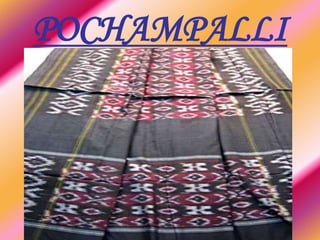
POCHAMPALLI
MAP OF ANDHRA PRADESH
MAP OF NALGONDA
Pochampally is an interesting collage of tradition, history, heritage, modernity
and widely known for Pochampally Saree. Pochampally is the place where
threads and colours find their way into the hands of skillful weavers and
meander into the market as beautiful sarees and dress material is the most
typical weaving village in Nalgonda District of Andhra Pradesh.
As the history goes, Pochampally is the land where the historic Bhoodan
Movement started. It was Acharya Vinoba Bhave, the disciple of Mahatma
Gandhi, who launched this movement called as "Bhoodanodhyamam" with
the initiation of land donation by one Mr. Vedire Ramachandra Reddy in
1951. The land was donated by the rich to the poor and needy. Pochampally
silk saree manufacturing history goes back to 1970, when it was decided by
some village headmen of Pochampally to weave silk along with cotton
(cotton weaving was being done since very long back), to make a better
living. They sent two young weavers to learn the secrets of the art to
Bangalore. This was the beginning of a revolutionary era in the
Pochampally handloom industry, which led to the eventual dominance of
the Indian tie & die patola Industry.
The genesis of the decision to enter into new realms of weaving (silk), can be
attributed to a new era, in the history of POCHAMPALLY IKAT. Its
merchandise is a handicraft on which about a thirty thousand families
depend on traditionally. The industry is second only to agriculture.
Pochampally products are handcrafted to perfection by skilled artisans who are
endowed with critical skills in intricate designs, having decades of
experience behind them in their respective fields. In certain cases these
masterpieces can take up to one hundred and twenty days to take final
shape, to the satisfaction of our craftsmen.
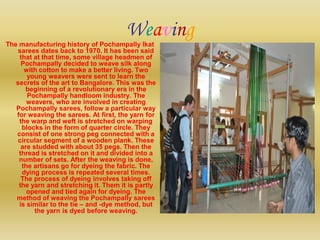
Weaving
The manufacturing history of Pochampally Ikat
sarees dates back to 1970. It has been said
that at that time, some village headmen of
Pochampally decided to weave silk along
with cotton to make a better living. Two
young weavers were sent to learn the
secrets of the art to Bangalore. This was the
beginning of a revolutionary era in the
Pochampally handloom industry. The
weavers, who are involved in creating
Pochampally sarees, follow a particular way
for weaving the sarees. At first, the yarn for
the warp and weft is stretched on warping
blocks in the form of quarter circle. They
consist of one strong peg connected with a
circular segment of a wooden plank. These
are studded with about 35 pegs. Then the
thread is stretched on it and divided into a
number of sets. After the weaving is done,
the artisans go for dyeing the fabric. The
dying process is repeated several times.
The process of dyeing involves taking off
the yarn and stretching it. Them it is partly
opened and tied again for dyeing. The
method of weaving the Pochampally sarees
is similar to the tie – and -dye method, but
the yarn is dyed before weaving.
Pochampalli Products
THANK YOU
IV-C
E.V.S. PROJECT
K.V.NO.1
GANDHI NAGAR

Pochampalli

  • 1.
  • 2.
  • 3.
  • 4.
    Pochampally is aninteresting collage of tradition, history, heritage, modernity and widely known for Pochampally Saree. Pochampally is the place where threads and colours find their way into the hands of skillful weavers and meander into the market as beautiful sarees and dress material is the most typical weaving village in Nalgonda District of Andhra Pradesh.
  • 5.
    As the historygoes, Pochampally is the land where the historic Bhoodan Movement started. It was Acharya Vinoba Bhave, the disciple of Mahatma Gandhi, who launched this movement called as "Bhoodanodhyamam" with the initiation of land donation by one Mr. Vedire Ramachandra Reddy in 1951. The land was donated by the rich to the poor and needy. Pochampally silk saree manufacturing history goes back to 1970, when it was decided by some village headmen of Pochampally to weave silk along with cotton (cotton weaving was being done since very long back), to make a better living. They sent two young weavers to learn the secrets of the art to Bangalore. This was the beginning of a revolutionary era in the Pochampally handloom industry, which led to the eventual dominance of the Indian tie & die patola Industry. The genesis of the decision to enter into new realms of weaving (silk), can be attributed to a new era, in the history of POCHAMPALLY IKAT. Its merchandise is a handicraft on which about a thirty thousand families depend on traditionally. The industry is second only to agriculture. Pochampally products are handcrafted to perfection by skilled artisans who are endowed with critical skills in intricate designs, having decades of experience behind them in their respective fields. In certain cases these masterpieces can take up to one hundred and twenty days to take final shape, to the satisfaction of our craftsmen.
  • 6.
    Weaving The manufacturing historyof Pochampally Ikat sarees dates back to 1970. It has been said that at that time, some village headmen of Pochampally decided to weave silk along with cotton to make a better living. Two young weavers were sent to learn the secrets of the art to Bangalore. This was the beginning of a revolutionary era in the Pochampally handloom industry. The weavers, who are involved in creating Pochampally sarees, follow a particular way for weaving the sarees. At first, the yarn for the warp and weft is stretched on warping blocks in the form of quarter circle. They consist of one strong peg connected with a circular segment of a wooden plank. These are studded with about 35 pegs. Then the thread is stretched on it and divided into a number of sets. After the weaving is done, the artisans go for dyeing the fabric. The dying process is repeated several times. The process of dyeing involves taking off the yarn and stretching it. Them it is partly opened and tied again for dyeing. The method of weaving the Pochampally sarees is similar to the tie – and -dye method, but the yarn is dyed before weaving.
  • 7.
  • 8.