Welcome……
THIS PRESENTATION IS OWNED BY
ABUL KALAM AZAD PATWARY
ASSISTANT TEACHER OF LAKSHMIPUR
GOVT GIRLS HIGH SCHOOL(ENGLISH)
“FOR CLASS 8”
GyanBikash.com
The “NOKSHI KANTHA”
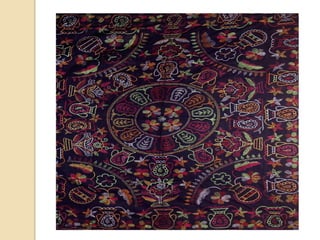
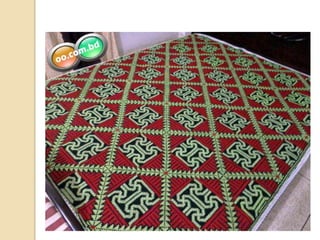
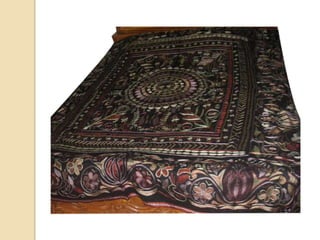
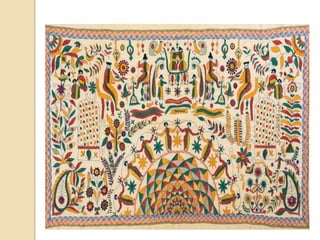
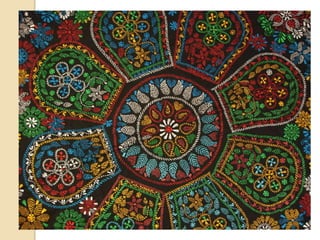
Nakshi kantha is a kind of embroidered quilt.
The name was taken from the Bengali
word, ‘naksha’ which means artistic pattern. It
is a kind of traditional craft and is said
to be indigenous to Bangladesh and West
Bengal in India. The art has been practised
in rural Bengal for centuries. The name
‘Nakshi kantha’ became popular after the
poet Jasimuddin’s poem ‘Nakshi kanthar
Math’was published in 1929.
Traditional kanthas are made for family use.
Old or new cloth and thread are used to
make these quilts. Mymensingh, Jamalpur,
Rajshahi, Faridpur, Bogra and Jessore are
most famous for this craft. Now it is
produced commercially. You can find them
in
many expensive handicraft shops in cities.
The quilts are now in great demand because
of the colourful patterns and designs
embroidered on them.
Traditional kanthas are made for family use.
Old or new cloth and thread are used to
make these quilts. Mymensingh, Jamalpur,
Rajshahi, Faridpur, Bogra and Jessore are
most famous for this craft. Now it is produced
commercially. You can find them in
many expensive handicraft shops in cities.
The quilts are now in great demand because
of the colourful patterns and designs
embroidered on them.
Tradition :
Like any other folk art, kantha
making is influenced by
factors such as materials
available, daily needs, climate,
geography, and economic
factors. Probably the earliest
form of kantha was the
patchwork kantha, and the
kanthas of the decorative
applique type evolved from
this
In literature
The earliest mention of
Bengal Kantha is found in the
book "Sri Sri Chaitanya
Charitamrita" by Krishnadas
Kaviraj, which was written
some five hundred years
ago.[
Making:
Traditionally old sarees, lungis and dhotis were used to make kanthas. Kantha
making was not a full-time job. Women in almost every household were expert
in the art. Rural women worked at leisure time or during the lazy days of the
rainy season, so taking months or even years to finish a kantha was normal. At
least five to seven sarees were needed to make a standard-size kantha. Today
the old materials are replaced by new cotton cloths. Traditionally the thread
was collected from the old sarees. That is rarely done today.
When a kantha is being made, first the sarees are joined together to attain the
required size, and then layers are spread out on the ground. The cloths are
then smoothed, and no folds or creases are left in between. During the
process, the cloth is kept flat on the ground with weights on the edges. Then
the four edges are stitched and two or three rows of large running stitches are
done to keep the kantha together. At this stage, the kantha can be folded and
stitched at leisure time.
Originally, designs and motifs were not drawn on the cloth. The design was
first outlined with needle and thread, followed by focal points, and then the
filling motifs were done. In a kantha with a predominant central motif the centre
was done first, followed by corner designs and the other details. In some types
of kanthas (carpet, lik and sujni, etc.) wooden blocks were used to print the
outline. The blocks are replaced today by patterns drawn in tracing papers.
Types……...
Running stitch :
The Running stitch kantha is truly the indigenous kantha. They are subdivided
into Nakshi (figured) and par tola (patterned). Nakshi (figured) kanthas are
further divided into motif or scenic kanthas.
Lohori kantha :
The name was derived from Persian word ‘lehr’, which means wave. This type
of kantha is particularly popular in Rajshahi. These kanthas are further divided
into soja (straight or simple), Kautar khupi (pigeon coop or triangle), borfi or
diamond (charchala, atchala or barachala).
Lik or anarasi :
The Lik or Anarasi (pine apple) type of kantha is found in the
Chapainawabgonj and Jessore areas. The variations are lik tan, lik tile, lik
jhumka, and lik lohori.
Cross stitch or carpet :
This type of kantha was introduced by the English during the British Rule in
India.[15] The stitch employed in these kanthas is the cross stitch.
Sujni kantha :
This type of kantha is found only in Rajshahi area. The popular motif used is
the undulating floral and vine motif.
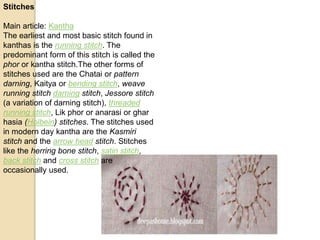
Stitches
Main article: Kantha
The earliest and most basic stitch found in
kanthas is the running stitch. The
predominant form of this stitch is called the
phor or kantha stitch.The other forms of
stitches used are the Chatai or pattern
darning, Kaitya or bending stitch, weave
running stitch darning stitch, Jessore stitch
(a variation of darning stitch), threaded
running stitch, Lik phor or anarasi or ghar
hasia (Holbein) stitches. The stitches used
in modern day kantha are the Kasmiri
stitch and the arrow head stitch. Stitches
like the herring bone stitch, satin stitch,
back stitch and cross stitch are
occasionally used.
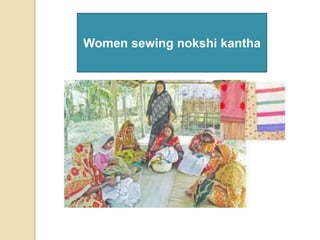
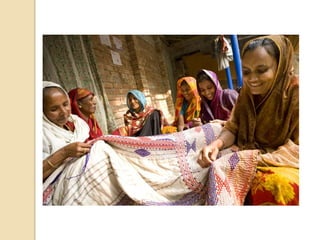
Women sewing nokshi kantha
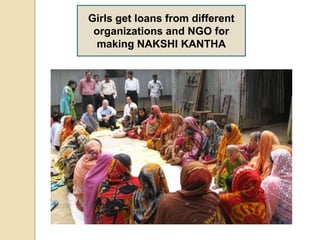
Girls get loans from different
organizations and NGO for
making NAKSHI KANTHA
Sells and business
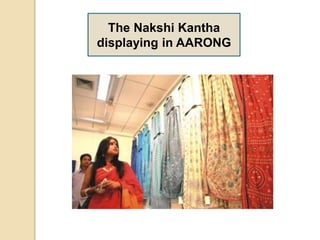
The Nakshi Kantha
displaying in AARONG
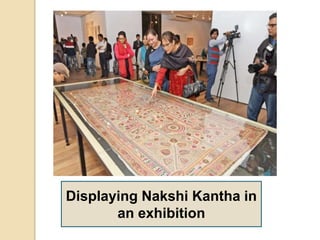
Displaying Nakshi Kantha in
an exhibition
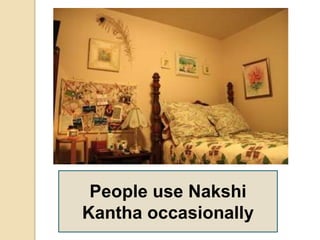
People use Nakshi
Kantha occasionally
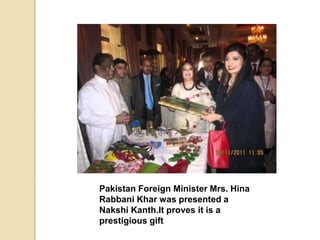
Pakistan Foreign Minister Mrs. Hina
Rabbani Khar was presented a
Nakshi Kanth.It proves it is a
prestigious gift
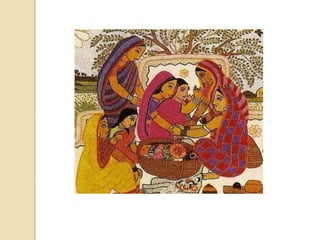
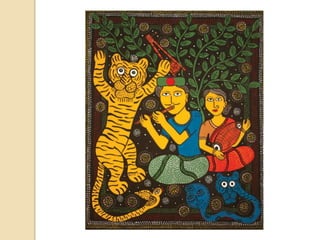
Bengali culture in nakshi
kantha
…… Thank you

Nokshi katha

  • 1.
  • 2.
    THIS PRESENTATION ISOWNED BY ABUL KALAM AZAD PATWARY ASSISTANT TEACHER OF LAKSHMIPUR GOVT GIRLS HIGH SCHOOL(ENGLISH) “FOR CLASS 8” GyanBikash.com
  • 3.
  • 5.
    Nakshi kantha isa kind of embroidered quilt. The name was taken from the Bengali word, ‘naksha’ which means artistic pattern. It is a kind of traditional craft and is said to be indigenous to Bangladesh and West Bengal in India. The art has been practised in rural Bengal for centuries. The name ‘Nakshi kantha’ became popular after the poet Jasimuddin’s poem ‘Nakshi kanthar Math’was published in 1929.
  • 7.
    Traditional kanthas aremade for family use. Old or new cloth and thread are used to make these quilts. Mymensingh, Jamalpur, Rajshahi, Faridpur, Bogra and Jessore are most famous for this craft. Now it is produced commercially. You can find them in many expensive handicraft shops in cities. The quilts are now in great demand because of the colourful patterns and designs embroidered on them.
  • 9.
    Traditional kanthas aremade for family use. Old or new cloth and thread are used to make these quilts. Mymensingh, Jamalpur, Rajshahi, Faridpur, Bogra and Jessore are most famous for this craft. Now it is produced commercially. You can find them in many expensive handicraft shops in cities. The quilts are now in great demand because of the colourful patterns and designs embroidered on them.
  • 11.
    Tradition : Like anyother folk art, kantha making is influenced by factors such as materials available, daily needs, climate, geography, and economic factors. Probably the earliest form of kantha was the patchwork kantha, and the kanthas of the decorative applique type evolved from this
  • 12.
    In literature The earliestmention of Bengal Kantha is found in the book "Sri Sri Chaitanya Charitamrita" by Krishnadas Kaviraj, which was written some five hundred years ago.[
  • 13.
    Making: Traditionally old sarees,lungis and dhotis were used to make kanthas. Kantha making was not a full-time job. Women in almost every household were expert in the art. Rural women worked at leisure time or during the lazy days of the rainy season, so taking months or even years to finish a kantha was normal. At least five to seven sarees were needed to make a standard-size kantha. Today the old materials are replaced by new cotton cloths. Traditionally the thread was collected from the old sarees. That is rarely done today. When a kantha is being made, first the sarees are joined together to attain the required size, and then layers are spread out on the ground. The cloths are then smoothed, and no folds or creases are left in between. During the process, the cloth is kept flat on the ground with weights on the edges. Then the four edges are stitched and two or three rows of large running stitches are done to keep the kantha together. At this stage, the kantha can be folded and stitched at leisure time. Originally, designs and motifs were not drawn on the cloth. The design was first outlined with needle and thread, followed by focal points, and then the filling motifs were done. In a kantha with a predominant central motif the centre was done first, followed by corner designs and the other details. In some types of kanthas (carpet, lik and sujni, etc.) wooden blocks were used to print the outline. The blocks are replaced today by patterns drawn in tracing papers.
  • 14.
  • 15.
    Running stitch : TheRunning stitch kantha is truly the indigenous kantha. They are subdivided into Nakshi (figured) and par tola (patterned). Nakshi (figured) kanthas are further divided into motif or scenic kanthas. Lohori kantha : The name was derived from Persian word ‘lehr’, which means wave. This type of kantha is particularly popular in Rajshahi. These kanthas are further divided into soja (straight or simple), Kautar khupi (pigeon coop or triangle), borfi or diamond (charchala, atchala or barachala). Lik or anarasi : The Lik or Anarasi (pine apple) type of kantha is found in the Chapainawabgonj and Jessore areas. The variations are lik tan, lik tile, lik jhumka, and lik lohori. Cross stitch or carpet : This type of kantha was introduced by the English during the British Rule in India.[15] The stitch employed in these kanthas is the cross stitch. Sujni kantha : This type of kantha is found only in Rajshahi area. The popular motif used is the undulating floral and vine motif.
  • 16.
    Stitches Main article: Kantha Theearliest and most basic stitch found in kanthas is the running stitch. The predominant form of this stitch is called the phor or kantha stitch.The other forms of stitches used are the Chatai or pattern darning, Kaitya or bending stitch, weave running stitch darning stitch, Jessore stitch (a variation of darning stitch), threaded running stitch, Lik phor or anarasi or ghar hasia (Holbein) stitches. The stitches used in modern day kantha are the Kasmiri stitch and the arrow head stitch. Stitches like the herring bone stitch, satin stitch, back stitch and cross stitch are occasionally used.
  • 18.
  • 21.
    Girls get loansfrom different organizations and NGO for making NAKSHI KANTHA
  • 22.
  • 23.
  • 24.
    Displaying Nakshi Kanthain an exhibition
  • 25.
  • 26.
    Pakistan Foreign MinisterMrs. Hina Rabbani Khar was presented a Nakshi Kanth.It proves it is a prestigious gift
  • 27.
    Bengali culture innakshi kantha
  • 30.