L A N G U A G E S
Department
of
Management
L A N G U A G E S
Department
of
Management
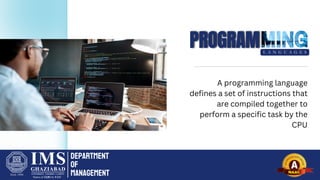
A programming language
defines a set of instructions that
are compiled together to
perform a specific task by the
CPU
Department
of
Management
CONTENT
CLASSIFICATION
MACHINE CODE
ASSEMBLY
LANGUAGE
HIGH LEVEL
LANGUAGE
GENERATION
LANGUAGES
H
i
g
h
-
Level Lan
g
u
a
g
e
Python, Java, C++
Department
of
Management
CLASSIFICATION
O F P R O G R A M M I N G L A N G U A G E S
L
o
w
-Level Lang
u
a
g
e
Machine Language
and Assembly
Language
Department
of
Management
LOW-LEVEL
L A N G U A G E S
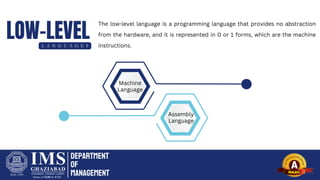
The low-level language is a programming language that provides no abstraction
from the hardware, and it is represented in 0 or 1 forms, which are the machine
instructions.
Machine
Language
Assembly
Language
Department
of
Management
MACHINE L A N G U A G E S
Machine Language
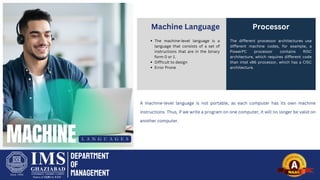
The machine-level language is a
language that consists of a set of
instructions that are in the binary
form 0 or 1.
Difficult to design
Error Prone
A machine-level language is not portable, as each computer has its own machine
instructions. Thus, if we write a program on one computer, it will no longer be valid on
another computer.
Processor
The different processor architectures use
different machine codes, for example, a
PowerPC processor contains RISC
architecture, which requires different code
than intel x86 processor, which has a CISC
architecture.
Department
of
Management
ASSEMBLYL A N G U A G E S
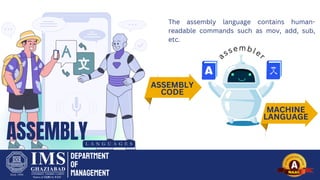
The assembly language contains human-
readable commands such as mov, add, sub,
etc.
ASSEMBLY
CODE
MACHINE
LANGUAGE
assemble
r
Department
of
Management
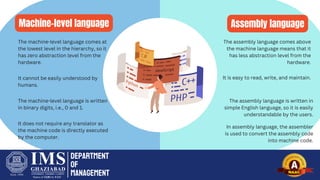
Machine-level language Assembly language
The machine-level language comes at
the lowest level in the hierarchy, so it
has zero abstraction level from the
hardware.
The assembly language comes above
the machine language means that it
has less abstraction level from the
hardware.
It cannot be easily understood by
humans.
It is easy to read, write, and maintain.
The machine-level language is written
in binary digits, i.e., 0 and 1.
The assembly language is written in
simple English language, so it is easily
understandable by the users.
It does not require any translator as
the machine code is directly executed
by the computer.
In assembly language, the assembler
is used to convert the assembly code
into machine code.
HIGH LEVEL LANGUAGE
Department
of
Management
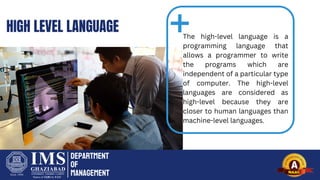
The high-level language is a
programming language that
allows a programmer to write
the programs which are
independent of a particular type
of computer. The high-level
languages are considered as
high-level because they are
closer to human languages than
machine-level languages.
Department
of
Management
ADVANTAGES OF A
HIGH-LEVEL LANGUAGE
The high-level language is easy to read, write,
and maintain as it is written in English-like
words.
The high-level languages are designed to
overcome the limitation of low-level
language, i.e., portability. The high-level
language is portable; i.e., these languages
are machine-independent.
It is a machine-friendly language, i.e., the computer
understands the machine language, which is
represented in 0 or 1.
The low-level language takes more time to execute.
It requires the assembler to convert the assembly
code into machine code.
The machine code cannot run on all machines, so it
is not a portable language.
It is a user-friendly language as this language is written in
simple English words, which can be easily understood by
humans.
It executes at a faster pace.
It requires the compiler to convert the high-level language
instructions into machine code.
The high-level code can run all the platforms, so it is a
portable language.
Low-level language High-level language
DIFFERENCES BETWEEN LOW-LEVEL LANGUAGE AND
HIGH-LEVEL LANGUAGE
Department
of
Management
GENERATIONS OF PROGRAMMING LANGUAGE
Department
of
Management
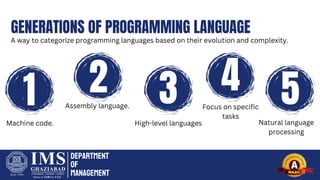
A way to categorize programming languages based on their evolution and complexity.
Machine code.
1 2
Assembly language.
High-level languages
3 4
Focus on specific
tasks
Natural language
processing
5

Cracking the Code: A Beginner's Guide to Programming Languages

  • 1.
    L A NG U A G E S Department of Management
  • 2.
    L A NG U A G E S Department of Management A programming language defines a set of instructions that are compiled together to perform a specific task by the CPU
  • 3.
  • 4.
    H i g h - Level Lan g u a g e Python, Java,C++ Department of Management CLASSIFICATION O F P R O G R A M M I N G L A N G U A G E S L o w -Level Lang u a g e Machine Language and Assembly Language
  • 5.
    Department of Management LOW-LEVEL L A NG U A G E S The low-level language is a programming language that provides no abstraction from the hardware, and it is represented in 0 or 1 forms, which are the machine instructions. Machine Language Assembly Language
  • 6.
    Department of Management MACHINE L AN G U A G E S Machine Language The machine-level language is a language that consists of a set of instructions that are in the binary form 0 or 1. Difficult to design Error Prone A machine-level language is not portable, as each computer has its own machine instructions. Thus, if we write a program on one computer, it will no longer be valid on another computer. Processor The different processor architectures use different machine codes, for example, a PowerPC processor contains RISC architecture, which requires different code than intel x86 processor, which has a CISC architecture.
  • 7.
    Department of Management ASSEMBLYL A NG U A G E S The assembly language contains human- readable commands such as mov, add, sub, etc. ASSEMBLY CODE MACHINE LANGUAGE assemble r
  • 8.
    Department of Management Machine-level language Assemblylanguage The machine-level language comes at the lowest level in the hierarchy, so it has zero abstraction level from the hardware. The assembly language comes above the machine language means that it has less abstraction level from the hardware. It cannot be easily understood by humans. It is easy to read, write, and maintain. The machine-level language is written in binary digits, i.e., 0 and 1. The assembly language is written in simple English language, so it is easily understandable by the users. It does not require any translator as the machine code is directly executed by the computer. In assembly language, the assembler is used to convert the assembly code into machine code.
  • 9.
    HIGH LEVEL LANGUAGE Department of Management Thehigh-level language is a programming language that allows a programmer to write the programs which are independent of a particular type of computer. The high-level languages are considered as high-level because they are closer to human languages than machine-level languages.
  • 10.
    Department of Management ADVANTAGES OF A HIGH-LEVELLANGUAGE The high-level language is easy to read, write, and maintain as it is written in English-like words. The high-level languages are designed to overcome the limitation of low-level language, i.e., portability. The high-level language is portable; i.e., these languages are machine-independent.
  • 11.
    It is amachine-friendly language, i.e., the computer understands the machine language, which is represented in 0 or 1. The low-level language takes more time to execute. It requires the assembler to convert the assembly code into machine code. The machine code cannot run on all machines, so it is not a portable language. It is a user-friendly language as this language is written in simple English words, which can be easily understood by humans. It executes at a faster pace. It requires the compiler to convert the high-level language instructions into machine code. The high-level code can run all the platforms, so it is a portable language. Low-level language High-level language DIFFERENCES BETWEEN LOW-LEVEL LANGUAGE AND HIGH-LEVEL LANGUAGE Department of Management
  • 12.
    GENERATIONS OF PROGRAMMINGLANGUAGE Department of Management A way to categorize programming languages based on their evolution and complexity. Machine code. 1 2 Assembly language. High-level languages 3 4 Focus on specific tasks Natural language processing 5