ComputerSystem
Hardware-CPU, Storage device and media, VDU, Input-
output devices, Data communication equipment; Software-
system.
Department
of
Management
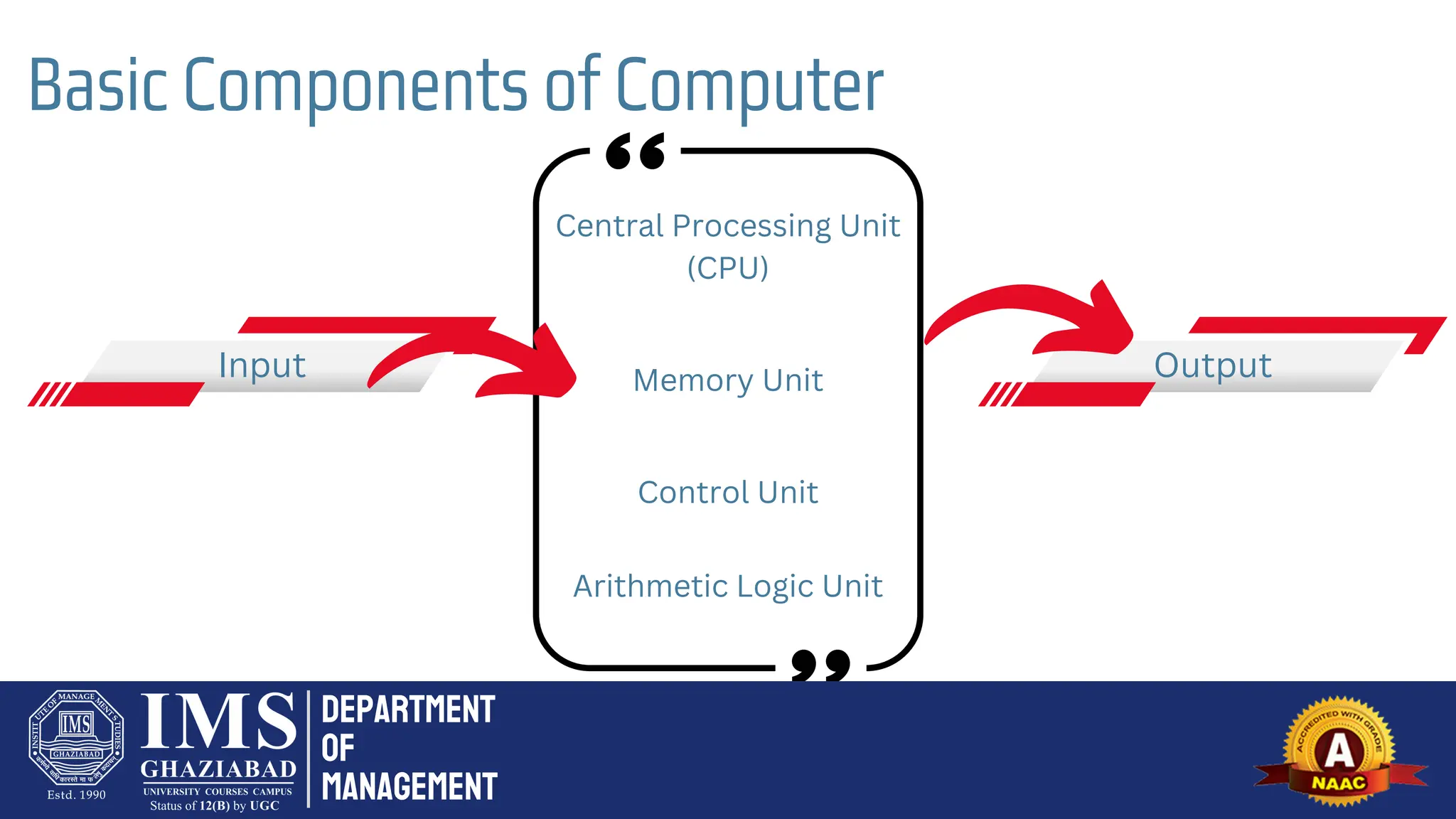
Basic Components of Computer
Input
Central Processing Unit
(CPU)
Memory Unit
Control Unit
Arithmetic Logic Unit
Output
Department
of
Management
Hardware
Department
of
Management
CPU (Central Processing Unit): The computer's
brain executes instructions and performs
calculations.
The global CPU market is expected to reach
USD 82.3 billion by 2027, highlighting the
continuous demand for processing power.
Types of Hardware
Department
of
Management
Input Hardware: For users to input data into the computer system. Examples: Keyboard,
mouse, Scanner
Output Hardware: To translate and display the result of the data processing =. Example:
Monitor Screen, Printer etc
Processing and Memory Hardware: Where data and information are processed and
manipulated to perform the task at hand. It is also the workspace of the computer, where it
temporarily stores data. Examples: Central Processing Unit (CPU), Read Only Memory (RAM)
Secondary Storage Hardware: Where the computer system stores data permanently.
Example: Harddisk, Pendrive etc
CPU Specifications
Department
of
Management
Two key CPU specifications significantly impact performance:
A CPU core is like an independent processing unit within the CPU.
Having more cores allows the CPU to handle multiple tasks simultaneously,
improving multitasking performance and speeding up processes that can be
broken down into smaller tasks.
For tasks that primarily rely on a single thread, like single-player gaming or
basic web browsing, the number of cores isn't as crucial as clock speed.
CPU Specifications
Department
of
Management
Two key CPU specifications significantly impact performance:
Clock speed is measured in GHz (gigahertz) and indicates how many cycles
the CPU can complete per second.
A higher clock speed generally translates to faster processing of individual
instructions.
Clock speed is crucial for single-threaded tasks and significantly impacts
overall responsiveness.
Where Clock and Cores are useful
Department
of
Management
For tasks that benefit from parallel processing, like multitasking, video
editing, and multi-threaded applications, prioritize more cores.
For tasks that primarily rely on single-threaded performance, like gaming and
basic applications, prioritize higher clock speed.
Additional Factor
Department
of
Management
Cache size: Larger cache sizes can improve performance by storing
frequently accessed data closer to the processor, reducing access time.
Memory (RAM): Sufficient RAM is crucial for smooth performance, as it
allows the CPU to store and access data that is actively being used.
Central processing unit
Department
of
Management
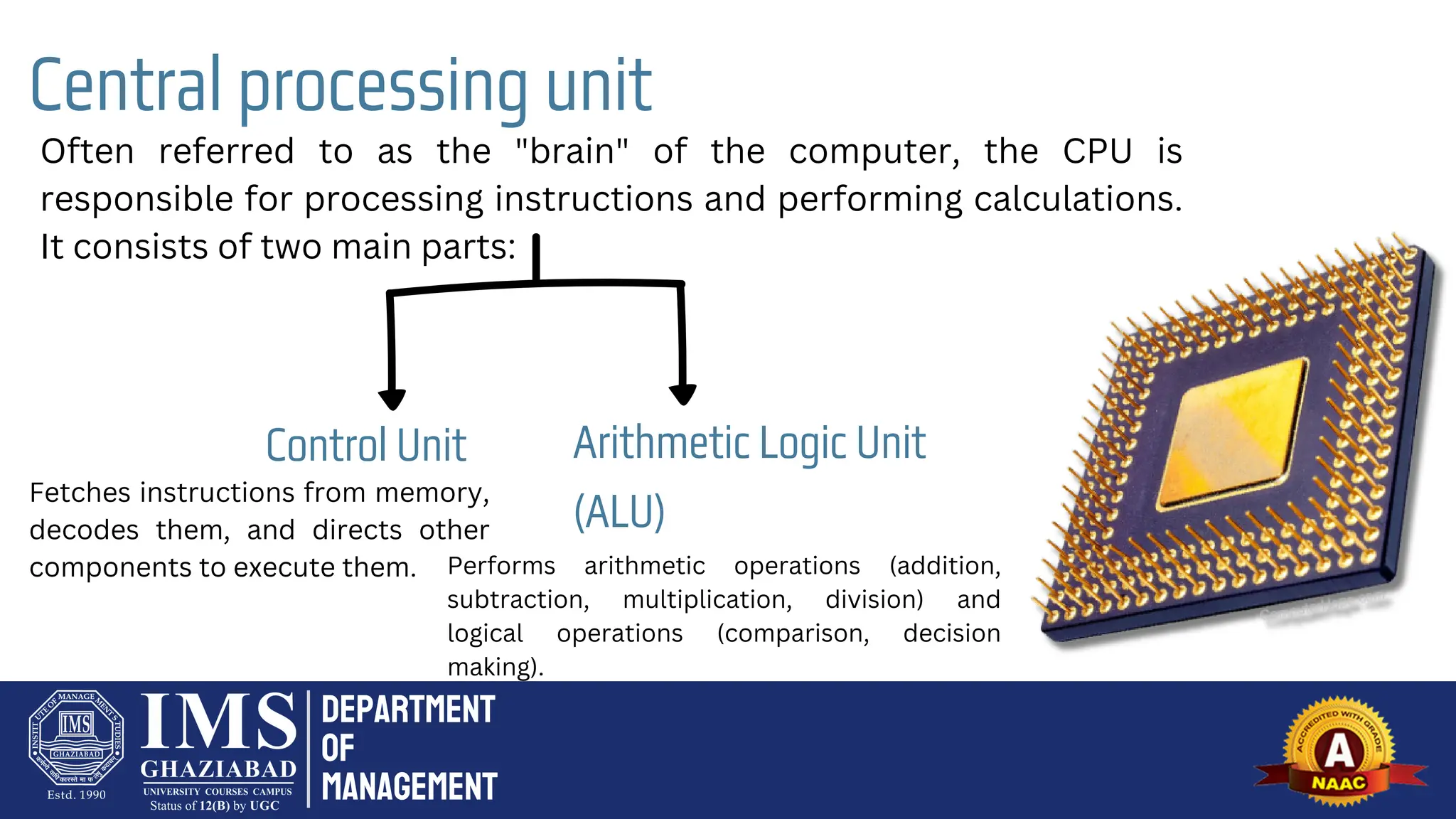
Often referred to as the "brain" of the computer, the CPU is
responsible for processing instructions and performing calculations.
It consists of two main parts:
Control Unit Arithmetic Logic Unit
(ALU)
Fetches instructions from memory,
decodes them, and directs other
components to execute them. Performs arithmetic operations (addition,
subtraction, multiplication, division) and
logical operations (comparison, decision
making).
Storage Devices and Media
Department
of
Management
These components store data and programs, both temporarily and
permanently. Examples include
Primary Memory (RAM) Secondary Storage
Volatile memory that holds data
currently being used by the CPU.
It's fast but temporary, losing data
when the computer is turned off
Non-volatile memory that retains data even
when the power is off. Examples include hard
disk drives (HDDs), solid-state drives (SSDs),
and optical media (CDs, DVDs).
VDU (Visual Display Unit)
Department
of
Management
Also known as a monitor, it displays visual information processed by the
computer.
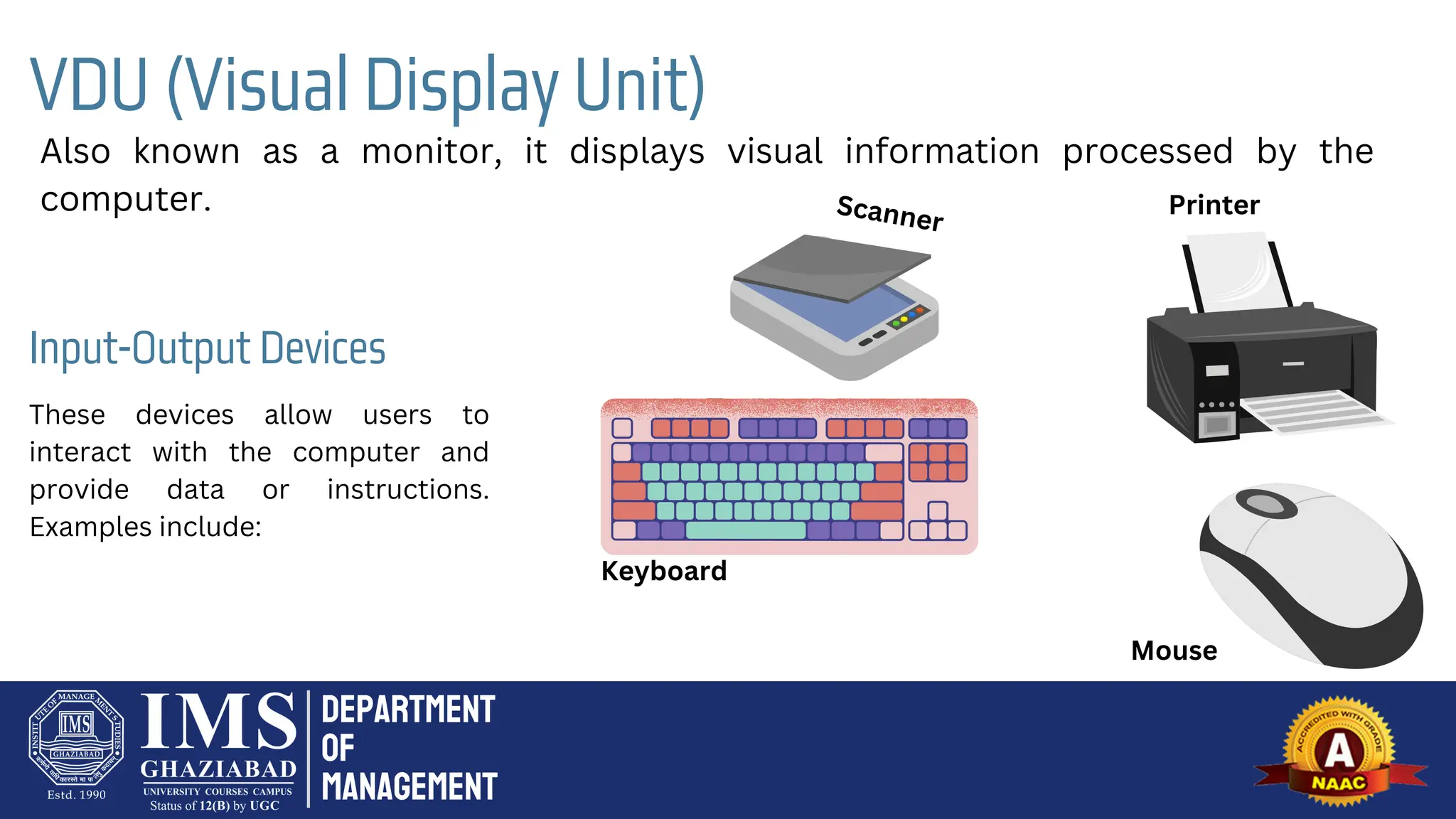
Input-Output Devices
These devices allow users to
interact with the computer and
provide data or instructions.
Examples include:
Keyboard
Mouse
Scanner
Printer
Data Communication Equipment
Department
of
Management
These devices enable communication between computers and other devices
over networks. Examples include:
Network Interface Card
(NIC)
Connects a computer to a network.
Modem
Modulates and demodulates
signals for data transmission over
telephone lines.
Software
Department
of
Management
Software refers to the set of instructions that tell the hardware what to do. It's
intangible and cannot be physically touched. There are two main categories of
software:
System Software
Manages the hardware
components and provides a
platform for running other
software. Examples include
Operating System (OS)
Controls the overall functionality
of the computer, manages
resources, and provides an
interface for users to interact with
the system. Examples include
Windows, macOS, Linux.
Device Drivers
Communicate between the
operating system and specific
hardware devices.
Application Software
Department
of
Management
Performs specific tasks for users, such as word processing, web browsing, gaming, etc. Examples
include Microsoft Word, Google Chrome, and various games.
Productivity Software:
Word processing: Microsoft Word, Google Docs, OpenOffice Writer (for creating and
editing text documents)
Spreadsheet: Microsoft Excel, Google Sheets, LibreOffice Calc (for data analysis and
calculations)
Presentation: Microsoft PowerPoint, Google Slides, LibreOffice Impress (for creating and
presenting visual information)
Email: Microsoft Outlook, Gmail, Thunderbird (for sending and receiving electronic
messages)
Personal Information Management (PIM): Microsoft Outlook, Google Calendar, Apple
Calendar (for managing schedules, contacts, and tasks)
Department
of
Management
Multimedia and Entertainment:
Web browsers: Google Chrome, Mozilla Firefox, Safari (for accessing websites and
navigating the internet)
Music players: Spotify, Apple Music, VLC Media Player (for playing audio files)
Video players: VLC Media Player, Windows Media Player, QuickTime Player (for playing
video files)
Photo editing: Adobe Photoshop, GIMP, Apple Photos (for editing and manipulating
images)
Games: Minecraft, League of Legends, Candy Crush Saga (for entertainment and leisure)
Department
of
Management
Communication and Collaboration:
Web browsers: Google Chrome, Mozilla Firefox, Safari (for accessing websites and
navigating the internet)
Music players: Spotify, Apple Music, VLC Media Player (for playing audio files)
Video players: VLC Media Player, Windows Media Player, QuickTime Player (for playing
video files)
Photo editing: Adobe Photoshop, GIMP, Apple Photos (for editing and manipulating
images)
Games: Minecraft, League of Legends, Candy Crush Saga (for entertainment and leisure)
Department
of
Management
Education and Learning:
Learning management systems: Blackboard, Moodle, Canvas (for online learning and
course delivery)
Educational software: Duolingo, Lumosity, Khan Academy (for interactive learning and
skill development)
E-books and reading apps: Kindle, Apple Books, Kobo (for reading digital books and
documents)

Elements of A Computer System: Demystifying Your Computer

  • 1.
    ComputerSystem Hardware-CPU, Storage deviceand media, VDU, Input- output devices, Data communication equipment; Software- system. Department of Management
  • 2.
    Basic Components ofComputer Input Central Processing Unit (CPU) Memory Unit Control Unit Arithmetic Logic Unit Output Department of Management
  • 3.
    Hardware Department of Management CPU (Central ProcessingUnit): The computer's brain executes instructions and performs calculations. The global CPU market is expected to reach USD 82.3 billion by 2027, highlighting the continuous demand for processing power.
  • 4.
    Types of Hardware Department of Management InputHardware: For users to input data into the computer system. Examples: Keyboard, mouse, Scanner Output Hardware: To translate and display the result of the data processing =. Example: Monitor Screen, Printer etc Processing and Memory Hardware: Where data and information are processed and manipulated to perform the task at hand. It is also the workspace of the computer, where it temporarily stores data. Examples: Central Processing Unit (CPU), Read Only Memory (RAM) Secondary Storage Hardware: Where the computer system stores data permanently. Example: Harddisk, Pendrive etc
  • 5.
    CPU Specifications Department of Management Two keyCPU specifications significantly impact performance: A CPU core is like an independent processing unit within the CPU. Having more cores allows the CPU to handle multiple tasks simultaneously, improving multitasking performance and speeding up processes that can be broken down into smaller tasks. For tasks that primarily rely on a single thread, like single-player gaming or basic web browsing, the number of cores isn't as crucial as clock speed.
  • 6.
    CPU Specifications Department of Management Two keyCPU specifications significantly impact performance: Clock speed is measured in GHz (gigahertz) and indicates how many cycles the CPU can complete per second. A higher clock speed generally translates to faster processing of individual instructions. Clock speed is crucial for single-threaded tasks and significantly impacts overall responsiveness.
  • 7.
    Where Clock andCores are useful Department of Management For tasks that benefit from parallel processing, like multitasking, video editing, and multi-threaded applications, prioritize more cores. For tasks that primarily rely on single-threaded performance, like gaming and basic applications, prioritize higher clock speed.
  • 8.
    Additional Factor Department of Management Cache size:Larger cache sizes can improve performance by storing frequently accessed data closer to the processor, reducing access time. Memory (RAM): Sufficient RAM is crucial for smooth performance, as it allows the CPU to store and access data that is actively being used.
  • 9.
    Central processing unit Department of Management Oftenreferred to as the "brain" of the computer, the CPU is responsible for processing instructions and performing calculations. It consists of two main parts: Control Unit Arithmetic Logic Unit (ALU) Fetches instructions from memory, decodes them, and directs other components to execute them. Performs arithmetic operations (addition, subtraction, multiplication, division) and logical operations (comparison, decision making).
  • 10.
    Storage Devices andMedia Department of Management These components store data and programs, both temporarily and permanently. Examples include Primary Memory (RAM) Secondary Storage Volatile memory that holds data currently being used by the CPU. It's fast but temporary, losing data when the computer is turned off Non-volatile memory that retains data even when the power is off. Examples include hard disk drives (HDDs), solid-state drives (SSDs), and optical media (CDs, DVDs).
  • 11.
    VDU (Visual DisplayUnit) Department of Management Also known as a monitor, it displays visual information processed by the computer. Input-Output Devices These devices allow users to interact with the computer and provide data or instructions. Examples include: Keyboard Mouse Scanner Printer
  • 12.
    Data Communication Equipment Department of Management Thesedevices enable communication between computers and other devices over networks. Examples include: Network Interface Card (NIC) Connects a computer to a network. Modem Modulates and demodulates signals for data transmission over telephone lines.
  • 13.
    Software Department of Management Software refers tothe set of instructions that tell the hardware what to do. It's intangible and cannot be physically touched. There are two main categories of software: System Software Manages the hardware components and provides a platform for running other software. Examples include Operating System (OS) Controls the overall functionality of the computer, manages resources, and provides an interface for users to interact with the system. Examples include Windows, macOS, Linux. Device Drivers Communicate between the operating system and specific hardware devices.
  • 14.
    Application Software Department of Management Performs specifictasks for users, such as word processing, web browsing, gaming, etc. Examples include Microsoft Word, Google Chrome, and various games. Productivity Software: Word processing: Microsoft Word, Google Docs, OpenOffice Writer (for creating and editing text documents) Spreadsheet: Microsoft Excel, Google Sheets, LibreOffice Calc (for data analysis and calculations) Presentation: Microsoft PowerPoint, Google Slides, LibreOffice Impress (for creating and presenting visual information) Email: Microsoft Outlook, Gmail, Thunderbird (for sending and receiving electronic messages) Personal Information Management (PIM): Microsoft Outlook, Google Calendar, Apple Calendar (for managing schedules, contacts, and tasks)
  • 15.
    Department of Management Multimedia and Entertainment: Webbrowsers: Google Chrome, Mozilla Firefox, Safari (for accessing websites and navigating the internet) Music players: Spotify, Apple Music, VLC Media Player (for playing audio files) Video players: VLC Media Player, Windows Media Player, QuickTime Player (for playing video files) Photo editing: Adobe Photoshop, GIMP, Apple Photos (for editing and manipulating images) Games: Minecraft, League of Legends, Candy Crush Saga (for entertainment and leisure)
  • 16.
    Department of Management Communication and Collaboration: Webbrowsers: Google Chrome, Mozilla Firefox, Safari (for accessing websites and navigating the internet) Music players: Spotify, Apple Music, VLC Media Player (for playing audio files) Video players: VLC Media Player, Windows Media Player, QuickTime Player (for playing video files) Photo editing: Adobe Photoshop, GIMP, Apple Photos (for editing and manipulating images) Games: Minecraft, League of Legends, Candy Crush Saga (for entertainment and leisure)
  • 17.
    Department of Management Education and Learning: Learningmanagement systems: Blackboard, Moodle, Canvas (for online learning and course delivery) Educational software: Duolingo, Lumosity, Khan Academy (for interactive learning and skill development) E-books and reading apps: Kindle, Apple Books, Kobo (for reading digital books and documents)