The Pre-Qualification Process –
competitive advantage or disadvantage?


Peter Smith
Spend Matters UK/Europe

July 11th 2012
Peter Smith
• 25 years in procurement (how did that happen)?
• Started with the Mars Group, buying raw materials, then CPO for the DSS,
  Dun & Bradstreet Europe and the NatWest Group. CIPS President in 2002
• 10 years of consulting, speaking, writing... Much of it public sector related
• “Buying Professional Services” (Czerniawska and Smith) published in 2010
  by the Economist Books
• Music fanatic, vegetable grower, SAFC fan, wine collector and food lover
• Launched Spend Matters UK / Europe in 2010 in conjunction with Jason
  Busch, editor of Spend Matters US. Metal Miner and Healthcare Matters
  also part of family
• Probably the best-read family of procurement websites in the world! (100s
  of thousands of views a month). Independent, insightful, irreverent....

                                                                                  2
Pre-Qualification

 • Who cares about PQQs? It’s not a glamourous or exciting
   element of the overall procurement process...

 • But – how did that supplier who turned out to be killing baby
   tigers or employing six-year olds get into your supply base?
 • Or the firm run by convicted drug dealers? Or the one who
   simply couldn’t do the work properly when it came to the
   crunch?

 • And why did some great firms refuse to bid or get eliminated
   because they didn’t have ISO9001 / their revenues were a few
   grand short of your notional qualification threshold?

 And how much time and energy do you spend on the process?
                                                                   3
Pre-Qualification

  How good our suppliers are largely
  determines the success or failure of the
  procurement function (and quite possibly
  the whole organisation)


                                             4
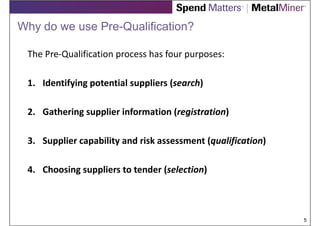
Why do we use Pre-Qualification?

 The Pre-Qualification process has four purposes:

 1. Identifying potential suppliers (search)

 2. Gathering supplier information (registration)

 3. Supplier capability and risk assessment (qualification)

 4. Choosing suppliers to tender (selection)


                                                              5
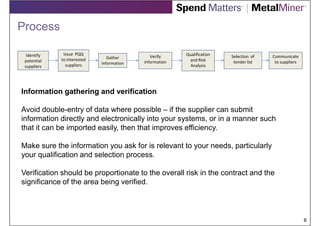
Process

  Identify    Issue PQQ                                  Qualification
                                Gather        Verify                     Selection of   Communicate
 potential   to interested                                and Risk
                             information   information                    tender list    to suppliers
 suppliers     suppliers                                   Analysis


Information gathering and verification

Avoid double-entry of data where possible – if the supplier can submit
information directly and electronically into your systems, or in a manner such
that it can be imported easily, then that improves efficiency.

Make sure the information you ask for is relevant to your needs, particularly
your qualification and selection process.

Verification should be proportionate to the overall risk in the contract and the
significance of the area being verified.


                                                                                                        6
•Make sure the information you ask for is relevant to your the contract and theyour qualification and selection verified.
•Verification should be proportionate to the overall risk in needs, particularly significance of the area being process.


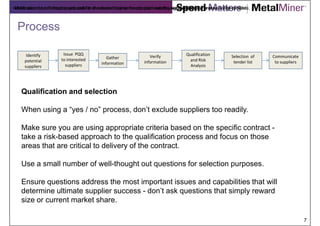
  Process

       Identify          Issue PQQ                                                      Qualification
                                                Gather                Verify                                   Selection of   Communicate
      potential         to interested                                                    and Risk
                                             information           information                                  tender list    to suppliers
      suppliers           suppliers                                                       Analysis


    Qualification and selection

    When using a “yes / no” process, don’t exclude suppliers too readily.

    Make sure you are using appropriate criteria based on the specific contract -
    take a risk-based approach to the qualification process and focus on those
    areas that are critical to delivery of the contract.

    Use a small number of well-thought out questions for selection purposes.

    Ensure questions address the most important issues and capabilities that will
    determine ultimate supplier success - don’t ask questions that simply reward
    size or current market share.

                                                                                                                                              7
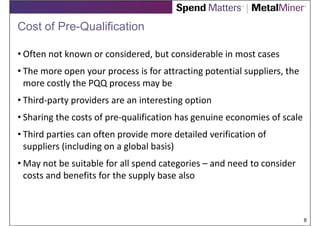
Cost of Pre-Qualification

• Often not known or considered, but considerable in most cases
• The more open your process is for attracting potential suppliers, the
  more costly the PQQ process may be
• Third-party providers are an interesting option
• Sharing the costs of pre-qualification has genuine economies of scale
• Third parties can often provide more detailed verification of
  suppliers (including on a global basis)
• May not be suitable for all spend categories – and need to consider
  costs and benefits for the supply base also


                                                                          8
Conclusions
• The pre-qualification process is important – ruling out “bad” suppliers,
  keeping “good” suppliers in play, and being proportionate in terms of
  time and cost .
• Pre-qualification has four key purposes - identifying suppliers,
  registration, qualification and selection.
• At all times, bear in mind the risk element of the process.
• The cost of the process, including the time taken and resource
  required, should also be considered and again should be proportionate
  to the risk.
• Third party providers, who can take advantage of economies of scale
  and expertise to offer a collaborative service to multiple buying
  organisations, are increasingly important in this field.
• Finally, remember the supplier’s viewpoint in this. Processes that are
  proportionate, well-structured, fair and transparent help them too.


                                                                             9
THANK YOU!

Please read spendmatters.co.uk every day!

Join our array of interesting, rude, informative, and smart
commentators like “Bitter and Twisted”, “Vegas Child” and
“Final Furlong”

Or email me at psmith@spendmatters.com , call me on 07717
734601


Peter Smith
                                                              10

SpendMatters Exec Breakfast Peter Smith Slides

  • 1.
    The Pre-Qualification Process– competitive advantage or disadvantage? Peter Smith Spend Matters UK/Europe July 11th 2012
  • 2.
    Peter Smith • 25years in procurement (how did that happen)? • Started with the Mars Group, buying raw materials, then CPO for the DSS, Dun & Bradstreet Europe and the NatWest Group. CIPS President in 2002 • 10 years of consulting, speaking, writing... Much of it public sector related • “Buying Professional Services” (Czerniawska and Smith) published in 2010 by the Economist Books • Music fanatic, vegetable grower, SAFC fan, wine collector and food lover • Launched Spend Matters UK / Europe in 2010 in conjunction with Jason Busch, editor of Spend Matters US. Metal Miner and Healthcare Matters also part of family • Probably the best-read family of procurement websites in the world! (100s of thousands of views a month). Independent, insightful, irreverent.... 2
  • 3.
    Pre-Qualification • Whocares about PQQs? It’s not a glamourous or exciting element of the overall procurement process... • But – how did that supplier who turned out to be killing baby tigers or employing six-year olds get into your supply base? • Or the firm run by convicted drug dealers? Or the one who simply couldn’t do the work properly when it came to the crunch? • And why did some great firms refuse to bid or get eliminated because they didn’t have ISO9001 / their revenues were a few grand short of your notional qualification threshold? And how much time and energy do you spend on the process? 3
  • 4.
    Pre-Qualification Howgood our suppliers are largely determines the success or failure of the procurement function (and quite possibly the whole organisation) 4
  • 5.
    Why do weuse Pre-Qualification? The Pre-Qualification process has four purposes: 1. Identifying potential suppliers (search) 2. Gathering supplier information (registration) 3. Supplier capability and risk assessment (qualification) 4. Choosing suppliers to tender (selection) 5
  • 6.
    Process Identify Issue PQQ Qualification Gather Verify Selection of Communicate potential to interested and Risk information information tender list to suppliers suppliers suppliers Analysis Information gathering and verification Avoid double-entry of data where possible – if the supplier can submit information directly and electronically into your systems, or in a manner such that it can be imported easily, then that improves efficiency. Make sure the information you ask for is relevant to your needs, particularly your qualification and selection process. Verification should be proportionate to the overall risk in the contract and the significance of the area being verified. 6
  • 7.
    •Make sure theinformation you ask for is relevant to your the contract and theyour qualification and selection verified. •Verification should be proportionate to the overall risk in needs, particularly significance of the area being process. Process Identify Issue PQQ Qualification Gather Verify Selection of Communicate potential to interested and Risk information information tender list to suppliers suppliers suppliers Analysis Qualification and selection When using a “yes / no” process, don’t exclude suppliers too readily. Make sure you are using appropriate criteria based on the specific contract - take a risk-based approach to the qualification process and focus on those areas that are critical to delivery of the contract. Use a small number of well-thought out questions for selection purposes. Ensure questions address the most important issues and capabilities that will determine ultimate supplier success - don’t ask questions that simply reward size or current market share. 7
  • 8.
    Cost of Pre-Qualification •Often not known or considered, but considerable in most cases • The more open your process is for attracting potential suppliers, the more costly the PQQ process may be • Third-party providers are an interesting option • Sharing the costs of pre-qualification has genuine economies of scale • Third parties can often provide more detailed verification of suppliers (including on a global basis) • May not be suitable for all spend categories – and need to consider costs and benefits for the supply base also 8
  • 9.
    Conclusions • The pre-qualificationprocess is important – ruling out “bad” suppliers, keeping “good” suppliers in play, and being proportionate in terms of time and cost . • Pre-qualification has four key purposes - identifying suppliers, registration, qualification and selection. • At all times, bear in mind the risk element of the process. • The cost of the process, including the time taken and resource required, should also be considered and again should be proportionate to the risk. • Third party providers, who can take advantage of economies of scale and expertise to offer a collaborative service to multiple buying organisations, are increasingly important in this field. • Finally, remember the supplier’s viewpoint in this. Processes that are proportionate, well-structured, fair and transparent help them too. 9
  • 10.
    THANK YOU! Please readspendmatters.co.uk every day! Join our array of interesting, rude, informative, and smart commentators like “Bitter and Twisted”, “Vegas Child” and “Final Furlong” Or email me at psmith@spendmatters.com , call me on 07717 734601 Peter Smith 10