1
September/2014
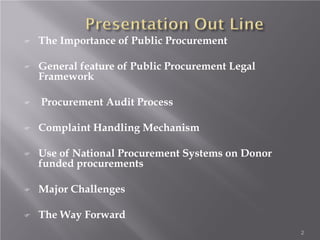
 The Importance of Public Procurement
 General feature of Public Procurement Legal
Framework
 Procurement Audit Process
 Complaint Handling Mechanism
 Use of National Procurement Systems on Donor
funded procurements
 Major Challenges
 The Way Forward
2
3
4
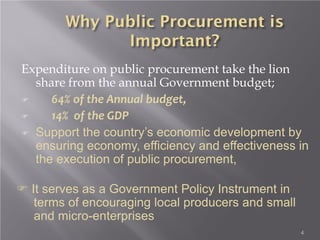
Expenditure on public procurement take the lion
share from the annual Government budget;
 64% of the Annual budget,
 14% of the GDP
 Support the country’s economic development by
ensuring economy, efficiency and effectiveness in
the execution of public procurement,
 It serves as a Government Policy Instrument in
terms of encouraging local producers and small
and micro-enterprises
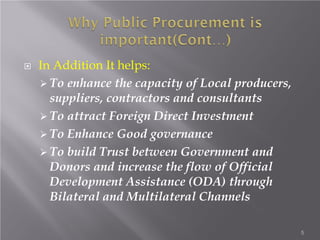
 In Addition It helps:
 To enhance the capacity of Local producers,
suppliers, contractors and consultants
 To attract Foreign Direct Investment
 To Enhance Good governance
 To build Trust between Government and
Donors and increase the flow of Official
Development Assistance (ODA) through
Bilateral and Multilateral Channels
5
 To Create a conducive environment for various
partnership arrangements between the Government
and the private Sector
 To Reduce Trade and non Trade Barriers with in the
framework of enhancing the competition policy
 As one of the Government Policy instrument to
protect the environment by encouraging the purchase
of environment friendly goods only
6
7
 Public Procurement and Property Administration
Proclamation No 649/2009 issued in Sept.2009
 Public Procurement Directive issued in June 2010
They have been prepared in line with UNCITRAL
Model Law, The World Bank Guideline and
COMESA Regulation and Directive
8
 Various Standard Bidding Documents including
SBD for Framework Agreement and Public
Procurement Manual have already been prepared
and disseminated to Procuring Entities
 The Public Procurement and Property
Administration Regulatory functions are now
administered by Public Procurement and Property
Administration Agency
9
10
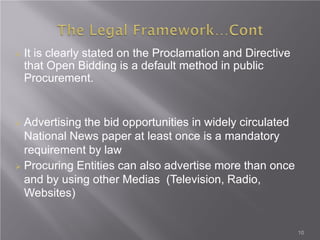
 It is clearly stated on the Proclamation and Directive
that Open Bidding is a default method in public
Procurement.
 Advertising the bid opportunities in widely circulated
National News paper at least once is a mandatory
requirement by law
 Procuring Entities can also advertise more than once
and by using other Medias (Television, Radio,
Websites)
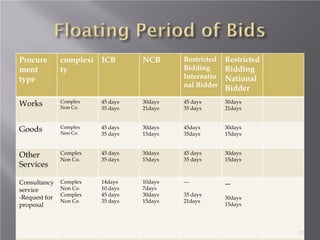
Procure
ment
type
complexi
ty
ICB NCB Restricted
Bidding
Internatio
nal Bidder
Restricted
Bidding
National
Bidder
Works Complex
Non Co.
45 days
35 days
30days
21days
45 days
35 days
30days
21days
Goods Complex
Non Co.
45 days
35 days
30days
15days
45days
35days
30days
15days
Other
Services
Complex
Non Co.
45 days
35 days
30days
15days
45 days
35 days
30days
15days
Consultancy
service
-Request for
proposal
Complex
Non Co.
Complex
Non Co
14days
10 days
45 days
35 days
10days
7days
30days
15days
---
35 days
21days
--
30days
15days
11
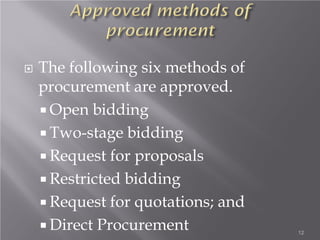
 The following six methods of
procurement are approved.
 Open bidding
 Two-stage bidding
 Request for proposals
 Restricted bidding
 Request for quotations; and
 Direct Procurement 12
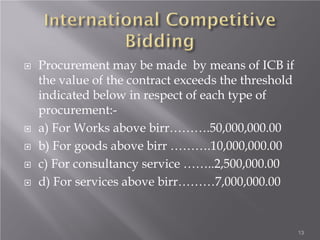
 Procurement may be made by means of ICB if
the value of the contract exceeds the threshold
indicated below in respect of each type of
procurement:-
 a) For Works above birr……….50,000,000.00
 b) For goods above birr ……….10,000,000.00
 c) For consultancy service ……..2,500,000.00
 d) For services above birr………7,000,000.00
13
14
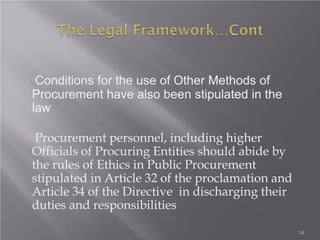
 Conditions for the use of Other Methods of
Procurement have also been stipulated in the
law
 Procurement personnel, including higher
Officials of Procuring Entities should abide by
the rules of Ethics in Public Procurement
stipulated in Article 32 of the proclamation and
Article 34 of the Directive in discharging their
duties and responsibilities
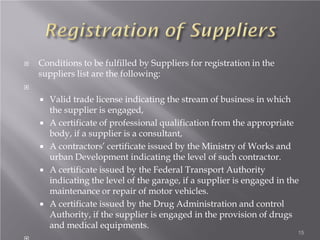
 Conditions to be fulfilled by Suppliers for registration in the
suppliers list are the following:

 Valid trade license indicating the stream of business in which
the supplier is engaged,
 A certificate of professional qualification from the appropriate
body, if a supplier is a consultant,
 A contractors’ certificate issued by the Ministry of Works and
urban Development indicating the level of such contractor.
 A certificate issued by the Federal Transport Authority
indicating the level of the garage, if a supplier is engaged in the
maintenance or repair of motor vehicles.
 A certificate issued by the Drug Administration and control
Authority, if the supplier is engaged in the provision of drugs
and medical equipments.
15
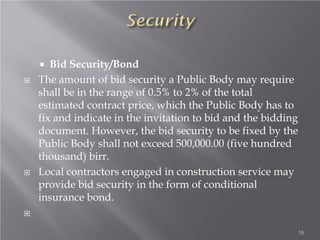
 Bid Security/Bond
 The amount of bid security a Public Body may require
shall be in the range of 0.5% to 2% of the total
estimated contract price, which the Public Body has to
fix and indicate in the invitation to bid and the bidding
document. However, the bid security to be fixed by the
Public Body shall not exceed 500,000.00 (five hundred
thousand) birr.
 Local contractors engaged in construction service may
provide bid security in the form of conditional
insurance bond.

16
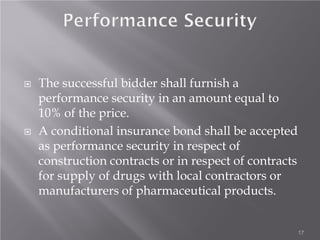
 The successful bidder shall furnish a
performance security in an amount equal to
10% of the price.
 A conditional insurance bond shall be accepted
as performance security in respect of
construction contracts or in respect of contracts
for supply of drugs with local contractors or
manufacturers of pharmaceutical products.
17
18
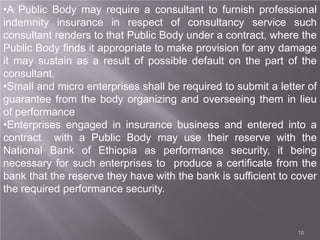
•A Public Body may require a consultant to furnish professional
indemnity insurance in respect of consultancy service such
consultant renders to that Public Body under a contract, where the
Public Body finds it appropriate to make provision for any damage
it may sustain as a result of possible default on the part of the
consultant.
•Small and micro enterprises shall be required to submit a letter of
guarantee from the body organizing and overseeing them in lieu
of performance
•Enterprises engaged in insurance business and entered into a
contract with a Public Body may use their reserve with the
National Bank of Ethiopia as performance security, it being
necessary for such enterprises to produce a certificate from the
bank that the reserve they have with the bank is sufficient to cover
the required performance security.
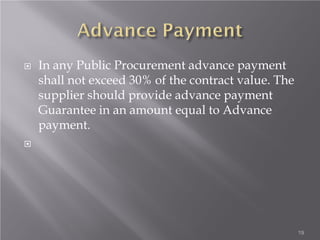
 In any Public Procurement advance payment
shall not exceed 30% of the contract value. The
supplier should provide advance payment
Guarantee in an amount equal to Advance
payment.

19
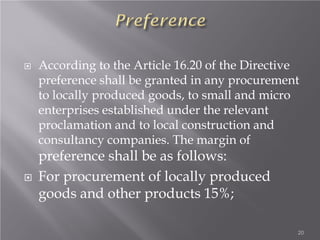
 According to the Article 16.20 of the Directive
preference shall be granted in any procurement
to locally produced goods, to small and micro
enterprises established under the relevant
proclamation and to local construction and
consultancy companies. The margin of
preference shall be as follows:
 For procurement of locally produced
goods and other products 15%;
20
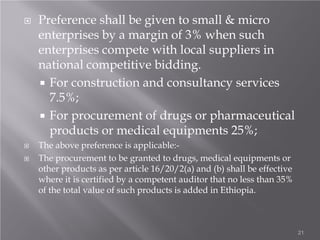
 Preference shall be given to small & micro
enterprises by a margin of 3% when such
enterprises compete with local suppliers in
national competitive bidding.
 For construction and consultancy services
7.5%;
 For procurement of drugs or pharmaceutical
products or medical equipments 25%;
 The above preference is applicable:-
 The procurement to be granted to drugs, medical equipments or
other products as per article 16/20/2(a) and (b) shall be effective
where it is certified by a competent auditor that no less than 35%
of the total value of such products is added in Ethiopia.
21
22
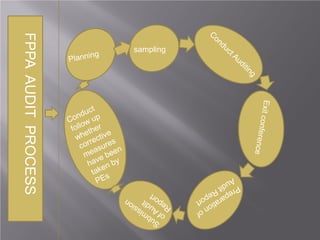
sampling
FPPA
AUDIT
PROCESS
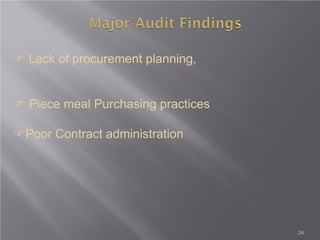
 Lack of procurement planning,
 Piece meal Purchasing practices
Poor Contract administration
24
25
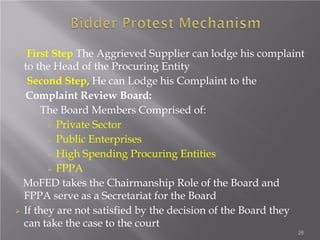
 First Step The Aggrieved Supplier can lodge his complaint
to the Head of the Procuring Entity
 Second Step, He can Lodge his Complaint to the
Complaint Review Board:
 The Board Members Comprised of:
 Private Sector
 Public Enterprises
 High Spending Procuring Entities
 FPPA
MoFED takes the Chairmanship Role of the Board and
FPPA serve as a Secretariat for the Board
 If they are not satisfied by the decision of the Board they
can take the case to the court
26
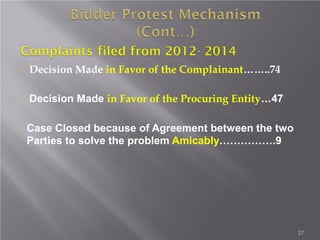
 Decision Made in Favor of the Complainant……..74
 Decision Made in Favor of the Procuring Entity…47
 Case Closed because of Agreement between the two
Parties to solve the problem Amicably…………….9
27
28
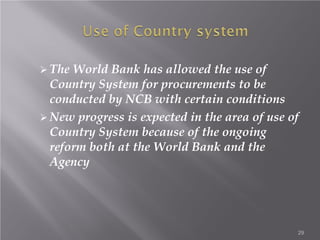
 The World Bank has allowed the use of
Country System for procurements to be
conducted by NCB with certain conditions
 New progress is expected in the area of use of
Country System because of the ongoing
reform both at the World Bank and the
Agency
29
30
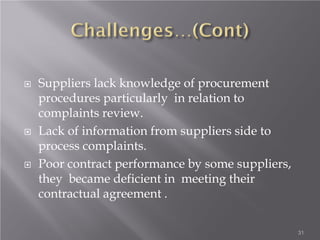
 Suppliers lack knowledge of procurement
procedures particularly in relation to
complaints review.
 Lack of information from suppliers side to
process complaints.
 Poor contract performance by some suppliers,
they became deficient in meeting their
contractual agreement .
31
32
 Introducing e-procurement to increase
transparency and efficiency of public
procurement performance
 Conduct continuous improvement of Legal
Framework.
33
34

Public_Procurement_System_Presentation_Sept2014.pdf

  • 1.
  • 2.
     The Importanceof Public Procurement  General feature of Public Procurement Legal Framework  Procurement Audit Process  Complaint Handling Mechanism  Use of National Procurement Systems on Donor funded procurements  Major Challenges  The Way Forward 2
  • 3.
  • 4.
    4 Expenditure on publicprocurement take the lion share from the annual Government budget;  64% of the Annual budget,  14% of the GDP  Support the country’s economic development by ensuring economy, efficiency and effectiveness in the execution of public procurement,  It serves as a Government Policy Instrument in terms of encouraging local producers and small and micro-enterprises
  • 5.
     In AdditionIt helps:  To enhance the capacity of Local producers, suppliers, contractors and consultants  To attract Foreign Direct Investment  To Enhance Good governance  To build Trust between Government and Donors and increase the flow of Official Development Assistance (ODA) through Bilateral and Multilateral Channels 5
  • 6.
     To Createa conducive environment for various partnership arrangements between the Government and the private Sector  To Reduce Trade and non Trade Barriers with in the framework of enhancing the competition policy  As one of the Government Policy instrument to protect the environment by encouraging the purchase of environment friendly goods only 6
  • 7.
  • 8.
     Public Procurementand Property Administration Proclamation No 649/2009 issued in Sept.2009  Public Procurement Directive issued in June 2010 They have been prepared in line with UNCITRAL Model Law, The World Bank Guideline and COMESA Regulation and Directive 8
  • 9.
     Various StandardBidding Documents including SBD for Framework Agreement and Public Procurement Manual have already been prepared and disseminated to Procuring Entities  The Public Procurement and Property Administration Regulatory functions are now administered by Public Procurement and Property Administration Agency 9
  • 10.
    10  It isclearly stated on the Proclamation and Directive that Open Bidding is a default method in public Procurement.  Advertising the bid opportunities in widely circulated National News paper at least once is a mandatory requirement by law  Procuring Entities can also advertise more than once and by using other Medias (Television, Radio, Websites)
  • 11.
    Procure ment type complexi ty ICB NCB Restricted Bidding Internatio nalBidder Restricted Bidding National Bidder Works Complex Non Co. 45 days 35 days 30days 21days 45 days 35 days 30days 21days Goods Complex Non Co. 45 days 35 days 30days 15days 45days 35days 30days 15days Other Services Complex Non Co. 45 days 35 days 30days 15days 45 days 35 days 30days 15days Consultancy service -Request for proposal Complex Non Co. Complex Non Co 14days 10 days 45 days 35 days 10days 7days 30days 15days --- 35 days 21days -- 30days 15days 11
  • 12.
     The followingsix methods of procurement are approved.  Open bidding  Two-stage bidding  Request for proposals  Restricted bidding  Request for quotations; and  Direct Procurement 12
  • 13.
     Procurement maybe made by means of ICB if the value of the contract exceeds the threshold indicated below in respect of each type of procurement:-  a) For Works above birr……….50,000,000.00  b) For goods above birr ……….10,000,000.00  c) For consultancy service ……..2,500,000.00  d) For services above birr………7,000,000.00 13
  • 14.
    14  Conditions forthe use of Other Methods of Procurement have also been stipulated in the law  Procurement personnel, including higher Officials of Procuring Entities should abide by the rules of Ethics in Public Procurement stipulated in Article 32 of the proclamation and Article 34 of the Directive in discharging their duties and responsibilities
  • 15.
     Conditions tobe fulfilled by Suppliers for registration in the suppliers list are the following:   Valid trade license indicating the stream of business in which the supplier is engaged,  A certificate of professional qualification from the appropriate body, if a supplier is a consultant,  A contractors’ certificate issued by the Ministry of Works and urban Development indicating the level of such contractor.  A certificate issued by the Federal Transport Authority indicating the level of the garage, if a supplier is engaged in the maintenance or repair of motor vehicles.  A certificate issued by the Drug Administration and control Authority, if the supplier is engaged in the provision of drugs and medical equipments. 15
  • 16.
     Bid Security/Bond The amount of bid security a Public Body may require shall be in the range of 0.5% to 2% of the total estimated contract price, which the Public Body has to fix and indicate in the invitation to bid and the bidding document. However, the bid security to be fixed by the Public Body shall not exceed 500,000.00 (five hundred thousand) birr.  Local contractors engaged in construction service may provide bid security in the form of conditional insurance bond.  16
  • 17.
     The successfulbidder shall furnish a performance security in an amount equal to 10% of the price.  A conditional insurance bond shall be accepted as performance security in respect of construction contracts or in respect of contracts for supply of drugs with local contractors or manufacturers of pharmaceutical products. 17
  • 18.
    18 •A Public Bodymay require a consultant to furnish professional indemnity insurance in respect of consultancy service such consultant renders to that Public Body under a contract, where the Public Body finds it appropriate to make provision for any damage it may sustain as a result of possible default on the part of the consultant. •Small and micro enterprises shall be required to submit a letter of guarantee from the body organizing and overseeing them in lieu of performance •Enterprises engaged in insurance business and entered into a contract with a Public Body may use their reserve with the National Bank of Ethiopia as performance security, it being necessary for such enterprises to produce a certificate from the bank that the reserve they have with the bank is sufficient to cover the required performance security.
  • 19.
     In anyPublic Procurement advance payment shall not exceed 30% of the contract value. The supplier should provide advance payment Guarantee in an amount equal to Advance payment.  19
  • 20.
     According tothe Article 16.20 of the Directive preference shall be granted in any procurement to locally produced goods, to small and micro enterprises established under the relevant proclamation and to local construction and consultancy companies. The margin of preference shall be as follows:  For procurement of locally produced goods and other products 15%; 20
  • 21.
     Preference shallbe given to small & micro enterprises by a margin of 3% when such enterprises compete with local suppliers in national competitive bidding.  For construction and consultancy services 7.5%;  For procurement of drugs or pharmaceutical products or medical equipments 25%;  The above preference is applicable:-  The procurement to be granted to drugs, medical equipments or other products as per article 16/20/2(a) and (b) shall be effective where it is certified by a competent auditor that no less than 35% of the total value of such products is added in Ethiopia. 21
  • 22.
  • 23.
  • 24.
     Lack ofprocurement planning,  Piece meal Purchasing practices Poor Contract administration 24
  • 25.
  • 26.
     First StepThe Aggrieved Supplier can lodge his complaint to the Head of the Procuring Entity  Second Step, He can Lodge his Complaint to the Complaint Review Board:  The Board Members Comprised of:  Private Sector  Public Enterprises  High Spending Procuring Entities  FPPA MoFED takes the Chairmanship Role of the Board and FPPA serve as a Secretariat for the Board  If they are not satisfied by the decision of the Board they can take the case to the court 26
  • 27.
     Decision Madein Favor of the Complainant……..74  Decision Made in Favor of the Procuring Entity…47  Case Closed because of Agreement between the two Parties to solve the problem Amicably…………….9 27
  • 28.
  • 29.
     The WorldBank has allowed the use of Country System for procurements to be conducted by NCB with certain conditions  New progress is expected in the area of use of Country System because of the ongoing reform both at the World Bank and the Agency 29
  • 30.
  • 31.
     Suppliers lackknowledge of procurement procedures particularly in relation to complaints review.  Lack of information from suppliers side to process complaints.  Poor contract performance by some suppliers, they became deficient in meeting their contractual agreement . 31
  • 32.
  • 33.
     Introducing e-procurementto increase transparency and efficiency of public procurement performance  Conduct continuous improvement of Legal Framework. 33
  • 34.