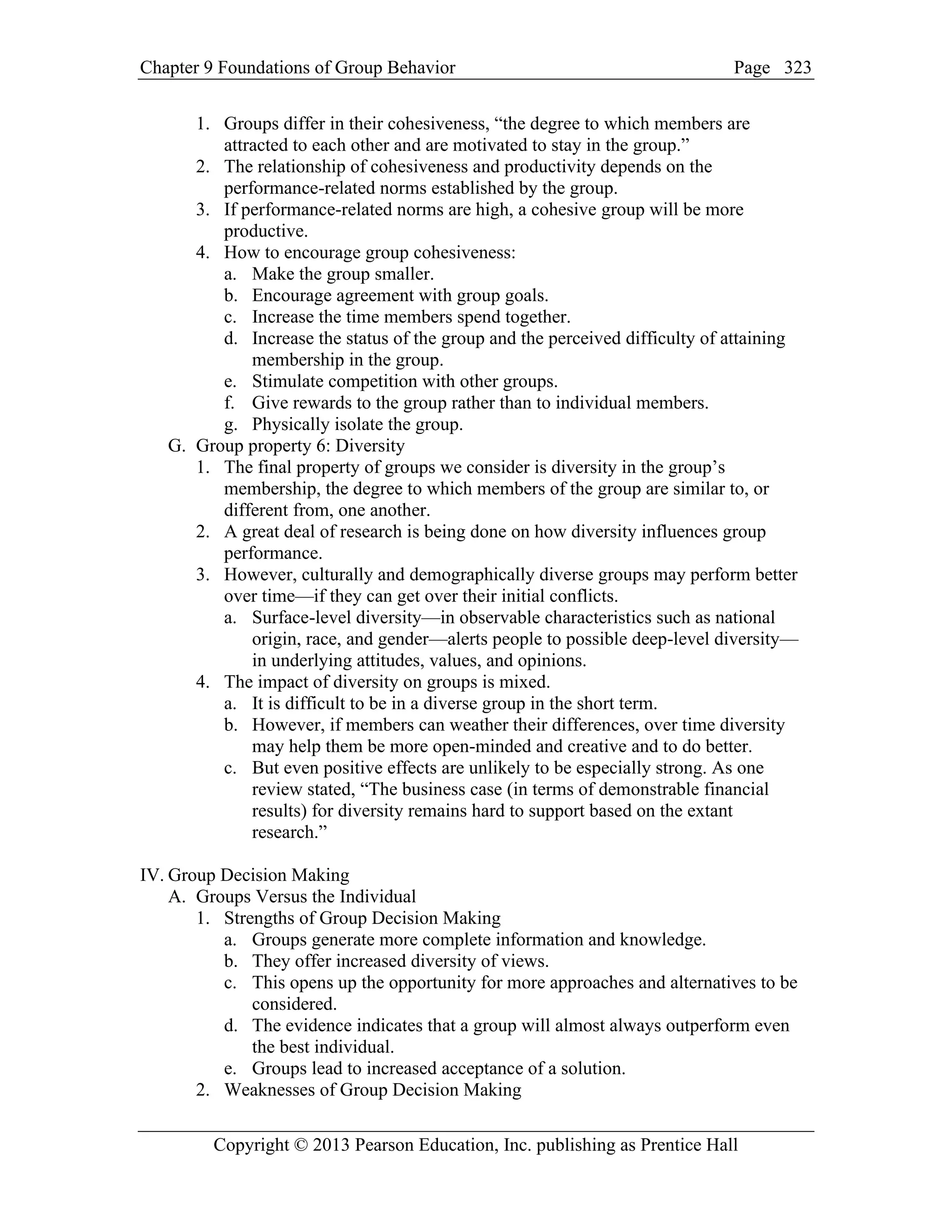
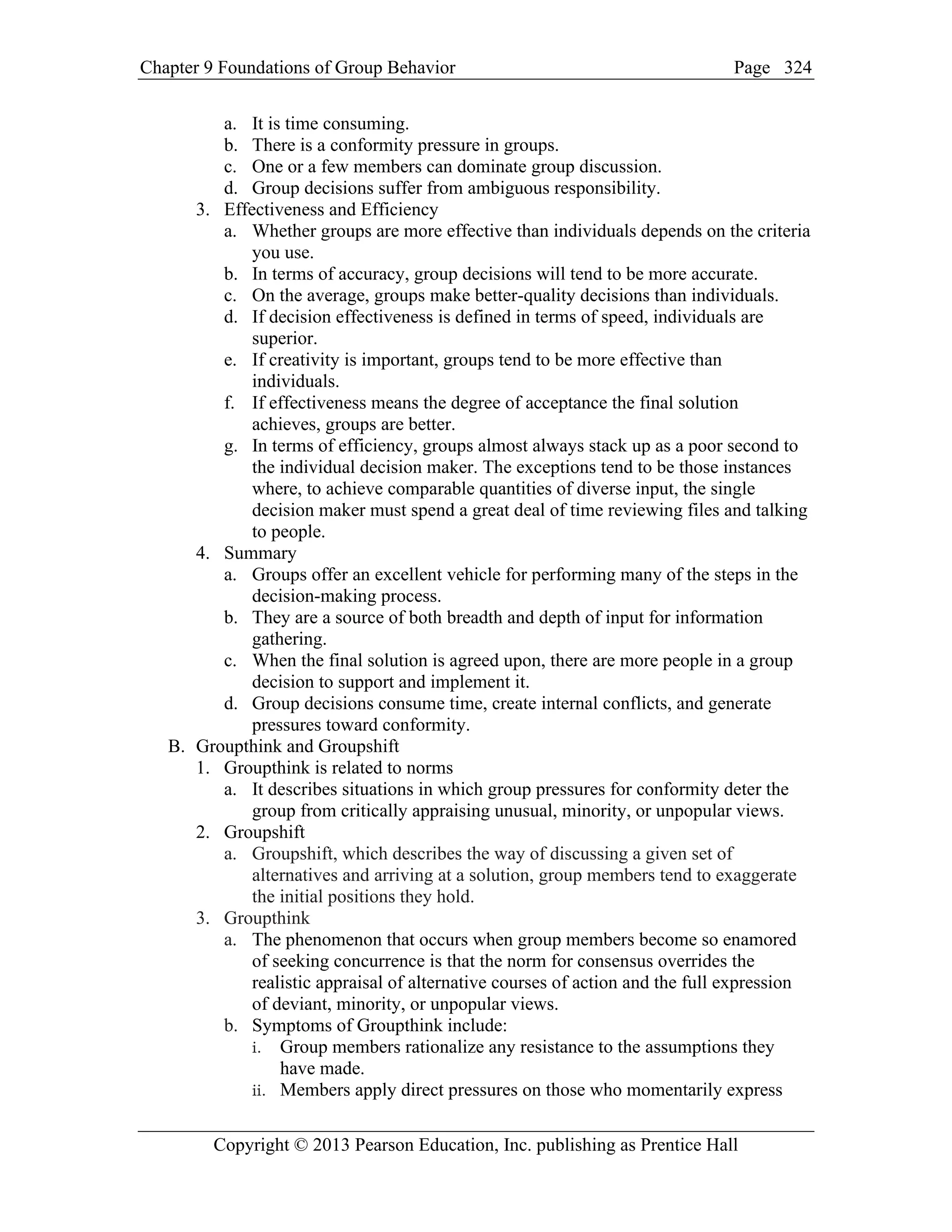
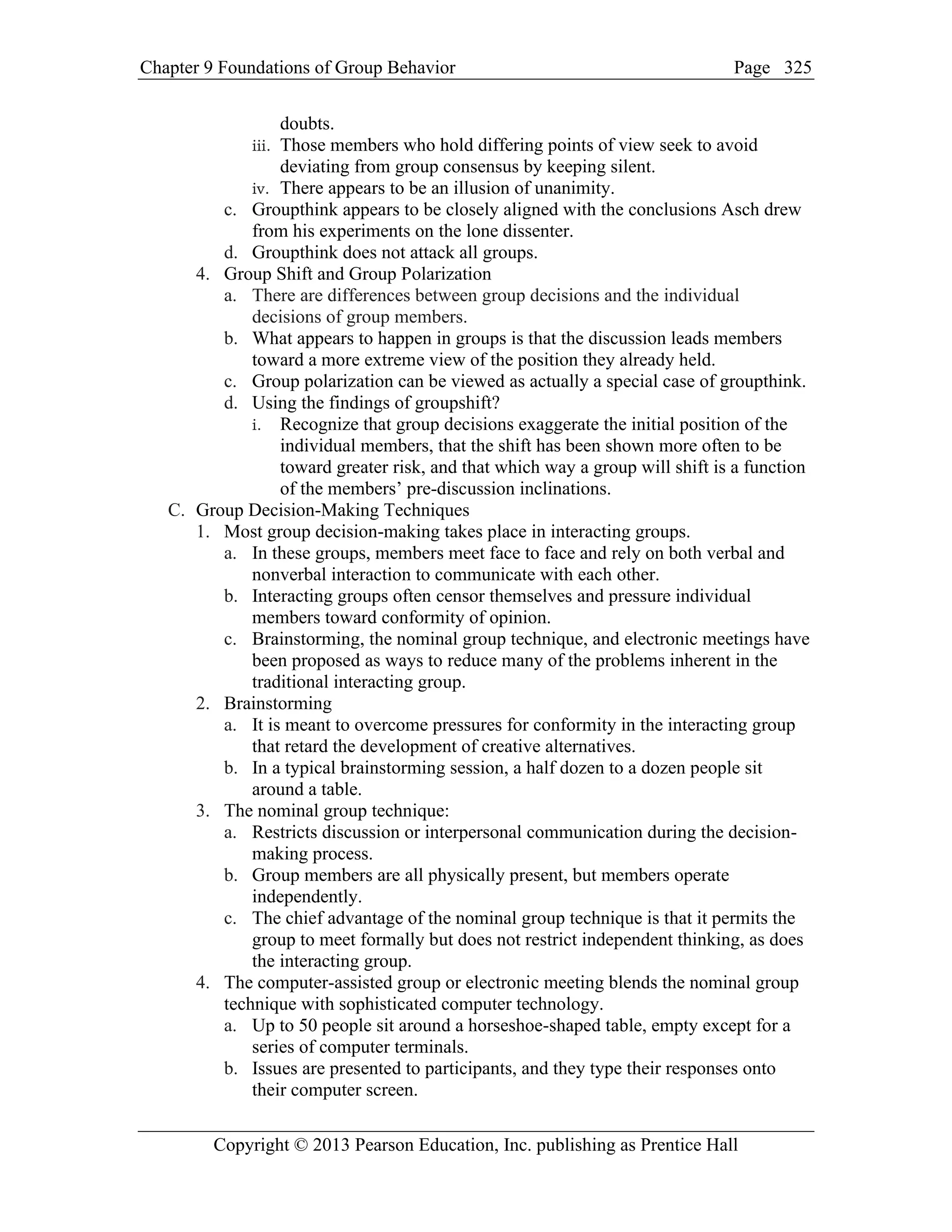
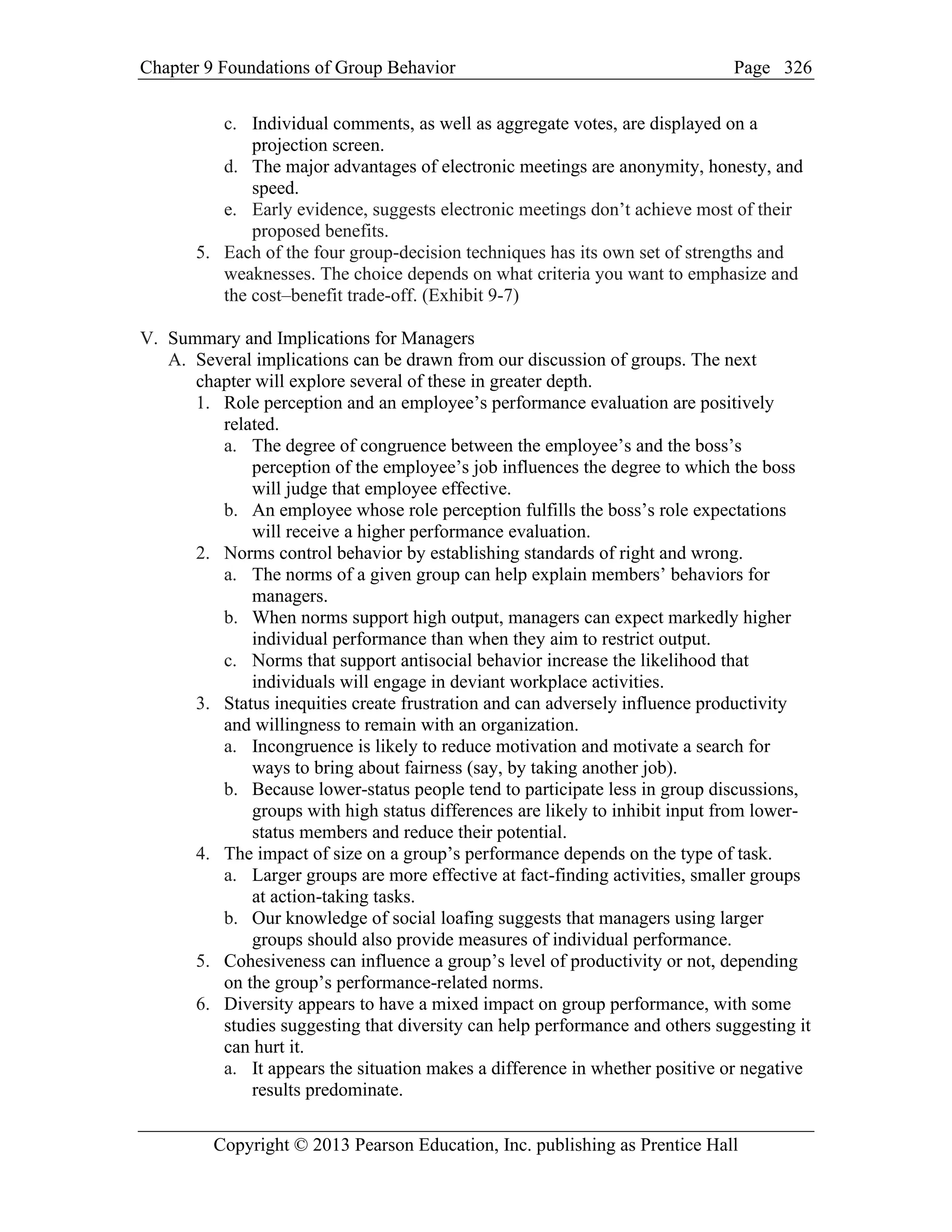
Organizational Behavior 15thEdition Robbins
Solutions Manual download
https://testbankfan.com/product/organizational-behavior-15th-
edition-robbins-solutions-manual/
Explore and download more test bank or solution manual
at testbankfan.com
2.
Here are somerecommended products for you. Click the link to
download, or explore more at testbankfan.com
Organizational Behavior 15th Edition Robbins Test Bank
https://testbankfan.com/product/organizational-behavior-15th-edition-
robbins-test-bank/
Organizational Behavior Global Edition 15th Edition
Robbins Test Bank
https://testbankfan.com/product/organizational-behavior-global-
edition-15th-edition-robbins-test-bank/
Organizational Behavior 18th Edition Robbins Solutions
Manual
https://testbankfan.com/product/organizational-behavior-18th-edition-
robbins-solutions-manual/
Organizational Behavior Human Behavior at Work 14th
Edition Newstrom Test Bank
https://testbankfan.com/product/organizational-behavior-human-
behavior-at-work-14th-edition-newstrom-test-bank/
3.
Management 9th EditionDaft Solutions Manual
https://testbankfan.com/product/management-9th-edition-daft-solutions-
manual/
Statistics For Managers Using Microsoft Excel 8th Edition
Levine Test Bank
https://testbankfan.com/product/statistics-for-managers-using-
microsoft-excel-8th-edition-levine-test-bank/
Intermediate Accounting Canadian Canadian 6th Edition
Beechy Test Bank
https://testbankfan.com/product/intermediate-accounting-canadian-
canadian-6th-edition-beechy-test-bank/
Social Psychology The Science of Everyday Life 1st Edition
Pyszczynski Test Bank
https://testbankfan.com/product/social-psychology-the-science-of-
everyday-life-1st-edition-pyszczynski-test-bank/
Project Management The Managerial Process 6th Edition
Larson Solutions Manual
https://testbankfan.com/product/project-management-the-managerial-
process-6th-edition-larson-solutions-manual/
4.
Exploring Art AGlobal Thematic Approach 5th Edition
Lazzari Test Bank
https://testbankfan.com/product/exploring-art-a-global-thematic-
approach-5th-edition-lazzari-test-bank/
"What makes theunion appear all the more admirable, is
the fact that the most discordant elements have here
been made to blend and intermingle. Savage is a
moderate drinker, who loves his wine at dinner, and his
punch before going to bed. Atkins is a stiff and
uncompromising temperance man. One is Maine law, the
other is Anti-Maine law. As for Blake, he is sometimes one,
sometimes both, and sometimes neither one thing nor the
other. But Atkins supports Savage. Savage supports Blake,
and they all support each other.
"Now, as our grandmother used to say, 'wherever you see
a turnip-top growing, you may be sure that there's a
turnip at the bottom of it. Large or small, it's still a turnip.'
Now, we have long admired the luxuriance of Savage,
Atkins, Blake & Co.'s turnip-tops. We have recently been
looking for the turnip, and lo! here it is! Who secured
Savage's re-election? Blake, when at the last county
convention of the Maine Laws, he advised them not to
make an independent temperance ticket for Congress.
Who devoted his paper to the cause of the moderate
drinker? Atkins. Who got Blake the post-office? Atkins and
Savage. But what are Savage and Blake doing for Atkins
all this time? Is Atkins so unselfish as to work for them
gratis? Nobody believes it! Where then does the milk in
the cocoa-nut come from? Let us see.
"In the first place—we have it on the authority of an old
lady who knows the genealogy of every family in the
county, and can trace most people's ancestry back to
Noah—Blake is Atkins's second cousin. There's one point.
Now for another. Blake owns three-fourths of the entire
Goblet printing establishment, and holds the property in
such a way, that he can any day take the paper into his
own hands, and manage it to suit himself! Therefore,
whoever edits the Goblet, is Blake's tributary. We were
23.
going to saytool or slave, but concluded to sacrifice truth
to politeness. Thus it happens that Atkins is only as it
were Blake's left hand," &c.
After several more paragraphs of the same sort, the author of the
annihilating article, who found it very difficult to conclude the
subject, being of a very rich and attractive nature, finally summed
up all his points, and bound them together with a striking original
quotation, attributed to Shakspeare. It was as follows:
"O consistency! thou art a jewel!
Which, like the toad, ugly and envious.
Bears yet a precious secret in his head."
It was this mongrel quotation which damped the Freeman's powder.
The Goblet took it up, turning the laugh against its rival; and for
months the modern style of rendering Shakspeare was a standing
joke. Of course a copy of the Freeman, containing the editorial
marked, was sent to the Post Master General; but on reading about
the toad at the end of the annihilating article, the Department
dismissed the whole subject with a good-natured laugh.
Notwithstanding the truth of the charges against him. Blake was
continued in office. 'Twas probably the fun of the thing that saved
him.
Then followed a lull. The good people of Harrowfork were worn out
with the harassing post-office question, and it was permitted to rest
until the approach of the next Congressional election.
Atkins of the Goblet went openly to work to secure the re-
nomination of Savage. But in the mean time, a "spy in
Washington"—there are always "spies in Washington"—privately
gave information to the leading Maine law men in the District,
concerning the Honorable member's very equivocal support of
temperance principles. Armed with this intelligence, the indignant
constituency remonstrated with Atkins on the inconsistency of his
course. He however, "flatly denied" the allegations against Savage.
24.
"Very well," saidthe constituency; "you may be sincere, but we shall
investigate the matter a little."
At the allusion to investigation, Atkins winced, and endeavored to
dissuade his friends from such a "needless step."
"We'll have a committee appointed to write Savage a letter, at all
events, and demand an exposition of his principles," replied they.
"We want to know what sort of a man we are supporting. We went
for Savage before, mainly through your influence; now we're
determined to make sure it's all right, before we give him a single
vote."
"Nonsense, gentlemen," said Atkins; "of course it's all right! Don't go
to bothering our candidate with letters. Letters are the devil in
politics."
The temperance men, however, were not to be dissuaded, and a
letter was written, in which the Hon. member was asked, among
other things, if he was or was not "in the habit of using intoxicating
liquors as a beverage, while at the seat of Government?"
In reply to this question, the gentleman of "enlightened views" wrote
to the committee:—
"I frankly admit, that the consequence of the bad water at
Washington, which has so deleterious an effect upon my
health, when I drink it, as to render me for a large portion
of the time unfit for business. I have occasionally, by the
advice of my physician, resorted to ardent spirits, simply
as a remedial agent. Yet this habit has been confined
strictly to the Capital. Never out of Washington have I
indulged in anything of the sort, even as a medicine."
This letter was received with significant nods and winks, expressive
of doubts and disapprobation, by the committee; and it was sent to
the "Goblet" for publication. In the mean time, however, its author
25.
had given Atkinsprivate instructions on the subject; and the
"Goblet" declined to publish the letter.
"Gentlemen," said Atkins, when called on for an explanation, "this is
an absurd affair from beginning to end. I opposed the proceeding at
the outset. I consider the letter perfectly satisfactory; but my
readers are tired of these things, and so am I. I must therefore be
excused from having anything to do with the affair."
"You will publish the letter, however, as an advertisement?"
suggested the committee.
"Not even as an advertisement!"
"Not if paid for?"
"No, not if paid for, gentlemen!" said the imperturbable Atkins.
"Very well," replied the committee, exasperated, "we know who will
publish it."
They went across the way to the office of the "Freeman," the "rum
paper," as it was called. Harmon, who was of the committee, knew
the editor, and took him confidentially aside.
"Atkins," said he, "refuses to print this document; 'twill be just the
thing for you, and it will spite him to see it in the Freeman."
"To tell you the truth," said he, "I'm afraid to publish it. 'Twill just
suit our moderate drinkers, and I'm not so sure but it would injure
our candidate with that class of men. On the whole," said he, "I
think I won't print it."
Foiled in this quarter, John Harmon bethought him of the "News
Courier," a neutral paper published in a neighboring town, which
offered to print communications relating to the approaching
campaign, provided they were written in a proper spirit, and did not
compromise too much its position as a neutral journal.
26.
The Savage letterwas accordingly sent to the Courier, and promptly
appeared in its columns. But the editor, desiring to keep both scales
of the balance as nearly in equilibrium as possible, inserted in the
same number of his paper a very profound, scientific treatise, signed
"Filter," giving an analysis of the Washington water, showing that its
chemical properties were identical with those of the member's own
well at home! and strongly questioning the utility of mixing whiskey
with it at all, and more especially such whiskey as is too often sold
at the seat of Government!
The result was decisive. The Goblet lost popularity and patronage;
Atkins lost influence and money; and Savage lost the election. On
the other hand, the News Courier gained the favor and support of
the temperance people, by its "bold and manly course" in exposing
the rottenness of Savage's principles. John Harmon was triumphant;
and one of the very leaders of the temperance cause was sent to
Congress.
The new member was no other than Judge Ames, the "reliable"
man, himself! Reader, be not surprised! Political life is fertile in such
unexpected events. The Judge had gained popularity by coming out
strongly for the Maine law. The old party to which he belonged had
endorsed his nomination. John Harmon electioneered for him, and
lent his horse and wagon to bring invalids, old men, and indifferent
voters to the polls, on election day; and the Judge was returned by
an overwhelming majority.
Then the old question of post master was again revived, and the
whole ground gone over again; the contest becoming more personal
and desperate than before, and the files of the Department teeming
with all sorts of exaggerated petitions and violent remonstrances.
The appointing power was made the victim of every kind of
imposition and abuse.
In the mean while the new member exercised that better part of
valor, called discretion. Popularity rendered him good-natured and
conservative; and he lost no time in effecting a reconciliation with
27.
the Post MasterGeneral, of whom he had so rashly complained.
Already, on the other hand he had written to his constituents
describing the embarrassment of his situation, and requesting as a
particular favor that he might for a brief period at least be excused
from any personal interference with the post-office quarrel.
This unexpected communication somewhat disappointed the
enemies of Blake; John Harmon, in particular, was highly
exasperated, having previously obtained a promise from Ames that,
in case of his election, he would use his influence to have Blake
removed.
The antagonistic parties were accordingly left to settle their
difficulties as best they could. The battle raged furiously. Fresh
petitions, remonstrances, affidavits, and accusations were volleyed
at the Department; and at length a special bearer of dispatches was
delegated to Washington, to support the charges against Blake, and
demand of the Post Master General his reasons for declining
immediate action in so plain a case.
Now, the person selected for this important mission was no other
than our old acquaintance, Mr. John Harmon. He was intrusted with
the business for several excellent reasons. In the first place, he was
a ready and vehement talker. Secondly, he was an enthusiast on the
post-office question, and a bitter opponent of the Blake faction.
Thirdly, he understood human nature, and knew how to manage
Ames. Fourthly, and chiefly, he was the author of the most serious
charge against Blake. He had a short time before posted a letter
containing a twenty dollar bank-note, at the Harrowfork post-office.
This letter never reached its destination. Now, Blake knew there was
money in that letter; and it could be proved that, not long after its
miscarriage, just such a bank-note as the one contained was passed
by the post master, "under suspicious circumstances."
This charge was on file among the papers of the Department; and it
was thought that Harmon was the most suitable person to agitate
the subject.
28.
Mr. John Harmonmade a comfortable journey, and arrived at the
seat of Government in due season. His first business was to secure
lodgings suited to the high character of a delegate from Harrowfork.
But Washington was crowded with visitors, and the hotels were
filled. Mr. John Harmon was chagrined. He leaned his chin upon his
hand, and his elbow upon the counter of the "National." Mr. John
Harmon ruminated.
"I don't see but what me'n' you'll hef to go halves, and turn in
together," said a voice at his other elbow.
Mr. John Harmon looked up. A stranger, of tall figure, prominent
cheek-bones, sallow complexion, dressed in a very new and very stiff
suit of clothes, smiled upon him in a decidedly friendly manner.
"There's jest one room, the landlord says'st we can hav' on a pinch,"
confined the speaker. "It's up pooty high, and an't a very sizable
room, at that. I've got the furst offer on't, but I won't mind makin' a
team'th you, if you're a mind to hitch on, and make the best on't.
What d'ye say?"
Mr. John Harmon said he supposed he would accept his new friend's
proposal. But at the same time he hinted to the clerk at the desk
that he was from the Hon. Mr. Ames' District.
"If you were the President, himself, we could not do any better by
you, under the circumstances," said the clerk.
This assurance served to soothe John Harmon's injured feelings, and
he retired to the room in the top of the house, with his new
acquaintance.
"Come down on Gov'ment business, I s'pose likely?" suggested the
latter.
"Yes," replied John Harmon, "on post-office business."
"I want to know! Glad we fell in," cried the stranger. "I came down
on some sich business myself."
29.
"Indeed!" said JohnHarmon. "You are going to call on the Post
Master General, then?"
"Shouldn't be 'tall surprised," remarked the other, rolling up his
sleeves over the wash-bowl. "Can't tell exac'ly, though. I wanted to
see what was goin' on down here, and git a sight of the big bugs,
and hear a little spoutin' in Congress; so I told our folks to hum—
says I, I b'lieve I'll scooter off down to Washin'ton, says I, and take
a peep into the Dead Letter Office, and see if I can find hide or hair
o' that 'ere hundred dollar letter, says I."
"Have you lost a letter containing a hundred dollars?" inquired John
Harmon, interested.
The stranger said "'twas jes' so," and went on to relate the
circumstances. He also incidentally stated that his name was
Forrester Wilcox; that he owned a farm somewhere "down East,"
comprising over two hundred acres of land, and one hundred and
fifty under cultivation; that he had been a member of the Maine
legislature, and held the office of "deputy sheriff" in his county. This
account of himself impressed John Harmon favorably; and in return
for the confidence, he talked Mr. Forrester Wilcox to sleep that night,
on the subject of the Harrowfork post-office.
On the following morning, our friends concluded to pay an early visit
to the Post-Office Department. They were now on excellent terms
with each other; and on arriving at the Department. John Harmon
readily accepted an invitation from Forrester Wilcox to accompany
him to the Dead Letter Office, before endangering the digestion of
his breakfast, by entering upon the perplexing Harrowfork business.
Accordingly, as they entered the building, Mr. Wilcox hailed a
messenger.
"Look here! you!" said he, "where abouts does a chap go to find the
Dead Letters?"
"This way," replied the polite messenger.
30.
The visitors wereshown to the left, through the lower main hall of
the Department; then turning into another passage, the messenger
pointed out the last door on the right, as the one they were in
search of.
"Thank ye," said Mr. Wilcox; "I'll do as much for you some time. May
as well bolt right in, I suppose?" he added, consulting his
companion.
John Harmon said "certainly," and the next moment the two found
themselves in the midst of the clerks of that important Bureau. Mr.
Forrester Wilson singled out one of the most approachable of them,
and addressed him on the subject of the hundred dollar letter.
"I have no recollection of any such letter," said the clerk. However,
for the visitor's satisfaction, he examined the list of returned money
letters, for the last quarter. John Harmon, interested for his friend
Wilcox, also ran his eye over the list.
"It's not here," said the clerk; "but you may rest assured, that in
case it is at any time discovered, it will find its way back to you in
safety."
He was about to dismiss the visitors, but John Harmon coughed;
John Harmon looked very red. John Harmon was perspiring very
profusely. The truth is, among the last letters on the list, he found
recorded the identical one, containing the twenty dollar bank note,
which Blake was charged with purloining! What to do in the matter,
John Harmon was at a loss to know. After some hesitation, however,
he asked permission to glance once more at the list. He was
accommodated, and presently his finger rested on the important
entry.
"I declare," said he, "if there ain't a letter I mailed at Harrowfork! I
had no idea of finding it here! Can I get it now, by proving
property?"
31.
"It has alreadybeen returned to your address," answered the clerk,
on learning the circumstances. "You will find it on your return to
Harrowfork. It miscarried in consequence of a mistake in the
superscription."
"Are you sure it has been sent?" inquired John Harmon.
The clerk was quite sure, and John Harmon instantly withdrew.
"So there's one of your charges agin Blake knocked overboard,"
suggested Wilcox. "He'll be a little grain tickled to see that 'ere letter
come back, I s'pect!"
"No person," answered John Harmon, magnanimously, "no person in
the world can be more rejoiced than I am, that Blake is proved
innocent of the charge."
Wilcox replied that he was very glad to hear it; and so they parted to
meet again at dinner. Whether John Harmon was so greatly rejoiced
at the proof of Blake's innocence, will be seen in the sequel.
While the Down Easter went to see the lions about town, our
delegate found his way to the apartment of the Post Master General,
and inquired for that officer in a manner which said very plainly, "I
am John Harmon, of Harrowfork; and I guess now we'll have that
little post-office affair settled."
Unfortunately—or rather fortunately, for his own peace of mind, at
least, the Post Master General was engaged that morning at Cabinet
meeting at the White House, and John Harmon was referred to the
First Assistant, who listened patiently to his statement. Our delegate
had a speech prepared for the occasion, which he now declaimed in
a very high tone of voice, "with a swaggering accent, sharply
twanged off," as Sir Toby Belch would have said, and with vehement
and abundant gestures.
"I am instructed by my constituents," he said, in conclusion, "to
demand of the Department satisfactory reasons for the delay and
procrastination to which we have been obliged tamely to submit!"
32.
"You should consider,"politely returned the Assistant, "that
Harrowfork numbers only one among some twenty-four thousand
post-offices in the Union; and that it is a little unreasonable to
expect us to bear in mind all the details of an occasional and not
uncommon case. We will attend to your business, however, directly."
The papers relating to the Harrowfork Post-Office were sent for, and
promptly produced. The delegate seized them without ceremony.
The first endorsement that caught his eye, checked his eagerness,
and induced reflection.
"I'd like to know, sir," said he, "what that means?" as he called the
Assistant's attention to the word "Rest," inscribed in formidable
characters, very much resembling the hand-writing of the Post
Master General.
"If you think," he continued, "or imagine, or flatter yourselves that
you're to have any kind of rest in this marble building, till that
rascally Blake is turned out, you're very much mistaken. Or if it
means that you want the rest of the temperance men in favor of his
removal, I can promise you so much, on my responsibility as a
delegate."
The Assistant smiled. He had dealt with persons of John Harmon's
temperament before.
"Permit me to inform you," said he, "what that harmless little word
signifies. It means nothing more nor less than that, for the present,
no action is to take place. Ah!" he added, glancing at the brief upon
the papers, "I remember this case very well! It has been from first to
last an exceedingly vexatious one to the Department, and these
memoranda bring it pretty fully to my recollection."
"Well, sir," interrupted John Harmon, in his declamatory way—"isn't
it plain? isn't it perfectly clear? Haven't we the rights of the case,
sir?"
33.
"It is notquite so plain—not quite so clear—nor is it easy to
determine who has the rights of the case," returned the official. "The
most troublesome point at the present time, seems to be this: while,
according to the documents, a majority of the citizens of Harrowfork
seem to be eager for a removal, both the late member of Congress,
and the newly elected one, have written private letters here—I
mention this confidentially—in favor of the present incumbent."
"You don't mean Ames?" cried John Harmon. "Ames hasn't come out
for Blake?"
"There is a letter on file, over his own signature, in which he
represents that Blake is as suitable a man as could be named, and
that he had better be continued in office."
The Assistant spoke with seriousness and candor. John Harmon was
thunderstruck.
"Just give me a look at that letter!" said he, through his closed
teeth. "I want to see it over Ames' own fist, before I believe it!
When we promised our support for his election, he agreed to carry
out our wishes in regard to the post-office, at all hazards! If he has
dared to turn traitor!" muttered John Harmon, revengefully.
"The letter is entirely of a private nature," said the Assistant, "but it
is contrary to our wishes to keep any communications secret, that
are designed to influence our public acts; and owing to the peculiar
circumstances of the case, I am willing to show you the letter,—on
condition, however, that its contents shall not be divulged outside
the Department."
John Harmon, burning to seize upon the evidence of Ames'
treachery, assented, although reluctantly; and the official explored
the wilderness of papers, for the document in question. "Here it is,"
said he, "no!"—glancing at the endorsement—"this is a
communication with regard to a letter of your own, containing a
twenty dollar note, which Blake is charged with purloining. How is it
about that? anything new?"
34.
"Well,—no,—hem!" coughed JohnHarmon. After discovering the
proof of Blake's innocence, in the Dead Letter Office, he rather
hoped the subject would not be mentioned; but he was too much
absorbed in looking after Ames' honesty, to take very good care of
his own. "The matter—hem!" (John's throat was quite musty)
—"stands about as it did."
"You have no positive proof of the charge, then?"
"No,—well,—that is, not what would be called legal proof. I suppose.
The circumstances were very strong against Blake at the time, but
being all in the neighborhood, nobody liked to prosecute. For my
part," said John Harmon, nobly, "I'd rather suffer wrong, than do
wrong, and I preferred to lose the twenty dollars, to injuring Blake's
private character."
The Assistant made a commendatory remark touching this generous
sentiment, and passed over the letter. John Harmon wiped the
perspiration from his brow, and felt relieved. Whether he was
ashamed to confess his own gross carelessness in the matter, and
the injustice of his charge, or whether—acting on the principle of
doing evil that good might come from it, he determined to make the
most of every point established against Blake, without regard to
truth—does not plainly appear. We leave the affair to his own
conscience.
The assistant meanwhile drew Ames' letter out of the "case." In his
eagerness to grasp it, John Harmon dropped it upon
35.
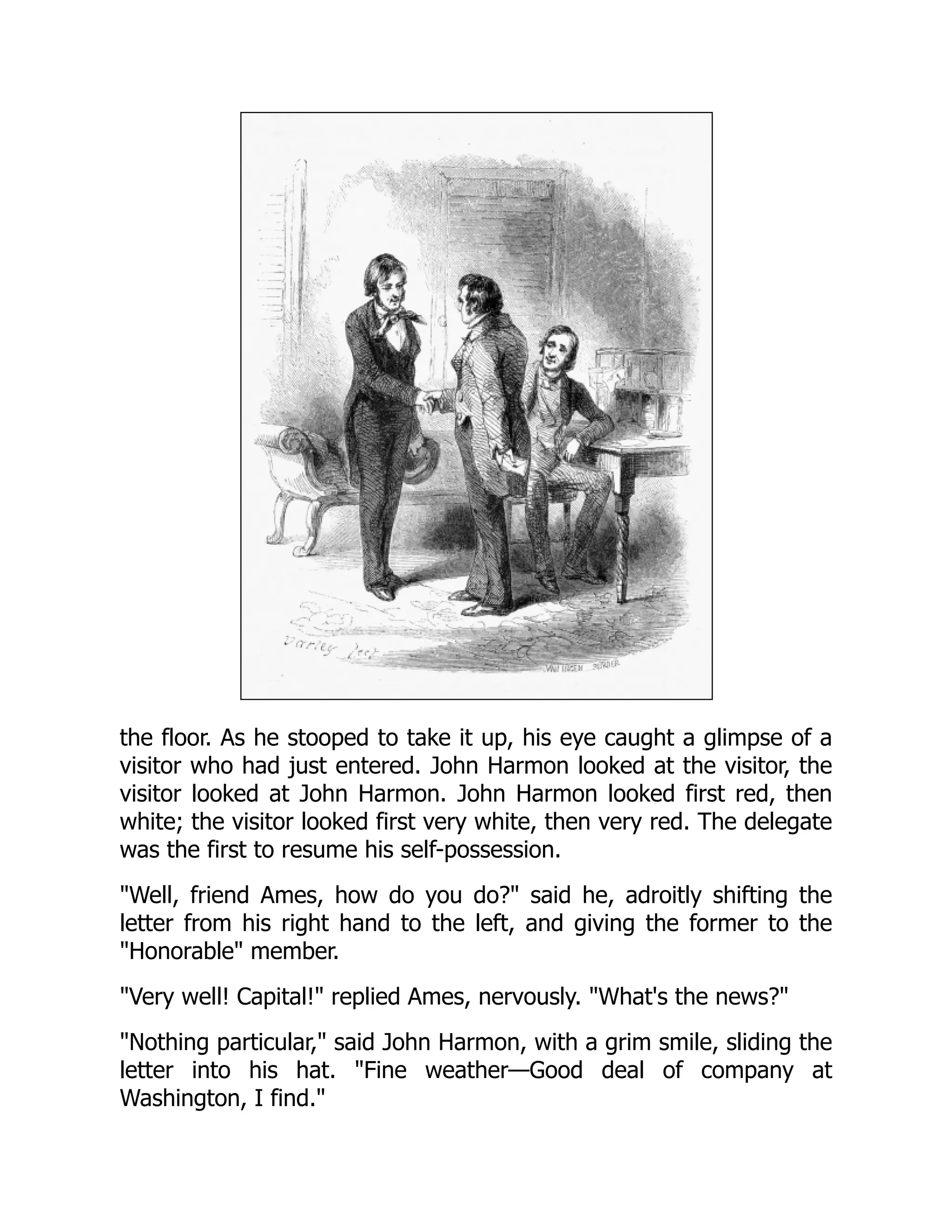
the floor. Ashe stooped to take it up, his eye caught a glimpse of a
visitor who had just entered. John Harmon looked at the visitor, the
visitor looked at John Harmon. John Harmon looked first red, then
white; the visitor looked first very white, then very red. The delegate
was the first to resume his self-possession.
"Well, friend Ames, how do you do?" said he, adroitly shifting the
letter from his right hand to the left, and giving the former to the
"Honorable" member.
"Very well! Capital!" replied Ames, nervously. "What's the news?"
"Nothing particular," said John Harmon, with a grim smile, sliding the
letter into his hat. "Fine weather—Good deal of company at
Washington, I find."
36.
"O yes, considerable!"Ames rubbed his hands, and tried to appear
at ease. "I am glad to see you here. You must go up to the House
with me. How are all the folks at home? How's Harrowfork now-a-
days?"
John Harmon answered these questions evasively.
At the same time, the Assistant's countenance betrayed an inward
appreciation of unspeakable fun. The member's face grew redder
still, and still more red. The truth is, he had that morning received a
note from Blake warning him of Harmon's journey to the Capital, and
had just left his seat in the House, hastening to the Department, to
secure the fatal letter before it betrayed his treachery.
As we have seen, he was just too late.
The Assistant took pleasure in seating the two visitors side by side
upon the same sofa, and allowed them to entertain each other. But
the conversation was forced, unnatural, embarrassing. At length
Ames, resolved upon knowing the worst, plunged desperately into
the all-important subject.
"I suppose," said he, "you don't entirely get over the excitement at
home about the post-office."
"No, we don't," replied John Harmon, significantly; "and that ain't
the worst of it." He bent over the end of the sofa, and deliberately,
with the grimmest sort of smile, drew from his hat the Honorable
member's private note.
"And, somehow, it don't strike me," he added, glancing his eye over
its contents, "that this letter of yours is going to lessen the
excitement very materially. I suppose you know that hand-writing?"
He thrust the letter into the Honorable member's face. The
Honorable member's face flushed more fiery than before. He
stammered, he smiled, he rubbed his handkerchief in his hands, and
upon his brow.
37.
"My dear Harmon,"said he, blandly, "I see you don't fully
understand this business."
"I'm sure I don't," cried John Harmon; "and I'd like to find the
honest man who does! Didn't you pledge yourself to use your
influence, if elected, to have Blake removed?"
"Don't speak so loud!" whispered the Honorable member, who didn't
at all fancy the humorous smile on the Assistant's face. "It's all right,
I assure you. But this isn't exactly the place to talk over the affair.
Come with me to my lodgings, and we'll discuss the matter."
Not averse to discussion, John Harmon consented to the proposal.
"I beg your pardon," said the Assistant Post Master General, "but
that paper,—I cannot suffer that to be removed."
It was the fatal letter. John Harmon wanted it; the Honorable
member wanted it still more; but the Assistant insisted, and the
document was left behind.
Now, the Honorable member was in what is commonly termed a
"fix." Like too many such politicians, who, nevertheless, as Mark
Antony says, are "all honorable men," he had found it convenient to
adopt the "good Lord, good devil" policy, using two oars to row his
boat into the comfortable haven of public office.
Accordingly, while gently drawing figmative wool over the visual
organs of the radical temperance people, he had managed, at the
same time, by private pledges, to conciliate Atkins, Blake &
Company, and secure the silence of the Goblet. Once elected, he did
not fail to look forward to a future election, in view of which he
considered it expedient to smile upon one faction with one side of
his face, and grin upon the opposition with the other.
For this double-dealing, honest, honest Iago,—we mean honest John
Harmon—called the member to account.
38.
How the affairwas settled is not generally known. But one thing is
positive. The Honorable member and the delegate from Harrowfork
suddenly blossomed into excellent and enduring friends; and not
long after, Mr. John Harmon became the occupant of a snug berth at
the seat of Government, supposed to have been obtained through
the influence of the Honorable member from his District.
"How about Blake and the post-office?" inquired Mr. Forrester
Wilcox, the morning he left Washington.
"I've concluded," replied John Harmon, candidly, "that the post-office
is well enough as it is. Blake turns out to be a passable kind of post
master after all, and I don't really think 'twill be worth while to make
any change for the present."
And this was the answer the worthy delegate made to all persons,
who, from that time forward, interrogated him on the subject.
Shortly after, his very Honorable friend, the member from his
District, being now decidedly averse to political letter-writing, went
home on a flying visit, and passing through Harrowfork, took pains
to make himself agreeable to all parties. Among other nice and
prudent acts, he privately consulted Blake. The post master listened
to his advice, and immediately on the member's return to
Washington, appointed as an assistant in his office, a young man of
strict temperance principles, who was quite popular with the
opposition, and who had for some time acted as Secretary of the
"County Association for the Suppression of Intemperance."
This appointment seemed to cast oil upon the troubled waters. And
so the matter rests at the present date.
Ames is still in Congress; John Harmon continues to enjoy his
comfortable quarters at the seat of Government. Tim Blake remains
the efficient post master of Harrowfork, with the young man of strict
temperance principles for his assistant; and Atkins still edits the
Goblet.
39.
This powerful organhas of late regained something of its former
popularity and patronage; but whether it will support Ames at the
next Congressional election, depends upon Blake; whether Blake
retains his office, depends upon Ames; whether Ames maintains his
position and influence at home, depends in a very great measure
upon honest John Harmon, who, like the Ghost in Hamlet,
"Could a tale unfold, whose lightest word would harrow up"
the political soil of Harrowfork, in a manner dangerous to the
Constitution and the Union.
40.
CHAPTER XXI.
UNJUST COMPLAINTS.
Infallibilitynot claimed—"Scape-Goats"—The Man of Business Habits
—Home Scrutiny.
A Lady in Trouble—A bold Charge—A wronged Husband—Precipitate
Retreat.
Complaints of a Lawyer—Careless Swearing—Wrong Address—No
Retraction.
A careless Broker—The Charge repulsed—The Apology—Mistake
repeated—The Affair explained—A comprehensive Toast.
Infallibility is not claimed by those connected with the Post-Office
Department, and it cannot be denied that mistakes sometimes occur
through the carelessness or incompetency of some clerk or other
official. But if there is a body of men who perform the duties of
scape-goats more frequently than any other, those men are post
masters, and post-office clerks.
Whoever takes this responsible station with the expectation that a
faithful discharge of his duty will protect him from all suspicion and
blame, cherishes a pleasing dream that may at any moment be
dispelled by the stupidity, or carelessness, or rascality of any one
among the many-headed public, whose servant he is.
When it is considered that in the selection of persons to fill the
important office of post master, the Department makes every effort
to secure the services of competent and honest men, and that they,
in the appointment of their clerks, generally endeavor to obtain
41.
those of alike character, it may reasonably be supposed that at least
as high a degree of accuracy and integrity can usually be found
inside of post-office walls, as without its boundaries.
I cannot, indeed, claim for this corps of officials entire immaculacy.
Could I justly do so, they would be vastly superior in this respect to
mankind at large. But without setting up any such high pretensions,
I would suggest that those connected with the post-office receive a
greater share of blame for failures in the transmission of letters than
justly belongs to them. Many people seem to think that nobody can
commit a blunder, or be guilty of dishonesty in matters connected
with the mails, but post masters or their employés.
Acting on this impression, such persons, when anything goes wrong
in their correspondence, do not stop to ascertain whether the fault
may not be nearer home, but at once make an onslaught upon the
luckless post-office functionary who is supposed to be the guilty one.
The investigation of some such unfounded charges, resulting in
placing the fault where it belonged, has brought to light curious and
surprising facts, respecting the atrocious blunders sometimes
committed by the most accurate and methodical business men. Such
men have been known to send off letters with no address, or a
wrong one; and even (as in one case which will be found in this
chapter) to persist in attempting to send a letter wrongly directed.
They have been known to mislay letters, and then to be ready to
swear that they had been mailed. The blame of these and similar
inadvertencies has been laid, of course, upon somebody connected
with the post-office.
Mr. A. is a man of business habits; he never makes such mistakes,
and indignantly repudiates the idea that any one in his employ could
be thus delinquent. So the weight of his censure falls on the much-
enduring shoulders of a post-office clerk.
Besides the class of cases to which I have alluded, which arise from
nothing worse than carelessness or stupidity, many instances occur
42.
in which theattempt is made by dishonest persons to escape
detection, by throwing the blame of their villany upon post-office
employés. Cases like the following are not uncommon.
A merchant sends his clerk or errand-boy to mail a letter containing
money. This messenger rifles it, reseals it, and deposits it in the
letter box. On the receipt of the letter by the person to whom it is
addressed, the robbery comes to light; and, as the merchant is
naturally slow to believe in the dishonesty of his messenger, he at
once jumps at the conclusion that the theft was committed after the
letter entered the post-office. In such cases, and in those of which I
have been speaking, it would be well to establish the rule that
scrutiny, like charity, should "begin at home."
Letters are sometimes mailed purporting to contain money for the
payment of debts—when in fact they contain none—with the
intention of making it appear that they have been robbed in their
passage through the mails. In short, the cases are numberless in
which, through inadvertence or design, censure is unjustly thrown
upon the employés of the post-office; and the investigations of this
class of cases forms no unimportant branch of the duties of a Special
Agent.
It has been the pleasing duty of the author, in not a few instances,
to relieve an honest and capable official from the load of suspicion
with which he was burdened, by discovering, often in an unexpected
quarter, where the guilt lay.
THE BITER BIT.
The following case, which might properly be entitled "The Biter Bit,"
displays still another phase of the subject in hand.
43.
A lady ofa very genteel and respectable appearance, called one day
on a prominent New England post master, with a letter in her hand,
which she insisted had been broken open and resealed. She handed
the letter to the post master, who examined it, and appearances
certainly seemed to justify her assertion. She further declared that
she well knew which clerk in the office had broken it open, and that
he had previously served several of her letters in the same way.
Upon hearing this, the post master requested her to walk inside the
office, and point out the person whom she suspected.
Such an unusual phenomenon as the appearance of a lady inside the
office, produced, as may be supposed, a decided sensation among
the clerks there assembled. Nor was the sensation diminished in
intensity when the post master informed them, that the lady was
there for the purpose of identifying the person who had been guilty
of breaking open her letters!
This announcement at once excited the liveliest feelings of curiosity
and solicitude in the mind of almost every one present, and each
one, conscious of innocence, indulged in conjectures as to who that
somebody else might be, whom the accusing Angel (?) was to fix
upon as the culprit.
All their conjectures fell wide of the mark. After looking about for a
moment, the lady pointed out the last man whom any one in the
office would have suspected of such an offence—one of the oldest
and most reliable of their number.
"That is the person," said she, indicating him by a slight nod of the
head; "and if he persists in making so free with my letters, I will
certainly have him arrested. Why my letters should always be
selected for this purpose, I cannot imagine; but if any more of them
are touched, he will wish he had let them alone."
This direct charge, and these threats, produced a greater commotion
among his fellow clerks, than in the mind of the gentleman accused.
Waiting for a moment after she had spoken, he broke the breathless
44.
silence that followedher words, by saying calmly,—"Mrs.——, I
believe?"
"That is my name, sir."
"Have you concluded your remarks, madam?"
"I have, sir, for the present."
"Then, madam, I will take the liberty to inform you that your
husband is the person on whom you ought to expend your
indignation. He has, at different times, taken several of your letters
from the office, opened and read them, and after resealing, returned
them to the letter box, having made certain discoveries in those
letters, to which he forced me to listen, as furnishing sufficient
ground for his course, and justifying former suspicions! He earnestly
requested me never to disclose who had opened the letters, and I
should have continued to observe secrecy, had not your accusation
forced me to this disclosure in self-defence. If you wish to have my
statement corroborated, I think I can produce a reliable witness."
The lady did not reply to this proposition, but made a precipitate
retreat, leaving the clerk master of the field, and was never
afterwards seen at that post-office.
In the summer of 1854, among the complaints of missing letters
made at the New York post-office, was one referring to a letter
written by a young lawyer of that city, directed as was claimed, to a
party in Newark, N. J. Enclosed was the sum of twenty-five dollars in
bank-notes.
The writer of the letter was annoyed by the circumstance, to an
unusual degree, and caused a severe notice of censure upon the
Post-Office Department, to be inserted in one of the leading New
45.
York journals. Aformal certificate was also drawn up, duly sworn to,
and forwarded to Washington.
It read as follows:—
State of New York.
City and County of New York, ss.
John B. C——, of said city, Counsellor at Law, being duly
sworn, doth depose and say that on the 19th day of July
instant, he enclosed the sum of $25 in a letter addressed
to Capt. John M——, Newark. N. J., and deposited the
same in the post-office in the city of New York. That the
said enclosure and deposit of the letter was made in the
presence of one of the principal clerks of the said post-
office, whose attention deponent particularly called to the
fact at the time. That deponent is informed, and believes
that the said clerk's name is John Hallet.
Sworn before me this
10th day of August, 1854.
(Signed) Henry H. M——,
Comr. of Deeds.
The complainant was visited by the Special Agent, and the bare
suggestion that the failure might have been owing to some error in
the address of the letter, was received with much indignation. He
didn't do business in that way, and the post-office and its clerks
couldn't cover up their carelessness or dishonesty, by any such
inventions.
The reader ought to have been present in the post master's room,
some few months subsequently, when this infallible (?) individual
called, in response to a notice that his letter had been returned from
the Dead Letter Office!
Secretary.—"Good morning, Mr. C——."
46.
C.—"Good morning, sir.I have received a notice to call here for a
letter."
Secretary.—"Yes, sir, that is the one referred to, (placing the unlucky
missive before him). Is that address in your hand-writing?"
C.—"Why,—y-e-s, it's mine sure—I couldn't dispute that."
Secretary.—"It seems to be directed to Newburg, N. Y., instead of to
Newark, N. J."
C.—"I have nothing to say. I could have sworn that the address was
correct."
Secretary.—"You did so swear, I believe. Mistakes will happen, but I
think the least you can do, will be to retract the article you published
censuring us, for what you were yourself to blame."
The amazed limb of the law made no further reply, but left the office
gazing intently on the letter, and in his bewilderment getting the
wrong door, as he had originally got the wrong address upon the
letter.
No such correction was ever made, however, and like hundreds of
similar faults, for which others are alone responsible, the charge yet
stands against the Post-Office Department, and those in its employ.
Some years since, a letter containing drafts and other remittances to
a considerable amount, was deposited in the New York office, to be
transmitted by mail, having been directed (as was supposed) to a
large firm in Philadelphia. This letter would pass through the hands
of a clerk, whose duty it was to separate all those deposited in the
letter box, and arrange them according to their respective
destinations. He discovered that it was directed to New York, yet
47.
though he hadheard of the firm to which it was addressed, he
thought it might have been so directed for some particular purpose,
and accordingly placed it in the "alphabet," for delivery to the proper
claimant. On the day after this, Mr. D., of the firm of D. & A., well
known brokers in Wall Street, called at the office and stated that his
clerk had deposited such a letter to be mailed in time to go to
Philadelphia the same day, but that he had been advised that it had
not been received.
The clerk in attendance was somewhat perplexed by this statement,
but suggested the probability that his clerk, in the hurry of business,
had directed it wrong.
Mr. D. replied that this could not be, for he saw all his letters before
they were confided to the charge of his clerk, and as the one in
question had not been received, it must have been mailed incorrectly
through the ignorance or carelessness of the clerk assigned to that
duty; and indeed went so far as to intimate that it might have been
detained purposely. This insulting remark induced the post-office
clerk to express his perfect indifference concerning such a
groundless conjecture, and to state, as his opinion, that the charge
of ignorance, carelessness, or sinister design, would eventually be
found to rest on the shoulders of Mr. D. or his clerks.
Against this turning of the tables, that gentleman indignantly
protested, and the post master, who overheard the altercation,
appeared vexed and displeased at the supposed delinquency of his
clerk. A general search was commenced in the office, in order, if
possible, to settle the disputed point. In the course of this
investigation, the "pigeon-hole" designed for letters corresponding
with such a name as that of the Philadelphia firm, was examined,
and the letter in question was found, directed "New York," instead of
"Philadelphia."
Upon this being known, Mr. D. made many apologies, begged to be
exonerated from all intention to charge criminality upon any one,
took his letter and retired, much disconcerted and chagrined.
48.
He went tohis office and poured out sundry vials of wrath upon the
head of his luckless clerk, to whom he attributed the atrocious
blunder which had been committed. The affair, however, did not end
here.
On the following day a letter was deposited in the post-office, at
about one o'clock, in time for the Philadelphia mail, directed
precisely as before! viz. addressed to the Philadelphia firm, but
directed "New York," and happened to fall under the eye of the clerk
who had been cognisant of the error of the day previous. This
second instance of gross inadvertence, or something worse, on the
part of somebody, was rather too much for the equanimity of the
post master, who at once sent for Mr. D., and showed him the letter,
which seemed as if it was under the influence of some mischievous
enchanter. As the words "New York," in the superscription, stared D.
in the face, he in turn became enraged, and was about to leave the
office with the fell design of discharging his clerk instanter. The post
master then requested him, before he left, to sit down and alter the
direction of the letter from "New York" to "Philadelphia," which he
did. The letter was mailed accordingly, and duly received.
A few days afterwards, the post-office clerk met Mr. D., and said to
him, "I suppose you have turned off your clerk for his
mismanagement in relation to the letter about which so much
trouble was made in our office."
"Ah!" replied he, "I believe I shall have to confess that I was the
only one to blame in the matter. My clerk was perfectly innocent. On
returning home with the letter, I laid it down with the intention of
having the mistake in the direction rectified, but having something
else to call off my attention just then, it was mixed with the letters
for city delivery, and was taken to the office with them by my clerk."
Thus all this trouble and vexation was caused by the carelessness of
a man who was accustomed to system and accuracy in the
transaction of his business; and the above related facts may lead
even persons of this description not to be too confident of their own
49.
freedom from error,when any mistake like that just mentioned
occurs.
I can give no better summary of the whole subject under
consideration, than that which is found in some remarks made by
Robert H. Morris, Esq., on the occasion of his retirement from the
office of post master of New York, in May, 1849, at a dinner
prepared for the occasion.
During the evening Mr. Morris said.
"Gentlemen, please fill your glasses for a toast. As I intend to toast a
man you may not know, I deem it necessary, before mentioning his
name, to tell you what sort of a man he is.
"He rises at 4 o'clock in the morning and works assiduously during
the whole day, until 7 o'clock in the evening—goes wearied to bed,
to rise again at 4 o'clock, and again to work assiduously.
"If the gentlemen of the press—and there are some among us—
incorrectly direct their newspapers for subscribers, it is the fault of
the man I intend to toast, if the papers do not reach those to whom
they should have been addressed.
"If a publishing clerk omits to address a newspaper to a subscriber, it
is the fault of the man I intend to toast that the subscriber does not
get his paper.
"If a man writes a letter and seals it, and neglects to put any
address upon it, it is the fault of the man I will toast, if the letter
does not reach the person for whom it was intended.
"If an officer of a bank addresses a letter to Boston instead of New
Orleans, it is the fault of the man I shall presently toast, if the letter
is not received at New Orleans.
"If a merchant's clerk puts a letter in his over-coat, and leaves that
coat at his boarding-house, with the letter in his pocket, the man I
50.
will toast isto blame because the letter has not reached its
destination.
"If a merchant shuts up a letter he has written, between the leaves
of his ledger, and locks that ledger in his safe, the man I will toast
has caused the non-reception of that letter.
"If a poor debtor has no money to pay his dunning creditor, and
writes a letter that he encloses fifty dollars, but encloses no money,
having none to enclose, the man I will toast has stolen the money.
"If a good, warm-hearted, true friend, receives a letter from a dear
(?) but poor friend, asking the loan of five dollars; and, desiring to
be considered a good, warm-hearted, true friend, and at the same
time to save his five dollars, writes a letter saying 'dear friend, I
enclose to you the five dollars,' but only wafers into the letter a
small corner of the bill,—the man I will toast has stolen the five
dollars out of the letter, and in pulling it out, tore the bill.
"If a rail-road-bridge is torn down or the draw left open, and the
locomotive is not able to jump the gap, but drops into the river with
the mail, the man I will toast has caused the failure of the mail.
"This, gentlemen, is the stranger to you, whom I will toast. I give
you, gentlemen—A Post-Office Clerk!"
PRACTICAL, ANECDOTAL, ETC.
Thewrong Address—Odd Names of Post-Offices—The Post-Office a
Detector of Crime—Suing the British Government—Pursuit of a
Letter Box—An "Extra" Customer—To my Grandmother—Improper
Interference—The Dead Letter—Sharp Correspondence—The
Irish Heart—My Wife's Sister.
Giving the wrong State in an address, is a disease as common
among letters, as hydrophobia among dogs. A draper's clerk in C——
sent a remittance to Boston which did not arrive there. The draper
was obliged to send the amount (three hundred and fifty dollars)
again, which he did personally, to prevent mistakes. This too failed
to arrive, but the first was soon received by him from the Dead
Letter Office, having died at Boston in New York, instead of
Massachusetts! The merchant drank gunpowder-tea, and gave his
clerk a "blowing up." The latter person, however, was in some sort
avenged, not long after, for Coroner John Marron reported that the
second letter, written and mailed by the merchant himself, had died
of the same disease that carried off the first, and forwarded the
body to him.
It should here be mentioned, for the benefit of the uninitiated, that
the gentleman referred to, is the Third Assistant Post Master
General, embracing the Superintendence of the Dead Letter Office.
His duties may be considered as in some respects analogous to
those of a Coroner, as he, or those in his bureau, in the case of
defunct money letters, ascertain the causes of death, and send the
remains to surviving friends.
The omission of the name of the State from the address of a letter,
often causes much uncertainty in its motions.
There are, for instance, seven Philadelphias besides the one in
Pennsylvania, twenty-three Salems, as many Troys, and no end of
Washingtons, Jeffersons, and other names distinguished in the
history of the country.
53.
Welcome to ourwebsite – the perfect destination for book lovers and
knowledge seekers. We believe that every book holds a new world,
offering opportunities for learning, discovery, and personal growth.
That’s why we are dedicated to bringing you a diverse collection of
books, ranging from classic literature and specialized publications to
self-development guides and children's books.
More than just a book-buying platform, we strive to be a bridge
connecting you with timeless cultural and intellectual values. With an
elegant, user-friendly interface and a smart search system, you can
quickly find the books that best suit your interests. Additionally,
our special promotions and home delivery services help you save time
and fully enjoy the joy of reading.
Join us on a journey of knowledge exploration, passion nurturing, and
personal growth every day!
testbankfan.com