Course Rep Online
Training
Students
(needing
help)
You
(knowledgeable)
Learning Objectives
By the end of this module, you should:
• Understand the skills which are important to your role
• Understand the importance of effective communication
• Understand how you can collect feedback, and how to close the feedback
loop
• Be able to explain why Liberation is important
Part 2: Being
an effective
Course Rep
Part 2: Being an effective Course Rep
• Developing skills as a Course Rep
• Communication
• Assertiveness
• Questioning, Negotiation and Conflict Resolution
• Presentation and Public Speaking
• How to gather feedback, and close the feedback loop
• Understanding Liberation Groups
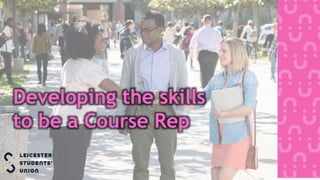
Developing the skills
to be a Course Rep
Communication
• Whether you’re communicating with your peers, the Students’ Union or your
department staff at SSCs, it’s important to always be professional, polite and
respectful
• Be approachable and accessible to your cohort
• Make sure your peers know that their feedback is valued
• When raising issues in your SSCs, be clear and coherent and provide evidence
where possible
• It’s important to be constructive in your criticism, and to offer suggestions on
how any issues could be improved
Assertiveness
After receiving feedback from your fellow students, you may want to
lobby the University to deliver meaningful and positive change on a
specific point, for the benefit of the student body. This may feel like
a daunting task, but don’t worry - this is natural and it shouldn’t put
you off approaching the issue head on.
Assertiveness
When raising your concerns, it is important to be assertive.
This means that you should:
• Express your concerns in a clear and confident manner
• If possible, provide evidence to support your argument
• Value yourself and your right to be treated with dignity and respect
• Remember that your rights, feelings and needs are just as important as
everyone else’s, but not more important than anyone else’s
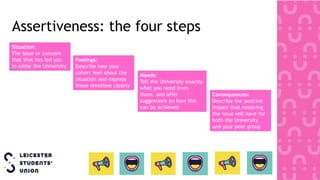
Assertiveness: the four steps
Situation:
The issue or concern
that that has led you
to lobby the University
Feelings:
Describe how your
cohort feel about the
situation and express
those emotions clearly
Needs:
Tell the University exactly
what you need from
them, and offer
suggestions on how this
can be achieved
Consequences:
Describe the positive
impact that resolving
the issue will have for
both the University
and your peer group
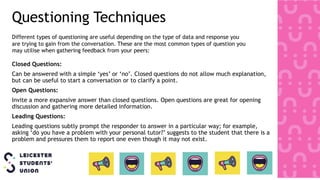
Questioning Techniques
Closed Questions:
Can be answered with a simple ‘yes’ or ‘no’. Closed questions do not allow much explanation,
but can be useful to start a conversation or to clarify a point.
Open Questions:
Invite a more expansive answer than closed questions. Open questions are great for opening
discussion and gathering more detailed information.
Leading Questions:
Leading questions subtly prompt the responder to answer in a particular way; for example,
asking ‘do you have a problem with your personal tutor?’ suggests to the student that there is a
problem and pressures them to report one even though it may not exist.
Different types of questioning are useful depending on the type of data and response you
are trying to gain from the conversation. These are the most common types of question you
may utilise when gathering feedback from your peers:
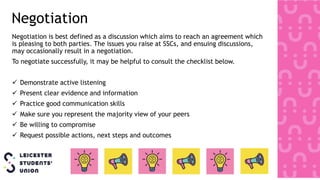
Negotiation
Negotiation is best defined as a discussion which aims to reach an agreement which
is pleasing to both parties. The issues you raise at SSCs, and ensuing discussions,
may occasionally result in a negotiation.
To negotiate successfully, it may be helpful to consult the checklist below.
 Demonstrate active listening
 Present clear evidence and information
 Practice good communication skills
 Make sure you represent the majority view of your peers
 Be willing to compromise
 Request possible actions, next steps and outcomes
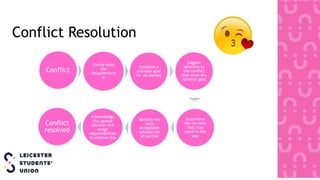
Conflict Resolution
Conflict
Clarify what
the
disagreement
is
Establish a
common goal
for all parties
Suggest
solutions to
the conflict
that meet the
common goal
Determine
the barriers
that may
stand in the
way
Identify the
most
acceptable
solution for
all parties
Acknowledge
the agreed
solution and
assign
responsibilities
to achieve this
Conflict
resolved
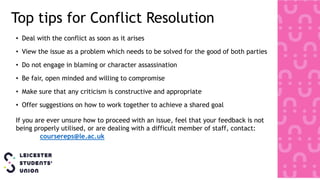
Top tips for Conflict Resolution
• Deal with the conflict as soon as it arises
• View the issue as a problem which needs to be solved for the good of both parties
• Do not engage in blaming or character assassination
• Be fair, open minded and willing to compromise
• Make sure that any criticism is constructive and appropriate
• Offer suggestions on how to work together to achieve a shared goal
If you are ever unsure how to proceed with an issue, feel that your feedback is not
being properly utilised, or are dealing with a difficult member of staff, contact:
coursereps@le.ac.uk
Presentation Skills
From time to time, you may be asked to give a presentation to your department
staff on an issue which is affecting the experience of the students’ on your course.
Approach public speaking by considering the six following points:
1. Control your nerves: we know it can be scary, but try to turn your nerves into
excitement! Do as much preparation as you can, all you can do is try your
hardest.
2. Body Language: relax your shoulders and have a solid stance. If you feel like
you have a lot of nervous energy, focus it into giving motivational hand gestures
to support your point. Remember to maintain eye contact to inspire feelings of
confidence.
3. Pronunciation and pace: Be as articulate as possible, make sure that you don’t
speak too quickly and be mindful of the audience’s needs.
Presentation Skills
4. Use your voice effectively: project rather than shouting, practice beforehand
and try to sound confident.
5. Content: Make sure that your presentation complements what you are saying
and is not distracting; use visual evidence to support your points.
6. You’re not alone: Remember that everyone has felt nervous presenting at some
point.
If you want further support, visit the Students’ Union website to find out more
about our workshops and face-to-face training sessions.
How to gather feedback
How to gather
feedback
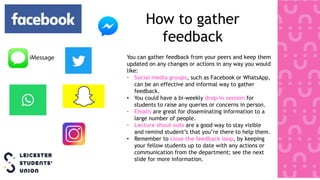
You can gather feedback from your peers and keep them
updated on any changes or actions in any way you would
like:
• Social media groups, such as Facebook or WhatsApp,
can be an effective and informal way to gather
feedback.
• You could have a bi-weekly drop-in session for
students to raise any queries or concerns in person.
• Emails are great for disseminating information to a
large number of people.
• Lecture shout outs are a good way to stay visible
and remind student’s that you’re there to help them.
• Remember to close the feedback loop, by keeping
your fellow students up to date with any actions or
communication from the department; see the next
slide for more information.
Closing the feedback Loop
As a Course Rep, you act as the bridge
between your peers and the staff in your
department.
It is your responsibility to communicate
any actions, plans or changes back to your
course mates, and to explain how their
feedback and suggestions for improvement
are being implemented. Doing this will
encourage your peers to get in touch with
any further issues, and will evidence that
you really are making a difference as a
Course Rep.
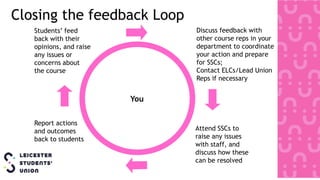
Closing the feedback Loop
Students’ feed
back with their
opinions, and raise
any issues or
concerns about
the course
Discuss feedback with
other course reps in your
department to coordinate
your action and prepare
for SSCs;
Contact ELCs/Lead Union
Reps if necessary
Attend SSCs to
raise any issues
with staff, and
discuss how these
can be resolved
Report actions
and outcomes
back to students
You
Understanding
Liberation Groups
What is Liberation?
Liberation can be defined as identifying the barriers that
stand in the way of certain groups within society, and
working to reduce or remove these barriers.
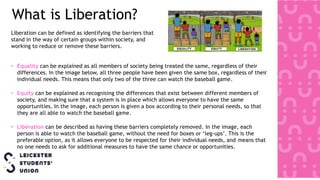
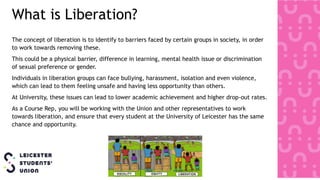
• Equality can be explained as all members of society being treated the same, regardless of their
differences. In the image below, all three people have been given the same box, regardless of their
individual needs. This means that only two of the three can watch the baseball game.
• Equity can be explained as recognising the differences that exist between different members of
society, and making sure that a system is in place which allows everyone to have the same
opportunities. In the image, each person is given a box according to their personal needs, so that
they are all able to watch the baseball game.
• Liberation can be described as having these barriers completely removed. In the image, each
person is able to watch the baseball game, without the need for boxes or ‘leg-ups’. This is the
preferable option, as it allows everyone to be respected for their individual needs, and means that
no one needs to ask for additional measures to have the same chance or opportunities.
What is Liberation?
The concept of liberation is to identify to barriers faced by certain groups in society, in order
to work towards removing these.
This could be a physical barrier, difference in learning, mental health issue or discrimination
of sexual preference or gender.
Individuals in liberation groups can face bullying, harassment, isolation and even violence,
which can lead to them feeling unsafe and having less opportunity than others.
At University, these issues can lead to lower academic achievement and higher drop-out rates.
As a Course Rep, you will be working with the Union and other representatives to work
towards liberation, and ensure that every student at the University of Leicester has the same
chance and opportunity.
How are Liberation Groups represented?
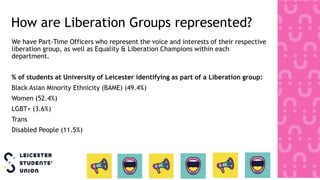
We have Part-Time Officers who represent the voice and interests of their respective
liberation group, as well as Equality & Liberation Champions within each
department.
% of students at University of Leicester identifying as part of a Liberation group:
Black Asian Minority Ethnicity (BAME) (49.4%)
Women (52.4%)
LGBT+ (3.6%)
Trans
Disabled People (11.5%)
It is your role as a representative of the Union to support
and empower those from all backgrounds and be non-
discriminatory in your working. Make sure to consider the
voice and needs of all students when feeding back to your
department.
Liberation Declaration
Learning Outcomes
You should now be able to:
• Understand the different skills which will be important to your role
as a Course Rep
• Understand the importance of effective communication
• Understand how to ask questions, resolve conflict and negotiate
• Have an idea of how to gather feedback, and understand why it is
important to close the feedback loop
• Explain why Liberation is important
Completed!
Part 2: Being an
effective Rep
Next: Part 3:
Behind the Scenes

Course rep training 2 Being an effective rep

  • 2.
  • 3.
    Learning Objectives By theend of this module, you should: • Understand the skills which are important to your role • Understand the importance of effective communication • Understand how you can collect feedback, and how to close the feedback loop • Be able to explain why Liberation is important
  • 4.
    Part 2: Being aneffective Course Rep
  • 5.
    Part 2: Beingan effective Course Rep • Developing skills as a Course Rep • Communication • Assertiveness • Questioning, Negotiation and Conflict Resolution • Presentation and Public Speaking • How to gather feedback, and close the feedback loop • Understanding Liberation Groups
  • 6.
    Developing the skills tobe a Course Rep
  • 7.
    Communication • Whether you’recommunicating with your peers, the Students’ Union or your department staff at SSCs, it’s important to always be professional, polite and respectful • Be approachable and accessible to your cohort • Make sure your peers know that their feedback is valued • When raising issues in your SSCs, be clear and coherent and provide evidence where possible • It’s important to be constructive in your criticism, and to offer suggestions on how any issues could be improved
  • 8.
    Assertiveness After receiving feedbackfrom your fellow students, you may want to lobby the University to deliver meaningful and positive change on a specific point, for the benefit of the student body. This may feel like a daunting task, but don’t worry - this is natural and it shouldn’t put you off approaching the issue head on.
  • 9.
    Assertiveness When raising yourconcerns, it is important to be assertive. This means that you should: • Express your concerns in a clear and confident manner • If possible, provide evidence to support your argument • Value yourself and your right to be treated with dignity and respect • Remember that your rights, feelings and needs are just as important as everyone else’s, but not more important than anyone else’s
  • 10.
    Assertiveness: the foursteps Situation: The issue or concern that that has led you to lobby the University Feelings: Describe how your cohort feel about the situation and express those emotions clearly Needs: Tell the University exactly what you need from them, and offer suggestions on how this can be achieved Consequences: Describe the positive impact that resolving the issue will have for both the University and your peer group
  • 11.
    Questioning Techniques Closed Questions: Canbe answered with a simple ‘yes’ or ‘no’. Closed questions do not allow much explanation, but can be useful to start a conversation or to clarify a point. Open Questions: Invite a more expansive answer than closed questions. Open questions are great for opening discussion and gathering more detailed information. Leading Questions: Leading questions subtly prompt the responder to answer in a particular way; for example, asking ‘do you have a problem with your personal tutor?’ suggests to the student that there is a problem and pressures them to report one even though it may not exist. Different types of questioning are useful depending on the type of data and response you are trying to gain from the conversation. These are the most common types of question you may utilise when gathering feedback from your peers:
  • 12.
    Negotiation Negotiation is bestdefined as a discussion which aims to reach an agreement which is pleasing to both parties. The issues you raise at SSCs, and ensuing discussions, may occasionally result in a negotiation. To negotiate successfully, it may be helpful to consult the checklist below.  Demonstrate active listening  Present clear evidence and information  Practice good communication skills  Make sure you represent the majority view of your peers  Be willing to compromise  Request possible actions, next steps and outcomes
  • 13.
    Conflict Resolution Conflict Clarify what the disagreement is Establisha common goal for all parties Suggest solutions to the conflict that meet the common goal Determine the barriers that may stand in the way Identify the most acceptable solution for all parties Acknowledge the agreed solution and assign responsibilities to achieve this Conflict resolved
  • 14.
    Top tips forConflict Resolution • Deal with the conflict as soon as it arises • View the issue as a problem which needs to be solved for the good of both parties • Do not engage in blaming or character assassination • Be fair, open minded and willing to compromise • Make sure that any criticism is constructive and appropriate • Offer suggestions on how to work together to achieve a shared goal If you are ever unsure how to proceed with an issue, feel that your feedback is not being properly utilised, or are dealing with a difficult member of staff, contact: coursereps@le.ac.uk
  • 15.
    Presentation Skills From timeto time, you may be asked to give a presentation to your department staff on an issue which is affecting the experience of the students’ on your course. Approach public speaking by considering the six following points: 1. Control your nerves: we know it can be scary, but try to turn your nerves into excitement! Do as much preparation as you can, all you can do is try your hardest. 2. Body Language: relax your shoulders and have a solid stance. If you feel like you have a lot of nervous energy, focus it into giving motivational hand gestures to support your point. Remember to maintain eye contact to inspire feelings of confidence. 3. Pronunciation and pace: Be as articulate as possible, make sure that you don’t speak too quickly and be mindful of the audience’s needs.
  • 16.
    Presentation Skills 4. Useyour voice effectively: project rather than shouting, practice beforehand and try to sound confident. 5. Content: Make sure that your presentation complements what you are saying and is not distracting; use visual evidence to support your points. 6. You’re not alone: Remember that everyone has felt nervous presenting at some point. If you want further support, visit the Students’ Union website to find out more about our workshops and face-to-face training sessions.
  • 17.
    How to gatherfeedback
  • 18.
    How to gather feedback Youcan gather feedback from your peers and keep them updated on any changes or actions in any way you would like: • Social media groups, such as Facebook or WhatsApp, can be an effective and informal way to gather feedback. • You could have a bi-weekly drop-in session for students to raise any queries or concerns in person. • Emails are great for disseminating information to a large number of people. • Lecture shout outs are a good way to stay visible and remind student’s that you’re there to help them. • Remember to close the feedback loop, by keeping your fellow students up to date with any actions or communication from the department; see the next slide for more information.
  • 19.
    Closing the feedbackLoop As a Course Rep, you act as the bridge between your peers and the staff in your department. It is your responsibility to communicate any actions, plans or changes back to your course mates, and to explain how their feedback and suggestions for improvement are being implemented. Doing this will encourage your peers to get in touch with any further issues, and will evidence that you really are making a difference as a Course Rep.
  • 20.
    Closing the feedbackLoop Students’ feed back with their opinions, and raise any issues or concerns about the course Discuss feedback with other course reps in your department to coordinate your action and prepare for SSCs; Contact ELCs/Lead Union Reps if necessary Attend SSCs to raise any issues with staff, and discuss how these can be resolved Report actions and outcomes back to students You
  • 21.
  • 22.
    What is Liberation? Liberationcan be defined as identifying the barriers that stand in the way of certain groups within society, and working to reduce or remove these barriers. • Equality can be explained as all members of society being treated the same, regardless of their differences. In the image below, all three people have been given the same box, regardless of their individual needs. This means that only two of the three can watch the baseball game. • Equity can be explained as recognising the differences that exist between different members of society, and making sure that a system is in place which allows everyone to have the same opportunities. In the image, each person is given a box according to their personal needs, so that they are all able to watch the baseball game. • Liberation can be described as having these barriers completely removed. In the image, each person is able to watch the baseball game, without the need for boxes or ‘leg-ups’. This is the preferable option, as it allows everyone to be respected for their individual needs, and means that no one needs to ask for additional measures to have the same chance or opportunities.
  • 23.
    What is Liberation? Theconcept of liberation is to identify to barriers faced by certain groups in society, in order to work towards removing these. This could be a physical barrier, difference in learning, mental health issue or discrimination of sexual preference or gender. Individuals in liberation groups can face bullying, harassment, isolation and even violence, which can lead to them feeling unsafe and having less opportunity than others. At University, these issues can lead to lower academic achievement and higher drop-out rates. As a Course Rep, you will be working with the Union and other representatives to work towards liberation, and ensure that every student at the University of Leicester has the same chance and opportunity.
  • 24.
    How are LiberationGroups represented? We have Part-Time Officers who represent the voice and interests of their respective liberation group, as well as Equality & Liberation Champions within each department. % of students at University of Leicester identifying as part of a Liberation group: Black Asian Minority Ethnicity (BAME) (49.4%) Women (52.4%) LGBT+ (3.6%) Trans Disabled People (11.5%)
  • 25.
    It is yourrole as a representative of the Union to support and empower those from all backgrounds and be non- discriminatory in your working. Make sure to consider the voice and needs of all students when feeding back to your department. Liberation Declaration
  • 26.
    Learning Outcomes You shouldnow be able to: • Understand the different skills which will be important to your role as a Course Rep • Understand the importance of effective communication • Understand how to ask questions, resolve conflict and negotiate • Have an idea of how to gather feedback, and understand why it is important to close the feedback loop • Explain why Liberation is important
  • 27.
    Completed! Part 2: Beingan effective Rep Next: Part 3: Behind the Scenes

Editor's Notes

  • #6 What does it mean to be a representative What skills will I develop Where do I fit in?