Course Rep Online
Training!
Students
(needing
help)
You
(knowledgeable)
Learning Objectives
By the end of this module, you should be able to:
• Outline the role of a Course Rep, within the structure of the University
and Students’ Union
• Identify your points of contact and the support networks available to you
• Have an idea of your goals for the year
• Understand how and where to signpost students
Part 1:
Overview
Part 1: Overview of your role
• What is a Course Rep?
• What does it mean to be a representative?
• Students’ Union Structure
• Who will I be working with?
• Course Rep Wins
What is a
Course
Rep?
Firstly, Congratulations on your new role as a Course Rep!
You’ve been appointed by your fellow students to represent their views, and give
them a voice within the University for this academic year.
As a Course Rep, you will act as a point of contact for your peers to feed back with
any issues or concerns about your course. You’ll act as a liaison between the
student body, Students’ Union and university staff.
Your primary aim as a Course Rep is to improve the academic experience of your
cohort by enacting positive change and promoting good practice within your
department. You’ll work to make sure you and your peers get the most out of your
time at the University of Leicester, and to ensure that your course is the best it can
be!
What is a Course Rep?
As a Course Rep, you will collate feedback from your peers on a regular and ongoing
basis. You can do this in any way you like – from drop-in sessions and lecture shout-
outs through to social media or email. It’s entirely up to you!
You will then feed this information back to your department at Student-Staff
Committee meetings, or SSCs. Here you will raise any issues, queries or concerns to
your department, offer possible solutions, and work with staff to get positive
change enacted.
From time to time, you will liaise with Lead Union Reps, Equality and Liberation
Champions and relevant Students’ Union staff, to bring larger-scale or university-
wide issues to attention.
What do they do?
What does it mean to
be a representative?
As a Course Rep, it is important that you represent the views of your entire cohort, rather than just your own. This might
occasionally mean that you that have to raise a point that you don’t necessarily agree with, for the good of your peers.
Remember, there is no such thing as a ‘typical’ student, and it’s important that you consider the needs of:
• International (and EU) students
• Mature Students
• Commuter Students
• Students from different socio-economic backgrounds
• Students who are parents or carers
• Liberation Groups
The Students’ Union is independent from the University, and you will be expected to uphold our values by ensuring that
the student voice is heard and represented.
What does it mean to be a
representative?
Course Rep
Responsibilities
Rep Responsibilities – Do’s!
To be a successful rep, there are a few essential steps you need to take. This is to ensure
that you are fully prepared, aware of the support services available to you, and able to get
the most out of your role:
• Attend course rep training sessions, both online and in person
• Attend Students’ Union briefings, to prepare you for your departmental meetings
• Attend and participate in Student-Staff Committees, and remember to offer constructive
feedback and suggestions for improvement
• Make sure it is easy for your peers to contact you with any concerns they would like to
raise, and remember to request feedback throughout the academic year
• Liaise with fellow course reps in your department to discuss any college-wide issues
affecting students
• Signpost students with individual or personal issues to the relevant services in the
University or Students’ Union
Rep Responsibilities – Do’s!
As a Course Rep, it is your responsibility to raise issues regarding:
• Learning and Teaching resources (e.g. accessibility of a lecture theatre)
• Study Resources (e.g. library books, department computers)
• Course content and structure
• Issues with Assessment and Feedback
• Methods of Teaching
• Any issues affecting a number of students
• Feedback on anything the department is doing well, that you’d like to see more of
Rep Responsibilities – Don'ts!
It is not your responsibility to deal with:
• Personal issues or complaints affecting a single student
• Allegations of bullying or harassment
• Issues regarding housing, finance and mental health
• Careers Advice
• Helping students with their coursework
• Personal issues between a student and staff member
In these cases, you should signpost the student to the relevant Students’ Union or
University Advice Service. As part of your role, you should familiarise yourself with
the services available to students, so you are able to point them in the right direction
for support – for more information on this, see the Signposting Prezi on Blackboard.
Remember, if you are ever unsure of how to proceed, or need any guidance,
contact the Academic Representation Team at: coursereps@le.ac.uk
Rep Responsibilities – Don'ts!
Students’ Union
Structure
What is the function of the Students’
Union?
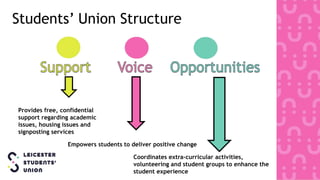
Empowers students to deliver positive change
Coordinates extra-curricular activities,
volunteering and student groups to enhance the
student experience
Provides free, confidential
support regarding academic
issues, housing issues and
signposting services
Students’ Union Structure
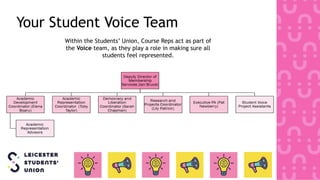
Your Student Voice Team
Within the Students’ Union, Course Reps act as part of
the Voice team, as they play a role in making sure all
students feel represented.
Who will I be working with?
Course Reps – This is your role!
Appointed, at least 1 per year per course.
Lead Union Reps
Elected, 2 per department
Equality & Liberation Champions
Interviewed, 2 per department
Azza Abdulla - Education Officer
Elected Officer in the Students’ Union
Azza wants your feedback on the
University. You might be teaming up with
her to fight University-wide issues.
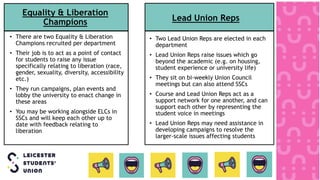
Equality & Liberation
Champions
• There are two Equality & Liberation
Champions recruited per department
• Their job is to act as a point of contact
for students to raise any issue
specifically relating to liberation (race,
gender, sexuality, diversity, accessibility
etc.)
• They run campaigns, plan events and
lobby the university to enact change in
these areas
• You may be working alongside ELCs in
SSCs and will keep each other up to
date with feedback relating to
liberation
Lead Union Reps
• Two Lead Union Reps are elected in each
department
• Lead Union Reps raise issues which go
beyond the academic (e.g. on housing,
student experience or university life)
• They sit on bi-weekly Union Council
meetings but can also attend SSCs
• Course and Lead Union Reps act as a
support network for one another, and can
support each other by representing the
student voice in meetings
• Lead Union Reps may need assistance in
developing campaigns to resolve the
larger-scale issues affecting students
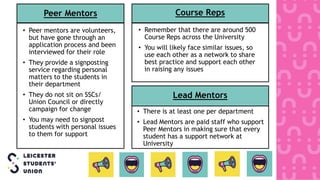
Peer Mentors
• Peer mentors are volunteers,
but have gone through an
application process and been
interviewed for their role
• They provide a signposting
service regarding personal
matters to the students in
their department
• They do not sit on SSCs/
Union Council or directly
campaign for change
• You may need to signpost
students with personal issues
to them for support
Lead Mentors
• There is at least one per department
• Lead Mentors are paid staff who support
Peer Mentors in making sure that every
student has a support network at
University
Course Reps
• Remember that there are around 500
Course Reps across the University
• You will likely face similar issues, so
use each other as a network to share
best practice and support each other
in raising any issues
Course Rep Wins
Before your first SSCs you will have a Course
Rep Briefing with your dedicated Academic
Representation team at the Students’ Union.
These briefings will outline the fantastic wins
achieved in your department last year, and
identify any areas for concern which could be
a good idea for you to look into this year.
We look forward to seeing what you can do!
2017/18 Course Rep Wins
• Breaks scheduled during two hours lectures (Accounting and Finance, STEM)
• Increase in the number of Study Abroad options (American Studies)
• Assessment deadlines amended (Biological Sciences)
• Department kitchen and printers opened to students (Criminology)
• Matlab lecture capture introduced (Physics)
• Mark Schemes and past papers uploaded to Blackboard (Engineering)
• Earlier timetable release (Business)
• Extra revision sessions and careers workshops (Criminology)
• More textbooks and resources available in the library (School of Arts)
Learning Outcomes
You should now be able to:
• Outline the role of Course Reps within the structure of the University and
Students’ Union
• Identify your points of contact and the support networks available to you
• Have an idea of the goals you may have for the year
• Understand how and where to signpost students
Next:
Part 2: Being
an Effective
Course Rep
Finished!
Part 1:
Overview

Course rep training 1 Role overview

  • 2.
  • 3.
    Learning Objectives By theend of this module, you should be able to: • Outline the role of a Course Rep, within the structure of the University and Students’ Union • Identify your points of contact and the support networks available to you • Have an idea of your goals for the year • Understand how and where to signpost students
  • 4.
  • 5.
    Part 1: Overviewof your role • What is a Course Rep? • What does it mean to be a representative? • Students’ Union Structure • Who will I be working with? • Course Rep Wins
  • 6.
  • 7.
    Firstly, Congratulations onyour new role as a Course Rep! You’ve been appointed by your fellow students to represent their views, and give them a voice within the University for this academic year. As a Course Rep, you will act as a point of contact for your peers to feed back with any issues or concerns about your course. You’ll act as a liaison between the student body, Students’ Union and university staff. Your primary aim as a Course Rep is to improve the academic experience of your cohort by enacting positive change and promoting good practice within your department. You’ll work to make sure you and your peers get the most out of your time at the University of Leicester, and to ensure that your course is the best it can be! What is a Course Rep?
  • 8.
    As a CourseRep, you will collate feedback from your peers on a regular and ongoing basis. You can do this in any way you like – from drop-in sessions and lecture shout- outs through to social media or email. It’s entirely up to you! You will then feed this information back to your department at Student-Staff Committee meetings, or SSCs. Here you will raise any issues, queries or concerns to your department, offer possible solutions, and work with staff to get positive change enacted. From time to time, you will liaise with Lead Union Reps, Equality and Liberation Champions and relevant Students’ Union staff, to bring larger-scale or university- wide issues to attention. What do they do?
  • 9.
    What does itmean to be a representative?
  • 10.
    As a CourseRep, it is important that you represent the views of your entire cohort, rather than just your own. This might occasionally mean that you that have to raise a point that you don’t necessarily agree with, for the good of your peers. Remember, there is no such thing as a ‘typical’ student, and it’s important that you consider the needs of: • International (and EU) students • Mature Students • Commuter Students • Students from different socio-economic backgrounds • Students who are parents or carers • Liberation Groups The Students’ Union is independent from the University, and you will be expected to uphold our values by ensuring that the student voice is heard and represented. What does it mean to be a representative?
  • 11.
  • 12.
    Rep Responsibilities –Do’s! To be a successful rep, there are a few essential steps you need to take. This is to ensure that you are fully prepared, aware of the support services available to you, and able to get the most out of your role: • Attend course rep training sessions, both online and in person • Attend Students’ Union briefings, to prepare you for your departmental meetings • Attend and participate in Student-Staff Committees, and remember to offer constructive feedback and suggestions for improvement • Make sure it is easy for your peers to contact you with any concerns they would like to raise, and remember to request feedback throughout the academic year • Liaise with fellow course reps in your department to discuss any college-wide issues affecting students • Signpost students with individual or personal issues to the relevant services in the University or Students’ Union
  • 13.
    Rep Responsibilities –Do’s! As a Course Rep, it is your responsibility to raise issues regarding: • Learning and Teaching resources (e.g. accessibility of a lecture theatre) • Study Resources (e.g. library books, department computers) • Course content and structure • Issues with Assessment and Feedback • Methods of Teaching • Any issues affecting a number of students • Feedback on anything the department is doing well, that you’d like to see more of
  • 14.
    Rep Responsibilities –Don'ts! It is not your responsibility to deal with: • Personal issues or complaints affecting a single student • Allegations of bullying or harassment • Issues regarding housing, finance and mental health • Careers Advice • Helping students with their coursework • Personal issues between a student and staff member
  • 15.
    In these cases,you should signpost the student to the relevant Students’ Union or University Advice Service. As part of your role, you should familiarise yourself with the services available to students, so you are able to point them in the right direction for support – for more information on this, see the Signposting Prezi on Blackboard. Remember, if you are ever unsure of how to proceed, or need any guidance, contact the Academic Representation Team at: coursereps@le.ac.uk Rep Responsibilities – Don'ts!
  • 16.
  • 17.
    What is thefunction of the Students’ Union?
  • 18.
    Empowers students todeliver positive change Coordinates extra-curricular activities, volunteering and student groups to enhance the student experience Provides free, confidential support regarding academic issues, housing issues and signposting services Students’ Union Structure
  • 19.
    Your Student VoiceTeam Within the Students’ Union, Course Reps act as part of the Voice team, as they play a role in making sure all students feel represented.
  • 20.
    Who will Ibe working with?
  • 21.
    Course Reps –This is your role! Appointed, at least 1 per year per course. Lead Union Reps Elected, 2 per department Equality & Liberation Champions Interviewed, 2 per department Azza Abdulla - Education Officer Elected Officer in the Students’ Union Azza wants your feedback on the University. You might be teaming up with her to fight University-wide issues.
  • 22.
    Equality & Liberation Champions •There are two Equality & Liberation Champions recruited per department • Their job is to act as a point of contact for students to raise any issue specifically relating to liberation (race, gender, sexuality, diversity, accessibility etc.) • They run campaigns, plan events and lobby the university to enact change in these areas • You may be working alongside ELCs in SSCs and will keep each other up to date with feedback relating to liberation Lead Union Reps • Two Lead Union Reps are elected in each department • Lead Union Reps raise issues which go beyond the academic (e.g. on housing, student experience or university life) • They sit on bi-weekly Union Council meetings but can also attend SSCs • Course and Lead Union Reps act as a support network for one another, and can support each other by representing the student voice in meetings • Lead Union Reps may need assistance in developing campaigns to resolve the larger-scale issues affecting students
  • 23.
    Peer Mentors • Peermentors are volunteers, but have gone through an application process and been interviewed for their role • They provide a signposting service regarding personal matters to the students in their department • They do not sit on SSCs/ Union Council or directly campaign for change • You may need to signpost students with personal issues to them for support Lead Mentors • There is at least one per department • Lead Mentors are paid staff who support Peer Mentors in making sure that every student has a support network at University Course Reps • Remember that there are around 500 Course Reps across the University • You will likely face similar issues, so use each other as a network to share best practice and support each other in raising any issues
  • 24.
  • 25.
    Before your firstSSCs you will have a Course Rep Briefing with your dedicated Academic Representation team at the Students’ Union. These briefings will outline the fantastic wins achieved in your department last year, and identify any areas for concern which could be a good idea for you to look into this year. We look forward to seeing what you can do! 2017/18 Course Rep Wins
  • 26.
    2017/18 Course RepWins • Breaks scheduled during two hours lectures (Accounting and Finance, STEM) • Increase in the number of Study Abroad options (American Studies) • Assessment deadlines amended (Biological Sciences) • Department kitchen and printers opened to students (Criminology) • Matlab lecture capture introduced (Physics) • Mark Schemes and past papers uploaded to Blackboard (Engineering) • Earlier timetable release (Business) • Extra revision sessions and careers workshops (Criminology) • More textbooks and resources available in the library (School of Arts)
  • 27.
    Learning Outcomes You shouldnow be able to: • Outline the role of Course Reps within the structure of the University and Students’ Union • Identify your points of contact and the support networks available to you • Have an idea of the goals you may have for the year • Understand how and where to signpost students
  • 28.
    Next: Part 2: Being anEffective Course Rep Finished! Part 1: Overview

Editor's Notes

  • #3 Make the dark outline clearer on all title slides
  • #4 Check font
  • #19 Make the colour the same on the arrows as the dots
  • #20 Change infographic
  • #24 Add more colour
  • #25 Make uniform title size, consistent transparency