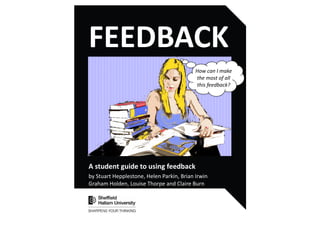
How can I make
the most of all
this feedback?
FEEDBACK
A student guide to using feedback
by Stuart Hepplestone, Helen Parkin, Brian Irwin
Graham Holden, Louise Thorpe and Claire Burn
Technology, Feedback, Action!: The impact of learning
technology upon students’ engagement with their
feedback
An Enhancing Learning Through Technology Research
Project funded by the Higher Education Academy
©Sheffield Hallam University 2010
Learning and Teaching Institute
Sheffield Hallam University
Howard Street
Sheffield S1 1WB
Why am I reading this?
Why do I get feedback?
What should I do with feedback?
Feeding forward
Why are my grades and feedback published online?
What is a Virtual Learning Environment?
Separating feedback from the grade
What is the point in separating feedback from my grade?
Reflection
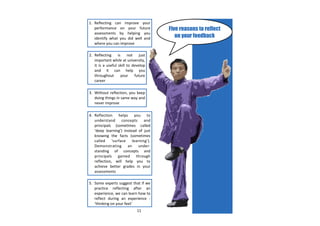
Five reasons to reflect on your feedback
Assessment criteria
Assessment timeline
Action planning
Sample action plan
Portfolios
2
3
3
4
6
7
8
9
10
11
12
13
14
15
16
1
Contents
This isn’t just another study guide written by academic
staff who can’t remember what it was like to be a student.
I’m a full time student at Sheffield Hallam University, in my
third year of an Events Management degree.
I’ve been asked to write this booklet by a group of staff at
Sheffield Hallam who carried out a research project to find
out how students use feedback and how a range of online
tools might help them to use feedback more effectively.
The project was called Technology, Feedback, Action! and
involved interviewing 23 undergraduate students from
across Sheffield Hallam University’s four faculties. This
guide contains the relevant findings from the research and
is intended to help you make the most of all the feedback
you receive at university.
Claire Burn
Why am I reading
this?
2
3
Everyone gets feedback at university. Some of it is praise,
some is criticism, but all of it is useful.
Feedback can help you to identify your own strengths and
weaknesses. You can build on positive feedback and
address critical feedback in your future work and
behaviour. Try to think of each piece of feedback you get
as a signpost pointing you in the right direction. Using
feedback from one assessment to help you in the future is
known as ‘feeding forward’ (page 4).
What should I do with feedback?
‘You can look back on
what you’ve been
doing, you can reflect
on how you’re going
to improve, which is
obviously why we’re
all here, so it makes it
clearer and you can
see exactly what’s
going on. You can set
yourself targets.’
Once you have received your feedback, try to identify the
main points and think about what your tutor actually
means. Some people find that writing things down or
talking to someone helps to clarify things. Doing this might
help you think of ways you can improve in future.
You may find keeping all of your feedback in one place
helps as it makes it easier to look back and identify
common mistakes. If you know which areas you need to
improve on, you can plan how you will address these
areas.
Why do you get feedback?
‘It is all really good,
valuable stuff and if
you don’t use it then
you’re currently doing
yourself an injustice
really.’
One student we spoke to consistently received critical
feedback about her referencing skills. Once she realised
this was an area she needed to address, she bought a
referencing guide and practiced until she got it right.
Something like this might only make a small difference to
the grades you receive in future but it could be the
difference between one degree classification and another.
What our
students said...
4
Feeding forward
It is easy to understand how a tutor’s feedback comment
about spelling or referencing might be used to feed
forward to your next assessment.
However, some of the students we interviewed said they
found it difficult to use feedback comments to feed
forward when the feedback given was very specific to a
particular assessment.
This can sometimes make it difficult to identify elements
of the feedback that are transferable to other
assessments. Content or subject-specific feedback
comments can be used to help you with your future work,
they just need a little more de-coding.
If your tutor gives you feedback which is specific to a
particular subject or assessment, think about why they
have made that comment and how you might use it to
improve your future work.
For example, a tutor might comment on an assessment
where you hadn’t understood what you had been required
to do. Although you will not be able to change the grade
you received for that assessment, in future it is important
to ensure you clearly read and understand the assessment
brief.
You could read some study books to find out the exact
definitions of words and phrases like ‘discuss’ and
‘critically analyse’. Or you could book an appointment with
your tutor and ask them to explain what you are being
asked to do.
‘It’s quite difficult to
use your feedback
because … we’ve got
five assignments and
they’re all totally
different from each
other.’
What our
students said... Feeding forward: using feedback from one assessment to
help you when completing a future assessment.
Activity
5
When was the last time you were given a piece
of feedback? Who gave you the feedback and
what was it about? How could you use that
feedback to help you feed forward to a different
assessment or situation?
Think...
What are the main points in this feedback?
_____________________________________________________________
_____________________________________________________________
_____________________________________________________________
_____________________________________________________________
What things attracted positive feedback?
_____________________________________________________________
_____________________________________________________________
_____________________________________________________________
What things attracted negative feedback?
_____________________________________________________________
_____________________________________________________________
_____________________________________________________________
How can I use this feedback in a future assessment?
_____________________________________________________________
_____________________________________________________________
_____________________________________________________________
Any other thoughts?
_____________________________________________________________
_____________________________________________________________
_____________________________________________________________
_____________________________________________________________
6
Why are my grades and feedback published
online?
Many universities use a Virtual Learning Environment
(more often referred to as a VLE) to keep programme and
module information and learning resources together in a
single place. Publishing feedback and grades online
through the VLE keeps them close to learning materials.
This makes it easier to refer back to and use learning
materials to help reflect on the feedback you receive.
Where your tutors have chosen to publish your feedback
and grades online, you may find the following benefits
 you don’t have to be on campus to access your grades
and feedback
 you can view your feedback and grades in privacy.
There is less pressure to share it with others in class
 your feedback is stored in one place. You can find it
again more easily
 typed feedback comments are often more legible and
easier to read than those written by hand
 for group assessments each group member will receive
their own copy of the feedback
 you can keep track of your progress as you complete
each assessment task and see how each task builds to
an overall profile for the module
‘You can [check
grades] as and when
you want rather than
when it suits the
university, when it fits
around your
timetable.’
‘You don’t have to
share it with everyone
whereas if you are in
a seminar and
everyone’s talking
about what they got
you kind of have to
feel the pressure to
join in whereas if you
get in on Blackboard
you can see it at your
own leisure.’
If your feedback and grades are not currently published
online for your assessments, you may be able to negotiate
the possibility of this with your tutors.
‘It keeps grades all in
one place. It means
you can see how
you’re progressing
throughout the course
of the year.’
What our
students said...
7
A Virtual Learning Environment is an online environment,
a bit like a website. The information available on a VLE will
depend on where and what you are study. It could include
information about your programme of study and the
modules you are taking, materials and links to library
resources to support your learning, personal and group
timetables, ways to manage your student record, and help
about all aspects of being a student enrolled at your
institution.
At Sheffield Hallam University we use Blackboard but it is
better known by students and staff as shuspace. Your
university might use something different and it might be
called a student portal, Student Gateway or Personal
Learning Environment.
What is a Virtual Learning Environment?
Separating feedback from the grade
Your tutor may return your work with only feedback
comments and not the grade. There are different ways
your tutor may do this
 you get an email or notification saying that feedback is
available online. You follow the link to the feedback and
read it. You are then asked to reflect on the feedback
you have received. Once you have submitted your
reflection, your grade is immediately released to you
 work is returned with feedback during a seminar. Your
tutor then encourages you to think about the feedback
you have received and possibly talk to your peers about
it. The tutor gives you the grade for that piece of work
at the end of the seminar
 you collect your feedback and are required to book an
appointment with your tutor to discuss your feedback
and receive your grade
When we interviewed students for this project, we talked
about a technique available to staff at Sheffield Hallam
University which required students to comment on their
feedback electronically before receiving their grade.
‘It makes you think
about your feedback
because it’s very easy
just to read feedback
and think ‘oh, I did
alright’ or ‘oh, that's
not so good’ but if it
actually makes you
think about it and you
have to write about it
because that’s how
you’re going to get
your grade then I
think that’s good for
yourself.’
What our
students said...
Feedback
Reflect...
Grade
8
Feed forward
How would you feel about receiving your feedback
before your grade? Have you experienced this
process? What actions did you take?
________________________________________________
________________________________________________
________________________________________________
________________________________________________
________________________________________________
________________________________________________
________________________________________________
9
At the moment, many tutors claim feedback doesn’t work.
They think that students don’t act on their feedback and
that they are only concerned with their grade.
Sometimes I have skim-read feedback comments just to
see that all-important grade. Some of the students we
spoke to said they did the same as they were anxious to
find out what their grade was.
However, this can mean that sometimes we don’t pay
enough attention to the feedback and miss out on the
opportunity to identify where we can improve and do
something about it.
Getting feedback before your grades encourages you to
read the feedback properly and think about what the tutor
has said instead of just looking at the grade. Some of the
students we spoke to found this helped them to
remember what their tutor had said. They were then able
to use the feedback when completing their next
assessment.
What is the point in separating the
feedback from my grades?
‘If I have to reflect on
the feedback before
receiving the grade
then it sticks in my
mind a bit longer, the
feedback I receive, the
points that I’m going
to use and it’s a little
bit easier to
remember when I’m
working on my next
assignment.’
What our
students said...
Think...
‘You’re just eager to
get that final mark so
you can relax.’
10
Reflection
There are various situations you could apply Kolb’s
learning cycle to, a telephone call, a conversation with a
tutor, an assessment or task you are asked to complete
during your work placement.
Reflection means thinking about something you have
done or experienced, making sense of it, and informing
how you can improve or do things differently in future.
The diagram below, based on Kolb’s learning cycle (Kolb,
1984), shows how reflecting on something you have done
or experienced can help you in the future.
think about what
you did and how
you did it
create an action
plan
think about how
you can use the
feedback
do something
Kolb, D.A. (1984)
Experiential learning:
experience as the
source of learning and
development. NJ:
Prentice-Hall
11
Five reasons to reflect
on your feedback
1. Reflecting can improve your
performance on your future
assessments by helping you
identify what you did well and
where you can improve
2. Reflecting is not just
important while at university,
it is a useful skill to develop
and it can help you
throughout your future
career
3. Without reflection, you keep
doing things in same way and
never improve
4. Reflection helps you to
understand concepts and
principals (sometimes called
‘deep learning’) instead of just
knowing the facts (sometimes
called ‘surface learning’).
Demonstrating an under-
standing of concepts and
principals gained through
reflection, will help you to
achieve better grades in your
assessments
5. Some experts suggest that if we
practice reflecting after an
experience, we can learn how to
reflect during an experience -
‘thinking on your feet’
12
Assessment criteria
Assessment criteria usually consist of four or five areas
which your tutors are going to assess you against. In my
assessments these often include development of an
argument, critical analysis, demonstrating your
understanding of the subject and using a wide variety of
sources.
Assessment criteria are often published in different places,
sometimes making it difficult for students to find. On my
course, assessment criteria can be found in the module
handbook, but you might find yours on assignment
submission sheets, published online via the VLE or given
out in class.
Make sure you read and understand assessment criteria
before completing and submitting your assessment. It can
help make sure you have done what has been asked.
Where do you normally look for and find your assessment
criteria?
____________________________________________
____________________________________________
____________________________________________
____________________________________________
____________________________________________
____________________________________________
____________________________________________
____________________________________________
____________________________________________
____________________________________________
____________________________________________
‘You could really
clearly see what you
had to do for the next
one and where you
could actually
improve.’
‘Normally you do your
assessment to the
criteria, you’ll look at
the mark scheme and
think right, they’re
looking for X, so I’ll
make sure I include
that.’
What our
students said...
13
Assessment timeline
 Leave enough time to review
your assessment
 Make sure you have included
everything
 ‘Self-assess’ yourself by
comparing your assessment back
to the criteria and make any
changes if necessary
 Make sure you know where to
find the assessment criteria and
that you understand it
 Read your feedback and think
about what your tutor has said
 Re-read the criteria for that
assessment
 Think about how your self-
assessment compares with your
tutor’s comments
 Reflect on what you could have
done differently
 Write an action plan,
using the assessment
criteria as learning
targets
 Keep checking against the
assessment criteria as you
complete your work to make
sure you stick to the assessment
activity
before you start
plan and
research your
assessment
writing up
review
submit
feedback
reflect
feed forward
Action planning
This isn’t the best way of reflecting
on your feedback. Making an
action plan, even if it just a very
simple one can be really useful in
helping you to think about how
you can improve when completing
future assessments.
Action plans don’t have to be really formal. It could just be
like a checklist of things you can do to improve your next
assessment based on feedback you have received
previously. You may just find that writing down your
thoughts or talking to someone about your feedback
helps.
The next page shows a sample template for writing an
action plan. You may find another method of writing an
action plan which works better for you.
Additional sample templates for your use can be
downloaded from http://tinyurl.com/tfaproject
‘I don’t tend to write
action plans down. I
tend to retain things
in my memory and
then if I need to look
something up I can
usually remember
where it is.’
‘I don’t write it down,
I just know in my head
what I have to do next
time and try to put it
into practice.’
‘I try to think that I do
that subconsciously
anyway if I’m doing
something and I’ve
done it wrong, I like to
think that I’ll do it
better next time.’
Many of the students we spoke to didn’t make any formal
action plans based on their feedback, preferring to make a
mental note of the points raised which they try to
remember when completing future assessments
14
If you do this...
...try this
Action plan
15
Module/unit of study
Assessment title
Main points made by tutor Positive or critical?
1.
2.
3.
Grade awarded for this assessment
How I will build on
positive feedback
How I will address critical
feedback
Things to do By when?
1.
2.
3.
Portfolios
What is a portfolio?
A portfolio is a collection of related things - these can be
documents, media, and snippets, often with captions or
descriptions which explain the relevance of items.
Portfolios may be very formal and professional, or can be
quite personal and informal, depending on your
preference and what you’ve been asked for.
You can keep more than one, and you can often decide
who you want to share it with. Sharing a portfolio with
others is a good way to obtain useful further feedback.
Why should I keep a portfolio?
Although keeping a portfolio may seem like a lot of extra
work, there are many advantages, including
 reminding you about the good quality of your work
 renewing your sense of self-esteem
 an opportunity to reflect on your
work
A portfolio can also be helpful
when you are preparing for an
interview because it helps you
to remember what you can do.
16
Types of portfolio
 Portfolios for assessment
You might be asked to create a portfolio as part of
your course, and according to set assessment criteria.
It could include evaluations, reports, photos and
reflections on work you have completed.
You may receive feedback directly in the portfolio, or
could add it yourself after the assessment.
 Portfolios for personal development
You can use a portfolio to bring together anything
relating to your personal development. It can include
experiences from outside your course, reflections on
your skills and approaches to learning, and plans for
your future.
This is a good place to consider how to respond to
feedback you’ve received.
 Portfolios for presentation
A portfolio for presentation can be used to introduce
yourself when applying for a university place, a
qualification, employment, professional promotion, or
potential clients. Presentation portfolios typically
include a personal statement and a selection of best
work, with appropriate captions or descriptions.
Including any positive feedback you’ve received can
help to demonstrate your skills to others.
17
Guide students

Guide students

  • 1.
    How can Imake the most of all this feedback? FEEDBACK A student guide to using feedback by Stuart Hepplestone, Helen Parkin, Brian Irwin Graham Holden, Louise Thorpe and Claire Burn
  • 2.
    Technology, Feedback, Action!:The impact of learning technology upon students’ engagement with their feedback An Enhancing Learning Through Technology Research Project funded by the Higher Education Academy ©Sheffield Hallam University 2010 Learning and Teaching Institute Sheffield Hallam University Howard Street Sheffield S1 1WB
  • 3.
    Why am Ireading this? Why do I get feedback? What should I do with feedback? Feeding forward Why are my grades and feedback published online? What is a Virtual Learning Environment? Separating feedback from the grade What is the point in separating feedback from my grade? Reflection Five reasons to reflect on your feedback Assessment criteria Assessment timeline Action planning Sample action plan Portfolios 2 3 3 4 6 7 8 9 10 11 12 13 14 15 16 1 Contents
  • 4.
    This isn’t justanother study guide written by academic staff who can’t remember what it was like to be a student. I’m a full time student at Sheffield Hallam University, in my third year of an Events Management degree. I’ve been asked to write this booklet by a group of staff at Sheffield Hallam who carried out a research project to find out how students use feedback and how a range of online tools might help them to use feedback more effectively. The project was called Technology, Feedback, Action! and involved interviewing 23 undergraduate students from across Sheffield Hallam University’s four faculties. This guide contains the relevant findings from the research and is intended to help you make the most of all the feedback you receive at university. Claire Burn Why am I reading this? 2
  • 5.
    3 Everyone gets feedbackat university. Some of it is praise, some is criticism, but all of it is useful. Feedback can help you to identify your own strengths and weaknesses. You can build on positive feedback and address critical feedback in your future work and behaviour. Try to think of each piece of feedback you get as a signpost pointing you in the right direction. Using feedback from one assessment to help you in the future is known as ‘feeding forward’ (page 4). What should I do with feedback? ‘You can look back on what you’ve been doing, you can reflect on how you’re going to improve, which is obviously why we’re all here, so it makes it clearer and you can see exactly what’s going on. You can set yourself targets.’ Once you have received your feedback, try to identify the main points and think about what your tutor actually means. Some people find that writing things down or talking to someone helps to clarify things. Doing this might help you think of ways you can improve in future. You may find keeping all of your feedback in one place helps as it makes it easier to look back and identify common mistakes. If you know which areas you need to improve on, you can plan how you will address these areas. Why do you get feedback? ‘It is all really good, valuable stuff and if you don’t use it then you’re currently doing yourself an injustice really.’ One student we spoke to consistently received critical feedback about her referencing skills. Once she realised this was an area she needed to address, she bought a referencing guide and practiced until she got it right. Something like this might only make a small difference to the grades you receive in future but it could be the difference between one degree classification and another. What our students said...
  • 6.
    4 Feeding forward It iseasy to understand how a tutor’s feedback comment about spelling or referencing might be used to feed forward to your next assessment. However, some of the students we interviewed said they found it difficult to use feedback comments to feed forward when the feedback given was very specific to a particular assessment. This can sometimes make it difficult to identify elements of the feedback that are transferable to other assessments. Content or subject-specific feedback comments can be used to help you with your future work, they just need a little more de-coding. If your tutor gives you feedback which is specific to a particular subject or assessment, think about why they have made that comment and how you might use it to improve your future work. For example, a tutor might comment on an assessment where you hadn’t understood what you had been required to do. Although you will not be able to change the grade you received for that assessment, in future it is important to ensure you clearly read and understand the assessment brief. You could read some study books to find out the exact definitions of words and phrases like ‘discuss’ and ‘critically analyse’. Or you could book an appointment with your tutor and ask them to explain what you are being asked to do. ‘It’s quite difficult to use your feedback because … we’ve got five assignments and they’re all totally different from each other.’ What our students said... Feeding forward: using feedback from one assessment to help you when completing a future assessment.
  • 7.
    Activity 5 When was thelast time you were given a piece of feedback? Who gave you the feedback and what was it about? How could you use that feedback to help you feed forward to a different assessment or situation? Think... What are the main points in this feedback? _____________________________________________________________ _____________________________________________________________ _____________________________________________________________ _____________________________________________________________ What things attracted positive feedback? _____________________________________________________________ _____________________________________________________________ _____________________________________________________________ What things attracted negative feedback? _____________________________________________________________ _____________________________________________________________ _____________________________________________________________ How can I use this feedback in a future assessment? _____________________________________________________________ _____________________________________________________________ _____________________________________________________________ Any other thoughts? _____________________________________________________________ _____________________________________________________________ _____________________________________________________________ _____________________________________________________________
  • 8.
    6 Why are mygrades and feedback published online? Many universities use a Virtual Learning Environment (more often referred to as a VLE) to keep programme and module information and learning resources together in a single place. Publishing feedback and grades online through the VLE keeps them close to learning materials. This makes it easier to refer back to and use learning materials to help reflect on the feedback you receive. Where your tutors have chosen to publish your feedback and grades online, you may find the following benefits  you don’t have to be on campus to access your grades and feedback  you can view your feedback and grades in privacy. There is less pressure to share it with others in class  your feedback is stored in one place. You can find it again more easily  typed feedback comments are often more legible and easier to read than those written by hand  for group assessments each group member will receive their own copy of the feedback  you can keep track of your progress as you complete each assessment task and see how each task builds to an overall profile for the module ‘You can [check grades] as and when you want rather than when it suits the university, when it fits around your timetable.’ ‘You don’t have to share it with everyone whereas if you are in a seminar and everyone’s talking about what they got you kind of have to feel the pressure to join in whereas if you get in on Blackboard you can see it at your own leisure.’ If your feedback and grades are not currently published online for your assessments, you may be able to negotiate the possibility of this with your tutors. ‘It keeps grades all in one place. It means you can see how you’re progressing throughout the course of the year.’ What our students said...
  • 9.
    7 A Virtual LearningEnvironment is an online environment, a bit like a website. The information available on a VLE will depend on where and what you are study. It could include information about your programme of study and the modules you are taking, materials and links to library resources to support your learning, personal and group timetables, ways to manage your student record, and help about all aspects of being a student enrolled at your institution. At Sheffield Hallam University we use Blackboard but it is better known by students and staff as shuspace. Your university might use something different and it might be called a student portal, Student Gateway or Personal Learning Environment. What is a Virtual Learning Environment?
  • 10.
    Separating feedback fromthe grade Your tutor may return your work with only feedback comments and not the grade. There are different ways your tutor may do this  you get an email or notification saying that feedback is available online. You follow the link to the feedback and read it. You are then asked to reflect on the feedback you have received. Once you have submitted your reflection, your grade is immediately released to you  work is returned with feedback during a seminar. Your tutor then encourages you to think about the feedback you have received and possibly talk to your peers about it. The tutor gives you the grade for that piece of work at the end of the seminar  you collect your feedback and are required to book an appointment with your tutor to discuss your feedback and receive your grade When we interviewed students for this project, we talked about a technique available to staff at Sheffield Hallam University which required students to comment on their feedback electronically before receiving their grade. ‘It makes you think about your feedback because it’s very easy just to read feedback and think ‘oh, I did alright’ or ‘oh, that's not so good’ but if it actually makes you think about it and you have to write about it because that’s how you’re going to get your grade then I think that’s good for yourself.’ What our students said... Feedback Reflect... Grade 8 Feed forward
  • 11.
    How would youfeel about receiving your feedback before your grade? Have you experienced this process? What actions did you take? ________________________________________________ ________________________________________________ ________________________________________________ ________________________________________________ ________________________________________________ ________________________________________________ ________________________________________________ 9 At the moment, many tutors claim feedback doesn’t work. They think that students don’t act on their feedback and that they are only concerned with their grade. Sometimes I have skim-read feedback comments just to see that all-important grade. Some of the students we spoke to said they did the same as they were anxious to find out what their grade was. However, this can mean that sometimes we don’t pay enough attention to the feedback and miss out on the opportunity to identify where we can improve and do something about it. Getting feedback before your grades encourages you to read the feedback properly and think about what the tutor has said instead of just looking at the grade. Some of the students we spoke to found this helped them to remember what their tutor had said. They were then able to use the feedback when completing their next assessment. What is the point in separating the feedback from my grades? ‘If I have to reflect on the feedback before receiving the grade then it sticks in my mind a bit longer, the feedback I receive, the points that I’m going to use and it’s a little bit easier to remember when I’m working on my next assignment.’ What our students said... Think... ‘You’re just eager to get that final mark so you can relax.’
  • 12.
    10 Reflection There are varioussituations you could apply Kolb’s learning cycle to, a telephone call, a conversation with a tutor, an assessment or task you are asked to complete during your work placement. Reflection means thinking about something you have done or experienced, making sense of it, and informing how you can improve or do things differently in future. The diagram below, based on Kolb’s learning cycle (Kolb, 1984), shows how reflecting on something you have done or experienced can help you in the future. think about what you did and how you did it create an action plan think about how you can use the feedback do something Kolb, D.A. (1984) Experiential learning: experience as the source of learning and development. NJ: Prentice-Hall
  • 13.
    11 Five reasons toreflect on your feedback 1. Reflecting can improve your performance on your future assessments by helping you identify what you did well and where you can improve 2. Reflecting is not just important while at university, it is a useful skill to develop and it can help you throughout your future career 3. Without reflection, you keep doing things in same way and never improve 4. Reflection helps you to understand concepts and principals (sometimes called ‘deep learning’) instead of just knowing the facts (sometimes called ‘surface learning’). Demonstrating an under- standing of concepts and principals gained through reflection, will help you to achieve better grades in your assessments 5. Some experts suggest that if we practice reflecting after an experience, we can learn how to reflect during an experience - ‘thinking on your feet’
  • 14.
    12 Assessment criteria Assessment criteriausually consist of four or five areas which your tutors are going to assess you against. In my assessments these often include development of an argument, critical analysis, demonstrating your understanding of the subject and using a wide variety of sources. Assessment criteria are often published in different places, sometimes making it difficult for students to find. On my course, assessment criteria can be found in the module handbook, but you might find yours on assignment submission sheets, published online via the VLE or given out in class. Make sure you read and understand assessment criteria before completing and submitting your assessment. It can help make sure you have done what has been asked. Where do you normally look for and find your assessment criteria? ____________________________________________ ____________________________________________ ____________________________________________ ____________________________________________ ____________________________________________ ____________________________________________ ____________________________________________ ____________________________________________ ____________________________________________ ____________________________________________ ____________________________________________ ‘You could really clearly see what you had to do for the next one and where you could actually improve.’ ‘Normally you do your assessment to the criteria, you’ll look at the mark scheme and think right, they’re looking for X, so I’ll make sure I include that.’ What our students said...
  • 15.
    13 Assessment timeline  Leaveenough time to review your assessment  Make sure you have included everything  ‘Self-assess’ yourself by comparing your assessment back to the criteria and make any changes if necessary  Make sure you know where to find the assessment criteria and that you understand it  Read your feedback and think about what your tutor has said  Re-read the criteria for that assessment  Think about how your self- assessment compares with your tutor’s comments  Reflect on what you could have done differently  Write an action plan, using the assessment criteria as learning targets  Keep checking against the assessment criteria as you complete your work to make sure you stick to the assessment activity before you start plan and research your assessment writing up review submit feedback reflect feed forward
  • 16.
    Action planning This isn’tthe best way of reflecting on your feedback. Making an action plan, even if it just a very simple one can be really useful in helping you to think about how you can improve when completing future assessments. Action plans don’t have to be really formal. It could just be like a checklist of things you can do to improve your next assessment based on feedback you have received previously. You may just find that writing down your thoughts or talking to someone about your feedback helps. The next page shows a sample template for writing an action plan. You may find another method of writing an action plan which works better for you. Additional sample templates for your use can be downloaded from http://tinyurl.com/tfaproject ‘I don’t tend to write action plans down. I tend to retain things in my memory and then if I need to look something up I can usually remember where it is.’ ‘I don’t write it down, I just know in my head what I have to do next time and try to put it into practice.’ ‘I try to think that I do that subconsciously anyway if I’m doing something and I’ve done it wrong, I like to think that I’ll do it better next time.’ Many of the students we spoke to didn’t make any formal action plans based on their feedback, preferring to make a mental note of the points raised which they try to remember when completing future assessments 14 If you do this... ...try this
  • 17.
    Action plan 15 Module/unit ofstudy Assessment title Main points made by tutor Positive or critical? 1. 2. 3. Grade awarded for this assessment How I will build on positive feedback How I will address critical feedback Things to do By when? 1. 2. 3.
  • 18.
    Portfolios What is aportfolio? A portfolio is a collection of related things - these can be documents, media, and snippets, often with captions or descriptions which explain the relevance of items. Portfolios may be very formal and professional, or can be quite personal and informal, depending on your preference and what you’ve been asked for. You can keep more than one, and you can often decide who you want to share it with. Sharing a portfolio with others is a good way to obtain useful further feedback. Why should I keep a portfolio? Although keeping a portfolio may seem like a lot of extra work, there are many advantages, including  reminding you about the good quality of your work  renewing your sense of self-esteem  an opportunity to reflect on your work A portfolio can also be helpful when you are preparing for an interview because it helps you to remember what you can do. 16
  • 19.
    Types of portfolio Portfolios for assessment You might be asked to create a portfolio as part of your course, and according to set assessment criteria. It could include evaluations, reports, photos and reflections on work you have completed. You may receive feedback directly in the portfolio, or could add it yourself after the assessment.  Portfolios for personal development You can use a portfolio to bring together anything relating to your personal development. It can include experiences from outside your course, reflections on your skills and approaches to learning, and plans for your future. This is a good place to consider how to respond to feedback you’ve received.  Portfolios for presentation A portfolio for presentation can be used to introduce yourself when applying for a university place, a qualification, employment, professional promotion, or potential clients. Presentation portfolios typically include a personal statement and a selection of best work, with appropriate captions or descriptions. Including any positive feedback you’ve received can help to demonstrate your skills to others. 17