COPYRIGHT ©2019 Ed Batista. All rights reserved. Page 1
The Art of Self-Coaching / OB 527
2018-19 Spring Quarter Syllabus
Ed Batista
1. CONTACT INFORMATION
• Instructor: Ed Batista
Email, text, and phone all work well.
I’m generally available 8am-6pm.
• Faculty Assistant: Paul Mattish
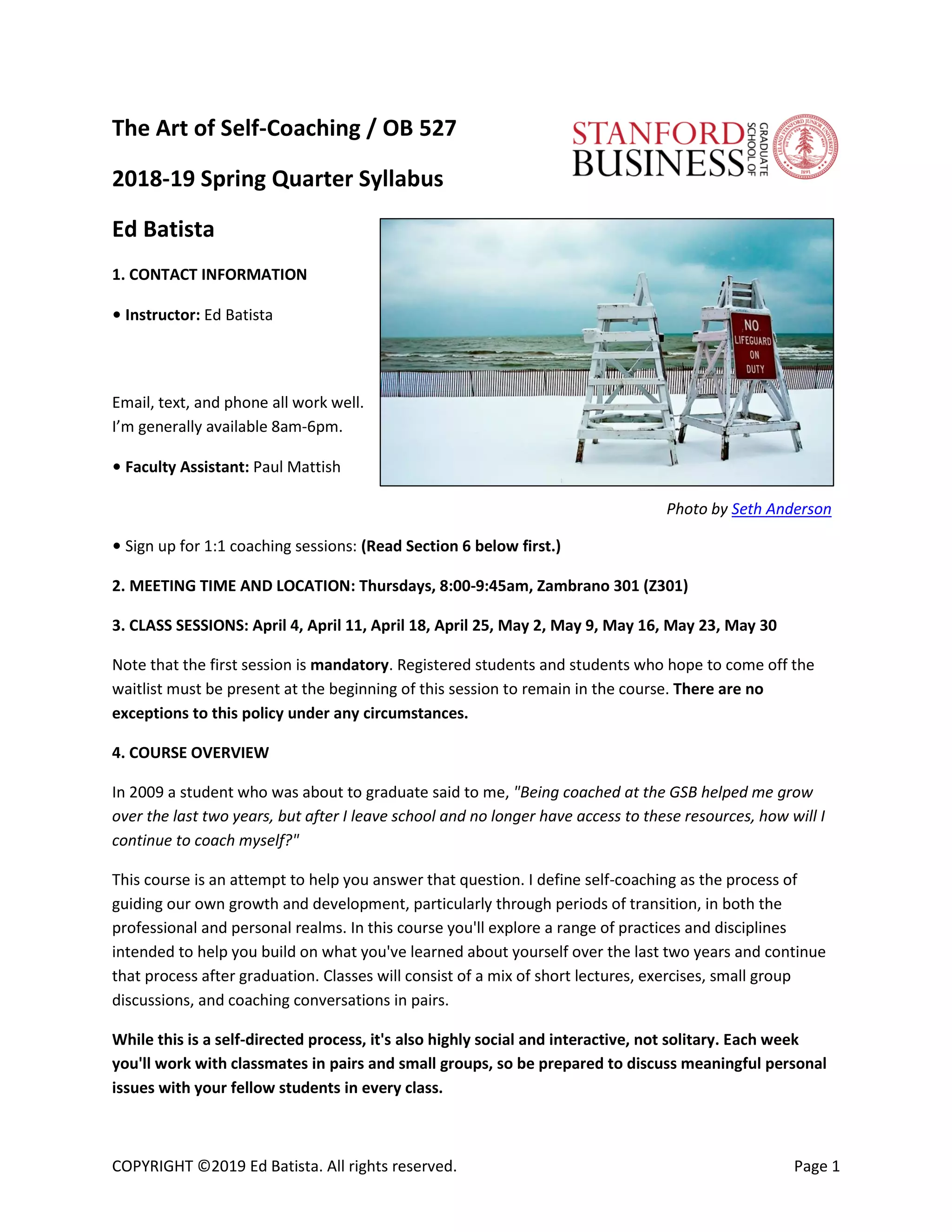
Photo by Seth Anderson
• Sign up for 1:1 coaching sessions: (Read Section 6 below first.)
2. MEETING TIME AND LOCATION: Thursdays, 8:00-9:45am, Zambrano 301 (Z301)
3. CLASS SESSIONS: April 4, April 11, April 18, April 25, May 2, May 9, May 16, May 23, May 30
Note that the first session is mandatory. Registered students and students who hope to come off the
waitlist must be present at the beginning of this session to remain in the course. There are no
exceptions to this policy under any circumstances.
4. COURSE OVERVIEW
In 2009 a student who was about to graduate said to me, "Being coached at the GSB helped me grow
over the last two years, but after I leave school and no longer have access to these resources, how will I
continue to coach myself?"
This course is an attempt to help you answer that question. I define self-coaching as the process of
guiding our own growth and development, particularly through periods of transition, in both the
professional and personal realms. In this course you'll explore a range of practices and disciplines
intended to help you build on what you've learned about yourself over the last two years and continue
that process after graduation. Classes will consist of a mix of short lectures, exercises, small group
discussions, and coaching conversations in pairs.
While this is a self-directed process, it's also highly social and interactive, not solitary. Each week
you'll work with classmates in pairs and small groups, so be prepared to discuss meaningful personal
issues with your fellow students in every class.
COPYRIGHT ©2019 Ed Batista. All rights reserved. Page 2
5. GRADING
Grades will be determined through attendance and weekly assignments. This course may be taken
Pass/Fail with my permission.
5.1. Grading Overview
 One unexcused absence will lower your grade a full level. More than one unexcused
absence will result in a grade of U.
 Two unsubmitted assignments will lower your grade a full level. More than two unsubmitted
assignments will result in a grade of U.
 Three late assignments will lower your grade a full level. More than three late assignments
may result in a grade of U.
5.2. Attendance
Because every class session involves extensive interaction with other students, missing a class
would negatively affect those students’ learning. As a result, you are obligated to attend every
class session. One unexcused absence will lower your grade a full level, and more than one
unexcused absence will result in a grade of U. For students taking the class Pass/Fail, a single
unexcused absence may result in a failing grade. As noted above, attendance at the first session
is mandatory, and registered students and students who hope to come off the waitlist must be
present at the beginning of this session to remain in the course.
There are no exceptions for interviews, recruiting trips, compressed classes, weddings, family
events, or any other unexcused absences. Check your calendar to confirm that you can fulfill
this requirement of the course.
5.3. Weekly Written Assignments
After Week One, in each week that we have class you’ll submit a written assignment based on
your responses to that week’s readings and your ongoing experience in the course. The deadline
for each weekly assignment is Tuesday at 9:00pm.
Each assignment should look ahead to the upcoming class and discuss the readings for that
class. Beyond that constraint, the content is to be determined by you as an individual. There are
no specific questions, prompts, or requirements.
Submit your weekly assignments via Canvas, and use the following naming convention for your
documents: Last Name—First Name–Week Number.
There is a 700 word limit for each weekly assignment. Identify the actual word count for your
assignment at the top of the document.
COPYRIGHT ©2019 Ed Batista. All rights reserved. Page 3
5.4. Grading Criteria
5.4.1. Timely Submission: Points will be deducted for all late and unsubmitted assignments.
Assignments are considered late if they are posted to Canvas after Tuesday at 9:00pm. Three
late assignments will lower your grade a full level. More than three late assignments may result
in a grade of U. Assignments are considered unsubmitted if they are not posted to Canvas by
Wednesday at 5:00pm and will not be accepted after that time. Two unsubmitted assignments
will lower your grade a full level. More than two unsubmitted assignments will result in a grade
of U. It is your responsibility to insure that an assignment has been posted to Canvas, and
technical issues will not excuse late or unsubmitted assignments.
5.4.2. Depth of Personal Learning: As the focus of this course is you and your development,
assignments will be assessed on the basis of your ability to discuss how course readings,
materials, and experiences are personally relevant to you as an individual. Good written work
will not be a generic document that could have been written by any student, but, rather, a
uniquely personal discussion of lessons learned that could have been written only by you.
5.4.3. Conceptual Rigor: Assignments will also be assessed on the basis of your ability to
reference and interpret various concepts presented in course readings and materials. Good
written work will not simply recapitulate this conceptual material, but instead will employ it to
make sense of your experience in the course.
5.4.4. Overall Quality: Finally, assignments will be assessed on the basis of overall quality, which
is not limited to but will specifically include clarity, cogency, and creativity. This course isn't a
composition class, but I view quality as a proxy for the effort you're putting into the process.
6. OPTIONAL COACHING SESSIONS
I’m available for a limited number of optional 1:1 coaching sessions on the days that we have class. (I’m
not available for meetings on other days.) There’s no obligation to meet with me, and no aspect of these
conversations will have any impact on your grade in the course. The agenda for each coaching session is
up to you; it need not focus on issues that we cover in the course. Please be certain that you can attend
at that time before signing up for a session. You can sign up for coaching sessions here:
Given my limited availability, please sign up for no more than two sessions. If you need to cancel a
session, please email me immediately so that I can make the time available to other students. Note
that it is not permissible to trade appointment slots with other students.
COPYRIGHT ©2019 Ed Batista. All rights reserved. Page 4
7. COURSE SCHEDULE
Concepts, objectives and readings for each class session are described below. Links are included where
readings are freely available online, and other readings can be downloaded as PDFs from Canvas.
WEEK 1 / CLASS 1: BEGINNINGS (Thursday, April 4, 2019)
Concepts
 Eustress (Hans Selye) and the neuroscience of “joyful education” (Judy Willis).
 Positive psychology and its limitations (Christopher Peterson).
 Coaching as a form of interpersonal support (Edgar Schein).
Objectives
 Provide an overview of the course.
 Create an environment that supports learning and growth.
 Understand basic principles of coaching.
 Form Personal and Professional Partnerships (which will meet throughout the Quarter).
Readings
 Self-Coaching Is SOCIAL, www.edbatista.com/2018/05/self-coaching-is-social.html (Ed Batista)
 Neuroscience, Joyful Learning and the SCARF Model,
www.edbatista.com/2010/05/learning.html (Ed Batista)
 Pursuing the Good Life: 100 Reflections from Positive Psychology (Christopher Peterson)
o Chapter 1, pages 3-6: “What Is Positive Psychology, and What Is It Not?”
o Chapter 4, pages 14-17: “Blaming the Science Versus Blaming the Victim”
 How Great Coaches Ask, Listen, and Empathize, https://hbr.org/2015/02/how-great-coaches-
ask-listen-and-empathize (Ed Batista)
 Humble Inquiry: The Gentle Art of Asking Instead of Telling (Edgar Schein)
o Chapter 3, pages 39-50: "Differentiating Humble Inquiry from Other Kinds of Inquiry"
 OPTIONAL: Helping: How to Offer, Give and Receive Help (Edgar Schein)
o Chapter 3, pages 30-47: “The Inequalities and Ambiguities of the Helping Relationship”
 OPTIONAL: Scott Ginsberg on Asking (Better) Questions,
www.edbatista.com/2008/04/questions.html (Ed Batista)
 OPTIONAL: Hammering Screws (Bad Coaching), www.edbatista.com/2011/12/hammering-
screws.html (Ed Batista)
 This course does not provide in-depth coaching training, but a basic understanding of coaching
tools and skills will help you get more out of the conversations you’ll have with classmates. In
addition to the optional readings above, more resources can be found at the course archive on
my website: www.edbatista.com/the-art-of-self-coaching-course.html#beginnings.
COPYRIGHT ©2019 Ed Batista. All rights reserved. Page 5
WEEK 2 / CLASS 2: CHANGE (Thursday, April 11, 2019)
Concepts
 Model of change (Kurt Lewin and Edgar Schein), Grit (Angela Duckworth), Mindset (Carol
Dweck), and the complex effects of goal-setting.
Objectives
 Reflect on changes experienced while at the GSB and your personal approach to change.
 Identify goals, hopes and expectations for your remaining time at the GSB.
 Consider implications of these concepts for your career after graduation.
Readings
 Why Change is Hard, www.edbatista.com/2014/12/why-change-is-hard.html (Ed Batista)
 Building Blocks (A Tactical Approach to Change), www.edbatista.com/2019/03/building-blocks-
a-tactical-approach-to-change.html (Ed Batista)
 True Grit, www.psychologicalscience.org/observer/true-grit (Angela Duckworth and Lauren
Eskreis-Winkler)
 Grit: The Power of Passion and Perseverance [6-minute video],
www.ted.com/talks/angela_lee_duckworth_the_key_to_success_grit?language=en (Angela
Duckworth)
 Fixed vs. Growth: The Two Basic Mindsets That Shape Our Lives,
www.brainpickings.org/2014/01/29/carol-dweck-mindset/ (Maria Popova)
o A discussion of the work of Stanford psychologist Carol Dweck.
 Babies, Bathwater and Goal-Setting, www.edbatista.com/2012/12/babies-bathwater-and-goal-
setting.html (Ed Batista)
 OPTIONAL: What Having a “Growth Mindset” Actually Means, https://hbr.org/2016/01/what-
having-a-growth-mindset-actually-means (Carol Dweck)
 OPTIONAL: Is Grit Overrated?, www.theatlantic.com/magazine/archive/2016/05/is-grit-
overrated/476397/ (Jerry Useem)
 OPTIONAL: Angela Duckworth Responds to a New Critique of Grit,
www.npr.org/sections/ed/2016/05/25/479172868/angela-duckworth-responds-to-a-new-
critique-of-grit (Anya Kamenetz)
 OPTIONAL: Grit: The Power of Passion and Perseverance (Angela Duckworth)
o Chapter 5 (excerpt), pages 89-92 (“If grit can grow, how does that happen?”)
COPYRIGHT ©2019 Ed Batista. All rights reserved. Page 6
WEEK 3 / CLASS 3: ATTENTION (Thursday, April 18, 2019)
Concepts
 System 1 and System 2, cognitive effort, ego depletion (Daniel Kahneman); mental control
(Daniel Wegner); concentration, practice, presence (Brad Stulberg and Steve Magness).
Objectives
 Consider the importance of attention as a resource.
 Understand the different modes of thinking in Kahneman’s framework.
 Consider difficulties in the process of mental control.
 Begin to explore the relationship between attention and emotion (the topic of Class 4).
Readings
 Thinking, Fast and Slow (Daniel Kahneman)
o Chapter 1, pages 19-30: “The Characters of the Story”
o OPTIONAL: Chapter 2, pages 31-38: “Attention and Effort”
o OPTIONAL: Chapter 3, pages 39-49: “The Lazy Controller”
 White Bears and Other Unwanted Thoughts: Suppression, Obsession, and the Psychology of
Mental Control (Daniel Wegner)
o Chapter 1, pages 1-18: “Mental Control”
 Peak Performance: Elevate Your Game, Avoid Burnout, and Thrive with the New Science of
Success (Brad Stulberg and Steve Magness)
o Chapter 3 (excerpt), pages 53-59: “Stress Yourself”
o OPTIONAL: Chapter 3 (excerpt), pages 60-64: “Stress Yourself”
 Don’t Just Do Something, Sit There! (Mindfulness for Busy People) (Ed Batista),
www.edbatista.com/2017/01/dont-just-do-something-sit-there-mindfulness-for-busy-
people.html
 OPTIONAL: Growth, Profitability, and Return on Attention,
www.edbatista.com/2015/02/return-on-attention.html (Ed Batista)
 OPTIONAL: Developing Mindful Leaders for the C-Suite, https://hbr.org/2014/03/developing-
mindful-leaders-for-the-c-suite/ (Bill George)
 OPTIONAL: You’re Not Multi-Tasking, You’re Half-Assing, www.edbatista.com/2016/12/youre-
not-multi-tasking-youre-half-assing.html/ (Ed Batista)
 OPTIONAL: The Marshmallow Test for Grownups, www.edbatista.com/2014/09/new-post-at-
hbr-the-marshmallow-test-for-grownups.html (Ed Batista)
 For further reading:
o Thinking, Fast and Slow (Kahneman), Chapters 4-9, pages 50-105
o White Bears and Other Unwanted Thoughts (Wegner), Chapters 4-7, pages 58-140
COPYRIGHT ©2019 Ed Batista. All rights reserved. Page 7
WEEK 4 / CLASS 4: EMOTION (Thursday, April 25, 2019)
Concepts
 Emotional style (Richard Davidson), emotion and reason (Antonio Damasio), and prefrontal
functions (Daniel Siegel).
Objectives
 Reflect on your Emotional Style and its impact on your life and career.
 Understand the role of emotions, particularly in reasoning and decision-making.
 Identify strengths to maintain and potential changes to consider.
Readings
 Emotional Style Assessment and Assessment Scoring (Richard Davidson)
o Download, complete and score the assessment (consisting of 60 true/false questions)
BEFORE doing this week’s readings.
o You will not be required to share your results, but bring a copy to class.
 The Emotional Life of Your Brain: How Its Unique Patterns Affect the Way You Think, Feel, and
Live—and How You Can Change Them (Richard Davidson)
o Chapter 1, pages 1-12: “One Brain Does Not Fit All”
o Chapter 3, pages 43-65: “Assessing Your Emotional Style”
o For further reading: Chapter 11, pages 225-252: “Rewired, or Neurally Inspired Exercises
to Change Your Emotional Style”
 Dimensions of Emotional Style Survey: Complete this very brief (1 minute) survey AFTER reading
Davidson: www.surveymonkey.com/r/L3C926S
 Antonio Damasio on Emotion and Reason (Part 1: Overview),
www.edbatista.com/2011/07/antonio-damasio-on-emotion-and-reason.html (Ed Batista)
o OPTIONAL: Part 2: Underlying Questions, Part 3, Conclusions and Part 4: Excerpts.
o Please note that only Part 1: Overview is required reading for this class.
 Mindsight: The New Science of Personal Transformation (Daniel Siegel)
o Introduction, pages ix-xvi
o Chapter 2, pages 23-44: “Crepes of Wrath: Mindsight Lost and Found”
 The Map Is Not the Territory, www.edbatista.com/2016/12/the-map-is-not-the-territory.html
(Ed Batista)
o This reading will be relevant for Weeks 4, 5 and 6. Refer back to it as needed.
 OPTIONAL: To Stay Focused, Manage Your Emotions, https://hbr.org/2015/02/to-stay-focused-
manage-your-emotions (Ed Batista)
 OPTIONAL: Talking About Feelings, www.edbatista.com/2018/07/talking-about-feelings.html
(Ed Batista)
 OPTIONAL: How Our Brains Feel Emotion, https://bigthink.com/videos/how-our-brains-feel-
emotion [9-minute video] (Antonio Damasio)
COPYRIGHT ©2019 Ed Batista. All rights reserved. Page 8
WEEK 5 / CLASS 5: HAPPINESS (Thursday, May 2, 2019)
Concepts
 Sources of happiness and hedonic adaptation (Sonja Lyubomirsky, Ed Diener, Chris Peterson).
Objectives
 Understand various sources of happiness as determined by social psychologists.
 Identify “happiness strategies” likely to be most suitable for you.
 Consider the limitations of current positive psychology research.
Readings
 The How of Happiness: A New Approach to Getting the Life You Want (Sonja Lyubomirsky)
o Chapter 2 (excerpt), pages 38-68: “How Happy Are You and Why?”
o Chapter 3, pages 69-79: “How to Find Happiness Activities That Fit Your Interests, Your
Values, and Your Needs”
 Understanding “The Pie Chart” in The How of Happiness,
www.edbatista.com/2017/12/understanding-the-pie-chart-in-the-how-of-happiness.html (Ed
Batista)
o It’s important to avoid common misinterpretations of positive psychology research. If
you find this reading insufficient, the optional readings by Peterson and Diener below
discuss this topic in greater detail.
 Activity-Fit Diagnostic (Sonja Lyubomirsky)
o Download and complete the diagnostic AFTER completing the readings above.
o You will not be required to share your results, but bring a copy to class.
 VIA Survey of Character Strengths, www.edbatista.com/via-survey-of-character-strengths.html
o After reviewing the introduction to this instrument, follow the instructions to register at
the VIA Institute site and complete the 120-question version of the survey.
o You will not be required to share your results, but bring a copy to class.
 OPTIONAL: Pursuing the Good Life: 100 Reflections on Positive Psychology (Christopher
Peterson)
o Chapter 21, pages 71-74: “Heritability and Happiness”
 OPTIONAL: The Science of Subjective Well-Being (Michael Eid and Randy Larson, editors)
o Chapter 24, pages 493-507: “Myths in the Science of Happiness” (Ed Diener)
 OPTIONAL: Meaning Is Healthier Than Happiness,
www.theatlantic.com/health/archive/2013/08/meaning-is-healthier-than-happiness/278250/
(Emily Esfahani Smith)
 OPTIONAL: There’s More to Life Than Being Happy,
www.ted.com/talks/emily_esfahani_smith_there_s_more_to_life_than_being_happy?language
=en [12-minute video] (Emily Esfahani Smith)
COPYRIGHT ©2019 Ed Batista. All rights reserved. Page 9
WEEK 6 / CLASS 6: RESILIENCE & VULNERABILITY (Thursday, May 9, 2019)
Concepts
 Components of resilience and Resilience Quotient (Karen Reivich and Andrew Shatté).
 Definitions of resilience and shame (Brené Brown).
Objectives
 Determine your Resilience Quotient.
 Identify current sources of resilience as well more effective ways of coping with setbacks.
 Consider strategies for expressing vulnerability and overcoming shame effectively.
Readings
 Resilience Quotient Assessment and Assessment Scoring (Karen Reivich and Andrew Shatté)
o Download, complete and score the assessment BEFORE doing this week’s readings.
o You will not be required to share your results, but bring a copy to class.
 The Resilience Factor (Karen Reivich and Andrew Shatté)
o Chapter 2, pages 31-47: “How Resilient Are You?”
o OPTIONAL: Chapter 3, pages 48-62: “Laying the Groundwork”
 Resilience Worksheet
o Download and complete this worksheet AFTER doing the readings above
o You will not be required to share your worksheet, but you will be conducting an exercise
that involves disclosing some aspect of your response. Bring a copy to class.
 Daring Greatly (Brené Brown)
o Chapter 2, pages 33-56: “Debunking the Vulnerability Myths”
o For further reading: Chapter 3, pages 59-111, “Understanding and Combating Shame”
 Brené Brown, Vulnerability, Empathy and Leadership, www.edbatista.com/2014/08/brene-
brown-vulnerability-empathy-and-leadership.html (Ed Batista)
o Note that this reading includes two videos: “The Power of Vulnerability” [20 minutes]
and “Shame and Empathy” [9 minutes].
 Vulnerability Stories
o Download and complete this worksheet AFTER doing this week's readings.
o You will not be required to share your worksheet, but you will be conducting an exercise
that involves disclosing some aspect of your response. Bring a copy to class.
 OPTIONAL: Peak Performance (Brad Stulberg and Steve Magness)
o Chapter 3 (excerpt), pages 65-74: “Stress Yourself”
 OPTIONAL: Embracing Stress is More Important Than Reducing Stress,
https://news.stanford.edu/news/2015/may/stress-embrace-mcgonigal-050715.html (Clifford
Parker, discussing recent work by Stanford psychologist Kelly McGonigal)
COPYRIGHT ©2019 Ed Batista. All rights reserved. Page 10
WEEK 7 / CLASS 7: UNHAPPINESS (Thursday, May 16, 2019)
Concepts
 Stoicism (Oliver Burkeman).
 Buddhist thought (Pema Chödrön).
 Logotherapy (Viktor Frankl).
Objectives
 Consider a range of approaches to dealing with setbacks and difficulties.
Readings
 The Antidote: Happiness for People Who Can’t Stand Positive Thinking (Oliver Burkeman)
o Chapter 2, pages 23-50: “What Would Seneca Do?”
 When Things Fall Apart: Heart Advice for Difficult Times (Pema Chödrön)
o Chapter 11, pages 84-94: “Nonaggression and the Four Maras”
o Chapter 21, pages 177-183: “Reversing the Wheel of Samsara”
o Note that if you find Chödrön too abstract, the optional reading by Burkeman below
provides a more accessible introduction to Buddhist thought.
 Man's Search for Meaning (Viktor Frankl)
o Pages 108-115: "The Meaning of Life," "The Essence of Existence," "The Meaning of
Love," and "The Meaning of Suffering"
o For further reading: Pages 97-107 and Postscript, pages 137-154
 Sources of Unhappiness
o Download and complete this worksheet AFTER doing this week's readings.
o You will not be required to share your worksheet, but you will be conducting an exercise
that involves disclosing some aspect of your response. Bring a copy to class.
 OPTIONAL: The Antidote: Happiness for People Who Can’t Stand Positive Thinking (Oliver
Burkeman)
o Chapter 3, pages 51-74: “The Storm Before the Calm”
 OPTIONAL: How I Read Stoicism, www.edbatista.com/2018/06/how-i-read-stoicism.html (Ed
Batista)
 OPTIONAL: Viktor Frankl at Ninety: An Interview, www.firstthings.com/article/1995/04/004-
viktor-frankl-at-ninety-an-interview (Matthew Scully)
 OPTIONAL: Pain, Suffering, and Hedonic Adaptation, www.edbatista.com/2015/10/pain-
suffering-and-hedonic-adaptation.html (Ed Batista)
COPYRIGHT ©2019 Ed Batista. All rights reserved. Page 11
WEEK 8 / CLASS 8: SUCCESS (Thursday, May 23, 2019)
Concepts
 Beliefs about success and fulfillment (David Foster Wallace and Sonja Lyubomirsky).
 Hedonic adaptation, social comparison, and goal pursuit (Lyubomirsky).
Objectives
 Prepare for the challenges that accompany professional struggles and success.
Readings
 This Is Water, www.edbatista.com/2015/05/david-foster-wallace-this-is-water.html (David
Foster Wallace)
 The Myths of Happiness: What Should Make You Happy, But Doesn't, What Shouldn't Make You
Happy, But Does (Sonja Lyubomirsky)
o Chapter 5, pages 115-143: “I’ll Be Happy When…I Find the Right Job”
 Managing Oneself Worksheet
o Download and complete this worksheet. You can explore the concepts behind it in
greater depth via the optional reading below.
o You will not be required to share your worksheet, but you will participate in an exercise
that involves disclosing some aspect of your response. Bring a copy to class.
 OPTIONAL: Managing Oneself (Peter Drucker)
 OPTIONAL: The Trap of Competition, www.edbatista.com/2019/01/the-trap-of-
competition.html (Ed Batista)
COPYRIGHT ©2019 Ed Batista. All rights reserved. Page 12
WEEK 9 / CLASS 9: ENDINGS (Thursday, May 30, 2019)
Concepts
 Transitions vs. changes (William Bridges)
Objectives
 Prepare for graduation, returning to full-time work, and other impending transitions.
 Acknowledge the endings of the coaching partnerships and other relationships within the class.
Readings
 William Bridges on Transitions, www.edbatista.com/2008/08/transitions.html (Ed Batista)
 Transitions: Making Sense of Life’s Changes (William Bridges)
o Chapter 4 (excerpt), pages 77-92: “Transitions in the Work Life”
 Pursuing the Good Life: 100 Reflections on Positive Psychology (Christopher Peterson)
o Chapter 88, pages 289-290: “Days Are Long—Life Is Short”
o Chapter 89, pages 291-294: “I Resolve to Take Benjamin Franklin Seriously”
 Partner Feedback
o Be prepared to provide both of your partners with feedback regarding their work with
you over the course of the Quarter. The worksheet on Canvas provides a suggested
format, but feel free to use any format that works for you.
 OPTIONAL: Learning How to Learn, www.edbatista.com/2018/07/learning-how-to-learn.html
(Ed Batista)
 OPTIONAL: Why You Should Make Time for Self-Reflection (Even If You Hate Doing It),
https://hbr.org/2017/03/why-you-should-make-time-for-self-reflection-even-if-you-hate-doing-
it (Jennifer Porter)
 OPTIONAL: A Checklist for Someone About to Take on a Tougher Job,
https://hbr.org/2015/01/a-checklist-for-someone-about-to-take-on-a-tougher-job (Ed Batista)
 OPTIONAL: Transitions: Making Sense of Life’s Changes (William Bridges)
o Chapter 5 (excerpt), pages 107-123: “Endings”
o For further reading: Chapter 6, pages 133-155: “The Neutral Zone”
COPYRIGHT ©2019 Ed Batista. All rights reserved. Page 13
8. BOOKS ON RESERVE IN BASS
All required readings are available on Canvas, and it is not necessary to do any additional reading to
complete the course successfully. But students in the past have expressed interest in reading further, so
I’ve asked the librarians in Bass to place the texts we use on reserve during the Quarter.
The Antidote: Happiness for People Who Can’t
Stand Positive Thinking, Oliver Burkeman
(Farrar, Straus and Giroux, 2013)
Bouncing Back: Rewiring Your Brain for Maximum
Resilience and Well-Being, Linda Graham
(New World Library, 2013)
Daring Greatly: How the Courage to Be Vulnerable
Transforms the Way We Live, Love, Parent, and
Lead, Brené Brown
(Avery, 2015)
The Emotional Life of Your Brain: How Its Unique
Patterns Affect the Way You Think, Feel, and Live—
and How You Can Change Them, Richard Davidson
and Sharon Begley (Hudson Street Press, 2012)
Grit: The Power of Passion and Perseverance,
Angela Duckworth
(Scribner, 2016)
Helping: How to Offer, Give and Receive Help,
Edgar Schein
(Berrett-Koehler, 2011)
The How of Happiness: A New Approach to Getting
the Life You Want, Sonja Lyubomirsky
(Penguin Books, 2008)
Humble Inquiry: The Gentle Art of Asking Instead of
Telling, Edgar Schein
(Berrett-Koehler, 2013)
Man’s Search for Meaning,
Viktor Frankl
(Beacon Press, 2006)
Mindsight: The New Science of Personal
Transformation, Daniel Siegel
(Bantam, 2010)
The Myths of Happiness: What Should Make You
Happy, But Doesn't, What Shouldn't Make You
Happy, But Does, Sonja Lyubomirsky
(Penguin Books, 2014)
Peak Performance: Elevate Your Game, Avoid
Burnout, and Thrive with the New Science of
Success, Brad Stulberg and Steve Magness
(Rodale Books, 2017)
Pursuing the Good Life: 100 Reflections on Positive
Psychology, Christopher Peterson
(Oxford University Press, 2012)
The Resilience Factor: 7 Keys to Finding Your Inner
Strength and Overcoming Life's Hurdles,
Karen Reivich and Andrew Shatté
(Harmony, 2003)
Thinking, Fast and Slow, Daniel Kahneman
(Farrar, Straus and Giroux, 2013)
Transitions: Making Sense of Life’s Changes,
William Bridges
(Da Capo Press, 2004)
When Things Fall Apart: Heart Advice for Difficult
Times, Pema Chödrön
(Shambhala, 2016)
White Bears and Other Unwanted Thoughts:
Suppression, Obsession, and the Psychology of
Mental Control, Daniel Wegner
(The Guilford Press, 1994)

Ed Batista, The Art of Self-Coaching @StanfordGSB, Spring 2019 Syllabus

  • 1.
    COPYRIGHT ©2019 EdBatista. All rights reserved. Page 1 The Art of Self-Coaching / OB 527 2018-19 Spring Quarter Syllabus Ed Batista 1. CONTACT INFORMATION • Instructor: Ed Batista Email, text, and phone all work well. I’m generally available 8am-6pm. • Faculty Assistant: Paul Mattish Photo by Seth Anderson • Sign up for 1:1 coaching sessions: (Read Section 6 below first.) 2. MEETING TIME AND LOCATION: Thursdays, 8:00-9:45am, Zambrano 301 (Z301) 3. CLASS SESSIONS: April 4, April 11, April 18, April 25, May 2, May 9, May 16, May 23, May 30 Note that the first session is mandatory. Registered students and students who hope to come off the waitlist must be present at the beginning of this session to remain in the course. There are no exceptions to this policy under any circumstances. 4. COURSE OVERVIEW In 2009 a student who was about to graduate said to me, "Being coached at the GSB helped me grow over the last two years, but after I leave school and no longer have access to these resources, how will I continue to coach myself?" This course is an attempt to help you answer that question. I define self-coaching as the process of guiding our own growth and development, particularly through periods of transition, in both the professional and personal realms. In this course you'll explore a range of practices and disciplines intended to help you build on what you've learned about yourself over the last two years and continue that process after graduation. Classes will consist of a mix of short lectures, exercises, small group discussions, and coaching conversations in pairs. While this is a self-directed process, it's also highly social and interactive, not solitary. Each week you'll work with classmates in pairs and small groups, so be prepared to discuss meaningful personal issues with your fellow students in every class.
  • 2.
    COPYRIGHT ©2019 EdBatista. All rights reserved. Page 2 5. GRADING Grades will be determined through attendance and weekly assignments. This course may be taken Pass/Fail with my permission. 5.1. Grading Overview  One unexcused absence will lower your grade a full level. More than one unexcused absence will result in a grade of U.  Two unsubmitted assignments will lower your grade a full level. More than two unsubmitted assignments will result in a grade of U.  Three late assignments will lower your grade a full level. More than three late assignments may result in a grade of U. 5.2. Attendance Because every class session involves extensive interaction with other students, missing a class would negatively affect those students’ learning. As a result, you are obligated to attend every class session. One unexcused absence will lower your grade a full level, and more than one unexcused absence will result in a grade of U. For students taking the class Pass/Fail, a single unexcused absence may result in a failing grade. As noted above, attendance at the first session is mandatory, and registered students and students who hope to come off the waitlist must be present at the beginning of this session to remain in the course. There are no exceptions for interviews, recruiting trips, compressed classes, weddings, family events, or any other unexcused absences. Check your calendar to confirm that you can fulfill this requirement of the course. 5.3. Weekly Written Assignments After Week One, in each week that we have class you’ll submit a written assignment based on your responses to that week’s readings and your ongoing experience in the course. The deadline for each weekly assignment is Tuesday at 9:00pm. Each assignment should look ahead to the upcoming class and discuss the readings for that class. Beyond that constraint, the content is to be determined by you as an individual. There are no specific questions, prompts, or requirements. Submit your weekly assignments via Canvas, and use the following naming convention for your documents: Last Name—First Name–Week Number. There is a 700 word limit for each weekly assignment. Identify the actual word count for your assignment at the top of the document.
  • 3.
    COPYRIGHT ©2019 EdBatista. All rights reserved. Page 3 5.4. Grading Criteria 5.4.1. Timely Submission: Points will be deducted for all late and unsubmitted assignments. Assignments are considered late if they are posted to Canvas after Tuesday at 9:00pm. Three late assignments will lower your grade a full level. More than three late assignments may result in a grade of U. Assignments are considered unsubmitted if they are not posted to Canvas by Wednesday at 5:00pm and will not be accepted after that time. Two unsubmitted assignments will lower your grade a full level. More than two unsubmitted assignments will result in a grade of U. It is your responsibility to insure that an assignment has been posted to Canvas, and technical issues will not excuse late or unsubmitted assignments. 5.4.2. Depth of Personal Learning: As the focus of this course is you and your development, assignments will be assessed on the basis of your ability to discuss how course readings, materials, and experiences are personally relevant to you as an individual. Good written work will not be a generic document that could have been written by any student, but, rather, a uniquely personal discussion of lessons learned that could have been written only by you. 5.4.3. Conceptual Rigor: Assignments will also be assessed on the basis of your ability to reference and interpret various concepts presented in course readings and materials. Good written work will not simply recapitulate this conceptual material, but instead will employ it to make sense of your experience in the course. 5.4.4. Overall Quality: Finally, assignments will be assessed on the basis of overall quality, which is not limited to but will specifically include clarity, cogency, and creativity. This course isn't a composition class, but I view quality as a proxy for the effort you're putting into the process. 6. OPTIONAL COACHING SESSIONS I’m available for a limited number of optional 1:1 coaching sessions on the days that we have class. (I’m not available for meetings on other days.) There’s no obligation to meet with me, and no aspect of these conversations will have any impact on your grade in the course. The agenda for each coaching session is up to you; it need not focus on issues that we cover in the course. Please be certain that you can attend at that time before signing up for a session. You can sign up for coaching sessions here: Given my limited availability, please sign up for no more than two sessions. If you need to cancel a session, please email me immediately so that I can make the time available to other students. Note that it is not permissible to trade appointment slots with other students.
  • 4.
    COPYRIGHT ©2019 EdBatista. All rights reserved. Page 4 7. COURSE SCHEDULE Concepts, objectives and readings for each class session are described below. Links are included where readings are freely available online, and other readings can be downloaded as PDFs from Canvas. WEEK 1 / CLASS 1: BEGINNINGS (Thursday, April 4, 2019) Concepts  Eustress (Hans Selye) and the neuroscience of “joyful education” (Judy Willis).  Positive psychology and its limitations (Christopher Peterson).  Coaching as a form of interpersonal support (Edgar Schein). Objectives  Provide an overview of the course.  Create an environment that supports learning and growth.  Understand basic principles of coaching.  Form Personal and Professional Partnerships (which will meet throughout the Quarter). Readings  Self-Coaching Is SOCIAL, www.edbatista.com/2018/05/self-coaching-is-social.html (Ed Batista)  Neuroscience, Joyful Learning and the SCARF Model, www.edbatista.com/2010/05/learning.html (Ed Batista)  Pursuing the Good Life: 100 Reflections from Positive Psychology (Christopher Peterson) o Chapter 1, pages 3-6: “What Is Positive Psychology, and What Is It Not?” o Chapter 4, pages 14-17: “Blaming the Science Versus Blaming the Victim”  How Great Coaches Ask, Listen, and Empathize, https://hbr.org/2015/02/how-great-coaches- ask-listen-and-empathize (Ed Batista)  Humble Inquiry: The Gentle Art of Asking Instead of Telling (Edgar Schein) o Chapter 3, pages 39-50: "Differentiating Humble Inquiry from Other Kinds of Inquiry"  OPTIONAL: Helping: How to Offer, Give and Receive Help (Edgar Schein) o Chapter 3, pages 30-47: “The Inequalities and Ambiguities of the Helping Relationship”  OPTIONAL: Scott Ginsberg on Asking (Better) Questions, www.edbatista.com/2008/04/questions.html (Ed Batista)  OPTIONAL: Hammering Screws (Bad Coaching), www.edbatista.com/2011/12/hammering- screws.html (Ed Batista)  This course does not provide in-depth coaching training, but a basic understanding of coaching tools and skills will help you get more out of the conversations you’ll have with classmates. In addition to the optional readings above, more resources can be found at the course archive on my website: www.edbatista.com/the-art-of-self-coaching-course.html#beginnings.
  • 5.
    COPYRIGHT ©2019 EdBatista. All rights reserved. Page 5 WEEK 2 / CLASS 2: CHANGE (Thursday, April 11, 2019) Concepts  Model of change (Kurt Lewin and Edgar Schein), Grit (Angela Duckworth), Mindset (Carol Dweck), and the complex effects of goal-setting. Objectives  Reflect on changes experienced while at the GSB and your personal approach to change.  Identify goals, hopes and expectations for your remaining time at the GSB.  Consider implications of these concepts for your career after graduation. Readings  Why Change is Hard, www.edbatista.com/2014/12/why-change-is-hard.html (Ed Batista)  Building Blocks (A Tactical Approach to Change), www.edbatista.com/2019/03/building-blocks- a-tactical-approach-to-change.html (Ed Batista)  True Grit, www.psychologicalscience.org/observer/true-grit (Angela Duckworth and Lauren Eskreis-Winkler)  Grit: The Power of Passion and Perseverance [6-minute video], www.ted.com/talks/angela_lee_duckworth_the_key_to_success_grit?language=en (Angela Duckworth)  Fixed vs. Growth: The Two Basic Mindsets That Shape Our Lives, www.brainpickings.org/2014/01/29/carol-dweck-mindset/ (Maria Popova) o A discussion of the work of Stanford psychologist Carol Dweck.  Babies, Bathwater and Goal-Setting, www.edbatista.com/2012/12/babies-bathwater-and-goal- setting.html (Ed Batista)  OPTIONAL: What Having a “Growth Mindset” Actually Means, https://hbr.org/2016/01/what- having-a-growth-mindset-actually-means (Carol Dweck)  OPTIONAL: Is Grit Overrated?, www.theatlantic.com/magazine/archive/2016/05/is-grit- overrated/476397/ (Jerry Useem)  OPTIONAL: Angela Duckworth Responds to a New Critique of Grit, www.npr.org/sections/ed/2016/05/25/479172868/angela-duckworth-responds-to-a-new- critique-of-grit (Anya Kamenetz)  OPTIONAL: Grit: The Power of Passion and Perseverance (Angela Duckworth) o Chapter 5 (excerpt), pages 89-92 (“If grit can grow, how does that happen?”)
  • 6.
    COPYRIGHT ©2019 EdBatista. All rights reserved. Page 6 WEEK 3 / CLASS 3: ATTENTION (Thursday, April 18, 2019) Concepts  System 1 and System 2, cognitive effort, ego depletion (Daniel Kahneman); mental control (Daniel Wegner); concentration, practice, presence (Brad Stulberg and Steve Magness). Objectives  Consider the importance of attention as a resource.  Understand the different modes of thinking in Kahneman’s framework.  Consider difficulties in the process of mental control.  Begin to explore the relationship between attention and emotion (the topic of Class 4). Readings  Thinking, Fast and Slow (Daniel Kahneman) o Chapter 1, pages 19-30: “The Characters of the Story” o OPTIONAL: Chapter 2, pages 31-38: “Attention and Effort” o OPTIONAL: Chapter 3, pages 39-49: “The Lazy Controller”  White Bears and Other Unwanted Thoughts: Suppression, Obsession, and the Psychology of Mental Control (Daniel Wegner) o Chapter 1, pages 1-18: “Mental Control”  Peak Performance: Elevate Your Game, Avoid Burnout, and Thrive with the New Science of Success (Brad Stulberg and Steve Magness) o Chapter 3 (excerpt), pages 53-59: “Stress Yourself” o OPTIONAL: Chapter 3 (excerpt), pages 60-64: “Stress Yourself”  Don’t Just Do Something, Sit There! (Mindfulness for Busy People) (Ed Batista), www.edbatista.com/2017/01/dont-just-do-something-sit-there-mindfulness-for-busy- people.html  OPTIONAL: Growth, Profitability, and Return on Attention, www.edbatista.com/2015/02/return-on-attention.html (Ed Batista)  OPTIONAL: Developing Mindful Leaders for the C-Suite, https://hbr.org/2014/03/developing- mindful-leaders-for-the-c-suite/ (Bill George)  OPTIONAL: You’re Not Multi-Tasking, You’re Half-Assing, www.edbatista.com/2016/12/youre- not-multi-tasking-youre-half-assing.html/ (Ed Batista)  OPTIONAL: The Marshmallow Test for Grownups, www.edbatista.com/2014/09/new-post-at- hbr-the-marshmallow-test-for-grownups.html (Ed Batista)  For further reading: o Thinking, Fast and Slow (Kahneman), Chapters 4-9, pages 50-105 o White Bears and Other Unwanted Thoughts (Wegner), Chapters 4-7, pages 58-140
  • 7.
    COPYRIGHT ©2019 EdBatista. All rights reserved. Page 7 WEEK 4 / CLASS 4: EMOTION (Thursday, April 25, 2019) Concepts  Emotional style (Richard Davidson), emotion and reason (Antonio Damasio), and prefrontal functions (Daniel Siegel). Objectives  Reflect on your Emotional Style and its impact on your life and career.  Understand the role of emotions, particularly in reasoning and decision-making.  Identify strengths to maintain and potential changes to consider. Readings  Emotional Style Assessment and Assessment Scoring (Richard Davidson) o Download, complete and score the assessment (consisting of 60 true/false questions) BEFORE doing this week’s readings. o You will not be required to share your results, but bring a copy to class.  The Emotional Life of Your Brain: How Its Unique Patterns Affect the Way You Think, Feel, and Live—and How You Can Change Them (Richard Davidson) o Chapter 1, pages 1-12: “One Brain Does Not Fit All” o Chapter 3, pages 43-65: “Assessing Your Emotional Style” o For further reading: Chapter 11, pages 225-252: “Rewired, or Neurally Inspired Exercises to Change Your Emotional Style”  Dimensions of Emotional Style Survey: Complete this very brief (1 minute) survey AFTER reading Davidson: www.surveymonkey.com/r/L3C926S  Antonio Damasio on Emotion and Reason (Part 1: Overview), www.edbatista.com/2011/07/antonio-damasio-on-emotion-and-reason.html (Ed Batista) o OPTIONAL: Part 2: Underlying Questions, Part 3, Conclusions and Part 4: Excerpts. o Please note that only Part 1: Overview is required reading for this class.  Mindsight: The New Science of Personal Transformation (Daniel Siegel) o Introduction, pages ix-xvi o Chapter 2, pages 23-44: “Crepes of Wrath: Mindsight Lost and Found”  The Map Is Not the Territory, www.edbatista.com/2016/12/the-map-is-not-the-territory.html (Ed Batista) o This reading will be relevant for Weeks 4, 5 and 6. Refer back to it as needed.  OPTIONAL: To Stay Focused, Manage Your Emotions, https://hbr.org/2015/02/to-stay-focused- manage-your-emotions (Ed Batista)  OPTIONAL: Talking About Feelings, www.edbatista.com/2018/07/talking-about-feelings.html (Ed Batista)  OPTIONAL: How Our Brains Feel Emotion, https://bigthink.com/videos/how-our-brains-feel- emotion [9-minute video] (Antonio Damasio)
  • 8.
    COPYRIGHT ©2019 EdBatista. All rights reserved. Page 8 WEEK 5 / CLASS 5: HAPPINESS (Thursday, May 2, 2019) Concepts  Sources of happiness and hedonic adaptation (Sonja Lyubomirsky, Ed Diener, Chris Peterson). Objectives  Understand various sources of happiness as determined by social psychologists.  Identify “happiness strategies” likely to be most suitable for you.  Consider the limitations of current positive psychology research. Readings  The How of Happiness: A New Approach to Getting the Life You Want (Sonja Lyubomirsky) o Chapter 2 (excerpt), pages 38-68: “How Happy Are You and Why?” o Chapter 3, pages 69-79: “How to Find Happiness Activities That Fit Your Interests, Your Values, and Your Needs”  Understanding “The Pie Chart” in The How of Happiness, www.edbatista.com/2017/12/understanding-the-pie-chart-in-the-how-of-happiness.html (Ed Batista) o It’s important to avoid common misinterpretations of positive psychology research. If you find this reading insufficient, the optional readings by Peterson and Diener below discuss this topic in greater detail.  Activity-Fit Diagnostic (Sonja Lyubomirsky) o Download and complete the diagnostic AFTER completing the readings above. o You will not be required to share your results, but bring a copy to class.  VIA Survey of Character Strengths, www.edbatista.com/via-survey-of-character-strengths.html o After reviewing the introduction to this instrument, follow the instructions to register at the VIA Institute site and complete the 120-question version of the survey. o You will not be required to share your results, but bring a copy to class.  OPTIONAL: Pursuing the Good Life: 100 Reflections on Positive Psychology (Christopher Peterson) o Chapter 21, pages 71-74: “Heritability and Happiness”  OPTIONAL: The Science of Subjective Well-Being (Michael Eid and Randy Larson, editors) o Chapter 24, pages 493-507: “Myths in the Science of Happiness” (Ed Diener)  OPTIONAL: Meaning Is Healthier Than Happiness, www.theatlantic.com/health/archive/2013/08/meaning-is-healthier-than-happiness/278250/ (Emily Esfahani Smith)  OPTIONAL: There’s More to Life Than Being Happy, www.ted.com/talks/emily_esfahani_smith_there_s_more_to_life_than_being_happy?language =en [12-minute video] (Emily Esfahani Smith)
  • 9.
    COPYRIGHT ©2019 EdBatista. All rights reserved. Page 9 WEEK 6 / CLASS 6: RESILIENCE & VULNERABILITY (Thursday, May 9, 2019) Concepts  Components of resilience and Resilience Quotient (Karen Reivich and Andrew Shatté).  Definitions of resilience and shame (Brené Brown). Objectives  Determine your Resilience Quotient.  Identify current sources of resilience as well more effective ways of coping with setbacks.  Consider strategies for expressing vulnerability and overcoming shame effectively. Readings  Resilience Quotient Assessment and Assessment Scoring (Karen Reivich and Andrew Shatté) o Download, complete and score the assessment BEFORE doing this week’s readings. o You will not be required to share your results, but bring a copy to class.  The Resilience Factor (Karen Reivich and Andrew Shatté) o Chapter 2, pages 31-47: “How Resilient Are You?” o OPTIONAL: Chapter 3, pages 48-62: “Laying the Groundwork”  Resilience Worksheet o Download and complete this worksheet AFTER doing the readings above o You will not be required to share your worksheet, but you will be conducting an exercise that involves disclosing some aspect of your response. Bring a copy to class.  Daring Greatly (Brené Brown) o Chapter 2, pages 33-56: “Debunking the Vulnerability Myths” o For further reading: Chapter 3, pages 59-111, “Understanding and Combating Shame”  Brené Brown, Vulnerability, Empathy and Leadership, www.edbatista.com/2014/08/brene- brown-vulnerability-empathy-and-leadership.html (Ed Batista) o Note that this reading includes two videos: “The Power of Vulnerability” [20 minutes] and “Shame and Empathy” [9 minutes].  Vulnerability Stories o Download and complete this worksheet AFTER doing this week's readings. o You will not be required to share your worksheet, but you will be conducting an exercise that involves disclosing some aspect of your response. Bring a copy to class.  OPTIONAL: Peak Performance (Brad Stulberg and Steve Magness) o Chapter 3 (excerpt), pages 65-74: “Stress Yourself”  OPTIONAL: Embracing Stress is More Important Than Reducing Stress, https://news.stanford.edu/news/2015/may/stress-embrace-mcgonigal-050715.html (Clifford Parker, discussing recent work by Stanford psychologist Kelly McGonigal)
  • 10.
    COPYRIGHT ©2019 EdBatista. All rights reserved. Page 10 WEEK 7 / CLASS 7: UNHAPPINESS (Thursday, May 16, 2019) Concepts  Stoicism (Oliver Burkeman).  Buddhist thought (Pema Chödrön).  Logotherapy (Viktor Frankl). Objectives  Consider a range of approaches to dealing with setbacks and difficulties. Readings  The Antidote: Happiness for People Who Can’t Stand Positive Thinking (Oliver Burkeman) o Chapter 2, pages 23-50: “What Would Seneca Do?”  When Things Fall Apart: Heart Advice for Difficult Times (Pema Chödrön) o Chapter 11, pages 84-94: “Nonaggression and the Four Maras” o Chapter 21, pages 177-183: “Reversing the Wheel of Samsara” o Note that if you find Chödrön too abstract, the optional reading by Burkeman below provides a more accessible introduction to Buddhist thought.  Man's Search for Meaning (Viktor Frankl) o Pages 108-115: "The Meaning of Life," "The Essence of Existence," "The Meaning of Love," and "The Meaning of Suffering" o For further reading: Pages 97-107 and Postscript, pages 137-154  Sources of Unhappiness o Download and complete this worksheet AFTER doing this week's readings. o You will not be required to share your worksheet, but you will be conducting an exercise that involves disclosing some aspect of your response. Bring a copy to class.  OPTIONAL: The Antidote: Happiness for People Who Can’t Stand Positive Thinking (Oliver Burkeman) o Chapter 3, pages 51-74: “The Storm Before the Calm”  OPTIONAL: How I Read Stoicism, www.edbatista.com/2018/06/how-i-read-stoicism.html (Ed Batista)  OPTIONAL: Viktor Frankl at Ninety: An Interview, www.firstthings.com/article/1995/04/004- viktor-frankl-at-ninety-an-interview (Matthew Scully)  OPTIONAL: Pain, Suffering, and Hedonic Adaptation, www.edbatista.com/2015/10/pain- suffering-and-hedonic-adaptation.html (Ed Batista)
  • 11.
    COPYRIGHT ©2019 EdBatista. All rights reserved. Page 11 WEEK 8 / CLASS 8: SUCCESS (Thursday, May 23, 2019) Concepts  Beliefs about success and fulfillment (David Foster Wallace and Sonja Lyubomirsky).  Hedonic adaptation, social comparison, and goal pursuit (Lyubomirsky). Objectives  Prepare for the challenges that accompany professional struggles and success. Readings  This Is Water, www.edbatista.com/2015/05/david-foster-wallace-this-is-water.html (David Foster Wallace)  The Myths of Happiness: What Should Make You Happy, But Doesn't, What Shouldn't Make You Happy, But Does (Sonja Lyubomirsky) o Chapter 5, pages 115-143: “I’ll Be Happy When…I Find the Right Job”  Managing Oneself Worksheet o Download and complete this worksheet. You can explore the concepts behind it in greater depth via the optional reading below. o You will not be required to share your worksheet, but you will participate in an exercise that involves disclosing some aspect of your response. Bring a copy to class.  OPTIONAL: Managing Oneself (Peter Drucker)  OPTIONAL: The Trap of Competition, www.edbatista.com/2019/01/the-trap-of- competition.html (Ed Batista)
  • 12.
    COPYRIGHT ©2019 EdBatista. All rights reserved. Page 12 WEEK 9 / CLASS 9: ENDINGS (Thursday, May 30, 2019) Concepts  Transitions vs. changes (William Bridges) Objectives  Prepare for graduation, returning to full-time work, and other impending transitions.  Acknowledge the endings of the coaching partnerships and other relationships within the class. Readings  William Bridges on Transitions, www.edbatista.com/2008/08/transitions.html (Ed Batista)  Transitions: Making Sense of Life’s Changes (William Bridges) o Chapter 4 (excerpt), pages 77-92: “Transitions in the Work Life”  Pursuing the Good Life: 100 Reflections on Positive Psychology (Christopher Peterson) o Chapter 88, pages 289-290: “Days Are Long—Life Is Short” o Chapter 89, pages 291-294: “I Resolve to Take Benjamin Franklin Seriously”  Partner Feedback o Be prepared to provide both of your partners with feedback regarding their work with you over the course of the Quarter. The worksheet on Canvas provides a suggested format, but feel free to use any format that works for you.  OPTIONAL: Learning How to Learn, www.edbatista.com/2018/07/learning-how-to-learn.html (Ed Batista)  OPTIONAL: Why You Should Make Time for Self-Reflection (Even If You Hate Doing It), https://hbr.org/2017/03/why-you-should-make-time-for-self-reflection-even-if-you-hate-doing- it (Jennifer Porter)  OPTIONAL: A Checklist for Someone About to Take on a Tougher Job, https://hbr.org/2015/01/a-checklist-for-someone-about-to-take-on-a-tougher-job (Ed Batista)  OPTIONAL: Transitions: Making Sense of Life’s Changes (William Bridges) o Chapter 5 (excerpt), pages 107-123: “Endings” o For further reading: Chapter 6, pages 133-155: “The Neutral Zone”
  • 13.
    COPYRIGHT ©2019 EdBatista. All rights reserved. Page 13 8. BOOKS ON RESERVE IN BASS All required readings are available on Canvas, and it is not necessary to do any additional reading to complete the course successfully. But students in the past have expressed interest in reading further, so I’ve asked the librarians in Bass to place the texts we use on reserve during the Quarter. The Antidote: Happiness for People Who Can’t Stand Positive Thinking, Oliver Burkeman (Farrar, Straus and Giroux, 2013) Bouncing Back: Rewiring Your Brain for Maximum Resilience and Well-Being, Linda Graham (New World Library, 2013) Daring Greatly: How the Courage to Be Vulnerable Transforms the Way We Live, Love, Parent, and Lead, Brené Brown (Avery, 2015) The Emotional Life of Your Brain: How Its Unique Patterns Affect the Way You Think, Feel, and Live— and How You Can Change Them, Richard Davidson and Sharon Begley (Hudson Street Press, 2012) Grit: The Power of Passion and Perseverance, Angela Duckworth (Scribner, 2016) Helping: How to Offer, Give and Receive Help, Edgar Schein (Berrett-Koehler, 2011) The How of Happiness: A New Approach to Getting the Life You Want, Sonja Lyubomirsky (Penguin Books, 2008) Humble Inquiry: The Gentle Art of Asking Instead of Telling, Edgar Schein (Berrett-Koehler, 2013) Man’s Search for Meaning, Viktor Frankl (Beacon Press, 2006) Mindsight: The New Science of Personal Transformation, Daniel Siegel (Bantam, 2010) The Myths of Happiness: What Should Make You Happy, But Doesn't, What Shouldn't Make You Happy, But Does, Sonja Lyubomirsky (Penguin Books, 2014) Peak Performance: Elevate Your Game, Avoid Burnout, and Thrive with the New Science of Success, Brad Stulberg and Steve Magness (Rodale Books, 2017) Pursuing the Good Life: 100 Reflections on Positive Psychology, Christopher Peterson (Oxford University Press, 2012) The Resilience Factor: 7 Keys to Finding Your Inner Strength and Overcoming Life's Hurdles, Karen Reivich and Andrew Shatté (Harmony, 2003) Thinking, Fast and Slow, Daniel Kahneman (Farrar, Straus and Giroux, 2013) Transitions: Making Sense of Life’s Changes, William Bridges (Da Capo Press, 2004) When Things Fall Apart: Heart Advice for Difficult Times, Pema Chödrön (Shambhala, 2016) White Bears and Other Unwanted Thoughts: Suppression, Obsession, and the Psychology of Mental Control, Daniel Wegner (The Guilford Press, 1994)