JAVA
VARIABLES- TYPES
DATA TYPES
1Prepared by
P.PRATHIBHA
Topics for Today’s Session
About JAVA
JVM
DATA TYPES
Variables
Type Casting
Types of Variables
AboutJava
 Java is a computing platform for application
development and an object-oriented,
 Java is Class-based and Concurrent programming
language 
 It means the code can be executed by multiple
processes at the same time.
 Java can run on all platforms and free to access.
 Java is Simple, Secure, Robust, Complete Object
oriented and Platform Independent High level
Language
 It is Portable and Multi-thread technology gives
High Performance.
 JAVA VIRTUAL MACHINE    (JVM)
vJava compiler produce an intermediatry code known as
byte code for a machine.
vThis machine is called the JVM, it exist only inside the
computer memory.
v The process of compiling a java program into byte code is
referred to as Virtual Machine code.
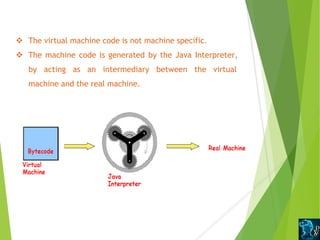
v The virtual machine code is not machine specific.
v The machine code is generated by the Java Interpreter,
by acting as an intermediary between the virtual
machine and the real machine.
Variables
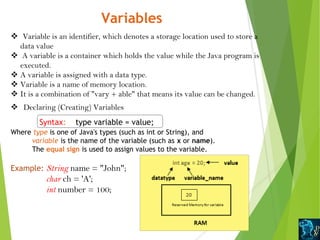
v Variable is an identifier, which denotes a storage location used to store a
data value
v A variable is a container which holds the value while the Java program is
executed.
v A variable is assigned with a data type.
v Variable is a name of memory location.
v It is a combination of vary + able that means its value can be changed.
v Declaring (Creating) Variables
Syntax: type variable = value;
Where type is one of Java's types (such as int or String), and 
variable is the name of the variable (such as x or name).
The equal sign is used to assign values to the variable.
Example: String name = John;
char ch = 'A';
int number = 100;
Variable Naming conventions
1) Variable names may consists letters, digits, _(underscore) 
 dollar ($).
2)  Variables naming cannot contain white spaces, 
  for example: int num ber = 100; // is invalid
      because the variable name has space in it.
3) Variable name can begin with special characters such as $ 
and _
4)  As per the java coding standards the variable name should 
begin with a lower case letter, 
for example: int num; 
5) Variable names are case sensitive in Java.
6) It should not be a Keyword.
7)  Variable names can be of any length.
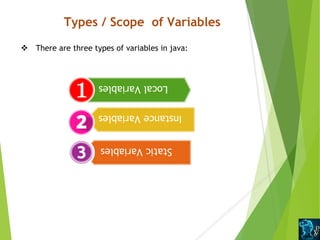
LocalVariables
InstanceVariables
StaticVariables
Types / Scope of Variables
v There are three types of variables in java:
1. Local Variable
 A variable defined within a block or method or constructor 
is called local variable.
 The scope of these variables exists only within the block in 
which the variable is declared. i.e. we can access these 
variable only within that block.
 A local variable cannot be defined with static keyword.
 These variable are created when the block in entered or the 
function is called and destroyed after exiting from the block 
or when the call returns from the function.
 Initialization of Local Variable is Mandatory.
2. Instance Variable
v Instance variables are non-static variables.
v A variable declared inside the class but outside the body of 
the method, Constructor or Block. 
v These  variables are created when an  object  of  the  class  is 
created and destroyed when the object is destroyed.
v Each instance(objects) of class has its own copy of instance 
variable.
v It  is  called  instance  variable  because  its  value  is  instance 
specific and is not shared among instances.
v Initialization  of  Instance  Variable  is  not  Mandatory.  Its 
default value is 0.
v Instance Variable can be accessed only by creating objects.
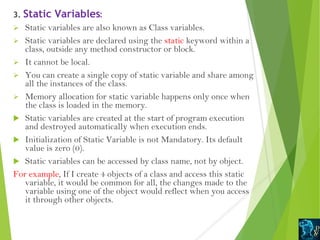
3. Static Variables:
Ø Static variables are also known as Class variables.
Ø Static variables are declared using the static keyword within a
class, outside any method constructor or block.
Ø It cannot be local.
Ø You can create a single copy of static variable and share among
all the instances of the class.
Ø Memory allocation for static variable happens only once when
the class is loaded in the memory.
 Static variables are created at the start of program execution
and destroyed automatically when execution ends.
 Initialization of Static Variable is not Mandatory. Its default
value is zero (0).
 Static variables can be accessed by class name, not by object.
For example, If I create 4 objects of a class and access this static
variable, it would be common for all, the changes made to the
variable using one of the object would reflect when you access
it through other objects.
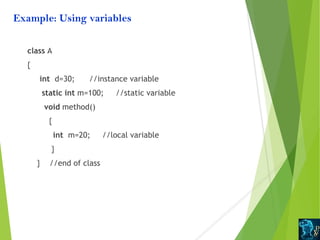
Example: Using variables
class A
{  
int  d=30; //instance variable  
static int m=100; //static variable  
void method()
{  
int  m=20; //local variable  
}  
} //end of class  
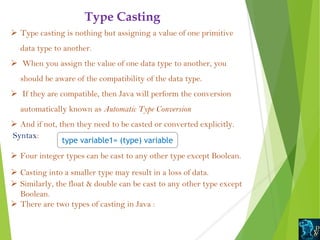
Type Casting
Ø Type casting is nothing but assigning a value of one primitive
data type to another.
Ø When you assign the value of one data type to another, you
should be aware of the compatibility of the data type.
Ø If they are compatible, then Java will perform the conversion
automatically known as Automatic Type Conversion 
Ø And if not, then they need to be casted or converted explicitly.
Syntax:
Ø Four integer types can be cast to any other type except Boolean.
Ø Casting into a smaller type may result in a loss of data.
Ø Similarly, the float  double can be cast to any other type except
Boolean.
Ø There are two types of casting in Java :
type variable1= (type) variable
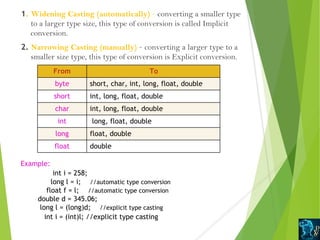
1. Widening Casting (automatically) – converting a smaller type
to a larger type size, this type of conversion is called Implicit
conversion.
2. Narrowing Casting (manually) – converting a larger type to a
smaller size type, this type of conversion is Explicit conversion.
From To
byte short, char, int, long, float, double
short int, long, float, double
char int, long, float, double
int long, float, double
long float, double
float double
Example:
int i = 258;
 long l = i; //automatic type conversion
float f = l; //automatic type conversion
double d = 345.06;
  long l = (long)d; //explicit type casting
int i = (int)l; //explicit type casting
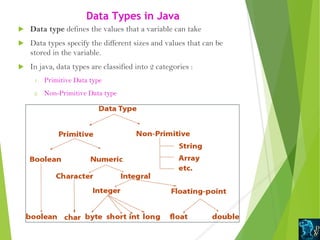
Data Types in Java
 Data type defines the values that a variable can take
 Data types specify the different sizes and values that can be
stored in the variable.
 In java, data types are classified into 2 categories :
1. Primitive Data type
2. Non-Primitive Data type
Primitive data types
 Primitive data types are the building blocks of data manipulation.
 These are the most basic data types available in Java.
 Java developers included these data types to maintain the portability of
java as the size of these primitive data types do not change from one
operating system to another.
 There are 8 types of primitive data types:
1. boolean data type
2. byte data type
3. char data type
4. short data type
5. int data type
6. long data type
7. float data type
8. double data type
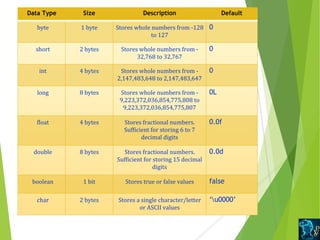
Data Type Size Description Default
byte 1 byte Stores whole numbers from -128 
to 127
0
short 2 bytes Stores whole numbers from -
32,768 to 32,767
0
int 4 bytes Stores whole numbers from -
2,147,483,648 to 2,147,483,647
0
long 8 bytes Stores whole numbers from -
9,223,372,036,854,775,808 to 
9,223,372,036,854,775,807
0L
float 4 bytes Stores fractional numbers. 
Sufficient for storing 6 to 7 
decimal digits
0.0f
double 8 bytes Stores fractional numbers. 
Sufficient for storing 15 decimal 
digits
0.0d
boolean 1 bit Stores true or false values false
char 2 bytes Stores a single character/letter 
or ASCII values
‘u0000’
Non-Primitive Data Types
 Non-Primitive data types refer to objects and hence they
are called reference types.
 Non-primitive types include Strings, Arrays, Classes,
Interface, etc.
Strings
Arrays
Interfaces
Classes
Non-
Primitive
Data types
Strings: String is a sequence of characters.
 used to store consecutive characters or proper 
sentences 
 But in Java, a string is an object that represents a 
sequence of characters. 
 The java.lang.String class is used to create a string 
object. 
Example:  String abc = “Satwika likes music;
Arrays:  Arrays in Java are homogeneous data structures
implemented in Java as objects.
Ø Arrays store one or more values o f a specific data type
and provide indexed access to store the same. A specific
element in an array is accessed by its index.
 It can store any type of data as the size of the array
is also declared by the programmer.
Classes:  Classes are used to create objects
 A class in Java is a blueprint which includes all your 
data.  
 A class contains fields(variables) and methods to 
describe the behavior of an object.
Interface:  An interface is like a dashboard or control 
panel for a class. 
Ø It has buttons/functions for the data types 
defined, but the implementation is somewhere 
else.
Ø  Like a class, an interface can have methods and 
variables, but the methods declared 
in interface are by default abstract (only method 
signature, no body).
Difference between primitive and non-primitive data types
 Primitive  types  are  predefined.  Non-primitive  types  are 
created by the programmer and is not defined by Java (except 
for String).
 Non-primitive types  can  be  used  to  call  methods  to  perform 
certain operations, while primitive types cannot.
 A primitive type has always a value, while non-primitive types 
can be null.
 A  primitive  type  starts  with  a  lowercase  letter,  while  non-
primitive types starts with an uppercase letter.
 The size of a primitive type depends on the data type, while 
non-primitive types have all the same size.
Summary
 In this lesson you learnt about
 About Java?
 Java Virtual Machine
 Variables
 Types / Scope of variables
 Type Casting
 Data Types
Java data types, variables and jvm

Java data types, variables and jvm