COURSE BOOK | Course coordinator and list of teachers | Two Lectures on Introduction &


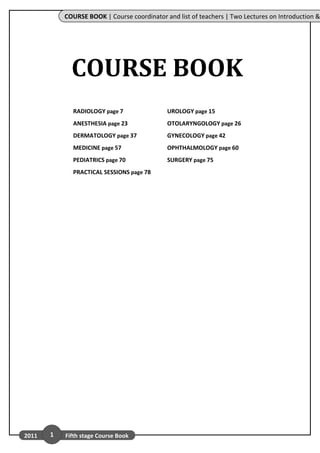
             COURSE BOOK
             RADIOLOGY page 7                UROLOGY page 15
             ANESTHESIA page 23              OTOLARYNGOLOGY page 26
             DERMATOLOGY page 37             GYNECOLOGY page 42
             MEDICINE page 57                OPHTHALMOLOGY page 60
             PEDIATRICS page 70              SURGERY page 75
             PRACTICAL SESSIONS page 78


2011   1   Fifth stage Course Book
COURSE BOOK | Course coordinator and list of teachers | Two Lectures on Introduction &


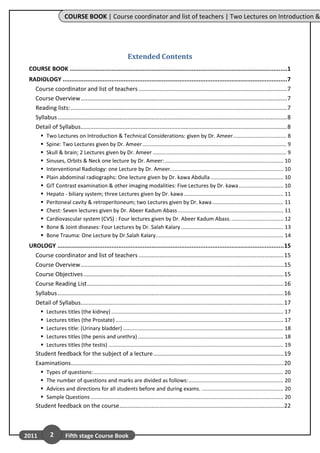
                                                             Extended Contents
 COURSE BOOK .............................................................................................................................1
 RADIOLOGY .................................................................................................................................7
   Course coordinator and list of teachers ............................................................................................ 7
   Course Overview ................................................................................................................................ 7
   Reading lists: ...................................................................................................................................... 7
   Syllabus .............................................................................................................................................. 8
   Detail of Syllabus................................................................................................................................ 8
          Two Lectures on Introduction & Technical Considerations: given by Dr. Ameer .................................... 8
          Spine: Two Lectures given by Dr. Ameer ................................................................................................. 9
          Skull & brain; 2 Lectures given by Dr. Ameer .......................................................................................... 9
          Sinuses, Orbits & Neck one lecture by Dr. Ameer: ................................................................................ 10
          Interventional Radiology: one Lecture by Dr. Ameer. ........................................................................... 10
          Plain abdominal radiographs: One lecture given by Dr. kawa Abdulla ................................................. 10
          GIT Contrast examination & other imaging modalities: Five Lectures by Dr. kawa .............................. 10
          Hepato - biliary system; three Lectures given by Dr. kawa ................................................................... 11
          Peritoneal cavity & retroperitoneum; two Lectures given by Dr. kawa ................................................ 11
          Chest: Seven lectures given by Dr. Abeer Kadum Abass ....................................................................... 11
          Cardiovascular system (CVS) : Four lectures given by Dr. Abeer Kadum Abass. ................................... 12
          Bone & Joint diseases: Four Lectures by Dr. Salah Kalary ..................................................................... 13
          Bone Trauma: One Lecture by Dr.Salah Kalary. ..................................................................................... 14
 UROLOGY .................................................................................................................................. 15
   Course coordinator and list of teachers .......................................................................................... 15
   Course Overview .............................................................................................................................. 15
   Course Objectives ............................................................................................................................ 15
   Course Reading List .......................................................................................................................... 16
   Syllabus ............................................................................................................................................ 16
   Detail of Syllabus.............................................................................................................................. 17
          Lectures titles (the kidney) .................................................................................................................... 17
          Lectures titles (the Prostate) ................................................................................................................. 17
          Lectures title: (Urinary bladder) ............................................................................................................ 18
          Lectures titles (the penis and urethra) .................................................................................................. 18
          Lectures titles (the testis) ...................................................................................................................... 19
    Student feedback for the subject of a lecture ................................................................................. 19
    Examinations.................................................................................................................................... 20
          Types of questions: ................................................................................................................................ 20
          The number of questions and marks are divided as follows: ................................................................ 20
          Advices and directions for all students before and during exams. ....................................................... 20
          Sample Questions .................................................................................................................................. 20
    Student feedback on the course ...................................................................................................... 22


2011         2        Fifth stage Course Book
COURSE BOOK | Course coordinator and list of teachers | Two Lectures on Introduction &


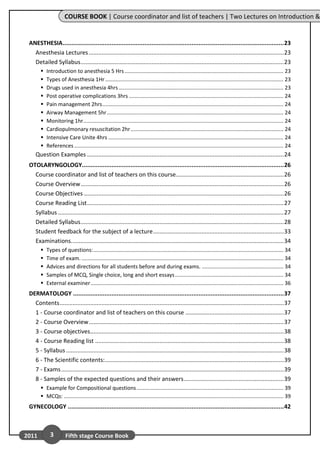
 ANESTHESIA ............................................................................................................................... 23
   Anesthesia Lectures ......................................................................................................................... 23
   Detailed Syllabus .............................................................................................................................. 23
          Introduction to anesthesia 5 Hrs ........................................................................................................... 23
          Types of Anesthesia 1Hr ........................................................................................................................ 23
          Drugs used in anesthesia 4hrs ............................................................................................................... 23
          Post operative complications 3hrs ........................................................................................................ 24
          Pain management 2hrs .......................................................................................................................... 24
          Airway Management 5hr ....................................................................................................................... 24
          Monitoring 1hr....................................................................................................................................... 24
          Cardiopulmonary resuscitation 2hr ....................................................................................................... 24
          Intensive Care Unite 4hrs ...................................................................................................................... 24
          References ............................................................................................................................................. 24
    Question Examples .......................................................................................................................... 24
 OTOLARYNGOLOGY.................................................................................................................... 26
   Course coordinator and list of teachers on this course................................................................... 26
   Course Overview .............................................................................................................................. 26
   Course Objectives ............................................................................................................................ 26
   Course Reading List .......................................................................................................................... 27
   Syllabus ............................................................................................................................................ 27
   Detailed Syllabus .............................................................................................................................. 28
   Student feedback for the subject of a lecture ................................................................................. 33
   Examinations.................................................................................................................................... 34
          Types of questions: ................................................................................................................................ 34
          Time of exam. ........................................................................................................................................ 34
          Advices and directions for all students before and during exams. ....................................................... 34
          Samples of MCQ, Single choice, long and short essays ......................................................................... 34
          External examiner .................................................................................................................................. 36
 DERMATOLOGY ......................................................................................................................... 37
   Contents ........................................................................................................................................... 37
   1 - Course coordinator and list of teachers on this course ............................................................. 37
   2 - Course Overview ......................................................................................................................... 37
   3 - Course objectives ........................................................................................................................ 38
   4 - Course Reading list ..................................................................................................................... 38
   5 - Syllabus ....................................................................................................................................... 38
   6 - The Scientific contents:............................................................................................................... 39
   7 - Exams .......................................................................................................................................... 39
   8 - Samples of the expected questions and their answers .............................................................. 39
        Example for Compositional questions ................................................................................................... 39
        MCQs: .................................................................................................................................................... 39
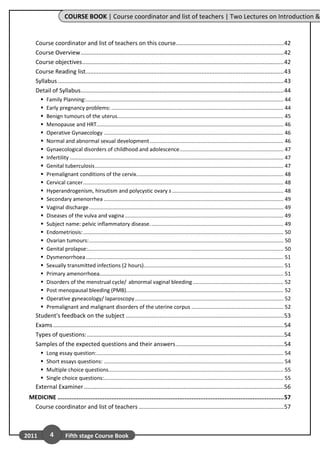
 GYNECOLOGY ............................................................................................................................ 42


2011         3        Fifth stage Course Book
COURSE BOOK | Course coordinator and list of teachers | Two Lectures on Introduction &


    Course coordinator and list of teachers on this course................................................................... 42
    Course Overview .............................................................................................................................. 42
    Course objectives ............................................................................................................................. 42
    Course Reading list........................................................................................................................... 43
    Syllabus ............................................................................................................................................ 43
    Detail of Syllabus.............................................................................................................................. 44
          Family Planning: ..................................................................................................................................... 44
          Early pregnancy problems: .................................................................................................................... 44
          Benign tumours of the uterus................................................................................................................ 45
          Menopause and HRT.............................................................................................................................. 46
          Operative Gynaecology ......................................................................................................................... 46
          Normal and abnormal sexual development .......................................................................................... 46
          Gynaecological disorders of childhood and adolescence ...................................................................... 47
          Infertility ................................................................................................................................................ 47
          Genital tuberculosis ............................................................................................................................... 47
          Premalignant conditions of the cervix. .................................................................................................. 48
          Cervical cancer ....................................................................................................................................... 48
          Hyperandrogenism, hirsutism and polycystic ovary s ........................................................................... 48
          Secondary amenorrhea ......................................................................................................................... 49
          Vaginal discharge ................................................................................................................................... 49
          Diseases of the vulva and vagina ........................................................................................................... 49
          Subject name: pelvic inflammatory disease. ......................................................................................... 49
          Endometriosis: ....................................................................................................................................... 50
          Ovarian tumours: ................................................................................................................................... 50
          Genital prolapse:.................................................................................................................................... 50
          Dysmenorrhoea ..................................................................................................................................... 51
          Sexually transmitted infections (2 hours) .............................................................................................. 51
          Primary amenorrhoea............................................................................................................................ 51
          Disorders of the menstrual cycle/ abnormal vaginal bleeding ............................................................. 52
          Post menopausal bleeding (PMB).......................................................................................................... 52
          Operative gyneacology/ laparoscopy .................................................................................................... 52
          Premalignant and malignant disorders of the uterine corpus .............................................................. 52
    Student's feedback on the subject .................................................................................................. 53
    Exams ............................................................................................................................................... 54
    Types of questions: .......................................................................................................................... 54
    Samples of the expected questions and their answers ................................................................... 54
          Long essay question:.............................................................................................................................. 54
          Short essays questions: ......................................................................................................................... 54
          Multiple choice questions...................................................................................................................... 55
          Single choice questions:......................................................................................................................... 55
    External Examiner ............................................................................................................................ 56
 MEDICINE .................................................................................................................................. 57
  Course coordinator and list of teachers .......................................................................................... 57


2011         4         Fifth stage Course Book
COURSE BOOK | Course coordinator and list of teachers | Two Lectures on Introduction &


    Course Overview .............................................................................................................................. 57
    Course objectives ............................................................................................................................. 58
    Course Reading List .......................................................................................................................... 58
    Exams ............................................................................................................................................... 58
        Composition (Essay) ;............................................................................................................................. 58
        MCQs ..................................................................................................................................................... 59
 OPHTHALMOLOGY ..................................................................................................................... 60
   Course Information: ......................................................................................................................... 60
   Course Description........................................................................................................................... 61
   Class objectives: ............................................................................................................................... 61
   Materials and Resources.................................................................................................................. 61
   Expectations and Policies................................................................................................................. 61
   Instruction methodology: ................................................................................................................ 62
   Theoretical Lectures Outline............................................................................................................ 62
   Practical Course Outline .................................................................................................................. 63
   Grading............................................................................................................................................. 64
   Detail of Syllabus.............................................................................................................................. 64
        Introduction to ophthalmology ............................................................................................................. 64
        The Ocular Examination......................................................................................................................... 65
    Examinations.................................................................................................................................... 67
          Types of questions: ................................................................................................................................ 67
          The number of questions and marks are divided as follows: ................................................................ 67
          Advices and directions for all students before and during exams. ....................................................... 67
          Sample of MCQ and long and short essays ........................................................................................... 67
    Student feedback for the subject of a lecture ................................................................................. 68
 PEDIATRICS ................................................................................................................................ 70
   Course Book Content ....................................................................................................................... 70
   Course objectives ............................................................................................................................. 70
   Course overview .............................................................................................................................. 70
   Course Reading list; ......................................................................................................................... 70
   Syllabus ............................................................................................................................................ 71
   Exams ............................................................................................................................................... 71
          Multiple choice questions: .................................................................................................................... 72
          True and false questions:....................................................................................................................... 72
          Problem solving questions ..................................................................................................................... 72
          Data questions; ...................................................................................................................................... 72
          Short assay questions ............................................................................................................................ 73
          Enumerate questions;............................................................................................................................ 73
          Exam’s duration: .................................................................................................................................... 74
          Clinical exams; ....................................................................................................................................... 74
 SURGERY ................................................................................................................................... 75


2011         5        Fifth stage Course Book
COURSE BOOK | Course coordinator and list of teachers | Two Lectures on Introduction &


    Course coordinator and list of teachers on this course................................................................... 75
    Course Overview .............................................................................................................................. 75
    Course Reading List .......................................................................................................................... 75
    Syllabus ............................................................................................................................................ 75
    Student feedback for the subject of a lecture ................................................................................. 76
    Examinations.................................................................................................................................... 76
    Examples: ......................................................................................................................................... 76
 PRACTICAL SESSIONS ................................................................................................................. 78
   Medicine .......................................................................................................................................... 78
   Neurosurgery ................................................................................................................................... 79
   Thoracic and Cardiovascular Surgery............................................................................................... 81


2011         6        Fifth stage Course Book
RADIOLOGY | Course coordinator and list of teachers | Two Lectures on Introduction &


                       RADIOLOGY
 Radiology for 5th Year Students of College of Medicine/ University of Sulaimani: 45 Lectures

 Course coordinator and list of teachers
 1 - Name of the Course: Radiology.
 2 - Lecturer tutor in charge: Dr. Ameer Ahmad
 3 - Department Branch and the college: Dept. Surgery/ college of medicine/ University of
 Sulaimani
 4 - Contacts:
  - Address: University of Sulaimani/ College of medicine/ Dept.
 of Surgery.
 E - Mail: amirkurda@yahoo.com
           U                                 U


 - Website Link:
          - Other participant Lecturers:
 1 - Dr. Kawa Abdulla
 2 - Dr.Abeer Kadhum.
 3 - Dr.Salal Fatih Tel no. 07701473771 salahkalary@yahoo.com
                                         U                              U


 4 - Dr. Nasreen Atrooshi

 Course Overview
 The student will be taught how to use the different imaging modalities properly & which imaging
 modality fits particular situation.
 The student should also learn how to read the radiographs of common clinical problems e.g. he or
 she should learn how to diagnose different fractures, pneumothorax, pneumonia, intestinal
 obstruction, pneumoperitoneum etc….. Not only that the graduated doctor should also learn how
 to read CT scan in patients with Stroke & head injury.
 Lastly the student should be taught about the update of Radiology & that radiology is no more used
 for diagnosis only, it is taking part in the therapy as well i.e. Interventional Radiology.

 Reading lists:
 1 - Diagnostic Imaging …Peter Armstrong & Martin Wastie…..
 Sixth edition ……2009
 2 - Textbook of Radiology & Imaging …….David Sutton
 Seventh Edition….2003
 3 - Bailey & Love's Short Practice of Surgery
 24th Edition…2004 2nd Chapter
 4 - WWW.LearningRadiology
       U                          U


2011       7   Fifth stage Course Book
RADIOLOGY | Syllabus | Two Lectures on Introduction & Technical Considerations: given b


 Syllabus
 No.        Title of the Subject                              Lecturer's/Tutor's Name

 2          Introduction                                      Dr.Ameer

 7          Chest diseases                                    Dr.Abeer

 4          Cardio - vascular diseases                        Dr.Abeer

 1          Plain abdomen                                     Dr.Kawa

 5          GIT                                               Dr.Kawa


            Hepato - biliary system
 3                                                            Dr.Kawa
            Pancreas & spleen


            Peritoneal cavity and
 2                                                            Dr.Kawa
            Retroperitoneum


 7          Urinary tract                                     Dr.Nasreen

 3          OBGYN                                             Dr.Nasreen

 4          Bone & joint diseases                             Dr.Salah

 1          Bone Trauma                                       Dr.Salah

 2          Spine                                             Dr.Ameer

 2          Skull & Brain                                     Dr.Ameer

 1          Sinuses, orbits & Neck                            Dr.Ameer

 1          Interventional Radiology                          Dr.Ameer

 45         Total


 Detail of Syllabus
 Two Lectures on Introduction & Technical Considerations: given by Dr. Ameer
 Objectives:
 - Proper use of imaging department.
 - How X - rays are produced in Conventional Radiography.


2011    8         Fifth stage Course Book
RADIOLOGY | Detail of Syllabus | Spine: Two Lectures given by Dr. Ameer


 Syllabus:
 - The basic radiographic densities.
 - Projections in conventional radiology:…PA. AP. Lateral, Horizontal X - ray
 beam, Lateral decubitus
 - CT Scan, Ultrasound, MRI, Radionuclide imaging & PET, Basic principles
 - Contrast agents in Conventional Radiography & CT.. Definition & side effects
 - PACS
 - Radiation Hazards

 Spine: Two Lectures given by Dr. Ameer
 Objectives:
  - Role of different imaging modalities in the diseases of the spine. (Plain
 radiographs, MRI, CT, Myelography)

 Syllabus:
  - Signs of abnormality on plain films.
  - How metastases/ myeloma/ lymphoma appear on different imaging modalities and which one is
 the best.
  - Infection of spine; Pyogenic & TB spondylodiscitis.
  - Spinal Trauma.
  - Degenerative disc disease (DDD) ; plain film & MRI findings.
  - Disc herniation.
  - Failed back syndrome.
  - Spinal canal stenosis.
  - Ankylosing Spondylitis.
  - Spinal dysraphism.
  - Spondylolisthesis.
  - Spinal cord compression.
  - Intrinsic disorders of the spinal cord..

 Skull & brain; 2 Lectures given by Dr. Ameer
 Objectives:
 - Role of different imaging modalities in head injury, Stroke, Brain tumors.

 Syllabus:
 - Plain film; normal & abnormal intra - cranial calcification.
 - Signs of raised intra - cranial pressure on Plain films.
 - Normal & abnormal Brain CT.
 - Cardinal signs of abnormal CT brain.
 - CT angiography.
 - MRI of the brain.
 - MRA.
 - US of the Brain in neonates.
 - Brain Tumors; How common brain tumors appear by CT & MRI? e.g. glioma, meningioma,
 acoustic neuroma, pituitary tumors & metastases.
 - Stroke; Role of CT to exclude hemorrhage initially.
 - CT in subarachnoid hemorrhage...


2011     9     Fifth stage Course Book
RADIOLOGY | Detail of Syllabus | Sinuses, Orbits & Neck one lecture by Dr. Ameer:


  - Role of CT in infarction.
  - Role of MRI in infarction. DWI
  - AVM in MRI & MRA.
  - Infection & brain abscesses.
  - MS.
  - Head injury; Role of CT to show epidural, subdural & parenchymal hemorrhage. Contusion &
 fractures.

 Sinuses, Orbits & Neck one lecture by Dr. Ameer:
 Objectives
 - Role of Plain film & CT in sinusitis.
 - Different causes of opaque sinuses.
 - Role of CT in blow out fracture.
 - Exophthalmus.
 - Diseases of Salivary glands & Role of plain radiograph, Sialography, CT & MRI.
 - Thyroid nodules; Role of US & radionuclide scan.

 Interventional Radiology: one Lecture by Dr. Ameer.
 Objectives
 To let the student know that Imaging has not only the role in diagnosis of diseases, but it can be of
 great help in treatment & may replace surgical procedures.:
 How can imaging guide biopsy? Draining abscesses? putting stents & e.g biliary drainage ?.
 Different interventional procedures via angiography; e.g. embolisation, thrombolysis.

 Plain abdominal radiographs: One lecture given by Dr. kawa Abdulla
 Objectives:
 Proper analysis of plain films
 Illustration of causes of abnormal plain films

 Syllabus:
 - The basic plain abdominal radiographs.
 - illustration of normal & abnormal plain films
 - analysis of GIT dilatation
 - analysis of extraluminal air.
 - analysis of GIT opacities & calcification on plain films
 - analysis of hepatic & splenic abnormalities on plain films
 - analysis of ascites; abdomino - pelvic masses on plain films

 GIT Contrast examination & other imaging modalities: Five Lectures by Dr. kawa
 Objectives:
 Analysis of role & findings of contrast studies & different imaging modalities in the GIT including US;
 CT; MRI; isotope studies & angiography

 Syllabus:
 - proper technique; limitations & hazards of contrast examinations
 - proper technique; limitations & hazards of other imaging modalities


2011    10     Fifth stage Course Book
RADIOLOGY | Detail of Syllabus | Hepato - biliary system; three Lectures given by Dr. kawa


 - analysis of causes & findings of barium study abnormalities; including strictures; filling defects &
 ulcerations
 - dedicated evaluation of major topics: GIT malignancies; peptic ulcer; malabsorption syndrome;
 ulcerative colitis & Crohns disease with diverticular disease.
 - emphasis on the role & findings on US; CT; MRI
 - emphasis on the role & findings of isotope studies& angiography especially in GI bleeding

 Hepato - biliary system; three Lectures given by Dr. kawa
 Objectives:
  - analysis of role & findings of US; CT; MRI; isotope studies & angiography in Hepatic; biliary;
 splenic & pancreatic problems
  - analysis of role; findings; limitation& hazards of biliary contras examinations & isotope studies.

 Syllabus:
 - normal imaging appearances of liver; spleen; pancreas & biliary system with the gall bladder.
 - analysis of causes & findings of liver masses; cysts & abscesses.
 - analysis of findings in cirrhosis & portal hypertension and in liver trauma.
 - analysis of role; findings; limitation& hazards of ERCP; PTC –
 - analysis of imaging findings & limitations in cholecystitis ; GB & bile duct stones
 - analysis of imaging evaluation of jaundice starting with non invasive studies US, CT; MRI & MRCP
 with occasional isotope studies then to diagnostic & therapeutic ERCP & PTC
 - dedicated evaluation of causes & findings in splenomegaly
 - emphasis on the imaging findings in splenic trauma
 - analysis of imaging role & findings in pancreatic tumors and in acute & chronic pancreatitis.

 Peritoneal cavity & retroperitoneum; two Lectures given by Dr. kawa
 Objectives:
  - analysis of imaging role & findings in ascites; peritoneal tumors & intra - peritoneal abscesses
  - analysis of imaging role; findings & limitation in evaluation of the adrenal glands; abdominal
 aorta; para - aortic lymphadenopathy & retroperitoneal
 tumors and abscesses

 Syllabus:
 - analysis of imaging role & findings in ascites
 - analysis of role & findings of US; CT & isotope studies in intra - peritoneal abscesses
 - analysis of findings on US & CT in peritoneal tumors
 - US; CT & MRI appearance of normal retroperitoneal structures
 - US & CT evaluation of para - aortic lymphadenopathy.
 - imaging evaluation of adrenal adenoma - functioning, cons, Cushing's and non functioning
 adenomas
 - US; CT; MRI & isotope studies evaluation of pheochromocytoma & adrenal metastases
 - Aortic aneurysms US; CT; MRI & angiographic evaluation.
 - imaging evaluation of retroperitoneal abscesses & tumors

 Chest: Seven lectures given by Dr. Abeer Kadum Abass
 Objectives:
 Role of different imaging modalities in the evaluation of different chest diseases.


2011    11     Fifth stage Course Book
RADIOLOGY | Detail of Syllabus | Cardiovascular system (CVS) : Four lectures given by Dr.


 Proper reading of normal CXR.
 Correlation between clinical & CXR findings for accurate way of achieving diagnosis.

 Syllabus:
 Normal CXR interpretation.
 Abnormal chest radiograph; Silhouette sign & radiological signs of lung diseases: air space filling
 (pul. Odema & pul. consolidation), pul. collapse, spherical pul. Shadows, band like pul. Shadow,
 wide spread small shadows.
 Pleura; CXR findings, & causes in pleural effusion (free & loculated).
 Pleural thickening.
 Pleural tumors.
 Pneumo thorax (diagnosis, causes & types).
 Mediastinum; compartment, plain chest film findings in mediastinal masses & complementary CT.
 Pneumo - mediastium (causes & CXR findings).
 Hilar enlargement; unilateral & bilateral; causes & CXR findings.
 Diaphragm: Normal anatomy, variant & causes of marked unilateral elevation of hemi diaphragm.
 Specific diseases : Infection : Bacterial pneumonia, viral & mycoplasma pneumonia, lung abscess,
 pulmonary TB (Primary & post primary), fungal & parasitic disease, pneumonia in
 immunocompromised host, Sarcoidosis, diffuse pulmonary fibrosis ; CXR findings & try to
 determine the cause of the abnormal CXR findings.
 Diseases of air way passages (Asthma, bronchiolitis, acute bronchitis, chronic obstructive air way
 diseases, cystic fibrosis) ; definition, & CXR findings).
 Respiratory distress in the new born (Meconium aspiration & hyaline membranes disease) CXR
 findings & complications of therapy.
 ARDS; causes & CXR findings.
 Pulmonary embolism & infarction (CXR diagnosis, role of CT angiography & Radionuclide scanning).
 Trauma to the chest (CXR & CT) findings.
 CA Bronchus (CXR findings in peripheral & central), spread.
 Metastatic neoplasm to the chest (lung, chest wall, pleura, & mediastium).
 Lymphoma in the chest.
 Mammography; indications, plain radiograph & US findings in benign & malignant focal lesions.

 Cardiovascular system (CVS) : Four lectures given by Dr. Abeer Kadum Abass.
 Objectives:
 1 - Role of imaging techniques in evaluation of cardiovascular disease.
 2 - Proper interpretation of the CXR; regarding normal & cardiac diseases emphasized that CXR is
 useful for looking at the effects of cardiac diseases on the lung & pleural cavity, but provide only
 limited information about the heart itself.

 Syllabus:
 Evaluation of the CVS, with CXR, Echo & Doppler, CT & CT angiography, MRI & MRA, Radionuclide
 techniques, cardiac catheterization & angiography.
 Cardiac disease; size (common causes of chamber enlargement), Chamber hypertrophy &
 dilatation.
 Valve movement deformity & calcification.
 Ventricular contractility.
 Pericardial diseases (effusion & calcification).


2011    12     Fifth stage Course Book
RADIOLOGY | Detail of Syllabus | Bone & Joint diseases: Four Lectures by Dr. Salah Kalary


 Pulmonary vessels: increased flow (CXR appearance & causes), decreased flow (CXR appearance &
 causes).
 Pulmonary arterial hypertension causes & CXR appearance.
 Pulmonary venous hypertension causes & CXR appearance.
 Pulmonary odema: Types, causes & CXR findings.
 Specific cardiac disorders; Heart failure, valvular heart disease, LT – atrial myxoma & other
 intracardiac tumors.
 Common Congenital heart diseases; LT –RT shunt, coarctation of aorta, Tetrology of Fallot.

 Bone & Joint diseases: Four Lectures by Dr. Salah Kalary
 Objectives:
 First: principal of reading of bone images in different modalities specially plain X - ray
 Second: how student can approach focal bone lesion & steps of imaging consequences
 Third: principles of differentiation between aggressive & benign bone lesions
 Fourth: principles of differentiation between joint degenerative changes like OA & inflammatory
 joint diseases like RA
 Fifth: information about criteria of differentiation between most common types of polyarticular
 joint diseases.

 Syllabus:
 Imaging techniques used in Dx of bone disease (role of different imaging modalities in approaching
 the bone disease
 Signs of bone disease in plain X - ray
 Types of bone diseases; focal, generalized & alteration in the trabecular pattern or changes in the
 shape
 Radiological approach for diagnosis of solitary bone lesions
 Bone tumors, including primary (benign & malignant) & secondaries
 Bone infection: Pyogenic (acute & chronic) & TB
 Generalize decreased bone density (osteopenia)
 Osteoporosis.
 Rickets & Osteomalacia.
 Hyperparathyroidism.
 Multiple myeloma.
 Generalized increase in bone density
 1 - Paget’s disease
 2 - Thalassemia
 3 - Radiation induced bone diseases
 Changes in bone shapes
 Diaphyseal aclasia
 Joints diseases (2 lectures each of 1 hr)
 Imaging technique (roles of each modalities in Dx of joint disease)
 Approach in Dx of arthritis & radiological features of deferent type of arthritis including OA,
 inflammatory & metabolic arthritis & principle differentiating radiological points between them
 Osteochondritis including Perthe’s, Kienbock’s disease
 Freiberg’s disease Kohler’s disease
 Slipped femoral epiphysis
 Developmental dysplasia of the hips (DDH or CDH)


2011    13    Fifth stage Course Book
RADIOLOGY | Detail of Syllabus | Bone Trauma: One Lecture by Dr.Salah Kalary.


 Internal derangement of the knee joint
 Shoulder Rotator cuff tear

 Bone Trauma: One Lecture by Dr.Salah Kalary.
 Objectives:
 Role of plain radiograph in bone trauma.
 Signs of Fracture & dislocation.
 Role of nuclear medicine, CT & MRI in bone trauma,
 Stress fracture.
 Insufficiency fracture.
 Pathological fracture.
 Salter Harris classification.
 Non - accidental trauma.


2011    14    Fifth stage Course Book
UROLOGY | Course coordinator and list of teachers | Bone Trauma: One Lecture by Dr.Sala


                             UROLOGY
 Fifth Stage
 Department of Surgery
 College of Medicine
 2010 - 2011

 Course coordinator and list of teachers
 Course: urology
 Course coordinator: Dr. Ali Kamal
 Department: surgery
 College: Medicine
 Course coordinator link: alikamal22@yahoo.com
 Tel. +9647705449905
 List of teachers on this course:
 Dr. Ismaeel Hama Ameen
 Dr. Aso Omer Rasheed
 Dr. Sarwar Noore Mahmoud
 Dr. Ali Kamal M.Sami
 Dr. Ahmed Abdulhameed


 Course Overview
 The course of urology is dedicated to deal with undergraduate level to know the importance of
 urology in the daily activities of the junior doctors and the sessions and the lectures are overall
 based on simple principles and standards for the juniors in urology to understand the physiology
 and pathology and management of these problems in simple and qualified methods in 16 lectures.
 The subjects should enable the students to understand the procedures of intervention in urology
 and the justification of such intervention and when to decide to treat conservatively and when to
 interfere with the disease process with a wide base of knowledge that will help the students to
 widen their experiences through journals and textbooks after understanding the basics of urology.


 Course Objectives
 At the end of the course of urology, the students should be able to master and perform the basic
 skills that are considered fundamentals in urology and to have basic urological experience needed
 for doctors in urology department or in case of urological emergency, and some of these objectives
 include:
      1. Insertion of urethral Foley’s catheter.
      2. Performing suprapubic cystostomy


2011    15     Fifth stage Course Book
UROLOGY | Course Reading List | Bone Trauma: One Lecture by Dr.Salah Kalary.


       3.   Diagnosing urine retention with its management.
       4.   Suspecting urethral injury and urethral rupture.
       5.   Diagnosing and treatment of urological diseases.
       6.   Suspecting malignancy and differentiating from benign lesions.

 Course Reading List
       1.   1 - Baily and Love, short practice of surgery
       2.   2 - Smith’s urology
       3.   3 - Journal of Urology. American Urological Association.
       4.   4 - European association of urology, clinical guidelines.

 Syllabus

  No.       Title of subject                                                Lecturer/Tuttor’s name

  1         kidney and urinary symptoms                                     Dr. Aso Omer Rasheed
  2         Investigation in urology                                        Dr. Aso Omer Rasheed
  3         Congenital anomalies of UT                                      Dr. Aso Omer Rasheed
  4         infection                                                       Dr. Aso Omer Rasheed
  5         Anuria                                                          Dr. Aso Omer Rasheed
  6         hydronephrosis                                                  Dr. Aso Omer Rasheed
  7         Urolithiasis                                                    Dr. Aso Omer Rasheed
  8         renal truma                                                     Dr. Aso Omer Rasheed
  9         renal tumor                                                     Dr. Aso Omer Rasheed
  10        Prostate infections 1                                           Dr. Sarwar Noore
  11        Prostate inferctions 2                                          Dr. Sarwar Noore
            BPH 1
  12                                                                        Dr. Sarwar Noore

  13        BPH 2                                                           Dr. Sarwar Noore
  14        Carcinoma of prostate 1                                         Dr. Sarwar Noore
  15        Carcinoma of prostate 2                                         Dr. Sarwar Noore
  No.       Title of subject                                                Lecturer/Tuttor’s name
  16        Urinary bladder anatomy, physiology and pathology               Dr. Ali Kamal
  17        Rupture of urinary bladder, urine retention                     Dr. Ali Kamal
  18        Neuropathic bladder + urinary incontinence                      Dr. Ali Kamal
  19        Urinary bladder stones, vesical fistula, bladder diverticulum   Dr. Ali Kamal
  20        Bladder tumors                                                  Dr. Ali Kamal


2011        16       Fifth stage Course Book
UROLOGY | Detail of Syllabus | Lectures titles (the kidney)


  21    Urinary bladder schistosomiasis,                             Dr. Ali Kamal
  22    Urethra and penis, anatomy and congenital anomalies          Dr. Ahmed Abdulhamed
  23    Hypospadias                                                  Dr. Ahmed Abdulhamed
  24    Acquired urethral stricture                                  Dr. Ahmed Abdulhamed
  25    Disorders of female urethra                                  Dr. Ahmed Abdulhamed
        Ectopic testis and cryptorchidism
  26                                                                 Dr.Ismaeel Hama amen
                                                                     Dr.Ismaeel Hama amen
  27    Hydrocele

  28    Orchitis                                                     Dr.Ismaeel Hama amen
  29    Torsion of the spermatic cord                                Dr.Ismaeel Hama amen
  30    Tumors of the testis                                         Dr.Ismaeel Hama amen


 Detail of Syllabus
 Lectures titles (the kidney)
 Lecturer (dr. Aso Omer)

 Objectives:
 these lectures are dedicated to help the medical students understand the importance of the
 kidneys in daily practice as a common problem that they will face every day in the hospital and
 urinary emergency of renal trauma or renal stones or anuria or infection of the kidneys, the
 objectives are:
     a. The function of kidneys.
     b. The investigations needed to diagnose and define renal problems.
     c. To differentiate between anuria and urine retention.
     d. To be clinically capable of differentiation between renal colic and acute abdomen.
     e. Management of renal colic.
     f. The lines of treatment of renal colic and renal pain.
     g. Surgical treatment of renal tumor.

 The lectures include:
    a. Introduction to kidney function and physiology of urine formation.
    b. Causes of renal colic, renal tumor, hydronephrosis, anuria, renal trauma and their managment

 Lectures titles (the Prostate)
 Lecturer (dr. Sarwar Noore)

 Objectives:
 these lectures are dedicated to help the medical students understand the importance of the
 prostate as a common problem that they will face every day in the hospital and urinary emergency
 of hematuria or urine retention or infection of the prostate, the objectives are:
     1. To understand the function of prostate.


2011    17     Fifth stage Course Book
UROLOGY | Detail of Syllabus | Lectures title: (Urinary bladder)


       2.   The investigations needed to diagnose and define prostate infections and relation to LUTS.
       3.   To differentiate between benign prostatic hyperplasia and prostatic carcinoma.
       4.   To be clinically capable of performing rectal examination.
       5.   Management of BPH.
       6.   Surgical treatment of prostatic carcinoma.

 The lectures include:
    a. Introduction to prostate anatomy and physiology.
    b. Presentation, diagnosis and treatment of prostatic problems.

 Lectures title: (Urinary bladder)
 Lecturer name: Dr. Ali kamal

 Objectives:
 Theses lectures are directed to dedicated to help the medical students understand the functions
 and anatomy and micturition process and the mechanism of urinary retention in daily practice as a
 common problem that they will encounter while dealing with patients suffering from urinary
 frequency and hematuria or urinary bladder carcinoma, also the rupture of bladder.the objectives
 are:
     1. The causes of urinary retention, also the causes of urinary bladder rupture.
     2. The difference between the urinary retention and anuria
     3. To differentiate between acute and chronic retention.
     4. To be clinically capable of differentiate between intraperitoneal and extraperitoneal rupture
        of bladder.
     5. Management of retention.
     6. The contraindications to catheterization in cases of urine retention with urethral injury.
     7. Surgical treatment of rupture of urinary bladder, , vesical fistula.

 The lectures include:
    a. Introduction to urinary bladder function and physiology of micturition. and meaning of urine
        retention.
    b. presentation and management of bladder stones, infections, and malignancy, fistulas,
        congenital anomalies.
    c. Causes of urine retention and classification of urine retention acute and chronic, neurogenic
        and obstructive and presentation of patients.
    d. What is difference between intraperitoneal and extraperitoneal bladder rupture, how to
        diagnose both and treatment of both types.

 References:
    1. Baily and Love short practice of surgery
    2. Journal of urology.

 Lectures titles (the penis and urethra)
 Lecturer (dr. Ahmed abdulhameed)


2011        18    Fifth stage Course Book
UROLOGY | Student feedback for the subject of a lecture | Lectures titles (the testis)


 Objectives:
 These lectures are dealing with the penis and urethra and are intending to introduce the penis and
 urethral problems as congenital and acquired diseases.
 the objectives are:
     1. To understand the anatomy of penis and urethra.
     2. The investigations needed to diagnose and treat urethral diseases.
     3. To differentiate between hypospadias and epispadius.
     4. To be clinically capable of catheterizing the urethra in female and male.
     5. Management of urethral injury.
     6. The lines of diagnosing female urethral problems.
     7. Surgical treatment of urethral strictures.

 The lectures include:
    a. Introduction to penis and urethral anatomy.
    b. presentation and treatment of congenital and acquired urethral problems in male and in
        females.

 Lectures titles (the testis)
 Lecturer (dr. Ismaeel Hama Ameen)

 Objectives:
 these lectures are dealing with the testes and the congenital abnormalities as well as the acquired
 problems of the testis, and a the emergency of testicular and spermatic conditions.
 the objectives are:
     1. The function, anatomy and physiology of testes.
     2. The investigations needed to diagnose and define testicular problems.
     3. To diagnose the emergency of testicular torsion and infection of testes.
     4. To be clinically capable of diagnosing hydrocele and varicocele.
     5. Management of renal colic.
     6. The lines of treatment of renal colic and renal pain.
     7. Surgical treatment of renal tumor.

 The lectures include:
    a. Introduction to testis anatomy, function and physiology,
    b. presentation and treatment of testicular torsion and hydrocele and varicocele and ect Causes
        of renal colic, renal tumor, hydronephrosis, and ectopic testis, also infection.

 Student feedback for the subject of a lecture
 Date: course: year: lecturer: title:
  NO.     EVALUATION QUESTIONS                                   SCORE (1 - 5)   SUBJECTIVE REMARKS
          The objectives and key messages of the subject
  1
          were clear
          The contents of the subject were useful and
  2
          related to the main objectives of the course
  3       The materials were prepared carefully as needed
  4       The lecturer/ tutor while lecturing tried to analyze


2011     19     Fifth stage Course Book
UROLOGY | Examinations | Types of questions:


             the principles, contents and the important points
             of the subject simply and properly.
             The lecturer/ tutor while lecturing kept my
  5
             attention.
             The lecturer/ tutor came into the classroom on
  6          time and was committed to the duration of the
             lecture.
             The lecturer's behavior in the classroom was calm
  7
             and respectful
             The slides used in the lecture were clear and
  8
             attractive.
             At the end of the lecture, the lecturer gave the
  9          students a chance for questions and comments.
             His/ her answers were complete.
             The reading sources are new and compatible with
  10
             the subject.
             Total score
 1 - very bad 2–bad 3–medium 4 - good 5 - verygood

 Examinations
 Time of exam. 3 Three hours.

 Types of questions:
 1 - short essay.
 2 - long essay.
 3 - multiple choice questions.

 The number of questions and marks are divided as follows:
 30 Marks for long essays.
 30 Marks for short essays.
 60 Marks for MCQs.
 The methods of correction of answers depend on key answers and key for multiple choice
 questions and correction and marks are given accordingly.

 Advices and directions for all students before and during exams.
       1.   Read the question twice before answering.
       2.   Think of the answer before writing.
       3.   Plan your answer in a separate page before writing it down on the answer paper.
       4.   Arrange the answer in the form of introduction, contents and the final part so that the student
            organizes his/her answer

 Sample Questions
 MCQ
 Regarding the penis all are true except:
    a. has a fixed root and a body that hangs free.
    b. the bulb of the penis is traversed by the urethra and covered on its outer surface by
       bulbospongiosus muscle.


2011        20    Fifth stage Course Book
UROLOGY | Examinations | Sample Questions


       c. the corpora cavernosa supplied by branches from the external femoral arteries.
       d. the corpus spongiosum at its end expands to form the glans penis.
       e. nerve supply is from the pudendal nerve and the pelvic plexus

 the correct answer is (c)
 Which of the following is correct regarding urethrorectal and vesicorectal fistula:
     a. they are very common congenital abnormality.
     b. they are almost always associated with imperforate anus.
     c. urorectal septum has developed completely.
     d. the fistula opens on the anterior abdominal wall.
     e. cystoscopy and panendoscopy can not show the fistulous opening.

 The correct answer is (d)
 Classification of hypospadias according to location include all the following except:
     a. perineal.
     b. glandular.
     c. suprapubic.
     d. coronal.
     e. penoscrotal.

 The correct answer is (c)
 Which of the following is not a clinical finding in Peyronie’s disease:
    a. painful erection.
    b. curvature of the penis.
    c. poor erection distal to the involved area.
    d. the patient has moderate to severe pain when the penis is in nonerect state.
    e. Examination of the penile shaft reveals a palpable dense, fibrous plaque involving the tunica
        albuginea.

 The correct answer is (d)
 Treatment of acquired urethral stricture and its complications, all are correct but one:
    a. dilation of urethral stricture is not usually curative.
    b. urethrotomy under endoscopic direct vision.
    c. short strictures (≤2 cm) of the anterior urethra should be completely excised and primary
        anastomosis done.
    d. strictures >2 cm in length can be managed by patch graft urethroplasty.
    e. periurethral abscess self - limited and will heal spontaneously.

 The correct answer is (e)

 long and short essays
 Question: Enumerate the causes of priapism
 Answer:
    a. Idiopathic in 60% of cases.
    b. Secondary in 40% of cases due to the following diseases:
       1. Leukemia.
       2. Sickle cell disease.


2011      21     Fifth stage Course Book
UROLOGY | Student feedback on the course | Sample Questions


       3.    Pelvic tumors.
       4.    Pelvic infections.
       5.    Penile trauma.
       6.    Spinal cord trauma.
       7.    Medications (trazodone). Currently, intracavernous injection therapy for impotence may
             be the most common cause

 Question: write short assay on the diagnosis of urethral diverticulum.
 Answer :
 Diagnosis:
    1. feeling a rounded cystic mass in the anterior wall of the vagina that leaks pus from the
        urethral orifice when pressure is applied.
    2. Endoscopy may reveal the urethral opening.
    3. The postvoiding film of an IVU series may demonstrate the lesion.
    4. Transvaginal ultrasonography.

 Student feedback on the course
 Date : course: year lecturer:
                                                                                  SCORE SUBJECTIVE
  NO. EVALUATION QUESTIONS
                                                                                  (1 - 5) REMARKS
  1     The objectives and key messages of the subject were clear
        The contents of the subject were useful and were related to the main
  2
        objectives of the course
  3     The coordinator teacher had worked hard to prepare the materials
        The coordinator teacher had worked hard to cooperate and prepare the
  4
        course
  5     The lecturers were carefully selected and were expert in their fields
        The coordinator teacher gave a good attention to the students'
  6
        criticisms and claims
  7     Information on the Examination process was well provided
  8     The questions of the exams were related to the contents of the course
        There is a potential to promote and develop the course in the following
  9
        areas:
  10    Total of the levels

 1 - very bad 2 - bad 3 - medium 4 - good 5 - very good


2011    22      Fifth stage Course Book
ANESTHESIA | Anesthesia Lectures | Introduction to anesthesia 5 Hrs


                      ANESTHESIA
 Fifth Stage
 Department of Surgery
 College of Medicine
 2010 - 2011

 Anesthesia Lectures
 Dr. Amir Boujan
 Dr. Gona Ahmed

 Detailed Syllabus
 Introduction to anesthesia 5 Hrs
 Objectives:
 the student will learn about
 History of anesthesia.
 Preoperative preparation of a patient to anesthesia which includes preoperative visit of the
 anesthetist to the patient.
 History (including drug history and its effect on anesthesia)
 clinical examination
 Interpretation of laboratory data
 Consent
 Planned management of anesthesia
 Methods available for relief of post operative pain
 Fasting guidelines
 Assignment the physical status classification
 Premedication and

 Types of Anesthesia 1Hr
 Objectives:
 The student should know the aim of anesthesia, the definition of general anesthesia and the
 meaning of induction maintenance and recovery.
 Also the student will learn about local anesthesia and the types of local anesthesia procedures (e.g.
 regional anesthesia)

 Drugs used in anesthesia 4hrs
 Objectives:
 The student will learn about different groups of anesthesia drugs, there effects, side effects also
 drug interaction.


2011    23     Fifth stage Course Book
ANESTHESIA | Question Examples | Post operative complications 3hrs


 Post operative complications 3hrs
 Objectives:
 The student should know the postoperative anesthesia complications and how to manage them

 Pain management 2hrs
 Objectives:
 The student will learn about pain, types of pain and the methods available to control acute pain and
 the methods to control chronic pain

 Airway Management 5hr
 Objectives:
  the student will learn about:
 Anatomy of the airway
 Airway assessment and difficult airway
 Endotracheal intubation, it’s indications and complications
 Surgical intervention to control the airway

 Monitoring 1hr
 Objective:
 The student will learn about patient monitoring in the operation room or in the ICU.

 Cardiopulmonary resuscitation 2hr
 Objectives:
 The student should know the ABC of Cardiopulmonary resuscitation and how to deal with patient
 developed cardiac arrest

 Intensive Care Unite 4hrs
 Objectives:
 The Student will learn about:
 ICU and the instrument available in it (e.g. respiratory support instruments)
 Criteria for admission to ICU
 Criteria for patient to discharge from ICU
 Care to critical ill patient
 Dealing with specific conditions in ICU (e.g. Salicylic acid poisoning)
 Total parenteral nutrition

 References
 Robert K.stoetling, Ronald D.Miller, Basics of anesthesia 2004
 Kith G.Allman, Iain Wilson, Oxford Handbook of Anaesthesia 2007
 A.R. Aitkenhead, G.Smith, Textbook of Anaesthesia

 Question Examples
 Q1/ Enumerate the Important aspects of the preoperative evaluation.
 Answer/ Important aspects of the preoperative evaluation includes the followings:


2011    24     Fifth stage Course Book
ANESTHESIA | Question Examples | References


 History
 Review of current drug therapy
 Physical examination
 Interpretation of laboratory data
 Consent
 Planned management of anesthesia
 Methods available for relief of post operative pain
 Fasting
 Assignment the physical status classification
 Premedication
 Q2/ Write short notes on the causes of post operative hypertension.
 Answer/ the causes are:
 Arterial hypoxemia.
 Enhanced sympathetic nervous system activity (pain, bladder distension).
 Preoperative hypertension.
 Hypervolemia.
 Hypercarbia
 Q2/ Match items in table A (1 - 12) with the appropriate items in table B (a - t) : (each items in
 table B should be used once only) (answer on this paper) (1mark/each)
 Table A
 Halothane J, O
 Atracurium H, R
 Thiopenton L
 Fentanyl
 Pentazocine T
 Ketamine I, Q, S
 Remifentanil P
 Propofol B
 Bupivacaine D, F, N
 Succinylcholine A, E, G, K, M
 Neostigmine C
 Pethidine
 Q/choose the most approperiat answer
 The sources of blood clot embolization in the arteries are all except:
                                                                U      U


     a. Mural thrombus
     b. Following myocardial infarction
     c. Mitral stenosis
     d. Aortic stenosis
     e. Atrial fibrillation

 Answer/c


2011    25     Fifth stage Course Book
OTOLARYNGOLOGY | Course coordinator and list of teachers on this course | References


       OTOLARYNGOLOGY
 Fifth Stage
 Department of Surgery
 College of Medicine
 2010 - 2011


 Course coordinator and list of teachers on this course
 Course: otolaryngology
 Course coordinator: Dr. Hewa As'ad
 Department: surgery - otolaryngology
 College: Medicine
 Course coordinator link: hewa_ent@yahoo.com
 Tel. +9647701580087
 List of teachers on this course:
 Dr. Hewa As'ad Abdelkareem
 Dr. Yousif Ibrahim chalabi
 Dr. Muaid Ismaiel Aziz
 Dr. Sherko Saeed Fathullah


 Course Overview
 The course of otolaryngology – head & neck surgery is dedicated to deal with undergraduate level
 to know the importance of otolaryngology in the daily activities of the junior doctors and the
 sessions and the lectures are overall based on simple principles and standards for the juniors in
 otolaryngology to understand the physiology and pathology and management of common diseases
 & how to deal with emergency situations that they may be faced in their practical work, these
 lectures given in simple and qualified methods in 28 lectures.


 Course Objectives
 At the end of the course of otolaryngology, the students should be able to master and perform the
 basic otolaryngology assessment & examinations that are considered fundamentals and learn how
 to be able to deal with emergency situations. some of these objectives include:
 Performing ENT examination.
 Deal with a patient complaining of nasal bleeding.
 How to manage a patients with foreign bodies inhalations or ingestion.
 How to manage a patients with an obstructed upper airway obstruction (stridor).
 Diagnosing and treatment of common otolaryngological diseases.


2011    26    Fifth stage Course Book
OTOLARYNGOLOGY | Course Reading List | References


 Course Reading List
 1 - Scott - Brown otolaryngology
 2 - Logans Turners diseases of ear, nose, throat
 3 - Synopsis otolaryngology
 4 - Makhbool otolaryngology
 5 - Essential Otolaryngology
 6 - Oxford handbook of ENT emergences
 7 - American journal of otolaryngology - head & neck Surgery
 8 - journal of laryngoscope
 9 - www.emedicine.com

 Syllabus
   NO    TITLE OF SUBJECT                                    LECTURER/TUTTOR’S NAME

    1    Anatomy and physiology of the larynx                Dr.Hewa asaad

    2    Traumatic conditions of the larynx.                 Dr.Hewa asaad

    3    Inflammations of the larynx: Acute laryngitis.      Dr.Hewa asaad

    4    Inflammations of the larynx: Chronic laryngitis.    Dr.Hewa asaad
         Neoplasms of the larynx: Benign tumors and
    5                                                        Dr.Hewa asaad
         cysts
    6    Neoplasms of the larynx: Malignant tumors.          Dr.Hewa asaad

    7    Hoarseness                                          Dr.Hewa asaad
         Anatomy, Embryology & physiology of the nose
    8                                                        Dr Yousif Chalabi
         & PNS
    9    congenital anomalies and trauma to the nose         Dr Yousif Chalabi

   10    Acute & Chronic nasal &PNS sinus inflammation       Dr Yousif Chalabi

   11    Epistaxis                                           Dr Yousif Chalabi

   12    Allergic rhinitis & nasal polyposis                 Dr Yousif Chalabi

   13    The deformed nose & nasal obstruction               Dr Yousif Chalabi

   14    Tumors of nose & paranasal sinuses                  Dr Yousif Chalabi

   15    Anatomy, physiology of the ear                      Dr. Muaid Ismaiel Aziz
         Physical& radiological assessment of the ear
   16                                                        Dr. Muaid Ismaiel Aziz
         diseases
   17    Symptomatology in ear diseases                      Dr. Muaid Ismaiel Aziz
         Diseases of the external ear (cong.anomalies,
   18                                                        Dr. Muaid Ismaiel Aziz
         infections, tumors)
   19    Diseases of the middle ear (acute otitis media)     Dr. Muaid Ismaiel Aziz

   20    Diseases of the middle ear (chronic otitis media)   Dr. Muaid Ismaiel Aziz


2011    27     Fifth stage Course Book
OTOLARYNGOLOGY | Detailed Syllabus | References


   21    Diseases of the inner ear, ear surgeries         Dr. Muaid Ismaiel Aziz

   22    Anatomy and physiology of the pharynx            Dr. Sherko Saeed Fathullah

   23    Common diseases of the buccal cavity             Dr. Sherko Saeed Fathullah

   24    Pharyngitis and pharyngeal abscesses             Dr. Sherko Saeed Fathullah

   25    Tonsillitis and adenoids                         Dr. Sherko Saeed Fathullah

   26    Tumors of the pharynx                            Dr. Sherko Saeed Fathullah
         Miscellaneous conditions of the pharynx and
   27                                                     Dr. Sherko Saeed Fathullah
         throat
   28    Neck masses and salivary glands                  Dr. Sherko Saeed Fathullah


 Detailed Syllabus
 Lecture title: Anatomy and physiology of the larynx.
 Lecturer name: Dr. Hiwa As'ad
 Objectives:
 This lecture is dedicated to help medical students understand anatomy and physiology of the larynx
 and their clinical importance, the lecture includes:
 a. Introduction to laryngeal structure.
 b. Description of laryngeal structure (laryngeal cartilages and membranes, muscles of the larynx
 and their actions) demonstrated by figures
 c. Description of surface anatomy of the larynx.
 d. Blood supply, nerve supply, and lymphatic drainage of larynx and their clinical importance.
 e. Description of functions of larynx.
 Lecture title: Traumatic conditions of the larynx
 Lecturer: Dr. Hiwa As'ad
 Objectives:
 This lecture is dedicated to help medical students understand management of trauma of larynx and
 neck which is a common clinical condition that they will face frequently in their practice in hospital
 and emergency department, the lecture includes:
 a. Introduction to laryngeal and neck trauma.
 b. Description of mechanism of injury (blunt trauma injury and penetrating trauma).
 c. Initial evaluation, clinical assessment, endoscopic assessment and imaging of the larynx.
 d. Classification of laryngeal injury according to extent of damage.
 e. Management of laryngeal trauma, goals of laryngeal exploration, laryngeal repair, and
 management of associated vascular and esophageal injuries.
 f. Outcome of management of this condition.
 Lecture title: Inflammations of the larynx: Acute laryngitis
 Lecturer name: Dr. Hiwa As'ad
 Objectives:
 This lecture is dedicated to help medical students understand this common problem that they will
 face in their practice in outpatient clinic, emergency department or if they work in otolaryngology
 or pediatric departments, the lecture includes:
 a. Introduction to acute laryngitis and its etiological factors.


2011    28     Fifth stage Course Book
OTOLARYNGOLOGY | Detailed Syllabus | References


 b. Description of clinical types of acute laryngitis.
 c. Comparison between pediatric patients and adult patients and relative clinical points to be
 considered.
 d. Treatment options and outcome.
 Lecturer title: Inflammations of the larynx: Chronic laryngitis
 Lecturer name: Dr. Hiwa as'ad
 Objectives: This lecture is dedicated to understand this troublesome condition caused by various
 etiological factors, and its types (specific and non specific), the lecture includes:
 a. Definition and etiological factors of chronic laryngitis.
 b. Clinical classification of chronic laryngitis into specific and non - specific, and subgroups of each
 type.
 c. Pathology, clinical features, and treatment modality for each type.
 Lecture title: Tumors of the larynx: Benign tumors
 Lecturer name: Dr. Hiwa As'ad
 Objectives: This lecture is dedicated to help medical students understand this important conditions
 that might affect respiration and voice of patients that needs specific management, the lecture
 includes :
 a. Introduction.
 b. Classification of benign tumors.
 c. Clinical features, diagnosis and treatment of each type.
 d. Pseudotumors types, clinical features and management of each type.
 Lecture title: Tumors of the larynx: Malignant tumors
 Lecturer name: Dr. Hiwa As'ad
 Objectives: This lecture is dedicated to help medical students understand this serious condition and
 develop high sense of suspicious for early diagnosis. It also demonstrates treatment options of this
 condition, the lecture includes:
 a. Introduction.
 b. Classification of carcinoma of larynx.
 c. Demonstration of etiological factors.
 d. Clinical features, examination of the larynx and the neck.
 e. Radiological investigations and other relevant investigations to assess tumor extension and
 spread.
 f. Staging and grading of Ca larynx.
 g. Demonstration of strategy of treatment and the options available for this condition.
 Lecture title: Hoarseness
 Lecturer name: Dr. Hiwa As'ad
 Objectives: to understand the students the meaning of the hoarseness & its causes &its treatment,
 were all objectives included in the lecture.
 Lecture title: Anatomy & Physiology of nose & paranasal sinus
 Lecturer : Dr. Yousif Chalabi
 Objective: To emphasize the importance of anatomy &its variations especially the osteomeatal
 complex in the clinical managements of common nose &sinus chronic diseases & correction of nose
 & nasal septum both for physiological & cosmetic purposes, the lecture includes
 an embyrological introduction to explain some congenital variation of nose like choanal atresia
 anatomy of external nose &its skeleton to explain the anatomical dangerous region of nose
 &anatomical & physiological background of cosmetic nasal surgery.
 anatomy &physiology of nasal fossae & its wall, their role in respiration


2011    29     Fifth stage Course Book
OTOLARYNGOLOGY | Detailed Syllabus | References


 anatomy of paranasal sinuses &their variation with its impact on pathogenesis of chronic sinus
 diseases & facial pain
 Lecture title: congenital anomalies and trauma to the nose
 Lecturer: Dr Yousif Chalabi
 Objectives : to emphasize the importance of early diagnosis of some congenital anomalies as a
 cause of embarrassed respiration in neonates & infants for urgent interference &to explain the
 clinical managements of broken nose &face both medically &legally in addition to its impact on
 possible intra cranial, base of skull, cosmetic & respiratory complications to guarantee early proper
 detection &management to prevent subsequent sequels. The lecture includes a quick review of
 embryological formation of nose. its openings & anatomy of nasal skeleton, Choanal atresia,
 fracture nasal bone &facial bones (Leforts) fractures, Foreign bodies in nose & their managements.
 Lecture title : Acute & Chronic nasal &paranasal sinus inflammation
 Lecturer: Dr Yousif Chalabi
 Objectives: To consider the predisposing factors& their prevention in the etiology of acute nasal &
 paranasal sinus (PNS) infections & to emphasize the effects of prompt & early treatments in
 prevention of persistence of infections & changing to chronic state. And how to manage whether
 medically or surgically the chronic state.
 The lecture includes
 A quick review of key points of previous lecture
 Acute viral &bacterial infections of nose &PNS
 Chronic non - specific nasal &PNS inflammation
 Chronic specific nasal & PNS infection
 Managements including the medical & surgical way of treatments
 Lecture title: Epistaxis
 Lecturer: Dr Yousif Chalabi
 Objectives : This lecture is dedicated to emphasize the importance of epistaxis as one of common
 acute emergencies in medicine in general & to teach the students how to manage it as first - aid,
 general &specific ENT managements. How to identify its causes as a local nasal causes or general
 systemic causes especially the blood dyscriasis causes. How to be treated specifically, generally &
 how to prevent & guard against it.
 The lecture includes
 A quick review of key points of previous lecture
 an introduction to epistaxis
 Causes as a local nasal causes &general systemic causes
 Management including the lab hematological., radiological & endoscopical way to find the cause as
 local nasal or general systemic. how to be treated whether medically or surgically conservatively or
 radically &how to be followed up properly.
 Lecture title: Allergic Rhinitis & Nasal polyposis
 Lecturer: Dr Yousif Chalabi
 Objectives: to emphasize the role of preventative measures especially the avoidance of
 allergens.proper use of immunization & medical treatments
 In reducing the complaint & severity of allergic patients. How to differentiate the different causes
 of wet nose including infections allergy & intrinsic vasomotor rhinitis &how to be treated
 properly.The lecture is dedicated to make the students understand the nature of common nasal
 problem of polyposis & how to differentiate it from normal or hypertrophied turbinates. To
 emphasize the role of medical treatment as an effective measures in the early & small polypi or as a
 preliminary measures for effective radical treatment or follow up for those treated surgically.


2011    30     Fifth stage Course Book
OTOLARYNGOLOGY | Detailed Syllabus | References


 The lecture includes
 A quick review of key points of previous lecture
 An introduction to the types of hypersensitivity reactions &nature of nasal allergy
 Etiology of allergy &types of allergens
 Management including the differentiation &how to diagnose different types of wet nose. Allergy
 dermatological & hematological test in addition to proper way of prevention &treatments
 Nasal polyposis as a pathogenesis, diagnosis & treatments whether medically emphasizing the role
 of proper use of cortisone in a non contra - indicated patients or surgically whether conservatively
 or radically by FEES or conventionally by traditional surgical way
 Lecture title : The deformed nose & nasal obstruction
 Lecturer: Dr Yousif Chalabi
 Objectives: This lecture is dedicated to emphasize the role of cosmetic nasal surgery with
 consideration of nasal passage for proper respiratory functions which so frequently threatened by
 some surgeon not considering the physiological aspect of nasal function &how to deal with nose
 surgically both for physiological & cosmetic purposes. It also aims to make the students
 understanding the causes of nasal obstruction &to differentiate the pathological from normal
 physiological obstructions of nasal cycle.The lecture includes
 A quick review of the key points of previous lecture
 A review of the nasal respiratory physiology &anatomy of the nasal skeleton
 Causes of deformed nose &nasal obstruction
 Management including the requested examination whether endoscopically or by imaging (CT SCAN)
 to determine the causes &sites of obstructions & how to be treated whether medically or surgically
 whether for cosmetic or physiological purpose separately or in combinations.
 Lecture title : Tumors of nose & paranasal sinuses
 Lecturer: Dr Yousif Chalabi
 Objectives: The lecture is dedicated to make the students understanding the nature of tumors
 &how the malignant tumors present with specific signs & symptoms to be differentiated from
 benign one.What are the predisposing factor & the definite causes to be diagnosed early before
 extension to nearby vital & dangerous area of eye & intracranially. Although generally they are rare
 tumors but they carry a great morbidity & mortality necessating a special considerations by the
 juniors &the surgeon. Also to teach the students how these tumors presents with different signs &
 symptoms making the patients wandering among different specialty until diagnosed too late as a
 nasal or paranasal malignant tumors.
 The lecture includes:
 A quick reviews of key points of previous lecture
 classifications of tumors as benign & malignant with their different types. Histological classification
 & staging of tumors
 predisposing & etiological factor for tumor causation
 Managements including the diagnosis of tumors whether benign or malignant &the best selected
 way of treatments whether surgically or by DXRT or combined in addition to their prognosis
 Lecture title : Embryology, anatomy, physiology of the ear
 Lecturer name: Dr. Muaid Ismaiel Aziz
 Objectives: This lecture is dedicated to help medical students understand embryology, anatomy
 and physiology of the ear and their clinical importance, the lecture will deal with followings :
 Embryological development of the ear
 Anatomical parts of the ear
 Anatomical landmarks of the ear


2011    31     Fifth stage Course Book
OTOLARYNGOLOGY | Detailed Syllabus | References


 Functions of the ear
 Lecture title: Physical & radiological assessment of the ear diseases
 Lecturer name: Dr. Muaid Ismaiel Aziz
 Objectives: in this lecture the students will learn how to examine & get diagnosis of the ear diseases
 as its includes;
 The different ways of ear examination
 What you will see in normal ear examination to make differentiation from disease ear
 Audio logical assessment & its interpretation
 Role of plain x - ray & ct scan in ear disease & their indications.
 Lecture title: Symptomatology in ear diseases
 Lecturer name: Dr. Muaid Ismaiel Aziz
 Objectives: to know different ear disease symptoms as deafness (hearing loss), tinnitus (perceptive
 noisy sound), vertigo (rotating movement of the surrounding or the patient himself with fixed
 environment), otalgia (pain in the ear). So you will get information about above topics shortly
 including their classifications, differential diagnosis, diagnosis & treatments.
 Lecture title: Diseases of the external ear
  (cong. anomalies, infections, tumors)
 Lecturer name: Dr. Muaid Ismaiel Aziz
 Objectives: to make the student oriented with the different ear diseases starting from external ear
 diseases, in this lecture will discuss the congenital diseases like auricle deformity (bat ear),
 preauricular sinus, otitis externa & its most common causes & types & its treatment, also will
 concentrate on benign & malignant tumors like osteoma, basal cell carcinoma.
 Lecture title : Diseases of the middle ear (acute otitis media)
 Lecturer name: Dr. Muaid Ismaiel Aziz
 Objectives: in this lecture the student will face the most important & commonest pathology which
 is middle ear infection (otitis media), pathology, types, causes, diagnosis & treatment.
 Lecture title : Diseases of the middle ear (chronic otitis media)
 Lecturer name: Dr. Muaid Ismaiel Aziz
 Objectives: chronic OM classified into safe & unsafe disease, so its important to know both types &
 its pathology & treatment, also will discuss different classifications for CSOM & which of them is
 useful.
 Lecture title : Diseases of the inner ear, ear surgeries
 Lecturer name: Dr. Muaid Ismaiel Aziz
 Objectives: in this lecture some of the inner ear disease which is more common than other inner
 ear disease like otosclerosis, meniers disease will discussed briefly in addition the students will get
 good & sufficient information about the common ear surgeries like myringotomy, myringoplasty.
 Lecture title : Anatomy and physiology of the pharynx
 Lecturer name: Dr. Sherko Saeed Fathullah
 Objectives: in this lecture the students will get enough information Concentrating on boundaries
 and parts of the pharynx including naso, oro and laryngopharynx, as well as muscles, nerve supplies
 with short notes on the anatomy of soft palate.
 In physiology, function of pharyngeal lymphoid tissue and deglutition are discussed
 Lecture title : Common diseases of the buccal cavity
 Lecturer name: Dr. Sherko Saeed Fathullah
 Objectives: Some of the common diseases of otolarygologist interest are described including :
 stomatitis, aphthous ulcers, Behcet’s syndrome tongue ulcers and AIDS, notes on cysts of mouth,
 carcinoma of the toungue, ludwing’s angina and tumours of the oral cavity


2011    32     Fifth stage Course Book
OTOLARYNGOLOGY | Student feedback for the subject of a lecture | References


 Lecture title : Pharyngitis and pharyngeal abscesses
 Lecturer name: Dr. Sherko Saeed Fathullah
 Objectives: in this lecture the students will know about common disease in the community
 (pharyngitis) Acute and chronic specific and non specific pharyngitis as well as acute and chronic
 pharyngeal abscesses, Pharyngitis and pharyngeal abscesses, & how these conditions can be dealt
 with.
 Lecture title : Tonsillitis and adenoids
 Lecturer name: Dr. Sherko Saeed Fathullah
 Objectives: Concentrating on acute and chronic tonsillitis with their complications.Tonsillectomy
 and post operative cares, Peritonsillar abscess, Clinical features of nasopharyngeal tonsillitis, its
 complication and adenoidectomy, Pharyngitis and pharyngeal abscesses
 Lecture title : Tumors of the pharynx
 Lecturer name: Dr. Sherko Saeed Fathullah
 Objectives: in this lecture will deal with important subject which is tumors of pharynx & its include
 Tumors of the nasopharynx
 Tumors of the oropharynx
 Tumors of the laryngopharynx
 Lecture title : Misceleneous conditions of the pharynx and throat
 Lecturer name: Dr. Sherko Saeed Fathullah
 Objectives: including Globus hysterics, palate and pharyngeal palsy, pharyngeal spasm, pharyngeal
 pouch, trismus, cleft palate and elongated styloid process
 Lecture title : Neck masses and salivary glands
 Lecturer name: Dr. Sherko Saeed Fathullah
 Objectives: in this lecture will discuss Thyroglossal cyst and fistula, branchial cyst, cystic hygroma
 sternomastoid tumor as well as mumps, submandibular gland calculus and sialography.

 Student feedback for the subject of a lecture
 Date: course: year: lecturer: title:
  No.    Evaluation Questions                                     Score (1 - 5)   Subjective Remarks
         The objectives and key messages of the subject were
   1
         clear
         The contents of the subject were useful and related
   2
         to the main objectives of the course
   3     The materials were prepared carefully as needed
         The lecturer/ tutor while lecturing tried to analyze
   4     the principles, contents and the important points of
         the subject simply and properly.
   5     The lecturer/ tutor while lecturing kept my attention.
         The lecturer/ tutor came into the classroom on time
   6
         and was committed to the duration of the lecture.
         The lecturer's behavior in the classroom was calm
   7
         and respectful
         The slides used in the lecture were clear and
   8
         attractive.
         At the end of the lecture, the lecturer gave the
   9
         students a chance for questions and comments. His/


2011    33     Fifth stage Course Book
OTOLARYNGOLOGY | Examinations. | Types of questions:


        her answers were complete.

        The reading sources are new and compatible with
   10
        the subject.
        Total score
 1 - very bad 2–bad 3–medium 4 - good 5 - verygood

 Examinations.
 Types of questions:
 1 - short essay.
 2 - long essay.
 3 - multiple choice questions.
 4 - Single choice questions

 Time of exam.
 3 Three hours.
 The number of questions and marks are variables :
 The methods of correction of answers depend on key answers of single choice and key for multiple
 choice questions & its usually that false answer will council the true answer in MCQ (either one for
 one or two for one) and correction and marks are given accordingly.

 Advices and directions for all students before and during exams.
 Read the question twice before answering.
 Think of the answer before writing.
 Plan your answer in a separate page before writing it down on the answer paper.
 Arrange the answer in the form of introduction, contents and the final part so that the student
 organizes his/her answer

 Samples of MCQ, Single choice, long and short essays
 Single choice question
 middle turbinate is formed by:
  (….) A. vomer bone
  (….) B. Ethmoid bone
  (….) C. Maxilla bone
  (….) D. All of the above
  (….) E. none of the above
 the correct answer is (B)
 MULTIPLE CHOICE QUESTIONS
 Regarding carcinoma of the larynx:
 SCC is the most common pathology
 Smoking has no any role in incidence
 Neck mass (lymph node invasion) is more incident with glottis carcinoma
 Surgery always curative
 The answers as fallow a. T, b. F, c. F, d. F
 SHORT ASSAY ON TREATMENT OF ALLERGIC RHIINITIS


2011    34     Fifth stage Course Book
OTOLARYNGOLOGY | Examinations. | Samples of MCQ, Single choice, long and short essay


 ANSWER
 Treatment: includes allergen avoidance, pharmacotherapy, immunotherapy & surgery which is
 rarely needed when there is local pathology affecting the regress of the symptoms like septal
 deviation, turbinate hypertrophy, nasal polyp.
 Medication include :
 Antihistamines : these rapidly relieve running, itching, & sneezing, but have little effect on
 blockage. 1st generation antihistamines (chlorphenramine & diphenhydramine) should be avoided
 because of sedation effect, its better to use non - sedative 2nd generation like (loratidine,
 fexofenadine).
 Topical corticosteroids: these are most effective for treatment of rhinitis especially if started prior
 to allergen exposure, it reduces inflammation, nasal, eye symptoms & improve sense of smell e.g
 (mometasone, beclomethasone, fluticasone).
 Sodium cromoglicate: its weak effective against all rhinitis symptoms but useful for children aged
 less than 4 years.
 Decongestant : topically used for reducing nasal obstruction, but increase rhinorroea. Systemic
 decongestant not effective with systemic side effects.
 Ipratropium bromide : this atropine –like nasal spray is useful against rhinorrhoea.
 Systemic corticosteroids : oral steroids used for very sever symptoms during hay fever season.
 Antileukotrienes : effective against congestion & mucous
 Production.
 8. Nasal douching : Its effective in seasonal rhinitis.
 9. Immunotherapy : Indicated in patients with sever
 symptoms not get response to routine medical
 treatments.
 write long assay on an intrinsic rhinitis
 Answer : Is a non - infective, non allergic condition. Like many diseases whose etiology is obscure,
 its also termed as perennial rhinitis or vasomotor rhinitis which is still perhaps the commonest
 term.
 The term (non allergic rhinitis) is commonly applied to a diagnosis of any nasal condition in which
 the symptoms are identical to those seen in allergic rhinitis but an allergic etiology has been
 excluded.These non allergic entities can be broadly be classified as :
 Idiopathic rhinitis (vasomotor rhinitis, or non allergic non infectious perennial rhinitis)
 Non allergic occupational rhinitis
 Hormonal rhinitis
 Drug - induced rhinitis
 Other forms (non allergic rhinitis with esinophilia syndrome, rhinitis due to physical & chemical
 factors, food - induced rhinitis, emotional rhinitis, atrophic rhinitis).
 unlike allergic rhinitis there are no specific diagnostic tests for non allergic rhinitis & diagnosis is
 made on the basis of rhinitis symptoms in the absence of identifiable allergy (by allergy skin test),
 structural abnormality, immune deficiency, sinus disease or other causes.
 Clinical presentation : there are 6 main symptoms of rhinitis, these are nasal congestion, sneezing,
 nasal itching, rhinorrhoea, hyposmia & postnasal discharge, of these nasal symptoms significant
 sneezing & itching are highly suggestive of allergic rhinitis & tend not to occur with intrinsic rhinitis,
 very marked nasal congestion & significant hyposmia tend to be symptoms of non allergic rhinitis.
 Rhinitis presenting in childhood is almost invariably of allergic etiology, whereas adult onset rhinitis
 is more likely to be due to intrinsic rhinitis.


2011    35     Fifth stage Course Book
OTOLARYNGOLOGY | Examinations. | External examiner


 Allergic rhinitis is always associated with nasal eosinophilia (more than 25% of nasal smear cells are
 eosinophils), whereas non allergic rhinitis (intrinsic rhinitis) may or may not associated with
 eosinophilia, approximately 1/3 of intrinsic rhinitis patients have nasal secretion eosinophilia, so
 clinically IR classified into Eosinophilic (obstruction syndrome) & Non - eosinophilic (rhinorrhoea
 syndrome) groups.
 The eosinophilic variety of (IR) was characterized by marked nasal congestion, profuse rhinorrhoea,
 hyposmia, marked inferior turbinate hypertrophy which is mild in the other group& mucoid nasal
 secretion, also nasal polyposis is more frequent in eosinophilic groups.
 Rhinorrhoea is profuse in both groups but more in non - eosinophilic group which is a predominant
 feature. The rhinorhoea group tend to occur in relatively advanced age whereas the nasal
 obstruction group tend to occur in middle age.
 Other clinical differences between the 2 groups are marked mucosal thickening frequently occurs in
 the eosinophlic group which is evident on plain radiological examination of the sinuses, also noted
 that patient with eosinophilic (IR) frequently have asthma & occasionally aspirin sensitivety, neither
 of which occurs in the non - eosinophilic (IR) group. One of the most clinically obvious differences is
 dramatic response of the eosinophilic group to intranasal steroids & poor response of the other
 group to any therapy apart from anticholinergic agents.
  ----------------------------------------------------------------------------
 ---------------------------------------------------------------

 External examiner
 From now on every course should have its own external examiner with identified roles.
 The one who can play the role of an external examiner should:
 Have an academic post with the scientific rank of assistant Professor and higher.
 He/she should be an active, reputable and experienced academic staff in his field or a related field
 to the course.
 He/she should have not participated in lecturing or administering of the course.
 The roles of the external examiner are:
 Evaluating the contents and the program of the course.
 Prior to the exam, he /she should contribute to choosing the questions and looking at the ideal
 answers.
 Evaluating the process of the examinations: he/she should see all the marked exam papers, then
 choose randomly nine marked papers: three with high marks, three with medium and three with
 low marks.
 Evaluating the students' feedbacks
 He/she should participate in the final meeting of the first round examinations committee and give
 his assessment on the entire course and the examination process, then to give his opinion about
 the final results.
 He/she should participate in the final meeting of the second round examinations committee and
 should have a main vote on those problems that may face them.
 Then the lecturer/ tutor in charge will respond to the external examiner's questions and will reply
 officially to all the questions and clarify the reasons.


2011    36     Fifth stage Course Book
DERMATOLOGY | Contents | External examiner


               DERMATOLOGY
 Contents
 Course coordinator and list of teachers on this course
 Course overview:
 Course objectives:
 Course Reading list.
 Course Contents:
 Syllabus:
 Exams: Rules and instructions. 100%
 Samples of expected questions and their answers.
 External examiners.
 Student's feedback.

 1 - Course coordinator and list of teachers on this course
 1 - Name of the Course: Dermatology
 2 - Lecturer tutor in charge:
  - Dr. Faraedon Kaftan: The coordinator.
  - Dr. Muhamad Yousif.
  - Dr. Ali Al - Ethawi.
  - Dr. Darseem Abdulla.
 - Dr. Kazhan A. Kadir
 3 - Department Branch and the college: Medicine, Dermatology, College of Medicine, University of
 Sulaimani
 4 - Contacts:
 - Address: College of Medicine, University of Sulaimani.
 - E - mail:
 * Dr. Faraedon Kaftan: The coordinator faraedonkaftan@yahoo.com
                                                      U


 * Dr. Muhamad Yousif. mohammadjaaf35@yahoo.com
                                      U                           U


 * Dr. Ali Al - Ethawi. elethawi67@yahoo.com
                              U                           U


 * Dr. Darseem Abdulla. darseem75@yahoo.com
                                      U                       U


 * Dr. Kazhan A. Kadir. kazhankadir@hotmail.com,
                                  U


 - Website Link: …..
 - Other participant Lecturers: No other Lecturers.

 2 - Course Overview
  - Unlike the small number in previous years now there are five
 instructors who are teaching the students the common subjects in
 dermatology to enable students to diagnose and treat skin


2011    37    Fifth stage Course Book
DERMATOLOGY | 3 - Course objectives | External examiner


 diseases through theoretical and clinical teaching by showing
 them data show and patients.

 3 - Course objectives
 First: To teach the students the ABC of the special language of the
 dermatology.
 Second: To make the students familiar with the common skin
 diseases and be able to diagnose and treat them.

 4 - Course Reading list
 Instructors’ data show and handout.
 Short notes in dermatology.
 There is no internet access to the instructors’ lectures.

 5 - Syllabus
 No.    Title of the Subject                                 Lecturer's/Tutor's Name
 1      - Anatomy, Organization, Histology, Functions        Dr Faraedon Kaftan
        of human Skin and Diagnosis.

 2       - Keratinization Disorders.                         Dr Faraedon Kaftan

 3       - Psoriasis and PR (Pityriasids Rosea).             Dr Faraedon Kaftan
 4       - Bullous Diseases                                  Dr Faraedon Kaftan
 5       - Autoimmune diseases and CT Diseases.              Dr Faraedon Kaftan
 6       - Dermatitis (Eczema) including Atopy.              Dr Muhammad Yousif
 7       - Viral Infections.                                 Dr Muhammad Yousif
 8       - Disorders of Skin Color.                          Dr Muhammad Yousif
 9       - Myclogy                                           Dr Muhammad Yousif
 10      - Bacterial Infections.                             Dr Muhammad Yousif
 11      - Disorders of the Nail.                            Dr Ali Al - Ethawyi
 12      - Disorders of the Hair.                            Dr Ali Al - Ethawyi
 13       - Drugs' Reactions.                                Dr Ali Al - Ethawyi
 14      - Lichen Planus and Lichenoids.                     Dr Ali Al - Ethawyi
 15       - Genetics and Genodermatosis.                     Dr Ali Al - Ethawyi
 16      - Skin tumours and Nevi.                            Dr Dersim Muhammad Abdulla
 17      - Pruritus.                                         Dr Dersim Muhammad Abdulla
 18     - Metabolic and Nutritional Disorders.               Dr Dersim Muhammad Abdulla
 19     - Erythema, Purpura, Urticaria, Mastocytosis,        Dr Dersim Muhammad Abdulla
        EM, SJS and TEN.
 20     - Disorders of Sebaceous and Sweat Glands.           Dr Dersim Muhammad Abdulla
 21     - Systemic Diseases and the Skin                     Dr Kazhan Ali Tofiq
 22     - Systemic Diseases and the Skin                     Dr Kazhan Ali Tofiq
 23     - Topical and Systemic Therapies                     Dr Kazhan Ali Tofiq
        and General Aspects of treatment


2011    38     Fifth stage Course Book
DERMATOLOGY | 6 - The Scientific contents: | Example for Compositional questions


 24      - Physical and Laser Therapies.                   Dr Kazhan Ali Tofiq
 25      - General Principles in                           Dr Kazhan Ali Tofiq
         Histopathology of the Skin.
 26      Occupational Dermatosis and Mechanical &          Dr Kazhan Ali Tofiq
         Thermal injuries.
 27      - Clinical dermatology.                           Dr Dersim Muhammad Abdulla
 28      - Clinical dermatology.                           Dr Ali Al - Ethawyi
 29      - Clinical dermatology.                           Dr Muhammad Yousif
 30      - Clinical dermatology.                           Dr Faraedon Kaftan


 6 - The Scientific contents:
 Important messages of the subject are delivered to the student by describing the basic contents
 that the student should know in order to pass the exams.
 Main references of the subject:
 Now the students have no other reading sources.

 7 - Exams
 Advises are given to the students in order to pass the exams successfully. For example:
 To read the questions twice
 Think carefully before answering
 Plan the answer on a separate paper
 * Total 100% score distributed as below:
 - Two theoretical exams: Mid - year (20°) and (60°) final.
 - One clinical exam (20°) at the end of 3 weeks (45 hours) clinical course after seeing patients daily.

 8 - Samples of the expected questions and their answers
 Compositional questions: Previously they were included but nowadays questions are only MCQs.

 Example for Compositional questions
 Q1. Enumerate the clinical types of Psoriasis and talk about clinical pictures, diagnosis and
 treatment of one of them.
 Q2. Classify Icthyosis and write the clinical pictures, diagnosis and treatment of its most common
 type.

 MCQs:
 * Indicate (T) in front of the True statement and (F) in front of the False statement.
 * A wrong answer cancels a right one in the same question.
 1. Based on the thickness of the epidermis, skin can be classified as thick or thin:
 F A. Thin skin covers palms and soles.
 T B. Thick skin has sweat glands.
 T C. Thick skin lacks hair follicles.
 T D. Thin skin has arrector pili muscles.
 F E. Thin skin lacks sebaceous glands.
 2. The skin melanocytes:


2011     39    Fifth stage Course Book
DERMATOLOGY | 8 - Samples of the expected questions and their answers | MCQs:


     F A. Are associated with langerhans cells forming epidermal melanin unit.
     F B. Are not dendritic.
     F C. Have desmosomes.
     F D. Are mostly suprabasal.
     F E. Originated from bone marrow and contain melanosomes synthesize melanin.
     3. The skin langerhans cells:
     F A. Originated from neural crest.
     F B. Do not contain tennis racket granules.
     F C. Are 80 cells/mm2.
     F D. Are not dendritic.
     F E. Are basal.
     4. Regarding skin Wheal:
     F A. The borders of a wheal are sharp, stable and can not move from involved to adjacent
     uninvolved areas over hours.
     F B. The epidermis is affected.
     T C. Are pale red or white especially in the center.
     F D. Wheals are not a common allergic reaction.
     T E. A wheal may be large coalescing plaques as in the allergic reaction.
     5. The skin Papule:
     T A. Is small solid elevation of skin< 5 mm in diameter.
     T B. Projects above the plane of the surrounding skin.
     T C. Flat - topped in lichen planus.
     T D. Dome shaped in xanthomas.
     T E. Spicular if related to hair follicles.
     9 - External Examiner
     By now there are no external examiners.
     Student's Feedback on the Course
     Date: Course: Year: 2009 - 2010
     Lecturer/ Dr. Kazhan Ali Tofiq
      Evaluation Questions                           Subject's    Subjective Remarks
                                                     Level
                                                     1-5
1     The objectives and key messages of the         5
      subject were clear

2     The contents of the subject were useful     5
      and were related to the main objectives
      of the course
3     The coordinator teacher had worked hard     5
      to prepare the materials

4     The coordinator teacher had worked hard     5
      to cooperate and prepare the course

5     The lecturers were carefully selected and   5
      were expert in their fields


    2011    40    Fifth stage Course Book
DERMATOLOGY | 8 - Samples of the expected questions and their answers | MCQs:


6      The coordinator teacher gave a good         5
       attention to the students' criticisms and
       claims
7      Information on the Examination process      5
       was well provided

8      The questions of the exams were related     5
       to the contents of the course.

9      Total of the levels                         40/40


10     There is a potential to     ...........
       promote and develop
       the course in the
       following areas:


      Course Book             Standards to evaluate the level of the contents
      Contents
      Course coordinator                                                        and list of teachers
                              1      2       3          4        5
      on this course.
                              Very Bad       Medium Good Very good
      Course overview
                              bad
      Course objectives.
      Course Reading list.
      Course Contents.
      Syllabus.
      Exams: Rules and instructions.
      Samples of expected questions and their answers.
      External examiners.
      Student's feedback.


     2011    41     Fifth stage Course Book
GYNECOLOGY | Course coordinator and list of teachers on this course | MCQs:


                    GYNECOLOGY
 Course coordinator and list of teachers on this course
 1 - Name of the Course: gynecology.
 2 - lecturer/tutor in charge: Dr Hanaa alani
 3 - Department Branch and the college: Department of Obstetrics and Gynecology/ College of
 Medicin
 4 - Contacts:
 - Address: University of Sulaimani/ College of Medicine/ Department of Obstetrics and Gynecology.
 - E - mail:HA_GRD @yahoo.com
 - Website Link:
 - Other participant Lecturers:
 1 - Dr. Sallama Kamel Nasir.
 2 - Dr. Sundus Yousif Kellow.
 3 - Dr. Hanaa Abbas Al - ani.
 4 - Dr. Mahabat Salih Saeed

 Course Overview
 The clinical and basic science of gynecology deals with female genital organs (external and internal).
 This involves the normal development, physiology and functions of the female genital organs, as
 well as abnormal development.
 The course deals with all diseases (including infections and malignancies) of the female
 reproductive organs.It also deals with infertility and contraception.

 Course objectives
 The fifth year students usually have about 30 theoretical lectures/ year in gynaecology (2 hours /
 week), and they have three weeks/ year of clinical session (3hours/day, 5days/ week) in suliamani
 maternity teaching hospital.
 For theoretical lectures by the end of the year the students should have knowledge about:
  - Normal and abnormal sexual development and puberty
  - The normal menstrual cycle
  - Disorders of the menstrual cycle
  - Fertility control (contraception).
  - infertility
  - Disorders of early pregnancy (abortion, ectopic pregnancy and trophoblastic diseases).
  - Infections of the female genital organs
  - Benign and malignant tumours of the female genital organs
  - Endometriosis and adenomyosis
  - Urogynaecology
  - Uterovaginal prolapse


2011    42     Fifth stage Course Book
GYNECOLOGY | Course Reading list | MCQs:


 - Menopause.
 Regarding the clinical sessions:
 The 5th year students will have 3weeks /year of clinical sessions during which the student will learn
 how to take history from a woman with gynecological problem and how to examine a woman as
 well as they are going to see instruments, contraceptive methods and x rays used in gynecology.

 Course Reading list
 REFRENSES:
 Gyaenecology by Ten Teachers 18th edition.
 Further reading:
 1 – Essentials of Obstetrics and Genecology 4th edition.
 2 – Lecture notes obstetrics and gynaecology 2nd edition.
 3   - Dewhurt’s textbook of Obstetric and Gynaecology, by D. Keith Edmonds
 Syllabus
  NO. TITLE OF THE SUBJECT                                 LECTURER'S/TUTOR'S NAME
          Developmental &congenital malformation of
     1.                                                    Dr Hanaa Alani
          female genital tract
     2    Physiology and menstruation                      Dr Hanaa

     3    Vaginal discharle                                Dr Hanaa

     4    Adolescence & puberty                            Dr Hanaa

     5    PID                                              Dr Salama

     6    Tuberculosis of the lenital tract                Dr Hanaa

     7    Infertility & IVF                                Dr Hanaa

     8    Sexually transmitted diseases and AIDS           Dr sundus

     9    Family planning                                  Dr mahabat

     10   Abortions (miscarriages)                         Dr mahabat

     11   Dysmenorrhea & premenstrual syndrome             Dr sundus

     12   Abnormal uterine bleeding                        Dr Salama

     13   Early pregnancy problems and ectopic pregnancy   Dr mahabat

     14   Trophoblastic disease                            Dr mahabat

     15   Endometriosis                                    Dr Salama

     16   Primary Amenorrhea                               Dr sundus
          Secondary amenorrhea &polycystic ovarian
     17                                                    Dr Hanaa
          syndrome
     18   Intersexuality                                   Dr Hanaa


2011      43      Fifth stage Course Book
GYNECOLOGY | Detail of Syllabus | Family Planning:


  19    Genital prolapsed                                Dr Salama

  20    Urine incontinence                               Dr mahabat

  21    Tumours of the vulva (benign &malignant          Dr Hanaa

  22    Tumours of the vagina (benign &malignant         Dr Hanaa

  23    Benign tumours of the uterus                     Dr mahabat

  24    Premalignant diseasesof the cervix               Dr Hanaa

  25    Malignant diseases of the cervix                 Dr Hanaa

  26    Carcinoma of the endometrim                      Dr sundus

  27    Menapouse &HRT                                   Dr mahabat

  28    Postmenapousal bleeding                          Dr sundus

  29    Operative gynecology                             Dr mahabat

  30    Chronic pelvic pain                              Dr sundus

  31    Ovarian tumours (benign)                         Dr Salama

  32    Malignant ovarian tumours                        Dr Salama

  33    Pre &postoperative evaluation                    Dr Hanaa


 Detail of Syllabus
 Family Planning:
 Lecturer/tutor’s name: Dr. mahabat Salih saeed

 Learning Objectives:
 1) to outline the types of contraception
 2) to evaluate the methods of contraception, the advantage and disadvantage of each method.
 3) to determine the complications of contraception.

 Reference:
 Gynaecology by ten teachers, 18th edition, Chapter 6, fertility control
 - Obstetric and Gynaecology by Lawrence Impey, Printed in 1999
 Chapter 12 Contraception, page 78.
 - Dewhurt’s textbook of Obstetric and Gynaecology, by D. Keith Edmonds
 7th edition 2007, Chapter 32, page 299

 Early pregnancy problems:
 Lecturer/tutor’s name: Dr. Mahabat Salih Saeed

 1. Miscarriages
 Learning objectives:
 1) To familiarise the students with the cause of early pregnancy bleeding,


2011    44     Fifth stage Course Book
GYNECOLOGY | Detail of Syllabus | Benign tumours of the uterus


 2) To learn about the risks of morbidity and mortality associated with miscarriages
 3) To learn the methods of diagnosis
 References:
 - Gynaecology by ten teachers, 18th edition, Chapter 8, Disorders of early pregnancy.
 - Dewhurt’s textbook of Obstetric and Gynaecology, by D. Keith Edmonds
 7th edition 2007, Chapter 12 + 13, page 94, 100
 - Obstetric and Gynaecology by Lawrence Impey, Printed in 1999
 Chapter 14, page 94

 2) Ectopic Pregnancy
 Learning objectives:
 1) To learn about risks of Ectopic pregnancy
 2) To understand the seriousness of the delayed management
 3) To outline the methods of management
 References:
  - Gynaecology by ten teachers, 18th edition, Chapter 8, page 97
  - Dewhurt’s textbook of Obstetric and Gynaecology, by D. Keith Edmonds
 7th edition 2007, Chapter 14, page 106
  - Obstetric and Gynaecology by Lawrence Impey, Printed in 1999
 Chapter 14, page 97

 3) Trophoblastic disease
 Learning objectives:
 1) To determine the types of trophoblastic disease, differentiate between benign and malignant
 types.
 2) To understand the types of management
 References:
 Gynaecology by ten teachers, 18th edition, Chapter 8, page 99
 Dewhurt’s textbook of Obstetric and Gynaecology, by D. Keith Edmonds
 7th edition 2007, Chapter 15, page 117
 Obstetric and Gynaecology by Lawrence Impey, Printed in 1999
 Chapter 14, page 100

 Benign tumours of the uterus
 Learning objectives:
 1) to understand the effect of this problem on pregnancy
 2) To provide a framework for different ways of managing this problem. 3) To learn about the types
 and locations of fibroids.

 References:
 Gynaecology by ten teachers, 18th edition, Chapter 9, page 103
 Dewhurt’s textbook of Obstetric and Gynaecology, by D. Keith Edmonds
 7th edition 2007, Chapter 56, page 636
         Obstetric and Gynaecology by Lawrence Impey
          Printed in 1999
         Chapter 3, page 18


2011    45    Fifth stage Course Book
GYNECOLOGY | Detail of Syllabus | Menopause and HRT


 Menopause and HRT
 Learning objectives:
    1) to know the definition of menopause and age of menopause
    2) to recognise the psychological and physical signs of menopause
    3) to raise awareness about the benefits and risks of HRT

 References:
 Gynaecology by ten teachers, by Ash Monga
 18th edition
 Chapter 18, page 207
 Dewhurt’s textbook of Obstetric and Gynaecology, by D. Keith Edmonds
 7th edition 2007
 Chapter 47, page 479
 Obstetric and Gynaecology by Lawrence Impey
 Printed in 1999
 Chapter 13, page 86

 Operative Gynaecology
 Learning objectives:
    1) to learn about the technique of laparoscopy and hysteroscopy
    2) To understand the risks of laparoscopy and hysteroscopy.
    3) To determine the indications for these procedures.

 References:
 Gynaecology by ten teachers, by Ash Monga
        18th edition
       Appendix 1, common gynaecological procedures, page 232


        Dewhurt’s textbook of Obstetric and Gynaecology, by D. Keith Edmonds
        7th edition 2007
        Hysteroscopy and laparoscopy, chapter 50, page 560
        Obstetric and Gynaecology by Lawrence Impey
        Printed in 1999
        Chapter 15, page 103

 Normal and abnormal sexual development
 • Genetic sex is determined by the presence of the sex chromosomes X and Y.
 • The presence of a Y chromosome determines male development; the absence of a Y chromosome
 leads to a female phenotype.
 • In Turner's syndrome, the absence of a second X chromosome leads to streak ovaries.
 • If the testis fails to develop or cannot function, the default state is female.
 • True hermaphrodites have both ovarian and testicular tissue.The effect is determined by the
 dominant cell line
 Congenital absence of the uterus and vagina is the second
 most common cause of primary amenorrhoea.
 • Uterine maldevelopment does not usually result in reproductive failure.


2011    46    Fifth stage Course Book
GYNECOLOGY | Detail of Syllabus | Gynaecological disorders of childhood and adolescence


 • External genitalia in girls may be virilized by excessive androgen exposure in utero.
 • Puberty is genetically determined and controlled from the hypothalamus.

 References
 Gynaecology by Ten Teachers, 2006, 18th Edition, P21

 Gynaecological disorders of childhood and adolescence
 Gynaecological problems in the prepubertal child and at adolescence create great levels of anxiety
 in parents
 The end result of puberty is the establishment of the fully physically mature adult woman capable
 of reproductive performance and fully psychologically developed as an adult.
 Precocious puberty is defined as the onset of secondary sexual characteristics prior to the age of 8
 years. The aetiology of this is varied.
 Delayed pubertyis rare with only 1% of females not having had menarche by the age of 18. If there
 are no secondary sexual characteristics by the age of 14 delay is diagnosed and investigation is
 appropriae.

 References
 Gynaecology by Ten Teachers, 2006, 18th Edition,

 Infertility
 History, examination, investigations and counselling must include both partners
 Treatment should be initiated taking into account the duration of infertility, the female partner's
 age, previous conception history and success rates.
 Men with abnormal sperm analysis should have endocrine assessment; those with low «5
 million/mL) or no sperm must be offered chromosomal analyses.
 Couples must be given written information regarding the risks of ovarian hyperstimulation
 syndrome, multiple gestation and ovarian tumours.
 FSH and human menopausal gonadotrophin should be used in low dose in clomiphene - resistant
 women ; clomiphene is an effective treatment in anovulatory women.
 • All ovulation induction cycles should be monitored

 References
 Gynaecology by Ten Teachers, 2006, 18th Edition, P30
 Dewhurst’s textbook of obstetrics and gynaecology. / edited by D. Keith Edmonds. –7thed. 2007

 Genital tuberculosis
 Genitourinary TB is almost always secondary to infection elsewhere in the body, usually pulmonary
 TB, but active pulmonary disease can be documented in only one third of patients
 Vascular dissemination is responsible for infection of fallopian tubes in almost all patient with
 genitalTB, & involvement of endometrium follows in 90%
 Most patients are cured by medical management alone, patients who respond poorly or who have
 other problems (e.g tumer or fistula) may require total hysterectomy & BSO after a trial of
 chemotherapy.

 References
 Current obstetric &gynecologic diagnosis &treatment, fiftht edition, p421 - 422, 2003


2011    47     Fifth stage Course Book
GYNECOLOGY | Detail of Syllabus | Premalignant conditions of the cervix.


 Premalignant conditions of the cervix.
 Dysplasia The process of metaplasia can be disrupted by external influences& can lead to
 disordered squamous epithelium called dysplastic epithelium (HPV, smoking, immune suppression
 may act as coagent
 Observation and repeat Pap smears and biopsies can confirm such spontaneous self - correction.
 Currently, there is no treatment per se for CIN I, which either resolves or progresses to CIN II, which
 is treated.
 If CIN does not resolve but instead progresses, or is detected at CIN stage II or III, treatment is
 needed to prevent the development of invasive disease.
 CIN lesions may be treated on an outpatient or inpatient basis.

 References
 Current obstetric &gynecologic diagnosis &treatment, fiftht edition, p894 - 903, 2003
 Gynaecology by Ten Teachers, 2006, 18th Edition

 Cervical cancer
 The cervix is made up of two kinds of cells: columnar cells and squamous cells. Columnar cells
 constantly change into squamous cells in an area of the cervix called the transformation zone. As a
 result of this natural process of change, some cervical cells can become abnormal. Infection can
 also cause abnormal cervical cell changes. When abnormal cell changes persist over time (years)
 and become severe, these cells may develop into cervical cancer
 Surgery is generally only employed in early stage cervical cancers.
 Higher stage disease is usually treated with radiation and chemotherapy, but sometimes surgery is
 employed if cervical cancer comes back after it has already been treate

 References
 Current obstetric &gynecologic diagnosis &treatment, fiftht edition, p903, 2003
 Gynaecology by Ten Teachers, 2006, 18th Edition,

 Hyperandrogenism, hirsutism and polycystic ovary s
 The most common clinical presentation of hyperandrogenism in reproductive - aged women is
 hirsutism or acne with or without evidence of anovulation such as oligoamenorrhea - or
 amenorrhea or dysfunctional uterine bleeding.
 PCOS is the most common cause of hirsutism and the most common endocrinopathy in
 reproductive aged women.
 The etiology of anovulation in PCOS is often explained by high intraovarian androgen levels which
 induce atresia and prevent the emergence of a dominant follicle
 There are many therapies for the induction of ovulation in PCOS patients.
 The aim of medical therapy in hirsutism is to suppress androgen production, block androgen
 receptors or decrease the conversion of testosterone to dihydrotestosterone by inhibition of the
 enzyme 5a - reductase

 References
 Current obstetric &gynecologic diagnosis &treatment, fiftht edition, p1001, 2003
 Gynaecology by Ten Teachers, 2006, 18th Edition,


2011    48     Fifth stage Course Book
GYNECOLOGY | Detail of Syllabus | Secondary amenorrhea


 Secondary amenorrhea
 the cessation of menstrual flow for a period of 6 months or more in the absence of pregnancy,
 breastfeeding or menopause.
 The problem may lie in the hypothalamus and the pituitary, or the uterus or the ovary.
 Other endocrine glands like the thyroid, the pancreas and the adrenal cortex also have a role to
 play in causing amenorrhoea.

 References
 Current obstetric &gynecologic diagnosis &treatment, fiftht edition, p991 - 1000, 2003
 Gynaecology by Ten Teachers, 2006, 18th Edition

 Vaginal discharge
 In children, vaginitis usually involves infection with GI tract flora (nonspecific vulvovaginitis).
 Women of reproductive age: In these women, vaginitis is usually infectious. The most common
 types are bacterial vaginosis, candidal vaginitis and trichomonal vaginitis which is sexually
 transmitted.
 Postmenopausal women: Usually, a marked decrease in estrogen causes vaginal thinning,
 increasing vulnerability to infection and inflammation.
 Normal vaginal discharge is white, becoming yellowish on contact with air, due to oxidation.

 References
 Dewhurst’s textbook of obstetrics and gynaecology. / edited by D. Keith Edmonds. –7thed, 2007
 Obstetrics and gynaecology an evidence - based text for MRCOG
 Gynaecology by Ten Teachers, 2006, 18th Edition,

 Diseases of the vulva and vagina
 •Be familiar with common inflammatory conditions affecting the vulva and vagina. Know which are
 infectious and which are frequently transmitted sexually.
 • Understand the relationship between HPV, VIN, VAIN, and squamous cell carcinoma.
 • Be familiar with “Bowen’s disease” and “extramammary Paget’s disease.”
 • Understand the relationship between DES, vaginal adenosis and clear cell carcinoma of the
 vagina.
 • Know which mesenchymal tumors (benign and malignant) can involve the vagina.

 References
 Dewhurst’s textbook of obstetrics and gynaecology. / edited by D. Keith Edmonds. –7thed, 2007
 Obstetrics and gynaecology an evidence - based text for MRCOG
 Gynaecology by Ten Teachers, 2006, 18th Edition,

 Subject name: pelvic inflammatory disease.
 This subject is given in two hours.

 Objectives:
 This lecture is included in the program so that the student can understand the following
 1. The natural defense mechanisms against genital infection.
 2. The conditions that predispose to genital infection.
 3. What is pelvic inflammatory disease?
 4. causes of PID.


2011    49     Fifth stage Course Book
GYNECOLOGY | Detail of Syllabus | Endometriosis:


 5. Pathological changes of PID.
 6. Clinical presentation and diagnosis of PID.
 7. Complications of PID.
 8. Treatment of PID.

 References
 Gynecology by ten teachers 18th edition.
 Current for obstetrics and gynecology.
 Dweharts for obstetrics and cynecology 7th edition

 Endometriosis:
 This lecture is included so that the student will understand the following:
 1. The definition of endometriosis.
 2. The theories that explain the development of endometriosis.
 3. The pathological features of endometriosis.
 4. Clinical features and diagnosis of endometriosis.
 5. The relationship between endometriosis and infertility and endometriosis.
 6. Treatment of endometriosis.

 References:
 Gynecology by ten teachers 18th edition.
 Dwehurts obstetrics and gynecology 7th edition.

 Ovarian tumours:
 This subject is given in two hours.

 Objectives:
 This subject is included so that the student should understand:
 1. The classification and different pathological types of ovarian tumours.
 2. What is functional ovarian cysts and how to differentiate between functional ovarian cysts and
 true ovarian tumours?
 3. How to differentiate between benign and malignant ovarian tumor.
 4. How to diagnose ovarian tumours.
 5. Risk factors of malignant disease of the ovary.
 6. Staging of malignant ovarian tumours.
 7. Management of ovarian tumours.
 8. Prognosis and 5years survival.

 References:

 Genital prolapse:
 Objectives:
 1. Defenition of genital prolapse.
 2. Classification of genital prolapse.
 3. Structures that support the genital organs and prevent prolapse.
 4. Factors that predispose to genital prolapse.
 5. Clinical presentation of genital prolapse.
 6. Treatment of genital prolapse.


2011    50     Fifth stage Course Book
GYNECOLOGY | Detail of Syllabus | Dysmenorrhoea


 Reference:
 Gynecology by ten teachers 18th edition.
 Dwehurts obstetrics and gynecology 7th edition.

 Dysmenorrhoea
 Objectives:
 At the completion of this presentation, the participant should know:
 1 – Definition and classification of dysmenorrhoea.
 2 – Etiology, diagnosis and management of primary dysmenorrhoea.
 3 – Etiology, diagnosis and management of secondary dysmenorrhae
 4 – Definition and the various hypothesis behind the etiology of premenstrual syndrome.
 5 – Diagnosis and management of premenstrual syndrome.

 References:
 1 –Gynaecology by ten teacher 17th edition.
 2 –Current 2003 obstetric and gynaecologic diagnosis and treatment 9th edition.

 Sexually transmitted infections (2 hours)
 Objectives:
 At the completion of this presentation, the participant should know:
 1 – Principles of management of sexually transmitted infections (STDs).
 2 – Why STDs are a significant problem, classification of STDs.
 3 – Chlamydia trachomatis; prevalence, signs and symptoms, diagnosis and treatment.
 4 – Gonorrhea; incidence and epidemiology, diagnosis and treatment.
 5 – Classification of genital ulcer diseases.
 6 – Herpes simplex virus; epidemiology, primary and recurrent herpes infection, diagnosis,
 treatment and complications.
 7 – Syphilis; epidemiology, clinical features, diagnosis and treatment.
 8 – Tropical Genital Ulcer Disease; Lymphogranuloma venereum (LGV) and Chancroid. Their clinical
 features and treatment.
 9 – Human papilloma virus; epidemiology, diagnosis and treatment.
 19 - HIV infection; virology, diagnosis, transmission, natural history and principles of treatment,
 gynecological manifestations of HIV, Vertical transmission of HIV and how to minimize it.

 References:
 1 –Gynaecology by ten teacher 17th edition.

 Primary amenorrhoea
 Objectives:
 At the completion of this presentation, the participant should know:
 1 – Definition of primary amenorrhoea.
 2 – Causes of primary amenorrhoea.
 3 – Description of the various causes of primary amenorrhoea.
 4 – General investigations of primary amenorrhoea.
 5 – Management of the various causes of primary amenorrhoea.


2011    51    Fifth stage Course Book
GYNECOLOGY | Detail of Syllabus | Disorders of the menstrual cycle/ abnormal vaginal


 References:
 1 –Gynaecology by ten teacher 17th edition.
 2 – Lecture notes obstetrics and gynaecology 2nd edition.

 Disorders of the menstrual cycle/ abnormal vaginal bleeding
 Objectives:
 At the completion of this presentation, the participant should know:
 1 – Classification of menstrual disorders.
 2 – Definition of the various terms used in abnormal uterine bleeding.
 3 – Causes of abnormal uterine bleeding.
 4 – MENORRHAGIA; definition, prevalence, classification and etiology.
 5 – Diagnosis; clinical features, Initial investigations, Investigations in women who fail to respond to
 treatment after 3 months.
 6 –Treatment; various medical options and surgical treatment (different types and indications).

 References:
 1 –Gynaecology by ten teacher 18th edition.
 2 – Essential of obstetrics and gynecology 4th edition.

 Post menopausal bleeding (PMB)
 Objectives:
 At the completion of this presentation, the participant should know:
 1 – Definition of PMB.
 2 – Causes of PMB; gynecologic causes and non gynecologic causes.
 3 – Management of PMB including diagnosis, investigations and treatment options.

 References:
 1 –Gynaecology by ten teacher 18th edition.
 2 – Essential of obstetrics and gynecology 4th edition.

 Operative gyneacology/ laparoscopy
 Objectives:
 At the completion of this presentation, the participant should know:
 1 – What is pelvic endoscopy.
 2 – What is laparoscopy; indications and contraindications of the procedure.
 3 – Equipment for laparoscopy.
 4 – Technique of laparoscopy.
 5 – Complications of the procedure.

 References:
 1 – Dewhursts textbook of obstetrics and gynaecology 7th edition.
 2 – Lecture notes obstetrics and gynaecology 2nd edition.


 Premalignant and malignant disorders of the uterine corpus
 Objectives:
 At the completion of this presentation, the participant should know:


2011    52     Fifth stage Course Book
GYNECOLOGY | Student's feedback on the subject |


 1 – Epidemiology and incidence.
 2 – Etiology and risks factors for endometrial hyperplasia and cancer.
 3 – Classification; endometrial hyperplasia and malignant endometrial cancer.
 4 – Pathology, spread, and FIGO staging of endometrial cancer.
 5 – Clinical presentation and diagnosis.
 6 – Differential diagnosis and prognosis.
 7 – Treatment of the different stages of endometrial cancer.

 References:
 1 –Gynaecology by ten teacher 18th edition.
 2 – Essential of obstetrics and gynecology 4th edition.
 :

 Student's feedback on the subject
 Date: Course: Year: Lecturer/ tutor:
  NO.    EVALUATION QUESTIONS                               SUBJECT'S LEVEL /1 - 5   SUBJECTIVE REMARKS
         The objectives and key messages of the subject
   1
         were clear
         The contents of the subject were useful and
   2
         related to the main objectives of the course
         The materials were prepared carefully as
   3
         needed
         The lecturer/ tutor while lecturing tried to
         analyze the principles, contents and the
   4
         important points of the subject simply and
         properly.
         The lecturer/ tutor while lecturing kept my
   5
         attention.
         The lecturer/ tutor came into the classroom on
   6     time and was committed to the duration of the
         lecture.
         The lecturer's behavior in the classroom was
   7
         calm and respectful.
         The slides used in the lecture were clear and
   8
         attractive.
         At the end of the lecture, the lecturer gave the
   9     students a chance for questions and
         comments. His/ her answers were complete.
         The reading sources are new and compatible
   10
         with the subject.
         Total of the levels


                               STANDARDS TO EVALUATE THE LEVEL OF THE
                               CONTENTS
                                   1         2       3         4         5

                               Very bad    Bad Medium        Good    Very good


2011    53      Fifth stage Course Book
GYNECOLOGY | Exams | Long essay question:


 Exams
 The fifth year students will have one clinical exams and one written final exam.
 The clinical exams is at the end of the course & it includes all the gynecological cases that have
 been discussed in an outpatient clinic in maternity hospital, the student is asked about history,
 examination, investigation& how to manage these cases including medical & surgical management.
 For the written exam, it is only one exam at the end of the year lasts for 3 hours and includes the
 following types of questions:

 Types of questions:
 1. An essays questions (there will be long and short essays
 For long essays the student will asked the following:
 Discuss, write in details about, how you manage, mention the causes, presentation and
 management, ect.
 For such type of question the student should write in details about the subject.
 For short essays, the student will be asked to enumerate, write briefly, and Mention the causes,
 ect.
 For such question the student should answer briefly according to the question.
 We advice the students to do the following in order to have proper answer:
  - To read the questions twice.
  - Think carefully before answering.
  - Plan the answer on a separate paper.
  - The answer should contain preface, main contents and conclusion.
 2. Multiple choice questions:
 For such questions, there will be a statement and below it four different answers.
 For each answer the student should write true or false.
 3. Single choice questions:
 For such question there will be a statement, and below it four different answers, the student should
 select one answer only which is the right answer.

 Samples of the expected questions and their answers
 Long essay question:
 A 32 - year - old lady with 8 weeks amenorrhea came to outpatient clinic with mild vaginal bleeding
 and she feels no more pregnant and ultrasound result showed no fetal heart. What is your
 management plan:
 To answer such question, the student should analyze its component:
 Woman with 8weeks amenorrhea and she feel no more pregnant, this means that she is pregnant
 8weeks.
 Clinically she feels disappearance of symptoms of pregnancy and her ultrasound showed no fetal
 heart sound so the pregnancy is not viable, so the diagnosis is missed abortion.
 3.Treatment of such woman will be treatment of missed abortion at 1st trimester and the student
 should write about treatment in details.

 Short essays questions:
 1. What are the complications of fibroid on pregnancy?
 2. Enumerate the types of urinary incontinence.


2011    54    Fifth stage Course Book
GYNECOLOGY | Samples of the expected questions and their answers | Multiple choice


 To answer such questions is only by mentioning the complications and enumerating the types.

 Multiple choice questions
 In the presence of a positive pregnancy test and vaginal bleeding, the following are possible
 differential diagnoses if the CERVIX is closed:
  (T) a – Ectopic pregnancy.
  (F) b – Incomplete miscarriage.
  (T) c – Threatened miscarriage.
  (F) d – Inevitable miscarriage.
  (T) e – Complete miscarriage.
 – Regarding the pathophysiology of pelvic organ prolapsed:
  (F) a – Pelvic organ prolapse is commoner in nulliparous than in multiparous women.
  (F) b – Pelvic organ prolapsed is never seen in nulliparous women.
  (T) c –Prolapse is commoner after the menopause partly due to oestrogen deficiency
  (F) d – Epidural in labour is a risk factor for subsequent development of prolapse.
  (T) e – Forceps delivery is a risk factor for the development of prolapse.
 The main tissues which provide support to the uterus include:
  (T) a - uterosacral ligaments
  (F) b - perineal body
  (F) c - round ligament
  (T) d - cardinal ligaments
  (F) e - broad ligaments

 Single choice questions:
 Select the ONE lettered answer or completion that is BEST in each statement below.
 1–The most common symptom of endometrial hyperplasia is:
 a –Vaginal discharge.
 T (b) –Vaginal bleeding.
 c –Amenorrhoea.
 d –Pelvic pain.
 e –Abdominal distensions.
 2 –Hirsutisim is associated with all the following EXCEPT:
 a – Polycystic ovary syndrome.
 b – Congenital adrenal hyperplasia.
 c – Cushing syndrome.
 d – Increased androgen utilization by skin.
  (T) e – Hyperprolactinemia.

 For each description below, choose the SINGLE most appropriate answer from the above
 list of options. Each option may be used once, more than once, or not at all.
 1 –Gynaecological investigation:
 a –colostomy.
 b –laparoscopy.
 c –hysteroscopy.
 d –hysterosalpingography.
 e –ultrasound.
 F –more than one of the above.


2011    55    Fifth stage Course Book
GYNECOLOGY | External Examiner | Single choice questions:


 G – None of the above.
 D 1 - A procedure that assesses both the uterine cavity and tubal lumen.
 B 2 - A procedure that visualizes pelvic endometriosis.
 C 3 - A procedure that visualizes the endometrial cavity.
 F 4 - A procedure that assesses the tubal patency.

 External Examiner
 From now on every course should have its own external examiner with identified roles.
 The one who can play the role of an external examiner should:
 Have an academic post with the scientific rank of assistant Professor and higher.
 He/she should be an active, reputable and experienced academic staff in his field or a related field
 to the course.
 He/she should have not participated in lecturing or administering of the course.
 The roles of the external examiner are:
 Evaluating the contents and the program of the course.
 Prior to the exam, he/she should contribute to choosing the questions and looking at the ideal
 answers.
 Evaluating the process of the examinations: he/she should see all the marked exam papers, then
 choose randomly nine marked papers: three with high marks, three with medium and three with
 low marks.
 Evaluating the students' feedbacks
 He/she should participate in the final meeting of the first round examinations committee and give
 his assessment on the entire course and the examination process, then to give his opinion about
 the final results.
 He/she should participate in the final meeting of the second round examinations committee and
 should have a main vote on those problems that may face them.
 Then the lecturer/ tutor in charge will respond to the external examiner's questions and will reply
 officially to all the questions and clarify the reasons.


2011    56     Fifth stage Course Book
MEDICINE | Course coordinator and list of teachers | Single choice questions:


                           MEDICINE
 University of Sulaimani
 College of Medicine
 Department of Medicine
 Course Book
 Of
 5th Year students

 Course book
 Course coordinator and list of teachers
 1 - Name of the Course: Medicine for fifth year students
 2 - Lecturer tutor in charge: Dr. Saber Mohamed Amin
 3 - Department Branch and the college: Medicine
 4 - Contacts:
 - Address: College of Medicine / Univ. of Sulaimani
 - E - mail: sm_ameen4@yahoo.com
 - Website Link:
 1. www.emedicine.com
 2. Google Search.
 3. www.pubmed.com
 Other participant Lecturer
 1 - Dr. Rasool Mohamed Hasan
 2 - Dr. Taha Mahwy
 3 - Dr. Mohamed Shaikhani
 4 - Dr. Abdulla Sharief
 5. Dr. Mohamed Tahir
 6. Dr. Kawa Husain
 7. Dr. Raoof Merza
 8. Dr. Hasan Jumaili
 9. Dr. Nazar M. Amin
 10. Dr. Saman Anwar Faraj
 11. Dr. Rebwar Ghareeb Hama

 Course Overview
 Fifth year curriculum of Medicine include lectures in hematology, endocrinology, neurology,
 nephrology, toxicology and psychiatry.


2011    57    Fifth stage Course Book
MEDICINE | Course objectives | Composition (Essay) ;


 Lectures are given in the studying halls of the College of Medicine five hours per week in the form
 of power - point format displayed on a white board by aid of data show device, and copied by
 students at end of each session.
 Information given includes basic knowledge of diseases in each subject in addition to recent
 advances which are usually taken from internet and latest versions of medical books.
 The overall course is designed to supply future junior doctor with basic medical knowledge to be
 able to deal with common every day practice diseases and important emergencies and to take life -
 saving measures at appropriate and critical moments.

 Course objectives
 First: to understand diseases epidemiology and causes.
 Second: to be able to diagnose diseases and make differential diagnosis
 Third: to know how to investigate and treat diseases
 Fourth: to know how and when to refer to tertiary care
 Fifth: to know how to pass the exams.

 Course Reading List
 Davidson’s principles and practice of medicine
 Cecil’s essentials of medicine
 Kumar and Clark’s clinical medicine
 Hutchison’s methods of clinical examination
 Macleod’s clinical examination
 Psychiatry references mentioned in psychiatry paper

 Exams
 Types of the exam usually include both composition and multiple choices or single choice.
 Exam’s duration: usually 3 hours.
 Number of questions about 10 compositions and between 30 to 40 MCQs or single choice
 questions.
 Marks: each composition is given 10 marks and each MCQ 2 marks.
 Advice: to think carefully before answering and lecturer in charge usually attend to explain the best
 way to answer the question
 .
 Samples of the expected questions and their answers
 Two samples of compositional questions, five samples of multiple choices and some useful hints
 will be provided to the students which help them in planning their answers.
 Sample questions

 Composition (Essay) ;
 How would you investigate a patient who has pallor, faint jaundice and splenomegaly?
 Answer:
 The patient most likely has a hemolytic anemia, therefore first we have to prove this we should
 send blood samples for Hb level, reticulocyte count, serum bilirubin: with both direct and indirect
 (in which the latter will be high), serum LDH (high), and haptoglobin (low). By now we prove
 hemolytic process, we do Coomb’s test if positive (autoimmune hemolytic anemia) and if negative
 (non - immune). If non - immune: we see bloob film morphology:


2011    58     Fifth stage Course Book
MEDICINE | Exams | MCQs


 Sickle cells indicate sickle cell anemia, shistocytes may indicate microangiopathic hemolytic anemia.
 Special tests may be done like: osmotic fragility test (for hereditary spherocytosis), sickling test
 (sickle cell disease), Ham’s test (PNH), etc.
 Write short notes on the symptoms and signs and medical treatment of subarachnoid hemorrhage.
 Answer:
 Symptoms: sudden, devastating typically occipital headache. Vomiting, collapse (± seizures), and
 coma often follow. Coma/ drowsiness may last for days.
 Signs: neck stiffness; Kernig’s sign takes 6 hr to develop; retinal and subhyaloid hemorrhage. Focal
 neurological deficits (e.g: pupil changes indicating a IIIrd nerve palsy with a posterior
 communicating artery aneurysm).
 Medical treatment: cautious control of severe hypertension; analgesia for headache; bed rest±
 sedation for~4wk. Keep hydrated. Nimodipine 60 mg/4hr PO for 3 wk is calcium antagonist that
 improves outcome (Vasodilator).

 MCQs
 Recognized features of multiple sclerosis include:
 Double vision (T)
 Telangiectasia of face (F)
 Difficulty in micturition (T)
 Difficulty in swallowing (T)
 Sore throat (F)
 Factors predisposing to acute renal failure include:
 Severe hypoperfusion of kidneys during surgery (T)
 Endotxic shock (T)
 Obstructive jaundice (F)
 Hemolytic transfusion reaction (T)
 Long - standing renal disease (T)
 Hallucinations are characteristic of the following conditions:
 Obsessive compulsive disorder (F)
 Alcohol withdrawal (T)
 Schizophrenia (T)
 Sleep deprivation (F)
 Depression (F)
 The following complications can occur in rheumatoid arthritis:
 Acanthosis nigricans (F)
 Episcleritis (T)
 Malabsorption (F)
 Carpal tunnel syndrome (T)
 Amyloidosis (T)
 Normocytic normochromic anemia is known to occur in:
 Uremia (T)
 Folate deficiency (F)
 Secondaries in bone marrow (T)
 Hereditary elliptocytosis (F)
 Splenectomy (F)


2011    59     Fifth stage Course Book
OPHTHALMOLOGY | Course Information: | MCQs


        OPHTHALMOLOGY
 University of Sulaimani
 College of Medicine
 Department of Surgery
 Ophthalmology Unit
 (Ophthalmology Course Book)
 Ophthalmology Syllabus for Fifth Year Med Students (2010 - 2011)

 Course Information:

  Course Title: Ophthalmology
  Credit Hours : 72hours. (27hours theoretical lectures&45hours practical
  cessions)

  Theoretical:                   1 Lecture per week 1 - 2p.m (Monday) (27
  Practical:                     lectures)
                                 9a.m - 12.00p.m for 3 weeks
  Location
  Theoretical: college halls (3)
  Practical: Shahid Dr.Aso Teaching Eye Hospital
  Head of Unit: Dr. Tara Mahmood Hassan
  Coordinator: Dr. Ali Kamal
  Unit Location: Department of Surgery
  Email Address of unit :anwar772000@yahoo.com
  Tel..+96407702171917.
  Course coordinator link: alikamal22@yahoo.com
  Tel. +9647705449905

  List of teachers on this course:
  Dr. Khaled Saeed Abd Almajeed
  Dr. Ali Abdullah Taqi
  Dr. Bakhtiar Qadir Hamasalleh
  Dr. Tara Mahmood Hassan


2011    60       Fifth stage Course Book
OPHTHALMOLOGY | Course Description | MCQs


  Course Description
  The class of Ophthalmology includes series of theoretical lectures in the following titles
  1.Anatomy & Embryology of the eye
  2. physiology and function of the eye
  3. Orbit
  4. Eye lids diseases
  5. Lacrimal apparatus
  6. Conjunctiva
  7. Cornea
  8. Sclera
  9. Lens and its diseases (cataract)
  10. Refractive errors
  11. Glaucoma
  12. Uveitis
  13. Retina &Optic nerve
  14. Ocular motility & Strabismus
  15. Systemic diseases and the eye
  16. Eye emergencies and trauma
  17. Neurophthalmology
  The practical part of the course includes daily 3 hours practical training on ophthalmic
  history taking, uses of ophthalmic instruments (slitlamp, magnifying aiding lenses, direct and
  indirect ophthalmoscope, retinoscope, tonometers, snellen chart & perimeters)
  Also examining with students different clinical cases and we concentrate on clinical cases of eye
  emergencies, eye trauma, differential diagnosis of red eye

  Class objectives:
  1. Train the students how they can obtain a detailed ophthalmic history and examination technique
  of different eye diseases and concentrating on special practical points.
  2. How to use different ophthalmic instruments
  3. Diagnosis and management of different eye diseases
  4. How they can manage eye trauma and emergencies
  5. The differential diagnosis of different eye diseases for example red eye

  Materials and Resources
Material
Required Readings                                           Lecture notes In ophthalmology (text book),
                                                            Parsons disease of eye (text book)
Recommended Readings                                        Clinical Ophthalmology Kanski (text book)
Related Resources                                           American Academy of Ophthalmology series
                                                            web site www.aao.org


  Expectations and Policies
  Our policy in this course is to encourage the students to share in the theoretical and practical
  knowledge of Ophthalmology by building a strong relation between the students and their teachers


 2011    61     Fifth stage Course Book
OPHTHALMOLOGY | Instruction methodology: | MCQs


   based on friendship and respect and training them to use the basic instruments especially the direct
   ophthalmoscope & slit - lamp & how they can manage general ophthamological problems and
   emergencies and when they have to refer the patient to the specialist, all the above done with
   regular monitoring of class performance by assessment and personal evaluation at the end of the
   practical course.

Academic Honesty
Plagiarism. In speaking or writing, plagiarism is the act of passing someone else’s work off as one’s own. In
addition, plagiarism is defined as using the essential style and manner of expression of a source as if it were
one’s own. If there is any doubt, the student should consult his/her instructor or any manual of term paper
or report writing. Violations of academic honesty include:
1. Presenting the exact words of a source without quotation marks;
  2. Using another student’s computer source code or algorithm or copying a laboratory report; or
  3. Presenting information, judgments, ideas, or facts summarized from a source without giving credit.
  Cheating. Cheating includes using or relying on the work of someone else in an inappropriate manner.
  It includes, but is not limited to, those activities where a student:
  1. Obtains or attempts to obtain unauthorized knowledge of an examination’s contents prior to the time
  of that examination.
  2. Copies another student’s work or intentionally allows others to copy assignments, examinations,
  source codes or designs;
  3. Works in a group when she/he has been told to work individually;
  4. Uses unauthorized reference material during an examination; or
  5. Have someone else take an examination or takes the examination for another


   Instruction methodology:
   We use data show, different slides, white board, medical instruments, patients

   Theoretical Lectures Outline

     NO. TOPICS                                                          LECTURER

      1    Introduction to ophthalmology& Embryology,                    Dr.Bakhtiar

      2    Anatomy& Physiology of the eye                                Dr.Bakhtiar

      3    Orbit                                                         Dr. Tara

      4    Orbit                                                         Dr. Tara

      5    Eyelids                                                       Dr. Khaled

      6    Lacrimal apparatus                                            Dr. Khaled

      7    Conjunctiva                                                   Dr.Ali

      8    Conjunctiva                                                   Dr.Ali

      9    Cornea & Sclera                                               Dr. Bakhtiar


 2011      62        Fifth stage Course Book
OPHTHALMOLOGY | Practical Course Outline | MCQs


  10      Cornea & Sclera                                                Dr.Bakhtiar

  11      Lens & Cataract                                                Dr.Khaled

  12      Lens & Cataract                                                Dr.Khaled

  13      Glaucoma                                                       Dr.Ali

  14      Glaucoma                                                       Dr.Ali

  15      Optics & Refractive errors                                     Dr.Tara

  16      Optics & Refractive errors                                     Dr.Tara

  17      Uveitis                                                        Dr.Khaled

  18      Uveitis                                                        Dr.Khaled

  19      Retina & Optic nerve                                           Dr.Bakhtiar

  20      Retina & Optic nerve                                           Dr.Bakhtiar

  21      Ocular Motility & strabismus                                   Dr.Tara

  22      Ocular Motility & strabismus                                   Dr.Tara

  23      Systemic diseases & eye                                        Dr.Khaled

  24      Ocular Emergencies & Trauma                                    Dr.Ali

  25      Laser in Ophthalmology                                         Dr.Tara

  26      Neurophthalmology                                              Dr.Bakhtiar

  27      Differential Diagnosis of the Eye conditions                   Dr.Ali


 Practical Course Outline

  DATE          TOPICS

  Sat.          Ophthalmic case history, slitlamp&fundus examination lenses

  Sun.          V.A. & Perimetry

  Mon.          Patients examinations, red eye, corneal ulcer, uveitis

  Tues.         Direct & indirect ophthalmoscope

  Wed           Review of instruments

  Sat.          Refraction &lenses

  Sun.          Trauma &Chemical burns

  Mon.          Patients examinations


2011      63        Fifth stage Course Book
OPHTHALMOLOGY | Grading | Introduction to ophthalmology


  Tues.        Lid problems &masses, Corneal lesions

  Wed.         Eye Emergencies

  Sat.         Cataract

  Sun.         Glaucoma

  Mon.         Patients examinations

  Tues.        Review

  Wed.         Assessment & clinical Exam.


 Grading
  Assessment methods:
  Theoretical Mid - Year Exam 20%
  Clinical exam 20%
  Final exam 50%
  Attendence & medical ethics 10%Theoretical Lectures&5% for practical
  Grading scale:
  90% to 100% = EXCELLENT
  80% to 89% = VERY GOOD
  70% to 79% = GOOD
  60% to 69% = MEDIUM
  50% to 59% = FAIR
  < 50 % = FAIL

 Detail of Syllabus
 Introduction to ophthalmology
 The eyeball, or globe, sits in a protective bony structure known as the orbit. Lined with muscle,
 connective and adipose tissues, the orbit is about 4 cm in height, width, and depth and is shaped
 roughly like a four - sided pyramid, surrounded on three sides by the sinuses:
 The ethmoid (medially), the frontal (superiorly), and the maxillary (inferiorly).
  The optic nerve and the ophthalmic artery enter the orbit at its apex through the optic foramen.
 The anterior portion of the eye is protected by the eyelids, composed of thin elastic skin that covers
 striated and smooth muscles. Tears are vitally important to the health of the anterior segment of
 the eye. They are formed by the lacrimal gland and the accessory lacrimal glands.
  The conjunctiva, a mucous membrane, provides a barrier to the external environment and
 nourishes the eye. The sclera, commonly known as the "white of the eye, " is a dense fibrous
 structure that composes the posterior five sixths of the eye
 The cornea a transparent avascular domelike structure, forms the most anterior portion of the
 eyeball and is the main refracting surface of the eye. Behind the cornea lies the anterior chamber,
 filled with a continually replenished supply of clear aqueous humor, which nourishes the cornea.
 The uvea consists of the iris, the ciliary body, and the choroid. The iris, or colored part of the eye, is
 a highly vascularized, pigmented collection of fibers surrounding the pupil. The pupil is a space that
 dilates and constricts in response to light. Directly behind the pupil and iris lies the lens, a
 colorless and almost completely transparent biconvex structure held in position by zonular fibers. It


2011      64   Fifth stage Course Book
OPHTHALMOLOGY | Detail of Syllabus | The Ocular Examination


 is avascular and has no nerve or pain fibers.
  The lens is suspended behind the iris by the zonules and is connected to the ciliary body. The ciliary
 body controls accommodation through the zonular fibers and the ciliary muscles. The posterior
 chamber is a small space between the vitreous and the iris. Aqueous fluid is manufactured in the
 posterior chamber by the ciliary body
 The choroid is layered between the retina and the sclera and is a vascular tissue, supplying blood to
 the portion of the sensory retina closest to it.
 The ocular fundus is the largest chamber of the eye and contains the vitreous humor, a clear
 gelatinous substance, mostly water, encapsulated by a hyaloid membrane, the vitreous humor.
 Good visual acuity is not dependent solely on a healthy functioning eyeball but also on an intact
 visual pathway. This pathway is made up of the retina, optic nerve, optic chiasma, optic tracts,
 lateral geniculate bodies, optic radiations, and the visual cortex of the brain. The pathway is an
 extension of the central nervous system. The optic nerve is innervated by the second cranial nerve.
 Its purpose is to transmit impulses from the retina to the occipital lobe of the brain.

 The Ocular Examination
 Visual Acuity
 After the patient's chief complaint and history have been established, visual acuity should be
 assessed. This is an essential part of the eye examination and a measure against which all
 therapeutic outcomes are based Most health care providers are familiar with the standard Snellen
 chart. This chart is composed of a series of progressively smaller rows of letters and is used to test
 distance vision. The fraction 6/6 is considered the standard of normal vision. Most people can see
 the letters on the line designated as 6/6 from a distance of 6 meters. The External Eye
 Examination
 After the visual acuity has been recorded, an external eye examination is performed

 Diagnostic evaluation
 Direct Ophthalmoscopy
  Is a hand - held instrument with varying plus and minus lenses. The lenses can be rotated into
 place, enabling the examiner to bring the cornea, lens, and retina into focusIndirect
 Ophthalmoscopy
  Is an instrument commonly used by the ophthalmologist. It produces a bright and intense light. The
 light source is fixed with a pair of binocular lenses, which are mounted on the examiner's head. The
 ophthalmoscope is used in conjunction with a hand - held 20 - dioptcr lens. This instrument enables
 the examiner to see larger areas of the retina, although in an unmagnified state.
 Slit – Lamp Examination
 Is a binocular microscope mounted on a table. This instrument enabls the user to examine the eye
 with magnification of 10 to 40 times the real image.
 Color Vision Testing
 Because alteration in color vision is sometimes indicative of optic nerve problems, color vision
 testing is often performed in a neuro - ophthalmologic workup.
 Ultrasonography
 Lesions in the globe or the orbit may not be directly visible and are evaluated by ultrasound.
 Color Fundus Photography
 Fundus photography is a technique used to detect and document retinal lesions. The patient's
 pupils are widely dilated during the procedure, and visual acuity is diminished for about 30 minutes
 due to retinal "bleaching" by the intense flashing lights


2011    65     Fifth stage Course Book
OPHTHALMOLOGY | Detail of Syllabus | Impaired vision


 Tonometry
 Tonometry is used to measure IOP by determining the amount of force necessary to indent or
 flatten (applanate) a small anterior area of the globe of the eye.
 Gonioscopy
 Gonioscopy is used to visualize the angle of the anterior chamber to identify abnormalities in
 appearance and measurements.
 Perimetry Testing
 Perimetry testing is used to evaluate the field of vision. A visual field is the area or extent of
 physical space visible to an eye in a given position. Its average extent is 65 degrees upward, 75
 degrees downward, 60 degrees inward, and 95 degrees outward when the eye is in the primary
 gaze.

 Impaired vision
 Refractive errors
 In refractive errors, vision is impaired because a shortened or elongated eyeball prevents light rays
 from focusing sharply on the retina. Blurred vision due to refractive error can be corrected with
 eyeglasses and contact lenses.

 Glaucoma
 Glaucoma is the term used to describe a group of ocular conditions characterized by optic nerve
 damage, high intraocular pressure and visual field deffect.
 Classification of glaucoma
 Glaucoma can be open angle or angle closure, depending on which mechanisms cause the
 impairment of the aqueous outflow. Glaucoma can also be primary or secondary, depending on
 whether associated factors contribute to the rise in IOP.

 Catarct
 A cataract is a lens opacity or cloudiness
 Clinical Manifestations
 Painless blurring of vision is characteristic of cataracts. Commonly Used Ocular Medications
 Topical Anesthetics
 One to two drops of proparacaine hydrochloride and tetracaine hydrochlorid are instilled before
 diagnostic procedures such as tonometry and gonioscopy and in minor ocular procedures such as
 removal of sutures or conjunctival or corneal scrapings.

 Mydriatics and Cycloplegics
 Mydriasis, or pupil dilation, is the main objective of the administration of mydriatics and
 cycloplegicsAnti - lnfectives
 Anti - infective medications include antibiotics, antifungals, and antivirals. Most are available as
 drops, ointments, or subconjunctival or intravitreal injections. Antibiotics include penicillin, the
 cephalosporins, aminoglycosides, and fluoroquinolones. The main antifungal agent is amphotericin
 B. Antivirals include acyclovir and ganciclovir. Corticosteroids and Nonsteroidal Anti - nflammatory
 Drugs
 The topical preparations of corticosteroids are commonly used in inflammatory conditions of the
 eyelids, conjunctiva, cornea, anterior chamber, lens, and uvea. In posterior segment diseases that
 involve the posterior sclera, retina, and optic nerve, the topical agents are less effective; hence, the
 parenteral and oral routes are preferred.


2011    66     Fifth stage Course Book
OPHTHALMOLOGY | Examinations. | Types of questions:


 Examinations.
 Types of questions:
 1. Short essay.
 2. Long essay.
 3. Multiple choice questions.
 4. Blankets
 5. True & false
 Time of exam.
 3 Three hours.

 The number of questions and marks are divided as follows:
 20 Marks for long essays.
 20 Marks for short essays.
 40 Marks for MCQs.
 10 Marks for T&F
 10 Marks for Blankets
 The methods of correction of answers depend on key answers and key for multiple choice
 questions and correction and marks are given accordingly.

 Advices and directions for all students before and during exams.
       1.   Read the question twice before answering.
       2.   Think of the answer before writing.
       3.   Plan your answer in a separate page before writing it down on the answer paper.
       4.   Arrange the answer in the form of introduction, contents and the final part so that the student
            organizes his/her answer

 Sample of MCQ and long and short essays
 Chose the most appropriate answer (single choice)
 1. Pigmented Layer of the Retina which is not true
 a. consists of a single layer of cells.
 b. these cells have a secretory function.
 c. absorption of light is one of there functions.
 d. consists of multiple layers of cells.
 2. Adverse Risk Factors for diabetic retinopathy; all true except
 a. poor metabolic control.
 b. myopia.
 c. obesity
 d. smoking
 3. Obstruction of the central retinal artery; the false answer is
 a. mostly occur at the lamina cribrosa.
 b. giant - cell arteritis.
 c. subacute bacterial endocarditis.
 d. cause reversible visual loss.


2011        67    Fifth stage Course Book
OPHTHALMOLOGY | Student feedback for the subject of a lecture | Sample of MCQ and lo


 Put (T) in front the true one and (F) for false one and (D) if you don’t know
 1. Keratic precipitates are inflammatory cell deposition over corneal endothelium.
 2. Photophobia is one of the signs of acute iridocyclitis.

 Answer by true (T) and false (F) (10 M)
 1. Causes of ptosis could be: -
 ( ) a. senile aponeurotic.
 ( ) b. vascular.
 ( ) c. mechanical.
 ( ) d. self induced.
 2. Epiphora caused by: -
 ( ) a. aqueous humor leakage.
 ( ) b. hyposecretion of tears.
 ( ) c. block of nasolacrimal duct.
 ( ) d. parasympathetic stimulation of lacrimal gland.

 Chose the appropriate answer for each blanket (8 M)
 Mature cataract……………………………………
 Congenital cataract ………………………………
 Hypermature cataract…………………………….
 mitotics
 corticosteroids
 diabetes mellitus
 lamellar or zonular cataract

 Assay questions
 Enumerate the possible the nerve affected & the muscles involved paralytic squint? Answer
 1. Oculomotor nerve (3rd cranial nerve) palsy, it affects the following extraocular muscles: -
    i - medial rectus.
    ii - superior rectus.
    iii - inferior rectus.
    iv - inferior oblique.
 2. Abducent nerve (6th cranial nerve) palsy, it affects the: -
 lateral rectus muscle.
 3. Trochlear nerve (4th cranial nerve) palsy it affects the : -
 superior oblique muscle.

 Student feedback for the subject of a lecture
 Date: course: year: lecturer: title:
  No.   Evaluation Questions                              Score (1 - 5)   Subjective Remarks
        The objectives and key messages of the subject
   1
        were clear
        The contents of the subject were useful and
   2
        related to the main objectives of the course
   3    The materials were prepared carefully as needed
        The lecturer/ tutor while lecturing tried to
   4
        analyze the principles, contents and the


2011     68     Fifth stage Course Book
OPHTHALMOLOGY | Student feedback for the subject of a lecture | Sample of MCQ and lo


       important points of the subject simply and
       properly.
       The lecturer/ tutor while lecturing kept my
   5
       attention.
       The lecturer/ tutor came into the classroom on
   6   time and was committed to the duration of the
       lecture.
       The lecturer's behavior in the classroom was
   7
       calm and respectful
       The slides used in the lecture were clear and
   8
       attractive.
       At the end of the lecture, the lecturer gave the
   9   students a chance for questions and comments.
       His/ her answers were complete.
       The reading sources are new and compatible
  10
       with the subject.
       Total score
 1 - very bad 2–bad 3–medium 4 - good 5 - verygood


2011    69    Fifth stage Course Book
PEDIATRICS | Course Book Content | Sample of MCQ and long and short essays


                        PEDIATRICS
 Course Book Content
 Course coordinator and list of teachers on this course
 1 - Name of the cores; Paediatric
 2 - Torter in charge; assistant professor Dr. Jamal Ahmad Rashid.
 3 - Department / Branch and the college: Pediatrics / College of Medicine
 4 - Contacs;
 Web site links;
 Dr.Jamal Ahmad Rashid; drfamalahmadrashid@yahoo.com
                            U                               U


 Dr.Adanan Mohamad Hassan; adnan - alhamwandi@yahoo.com
                                U                                 U


 Dr. Haydar Fakher; hayderfmoh@yahoo.com
                    U                         U


 Dr. Tara Hussain Tyib; tarahus73@yahoo.com
                        U                         U


 Course objectives
 Our main objective in this course is to provide the student with the important knowledge and skills
 in basic pediatrics that will help him deal with children in general and encounter the important
 clinical skills that will help him as a physician dealing with children whatever his specialty branch
 would be latter on.
 At the end of the cores students should be able to;
 1 - Have the necessary skill to take a good history and perform a systemized and thorough clinical
 examination.
 2 - Be familiar with basic topics in pediatrics; including growth and development, main infectious
 diseases, diarrhea and fluid and electrolyte management.
 3 - Be familiar with pediatric emergencies such as respiratory distress and shock …etc.
 4 - Students should have learned the ethics of communication with the child and their parents.

 Course overview
 The students have their theory study at collage in the form of lectures.
 The practical cessions are performed at hospital in the form of clinical cessions on admitted
 patients. Here they review history taking and physical examination they had studied in fourth year,
 with more discussion and interpretation of data.
 They are divided into 12 groups each group will come daily to paediatric teaching hospital for 3
 weeks.


 Course Reading list;
 Student can benefit from the following reading list;
 1 - Nelson essential of paediatrics.
 2 - Nelson Text book of paediatrics.


2011    70     Fifth stage Course Book
PEDIATRICS | Syllabus | Sample of MCQ and long and short essays


 3 - Furfur Text book of paediatrics.
 4 - Lange clinical manual of Neonatology.

 Syllabus
  LECTURER                                     SUBJECT
  Dr. Adnan Hamawendi                          Attention deficit hyperactivity disorder
  Dr. Adnan Hamawendi                          Enuresis
  Dr. Adnan Hamawendi                          Habit disorders
  Dr. Adnan Hamawendi                          Recurrent abdominal pain
  Dr. Adnan Hamawendi                           Diarrhoea 1 (4 lectures)
  Dr. Adnan Hamawendi                          Cystic Fibrosis
  Dr. Adnan Hamawendi                          Constipation
  Dr. Adnan Hamawendi                          Gastroesophageal reflux, peptic ulcer
  Dr. Adnan Hamawendi                          Malabsorbtion
  Dr. Adnan Hamawendi                          Neonatal cholestasis
  Dr. Adnan Hamawendi                          Cerebral palsy
  Dr. Adnan Hamawendi                          Encephalitis
  Dr. Adnan Hamawendi                          Epilepsy (2 lectures)
  Dr. Adnan Hamawendi                          Mental retardation
  Dr. Adnan Hamawendi                          Neuromuscular disease
  Dr. Adnan Hamawendi                          Seizure and epilepsy
  Dr. Adnan Hamawendi
  Dr. Adnan Hamawendi                          Evaluation of renal function and structure
  Dr. Adnan Hamawendi                          Glomerulonephritis
  Dr. Adnan Hamawendi                          Nephrotic syndrome
  Dr. Adnan Hamawendi                          Renal tubular acidosis
  Dr. Adnan Hamawendi                          UTI
  Dr. Jamal Ahmad Rashid                       Introduction
  Dr. Jamal Ahmad Rashid                       Congenital heart disease
  Dr. Jamal Ahmad Rashid                       Cardiac Arrhythmias
  Dr. Jamal Ahmad Rashid                       Poisoning
  Dr. Jamal Ahmad Rashid                       Diabetes mellitus
  Dr. Jamal Ahmad Rashid                       Diabetes insipidus
  Dr. Jamal Ahmad Rashid                       Bleeding disorders
  Dr. Jamal Ahmad Rashid                       Endocrine lectures
  Dr. Jamal Ahmad Rashid                       Genetics
  Dr. Jamal Ahmad Rashid                       Haematology (2 lectures)
  Dr. Jamal Ahmad Rashid                       Homocystine urea
  Dr. Jamal Ahmad Rashid                        Inborn errors of metabolism
  Dr. Jamal Ahmad Rashid                       Paediatric oncology 2 lectures
  Dr. Jamal Ahmad Rashid                       Skill cell anaemia

 Exams
 Department of paediatrics is accustomed to the following pattern of questions in the final
 theoretical exams;


2011    71    Fifth stage Course Book
PEDIATRICS | Exams | Multiple choice questions:


 Multiple choice questions:
  We write down numbered statements followed by 4 - 5 answers, suggestions or completions. We
 ask the student to encircle the lettered answer which perfectly fits (single choice only).
 Example
 Factors associated with increased susceptibility to acquire diarrhoea include
 all the followings except:
      a. Bottle feeding.
      b. Age more than 5 years.
      c. Introduction of weaning food at 6 months of age.
      d. Shortage of water supplies.
      e. Failure to wash hands after going to toilet.

 Answer B

 True and false questions:
  Numbered statement is given followed by 4 - 5 lettered descriptions, suggestions or any
 information in context with the aforesaid statement. The student is asked to write either (F) for
 false or (T) for true in the parentheses cited after the lettered answer or suggestion. Department’s
 policy is to cancel one right answer for every wrong one. It is advisable for the student not to write
 down the (T) or (F) unless he’s /she’s absolutely sure about, if not the student is advised to put D in
 between the brackets (short for I don’t know).
 EXAMPLE ; - Precocious puberty:
  (T) A. Is defined as the onset of sexual maturation before 10 years in girls & before
 11 years in boys.
  (T) B. Is more common in girls.
  (F) C. Is less serious in boys
  (F) D. Results in an increased final height
  (T) E. May be caused by untreated celiac disease

 Problem solving questions
 Problem solving questions in which present the student with cases and ask him or her for his
 approach as to which investigation he would send, differential diagnosis or a provisional diagnosis,
 and may be some points on management.
 EXAMPLE ;An eight - month - old infant presents with diarrhoea and vomiting of three days
 duration, he looks lethargic, with sunken eyes and dry tongue, he drinks poorly and a skin pinch
 goes back very slowly.
 Q.1 what is hydration state of this infant? Severe dehydration
 Q.2 what single investigation can help in his management? Blood urea and electrolyte
 Q.3 what type of fluid is most suitable for treatment? Normal saline shoot, followed by ½ glucose
 saline

 Data questions;
 In which we present the student with very short historical point as the age and sex of the patient
 and his main chief complain or presentation and give him some laboratory data in which he should
 be able to interpret.
 Example


2011    72     Fifth stage Course Book
PEDIATRICS | Exams | Short assay questions


 The following is the pedigree of the arrowed 10 - year old boy who had showed delayed motor mile
 - stones since 2 - year of age & became Wheel - chair bound by 9 years of age.


 Q1 - What is the most probable diagnosis?
 Duchene muscular dystrophy
 Q2 - What is the mode of inheritance of his illness?
 X linked recessive
 Q3 - What investigation do you suggest?
 EMG
 Creatinine phosphokinase level
 Muscle biopsy.

 Short assay questions
 Short assay questions in which we ask the student to write a short assay about a certain subject.
 Example
 Q) Write short notes about honey moon period.
 Answer :
 Honey moon of diabetic children: this is a temporary reduction in insulin requirement, which occurs
 in about 70% of diabetic children within few weeks after initial diagnosis.
 This period is probably due to transient recovery of islet cell function and some increase in insulin
 production.
 The period usually lasts about a month, but may rarely continue for up to 2 years.

 Enumerate questions;
  In which we ask the student to enumerate only, for example complications of a certain disease or
 the contraindications of a certain procedure.
 Example
 Q) Enumerate the main lines in treatment of cerebral palsy
 Answer :
 Physiotherapy.
 Orthopedic intervention.
 Treatment of associated problems, like seizures, learning disabilities, strabismus, and behavioral
 problems.


2011    73     Fifth stage Course Book
PEDIATRICS | Exams | Exam’s duration:


 Exam’s duration:
 Mid - year or final exam duration is three hours (standardized by the Council of the College of
 Medicine).

 Clinical exams;
 Clinical examination is performed at the end of the course and there are also final exams at the end
 of the term.
 End of course exams include the following;
 The clinical exam is in the form of long case examination by which we asses the skill of history
 taking and examination, and their interpretation of the clinical data.


2011    74     Fifth stage Course Book
SURGERY | Course coordinator and list of teachers on this course | Clinical exams;


                              SURGERY
 Course coordinator and list of teachers on this course
 Course: Plastic and Reconstructive Surgery
 Course coordinator: Dr. Ari Raheem Qader
 Department: surgery
 College: Medicine
 Course coordinator link:drzangana@yahoo.com
 Tel. +9647701526316
 List of teacher on this course:
 Dr. Ari Raheem Qader

 Course Overview
 The course of Plastic and Reconstructive Surgery is dedicated to deal with undergraduate level to
 know the importance of Plastic and Reconstructive Surgery in the daily activities of the junior
 doctors and the sessions and the lectures are overall based on simple principles and standards for
 the juniors in Plastic and Reconstructive Surgery to understand the physiology and pathology and
 management of these problems in simple and qualified methods in 6 lectures and 6 hours practical.
 Course Objectives
 At the end of the course of Plastic and Reconstructive Surgery, the students should be able to
 master and perform the basic skills that are considered fundamentals in Plastic and Reconstructive
 Surgery and to have basic Plastic and Reconstructive Surgery experience needed for doctors in
 surgery department or in case of surgical emergency.

 Course Reading List
 1 - Baily and Love, short practice of surgery
 2 - Grabb and Smiths plastic surgery.
 3 - Journal of Plastic and Reconstructive Surgery. American Plastic and Reconstructive Surgery
 Association.
 4 - Mathes plastic surgery

 Syllabus
  NO.    TITLE OF SUBJECT

    1    Basic Principle

    2    Reconstructive Ladder

    3    Skin Graft


2011    75     Fifth stage Course Book
SURGERY | Student feedback for the subject of a lecture | Clinical exams;


    4      Skin Flap

    5      Cleft Lip and Palate

    6      Vascular Anomalies


 Student feedback for the subject of a lecture
   No.     Evaluation Questions                               Score (1 - 5)   Subjective Remarks
           The objectives and key messages of the subject
       1
           were clear
           The contents of the subject were useful and
       2
           related to the main objectives of the course
       3   The materials were prepared carefully as needed
           The lecturer/ tutor while lecturing tried to
           analyze the principles, contents and the
       4
           important points of the subject simply and
           properly.
           The lecturer/ tutor while lecturing kept my
       5
           attention.
           The lecturer/ tutor came into the classroom on
       6   time and was committed to the duration of the
           lecture.
           The lecturer's behavior in the classroom was
       7
           calm and respectful
           The slides used in the lecture were clear and
       8
           attractive.
           At the end of the lecture, the lecturer gave the
       9   students a chance for questions and comments.
           His/ her answers were complete.
           The reading sources are new and compatible
   10
           with the subject.
           Total score
 1 - very bad 2–bad 3–medium 4 - good 5 - verygood

 Examinations.
 It is part in general surgery examination
 Types of questions:
 1 - short essay.
 2 - multiple choice questions
 3 - Enumerate

 Examples:
 1 - Full thickness graft:
 a - Have greatest sensory return.


2011       76    Fifth stage Course Book
SURGERY | Examples: | Clinical exams;


 b - Contain less hair follicles.
 c - Survival of graft more.
 D - Harvest site can close primary.
 E - have less cosmetic appearance.
 2 - Skin flaps:
 a - Has its own blood supply.
 b - Is often simpler than skin graft.
 c - Needed for covering recipient beds that have poor vascularity.
 d - Muscle flaps may provide a functional motor unit.
 e - Consist of skin only.


2011    77    Fifth stage Course Book
PRACTICAL SESSIONS | Medicine | Clinical exams;


  PRACTICAL SESSIONS
 Medicine
 Objectives:
 To enable students observe and perform physical examination on real patients to enhance their
 clinical skills. Also students shown new hi - tech medical devices to be familiar with. Special
 attention is given to emergency cases in the ER and how patients are dealt with.
 Methods:
 Each session is about 3 hr and students are divided in to 2 groups one attending general medicine,
 cardiology and rheumatology, the other attending neurology. They are required to take history and
 perform physical examination on patients and give differential diagnoses.
 In neurology hours, full neurological examination is performed in front of them, later on to be
 performed by the student and attend the EMG and EEG units. In cardiology they attend to the CCU
 and observe how thrombolytic therapy is given and monitoring of patients. They attend exercise
 test room and echocardiography to listen to cardiac murmurs.
 In rheumatology hours they attend the outpatient and observe physiotherapy and articular
 injection techniques.
 In nephrology hours they are shown techniques of renal transplantation and renal biopsy.
 Students also attend gastroenterology unit to see different types of endoscopies and endoscopic
 ultrasound, ERCP and manometry.
 In endocrinology sessions they attend to the diabetes centre and see how patients are treated and
 keep files for them for future visits and notice injection techniques of insulin and blood sugar
 monitoring.
 Syllabus
     1. Medicine group


 Day           Session         Professor
 Saturday      Endocrine       Dr. Taha Mahwy
 Sunday        GIT             Dr. Taha Karbuly
 Monday        Renal           Dr. Alaa Husain
 Tuesday       Rheumatology    Dr. Raoof Merza
 Wednesday     Cardiology      Dr. Dara Muhyadin
 Thursday      off

       2. Neurology group


 Day           Session   Professor
 Saturday      Neurology Dr. Hasan Jumaili
 Sunday        Neurology Dr. Hawar


2011      78   Fifth stage Course Book
PRACTICAL SESSIONS | Neurosurgery | Clinical exams;


  Monday          Neurology Dr. M. Tahir
  Tuesday         Neurology Dr. Hasan
  Wednesday       Neurology Dr. M. Tahir
  Thursday        off


  Neurosurgery
IRAQI KURDISTAN REGION                                                    COLLEGE OF MEDICINE
COUNCIL OF MINISTERS                                                      Department of Surgery
                                                                          Neurosurgery Unit
MINISTRY OF HIGHER EDUCATION
                                                                          2009 - 2010/2010 - 2011
AND SCIENTIFIC RESEARCHES
                                                                          E - mail med@univsul.net
UNIVERSITY OF SULAIMANI


  Neurosurgery Syllabus for “5th” Year Medical Students
      Course Title
      Neurosurgery


      Theoretical: (Every week: one Unit) Thursday: 8:00am - 9:00am
      Practical: (Every week: three units) Monday: 9:00am - 12:00pm


      Location
      Theory: Lecture hall (3) in the College Of Medicine, University of Sulaimani
      Practical: Neurosurgical Department, Sulaimani Teaching Hospital.
      Head of Department: Dr.ari Sami Hussain Nadhim, Assist Professor.
      Coordinator: Mazin Murad, senior lecturer.

  Course Description
  Neurosurgery (or Neurological Surgery) is the surgical specialty involved in the treatment of
  disorders of the brain, spinal cord, and peripheral nerves.Neurosurgery is the branch of surgery that
  deals with the diagnosis, assessment and surgical management of disorders of the nervous system.
  The specialty developed in the first half of the twentieth century. Modern neurosurgery has
  benefited greatly from advances in microsurgery, computer assisted imaging computed
                                                      U


  tomography (CT) , magnetic resonance imaging (MRI) , positron emission tomography (PET) ,
                     U   U                                 U   U                                 U


  magnetoencephalography (MEG) and the development of stereotactic surgery. Some neurosurgical
  U                                   U                            U                 U


  procedures even involve the use of MRI and functional MRI intraoperatively
  Course Objectives
  The course in Neurosurgery aims that the student should be able to:
  1 - corelates the theoretical information with the practical and clinical work in the ward, which
  includes:


 2011      79     Fifth stage Course Book
PRACTICAL SESSIONS | Neurosurgery | Clinical exams;


 Investigation in Neurosurgery.
 Congenital CNS anomalies.
 Head injury.
 Intracranial hemorrhages.
 Raised intracranial pressure.
 CNS tumours.
 CNS infections.
 Diseases of spine and spinal cord.
 2 - Performing proper neurological examination.
 3 - Discussion of common neurosurgical operative techniques
 Materials and Resources
   Required Readings (Textbooks) Short practice of surgery
                                     Essentials of neurosurgery
   Recommended Readings              1 - Principals of neurosurgery
                                     2 - Hand book of neurosurgery.
   Related Resources                 WWW.Neurosurgeryonline.com

 Attendance and behavior

  Attendance
  Students are expected to attend all classes and to complete all assignments for courses in which they
  are enrolled. An absence does not relieve the student of the responsibility to complete all
  assignments. If an absence is associated with a university - sanctioned activity, the instructor will
  provide an opportunity for assignment make - up. However, it is the instructor’s decision to provide,
  or not to provide, make - up work related to absences for any other reason.
  Academic Honesty
  Plagiarism. In speaking or writing, plagiarism is the act of passing someone else’s work off as one’s
  own. In addition, plagiarism is defined as using the essential style and manner of expression of a
  source as if it were one’s own. If there is any doubt, the student should consult his/her instructor or
  any manual of term paper or report writing. Violations of academic honesty include:
  1. Presenting the exact words of a source without quotation marks;
  2. Using another student’s computer source code or algorithm or copying a laboratory report; or
  3. Presenting information, judgments, ideas, or facts summarized from a source without giving credit.
  Cheating. Cheating includes using or relying on the work of someone else in an inappropriate manner.
  It includes, but is not limited to, those activities where a student:
  1. Obtains or attempts to obtain unauthorized knowledge of an examination’s contents prior to the
  time of that examination.
  2. Copies another student’s work or intentionally allows others to copy assignments, examinations,
  source codes or designs;
  3. Works in a group when she/he has been told to work individually;
  4. Uses unauthorized reference material during an examination; or
  5. Have someone else take an examination or takes the examination for another

 Instruction methodology:
 INTERACTIVE TEACHING
 DEMONSTRATIONS
 USE OF MODELS


2011    80    Fifth stage Course Book
PRACTICAL SESSIONS | Thoracic and Cardiovascular Surgery | Clinical exams;


 SMALL GROUP TEACHING
 Theory:

 Topics                                                                  Lecturer
    1. Introduction to Neurosurgery and investigation in Neurosurgery.   Dr. Ari Sami Hussain Nadhim
    2. Congenital anomalies of the CNS.                                  Dr. Ali Omer Saadon
    3. Intracranial pressure.                                            Dr. Ali Omer Saadon
    4. Head injury and Traumatic CNS problems.                           Dr. Ari Sami Hussain Nadhim
    5. Assessment of head injured patients.                              Dr. Ari Sami Hussain Nadhim
    6. Complication of head injury.                                      Dr. Ari Sami Hussain Nadhim
    7. Intracranial hemorrhages.                                         Dr. Ari Sami Hussain Nadhim
    8. CNS infections and abscesses.
                                                                         Dr. Ali Omer Saadon
    9. Brain tumors: introduction and clinical features.
                                                                         Dr. Khalid Shukir
    10. Brain tumors: investigations and management.
    11. Spine : trauma and diseases.                                     Dr. Khalid shukir
    12. Spinal cord injury.                                              Dr. Mazin Murad
                                                                         Dr. Mazin Murad
 Clinical and practical topics:
             1. History taking
             2. Proper neurological examination.
             3. Neuro - radiology and imaging.
             4. Case discussion.
             5. Management.
 Grading Assessment methods

  Theory:
  MCQ & single choice question.
  Short assy.
  Practical:
  OSCI
  Grading scale:
  90% to 100% = EXCELLENT
  80% to 89% = VERY GOOD
  70% to 79% = GOOD
  60% to 69% = MEDIUM
  50% to 59% = FAIR
  < 50 % = FAIL
  1 - End course Theoretical paper based examination (100 mark)
  MCQ and Single choice question 40%
  Short essay questions 60%
  2 - End course practical based examination /OSCI (100 mark)
  The semester final result will be from 50% which is the summation of 1 &2 (above) and the other
  50%will be gain from the final written exam.


 Thoracic and Cardiovascular Surgery
 UNIVERSITY OF SULAIMANI


2011    81    Fifth stage Course Book
PRACTICAL SESSIONS | Thoracic and Cardiovascular Surgery | Clinical exams;


 COLLEGE OF MEDICINE
 DEPARTMENT OF SURGERY
 UNIT OF THORACIC AND CARDIOVASCULAR SURGERY
 COURSE BOOK
 FOR ACADEMIC YEAR 2010 - 2011
 FOURTH YEAR
 TEACHING STAFF:
 Dr. Abdulsalam Y Taha FICMS (CTVS). Professor
 E mail: salamyt_1963@hotmail.com
 Mobile phone: 07701 51 0420
 Dr. Ahmed Ibraheem Abbass FICMS (CTVS) ; Lecturer
 E mail: alazzawi_69@yahoo.com
 Mobile phone: 07702163557
 Dr. Aram Baram Mohammed MD, AFSCTCVS, MRCSEd ; Lecturer
 e - mail: baram_aram@yahoo.com
 Mobile phone: 009647702217248
 SURGICAL OBJECTIVES
 Glossary of Terms:
 OBJECTIVE: What is hoped that the student will be able to demonstrate as learned knowledge.
 SKILL: A technical ability.
 RECALL: Rememberance of what has been learned from other disciplines which are applicable to
 present course.
 DESCRIBE: Detailed explanation of facts.
 OUTLINE: Usually a brief explanation of principles.
 DISCUSS: Be able to explain and argue about studied facts or problems.
 LIST: Place, usually in order of priority or importance a number of causes, details or modes of
 treatment.
 IDENTIFY: Present in argument based on historical and clinical features.
 CLINICAL FEATURES: Signs and symptoms of disease.
 TREATMENT: Medical or surgical therapy.
 MANAGEMENT: Whole care of a patient and his disease from initial presentation, clinical and
 diagnostic features to treatment and final outcome.
 COURSE OVERVIEW:
 The unit of Thoracic and Cardiovascular Surgery is involved in theoretical teaching of Fourth Year
 students as follows:
 FOURTH YEAR:
 Oesophagus, hiatal hernia and diaphragm - 5 lectures; given by Dr. Aram Baram Muhammad.
 Symptoms and signs of vascular surgical disorders 1 lecture; given by Dr. Ahmed Ibraheem Al
 Azzawi
 Acute Arterial Disorders: 2 lectures; given by Dr. Ahmed Ibraheem Al Azzawi.
 Chronic Arterial Disorders: 1 lecture; given by Dr. Ahmed Ibraheem Al Azzawi.
 Symptoms and signs of cardiothoracic surgical disorders 1 lecture; given by Dr. Abdulsalam Y Taha.
 Venous Disorders: 2 lectures; given by Dr. Abdulsalam Y Taha
 Lymphatic Disorders: 1 lecture; given by Dr. Abdulsalam Y Taha
 Total: 13 lectures.
 SURGICAL OBJECTIVES:
 OESOPHAGUS:


2011    82    Fifth stage Course Book
PRACTICAL SESSIONS | Thoracic and Cardiovascular Surgery | Clinical exams;


 Recall the surgical anatomy of the oesophagus and the physiological process of peristalsis and
 upper and lower sphincter action.
 Recall the disturbances of oesophageal hypermotility (oesophageal spasm) and of hypomotility
 (Achalasia).
 Outline the clinical tests performed in the study of oesophageal motility and their diagnostic
 significance.
 Recall the pathogenesis of oesophageal diverticula.
 List the types of oesophageal hiatal hernia.
 Describe the clinical features of reflux oesophagitis and outline its causes, diagnostic tests and
 principles of medical and surgical management.
 Outline the emergency management following ingestion of corrosives and acids.
 Outline the emergency management of ingestion of foreign bodies.
 Outline the causes and clinical features of rupture of the oesophagus.
 Describe the clinical features of carcinoma of the oesophagus and give a differential diagnosis and
 investigations that would confirm the diagnosis.
 Outline the methods of treatment of oesophageal cancer at various levels.
 List causes of dysphagia and describe the diagnostic workup of a patient with this symptom.
 DIAPHRAGM
 Recall the surgical anatomy and function of the diaphragm.
 Describe the clinical features, diagnostic methods and surgical treatments of congenital
 diaphragmatic hernias.
 Describe the aetiology and management of acute and chronic rupture of the diaphragm.
 PERIPHERAL ARTERIAL DISEASE
 Recall the surgical anatomy of the major arteries.
 List the common causes of occlusive arterial disease.
 Outline the patho - physiological changes resulting from occlusive disease in the subclavian -
 axillary, aorto - iliac, femoro - popliteal, renal, superior mesenteric, carotid, vertebral regions and
 pulmonary region.
 Describe how should assess for possible vascular injury in extremity trauma.
 Outline the consequences of untreated vascular injury.
 List the cardinal manifestations of acute arterial occlusion.
 Describe the clinical features of Aortic aneurysms and their complications.
 Describe the causes, patho - physiology and local as well as general effects of arterio - venous
 fistulae.
 Outline current methods of investigations of flow in peripheral vascular disease.
 Describe the non - operative treatment of intermittent claudication.
 List the clinical features, diagnosis and role of surgery in the management of chronic arterial
 obstruction.
 Outline the causes, and pathophysiology, clinical features of arterial embolism.
 Define (Reynaud’s phenomenon) ; list its causes and methods of management.
 Discuss the role of diabetis, hyperlipidemia, smoking, exercise and drugs in the causation and
 effects on therapy of peripheral arterial disease.
 VENOUS DISEASE:
 1. Recall the surgical anatomy of the venous system of the lower limb and the normal method of
 venous return to the heart.
 2. Describe the clinical features, pathophysiology and role of surgery in chronic venous varicosities
 of the lower limb.


2011    83     Fifth stage Course Book
PRACTICAL SESSIONS | Thoracic and Cardiovascular Surgery | Clinical exams;


 3. Recall the classification of ulcers of the lower limb and describe their diagnosis and surgical
 management.
 4. Outline methods of deep venous thrombosis prevention.
 5. Recall the clinical features of deep venous thrombosis and outline its diagnosis and management.
 6. Describe the pathophysiology, clinical features and management of post - thrombotic syndrome.
 THE LYMPHATIC SYSTEM
 Recall the surgical anatomy and physiology of the lymphatic vessels and system.
 Describe the diagnostic methods of lymphoedema particularly lymphangiography.
 Recall the pathology of lymphoedema and describe its clinical features and non - operative
 management.
 Describe surgical treatment of lymphoedema.
 Recall the pathogenesis of chylus effusion in the thorax and abdomen.
 READING LIST:
 Bailey & Love’s SHORT PRACTICE OF SURGERY. 25TH EDITION.
 PHYSICAL SIGNS. Hamilton Bailey’s Demonstrations of Physical Signs in Clinical Surgery.
 NMS - Surgery 4th Edition. Edited by Bruce E. Jarrell and R. Anthony Carabasi, III


2011    84    Fifth stage Course Book

Course book

  • 1.
    COURSE BOOK |Course coordinator and list of teachers | Two Lectures on Introduction & COURSE BOOK RADIOLOGY page 7 UROLOGY page 15 ANESTHESIA page 23 OTOLARYNGOLOGY page 26 DERMATOLOGY page 37 GYNECOLOGY page 42 MEDICINE page 57 OPHTHALMOLOGY page 60 PEDIATRICS page 70 SURGERY page 75 PRACTICAL SESSIONS page 78 2011 1 Fifth stage Course Book
  • 2.
    COURSE BOOK |Course coordinator and list of teachers | Two Lectures on Introduction & Extended Contents COURSE BOOK .............................................................................................................................1 RADIOLOGY .................................................................................................................................7 Course coordinator and list of teachers ............................................................................................ 7 Course Overview ................................................................................................................................ 7 Reading lists: ...................................................................................................................................... 7 Syllabus .............................................................................................................................................. 8 Detail of Syllabus................................................................................................................................ 8  Two Lectures on Introduction & Technical Considerations: given by Dr. Ameer .................................... 8  Spine: Two Lectures given by Dr. Ameer ................................................................................................. 9  Skull & brain; 2 Lectures given by Dr. Ameer .......................................................................................... 9  Sinuses, Orbits & Neck one lecture by Dr. Ameer: ................................................................................ 10  Interventional Radiology: one Lecture by Dr. Ameer. ........................................................................... 10  Plain abdominal radiographs: One lecture given by Dr. kawa Abdulla ................................................. 10  GIT Contrast examination & other imaging modalities: Five Lectures by Dr. kawa .............................. 10  Hepato - biliary system; three Lectures given by Dr. kawa ................................................................... 11  Peritoneal cavity & retroperitoneum; two Lectures given by Dr. kawa ................................................ 11  Chest: Seven lectures given by Dr. Abeer Kadum Abass ....................................................................... 11  Cardiovascular system (CVS) : Four lectures given by Dr. Abeer Kadum Abass. ................................... 12  Bone & Joint diseases: Four Lectures by Dr. Salah Kalary ..................................................................... 13  Bone Trauma: One Lecture by Dr.Salah Kalary. ..................................................................................... 14 UROLOGY .................................................................................................................................. 15 Course coordinator and list of teachers .......................................................................................... 15 Course Overview .............................................................................................................................. 15 Course Objectives ............................................................................................................................ 15 Course Reading List .......................................................................................................................... 16 Syllabus ............................................................................................................................................ 16 Detail of Syllabus.............................................................................................................................. 17  Lectures titles (the kidney) .................................................................................................................... 17  Lectures titles (the Prostate) ................................................................................................................. 17  Lectures title: (Urinary bladder) ............................................................................................................ 18  Lectures titles (the penis and urethra) .................................................................................................. 18  Lectures titles (the testis) ...................................................................................................................... 19 Student feedback for the subject of a lecture ................................................................................. 19 Examinations.................................................................................................................................... 20  Types of questions: ................................................................................................................................ 20  The number of questions and marks are divided as follows: ................................................................ 20  Advices and directions for all students before and during exams. ....................................................... 20  Sample Questions .................................................................................................................................. 20 Student feedback on the course ...................................................................................................... 22 2011 2 Fifth stage Course Book
  • 3.
    COURSE BOOK |Course coordinator and list of teachers | Two Lectures on Introduction & ANESTHESIA ............................................................................................................................... 23 Anesthesia Lectures ......................................................................................................................... 23 Detailed Syllabus .............................................................................................................................. 23  Introduction to anesthesia 5 Hrs ........................................................................................................... 23  Types of Anesthesia 1Hr ........................................................................................................................ 23  Drugs used in anesthesia 4hrs ............................................................................................................... 23  Post operative complications 3hrs ........................................................................................................ 24  Pain management 2hrs .......................................................................................................................... 24  Airway Management 5hr ....................................................................................................................... 24  Monitoring 1hr....................................................................................................................................... 24  Cardiopulmonary resuscitation 2hr ....................................................................................................... 24  Intensive Care Unite 4hrs ...................................................................................................................... 24  References ............................................................................................................................................. 24 Question Examples .......................................................................................................................... 24 OTOLARYNGOLOGY.................................................................................................................... 26 Course coordinator and list of teachers on this course................................................................... 26 Course Overview .............................................................................................................................. 26 Course Objectives ............................................................................................................................ 26 Course Reading List .......................................................................................................................... 27 Syllabus ............................................................................................................................................ 27 Detailed Syllabus .............................................................................................................................. 28 Student feedback for the subject of a lecture ................................................................................. 33 Examinations.................................................................................................................................... 34  Types of questions: ................................................................................................................................ 34  Time of exam. ........................................................................................................................................ 34  Advices and directions for all students before and during exams. ....................................................... 34  Samples of MCQ, Single choice, long and short essays ......................................................................... 34  External examiner .................................................................................................................................. 36 DERMATOLOGY ......................................................................................................................... 37 Contents ........................................................................................................................................... 37 1 - Course coordinator and list of teachers on this course ............................................................. 37 2 - Course Overview ......................................................................................................................... 37 3 - Course objectives ........................................................................................................................ 38 4 - Course Reading list ..................................................................................................................... 38 5 - Syllabus ....................................................................................................................................... 38 6 - The Scientific contents:............................................................................................................... 39 7 - Exams .......................................................................................................................................... 39 8 - Samples of the expected questions and their answers .............................................................. 39  Example for Compositional questions ................................................................................................... 39  MCQs: .................................................................................................................................................... 39 GYNECOLOGY ............................................................................................................................ 42 2011 3 Fifth stage Course Book
  • 4.
    COURSE BOOK |Course coordinator and list of teachers | Two Lectures on Introduction & Course coordinator and list of teachers on this course................................................................... 42 Course Overview .............................................................................................................................. 42 Course objectives ............................................................................................................................. 42 Course Reading list........................................................................................................................... 43 Syllabus ............................................................................................................................................ 43 Detail of Syllabus.............................................................................................................................. 44  Family Planning: ..................................................................................................................................... 44  Early pregnancy problems: .................................................................................................................... 44  Benign tumours of the uterus................................................................................................................ 45  Menopause and HRT.............................................................................................................................. 46  Operative Gynaecology ......................................................................................................................... 46  Normal and abnormal sexual development .......................................................................................... 46  Gynaecological disorders of childhood and adolescence ...................................................................... 47  Infertility ................................................................................................................................................ 47  Genital tuberculosis ............................................................................................................................... 47  Premalignant conditions of the cervix. .................................................................................................. 48  Cervical cancer ....................................................................................................................................... 48  Hyperandrogenism, hirsutism and polycystic ovary s ........................................................................... 48  Secondary amenorrhea ......................................................................................................................... 49  Vaginal discharge ................................................................................................................................... 49  Diseases of the vulva and vagina ........................................................................................................... 49  Subject name: pelvic inflammatory disease. ......................................................................................... 49  Endometriosis: ....................................................................................................................................... 50  Ovarian tumours: ................................................................................................................................... 50  Genital prolapse:.................................................................................................................................... 50  Dysmenorrhoea ..................................................................................................................................... 51  Sexually transmitted infections (2 hours) .............................................................................................. 51  Primary amenorrhoea............................................................................................................................ 51  Disorders of the menstrual cycle/ abnormal vaginal bleeding ............................................................. 52  Post menopausal bleeding (PMB).......................................................................................................... 52  Operative gyneacology/ laparoscopy .................................................................................................... 52  Premalignant and malignant disorders of the uterine corpus .............................................................. 52 Student's feedback on the subject .................................................................................................. 53 Exams ............................................................................................................................................... 54 Types of questions: .......................................................................................................................... 54 Samples of the expected questions and their answers ................................................................... 54  Long essay question:.............................................................................................................................. 54  Short essays questions: ......................................................................................................................... 54  Multiple choice questions...................................................................................................................... 55  Single choice questions:......................................................................................................................... 55 External Examiner ............................................................................................................................ 56 MEDICINE .................................................................................................................................. 57 Course coordinator and list of teachers .......................................................................................... 57 2011 4 Fifth stage Course Book
  • 5.
    COURSE BOOK |Course coordinator and list of teachers | Two Lectures on Introduction & Course Overview .............................................................................................................................. 57 Course objectives ............................................................................................................................. 58 Course Reading List .......................................................................................................................... 58 Exams ............................................................................................................................................... 58  Composition (Essay) ;............................................................................................................................. 58  MCQs ..................................................................................................................................................... 59 OPHTHALMOLOGY ..................................................................................................................... 60 Course Information: ......................................................................................................................... 60 Course Description........................................................................................................................... 61 Class objectives: ............................................................................................................................... 61 Materials and Resources.................................................................................................................. 61 Expectations and Policies................................................................................................................. 61 Instruction methodology: ................................................................................................................ 62 Theoretical Lectures Outline............................................................................................................ 62 Practical Course Outline .................................................................................................................. 63 Grading............................................................................................................................................. 64 Detail of Syllabus.............................................................................................................................. 64  Introduction to ophthalmology ............................................................................................................. 64  The Ocular Examination......................................................................................................................... 65 Examinations.................................................................................................................................... 67  Types of questions: ................................................................................................................................ 67  The number of questions and marks are divided as follows: ................................................................ 67  Advices and directions for all students before and during exams. ....................................................... 67  Sample of MCQ and long and short essays ........................................................................................... 67 Student feedback for the subject of a lecture ................................................................................. 68 PEDIATRICS ................................................................................................................................ 70 Course Book Content ....................................................................................................................... 70 Course objectives ............................................................................................................................. 70 Course overview .............................................................................................................................. 70 Course Reading list; ......................................................................................................................... 70 Syllabus ............................................................................................................................................ 71 Exams ............................................................................................................................................... 71  Multiple choice questions: .................................................................................................................... 72  True and false questions:....................................................................................................................... 72  Problem solving questions ..................................................................................................................... 72  Data questions; ...................................................................................................................................... 72  Short assay questions ............................................................................................................................ 73  Enumerate questions;............................................................................................................................ 73  Exam’s duration: .................................................................................................................................... 74  Clinical exams; ....................................................................................................................................... 74 SURGERY ................................................................................................................................... 75 2011 5 Fifth stage Course Book
  • 6.
    COURSE BOOK |Course coordinator and list of teachers | Two Lectures on Introduction & Course coordinator and list of teachers on this course................................................................... 75 Course Overview .............................................................................................................................. 75 Course Reading List .......................................................................................................................... 75 Syllabus ............................................................................................................................................ 75 Student feedback for the subject of a lecture ................................................................................. 76 Examinations.................................................................................................................................... 76 Examples: ......................................................................................................................................... 76 PRACTICAL SESSIONS ................................................................................................................. 78 Medicine .......................................................................................................................................... 78 Neurosurgery ................................................................................................................................... 79 Thoracic and Cardiovascular Surgery............................................................................................... 81 2011 6 Fifth stage Course Book
  • 7.
    RADIOLOGY | Coursecoordinator and list of teachers | Two Lectures on Introduction & RADIOLOGY Radiology for 5th Year Students of College of Medicine/ University of Sulaimani: 45 Lectures Course coordinator and list of teachers 1 - Name of the Course: Radiology. 2 - Lecturer tutor in charge: Dr. Ameer Ahmad 3 - Department Branch and the college: Dept. Surgery/ college of medicine/ University of Sulaimani 4 - Contacts: - Address: University of Sulaimani/ College of medicine/ Dept. of Surgery. E - Mail: amirkurda@yahoo.com U U - Website Link: - Other participant Lecturers: 1 - Dr. Kawa Abdulla 2 - Dr.Abeer Kadhum. 3 - Dr.Salal Fatih Tel no. 07701473771 salahkalary@yahoo.com U U 4 - Dr. Nasreen Atrooshi Course Overview The student will be taught how to use the different imaging modalities properly & which imaging modality fits particular situation. The student should also learn how to read the radiographs of common clinical problems e.g. he or she should learn how to diagnose different fractures, pneumothorax, pneumonia, intestinal obstruction, pneumoperitoneum etc….. Not only that the graduated doctor should also learn how to read CT scan in patients with Stroke & head injury. Lastly the student should be taught about the update of Radiology & that radiology is no more used for diagnosis only, it is taking part in the therapy as well i.e. Interventional Radiology. Reading lists: 1 - Diagnostic Imaging …Peter Armstrong & Martin Wastie….. Sixth edition ……2009 2 - Textbook of Radiology & Imaging …….David Sutton Seventh Edition….2003 3 - Bailey & Love's Short Practice of Surgery 24th Edition…2004 2nd Chapter 4 - WWW.LearningRadiology U U 2011 7 Fifth stage Course Book
  • 8.
    RADIOLOGY | Syllabus| Two Lectures on Introduction & Technical Considerations: given b Syllabus No. Title of the Subject Lecturer's/Tutor's Name 2 Introduction Dr.Ameer 7 Chest diseases Dr.Abeer 4 Cardio - vascular diseases Dr.Abeer 1 Plain abdomen Dr.Kawa 5 GIT Dr.Kawa Hepato - biliary system 3 Dr.Kawa Pancreas & spleen Peritoneal cavity and 2 Dr.Kawa Retroperitoneum 7 Urinary tract Dr.Nasreen 3 OBGYN Dr.Nasreen 4 Bone & joint diseases Dr.Salah 1 Bone Trauma Dr.Salah 2 Spine Dr.Ameer 2 Skull & Brain Dr.Ameer 1 Sinuses, orbits & Neck Dr.Ameer 1 Interventional Radiology Dr.Ameer 45 Total Detail of Syllabus Two Lectures on Introduction & Technical Considerations: given by Dr. Ameer Objectives: - Proper use of imaging department. - How X - rays are produced in Conventional Radiography. 2011 8 Fifth stage Course Book
  • 9.
    RADIOLOGY | Detailof Syllabus | Spine: Two Lectures given by Dr. Ameer Syllabus: - The basic radiographic densities. - Projections in conventional radiology:…PA. AP. Lateral, Horizontal X - ray beam, Lateral decubitus - CT Scan, Ultrasound, MRI, Radionuclide imaging & PET, Basic principles - Contrast agents in Conventional Radiography & CT.. Definition & side effects - PACS - Radiation Hazards Spine: Two Lectures given by Dr. Ameer Objectives: - Role of different imaging modalities in the diseases of the spine. (Plain radiographs, MRI, CT, Myelography) Syllabus: - Signs of abnormality on plain films. - How metastases/ myeloma/ lymphoma appear on different imaging modalities and which one is the best. - Infection of spine; Pyogenic & TB spondylodiscitis. - Spinal Trauma. - Degenerative disc disease (DDD) ; plain film & MRI findings. - Disc herniation. - Failed back syndrome. - Spinal canal stenosis. - Ankylosing Spondylitis. - Spinal dysraphism. - Spondylolisthesis. - Spinal cord compression. - Intrinsic disorders of the spinal cord.. Skull & brain; 2 Lectures given by Dr. Ameer Objectives: - Role of different imaging modalities in head injury, Stroke, Brain tumors. Syllabus: - Plain film; normal & abnormal intra - cranial calcification. - Signs of raised intra - cranial pressure on Plain films. - Normal & abnormal Brain CT. - Cardinal signs of abnormal CT brain. - CT angiography. - MRI of the brain. - MRA. - US of the Brain in neonates. - Brain Tumors; How common brain tumors appear by CT & MRI? e.g. glioma, meningioma, acoustic neuroma, pituitary tumors & metastases. - Stroke; Role of CT to exclude hemorrhage initially. - CT in subarachnoid hemorrhage... 2011 9 Fifth stage Course Book
  • 10.
    RADIOLOGY | Detailof Syllabus | Sinuses, Orbits & Neck one lecture by Dr. Ameer: - Role of CT in infarction. - Role of MRI in infarction. DWI - AVM in MRI & MRA. - Infection & brain abscesses. - MS. - Head injury; Role of CT to show epidural, subdural & parenchymal hemorrhage. Contusion & fractures. Sinuses, Orbits & Neck one lecture by Dr. Ameer: Objectives - Role of Plain film & CT in sinusitis. - Different causes of opaque sinuses. - Role of CT in blow out fracture. - Exophthalmus. - Diseases of Salivary glands & Role of plain radiograph, Sialography, CT & MRI. - Thyroid nodules; Role of US & radionuclide scan. Interventional Radiology: one Lecture by Dr. Ameer. Objectives To let the student know that Imaging has not only the role in diagnosis of diseases, but it can be of great help in treatment & may replace surgical procedures.: How can imaging guide biopsy? Draining abscesses? putting stents & e.g biliary drainage ?. Different interventional procedures via angiography; e.g. embolisation, thrombolysis. Plain abdominal radiographs: One lecture given by Dr. kawa Abdulla Objectives: Proper analysis of plain films Illustration of causes of abnormal plain films Syllabus: - The basic plain abdominal radiographs. - illustration of normal & abnormal plain films - analysis of GIT dilatation - analysis of extraluminal air. - analysis of GIT opacities & calcification on plain films - analysis of hepatic & splenic abnormalities on plain films - analysis of ascites; abdomino - pelvic masses on plain films GIT Contrast examination & other imaging modalities: Five Lectures by Dr. kawa Objectives: Analysis of role & findings of contrast studies & different imaging modalities in the GIT including US; CT; MRI; isotope studies & angiography Syllabus: - proper technique; limitations & hazards of contrast examinations - proper technique; limitations & hazards of other imaging modalities 2011 10 Fifth stage Course Book
  • 11.
    RADIOLOGY | Detailof Syllabus | Hepato - biliary system; three Lectures given by Dr. kawa - analysis of causes & findings of barium study abnormalities; including strictures; filling defects & ulcerations - dedicated evaluation of major topics: GIT malignancies; peptic ulcer; malabsorption syndrome; ulcerative colitis & Crohns disease with diverticular disease. - emphasis on the role & findings on US; CT; MRI - emphasis on the role & findings of isotope studies& angiography especially in GI bleeding Hepato - biliary system; three Lectures given by Dr. kawa Objectives: - analysis of role & findings of US; CT; MRI; isotope studies & angiography in Hepatic; biliary; splenic & pancreatic problems - analysis of role; findings; limitation& hazards of biliary contras examinations & isotope studies. Syllabus: - normal imaging appearances of liver; spleen; pancreas & biliary system with the gall bladder. - analysis of causes & findings of liver masses; cysts & abscesses. - analysis of findings in cirrhosis & portal hypertension and in liver trauma. - analysis of role; findings; limitation& hazards of ERCP; PTC – - analysis of imaging findings & limitations in cholecystitis ; GB & bile duct stones - analysis of imaging evaluation of jaundice starting with non invasive studies US, CT; MRI & MRCP with occasional isotope studies then to diagnostic & therapeutic ERCP & PTC - dedicated evaluation of causes & findings in splenomegaly - emphasis on the imaging findings in splenic trauma - analysis of imaging role & findings in pancreatic tumors and in acute & chronic pancreatitis. Peritoneal cavity & retroperitoneum; two Lectures given by Dr. kawa Objectives: - analysis of imaging role & findings in ascites; peritoneal tumors & intra - peritoneal abscesses - analysis of imaging role; findings & limitation in evaluation of the adrenal glands; abdominal aorta; para - aortic lymphadenopathy & retroperitoneal tumors and abscesses Syllabus: - analysis of imaging role & findings in ascites - analysis of role & findings of US; CT & isotope studies in intra - peritoneal abscesses - analysis of findings on US & CT in peritoneal tumors - US; CT & MRI appearance of normal retroperitoneal structures - US & CT evaluation of para - aortic lymphadenopathy. - imaging evaluation of adrenal adenoma - functioning, cons, Cushing's and non functioning adenomas - US; CT; MRI & isotope studies evaluation of pheochromocytoma & adrenal metastases - Aortic aneurysms US; CT; MRI & angiographic evaluation. - imaging evaluation of retroperitoneal abscesses & tumors Chest: Seven lectures given by Dr. Abeer Kadum Abass Objectives: Role of different imaging modalities in the evaluation of different chest diseases. 2011 11 Fifth stage Course Book
  • 12.
    RADIOLOGY | Detailof Syllabus | Cardiovascular system (CVS) : Four lectures given by Dr. Proper reading of normal CXR. Correlation between clinical & CXR findings for accurate way of achieving diagnosis. Syllabus: Normal CXR interpretation. Abnormal chest radiograph; Silhouette sign & radiological signs of lung diseases: air space filling (pul. Odema & pul. consolidation), pul. collapse, spherical pul. Shadows, band like pul. Shadow, wide spread small shadows. Pleura; CXR findings, & causes in pleural effusion (free & loculated). Pleural thickening. Pleural tumors. Pneumo thorax (diagnosis, causes & types). Mediastinum; compartment, plain chest film findings in mediastinal masses & complementary CT. Pneumo - mediastium (causes & CXR findings). Hilar enlargement; unilateral & bilateral; causes & CXR findings. Diaphragm: Normal anatomy, variant & causes of marked unilateral elevation of hemi diaphragm. Specific diseases : Infection : Bacterial pneumonia, viral & mycoplasma pneumonia, lung abscess, pulmonary TB (Primary & post primary), fungal & parasitic disease, pneumonia in immunocompromised host, Sarcoidosis, diffuse pulmonary fibrosis ; CXR findings & try to determine the cause of the abnormal CXR findings. Diseases of air way passages (Asthma, bronchiolitis, acute bronchitis, chronic obstructive air way diseases, cystic fibrosis) ; definition, & CXR findings). Respiratory distress in the new born (Meconium aspiration & hyaline membranes disease) CXR findings & complications of therapy. ARDS; causes & CXR findings. Pulmonary embolism & infarction (CXR diagnosis, role of CT angiography & Radionuclide scanning). Trauma to the chest (CXR & CT) findings. CA Bronchus (CXR findings in peripheral & central), spread. Metastatic neoplasm to the chest (lung, chest wall, pleura, & mediastium). Lymphoma in the chest. Mammography; indications, plain radiograph & US findings in benign & malignant focal lesions. Cardiovascular system (CVS) : Four lectures given by Dr. Abeer Kadum Abass. Objectives: 1 - Role of imaging techniques in evaluation of cardiovascular disease. 2 - Proper interpretation of the CXR; regarding normal & cardiac diseases emphasized that CXR is useful for looking at the effects of cardiac diseases on the lung & pleural cavity, but provide only limited information about the heart itself. Syllabus: Evaluation of the CVS, with CXR, Echo & Doppler, CT & CT angiography, MRI & MRA, Radionuclide techniques, cardiac catheterization & angiography. Cardiac disease; size (common causes of chamber enlargement), Chamber hypertrophy & dilatation. Valve movement deformity & calcification. Ventricular contractility. Pericardial diseases (effusion & calcification). 2011 12 Fifth stage Course Book
  • 13.
    RADIOLOGY | Detailof Syllabus | Bone & Joint diseases: Four Lectures by Dr. Salah Kalary Pulmonary vessels: increased flow (CXR appearance & causes), decreased flow (CXR appearance & causes). Pulmonary arterial hypertension causes & CXR appearance. Pulmonary venous hypertension causes & CXR appearance. Pulmonary odema: Types, causes & CXR findings. Specific cardiac disorders; Heart failure, valvular heart disease, LT – atrial myxoma & other intracardiac tumors. Common Congenital heart diseases; LT –RT shunt, coarctation of aorta, Tetrology of Fallot. Bone & Joint diseases: Four Lectures by Dr. Salah Kalary Objectives: First: principal of reading of bone images in different modalities specially plain X - ray Second: how student can approach focal bone lesion & steps of imaging consequences Third: principles of differentiation between aggressive & benign bone lesions Fourth: principles of differentiation between joint degenerative changes like OA & inflammatory joint diseases like RA Fifth: information about criteria of differentiation between most common types of polyarticular joint diseases. Syllabus: Imaging techniques used in Dx of bone disease (role of different imaging modalities in approaching the bone disease Signs of bone disease in plain X - ray Types of bone diseases; focal, generalized & alteration in the trabecular pattern or changes in the shape Radiological approach for diagnosis of solitary bone lesions Bone tumors, including primary (benign & malignant) & secondaries Bone infection: Pyogenic (acute & chronic) & TB Generalize decreased bone density (osteopenia) Osteoporosis. Rickets & Osteomalacia. Hyperparathyroidism. Multiple myeloma. Generalized increase in bone density 1 - Paget’s disease 2 - Thalassemia 3 - Radiation induced bone diseases Changes in bone shapes Diaphyseal aclasia Joints diseases (2 lectures each of 1 hr) Imaging technique (roles of each modalities in Dx of joint disease) Approach in Dx of arthritis & radiological features of deferent type of arthritis including OA, inflammatory & metabolic arthritis & principle differentiating radiological points between them Osteochondritis including Perthe’s, Kienbock’s disease Freiberg’s disease Kohler’s disease Slipped femoral epiphysis Developmental dysplasia of the hips (DDH or CDH) 2011 13 Fifth stage Course Book
  • 14.
    RADIOLOGY | Detailof Syllabus | Bone Trauma: One Lecture by Dr.Salah Kalary. Internal derangement of the knee joint Shoulder Rotator cuff tear Bone Trauma: One Lecture by Dr.Salah Kalary. Objectives: Role of plain radiograph in bone trauma. Signs of Fracture & dislocation. Role of nuclear medicine, CT & MRI in bone trauma, Stress fracture. Insufficiency fracture. Pathological fracture. Salter Harris classification. Non - accidental trauma. 2011 14 Fifth stage Course Book
  • 15.
    UROLOGY | Coursecoordinator and list of teachers | Bone Trauma: One Lecture by Dr.Sala UROLOGY Fifth Stage Department of Surgery College of Medicine 2010 - 2011 Course coordinator and list of teachers Course: urology Course coordinator: Dr. Ali Kamal Department: surgery College: Medicine Course coordinator link: alikamal22@yahoo.com Tel. +9647705449905 List of teachers on this course: Dr. Ismaeel Hama Ameen Dr. Aso Omer Rasheed Dr. Sarwar Noore Mahmoud Dr. Ali Kamal M.Sami Dr. Ahmed Abdulhameed Course Overview The course of urology is dedicated to deal with undergraduate level to know the importance of urology in the daily activities of the junior doctors and the sessions and the lectures are overall based on simple principles and standards for the juniors in urology to understand the physiology and pathology and management of these problems in simple and qualified methods in 16 lectures. The subjects should enable the students to understand the procedures of intervention in urology and the justification of such intervention and when to decide to treat conservatively and when to interfere with the disease process with a wide base of knowledge that will help the students to widen their experiences through journals and textbooks after understanding the basics of urology. Course Objectives At the end of the course of urology, the students should be able to master and perform the basic skills that are considered fundamentals in urology and to have basic urological experience needed for doctors in urology department or in case of urological emergency, and some of these objectives include: 1. Insertion of urethral Foley’s catheter. 2. Performing suprapubic cystostomy 2011 15 Fifth stage Course Book
  • 16.
    UROLOGY | CourseReading List | Bone Trauma: One Lecture by Dr.Salah Kalary. 3. Diagnosing urine retention with its management. 4. Suspecting urethral injury and urethral rupture. 5. Diagnosing and treatment of urological diseases. 6. Suspecting malignancy and differentiating from benign lesions. Course Reading List 1. 1 - Baily and Love, short practice of surgery 2. 2 - Smith’s urology 3. 3 - Journal of Urology. American Urological Association. 4. 4 - European association of urology, clinical guidelines. Syllabus No. Title of subject Lecturer/Tuttor’s name 1 kidney and urinary symptoms Dr. Aso Omer Rasheed 2 Investigation in urology Dr. Aso Omer Rasheed 3 Congenital anomalies of UT Dr. Aso Omer Rasheed 4 infection Dr. Aso Omer Rasheed 5 Anuria Dr. Aso Omer Rasheed 6 hydronephrosis Dr. Aso Omer Rasheed 7 Urolithiasis Dr. Aso Omer Rasheed 8 renal truma Dr. Aso Omer Rasheed 9 renal tumor Dr. Aso Omer Rasheed 10 Prostate infections 1 Dr. Sarwar Noore 11 Prostate inferctions 2 Dr. Sarwar Noore BPH 1 12 Dr. Sarwar Noore 13 BPH 2 Dr. Sarwar Noore 14 Carcinoma of prostate 1 Dr. Sarwar Noore 15 Carcinoma of prostate 2 Dr. Sarwar Noore No. Title of subject Lecturer/Tuttor’s name 16 Urinary bladder anatomy, physiology and pathology Dr. Ali Kamal 17 Rupture of urinary bladder, urine retention Dr. Ali Kamal 18 Neuropathic bladder + urinary incontinence Dr. Ali Kamal 19 Urinary bladder stones, vesical fistula, bladder diverticulum Dr. Ali Kamal 20 Bladder tumors Dr. Ali Kamal 2011 16 Fifth stage Course Book
  • 17.
    UROLOGY | Detailof Syllabus | Lectures titles (the kidney) 21 Urinary bladder schistosomiasis, Dr. Ali Kamal 22 Urethra and penis, anatomy and congenital anomalies Dr. Ahmed Abdulhamed 23 Hypospadias Dr. Ahmed Abdulhamed 24 Acquired urethral stricture Dr. Ahmed Abdulhamed 25 Disorders of female urethra Dr. Ahmed Abdulhamed Ectopic testis and cryptorchidism 26 Dr.Ismaeel Hama amen Dr.Ismaeel Hama amen 27 Hydrocele 28 Orchitis Dr.Ismaeel Hama amen 29 Torsion of the spermatic cord Dr.Ismaeel Hama amen 30 Tumors of the testis Dr.Ismaeel Hama amen Detail of Syllabus Lectures titles (the kidney) Lecturer (dr. Aso Omer) Objectives: these lectures are dedicated to help the medical students understand the importance of the kidneys in daily practice as a common problem that they will face every day in the hospital and urinary emergency of renal trauma or renal stones or anuria or infection of the kidneys, the objectives are: a. The function of kidneys. b. The investigations needed to diagnose and define renal problems. c. To differentiate between anuria and urine retention. d. To be clinically capable of differentiation between renal colic and acute abdomen. e. Management of renal colic. f. The lines of treatment of renal colic and renal pain. g. Surgical treatment of renal tumor. The lectures include: a. Introduction to kidney function and physiology of urine formation. b. Causes of renal colic, renal tumor, hydronephrosis, anuria, renal trauma and their managment Lectures titles (the Prostate) Lecturer (dr. Sarwar Noore) Objectives: these lectures are dedicated to help the medical students understand the importance of the prostate as a common problem that they will face every day in the hospital and urinary emergency of hematuria or urine retention or infection of the prostate, the objectives are: 1. To understand the function of prostate. 2011 17 Fifth stage Course Book
  • 18.
    UROLOGY | Detailof Syllabus | Lectures title: (Urinary bladder) 2. The investigations needed to diagnose and define prostate infections and relation to LUTS. 3. To differentiate between benign prostatic hyperplasia and prostatic carcinoma. 4. To be clinically capable of performing rectal examination. 5. Management of BPH. 6. Surgical treatment of prostatic carcinoma. The lectures include: a. Introduction to prostate anatomy and physiology. b. Presentation, diagnosis and treatment of prostatic problems. Lectures title: (Urinary bladder) Lecturer name: Dr. Ali kamal Objectives: Theses lectures are directed to dedicated to help the medical students understand the functions and anatomy and micturition process and the mechanism of urinary retention in daily practice as a common problem that they will encounter while dealing with patients suffering from urinary frequency and hematuria or urinary bladder carcinoma, also the rupture of bladder.the objectives are: 1. The causes of urinary retention, also the causes of urinary bladder rupture. 2. The difference between the urinary retention and anuria 3. To differentiate between acute and chronic retention. 4. To be clinically capable of differentiate between intraperitoneal and extraperitoneal rupture of bladder. 5. Management of retention. 6. The contraindications to catheterization in cases of urine retention with urethral injury. 7. Surgical treatment of rupture of urinary bladder, , vesical fistula. The lectures include: a. Introduction to urinary bladder function and physiology of micturition. and meaning of urine retention. b. presentation and management of bladder stones, infections, and malignancy, fistulas, congenital anomalies. c. Causes of urine retention and classification of urine retention acute and chronic, neurogenic and obstructive and presentation of patients. d. What is difference between intraperitoneal and extraperitoneal bladder rupture, how to diagnose both and treatment of both types. References: 1. Baily and Love short practice of surgery 2. Journal of urology. Lectures titles (the penis and urethra) Lecturer (dr. Ahmed abdulhameed) 2011 18 Fifth stage Course Book
  • 19.
    UROLOGY | Studentfeedback for the subject of a lecture | Lectures titles (the testis) Objectives: These lectures are dealing with the penis and urethra and are intending to introduce the penis and urethral problems as congenital and acquired diseases. the objectives are: 1. To understand the anatomy of penis and urethra. 2. The investigations needed to diagnose and treat urethral diseases. 3. To differentiate between hypospadias and epispadius. 4. To be clinically capable of catheterizing the urethra in female and male. 5. Management of urethral injury. 6. The lines of diagnosing female urethral problems. 7. Surgical treatment of urethral strictures. The lectures include: a. Introduction to penis and urethral anatomy. b. presentation and treatment of congenital and acquired urethral problems in male and in females. Lectures titles (the testis) Lecturer (dr. Ismaeel Hama Ameen) Objectives: these lectures are dealing with the testes and the congenital abnormalities as well as the acquired problems of the testis, and a the emergency of testicular and spermatic conditions. the objectives are: 1. The function, anatomy and physiology of testes. 2. The investigations needed to diagnose and define testicular problems. 3. To diagnose the emergency of testicular torsion and infection of testes. 4. To be clinically capable of diagnosing hydrocele and varicocele. 5. Management of renal colic. 6. The lines of treatment of renal colic and renal pain. 7. Surgical treatment of renal tumor. The lectures include: a. Introduction to testis anatomy, function and physiology, b. presentation and treatment of testicular torsion and hydrocele and varicocele and ect Causes of renal colic, renal tumor, hydronephrosis, and ectopic testis, also infection. Student feedback for the subject of a lecture Date: course: year: lecturer: title: NO. EVALUATION QUESTIONS SCORE (1 - 5) SUBJECTIVE REMARKS The objectives and key messages of the subject 1 were clear The contents of the subject were useful and 2 related to the main objectives of the course 3 The materials were prepared carefully as needed 4 The lecturer/ tutor while lecturing tried to analyze 2011 19 Fifth stage Course Book
  • 20.
    UROLOGY | Examinations| Types of questions: the principles, contents and the important points of the subject simply and properly. The lecturer/ tutor while lecturing kept my 5 attention. The lecturer/ tutor came into the classroom on 6 time and was committed to the duration of the lecture. The lecturer's behavior in the classroom was calm 7 and respectful The slides used in the lecture were clear and 8 attractive. At the end of the lecture, the lecturer gave the 9 students a chance for questions and comments. His/ her answers were complete. The reading sources are new and compatible with 10 the subject. Total score 1 - very bad 2–bad 3–medium 4 - good 5 - verygood Examinations Time of exam. 3 Three hours. Types of questions: 1 - short essay. 2 - long essay. 3 - multiple choice questions. The number of questions and marks are divided as follows: 30 Marks for long essays. 30 Marks for short essays. 60 Marks for MCQs. The methods of correction of answers depend on key answers and key for multiple choice questions and correction and marks are given accordingly. Advices and directions for all students before and during exams. 1. Read the question twice before answering. 2. Think of the answer before writing. 3. Plan your answer in a separate page before writing it down on the answer paper. 4. Arrange the answer in the form of introduction, contents and the final part so that the student organizes his/her answer Sample Questions MCQ Regarding the penis all are true except: a. has a fixed root and a body that hangs free. b. the bulb of the penis is traversed by the urethra and covered on its outer surface by bulbospongiosus muscle. 2011 20 Fifth stage Course Book
  • 21.
    UROLOGY | Examinations| Sample Questions c. the corpora cavernosa supplied by branches from the external femoral arteries. d. the corpus spongiosum at its end expands to form the glans penis. e. nerve supply is from the pudendal nerve and the pelvic plexus the correct answer is (c) Which of the following is correct regarding urethrorectal and vesicorectal fistula: a. they are very common congenital abnormality. b. they are almost always associated with imperforate anus. c. urorectal septum has developed completely. d. the fistula opens on the anterior abdominal wall. e. cystoscopy and panendoscopy can not show the fistulous opening. The correct answer is (d) Classification of hypospadias according to location include all the following except: a. perineal. b. glandular. c. suprapubic. d. coronal. e. penoscrotal. The correct answer is (c) Which of the following is not a clinical finding in Peyronie’s disease: a. painful erection. b. curvature of the penis. c. poor erection distal to the involved area. d. the patient has moderate to severe pain when the penis is in nonerect state. e. Examination of the penile shaft reveals a palpable dense, fibrous plaque involving the tunica albuginea. The correct answer is (d) Treatment of acquired urethral stricture and its complications, all are correct but one: a. dilation of urethral stricture is not usually curative. b. urethrotomy under endoscopic direct vision. c. short strictures (≤2 cm) of the anterior urethra should be completely excised and primary anastomosis done. d. strictures >2 cm in length can be managed by patch graft urethroplasty. e. periurethral abscess self - limited and will heal spontaneously. The correct answer is (e) long and short essays Question: Enumerate the causes of priapism Answer: a. Idiopathic in 60% of cases. b. Secondary in 40% of cases due to the following diseases: 1. Leukemia. 2. Sickle cell disease. 2011 21 Fifth stage Course Book
  • 22.
    UROLOGY | Studentfeedback on the course | Sample Questions 3. Pelvic tumors. 4. Pelvic infections. 5. Penile trauma. 6. Spinal cord trauma. 7. Medications (trazodone). Currently, intracavernous injection therapy for impotence may be the most common cause Question: write short assay on the diagnosis of urethral diverticulum. Answer : Diagnosis: 1. feeling a rounded cystic mass in the anterior wall of the vagina that leaks pus from the urethral orifice when pressure is applied. 2. Endoscopy may reveal the urethral opening. 3. The postvoiding film of an IVU series may demonstrate the lesion. 4. Transvaginal ultrasonography. Student feedback on the course Date : course: year lecturer: SCORE SUBJECTIVE NO. EVALUATION QUESTIONS (1 - 5) REMARKS 1 The objectives and key messages of the subject were clear The contents of the subject were useful and were related to the main 2 objectives of the course 3 The coordinator teacher had worked hard to prepare the materials The coordinator teacher had worked hard to cooperate and prepare the 4 course 5 The lecturers were carefully selected and were expert in their fields The coordinator teacher gave a good attention to the students' 6 criticisms and claims 7 Information on the Examination process was well provided 8 The questions of the exams were related to the contents of the course There is a potential to promote and develop the course in the following 9 areas: 10 Total of the levels 1 - very bad 2 - bad 3 - medium 4 - good 5 - very good 2011 22 Fifth stage Course Book
  • 23.
    ANESTHESIA | AnesthesiaLectures | Introduction to anesthesia 5 Hrs ANESTHESIA Fifth Stage Department of Surgery College of Medicine 2010 - 2011 Anesthesia Lectures Dr. Amir Boujan Dr. Gona Ahmed Detailed Syllabus Introduction to anesthesia 5 Hrs Objectives: the student will learn about History of anesthesia. Preoperative preparation of a patient to anesthesia which includes preoperative visit of the anesthetist to the patient. History (including drug history and its effect on anesthesia) clinical examination Interpretation of laboratory data Consent Planned management of anesthesia Methods available for relief of post operative pain Fasting guidelines Assignment the physical status classification Premedication and Types of Anesthesia 1Hr Objectives: The student should know the aim of anesthesia, the definition of general anesthesia and the meaning of induction maintenance and recovery. Also the student will learn about local anesthesia and the types of local anesthesia procedures (e.g. regional anesthesia) Drugs used in anesthesia 4hrs Objectives: The student will learn about different groups of anesthesia drugs, there effects, side effects also drug interaction. 2011 23 Fifth stage Course Book
  • 24.
    ANESTHESIA | QuestionExamples | Post operative complications 3hrs Post operative complications 3hrs Objectives: The student should know the postoperative anesthesia complications and how to manage them Pain management 2hrs Objectives: The student will learn about pain, types of pain and the methods available to control acute pain and the methods to control chronic pain Airway Management 5hr Objectives: the student will learn about: Anatomy of the airway Airway assessment and difficult airway Endotracheal intubation, it’s indications and complications Surgical intervention to control the airway Monitoring 1hr Objective: The student will learn about patient monitoring in the operation room or in the ICU. Cardiopulmonary resuscitation 2hr Objectives: The student should know the ABC of Cardiopulmonary resuscitation and how to deal with patient developed cardiac arrest Intensive Care Unite 4hrs Objectives: The Student will learn about: ICU and the instrument available in it (e.g. respiratory support instruments) Criteria for admission to ICU Criteria for patient to discharge from ICU Care to critical ill patient Dealing with specific conditions in ICU (e.g. Salicylic acid poisoning) Total parenteral nutrition References Robert K.stoetling, Ronald D.Miller, Basics of anesthesia 2004 Kith G.Allman, Iain Wilson, Oxford Handbook of Anaesthesia 2007 A.R. Aitkenhead, G.Smith, Textbook of Anaesthesia Question Examples Q1/ Enumerate the Important aspects of the preoperative evaluation. Answer/ Important aspects of the preoperative evaluation includes the followings: 2011 24 Fifth stage Course Book
  • 25.
    ANESTHESIA | QuestionExamples | References History Review of current drug therapy Physical examination Interpretation of laboratory data Consent Planned management of anesthesia Methods available for relief of post operative pain Fasting Assignment the physical status classification Premedication Q2/ Write short notes on the causes of post operative hypertension. Answer/ the causes are: Arterial hypoxemia. Enhanced sympathetic nervous system activity (pain, bladder distension). Preoperative hypertension. Hypervolemia. Hypercarbia Q2/ Match items in table A (1 - 12) with the appropriate items in table B (a - t) : (each items in table B should be used once only) (answer on this paper) (1mark/each) Table A Halothane J, O Atracurium H, R Thiopenton L Fentanyl Pentazocine T Ketamine I, Q, S Remifentanil P Propofol B Bupivacaine D, F, N Succinylcholine A, E, G, K, M Neostigmine C Pethidine Q/choose the most approperiat answer The sources of blood clot embolization in the arteries are all except: U U a. Mural thrombus b. Following myocardial infarction c. Mitral stenosis d. Aortic stenosis e. Atrial fibrillation Answer/c 2011 25 Fifth stage Course Book
  • 26.
    OTOLARYNGOLOGY | Coursecoordinator and list of teachers on this course | References OTOLARYNGOLOGY Fifth Stage Department of Surgery College of Medicine 2010 - 2011 Course coordinator and list of teachers on this course Course: otolaryngology Course coordinator: Dr. Hewa As'ad Department: surgery - otolaryngology College: Medicine Course coordinator link: hewa_ent@yahoo.com Tel. +9647701580087 List of teachers on this course: Dr. Hewa As'ad Abdelkareem Dr. Yousif Ibrahim chalabi Dr. Muaid Ismaiel Aziz Dr. Sherko Saeed Fathullah Course Overview The course of otolaryngology – head & neck surgery is dedicated to deal with undergraduate level to know the importance of otolaryngology in the daily activities of the junior doctors and the sessions and the lectures are overall based on simple principles and standards for the juniors in otolaryngology to understand the physiology and pathology and management of common diseases & how to deal with emergency situations that they may be faced in their practical work, these lectures given in simple and qualified methods in 28 lectures. Course Objectives At the end of the course of otolaryngology, the students should be able to master and perform the basic otolaryngology assessment & examinations that are considered fundamentals and learn how to be able to deal with emergency situations. some of these objectives include: Performing ENT examination. Deal with a patient complaining of nasal bleeding. How to manage a patients with foreign bodies inhalations or ingestion. How to manage a patients with an obstructed upper airway obstruction (stridor). Diagnosing and treatment of common otolaryngological diseases. 2011 26 Fifth stage Course Book
  • 27.
    OTOLARYNGOLOGY | CourseReading List | References Course Reading List 1 - Scott - Brown otolaryngology 2 - Logans Turners diseases of ear, nose, throat 3 - Synopsis otolaryngology 4 - Makhbool otolaryngology 5 - Essential Otolaryngology 6 - Oxford handbook of ENT emergences 7 - American journal of otolaryngology - head & neck Surgery 8 - journal of laryngoscope 9 - www.emedicine.com Syllabus NO TITLE OF SUBJECT LECTURER/TUTTOR’S NAME 1 Anatomy and physiology of the larynx Dr.Hewa asaad 2 Traumatic conditions of the larynx. Dr.Hewa asaad 3 Inflammations of the larynx: Acute laryngitis. Dr.Hewa asaad 4 Inflammations of the larynx: Chronic laryngitis. Dr.Hewa asaad Neoplasms of the larynx: Benign tumors and 5 Dr.Hewa asaad cysts 6 Neoplasms of the larynx: Malignant tumors. Dr.Hewa asaad 7 Hoarseness Dr.Hewa asaad Anatomy, Embryology & physiology of the nose 8 Dr Yousif Chalabi & PNS 9 congenital anomalies and trauma to the nose Dr Yousif Chalabi 10 Acute & Chronic nasal &PNS sinus inflammation Dr Yousif Chalabi 11 Epistaxis Dr Yousif Chalabi 12 Allergic rhinitis & nasal polyposis Dr Yousif Chalabi 13 The deformed nose & nasal obstruction Dr Yousif Chalabi 14 Tumors of nose & paranasal sinuses Dr Yousif Chalabi 15 Anatomy, physiology of the ear Dr. Muaid Ismaiel Aziz Physical& radiological assessment of the ear 16 Dr. Muaid Ismaiel Aziz diseases 17 Symptomatology in ear diseases Dr. Muaid Ismaiel Aziz Diseases of the external ear (cong.anomalies, 18 Dr. Muaid Ismaiel Aziz infections, tumors) 19 Diseases of the middle ear (acute otitis media) Dr. Muaid Ismaiel Aziz 20 Diseases of the middle ear (chronic otitis media) Dr. Muaid Ismaiel Aziz 2011 27 Fifth stage Course Book
  • 28.
    OTOLARYNGOLOGY | DetailedSyllabus | References 21 Diseases of the inner ear, ear surgeries Dr. Muaid Ismaiel Aziz 22 Anatomy and physiology of the pharynx Dr. Sherko Saeed Fathullah 23 Common diseases of the buccal cavity Dr. Sherko Saeed Fathullah 24 Pharyngitis and pharyngeal abscesses Dr. Sherko Saeed Fathullah 25 Tonsillitis and adenoids Dr. Sherko Saeed Fathullah 26 Tumors of the pharynx Dr. Sherko Saeed Fathullah Miscellaneous conditions of the pharynx and 27 Dr. Sherko Saeed Fathullah throat 28 Neck masses and salivary glands Dr. Sherko Saeed Fathullah Detailed Syllabus Lecture title: Anatomy and physiology of the larynx. Lecturer name: Dr. Hiwa As'ad Objectives: This lecture is dedicated to help medical students understand anatomy and physiology of the larynx and their clinical importance, the lecture includes: a. Introduction to laryngeal structure. b. Description of laryngeal structure (laryngeal cartilages and membranes, muscles of the larynx and their actions) demonstrated by figures c. Description of surface anatomy of the larynx. d. Blood supply, nerve supply, and lymphatic drainage of larynx and their clinical importance. e. Description of functions of larynx. Lecture title: Traumatic conditions of the larynx Lecturer: Dr. Hiwa As'ad Objectives: This lecture is dedicated to help medical students understand management of trauma of larynx and neck which is a common clinical condition that they will face frequently in their practice in hospital and emergency department, the lecture includes: a. Introduction to laryngeal and neck trauma. b. Description of mechanism of injury (blunt trauma injury and penetrating trauma). c. Initial evaluation, clinical assessment, endoscopic assessment and imaging of the larynx. d. Classification of laryngeal injury according to extent of damage. e. Management of laryngeal trauma, goals of laryngeal exploration, laryngeal repair, and management of associated vascular and esophageal injuries. f. Outcome of management of this condition. Lecture title: Inflammations of the larynx: Acute laryngitis Lecturer name: Dr. Hiwa As'ad Objectives: This lecture is dedicated to help medical students understand this common problem that they will face in their practice in outpatient clinic, emergency department or if they work in otolaryngology or pediatric departments, the lecture includes: a. Introduction to acute laryngitis and its etiological factors. 2011 28 Fifth stage Course Book
  • 29.
    OTOLARYNGOLOGY | DetailedSyllabus | References b. Description of clinical types of acute laryngitis. c. Comparison between pediatric patients and adult patients and relative clinical points to be considered. d. Treatment options and outcome. Lecturer title: Inflammations of the larynx: Chronic laryngitis Lecturer name: Dr. Hiwa as'ad Objectives: This lecture is dedicated to understand this troublesome condition caused by various etiological factors, and its types (specific and non specific), the lecture includes: a. Definition and etiological factors of chronic laryngitis. b. Clinical classification of chronic laryngitis into specific and non - specific, and subgroups of each type. c. Pathology, clinical features, and treatment modality for each type. Lecture title: Tumors of the larynx: Benign tumors Lecturer name: Dr. Hiwa As'ad Objectives: This lecture is dedicated to help medical students understand this important conditions that might affect respiration and voice of patients that needs specific management, the lecture includes : a. Introduction. b. Classification of benign tumors. c. Clinical features, diagnosis and treatment of each type. d. Pseudotumors types, clinical features and management of each type. Lecture title: Tumors of the larynx: Malignant tumors Lecturer name: Dr. Hiwa As'ad Objectives: This lecture is dedicated to help medical students understand this serious condition and develop high sense of suspicious for early diagnosis. It also demonstrates treatment options of this condition, the lecture includes: a. Introduction. b. Classification of carcinoma of larynx. c. Demonstration of etiological factors. d. Clinical features, examination of the larynx and the neck. e. Radiological investigations and other relevant investigations to assess tumor extension and spread. f. Staging and grading of Ca larynx. g. Demonstration of strategy of treatment and the options available for this condition. Lecture title: Hoarseness Lecturer name: Dr. Hiwa As'ad Objectives: to understand the students the meaning of the hoarseness & its causes &its treatment, were all objectives included in the lecture. Lecture title: Anatomy & Physiology of nose & paranasal sinus Lecturer : Dr. Yousif Chalabi Objective: To emphasize the importance of anatomy &its variations especially the osteomeatal complex in the clinical managements of common nose &sinus chronic diseases & correction of nose & nasal septum both for physiological & cosmetic purposes, the lecture includes an embyrological introduction to explain some congenital variation of nose like choanal atresia anatomy of external nose &its skeleton to explain the anatomical dangerous region of nose &anatomical & physiological background of cosmetic nasal surgery. anatomy &physiology of nasal fossae & its wall, their role in respiration 2011 29 Fifth stage Course Book
  • 30.
    OTOLARYNGOLOGY | DetailedSyllabus | References anatomy of paranasal sinuses &their variation with its impact on pathogenesis of chronic sinus diseases & facial pain Lecture title: congenital anomalies and trauma to the nose Lecturer: Dr Yousif Chalabi Objectives : to emphasize the importance of early diagnosis of some congenital anomalies as a cause of embarrassed respiration in neonates & infants for urgent interference &to explain the clinical managements of broken nose &face both medically &legally in addition to its impact on possible intra cranial, base of skull, cosmetic & respiratory complications to guarantee early proper detection &management to prevent subsequent sequels. The lecture includes a quick review of embryological formation of nose. its openings & anatomy of nasal skeleton, Choanal atresia, fracture nasal bone &facial bones (Leforts) fractures, Foreign bodies in nose & their managements. Lecture title : Acute & Chronic nasal &paranasal sinus inflammation Lecturer: Dr Yousif Chalabi Objectives: To consider the predisposing factors& their prevention in the etiology of acute nasal & paranasal sinus (PNS) infections & to emphasize the effects of prompt & early treatments in prevention of persistence of infections & changing to chronic state. And how to manage whether medically or surgically the chronic state. The lecture includes A quick review of key points of previous lecture Acute viral &bacterial infections of nose &PNS Chronic non - specific nasal &PNS inflammation Chronic specific nasal & PNS infection Managements including the medical & surgical way of treatments Lecture title: Epistaxis Lecturer: Dr Yousif Chalabi Objectives : This lecture is dedicated to emphasize the importance of epistaxis as one of common acute emergencies in medicine in general & to teach the students how to manage it as first - aid, general &specific ENT managements. How to identify its causes as a local nasal causes or general systemic causes especially the blood dyscriasis causes. How to be treated specifically, generally & how to prevent & guard against it. The lecture includes A quick review of key points of previous lecture an introduction to epistaxis Causes as a local nasal causes &general systemic causes Management including the lab hematological., radiological & endoscopical way to find the cause as local nasal or general systemic. how to be treated whether medically or surgically conservatively or radically &how to be followed up properly. Lecture title: Allergic Rhinitis & Nasal polyposis Lecturer: Dr Yousif Chalabi Objectives: to emphasize the role of preventative measures especially the avoidance of allergens.proper use of immunization & medical treatments In reducing the complaint & severity of allergic patients. How to differentiate the different causes of wet nose including infections allergy & intrinsic vasomotor rhinitis &how to be treated properly.The lecture is dedicated to make the students understand the nature of common nasal problem of polyposis & how to differentiate it from normal or hypertrophied turbinates. To emphasize the role of medical treatment as an effective measures in the early & small polypi or as a preliminary measures for effective radical treatment or follow up for those treated surgically. 2011 30 Fifth stage Course Book
  • 31.
    OTOLARYNGOLOGY | DetailedSyllabus | References The lecture includes A quick review of key points of previous lecture An introduction to the types of hypersensitivity reactions &nature of nasal allergy Etiology of allergy &types of allergens Management including the differentiation &how to diagnose different types of wet nose. Allergy dermatological & hematological test in addition to proper way of prevention &treatments Nasal polyposis as a pathogenesis, diagnosis & treatments whether medically emphasizing the role of proper use of cortisone in a non contra - indicated patients or surgically whether conservatively or radically by FEES or conventionally by traditional surgical way Lecture title : The deformed nose & nasal obstruction Lecturer: Dr Yousif Chalabi Objectives: This lecture is dedicated to emphasize the role of cosmetic nasal surgery with consideration of nasal passage for proper respiratory functions which so frequently threatened by some surgeon not considering the physiological aspect of nasal function &how to deal with nose surgically both for physiological & cosmetic purposes. It also aims to make the students understanding the causes of nasal obstruction &to differentiate the pathological from normal physiological obstructions of nasal cycle.The lecture includes A quick review of the key points of previous lecture A review of the nasal respiratory physiology &anatomy of the nasal skeleton Causes of deformed nose &nasal obstruction Management including the requested examination whether endoscopically or by imaging (CT SCAN) to determine the causes &sites of obstructions & how to be treated whether medically or surgically whether for cosmetic or physiological purpose separately or in combinations. Lecture title : Tumors of nose & paranasal sinuses Lecturer: Dr Yousif Chalabi Objectives: The lecture is dedicated to make the students understanding the nature of tumors &how the malignant tumors present with specific signs & symptoms to be differentiated from benign one.What are the predisposing factor & the definite causes to be diagnosed early before extension to nearby vital & dangerous area of eye & intracranially. Although generally they are rare tumors but they carry a great morbidity & mortality necessating a special considerations by the juniors &the surgeon. Also to teach the students how these tumors presents with different signs & symptoms making the patients wandering among different specialty until diagnosed too late as a nasal or paranasal malignant tumors. The lecture includes: A quick reviews of key points of previous lecture classifications of tumors as benign & malignant with their different types. Histological classification & staging of tumors predisposing & etiological factor for tumor causation Managements including the diagnosis of tumors whether benign or malignant &the best selected way of treatments whether surgically or by DXRT or combined in addition to their prognosis Lecture title : Embryology, anatomy, physiology of the ear Lecturer name: Dr. Muaid Ismaiel Aziz Objectives: This lecture is dedicated to help medical students understand embryology, anatomy and physiology of the ear and their clinical importance, the lecture will deal with followings : Embryological development of the ear Anatomical parts of the ear Anatomical landmarks of the ear 2011 31 Fifth stage Course Book
  • 32.
    OTOLARYNGOLOGY | DetailedSyllabus | References Functions of the ear Lecture title: Physical & radiological assessment of the ear diseases Lecturer name: Dr. Muaid Ismaiel Aziz Objectives: in this lecture the students will learn how to examine & get diagnosis of the ear diseases as its includes; The different ways of ear examination What you will see in normal ear examination to make differentiation from disease ear Audio logical assessment & its interpretation Role of plain x - ray & ct scan in ear disease & their indications. Lecture title: Symptomatology in ear diseases Lecturer name: Dr. Muaid Ismaiel Aziz Objectives: to know different ear disease symptoms as deafness (hearing loss), tinnitus (perceptive noisy sound), vertigo (rotating movement of the surrounding or the patient himself with fixed environment), otalgia (pain in the ear). So you will get information about above topics shortly including their classifications, differential diagnosis, diagnosis & treatments. Lecture title: Diseases of the external ear (cong. anomalies, infections, tumors) Lecturer name: Dr. Muaid Ismaiel Aziz Objectives: to make the student oriented with the different ear diseases starting from external ear diseases, in this lecture will discuss the congenital diseases like auricle deformity (bat ear), preauricular sinus, otitis externa & its most common causes & types & its treatment, also will concentrate on benign & malignant tumors like osteoma, basal cell carcinoma. Lecture title : Diseases of the middle ear (acute otitis media) Lecturer name: Dr. Muaid Ismaiel Aziz Objectives: in this lecture the student will face the most important & commonest pathology which is middle ear infection (otitis media), pathology, types, causes, diagnosis & treatment. Lecture title : Diseases of the middle ear (chronic otitis media) Lecturer name: Dr. Muaid Ismaiel Aziz Objectives: chronic OM classified into safe & unsafe disease, so its important to know both types & its pathology & treatment, also will discuss different classifications for CSOM & which of them is useful. Lecture title : Diseases of the inner ear, ear surgeries Lecturer name: Dr. Muaid Ismaiel Aziz Objectives: in this lecture some of the inner ear disease which is more common than other inner ear disease like otosclerosis, meniers disease will discussed briefly in addition the students will get good & sufficient information about the common ear surgeries like myringotomy, myringoplasty. Lecture title : Anatomy and physiology of the pharynx Lecturer name: Dr. Sherko Saeed Fathullah Objectives: in this lecture the students will get enough information Concentrating on boundaries and parts of the pharynx including naso, oro and laryngopharynx, as well as muscles, nerve supplies with short notes on the anatomy of soft palate. In physiology, function of pharyngeal lymphoid tissue and deglutition are discussed Lecture title : Common diseases of the buccal cavity Lecturer name: Dr. Sherko Saeed Fathullah Objectives: Some of the common diseases of otolarygologist interest are described including : stomatitis, aphthous ulcers, Behcet’s syndrome tongue ulcers and AIDS, notes on cysts of mouth, carcinoma of the toungue, ludwing’s angina and tumours of the oral cavity 2011 32 Fifth stage Course Book
  • 33.
    OTOLARYNGOLOGY | Studentfeedback for the subject of a lecture | References Lecture title : Pharyngitis and pharyngeal abscesses Lecturer name: Dr. Sherko Saeed Fathullah Objectives: in this lecture the students will know about common disease in the community (pharyngitis) Acute and chronic specific and non specific pharyngitis as well as acute and chronic pharyngeal abscesses, Pharyngitis and pharyngeal abscesses, & how these conditions can be dealt with. Lecture title : Tonsillitis and adenoids Lecturer name: Dr. Sherko Saeed Fathullah Objectives: Concentrating on acute and chronic tonsillitis with their complications.Tonsillectomy and post operative cares, Peritonsillar abscess, Clinical features of nasopharyngeal tonsillitis, its complication and adenoidectomy, Pharyngitis and pharyngeal abscesses Lecture title : Tumors of the pharynx Lecturer name: Dr. Sherko Saeed Fathullah Objectives: in this lecture will deal with important subject which is tumors of pharynx & its include Tumors of the nasopharynx Tumors of the oropharynx Tumors of the laryngopharynx Lecture title : Misceleneous conditions of the pharynx and throat Lecturer name: Dr. Sherko Saeed Fathullah Objectives: including Globus hysterics, palate and pharyngeal palsy, pharyngeal spasm, pharyngeal pouch, trismus, cleft palate and elongated styloid process Lecture title : Neck masses and salivary glands Lecturer name: Dr. Sherko Saeed Fathullah Objectives: in this lecture will discuss Thyroglossal cyst and fistula, branchial cyst, cystic hygroma sternomastoid tumor as well as mumps, submandibular gland calculus and sialography. Student feedback for the subject of a lecture Date: course: year: lecturer: title: No. Evaluation Questions Score (1 - 5) Subjective Remarks The objectives and key messages of the subject were 1 clear The contents of the subject were useful and related 2 to the main objectives of the course 3 The materials were prepared carefully as needed The lecturer/ tutor while lecturing tried to analyze 4 the principles, contents and the important points of the subject simply and properly. 5 The lecturer/ tutor while lecturing kept my attention. The lecturer/ tutor came into the classroom on time 6 and was committed to the duration of the lecture. The lecturer's behavior in the classroom was calm 7 and respectful The slides used in the lecture were clear and 8 attractive. At the end of the lecture, the lecturer gave the 9 students a chance for questions and comments. His/ 2011 33 Fifth stage Course Book
  • 34.
    OTOLARYNGOLOGY | Examinations.| Types of questions: her answers were complete. The reading sources are new and compatible with 10 the subject. Total score 1 - very bad 2–bad 3–medium 4 - good 5 - verygood Examinations. Types of questions: 1 - short essay. 2 - long essay. 3 - multiple choice questions. 4 - Single choice questions Time of exam. 3 Three hours. The number of questions and marks are variables : The methods of correction of answers depend on key answers of single choice and key for multiple choice questions & its usually that false answer will council the true answer in MCQ (either one for one or two for one) and correction and marks are given accordingly. Advices and directions for all students before and during exams. Read the question twice before answering. Think of the answer before writing. Plan your answer in a separate page before writing it down on the answer paper. Arrange the answer in the form of introduction, contents and the final part so that the student organizes his/her answer Samples of MCQ, Single choice, long and short essays Single choice question middle turbinate is formed by: (….) A. vomer bone (….) B. Ethmoid bone (….) C. Maxilla bone (….) D. All of the above (….) E. none of the above the correct answer is (B) MULTIPLE CHOICE QUESTIONS Regarding carcinoma of the larynx: SCC is the most common pathology Smoking has no any role in incidence Neck mass (lymph node invasion) is more incident with glottis carcinoma Surgery always curative The answers as fallow a. T, b. F, c. F, d. F SHORT ASSAY ON TREATMENT OF ALLERGIC RHIINITIS 2011 34 Fifth stage Course Book
  • 35.
    OTOLARYNGOLOGY | Examinations.| Samples of MCQ, Single choice, long and short essay ANSWER Treatment: includes allergen avoidance, pharmacotherapy, immunotherapy & surgery which is rarely needed when there is local pathology affecting the regress of the symptoms like septal deviation, turbinate hypertrophy, nasal polyp. Medication include : Antihistamines : these rapidly relieve running, itching, & sneezing, but have little effect on blockage. 1st generation antihistamines (chlorphenramine & diphenhydramine) should be avoided because of sedation effect, its better to use non - sedative 2nd generation like (loratidine, fexofenadine). Topical corticosteroids: these are most effective for treatment of rhinitis especially if started prior to allergen exposure, it reduces inflammation, nasal, eye symptoms & improve sense of smell e.g (mometasone, beclomethasone, fluticasone). Sodium cromoglicate: its weak effective against all rhinitis symptoms but useful for children aged less than 4 years. Decongestant : topically used for reducing nasal obstruction, but increase rhinorroea. Systemic decongestant not effective with systemic side effects. Ipratropium bromide : this atropine –like nasal spray is useful against rhinorrhoea. Systemic corticosteroids : oral steroids used for very sever symptoms during hay fever season. Antileukotrienes : effective against congestion & mucous Production. 8. Nasal douching : Its effective in seasonal rhinitis. 9. Immunotherapy : Indicated in patients with sever symptoms not get response to routine medical treatments. write long assay on an intrinsic rhinitis Answer : Is a non - infective, non allergic condition. Like many diseases whose etiology is obscure, its also termed as perennial rhinitis or vasomotor rhinitis which is still perhaps the commonest term. The term (non allergic rhinitis) is commonly applied to a diagnosis of any nasal condition in which the symptoms are identical to those seen in allergic rhinitis but an allergic etiology has been excluded.These non allergic entities can be broadly be classified as : Idiopathic rhinitis (vasomotor rhinitis, or non allergic non infectious perennial rhinitis) Non allergic occupational rhinitis Hormonal rhinitis Drug - induced rhinitis Other forms (non allergic rhinitis with esinophilia syndrome, rhinitis due to physical & chemical factors, food - induced rhinitis, emotional rhinitis, atrophic rhinitis). unlike allergic rhinitis there are no specific diagnostic tests for non allergic rhinitis & diagnosis is made on the basis of rhinitis symptoms in the absence of identifiable allergy (by allergy skin test), structural abnormality, immune deficiency, sinus disease or other causes. Clinical presentation : there are 6 main symptoms of rhinitis, these are nasal congestion, sneezing, nasal itching, rhinorrhoea, hyposmia & postnasal discharge, of these nasal symptoms significant sneezing & itching are highly suggestive of allergic rhinitis & tend not to occur with intrinsic rhinitis, very marked nasal congestion & significant hyposmia tend to be symptoms of non allergic rhinitis. Rhinitis presenting in childhood is almost invariably of allergic etiology, whereas adult onset rhinitis is more likely to be due to intrinsic rhinitis. 2011 35 Fifth stage Course Book
  • 36.
    OTOLARYNGOLOGY | Examinations.| External examiner Allergic rhinitis is always associated with nasal eosinophilia (more than 25% of nasal smear cells are eosinophils), whereas non allergic rhinitis (intrinsic rhinitis) may or may not associated with eosinophilia, approximately 1/3 of intrinsic rhinitis patients have nasal secretion eosinophilia, so clinically IR classified into Eosinophilic (obstruction syndrome) & Non - eosinophilic (rhinorrhoea syndrome) groups. The eosinophilic variety of (IR) was characterized by marked nasal congestion, profuse rhinorrhoea, hyposmia, marked inferior turbinate hypertrophy which is mild in the other group& mucoid nasal secretion, also nasal polyposis is more frequent in eosinophilic groups. Rhinorrhoea is profuse in both groups but more in non - eosinophilic group which is a predominant feature. The rhinorhoea group tend to occur in relatively advanced age whereas the nasal obstruction group tend to occur in middle age. Other clinical differences between the 2 groups are marked mucosal thickening frequently occurs in the eosinophlic group which is evident on plain radiological examination of the sinuses, also noted that patient with eosinophilic (IR) frequently have asthma & occasionally aspirin sensitivety, neither of which occurs in the non - eosinophilic (IR) group. One of the most clinically obvious differences is dramatic response of the eosinophilic group to intranasal steroids & poor response of the other group to any therapy apart from anticholinergic agents. ---------------------------------------------------------------------------- --------------------------------------------------------------- External examiner From now on every course should have its own external examiner with identified roles. The one who can play the role of an external examiner should: Have an academic post with the scientific rank of assistant Professor and higher. He/she should be an active, reputable and experienced academic staff in his field or a related field to the course. He/she should have not participated in lecturing or administering of the course. The roles of the external examiner are: Evaluating the contents and the program of the course. Prior to the exam, he /she should contribute to choosing the questions and looking at the ideal answers. Evaluating the process of the examinations: he/she should see all the marked exam papers, then choose randomly nine marked papers: three with high marks, three with medium and three with low marks. Evaluating the students' feedbacks He/she should participate in the final meeting of the first round examinations committee and give his assessment on the entire course and the examination process, then to give his opinion about the final results. He/she should participate in the final meeting of the second round examinations committee and should have a main vote on those problems that may face them. Then the lecturer/ tutor in charge will respond to the external examiner's questions and will reply officially to all the questions and clarify the reasons. 2011 36 Fifth stage Course Book
  • 37.
    DERMATOLOGY | Contents| External examiner DERMATOLOGY Contents Course coordinator and list of teachers on this course Course overview: Course objectives: Course Reading list. Course Contents: Syllabus: Exams: Rules and instructions. 100% Samples of expected questions and their answers. External examiners. Student's feedback. 1 - Course coordinator and list of teachers on this course 1 - Name of the Course: Dermatology 2 - Lecturer tutor in charge: - Dr. Faraedon Kaftan: The coordinator. - Dr. Muhamad Yousif. - Dr. Ali Al - Ethawi. - Dr. Darseem Abdulla. - Dr. Kazhan A. Kadir 3 - Department Branch and the college: Medicine, Dermatology, College of Medicine, University of Sulaimani 4 - Contacts: - Address: College of Medicine, University of Sulaimani. - E - mail: * Dr. Faraedon Kaftan: The coordinator faraedonkaftan@yahoo.com U * Dr. Muhamad Yousif. mohammadjaaf35@yahoo.com U U * Dr. Ali Al - Ethawi. elethawi67@yahoo.com U U * Dr. Darseem Abdulla. darseem75@yahoo.com U U * Dr. Kazhan A. Kadir. kazhankadir@hotmail.com, U - Website Link: ….. - Other participant Lecturers: No other Lecturers. 2 - Course Overview - Unlike the small number in previous years now there are five instructors who are teaching the students the common subjects in dermatology to enable students to diagnose and treat skin 2011 37 Fifth stage Course Book
  • 38.
    DERMATOLOGY | 3- Course objectives | External examiner diseases through theoretical and clinical teaching by showing them data show and patients. 3 - Course objectives First: To teach the students the ABC of the special language of the dermatology. Second: To make the students familiar with the common skin diseases and be able to diagnose and treat them. 4 - Course Reading list Instructors’ data show and handout. Short notes in dermatology. There is no internet access to the instructors’ lectures. 5 - Syllabus No. Title of the Subject Lecturer's/Tutor's Name 1 - Anatomy, Organization, Histology, Functions Dr Faraedon Kaftan of human Skin and Diagnosis. 2 - Keratinization Disorders. Dr Faraedon Kaftan 3 - Psoriasis and PR (Pityriasids Rosea). Dr Faraedon Kaftan 4 - Bullous Diseases Dr Faraedon Kaftan 5 - Autoimmune diseases and CT Diseases. Dr Faraedon Kaftan 6 - Dermatitis (Eczema) including Atopy. Dr Muhammad Yousif 7 - Viral Infections. Dr Muhammad Yousif 8 - Disorders of Skin Color. Dr Muhammad Yousif 9 - Myclogy Dr Muhammad Yousif 10 - Bacterial Infections. Dr Muhammad Yousif 11 - Disorders of the Nail. Dr Ali Al - Ethawyi 12 - Disorders of the Hair. Dr Ali Al - Ethawyi 13 - Drugs' Reactions. Dr Ali Al - Ethawyi 14 - Lichen Planus and Lichenoids. Dr Ali Al - Ethawyi 15 - Genetics and Genodermatosis. Dr Ali Al - Ethawyi 16 - Skin tumours and Nevi. Dr Dersim Muhammad Abdulla 17 - Pruritus. Dr Dersim Muhammad Abdulla 18 - Metabolic and Nutritional Disorders. Dr Dersim Muhammad Abdulla 19 - Erythema, Purpura, Urticaria, Mastocytosis, Dr Dersim Muhammad Abdulla EM, SJS and TEN. 20 - Disorders of Sebaceous and Sweat Glands. Dr Dersim Muhammad Abdulla 21 - Systemic Diseases and the Skin Dr Kazhan Ali Tofiq 22 - Systemic Diseases and the Skin Dr Kazhan Ali Tofiq 23 - Topical and Systemic Therapies Dr Kazhan Ali Tofiq and General Aspects of treatment 2011 38 Fifth stage Course Book
  • 39.
    DERMATOLOGY | 6- The Scientific contents: | Example for Compositional questions 24 - Physical and Laser Therapies. Dr Kazhan Ali Tofiq 25 - General Principles in Dr Kazhan Ali Tofiq Histopathology of the Skin. 26 Occupational Dermatosis and Mechanical & Dr Kazhan Ali Tofiq Thermal injuries. 27 - Clinical dermatology. Dr Dersim Muhammad Abdulla 28 - Clinical dermatology. Dr Ali Al - Ethawyi 29 - Clinical dermatology. Dr Muhammad Yousif 30 - Clinical dermatology. Dr Faraedon Kaftan 6 - The Scientific contents: Important messages of the subject are delivered to the student by describing the basic contents that the student should know in order to pass the exams. Main references of the subject: Now the students have no other reading sources. 7 - Exams Advises are given to the students in order to pass the exams successfully. For example: To read the questions twice Think carefully before answering Plan the answer on a separate paper * Total 100% score distributed as below: - Two theoretical exams: Mid - year (20°) and (60°) final. - One clinical exam (20°) at the end of 3 weeks (45 hours) clinical course after seeing patients daily. 8 - Samples of the expected questions and their answers Compositional questions: Previously they were included but nowadays questions are only MCQs. Example for Compositional questions Q1. Enumerate the clinical types of Psoriasis and talk about clinical pictures, diagnosis and treatment of one of them. Q2. Classify Icthyosis and write the clinical pictures, diagnosis and treatment of its most common type. MCQs: * Indicate (T) in front of the True statement and (F) in front of the False statement. * A wrong answer cancels a right one in the same question. 1. Based on the thickness of the epidermis, skin can be classified as thick or thin: F A. Thin skin covers palms and soles. T B. Thick skin has sweat glands. T C. Thick skin lacks hair follicles. T D. Thin skin has arrector pili muscles. F E. Thin skin lacks sebaceous glands. 2. The skin melanocytes: 2011 39 Fifth stage Course Book
  • 40.
    DERMATOLOGY | 8- Samples of the expected questions and their answers | MCQs: F A. Are associated with langerhans cells forming epidermal melanin unit. F B. Are not dendritic. F C. Have desmosomes. F D. Are mostly suprabasal. F E. Originated from bone marrow and contain melanosomes synthesize melanin. 3. The skin langerhans cells: F A. Originated from neural crest. F B. Do not contain tennis racket granules. F C. Are 80 cells/mm2. F D. Are not dendritic. F E. Are basal. 4. Regarding skin Wheal: F A. The borders of a wheal are sharp, stable and can not move from involved to adjacent uninvolved areas over hours. F B. The epidermis is affected. T C. Are pale red or white especially in the center. F D. Wheals are not a common allergic reaction. T E. A wheal may be large coalescing plaques as in the allergic reaction. 5. The skin Papule: T A. Is small solid elevation of skin< 5 mm in diameter. T B. Projects above the plane of the surrounding skin. T C. Flat - topped in lichen planus. T D. Dome shaped in xanthomas. T E. Spicular if related to hair follicles. 9 - External Examiner By now there are no external examiners. Student's Feedback on the Course Date: Course: Year: 2009 - 2010 Lecturer/ Dr. Kazhan Ali Tofiq Evaluation Questions Subject's Subjective Remarks Level 1-5 1 The objectives and key messages of the 5 subject were clear 2 The contents of the subject were useful 5 and were related to the main objectives of the course 3 The coordinator teacher had worked hard 5 to prepare the materials 4 The coordinator teacher had worked hard 5 to cooperate and prepare the course 5 The lecturers were carefully selected and 5 were expert in their fields 2011 40 Fifth stage Course Book
  • 41.
    DERMATOLOGY | 8- Samples of the expected questions and their answers | MCQs: 6 The coordinator teacher gave a good 5 attention to the students' criticisms and claims 7 Information on the Examination process 5 was well provided 8 The questions of the exams were related 5 to the contents of the course. 9 Total of the levels 40/40 10 There is a potential to ........... promote and develop the course in the following areas: Course Book Standards to evaluate the level of the contents Contents Course coordinator and list of teachers 1 2 3 4 5 on this course. Very Bad Medium Good Very good Course overview bad Course objectives. Course Reading list. Course Contents. Syllabus. Exams: Rules and instructions. Samples of expected questions and their answers. External examiners. Student's feedback. 2011 41 Fifth stage Course Book
  • 42.
    GYNECOLOGY | Coursecoordinator and list of teachers on this course | MCQs: GYNECOLOGY Course coordinator and list of teachers on this course 1 - Name of the Course: gynecology. 2 - lecturer/tutor in charge: Dr Hanaa alani 3 - Department Branch and the college: Department of Obstetrics and Gynecology/ College of Medicin 4 - Contacts: - Address: University of Sulaimani/ College of Medicine/ Department of Obstetrics and Gynecology. - E - mail:HA_GRD @yahoo.com - Website Link: - Other participant Lecturers: 1 - Dr. Sallama Kamel Nasir. 2 - Dr. Sundus Yousif Kellow. 3 - Dr. Hanaa Abbas Al - ani. 4 - Dr. Mahabat Salih Saeed Course Overview The clinical and basic science of gynecology deals with female genital organs (external and internal). This involves the normal development, physiology and functions of the female genital organs, as well as abnormal development. The course deals with all diseases (including infections and malignancies) of the female reproductive organs.It also deals with infertility and contraception. Course objectives The fifth year students usually have about 30 theoretical lectures/ year in gynaecology (2 hours / week), and they have three weeks/ year of clinical session (3hours/day, 5days/ week) in suliamani maternity teaching hospital. For theoretical lectures by the end of the year the students should have knowledge about: - Normal and abnormal sexual development and puberty - The normal menstrual cycle - Disorders of the menstrual cycle - Fertility control (contraception). - infertility - Disorders of early pregnancy (abortion, ectopic pregnancy and trophoblastic diseases). - Infections of the female genital organs - Benign and malignant tumours of the female genital organs - Endometriosis and adenomyosis - Urogynaecology - Uterovaginal prolapse 2011 42 Fifth stage Course Book
  • 43.
    GYNECOLOGY | CourseReading list | MCQs: - Menopause. Regarding the clinical sessions: The 5th year students will have 3weeks /year of clinical sessions during which the student will learn how to take history from a woman with gynecological problem and how to examine a woman as well as they are going to see instruments, contraceptive methods and x rays used in gynecology. Course Reading list REFRENSES: Gyaenecology by Ten Teachers 18th edition. Further reading: 1 – Essentials of Obstetrics and Genecology 4th edition. 2 – Lecture notes obstetrics and gynaecology 2nd edition. 3 - Dewhurt’s textbook of Obstetric and Gynaecology, by D. Keith Edmonds Syllabus NO. TITLE OF THE SUBJECT LECTURER'S/TUTOR'S NAME Developmental &congenital malformation of 1. Dr Hanaa Alani female genital tract 2 Physiology and menstruation Dr Hanaa 3 Vaginal discharle Dr Hanaa 4 Adolescence & puberty Dr Hanaa 5 PID Dr Salama 6 Tuberculosis of the lenital tract Dr Hanaa 7 Infertility & IVF Dr Hanaa 8 Sexually transmitted diseases and AIDS Dr sundus 9 Family planning Dr mahabat 10 Abortions (miscarriages) Dr mahabat 11 Dysmenorrhea & premenstrual syndrome Dr sundus 12 Abnormal uterine bleeding Dr Salama 13 Early pregnancy problems and ectopic pregnancy Dr mahabat 14 Trophoblastic disease Dr mahabat 15 Endometriosis Dr Salama 16 Primary Amenorrhea Dr sundus Secondary amenorrhea &polycystic ovarian 17 Dr Hanaa syndrome 18 Intersexuality Dr Hanaa 2011 43 Fifth stage Course Book
  • 44.
    GYNECOLOGY | Detailof Syllabus | Family Planning: 19 Genital prolapsed Dr Salama 20 Urine incontinence Dr mahabat 21 Tumours of the vulva (benign &malignant Dr Hanaa 22 Tumours of the vagina (benign &malignant Dr Hanaa 23 Benign tumours of the uterus Dr mahabat 24 Premalignant diseasesof the cervix Dr Hanaa 25 Malignant diseases of the cervix Dr Hanaa 26 Carcinoma of the endometrim Dr sundus 27 Menapouse &HRT Dr mahabat 28 Postmenapousal bleeding Dr sundus 29 Operative gynecology Dr mahabat 30 Chronic pelvic pain Dr sundus 31 Ovarian tumours (benign) Dr Salama 32 Malignant ovarian tumours Dr Salama 33 Pre &postoperative evaluation Dr Hanaa Detail of Syllabus Family Planning: Lecturer/tutor’s name: Dr. mahabat Salih saeed Learning Objectives: 1) to outline the types of contraception 2) to evaluate the methods of contraception, the advantage and disadvantage of each method. 3) to determine the complications of contraception. Reference: Gynaecology by ten teachers, 18th edition, Chapter 6, fertility control - Obstetric and Gynaecology by Lawrence Impey, Printed in 1999 Chapter 12 Contraception, page 78. - Dewhurt’s textbook of Obstetric and Gynaecology, by D. Keith Edmonds 7th edition 2007, Chapter 32, page 299 Early pregnancy problems: Lecturer/tutor’s name: Dr. Mahabat Salih Saeed 1. Miscarriages Learning objectives: 1) To familiarise the students with the cause of early pregnancy bleeding, 2011 44 Fifth stage Course Book
  • 45.
    GYNECOLOGY | Detailof Syllabus | Benign tumours of the uterus 2) To learn about the risks of morbidity and mortality associated with miscarriages 3) To learn the methods of diagnosis References: - Gynaecology by ten teachers, 18th edition, Chapter 8, Disorders of early pregnancy. - Dewhurt’s textbook of Obstetric and Gynaecology, by D. Keith Edmonds 7th edition 2007, Chapter 12 + 13, page 94, 100 - Obstetric and Gynaecology by Lawrence Impey, Printed in 1999 Chapter 14, page 94 2) Ectopic Pregnancy Learning objectives: 1) To learn about risks of Ectopic pregnancy 2) To understand the seriousness of the delayed management 3) To outline the methods of management References: - Gynaecology by ten teachers, 18th edition, Chapter 8, page 97 - Dewhurt’s textbook of Obstetric and Gynaecology, by D. Keith Edmonds 7th edition 2007, Chapter 14, page 106 - Obstetric and Gynaecology by Lawrence Impey, Printed in 1999 Chapter 14, page 97 3) Trophoblastic disease Learning objectives: 1) To determine the types of trophoblastic disease, differentiate between benign and malignant types. 2) To understand the types of management References: Gynaecology by ten teachers, 18th edition, Chapter 8, page 99 Dewhurt’s textbook of Obstetric and Gynaecology, by D. Keith Edmonds 7th edition 2007, Chapter 15, page 117 Obstetric and Gynaecology by Lawrence Impey, Printed in 1999 Chapter 14, page 100 Benign tumours of the uterus Learning objectives: 1) to understand the effect of this problem on pregnancy 2) To provide a framework for different ways of managing this problem. 3) To learn about the types and locations of fibroids. References: Gynaecology by ten teachers, 18th edition, Chapter 9, page 103 Dewhurt’s textbook of Obstetric and Gynaecology, by D. Keith Edmonds 7th edition 2007, Chapter 56, page 636 Obstetric and Gynaecology by Lawrence Impey Printed in 1999 Chapter 3, page 18 2011 45 Fifth stage Course Book
  • 46.
    GYNECOLOGY | Detailof Syllabus | Menopause and HRT Menopause and HRT Learning objectives: 1) to know the definition of menopause and age of menopause 2) to recognise the psychological and physical signs of menopause 3) to raise awareness about the benefits and risks of HRT References: Gynaecology by ten teachers, by Ash Monga 18th edition Chapter 18, page 207 Dewhurt’s textbook of Obstetric and Gynaecology, by D. Keith Edmonds 7th edition 2007 Chapter 47, page 479 Obstetric and Gynaecology by Lawrence Impey Printed in 1999 Chapter 13, page 86 Operative Gynaecology Learning objectives: 1) to learn about the technique of laparoscopy and hysteroscopy 2) To understand the risks of laparoscopy and hysteroscopy. 3) To determine the indications for these procedures. References: Gynaecology by ten teachers, by Ash Monga 18th edition Appendix 1, common gynaecological procedures, page 232 Dewhurt’s textbook of Obstetric and Gynaecology, by D. Keith Edmonds 7th edition 2007 Hysteroscopy and laparoscopy, chapter 50, page 560 Obstetric and Gynaecology by Lawrence Impey Printed in 1999 Chapter 15, page 103 Normal and abnormal sexual development • Genetic sex is determined by the presence of the sex chromosomes X and Y. • The presence of a Y chromosome determines male development; the absence of a Y chromosome leads to a female phenotype. • In Turner's syndrome, the absence of a second X chromosome leads to streak ovaries. • If the testis fails to develop or cannot function, the default state is female. • True hermaphrodites have both ovarian and testicular tissue.The effect is determined by the dominant cell line Congenital absence of the uterus and vagina is the second most common cause of primary amenorrhoea. • Uterine maldevelopment does not usually result in reproductive failure. 2011 46 Fifth stage Course Book
  • 47.
    GYNECOLOGY | Detailof Syllabus | Gynaecological disorders of childhood and adolescence • External genitalia in girls may be virilized by excessive androgen exposure in utero. • Puberty is genetically determined and controlled from the hypothalamus. References Gynaecology by Ten Teachers, 2006, 18th Edition, P21 Gynaecological disorders of childhood and adolescence Gynaecological problems in the prepubertal child and at adolescence create great levels of anxiety in parents The end result of puberty is the establishment of the fully physically mature adult woman capable of reproductive performance and fully psychologically developed as an adult. Precocious puberty is defined as the onset of secondary sexual characteristics prior to the age of 8 years. The aetiology of this is varied. Delayed pubertyis rare with only 1% of females not having had menarche by the age of 18. If there are no secondary sexual characteristics by the age of 14 delay is diagnosed and investigation is appropriae. References Gynaecology by Ten Teachers, 2006, 18th Edition, Infertility History, examination, investigations and counselling must include both partners Treatment should be initiated taking into account the duration of infertility, the female partner's age, previous conception history and success rates. Men with abnormal sperm analysis should have endocrine assessment; those with low «5 million/mL) or no sperm must be offered chromosomal analyses. Couples must be given written information regarding the risks of ovarian hyperstimulation syndrome, multiple gestation and ovarian tumours. FSH and human menopausal gonadotrophin should be used in low dose in clomiphene - resistant women ; clomiphene is an effective treatment in anovulatory women. • All ovulation induction cycles should be monitored References Gynaecology by Ten Teachers, 2006, 18th Edition, P30 Dewhurst’s textbook of obstetrics and gynaecology. / edited by D. Keith Edmonds. –7thed. 2007 Genital tuberculosis Genitourinary TB is almost always secondary to infection elsewhere in the body, usually pulmonary TB, but active pulmonary disease can be documented in only one third of patients Vascular dissemination is responsible for infection of fallopian tubes in almost all patient with genitalTB, & involvement of endometrium follows in 90% Most patients are cured by medical management alone, patients who respond poorly or who have other problems (e.g tumer or fistula) may require total hysterectomy & BSO after a trial of chemotherapy. References Current obstetric &gynecologic diagnosis &treatment, fiftht edition, p421 - 422, 2003 2011 47 Fifth stage Course Book
  • 48.
    GYNECOLOGY | Detailof Syllabus | Premalignant conditions of the cervix. Premalignant conditions of the cervix. Dysplasia The process of metaplasia can be disrupted by external influences& can lead to disordered squamous epithelium called dysplastic epithelium (HPV, smoking, immune suppression may act as coagent Observation and repeat Pap smears and biopsies can confirm such spontaneous self - correction. Currently, there is no treatment per se for CIN I, which either resolves or progresses to CIN II, which is treated. If CIN does not resolve but instead progresses, or is detected at CIN stage II or III, treatment is needed to prevent the development of invasive disease. CIN lesions may be treated on an outpatient or inpatient basis. References Current obstetric &gynecologic diagnosis &treatment, fiftht edition, p894 - 903, 2003 Gynaecology by Ten Teachers, 2006, 18th Edition Cervical cancer The cervix is made up of two kinds of cells: columnar cells and squamous cells. Columnar cells constantly change into squamous cells in an area of the cervix called the transformation zone. As a result of this natural process of change, some cervical cells can become abnormal. Infection can also cause abnormal cervical cell changes. When abnormal cell changes persist over time (years) and become severe, these cells may develop into cervical cancer Surgery is generally only employed in early stage cervical cancers. Higher stage disease is usually treated with radiation and chemotherapy, but sometimes surgery is employed if cervical cancer comes back after it has already been treate References Current obstetric &gynecologic diagnosis &treatment, fiftht edition, p903, 2003 Gynaecology by Ten Teachers, 2006, 18th Edition, Hyperandrogenism, hirsutism and polycystic ovary s The most common clinical presentation of hyperandrogenism in reproductive - aged women is hirsutism or acne with or without evidence of anovulation such as oligoamenorrhea - or amenorrhea or dysfunctional uterine bleeding. PCOS is the most common cause of hirsutism and the most common endocrinopathy in reproductive aged women. The etiology of anovulation in PCOS is often explained by high intraovarian androgen levels which induce atresia and prevent the emergence of a dominant follicle There are many therapies for the induction of ovulation in PCOS patients. The aim of medical therapy in hirsutism is to suppress androgen production, block androgen receptors or decrease the conversion of testosterone to dihydrotestosterone by inhibition of the enzyme 5a - reductase References Current obstetric &gynecologic diagnosis &treatment, fiftht edition, p1001, 2003 Gynaecology by Ten Teachers, 2006, 18th Edition, 2011 48 Fifth stage Course Book
  • 49.
    GYNECOLOGY | Detailof Syllabus | Secondary amenorrhea Secondary amenorrhea the cessation of menstrual flow for a period of 6 months or more in the absence of pregnancy, breastfeeding or menopause. The problem may lie in the hypothalamus and the pituitary, or the uterus or the ovary. Other endocrine glands like the thyroid, the pancreas and the adrenal cortex also have a role to play in causing amenorrhoea. References Current obstetric &gynecologic diagnosis &treatment, fiftht edition, p991 - 1000, 2003 Gynaecology by Ten Teachers, 2006, 18th Edition Vaginal discharge In children, vaginitis usually involves infection with GI tract flora (nonspecific vulvovaginitis). Women of reproductive age: In these women, vaginitis is usually infectious. The most common types are bacterial vaginosis, candidal vaginitis and trichomonal vaginitis which is sexually transmitted. Postmenopausal women: Usually, a marked decrease in estrogen causes vaginal thinning, increasing vulnerability to infection and inflammation. Normal vaginal discharge is white, becoming yellowish on contact with air, due to oxidation. References Dewhurst’s textbook of obstetrics and gynaecology. / edited by D. Keith Edmonds. –7thed, 2007 Obstetrics and gynaecology an evidence - based text for MRCOG Gynaecology by Ten Teachers, 2006, 18th Edition, Diseases of the vulva and vagina •Be familiar with common inflammatory conditions affecting the vulva and vagina. Know which are infectious and which are frequently transmitted sexually. • Understand the relationship between HPV, VIN, VAIN, and squamous cell carcinoma. • Be familiar with “Bowen’s disease” and “extramammary Paget’s disease.” • Understand the relationship between DES, vaginal adenosis and clear cell carcinoma of the vagina. • Know which mesenchymal tumors (benign and malignant) can involve the vagina. References Dewhurst’s textbook of obstetrics and gynaecology. / edited by D. Keith Edmonds. –7thed, 2007 Obstetrics and gynaecology an evidence - based text for MRCOG Gynaecology by Ten Teachers, 2006, 18th Edition, Subject name: pelvic inflammatory disease. This subject is given in two hours. Objectives: This lecture is included in the program so that the student can understand the following 1. The natural defense mechanisms against genital infection. 2. The conditions that predispose to genital infection. 3. What is pelvic inflammatory disease? 4. causes of PID. 2011 49 Fifth stage Course Book
  • 50.
    GYNECOLOGY | Detailof Syllabus | Endometriosis: 5. Pathological changes of PID. 6. Clinical presentation and diagnosis of PID. 7. Complications of PID. 8. Treatment of PID. References Gynecology by ten teachers 18th edition. Current for obstetrics and gynecology. Dweharts for obstetrics and cynecology 7th edition Endometriosis: This lecture is included so that the student will understand the following: 1. The definition of endometriosis. 2. The theories that explain the development of endometriosis. 3. The pathological features of endometriosis. 4. Clinical features and diagnosis of endometriosis. 5. The relationship between endometriosis and infertility and endometriosis. 6. Treatment of endometriosis. References: Gynecology by ten teachers 18th edition. Dwehurts obstetrics and gynecology 7th edition. Ovarian tumours: This subject is given in two hours. Objectives: This subject is included so that the student should understand: 1. The classification and different pathological types of ovarian tumours. 2. What is functional ovarian cysts and how to differentiate between functional ovarian cysts and true ovarian tumours? 3. How to differentiate between benign and malignant ovarian tumor. 4. How to diagnose ovarian tumours. 5. Risk factors of malignant disease of the ovary. 6. Staging of malignant ovarian tumours. 7. Management of ovarian tumours. 8. Prognosis and 5years survival. References: Genital prolapse: Objectives: 1. Defenition of genital prolapse. 2. Classification of genital prolapse. 3. Structures that support the genital organs and prevent prolapse. 4. Factors that predispose to genital prolapse. 5. Clinical presentation of genital prolapse. 6. Treatment of genital prolapse. 2011 50 Fifth stage Course Book
  • 51.
    GYNECOLOGY | Detailof Syllabus | Dysmenorrhoea Reference: Gynecology by ten teachers 18th edition. Dwehurts obstetrics and gynecology 7th edition. Dysmenorrhoea Objectives: At the completion of this presentation, the participant should know: 1 – Definition and classification of dysmenorrhoea. 2 – Etiology, diagnosis and management of primary dysmenorrhoea. 3 – Etiology, diagnosis and management of secondary dysmenorrhae 4 – Definition and the various hypothesis behind the etiology of premenstrual syndrome. 5 – Diagnosis and management of premenstrual syndrome. References: 1 –Gynaecology by ten teacher 17th edition. 2 –Current 2003 obstetric and gynaecologic diagnosis and treatment 9th edition. Sexually transmitted infections (2 hours) Objectives: At the completion of this presentation, the participant should know: 1 – Principles of management of sexually transmitted infections (STDs). 2 – Why STDs are a significant problem, classification of STDs. 3 – Chlamydia trachomatis; prevalence, signs and symptoms, diagnosis and treatment. 4 – Gonorrhea; incidence and epidemiology, diagnosis and treatment. 5 – Classification of genital ulcer diseases. 6 – Herpes simplex virus; epidemiology, primary and recurrent herpes infection, diagnosis, treatment and complications. 7 – Syphilis; epidemiology, clinical features, diagnosis and treatment. 8 – Tropical Genital Ulcer Disease; Lymphogranuloma venereum (LGV) and Chancroid. Their clinical features and treatment. 9 – Human papilloma virus; epidemiology, diagnosis and treatment. 19 - HIV infection; virology, diagnosis, transmission, natural history and principles of treatment, gynecological manifestations of HIV, Vertical transmission of HIV and how to minimize it. References: 1 –Gynaecology by ten teacher 17th edition. Primary amenorrhoea Objectives: At the completion of this presentation, the participant should know: 1 – Definition of primary amenorrhoea. 2 – Causes of primary amenorrhoea. 3 – Description of the various causes of primary amenorrhoea. 4 – General investigations of primary amenorrhoea. 5 – Management of the various causes of primary amenorrhoea. 2011 51 Fifth stage Course Book
  • 52.
    GYNECOLOGY | Detailof Syllabus | Disorders of the menstrual cycle/ abnormal vaginal References: 1 –Gynaecology by ten teacher 17th edition. 2 – Lecture notes obstetrics and gynaecology 2nd edition. Disorders of the menstrual cycle/ abnormal vaginal bleeding Objectives: At the completion of this presentation, the participant should know: 1 – Classification of menstrual disorders. 2 – Definition of the various terms used in abnormal uterine bleeding. 3 – Causes of abnormal uterine bleeding. 4 – MENORRHAGIA; definition, prevalence, classification and etiology. 5 – Diagnosis; clinical features, Initial investigations, Investigations in women who fail to respond to treatment after 3 months. 6 –Treatment; various medical options and surgical treatment (different types and indications). References: 1 –Gynaecology by ten teacher 18th edition. 2 – Essential of obstetrics and gynecology 4th edition. Post menopausal bleeding (PMB) Objectives: At the completion of this presentation, the participant should know: 1 – Definition of PMB. 2 – Causes of PMB; gynecologic causes and non gynecologic causes. 3 – Management of PMB including diagnosis, investigations and treatment options. References: 1 –Gynaecology by ten teacher 18th edition. 2 – Essential of obstetrics and gynecology 4th edition. Operative gyneacology/ laparoscopy Objectives: At the completion of this presentation, the participant should know: 1 – What is pelvic endoscopy. 2 – What is laparoscopy; indications and contraindications of the procedure. 3 – Equipment for laparoscopy. 4 – Technique of laparoscopy. 5 – Complications of the procedure. References: 1 – Dewhursts textbook of obstetrics and gynaecology 7th edition. 2 – Lecture notes obstetrics and gynaecology 2nd edition. Premalignant and malignant disorders of the uterine corpus Objectives: At the completion of this presentation, the participant should know: 2011 52 Fifth stage Course Book
  • 53.
    GYNECOLOGY | Student'sfeedback on the subject | 1 – Epidemiology and incidence. 2 – Etiology and risks factors for endometrial hyperplasia and cancer. 3 – Classification; endometrial hyperplasia and malignant endometrial cancer. 4 – Pathology, spread, and FIGO staging of endometrial cancer. 5 – Clinical presentation and diagnosis. 6 – Differential diagnosis and prognosis. 7 – Treatment of the different stages of endometrial cancer. References: 1 –Gynaecology by ten teacher 18th edition. 2 – Essential of obstetrics and gynecology 4th edition. : Student's feedback on the subject Date: Course: Year: Lecturer/ tutor: NO. EVALUATION QUESTIONS SUBJECT'S LEVEL /1 - 5 SUBJECTIVE REMARKS The objectives and key messages of the subject 1 were clear The contents of the subject were useful and 2 related to the main objectives of the course The materials were prepared carefully as 3 needed The lecturer/ tutor while lecturing tried to analyze the principles, contents and the 4 important points of the subject simply and properly. The lecturer/ tutor while lecturing kept my 5 attention. The lecturer/ tutor came into the classroom on 6 time and was committed to the duration of the lecture. The lecturer's behavior in the classroom was 7 calm and respectful. The slides used in the lecture were clear and 8 attractive. At the end of the lecture, the lecturer gave the 9 students a chance for questions and comments. His/ her answers were complete. The reading sources are new and compatible 10 with the subject. Total of the levels STANDARDS TO EVALUATE THE LEVEL OF THE CONTENTS 1 2 3 4 5 Very bad Bad Medium Good Very good 2011 53 Fifth stage Course Book
  • 54.
    GYNECOLOGY | Exams| Long essay question: Exams The fifth year students will have one clinical exams and one written final exam. The clinical exams is at the end of the course & it includes all the gynecological cases that have been discussed in an outpatient clinic in maternity hospital, the student is asked about history, examination, investigation& how to manage these cases including medical & surgical management. For the written exam, it is only one exam at the end of the year lasts for 3 hours and includes the following types of questions: Types of questions: 1. An essays questions (there will be long and short essays For long essays the student will asked the following: Discuss, write in details about, how you manage, mention the causes, presentation and management, ect. For such type of question the student should write in details about the subject. For short essays, the student will be asked to enumerate, write briefly, and Mention the causes, ect. For such question the student should answer briefly according to the question. We advice the students to do the following in order to have proper answer: - To read the questions twice. - Think carefully before answering. - Plan the answer on a separate paper. - The answer should contain preface, main contents and conclusion. 2. Multiple choice questions: For such questions, there will be a statement and below it four different answers. For each answer the student should write true or false. 3. Single choice questions: For such question there will be a statement, and below it four different answers, the student should select one answer only which is the right answer. Samples of the expected questions and their answers Long essay question: A 32 - year - old lady with 8 weeks amenorrhea came to outpatient clinic with mild vaginal bleeding and she feels no more pregnant and ultrasound result showed no fetal heart. What is your management plan: To answer such question, the student should analyze its component: Woman with 8weeks amenorrhea and she feel no more pregnant, this means that she is pregnant 8weeks. Clinically she feels disappearance of symptoms of pregnancy and her ultrasound showed no fetal heart sound so the pregnancy is not viable, so the diagnosis is missed abortion. 3.Treatment of such woman will be treatment of missed abortion at 1st trimester and the student should write about treatment in details. Short essays questions: 1. What are the complications of fibroid on pregnancy? 2. Enumerate the types of urinary incontinence. 2011 54 Fifth stage Course Book
  • 55.
    GYNECOLOGY | Samplesof the expected questions and their answers | Multiple choice To answer such questions is only by mentioning the complications and enumerating the types. Multiple choice questions In the presence of a positive pregnancy test and vaginal bleeding, the following are possible differential diagnoses if the CERVIX is closed: (T) a – Ectopic pregnancy. (F) b – Incomplete miscarriage. (T) c – Threatened miscarriage. (F) d – Inevitable miscarriage. (T) e – Complete miscarriage. – Regarding the pathophysiology of pelvic organ prolapsed: (F) a – Pelvic organ prolapse is commoner in nulliparous than in multiparous women. (F) b – Pelvic organ prolapsed is never seen in nulliparous women. (T) c –Prolapse is commoner after the menopause partly due to oestrogen deficiency (F) d – Epidural in labour is a risk factor for subsequent development of prolapse. (T) e – Forceps delivery is a risk factor for the development of prolapse. The main tissues which provide support to the uterus include: (T) a - uterosacral ligaments (F) b - perineal body (F) c - round ligament (T) d - cardinal ligaments (F) e - broad ligaments Single choice questions: Select the ONE lettered answer or completion that is BEST in each statement below. 1–The most common symptom of endometrial hyperplasia is: a –Vaginal discharge. T (b) –Vaginal bleeding. c –Amenorrhoea. d –Pelvic pain. e –Abdominal distensions. 2 –Hirsutisim is associated with all the following EXCEPT: a – Polycystic ovary syndrome. b – Congenital adrenal hyperplasia. c – Cushing syndrome. d – Increased androgen utilization by skin. (T) e – Hyperprolactinemia. For each description below, choose the SINGLE most appropriate answer from the above list of options. Each option may be used once, more than once, or not at all. 1 –Gynaecological investigation: a –colostomy. b –laparoscopy. c –hysteroscopy. d –hysterosalpingography. e –ultrasound. F –more than one of the above. 2011 55 Fifth stage Course Book
  • 56.
    GYNECOLOGY | ExternalExaminer | Single choice questions: G – None of the above. D 1 - A procedure that assesses both the uterine cavity and tubal lumen. B 2 - A procedure that visualizes pelvic endometriosis. C 3 - A procedure that visualizes the endometrial cavity. F 4 - A procedure that assesses the tubal patency. External Examiner From now on every course should have its own external examiner with identified roles. The one who can play the role of an external examiner should: Have an academic post with the scientific rank of assistant Professor and higher. He/she should be an active, reputable and experienced academic staff in his field or a related field to the course. He/she should have not participated in lecturing or administering of the course. The roles of the external examiner are: Evaluating the contents and the program of the course. Prior to the exam, he/she should contribute to choosing the questions and looking at the ideal answers. Evaluating the process of the examinations: he/she should see all the marked exam papers, then choose randomly nine marked papers: three with high marks, three with medium and three with low marks. Evaluating the students' feedbacks He/she should participate in the final meeting of the first round examinations committee and give his assessment on the entire course and the examination process, then to give his opinion about the final results. He/she should participate in the final meeting of the second round examinations committee and should have a main vote on those problems that may face them. Then the lecturer/ tutor in charge will respond to the external examiner's questions and will reply officially to all the questions and clarify the reasons. 2011 56 Fifth stage Course Book
  • 57.
    MEDICINE | Coursecoordinator and list of teachers | Single choice questions: MEDICINE University of Sulaimani College of Medicine Department of Medicine Course Book Of 5th Year students Course book Course coordinator and list of teachers 1 - Name of the Course: Medicine for fifth year students 2 - Lecturer tutor in charge: Dr. Saber Mohamed Amin 3 - Department Branch and the college: Medicine 4 - Contacts: - Address: College of Medicine / Univ. of Sulaimani - E - mail: sm_ameen4@yahoo.com - Website Link: 1. www.emedicine.com 2. Google Search. 3. www.pubmed.com Other participant Lecturer 1 - Dr. Rasool Mohamed Hasan 2 - Dr. Taha Mahwy 3 - Dr. Mohamed Shaikhani 4 - Dr. Abdulla Sharief 5. Dr. Mohamed Tahir 6. Dr. Kawa Husain 7. Dr. Raoof Merza 8. Dr. Hasan Jumaili 9. Dr. Nazar M. Amin 10. Dr. Saman Anwar Faraj 11. Dr. Rebwar Ghareeb Hama Course Overview Fifth year curriculum of Medicine include lectures in hematology, endocrinology, neurology, nephrology, toxicology and psychiatry. 2011 57 Fifth stage Course Book
  • 58.
    MEDICINE | Courseobjectives | Composition (Essay) ; Lectures are given in the studying halls of the College of Medicine five hours per week in the form of power - point format displayed on a white board by aid of data show device, and copied by students at end of each session. Information given includes basic knowledge of diseases in each subject in addition to recent advances which are usually taken from internet and latest versions of medical books. The overall course is designed to supply future junior doctor with basic medical knowledge to be able to deal with common every day practice diseases and important emergencies and to take life - saving measures at appropriate and critical moments. Course objectives First: to understand diseases epidemiology and causes. Second: to be able to diagnose diseases and make differential diagnosis Third: to know how to investigate and treat diseases Fourth: to know how and when to refer to tertiary care Fifth: to know how to pass the exams. Course Reading List Davidson’s principles and practice of medicine Cecil’s essentials of medicine Kumar and Clark’s clinical medicine Hutchison’s methods of clinical examination Macleod’s clinical examination Psychiatry references mentioned in psychiatry paper Exams Types of the exam usually include both composition and multiple choices or single choice. Exam’s duration: usually 3 hours. Number of questions about 10 compositions and between 30 to 40 MCQs or single choice questions. Marks: each composition is given 10 marks and each MCQ 2 marks. Advice: to think carefully before answering and lecturer in charge usually attend to explain the best way to answer the question . Samples of the expected questions and their answers Two samples of compositional questions, five samples of multiple choices and some useful hints will be provided to the students which help them in planning their answers. Sample questions Composition (Essay) ; How would you investigate a patient who has pallor, faint jaundice and splenomegaly? Answer: The patient most likely has a hemolytic anemia, therefore first we have to prove this we should send blood samples for Hb level, reticulocyte count, serum bilirubin: with both direct and indirect (in which the latter will be high), serum LDH (high), and haptoglobin (low). By now we prove hemolytic process, we do Coomb’s test if positive (autoimmune hemolytic anemia) and if negative (non - immune). If non - immune: we see bloob film morphology: 2011 58 Fifth stage Course Book
  • 59.
    MEDICINE | Exams| MCQs Sickle cells indicate sickle cell anemia, shistocytes may indicate microangiopathic hemolytic anemia. Special tests may be done like: osmotic fragility test (for hereditary spherocytosis), sickling test (sickle cell disease), Ham’s test (PNH), etc. Write short notes on the symptoms and signs and medical treatment of subarachnoid hemorrhage. Answer: Symptoms: sudden, devastating typically occipital headache. Vomiting, collapse (± seizures), and coma often follow. Coma/ drowsiness may last for days. Signs: neck stiffness; Kernig’s sign takes 6 hr to develop; retinal and subhyaloid hemorrhage. Focal neurological deficits (e.g: pupil changes indicating a IIIrd nerve palsy with a posterior communicating artery aneurysm). Medical treatment: cautious control of severe hypertension; analgesia for headache; bed rest± sedation for~4wk. Keep hydrated. Nimodipine 60 mg/4hr PO for 3 wk is calcium antagonist that improves outcome (Vasodilator). MCQs Recognized features of multiple sclerosis include: Double vision (T) Telangiectasia of face (F) Difficulty in micturition (T) Difficulty in swallowing (T) Sore throat (F) Factors predisposing to acute renal failure include: Severe hypoperfusion of kidneys during surgery (T) Endotxic shock (T) Obstructive jaundice (F) Hemolytic transfusion reaction (T) Long - standing renal disease (T) Hallucinations are characteristic of the following conditions: Obsessive compulsive disorder (F) Alcohol withdrawal (T) Schizophrenia (T) Sleep deprivation (F) Depression (F) The following complications can occur in rheumatoid arthritis: Acanthosis nigricans (F) Episcleritis (T) Malabsorption (F) Carpal tunnel syndrome (T) Amyloidosis (T) Normocytic normochromic anemia is known to occur in: Uremia (T) Folate deficiency (F) Secondaries in bone marrow (T) Hereditary elliptocytosis (F) Splenectomy (F) 2011 59 Fifth stage Course Book
  • 60.
    OPHTHALMOLOGY | CourseInformation: | MCQs OPHTHALMOLOGY University of Sulaimani College of Medicine Department of Surgery Ophthalmology Unit (Ophthalmology Course Book) Ophthalmology Syllabus for Fifth Year Med Students (2010 - 2011) Course Information: Course Title: Ophthalmology Credit Hours : 72hours. (27hours theoretical lectures&45hours practical cessions) Theoretical: 1 Lecture per week 1 - 2p.m (Monday) (27 Practical: lectures) 9a.m - 12.00p.m for 3 weeks Location Theoretical: college halls (3) Practical: Shahid Dr.Aso Teaching Eye Hospital Head of Unit: Dr. Tara Mahmood Hassan Coordinator: Dr. Ali Kamal Unit Location: Department of Surgery Email Address of unit :anwar772000@yahoo.com Tel..+96407702171917. Course coordinator link: alikamal22@yahoo.com Tel. +9647705449905 List of teachers on this course: Dr. Khaled Saeed Abd Almajeed Dr. Ali Abdullah Taqi Dr. Bakhtiar Qadir Hamasalleh Dr. Tara Mahmood Hassan 2011 60 Fifth stage Course Book
  • 61.
    OPHTHALMOLOGY | CourseDescription | MCQs Course Description The class of Ophthalmology includes series of theoretical lectures in the following titles 1.Anatomy & Embryology of the eye 2. physiology and function of the eye 3. Orbit 4. Eye lids diseases 5. Lacrimal apparatus 6. Conjunctiva 7. Cornea 8. Sclera 9. Lens and its diseases (cataract) 10. Refractive errors 11. Glaucoma 12. Uveitis 13. Retina &Optic nerve 14. Ocular motility & Strabismus 15. Systemic diseases and the eye 16. Eye emergencies and trauma 17. Neurophthalmology The practical part of the course includes daily 3 hours practical training on ophthalmic history taking, uses of ophthalmic instruments (slitlamp, magnifying aiding lenses, direct and indirect ophthalmoscope, retinoscope, tonometers, snellen chart & perimeters) Also examining with students different clinical cases and we concentrate on clinical cases of eye emergencies, eye trauma, differential diagnosis of red eye Class objectives: 1. Train the students how they can obtain a detailed ophthalmic history and examination technique of different eye diseases and concentrating on special practical points. 2. How to use different ophthalmic instruments 3. Diagnosis and management of different eye diseases 4. How they can manage eye trauma and emergencies 5. The differential diagnosis of different eye diseases for example red eye Materials and Resources Material Required Readings Lecture notes In ophthalmology (text book), Parsons disease of eye (text book) Recommended Readings Clinical Ophthalmology Kanski (text book) Related Resources American Academy of Ophthalmology series web site www.aao.org Expectations and Policies Our policy in this course is to encourage the students to share in the theoretical and practical knowledge of Ophthalmology by building a strong relation between the students and their teachers 2011 61 Fifth stage Course Book
  • 62.
    OPHTHALMOLOGY | Instructionmethodology: | MCQs based on friendship and respect and training them to use the basic instruments especially the direct ophthalmoscope & slit - lamp & how they can manage general ophthamological problems and emergencies and when they have to refer the patient to the specialist, all the above done with regular monitoring of class performance by assessment and personal evaluation at the end of the practical course. Academic Honesty Plagiarism. In speaking or writing, plagiarism is the act of passing someone else’s work off as one’s own. In addition, plagiarism is defined as using the essential style and manner of expression of a source as if it were one’s own. If there is any doubt, the student should consult his/her instructor or any manual of term paper or report writing. Violations of academic honesty include: 1. Presenting the exact words of a source without quotation marks; 2. Using another student’s computer source code or algorithm or copying a laboratory report; or 3. Presenting information, judgments, ideas, or facts summarized from a source without giving credit. Cheating. Cheating includes using or relying on the work of someone else in an inappropriate manner. It includes, but is not limited to, those activities where a student: 1. Obtains or attempts to obtain unauthorized knowledge of an examination’s contents prior to the time of that examination. 2. Copies another student’s work or intentionally allows others to copy assignments, examinations, source codes or designs; 3. Works in a group when she/he has been told to work individually; 4. Uses unauthorized reference material during an examination; or 5. Have someone else take an examination or takes the examination for another Instruction methodology: We use data show, different slides, white board, medical instruments, patients Theoretical Lectures Outline NO. TOPICS LECTURER 1 Introduction to ophthalmology& Embryology, Dr.Bakhtiar 2 Anatomy& Physiology of the eye Dr.Bakhtiar 3 Orbit Dr. Tara 4 Orbit Dr. Tara 5 Eyelids Dr. Khaled 6 Lacrimal apparatus Dr. Khaled 7 Conjunctiva Dr.Ali 8 Conjunctiva Dr.Ali 9 Cornea & Sclera Dr. Bakhtiar 2011 62 Fifth stage Course Book
  • 63.
    OPHTHALMOLOGY | PracticalCourse Outline | MCQs 10 Cornea & Sclera Dr.Bakhtiar 11 Lens & Cataract Dr.Khaled 12 Lens & Cataract Dr.Khaled 13 Glaucoma Dr.Ali 14 Glaucoma Dr.Ali 15 Optics & Refractive errors Dr.Tara 16 Optics & Refractive errors Dr.Tara 17 Uveitis Dr.Khaled 18 Uveitis Dr.Khaled 19 Retina & Optic nerve Dr.Bakhtiar 20 Retina & Optic nerve Dr.Bakhtiar 21 Ocular Motility & strabismus Dr.Tara 22 Ocular Motility & strabismus Dr.Tara 23 Systemic diseases & eye Dr.Khaled 24 Ocular Emergencies & Trauma Dr.Ali 25 Laser in Ophthalmology Dr.Tara 26 Neurophthalmology Dr.Bakhtiar 27 Differential Diagnosis of the Eye conditions Dr.Ali Practical Course Outline DATE TOPICS Sat. Ophthalmic case history, slitlamp&fundus examination lenses Sun. V.A. & Perimetry Mon. Patients examinations, red eye, corneal ulcer, uveitis Tues. Direct & indirect ophthalmoscope Wed Review of instruments Sat. Refraction &lenses Sun. Trauma &Chemical burns Mon. Patients examinations 2011 63 Fifth stage Course Book
  • 64.
    OPHTHALMOLOGY | Grading| Introduction to ophthalmology Tues. Lid problems &masses, Corneal lesions Wed. Eye Emergencies Sat. Cataract Sun. Glaucoma Mon. Patients examinations Tues. Review Wed. Assessment & clinical Exam. Grading Assessment methods: Theoretical Mid - Year Exam 20% Clinical exam 20% Final exam 50% Attendence & medical ethics 10%Theoretical Lectures&5% for practical Grading scale: 90% to 100% = EXCELLENT 80% to 89% = VERY GOOD 70% to 79% = GOOD 60% to 69% = MEDIUM 50% to 59% = FAIR < 50 % = FAIL Detail of Syllabus Introduction to ophthalmology The eyeball, or globe, sits in a protective bony structure known as the orbit. Lined with muscle, connective and adipose tissues, the orbit is about 4 cm in height, width, and depth and is shaped roughly like a four - sided pyramid, surrounded on three sides by the sinuses: The ethmoid (medially), the frontal (superiorly), and the maxillary (inferiorly). The optic nerve and the ophthalmic artery enter the orbit at its apex through the optic foramen. The anterior portion of the eye is protected by the eyelids, composed of thin elastic skin that covers striated and smooth muscles. Tears are vitally important to the health of the anterior segment of the eye. They are formed by the lacrimal gland and the accessory lacrimal glands. The conjunctiva, a mucous membrane, provides a barrier to the external environment and nourishes the eye. The sclera, commonly known as the "white of the eye, " is a dense fibrous structure that composes the posterior five sixths of the eye The cornea a transparent avascular domelike structure, forms the most anterior portion of the eyeball and is the main refracting surface of the eye. Behind the cornea lies the anterior chamber, filled with a continually replenished supply of clear aqueous humor, which nourishes the cornea. The uvea consists of the iris, the ciliary body, and the choroid. The iris, or colored part of the eye, is a highly vascularized, pigmented collection of fibers surrounding the pupil. The pupil is a space that dilates and constricts in response to light. Directly behind the pupil and iris lies the lens, a colorless and almost completely transparent biconvex structure held in position by zonular fibers. It 2011 64 Fifth stage Course Book
  • 65.
    OPHTHALMOLOGY | Detailof Syllabus | The Ocular Examination is avascular and has no nerve or pain fibers. The lens is suspended behind the iris by the zonules and is connected to the ciliary body. The ciliary body controls accommodation through the zonular fibers and the ciliary muscles. The posterior chamber is a small space between the vitreous and the iris. Aqueous fluid is manufactured in the posterior chamber by the ciliary body The choroid is layered between the retina and the sclera and is a vascular tissue, supplying blood to the portion of the sensory retina closest to it. The ocular fundus is the largest chamber of the eye and contains the vitreous humor, a clear gelatinous substance, mostly water, encapsulated by a hyaloid membrane, the vitreous humor. Good visual acuity is not dependent solely on a healthy functioning eyeball but also on an intact visual pathway. This pathway is made up of the retina, optic nerve, optic chiasma, optic tracts, lateral geniculate bodies, optic radiations, and the visual cortex of the brain. The pathway is an extension of the central nervous system. The optic nerve is innervated by the second cranial nerve. Its purpose is to transmit impulses from the retina to the occipital lobe of the brain. The Ocular Examination Visual Acuity After the patient's chief complaint and history have been established, visual acuity should be assessed. This is an essential part of the eye examination and a measure against which all therapeutic outcomes are based Most health care providers are familiar with the standard Snellen chart. This chart is composed of a series of progressively smaller rows of letters and is used to test distance vision. The fraction 6/6 is considered the standard of normal vision. Most people can see the letters on the line designated as 6/6 from a distance of 6 meters. The External Eye Examination After the visual acuity has been recorded, an external eye examination is performed Diagnostic evaluation Direct Ophthalmoscopy Is a hand - held instrument with varying plus and minus lenses. The lenses can be rotated into place, enabling the examiner to bring the cornea, lens, and retina into focusIndirect Ophthalmoscopy Is an instrument commonly used by the ophthalmologist. It produces a bright and intense light. The light source is fixed with a pair of binocular lenses, which are mounted on the examiner's head. The ophthalmoscope is used in conjunction with a hand - held 20 - dioptcr lens. This instrument enables the examiner to see larger areas of the retina, although in an unmagnified state. Slit – Lamp Examination Is a binocular microscope mounted on a table. This instrument enabls the user to examine the eye with magnification of 10 to 40 times the real image. Color Vision Testing Because alteration in color vision is sometimes indicative of optic nerve problems, color vision testing is often performed in a neuro - ophthalmologic workup. Ultrasonography Lesions in the globe or the orbit may not be directly visible and are evaluated by ultrasound. Color Fundus Photography Fundus photography is a technique used to detect and document retinal lesions. The patient's pupils are widely dilated during the procedure, and visual acuity is diminished for about 30 minutes due to retinal "bleaching" by the intense flashing lights 2011 65 Fifth stage Course Book
  • 66.
    OPHTHALMOLOGY | Detailof Syllabus | Impaired vision Tonometry Tonometry is used to measure IOP by determining the amount of force necessary to indent or flatten (applanate) a small anterior area of the globe of the eye. Gonioscopy Gonioscopy is used to visualize the angle of the anterior chamber to identify abnormalities in appearance and measurements. Perimetry Testing Perimetry testing is used to evaluate the field of vision. A visual field is the area or extent of physical space visible to an eye in a given position. Its average extent is 65 degrees upward, 75 degrees downward, 60 degrees inward, and 95 degrees outward when the eye is in the primary gaze. Impaired vision Refractive errors In refractive errors, vision is impaired because a shortened or elongated eyeball prevents light rays from focusing sharply on the retina. Blurred vision due to refractive error can be corrected with eyeglasses and contact lenses. Glaucoma Glaucoma is the term used to describe a group of ocular conditions characterized by optic nerve damage, high intraocular pressure and visual field deffect. Classification of glaucoma Glaucoma can be open angle or angle closure, depending on which mechanisms cause the impairment of the aqueous outflow. Glaucoma can also be primary or secondary, depending on whether associated factors contribute to the rise in IOP. Catarct A cataract is a lens opacity or cloudiness Clinical Manifestations Painless blurring of vision is characteristic of cataracts. Commonly Used Ocular Medications Topical Anesthetics One to two drops of proparacaine hydrochloride and tetracaine hydrochlorid are instilled before diagnostic procedures such as tonometry and gonioscopy and in minor ocular procedures such as removal of sutures or conjunctival or corneal scrapings. Mydriatics and Cycloplegics Mydriasis, or pupil dilation, is the main objective of the administration of mydriatics and cycloplegicsAnti - lnfectives Anti - infective medications include antibiotics, antifungals, and antivirals. Most are available as drops, ointments, or subconjunctival or intravitreal injections. Antibiotics include penicillin, the cephalosporins, aminoglycosides, and fluoroquinolones. The main antifungal agent is amphotericin B. Antivirals include acyclovir and ganciclovir. Corticosteroids and Nonsteroidal Anti - nflammatory Drugs The topical preparations of corticosteroids are commonly used in inflammatory conditions of the eyelids, conjunctiva, cornea, anterior chamber, lens, and uvea. In posterior segment diseases that involve the posterior sclera, retina, and optic nerve, the topical agents are less effective; hence, the parenteral and oral routes are preferred. 2011 66 Fifth stage Course Book
  • 67.
    OPHTHALMOLOGY | Examinations.| Types of questions: Examinations. Types of questions: 1. Short essay. 2. Long essay. 3. Multiple choice questions. 4. Blankets 5. True & false Time of exam. 3 Three hours. The number of questions and marks are divided as follows: 20 Marks for long essays. 20 Marks for short essays. 40 Marks for MCQs. 10 Marks for T&F 10 Marks for Blankets The methods of correction of answers depend on key answers and key for multiple choice questions and correction and marks are given accordingly. Advices and directions for all students before and during exams. 1. Read the question twice before answering. 2. Think of the answer before writing. 3. Plan your answer in a separate page before writing it down on the answer paper. 4. Arrange the answer in the form of introduction, contents and the final part so that the student organizes his/her answer Sample of MCQ and long and short essays Chose the most appropriate answer (single choice) 1. Pigmented Layer of the Retina which is not true a. consists of a single layer of cells. b. these cells have a secretory function. c. absorption of light is one of there functions. d. consists of multiple layers of cells. 2. Adverse Risk Factors for diabetic retinopathy; all true except a. poor metabolic control. b. myopia. c. obesity d. smoking 3. Obstruction of the central retinal artery; the false answer is a. mostly occur at the lamina cribrosa. b. giant - cell arteritis. c. subacute bacterial endocarditis. d. cause reversible visual loss. 2011 67 Fifth stage Course Book
  • 68.
    OPHTHALMOLOGY | Studentfeedback for the subject of a lecture | Sample of MCQ and lo Put (T) in front the true one and (F) for false one and (D) if you don’t know 1. Keratic precipitates are inflammatory cell deposition over corneal endothelium. 2. Photophobia is one of the signs of acute iridocyclitis. Answer by true (T) and false (F) (10 M) 1. Causes of ptosis could be: - ( ) a. senile aponeurotic. ( ) b. vascular. ( ) c. mechanical. ( ) d. self induced. 2. Epiphora caused by: - ( ) a. aqueous humor leakage. ( ) b. hyposecretion of tears. ( ) c. block of nasolacrimal duct. ( ) d. parasympathetic stimulation of lacrimal gland. Chose the appropriate answer for each blanket (8 M) Mature cataract…………………………………… Congenital cataract ……………………………… Hypermature cataract……………………………. mitotics corticosteroids diabetes mellitus lamellar or zonular cataract Assay questions Enumerate the possible the nerve affected & the muscles involved paralytic squint? Answer 1. Oculomotor nerve (3rd cranial nerve) palsy, it affects the following extraocular muscles: - i - medial rectus. ii - superior rectus. iii - inferior rectus. iv - inferior oblique. 2. Abducent nerve (6th cranial nerve) palsy, it affects the: - lateral rectus muscle. 3. Trochlear nerve (4th cranial nerve) palsy it affects the : - superior oblique muscle. Student feedback for the subject of a lecture Date: course: year: lecturer: title: No. Evaluation Questions Score (1 - 5) Subjective Remarks The objectives and key messages of the subject 1 were clear The contents of the subject were useful and 2 related to the main objectives of the course 3 The materials were prepared carefully as needed The lecturer/ tutor while lecturing tried to 4 analyze the principles, contents and the 2011 68 Fifth stage Course Book
  • 69.
    OPHTHALMOLOGY | Studentfeedback for the subject of a lecture | Sample of MCQ and lo important points of the subject simply and properly. The lecturer/ tutor while lecturing kept my 5 attention. The lecturer/ tutor came into the classroom on 6 time and was committed to the duration of the lecture. The lecturer's behavior in the classroom was 7 calm and respectful The slides used in the lecture were clear and 8 attractive. At the end of the lecture, the lecturer gave the 9 students a chance for questions and comments. His/ her answers were complete. The reading sources are new and compatible 10 with the subject. Total score 1 - very bad 2–bad 3–medium 4 - good 5 - verygood 2011 69 Fifth stage Course Book
  • 70.
    PEDIATRICS | CourseBook Content | Sample of MCQ and long and short essays PEDIATRICS Course Book Content Course coordinator and list of teachers on this course 1 - Name of the cores; Paediatric 2 - Torter in charge; assistant professor Dr. Jamal Ahmad Rashid. 3 - Department / Branch and the college: Pediatrics / College of Medicine 4 - Contacs; Web site links; Dr.Jamal Ahmad Rashid; drfamalahmadrashid@yahoo.com U U Dr.Adanan Mohamad Hassan; adnan - alhamwandi@yahoo.com U U Dr. Haydar Fakher; hayderfmoh@yahoo.com U U Dr. Tara Hussain Tyib; tarahus73@yahoo.com U U Course objectives Our main objective in this course is to provide the student with the important knowledge and skills in basic pediatrics that will help him deal with children in general and encounter the important clinical skills that will help him as a physician dealing with children whatever his specialty branch would be latter on. At the end of the cores students should be able to; 1 - Have the necessary skill to take a good history and perform a systemized and thorough clinical examination. 2 - Be familiar with basic topics in pediatrics; including growth and development, main infectious diseases, diarrhea and fluid and electrolyte management. 3 - Be familiar with pediatric emergencies such as respiratory distress and shock …etc. 4 - Students should have learned the ethics of communication with the child and their parents. Course overview The students have their theory study at collage in the form of lectures. The practical cessions are performed at hospital in the form of clinical cessions on admitted patients. Here they review history taking and physical examination they had studied in fourth year, with more discussion and interpretation of data. They are divided into 12 groups each group will come daily to paediatric teaching hospital for 3 weeks. Course Reading list; Student can benefit from the following reading list; 1 - Nelson essential of paediatrics. 2 - Nelson Text book of paediatrics. 2011 70 Fifth stage Course Book
  • 71.
    PEDIATRICS | Syllabus| Sample of MCQ and long and short essays 3 - Furfur Text book of paediatrics. 4 - Lange clinical manual of Neonatology. Syllabus LECTURER SUBJECT Dr. Adnan Hamawendi Attention deficit hyperactivity disorder Dr. Adnan Hamawendi Enuresis Dr. Adnan Hamawendi Habit disorders Dr. Adnan Hamawendi Recurrent abdominal pain Dr. Adnan Hamawendi Diarrhoea 1 (4 lectures) Dr. Adnan Hamawendi Cystic Fibrosis Dr. Adnan Hamawendi Constipation Dr. Adnan Hamawendi Gastroesophageal reflux, peptic ulcer Dr. Adnan Hamawendi Malabsorbtion Dr. Adnan Hamawendi Neonatal cholestasis Dr. Adnan Hamawendi Cerebral palsy Dr. Adnan Hamawendi Encephalitis Dr. Adnan Hamawendi Epilepsy (2 lectures) Dr. Adnan Hamawendi Mental retardation Dr. Adnan Hamawendi Neuromuscular disease Dr. Adnan Hamawendi Seizure and epilepsy Dr. Adnan Hamawendi Dr. Adnan Hamawendi Evaluation of renal function and structure Dr. Adnan Hamawendi Glomerulonephritis Dr. Adnan Hamawendi Nephrotic syndrome Dr. Adnan Hamawendi Renal tubular acidosis Dr. Adnan Hamawendi UTI Dr. Jamal Ahmad Rashid Introduction Dr. Jamal Ahmad Rashid Congenital heart disease Dr. Jamal Ahmad Rashid Cardiac Arrhythmias Dr. Jamal Ahmad Rashid Poisoning Dr. Jamal Ahmad Rashid Diabetes mellitus Dr. Jamal Ahmad Rashid Diabetes insipidus Dr. Jamal Ahmad Rashid Bleeding disorders Dr. Jamal Ahmad Rashid Endocrine lectures Dr. Jamal Ahmad Rashid Genetics Dr. Jamal Ahmad Rashid Haematology (2 lectures) Dr. Jamal Ahmad Rashid Homocystine urea Dr. Jamal Ahmad Rashid Inborn errors of metabolism Dr. Jamal Ahmad Rashid Paediatric oncology 2 lectures Dr. Jamal Ahmad Rashid Skill cell anaemia Exams Department of paediatrics is accustomed to the following pattern of questions in the final theoretical exams; 2011 71 Fifth stage Course Book
  • 72.
    PEDIATRICS | Exams| Multiple choice questions: Multiple choice questions: We write down numbered statements followed by 4 - 5 answers, suggestions or completions. We ask the student to encircle the lettered answer which perfectly fits (single choice only). Example Factors associated with increased susceptibility to acquire diarrhoea include all the followings except: a. Bottle feeding. b. Age more than 5 years. c. Introduction of weaning food at 6 months of age. d. Shortage of water supplies. e. Failure to wash hands after going to toilet. Answer B True and false questions: Numbered statement is given followed by 4 - 5 lettered descriptions, suggestions or any information in context with the aforesaid statement. The student is asked to write either (F) for false or (T) for true in the parentheses cited after the lettered answer or suggestion. Department’s policy is to cancel one right answer for every wrong one. It is advisable for the student not to write down the (T) or (F) unless he’s /she’s absolutely sure about, if not the student is advised to put D in between the brackets (short for I don’t know). EXAMPLE ; - Precocious puberty: (T) A. Is defined as the onset of sexual maturation before 10 years in girls & before 11 years in boys. (T) B. Is more common in girls. (F) C. Is less serious in boys (F) D. Results in an increased final height (T) E. May be caused by untreated celiac disease Problem solving questions Problem solving questions in which present the student with cases and ask him or her for his approach as to which investigation he would send, differential diagnosis or a provisional diagnosis, and may be some points on management. EXAMPLE ;An eight - month - old infant presents with diarrhoea and vomiting of three days duration, he looks lethargic, with sunken eyes and dry tongue, he drinks poorly and a skin pinch goes back very slowly. Q.1 what is hydration state of this infant? Severe dehydration Q.2 what single investigation can help in his management? Blood urea and electrolyte Q.3 what type of fluid is most suitable for treatment? Normal saline shoot, followed by ½ glucose saline Data questions; In which we present the student with very short historical point as the age and sex of the patient and his main chief complain or presentation and give him some laboratory data in which he should be able to interpret. Example 2011 72 Fifth stage Course Book
  • 73.
    PEDIATRICS | Exams| Short assay questions The following is the pedigree of the arrowed 10 - year old boy who had showed delayed motor mile - stones since 2 - year of age & became Wheel - chair bound by 9 years of age. Q1 - What is the most probable diagnosis? Duchene muscular dystrophy Q2 - What is the mode of inheritance of his illness? X linked recessive Q3 - What investigation do you suggest? EMG Creatinine phosphokinase level Muscle biopsy. Short assay questions Short assay questions in which we ask the student to write a short assay about a certain subject. Example Q) Write short notes about honey moon period. Answer : Honey moon of diabetic children: this is a temporary reduction in insulin requirement, which occurs in about 70% of diabetic children within few weeks after initial diagnosis. This period is probably due to transient recovery of islet cell function and some increase in insulin production. The period usually lasts about a month, but may rarely continue for up to 2 years. Enumerate questions; In which we ask the student to enumerate only, for example complications of a certain disease or the contraindications of a certain procedure. Example Q) Enumerate the main lines in treatment of cerebral palsy Answer : Physiotherapy. Orthopedic intervention. Treatment of associated problems, like seizures, learning disabilities, strabismus, and behavioral problems. 2011 73 Fifth stage Course Book
  • 74.
    PEDIATRICS | Exams| Exam’s duration: Exam’s duration: Mid - year or final exam duration is three hours (standardized by the Council of the College of Medicine). Clinical exams; Clinical examination is performed at the end of the course and there are also final exams at the end of the term. End of course exams include the following; The clinical exam is in the form of long case examination by which we asses the skill of history taking and examination, and their interpretation of the clinical data. 2011 74 Fifth stage Course Book
  • 75.
    SURGERY | Coursecoordinator and list of teachers on this course | Clinical exams; SURGERY Course coordinator and list of teachers on this course Course: Plastic and Reconstructive Surgery Course coordinator: Dr. Ari Raheem Qader Department: surgery College: Medicine Course coordinator link:drzangana@yahoo.com Tel. +9647701526316 List of teacher on this course: Dr. Ari Raheem Qader Course Overview The course of Plastic and Reconstructive Surgery is dedicated to deal with undergraduate level to know the importance of Plastic and Reconstructive Surgery in the daily activities of the junior doctors and the sessions and the lectures are overall based on simple principles and standards for the juniors in Plastic and Reconstructive Surgery to understand the physiology and pathology and management of these problems in simple and qualified methods in 6 lectures and 6 hours practical. Course Objectives At the end of the course of Plastic and Reconstructive Surgery, the students should be able to master and perform the basic skills that are considered fundamentals in Plastic and Reconstructive Surgery and to have basic Plastic and Reconstructive Surgery experience needed for doctors in surgery department or in case of surgical emergency. Course Reading List 1 - Baily and Love, short practice of surgery 2 - Grabb and Smiths plastic surgery. 3 - Journal of Plastic and Reconstructive Surgery. American Plastic and Reconstructive Surgery Association. 4 - Mathes plastic surgery Syllabus NO. TITLE OF SUBJECT 1 Basic Principle 2 Reconstructive Ladder 3 Skin Graft 2011 75 Fifth stage Course Book
  • 76.
    SURGERY | Studentfeedback for the subject of a lecture | Clinical exams; 4 Skin Flap 5 Cleft Lip and Palate 6 Vascular Anomalies Student feedback for the subject of a lecture No. Evaluation Questions Score (1 - 5) Subjective Remarks The objectives and key messages of the subject 1 were clear The contents of the subject were useful and 2 related to the main objectives of the course 3 The materials were prepared carefully as needed The lecturer/ tutor while lecturing tried to analyze the principles, contents and the 4 important points of the subject simply and properly. The lecturer/ tutor while lecturing kept my 5 attention. The lecturer/ tutor came into the classroom on 6 time and was committed to the duration of the lecture. The lecturer's behavior in the classroom was 7 calm and respectful The slides used in the lecture were clear and 8 attractive. At the end of the lecture, the lecturer gave the 9 students a chance for questions and comments. His/ her answers were complete. The reading sources are new and compatible 10 with the subject. Total score 1 - very bad 2–bad 3–medium 4 - good 5 - verygood Examinations. It is part in general surgery examination Types of questions: 1 - short essay. 2 - multiple choice questions 3 - Enumerate Examples: 1 - Full thickness graft: a - Have greatest sensory return. 2011 76 Fifth stage Course Book
  • 77.
    SURGERY | Examples:| Clinical exams; b - Contain less hair follicles. c - Survival of graft more. D - Harvest site can close primary. E - have less cosmetic appearance. 2 - Skin flaps: a - Has its own blood supply. b - Is often simpler than skin graft. c - Needed for covering recipient beds that have poor vascularity. d - Muscle flaps may provide a functional motor unit. e - Consist of skin only. 2011 77 Fifth stage Course Book
  • 78.
    PRACTICAL SESSIONS |Medicine | Clinical exams; PRACTICAL SESSIONS Medicine Objectives: To enable students observe and perform physical examination on real patients to enhance their clinical skills. Also students shown new hi - tech medical devices to be familiar with. Special attention is given to emergency cases in the ER and how patients are dealt with. Methods: Each session is about 3 hr and students are divided in to 2 groups one attending general medicine, cardiology and rheumatology, the other attending neurology. They are required to take history and perform physical examination on patients and give differential diagnoses. In neurology hours, full neurological examination is performed in front of them, later on to be performed by the student and attend the EMG and EEG units. In cardiology they attend to the CCU and observe how thrombolytic therapy is given and monitoring of patients. They attend exercise test room and echocardiography to listen to cardiac murmurs. In rheumatology hours they attend the outpatient and observe physiotherapy and articular injection techniques. In nephrology hours they are shown techniques of renal transplantation and renal biopsy. Students also attend gastroenterology unit to see different types of endoscopies and endoscopic ultrasound, ERCP and manometry. In endocrinology sessions they attend to the diabetes centre and see how patients are treated and keep files for them for future visits and notice injection techniques of insulin and blood sugar monitoring. Syllabus 1. Medicine group Day Session Professor Saturday Endocrine Dr. Taha Mahwy Sunday GIT Dr. Taha Karbuly Monday Renal Dr. Alaa Husain Tuesday Rheumatology Dr. Raoof Merza Wednesday Cardiology Dr. Dara Muhyadin Thursday off 2. Neurology group Day Session Professor Saturday Neurology Dr. Hasan Jumaili Sunday Neurology Dr. Hawar 2011 78 Fifth stage Course Book
  • 79.
    PRACTICAL SESSIONS |Neurosurgery | Clinical exams; Monday Neurology Dr. M. Tahir Tuesday Neurology Dr. Hasan Wednesday Neurology Dr. M. Tahir Thursday off Neurosurgery IRAQI KURDISTAN REGION COLLEGE OF MEDICINE COUNCIL OF MINISTERS Department of Surgery Neurosurgery Unit MINISTRY OF HIGHER EDUCATION 2009 - 2010/2010 - 2011 AND SCIENTIFIC RESEARCHES E - mail med@univsul.net UNIVERSITY OF SULAIMANI Neurosurgery Syllabus for “5th” Year Medical Students Course Title Neurosurgery Theoretical: (Every week: one Unit) Thursday: 8:00am - 9:00am Practical: (Every week: three units) Monday: 9:00am - 12:00pm Location Theory: Lecture hall (3) in the College Of Medicine, University of Sulaimani Practical: Neurosurgical Department, Sulaimani Teaching Hospital. Head of Department: Dr.ari Sami Hussain Nadhim, Assist Professor. Coordinator: Mazin Murad, senior lecturer. Course Description Neurosurgery (or Neurological Surgery) is the surgical specialty involved in the treatment of disorders of the brain, spinal cord, and peripheral nerves.Neurosurgery is the branch of surgery that deals with the diagnosis, assessment and surgical management of disorders of the nervous system. The specialty developed in the first half of the twentieth century. Modern neurosurgery has benefited greatly from advances in microsurgery, computer assisted imaging computed U tomography (CT) , magnetic resonance imaging (MRI) , positron emission tomography (PET) , U U U U U magnetoencephalography (MEG) and the development of stereotactic surgery. Some neurosurgical U U U U procedures even involve the use of MRI and functional MRI intraoperatively Course Objectives The course in Neurosurgery aims that the student should be able to: 1 - corelates the theoretical information with the practical and clinical work in the ward, which includes: 2011 79 Fifth stage Course Book
  • 80.
    PRACTICAL SESSIONS |Neurosurgery | Clinical exams; Investigation in Neurosurgery. Congenital CNS anomalies. Head injury. Intracranial hemorrhages. Raised intracranial pressure. CNS tumours. CNS infections. Diseases of spine and spinal cord. 2 - Performing proper neurological examination. 3 - Discussion of common neurosurgical operative techniques Materials and Resources Required Readings (Textbooks) Short practice of surgery Essentials of neurosurgery Recommended Readings 1 - Principals of neurosurgery 2 - Hand book of neurosurgery. Related Resources WWW.Neurosurgeryonline.com Attendance and behavior Attendance Students are expected to attend all classes and to complete all assignments for courses in which they are enrolled. An absence does not relieve the student of the responsibility to complete all assignments. If an absence is associated with a university - sanctioned activity, the instructor will provide an opportunity for assignment make - up. However, it is the instructor’s decision to provide, or not to provide, make - up work related to absences for any other reason. Academic Honesty Plagiarism. In speaking or writing, plagiarism is the act of passing someone else’s work off as one’s own. In addition, plagiarism is defined as using the essential style and manner of expression of a source as if it were one’s own. If there is any doubt, the student should consult his/her instructor or any manual of term paper or report writing. Violations of academic honesty include: 1. Presenting the exact words of a source without quotation marks; 2. Using another student’s computer source code or algorithm or copying a laboratory report; or 3. Presenting information, judgments, ideas, or facts summarized from a source without giving credit. Cheating. Cheating includes using or relying on the work of someone else in an inappropriate manner. It includes, but is not limited to, those activities where a student: 1. Obtains or attempts to obtain unauthorized knowledge of an examination’s contents prior to the time of that examination. 2. Copies another student’s work or intentionally allows others to copy assignments, examinations, source codes or designs; 3. Works in a group when she/he has been told to work individually; 4. Uses unauthorized reference material during an examination; or 5. Have someone else take an examination or takes the examination for another Instruction methodology: INTERACTIVE TEACHING DEMONSTRATIONS USE OF MODELS 2011 80 Fifth stage Course Book
  • 81.
    PRACTICAL SESSIONS |Thoracic and Cardiovascular Surgery | Clinical exams; SMALL GROUP TEACHING Theory: Topics Lecturer 1. Introduction to Neurosurgery and investigation in Neurosurgery. Dr. Ari Sami Hussain Nadhim 2. Congenital anomalies of the CNS. Dr. Ali Omer Saadon 3. Intracranial pressure. Dr. Ali Omer Saadon 4. Head injury and Traumatic CNS problems. Dr. Ari Sami Hussain Nadhim 5. Assessment of head injured patients. Dr. Ari Sami Hussain Nadhim 6. Complication of head injury. Dr. Ari Sami Hussain Nadhim 7. Intracranial hemorrhages. Dr. Ari Sami Hussain Nadhim 8. CNS infections and abscesses. Dr. Ali Omer Saadon 9. Brain tumors: introduction and clinical features. Dr. Khalid Shukir 10. Brain tumors: investigations and management. 11. Spine : trauma and diseases. Dr. Khalid shukir 12. Spinal cord injury. Dr. Mazin Murad Dr. Mazin Murad Clinical and practical topics: 1. History taking 2. Proper neurological examination. 3. Neuro - radiology and imaging. 4. Case discussion. 5. Management. Grading Assessment methods Theory: MCQ & single choice question. Short assy. Practical: OSCI Grading scale: 90% to 100% = EXCELLENT 80% to 89% = VERY GOOD 70% to 79% = GOOD 60% to 69% = MEDIUM 50% to 59% = FAIR < 50 % = FAIL 1 - End course Theoretical paper based examination (100 mark) MCQ and Single choice question 40% Short essay questions 60% 2 - End course practical based examination /OSCI (100 mark) The semester final result will be from 50% which is the summation of 1 &2 (above) and the other 50%will be gain from the final written exam. Thoracic and Cardiovascular Surgery UNIVERSITY OF SULAIMANI 2011 81 Fifth stage Course Book
  • 82.
    PRACTICAL SESSIONS |Thoracic and Cardiovascular Surgery | Clinical exams; COLLEGE OF MEDICINE DEPARTMENT OF SURGERY UNIT OF THORACIC AND CARDIOVASCULAR SURGERY COURSE BOOK FOR ACADEMIC YEAR 2010 - 2011 FOURTH YEAR TEACHING STAFF: Dr. Abdulsalam Y Taha FICMS (CTVS). Professor E mail: salamyt_1963@hotmail.com Mobile phone: 07701 51 0420 Dr. Ahmed Ibraheem Abbass FICMS (CTVS) ; Lecturer E mail: alazzawi_69@yahoo.com Mobile phone: 07702163557 Dr. Aram Baram Mohammed MD, AFSCTCVS, MRCSEd ; Lecturer e - mail: baram_aram@yahoo.com Mobile phone: 009647702217248 SURGICAL OBJECTIVES Glossary of Terms: OBJECTIVE: What is hoped that the student will be able to demonstrate as learned knowledge. SKILL: A technical ability. RECALL: Rememberance of what has been learned from other disciplines which are applicable to present course. DESCRIBE: Detailed explanation of facts. OUTLINE: Usually a brief explanation of principles. DISCUSS: Be able to explain and argue about studied facts or problems. LIST: Place, usually in order of priority or importance a number of causes, details or modes of treatment. IDENTIFY: Present in argument based on historical and clinical features. CLINICAL FEATURES: Signs and symptoms of disease. TREATMENT: Medical or surgical therapy. MANAGEMENT: Whole care of a patient and his disease from initial presentation, clinical and diagnostic features to treatment and final outcome. COURSE OVERVIEW: The unit of Thoracic and Cardiovascular Surgery is involved in theoretical teaching of Fourth Year students as follows: FOURTH YEAR: Oesophagus, hiatal hernia and diaphragm - 5 lectures; given by Dr. Aram Baram Muhammad. Symptoms and signs of vascular surgical disorders 1 lecture; given by Dr. Ahmed Ibraheem Al Azzawi Acute Arterial Disorders: 2 lectures; given by Dr. Ahmed Ibraheem Al Azzawi. Chronic Arterial Disorders: 1 lecture; given by Dr. Ahmed Ibraheem Al Azzawi. Symptoms and signs of cardiothoracic surgical disorders 1 lecture; given by Dr. Abdulsalam Y Taha. Venous Disorders: 2 lectures; given by Dr. Abdulsalam Y Taha Lymphatic Disorders: 1 lecture; given by Dr. Abdulsalam Y Taha Total: 13 lectures. SURGICAL OBJECTIVES: OESOPHAGUS: 2011 82 Fifth stage Course Book
  • 83.
    PRACTICAL SESSIONS |Thoracic and Cardiovascular Surgery | Clinical exams; Recall the surgical anatomy of the oesophagus and the physiological process of peristalsis and upper and lower sphincter action. Recall the disturbances of oesophageal hypermotility (oesophageal spasm) and of hypomotility (Achalasia). Outline the clinical tests performed in the study of oesophageal motility and their diagnostic significance. Recall the pathogenesis of oesophageal diverticula. List the types of oesophageal hiatal hernia. Describe the clinical features of reflux oesophagitis and outline its causes, diagnostic tests and principles of medical and surgical management. Outline the emergency management following ingestion of corrosives and acids. Outline the emergency management of ingestion of foreign bodies. Outline the causes and clinical features of rupture of the oesophagus. Describe the clinical features of carcinoma of the oesophagus and give a differential diagnosis and investigations that would confirm the diagnosis. Outline the methods of treatment of oesophageal cancer at various levels. List causes of dysphagia and describe the diagnostic workup of a patient with this symptom. DIAPHRAGM Recall the surgical anatomy and function of the diaphragm. Describe the clinical features, diagnostic methods and surgical treatments of congenital diaphragmatic hernias. Describe the aetiology and management of acute and chronic rupture of the diaphragm. PERIPHERAL ARTERIAL DISEASE Recall the surgical anatomy of the major arteries. List the common causes of occlusive arterial disease. Outline the patho - physiological changes resulting from occlusive disease in the subclavian - axillary, aorto - iliac, femoro - popliteal, renal, superior mesenteric, carotid, vertebral regions and pulmonary region. Describe how should assess for possible vascular injury in extremity trauma. Outline the consequences of untreated vascular injury. List the cardinal manifestations of acute arterial occlusion. Describe the clinical features of Aortic aneurysms and their complications. Describe the causes, patho - physiology and local as well as general effects of arterio - venous fistulae. Outline current methods of investigations of flow in peripheral vascular disease. Describe the non - operative treatment of intermittent claudication. List the clinical features, diagnosis and role of surgery in the management of chronic arterial obstruction. Outline the causes, and pathophysiology, clinical features of arterial embolism. Define (Reynaud’s phenomenon) ; list its causes and methods of management. Discuss the role of diabetis, hyperlipidemia, smoking, exercise and drugs in the causation and effects on therapy of peripheral arterial disease. VENOUS DISEASE: 1. Recall the surgical anatomy of the venous system of the lower limb and the normal method of venous return to the heart. 2. Describe the clinical features, pathophysiology and role of surgery in chronic venous varicosities of the lower limb. 2011 83 Fifth stage Course Book
  • 84.
    PRACTICAL SESSIONS |Thoracic and Cardiovascular Surgery | Clinical exams; 3. Recall the classification of ulcers of the lower limb and describe their diagnosis and surgical management. 4. Outline methods of deep venous thrombosis prevention. 5. Recall the clinical features of deep venous thrombosis and outline its diagnosis and management. 6. Describe the pathophysiology, clinical features and management of post - thrombotic syndrome. THE LYMPHATIC SYSTEM Recall the surgical anatomy and physiology of the lymphatic vessels and system. Describe the diagnostic methods of lymphoedema particularly lymphangiography. Recall the pathology of lymphoedema and describe its clinical features and non - operative management. Describe surgical treatment of lymphoedema. Recall the pathogenesis of chylus effusion in the thorax and abdomen. READING LIST: Bailey & Love’s SHORT PRACTICE OF SURGERY. 25TH EDITION. PHYSICAL SIGNS. Hamilton Bailey’s Demonstrations of Physical Signs in Clinical Surgery. NMS - Surgery 4th Edition. Edited by Bruce E. Jarrell and R. Anthony Carabasi, III 2011 84 Fifth stage Course Book