The Four Agreements
Courageous Conversations Protocol
To participate effectively in interracial dialogue
about race, the first step is to commit to
honoring and practicing the Four Agreements of
Courageous Conversation.
Embracing these agreements will allow
educators to engage, sustain, and deepen
interracial dialogue.
1. Stay Engaged
This means remaining morally, emotionally,
intellectually, and relationally involved in the dialogue
To stay engaged is to not let your heart and mind
“check out” of the conversation while leaving you
body seated at the table
Resist the natural inclination to move away from the
conversation by disengaging
2. Speak Your Truth
Means being absolutely honest about your thoughts,
feelings, and opinions and not just saying what you
perceive others want to hear
To not speak our truth often leads to deeper
confusion, mistrust, and misunderstanding
Speaking your own personal truth allows you to fully
engage and develop your racial consciousness
3. Experience Discomfort
Means engaging in tough conversations that may
make you feel uncomfortable
Agreeing to experience discomfort allows you to deal
with the reality of race and racism in an honest and
forthright way
This is how we “build muscle”, increasing our
tolerance for discomfort so that we increase our
ability to address the challenges associated with
racial achievement disparity
4. Expect/Accept Non-closure
Committing to an ongoing dialogue
Rule out any possibility of discovering a “quick fix”
There is no technical solution
The Six Conditions
Courageous Conversations Protocol
1. Focus on Personal, Local,
and Immediate
What are my own racial attitudes, beliefs, and
expectations?
Always speak from a place of “I”
I feel…
I believe...
2. Isolate Race
The critical need to address race explicitly and
intentionally
Identify your race when speaking
I’m Brandon and I am a white male…
As a white male, I believe...
3. Normalize Social
Construction & Multiple
Perspectives
Different racial groups offering different points of view
as determined and defined by their shared racial
experiences
The social construction is not just the dominant
narrative, our social construction is from our
experiences
4. Monitor Agreements,
Conditions, and Establish
Parameters
Keeping us all at the table by focusing on the
dialogue process as a way of ensuring greater safety
and sustained, deeper introspection
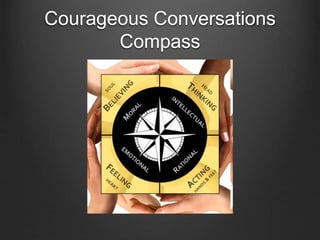
Checking in through the protocol and identifying
where we are on the Compass.
5. Use a “Working Definition”
for Race
Differentiated from “nationality” and “ethnicity”
Examining and understanding how race is lived
differently by white people and by people of color
6. Examine the Presence and
Role of “Whiteness”
Understanding how racial assimilation is present in
everyday life
Where is “whiteness” playing out in each situation?
Courageous Conversations
Compass

Courageous conversations protocol

  • 1.
    The Four Agreements CourageousConversations Protocol
  • 2.
    To participate effectivelyin interracial dialogue about race, the first step is to commit to honoring and practicing the Four Agreements of Courageous Conversation. Embracing these agreements will allow educators to engage, sustain, and deepen interracial dialogue.
  • 3.
    1. Stay Engaged Thismeans remaining morally, emotionally, intellectually, and relationally involved in the dialogue To stay engaged is to not let your heart and mind “check out” of the conversation while leaving you body seated at the table Resist the natural inclination to move away from the conversation by disengaging
  • 4.
    2. Speak YourTruth Means being absolutely honest about your thoughts, feelings, and opinions and not just saying what you perceive others want to hear To not speak our truth often leads to deeper confusion, mistrust, and misunderstanding Speaking your own personal truth allows you to fully engage and develop your racial consciousness
  • 5.
    3. Experience Discomfort Meansengaging in tough conversations that may make you feel uncomfortable Agreeing to experience discomfort allows you to deal with the reality of race and racism in an honest and forthright way This is how we “build muscle”, increasing our tolerance for discomfort so that we increase our ability to address the challenges associated with racial achievement disparity
  • 6.
    4. Expect/Accept Non-closure Committingto an ongoing dialogue Rule out any possibility of discovering a “quick fix” There is no technical solution
  • 7.
    The Six Conditions CourageousConversations Protocol
  • 8.
    1. Focus onPersonal, Local, and Immediate What are my own racial attitudes, beliefs, and expectations? Always speak from a place of “I” I feel… I believe...
  • 9.
    2. Isolate Race Thecritical need to address race explicitly and intentionally Identify your race when speaking I’m Brandon and I am a white male… As a white male, I believe...
  • 10.
    3. Normalize Social Construction& Multiple Perspectives Different racial groups offering different points of view as determined and defined by their shared racial experiences The social construction is not just the dominant narrative, our social construction is from our experiences
  • 11.
    4. Monitor Agreements, Conditions,and Establish Parameters Keeping us all at the table by focusing on the dialogue process as a way of ensuring greater safety and sustained, deeper introspection Checking in through the protocol and identifying where we are on the Compass.
  • 12.
    5. Use a“Working Definition” for Race Differentiated from “nationality” and “ethnicity” Examining and understanding how race is lived differently by white people and by people of color
  • 13.
    6. Examine thePresence and Role of “Whiteness” Understanding how racial assimilation is present in everyday life Where is “whiteness” playing out in each situation?
  • 14.