General Microstructure and Macrostructure of Textile
Fibres
Md Riazur Rahman
ID: 2019210009
College of Textiles
Contents
• Cellulose fibre structure
• Protein fibre sturcutre
• Polyester fibre structure
• Polyamide fibre structure
• Acrylic fibre structure
• Polyvinyl chloride fibre structure
• Vinylon fibre structure
• Spandex fibre structure
• Aramid fibre structure
• UHMWPE fibre structure
• Organic fibre structure (Carbon fibre
glass fibre ceramic fibre)
Cellulose fibre structure
Cellulose is a polymer made of repeating glucose molecules attached end to end. A cellulose molecule
may be from several hundred to over 10,000 glucose units long. Cellulose is similar in form to complex
carbohydrates like starch and glycogen. These polysaccharides are also made from multiple subunits of
glucose. The difference between cellulose and other complex carbohydrate molecules is how the
glucose molecules are linked together. In addition, cellulose is a straight chain polymer, and each
cellulose molecule is long and rod-like. This differs from starch, which is a coiled molecule. A result of
these differences in structure is that, compared to starch and other carbohydrates, cellulose cannot be
broken down into its glucose subunits by any enzymes produced by animals.
Macro structure of cotton
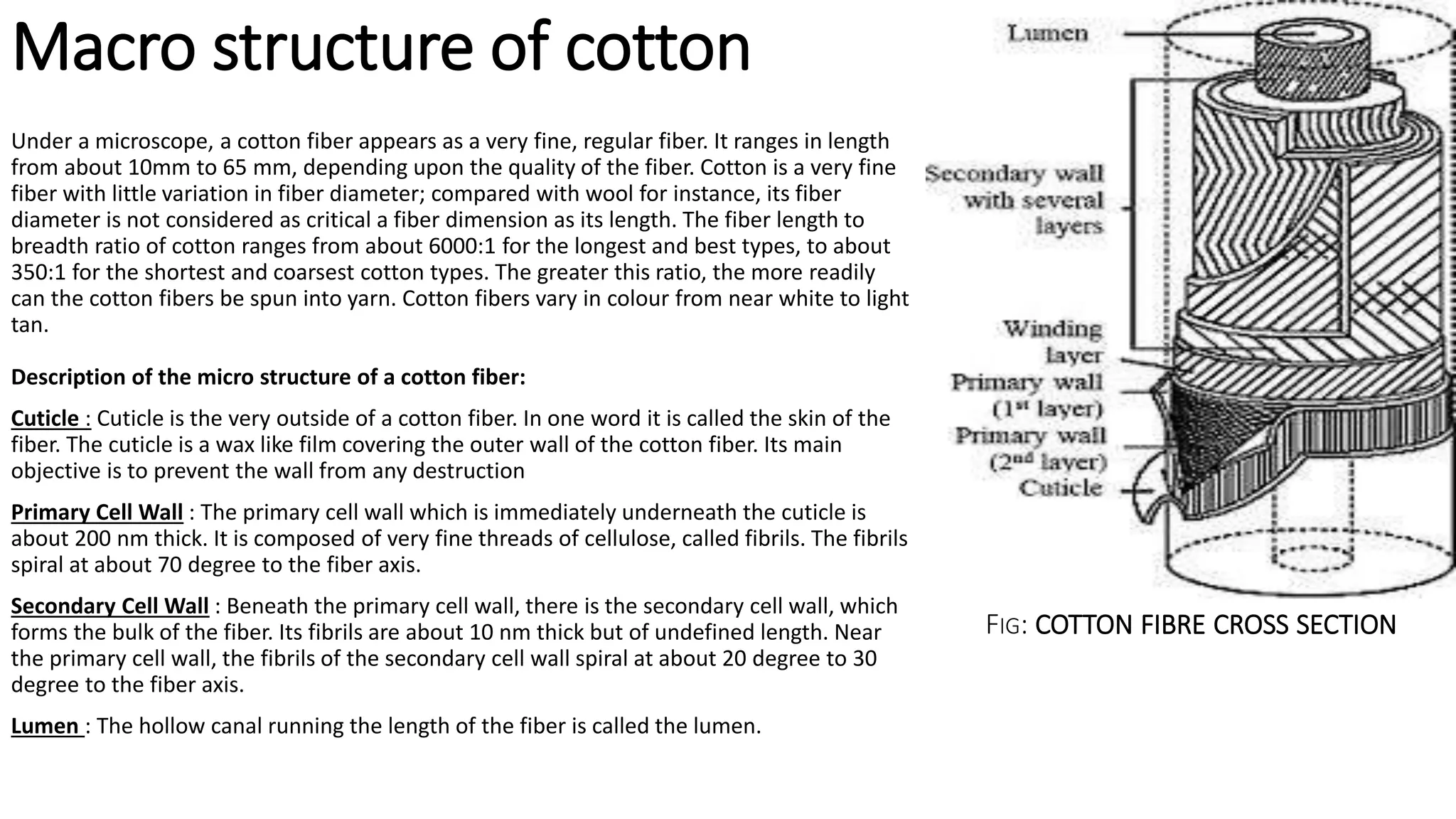
FIG: COTTON FIBRE CROSS SECTION
Under a microscope, a cotton fiber appears as a very fine, regular fiber. It ranges in length
from about 10mm to 65 mm, depending upon the quality of the fiber. Cotton is a very fine
fiber with little variation in fiber diameter; compared with wool for instance, its fiber
diameter is not considered as critical a fiber dimension as its length. The fiber length to
breadth ratio of cotton ranges from about 6000:1 for the longest and best types, to about
350:1 for the shortest and coarsest cotton types. The greater this ratio, the more readily
can the cotton fibers be spun into yarn. Cotton fibers vary in colour from near white to light
tan.
Description of the micro structure of a cotton fiber:
Cuticle : Cuticle is the very outside of a cotton fiber. In one word it is called the skin of the
fiber. The cuticle is a wax like film covering the outer wall of the cotton fiber. Its main
objective is to prevent the wall from any destruction
Primary Cell Wall : The primary cell wall which is immediately underneath the cuticle is
about 200 nm thick. It is composed of very fine threads of cellulose, called fibrils. The fibrils
spiral at about 70 degree to the fiber axis.
Secondary Cell Wall : Beneath the primary cell wall, there is the secondary cell wall, which
forms the bulk of the fiber. Its fibrils are about 10 nm thick but of undefined length. Near
the primary cell wall, the fibrils of the secondary cell wall spiral at about 20 degree to 30
degree to the fiber axis.
Lumen : The hollow canal running the length of the fiber is called the lumen.
Polymer system of cotton
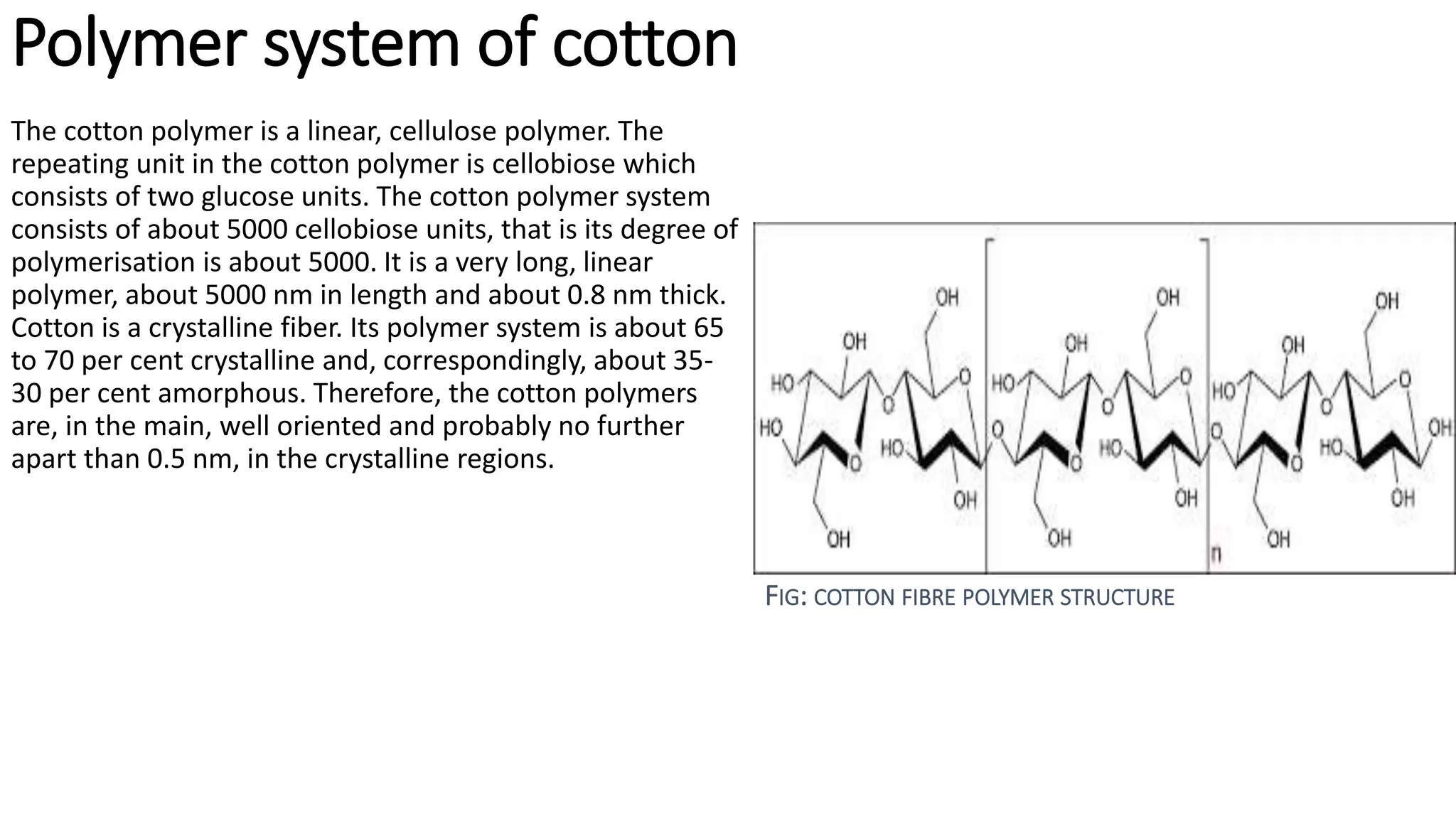
FIG: COTTON FIBRE POLYMER STRUCTURE
The cotton polymer is a linear, cellulose polymer. The
repeating unit in the cotton polymer is cellobiose which
consists of two glucose units. The cotton polymer system
consists of about 5000 cellobiose units, that is its degree of
polymerisation is about 5000. It is a very long, linear
polymer, about 5000 nm in length and about 0.8 nm thick.
Cotton is a crystalline fiber. Its polymer system is about 65
to 70 per cent crystalline and, correspondingly, about 35-
30 per cent amorphous. Therefore, the cotton polymers
are, in the main, well oriented and probably no further
apart than 0.5 nm, in the crystalline regions.
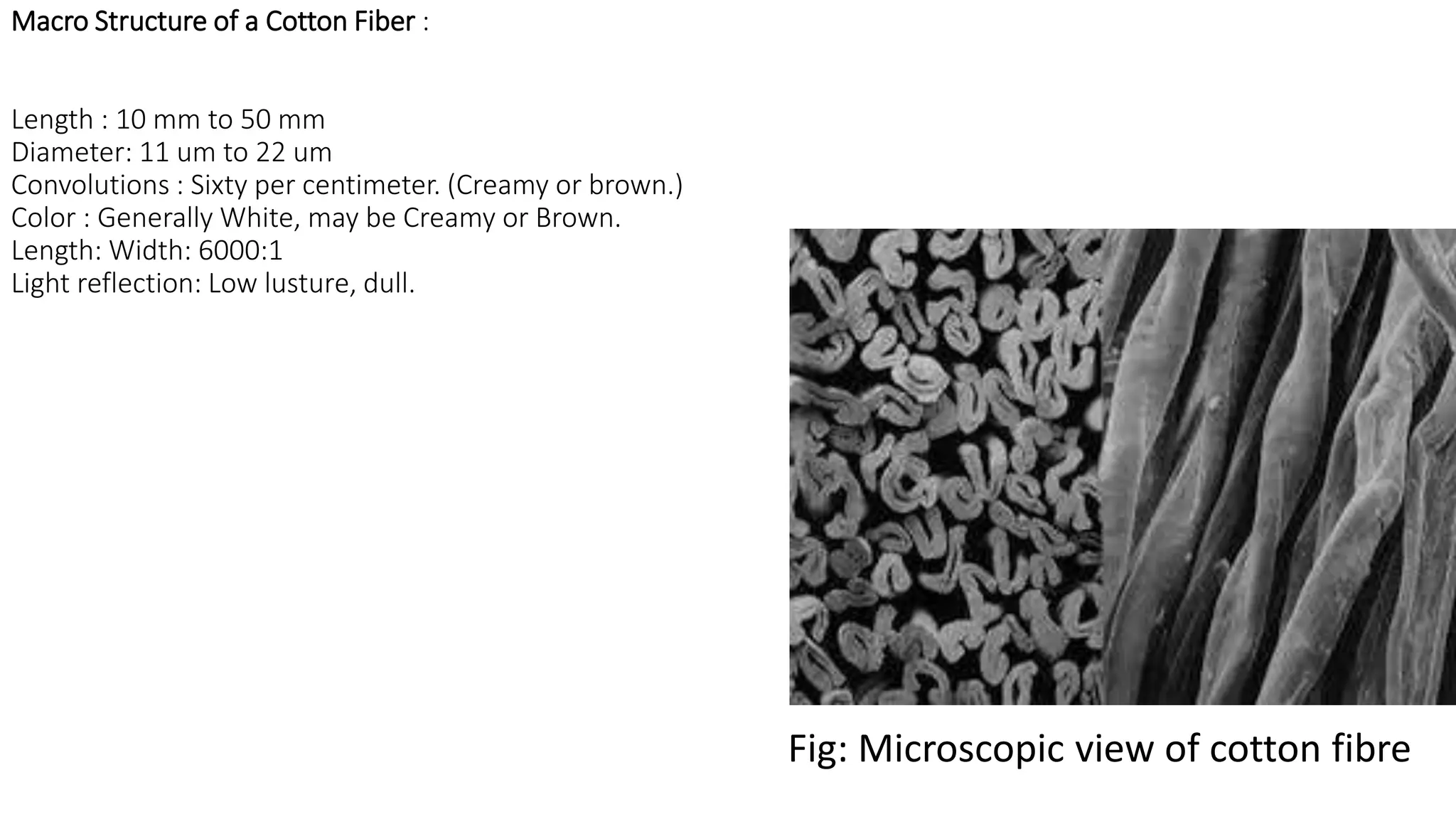
Macro Structure of a Cotton Fiber :
Length : 10 mm to 50 mm
Diameter: 11 um to 22 um
Convolutions : Sixty per centimeter. (Creamy or brown.)
Color : Generally White, may be Creamy or Brown.
Length: Width: 6000:1
Light reflection: Low lusture, dull.
Fig: Microscopic view of cotton fibre
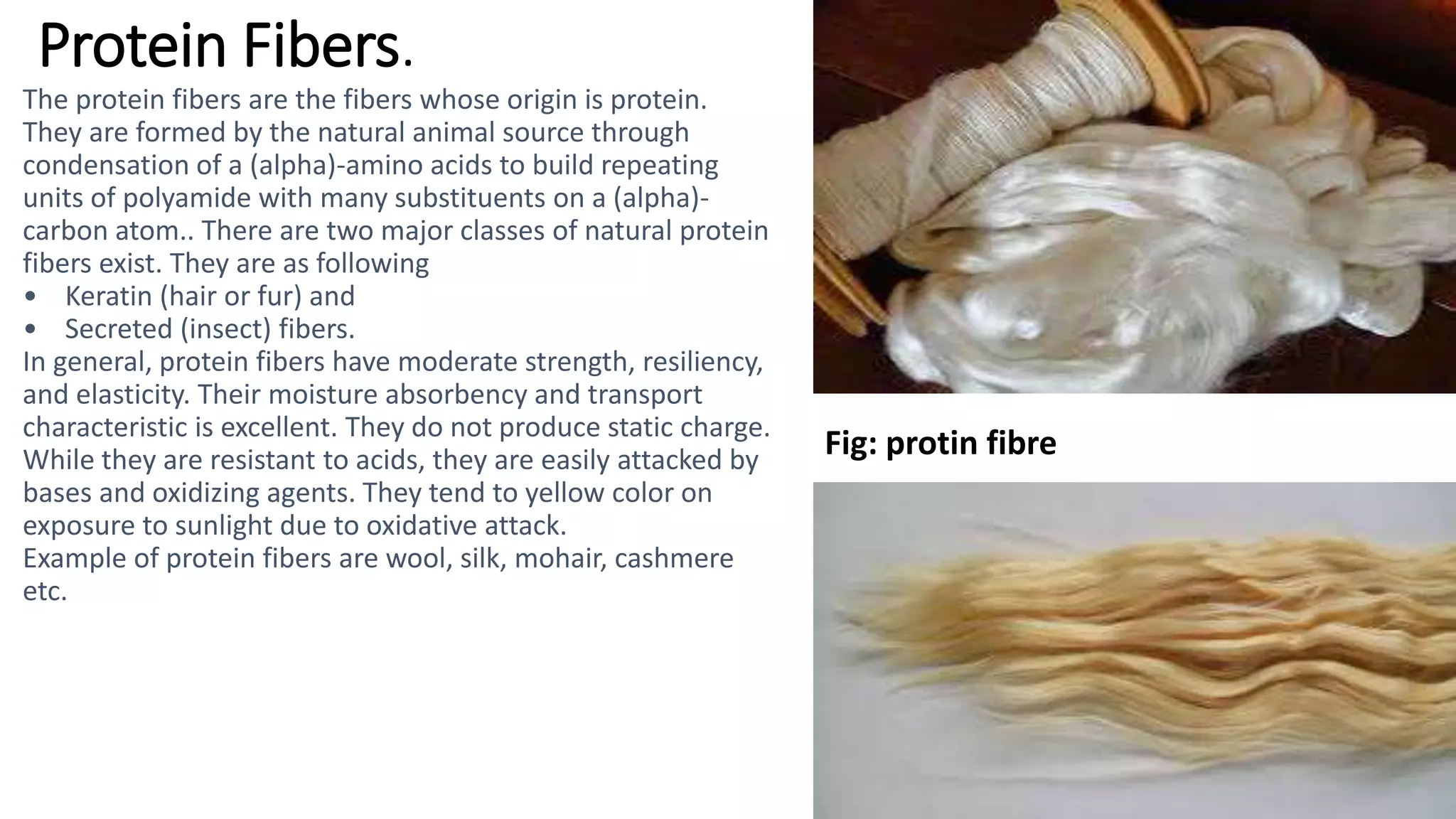
Protein Fibers.
The protein fibers are the fibers whose origin is protein.
They are formed by the natural animal source through
condensation of a (alpha)-amino acids to build repeating
units of polyamide with many substituents on a (alpha)-
carbon atom.. There are two major classes of natural protein
fibers exist. They are as following
• Keratin (hair or fur) and
• Secreted (insect) fibers.
In general, protein fibers have moderate strength, resiliency,
and elasticity. Their moisture absorbency and transport
characteristic is excellent. They do not produce static charge.
While they are resistant to acids, they are easily attacked by
bases and oxidizing agents. They tend to yellow color on
exposure to sunlight due to oxidative attack.
Example of protein fibers are wool, silk, mohair, cashmere
etc.
Fig: protin fibre
Wool Fibre Structure
Wool fiber also has a very complex physical structure, as shown schematically in Figure. A
wool fiber is a biological material consisting of regions that are both chemically and
physically different.
The different parts of the wool fiber structure are given below.
Cuticle
On the outside of the wool fiber is an outer covering called epidermis or cuticle. This
consists of a layer of horny, irregular scales, which cover the fiber. The thickness of the
scales is about 0.5-1.0 micrometer. The number of scales varies greatly depending on the
fineness of the fiber. The fine fibers such as merino have as many as 2000 scales per inch. A
courser fiber has upto 700 scales per inch..
Cortex
The cortex forms the main central (portion of fine wool fiber. It is built up from long,
spindle-shaped cells, which provide strength and elasticity to the wool. The average length
of cortical cells is about 80-110micro meter the average width 2-5micro meter and
thickness is 1.2-2.6 micrometer.
The microscopic study of the cortical cells have shown that they are built up of many tiny
fibrils which are in term constructed of micro fibrils which are in the constructed of micro –
fibrils. The internal cells of the cortex make up 90% of the wool fiber. There are two main
categories of cortical cells -ortho-cortical cells and para-cortical cells.
Cortical cell
Macro fibril
Matrix
Micro fibril
Fig: wool fibre cross section view
CHEMICAL COMPOSITION OF WOOL FIBER
keratin : 33%
grease : 28%
suint : 12%
impurities : 26%
mineral wat er : 01%
Fig: wool fibre chemical bond
Silk Fibre
The raw silk strand consists of two silk filaments encased by a protein called sericin. The thickness of the raw silk strand and its
uneven and irregular surface are due to the coating of sericin, which gives raw silk a coarse handle.The ability of a silk cocoon to
withstand prolonged exposure to weather shows that sericin is very weather resistant. However, is sericin is readily soluble in mild
alkaline solution, and when it is removed the two shiny silk filaments composing the raw silk strand are revealed.
Silk is very fine, regular, translucent filament. It may be up to 600 m long, but averages about 300 m in length. Depending upon
the health, diet and state under which silk larvae extruded the silk filaments, their diameter may vary from 12 um to 30 um. This
gives a fiber length to breadth ratio well in excess of 2000:1. The beauty and softness of silk's lustre is due to the triangular cross-
section of the silk filament. As the silk filament is usually slightly twisted about itself, the angle of light reflection changes
continuously. As a result, the intensity of the reflected light is broken, resulting in a soft, subdued lustre.
Fig: silk fibre
Micro-Structure of silk fibre:
The silk-filament is a fine, coagulated stream of fibroin solution, and
has no identifiable micro-structure. In this regard it resembles the man-
made fibers. Fibroin is the chemical name for the protein which
constitutes silk.
The Polymer System
The Silk Polymer
The silk polymer is a linear, fibroin polymer.
It differs fron the wool polymers as follows :
1. Silk is composed of sixteen different amino acids compared with the
twenty amino acids of the wool polymer. Three of these sixteen amino
acids, namely alanine, glycine and serine, make up about four-fifths of
the silk polymers composition.
2. The silk polymers are not composed of any amino acids containing
sulphur. Hence, the polymer system of silk does not contain any
disulphide bonds.
3. The silk polymer occurs only in the beta-configuration. It is thought
that silk polymer is about as long as (140 nm), or only slightly longer
than the wool polymer, and about 0.9 nm thick. Silk may be considered
to have the same composition as that of wool except that the silk
polymer system contains no disulphide bonds.
Fig: silk fibre cross section view
Polyester fibre
Polyester is a category of polymers that contain the ester functional group in their main chain. As a specific material, it most
commonly refers to a type called polyethylene terephthalate (PET). Polyesters include naturally occurring chemicals, such as in
the cutin of plant cuticles, as well as synthetics such as polybutyrate. Natural polyesters and a few synthetic ones
are biodegradable but most synthetic polyesters are not. The material is used extensively in clothing.
Fig: polyester fiber
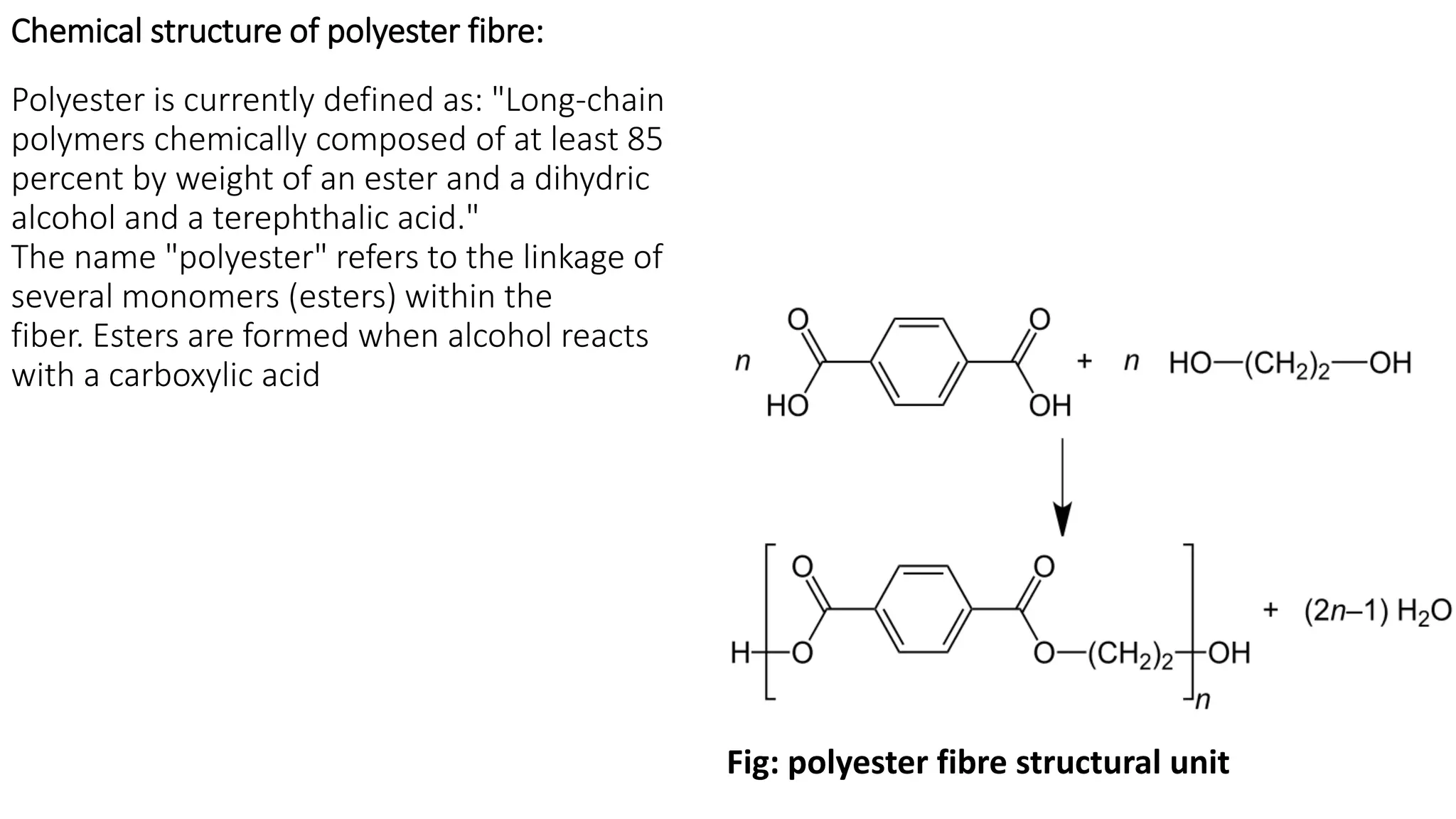
Chemical structure of polyester fibre:
Polyester is currently defined as: "Long-chain
polymers chemically composed of at least 85
percent by weight of an ester and a dihydric
alcohol and a terephthalic acid."
The name "polyester" refers to the linkage of
several monomers (esters) within the
fiber. Esters are formed when alcohol reacts
with a carboxylic acid
Fig: polyester fibre structural unit
Microscopic view of polyester:
Polyester is a smooth fiber with an even diameter.
The fiber diameter usually ranges from 12-25
micrometers (10-15 denier). The undyed fiber is
slightly off-white and partially transparent. The
fibers are approximately 35% crystaline and 65%
amorphous.
Fig: Cross section & longitudinal view of a
polyester fiber
Crystaline structure of polyester fibre
Fig: crystalline structure of polyester fibre
Polyamide fibre structure
A polyamide is a macromolecule with repeating units linked by amide bonds. Polyamide, any polymer (substance
composed of long, multiple-unit molecules) in which the repeating units in the molecular chain are linked together
by amide groups. Amide groups have the general chemical formula CO-NH. They may be produced by the interaction
of an amine (NH2) group and a carboxyl (CO2H) group, or they may be formed by the polymerization of amino
acids or amino-acid derivatives (whose molecules contain both amino and carboxyl groups)Polyamides occur both
naturally and artificially. Examples of naturally occurring polyamides are proteins, such as wool and silk. Artificially
made polyamides can be made through step-growth polymerization or solid-phase synthesis yielding materials such
as nylons, aramids, and sodium poly(aspartate).
Fig: polyamide fibre
Polyamide fibre structure
A polyamide is a macromolecule with repeating units linked by amide bonds. Polyamide,
any polymer (substance composed of long, multiple-unit molecules) in which the repeating units in the
molecular chain are linked together by amide groups. Amide groups have the general chemical formula CO-
NH. They may be produced by the interaction of an amine (NH2) group and a carboxyl (CO2H) group, or
they may be formed by the polymerization of amino acids or amino-acid derivatives (whose molecules
contain both amino and carboxyl groups)Polyamides occur both naturally and artificially. Examples of
naturally occurring polyamides are proteins, such as wool and silk. Artificially made polyamides can be
made through step-growth polymerization or solid-phase synthesis yielding materials such
as nylons, aramids, and sodium poly(aspartate).
Fig : polyamide fibre
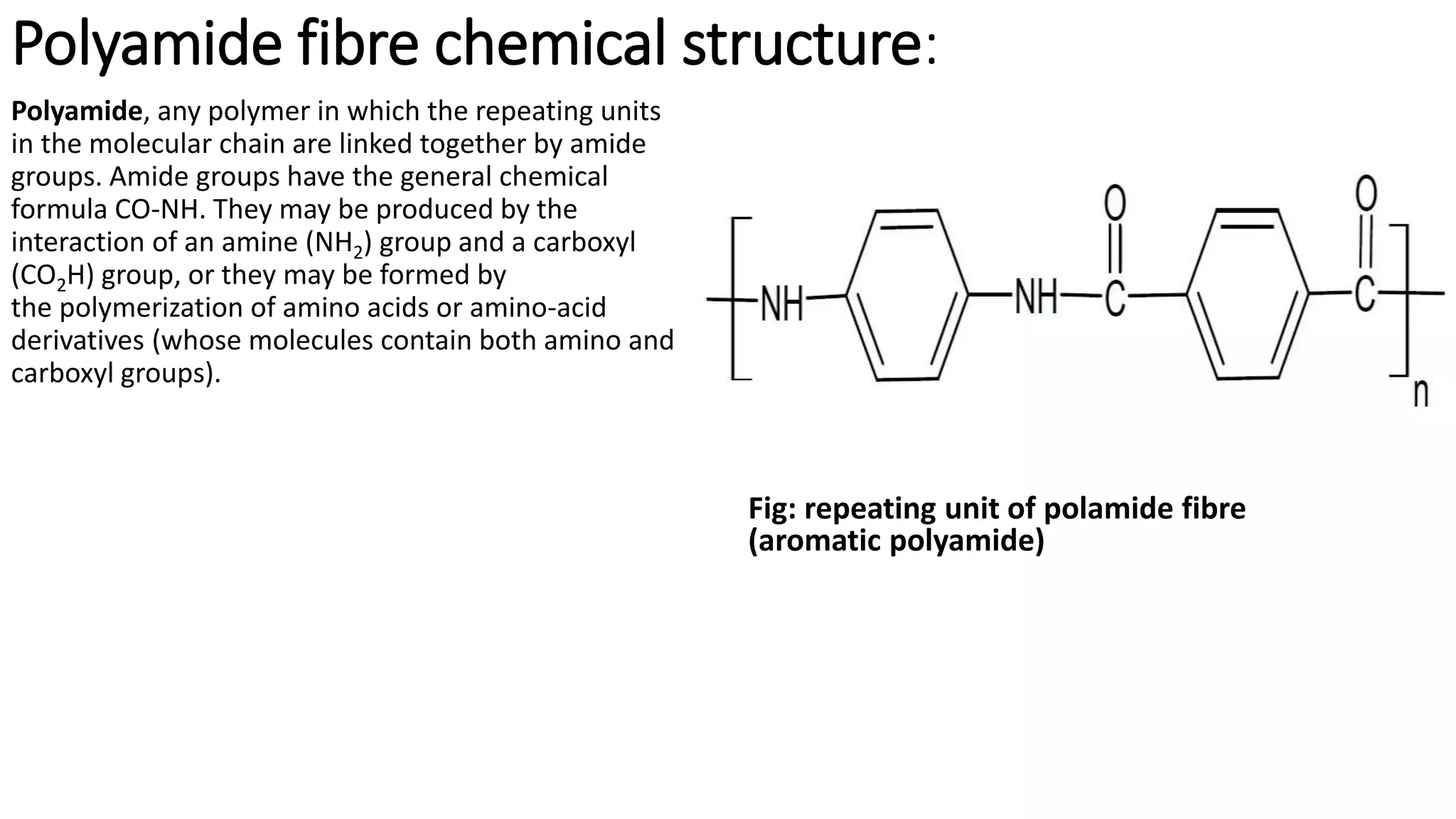
Polyamide fibre chemical structure:
Polyamide, any polymer in which the repeating units
in the molecular chain are linked together by amide
groups. Amide groups have the general chemical
formula CO-NH. They may be produced by the
interaction of an amine (NH2) group and a carboxyl
(CO2H) group, or they may be formed by
the polymerization of amino acids or amino-acid
derivatives (whose molecules contain both amino and
carboxyl groups).
Fig: repeating unit of polamide fibre
(aromatic polyamide)
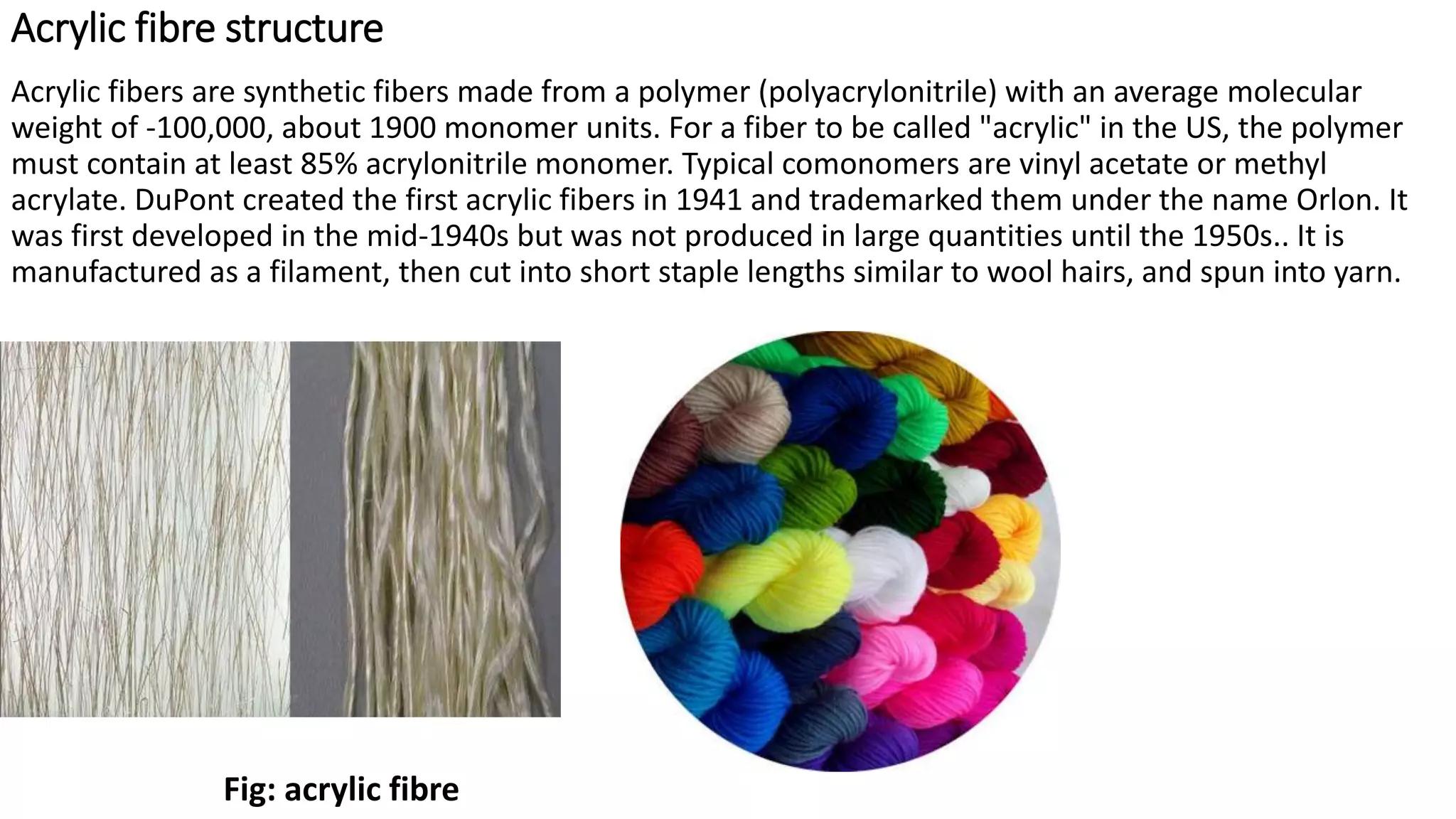
Acrylic fibre structure
Acrylic fibers are synthetic fibers made from a polymer (polyacrylonitrile) with an average molecular
weight of -100,000, about 1900 monomer units. For a fiber to be called "acrylic" in the US, the polymer
must contain at least 85% acrylonitrile monomer. Typical comonomers are vinyl acetate or methyl
acrylate. DuPont created the first acrylic fibers in 1941 and trademarked them under the name Orlon. It
was first developed in the mid-1940s but was not produced in large quantities until the 1950s.. It is
manufactured as a filament, then cut into short staple lengths similar to wool hairs, and spun into yarn.
Fig: acrylic fibre
Acrylic fibre chemical structure
Fig: Acrylic fibre chemical bond
The polymer is formed by free-radical
polymerization in aqueous suspension. The fiber is
produced by dissolving the polymer in a solvent such
as N,N-dimethylformamide (DMF) or
aqueous sodium thiocyanate, metering it through a
multi-hole spinnerette and coagulating the resultant
filaments in an aqueous solution of the same solvent
(wet spinning) or evaporating the solvent in a stream
of heated inert gas (dry spinning). Washing,
stretching, drying and crimping complete the
processing. Acrylic fibers are produced in a range
of deniers, usually from 0.9 to 15, as cut staple or as
a 500,000 to 1 million filament tow. End uses include
sweaters, hats, hand-knitting yarns, socks, rugs,
awnings, boat covers, and upholstery; the fiber is
also used as "PAN" precursor for carbon fiber.
Production of acrylic fibers is centered in the Far
East, Turkey, India, Mexico, and South America,
though a number of European producers still
continue to operate, including Dralon and Fisipe. US
producers have ended production (except for
specialty uses such as in friction materials, gaskets,
specialty papers, conductive, and stucco), though
acrylic tow and staple are still spun into yarns
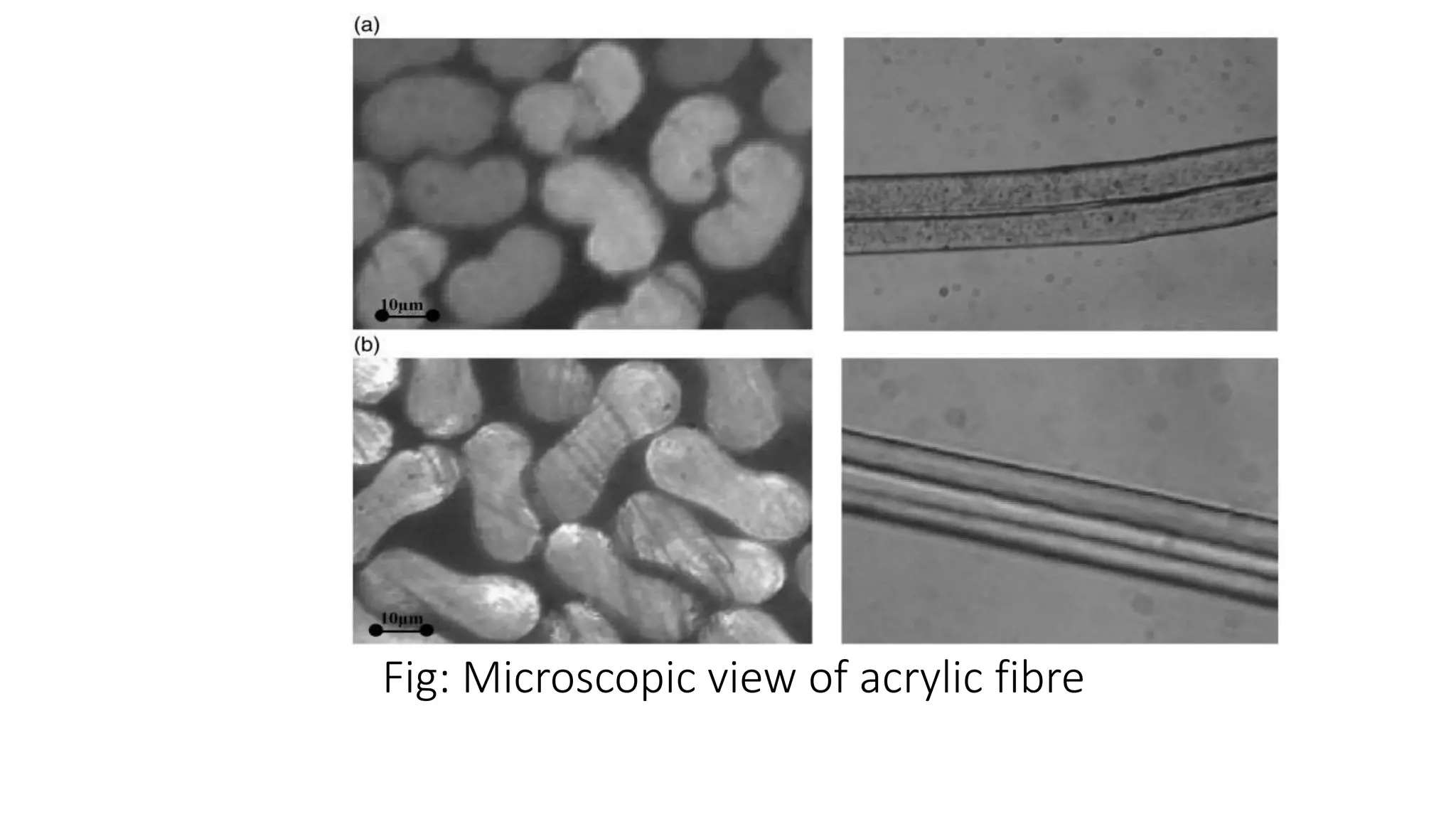
Fig: Microscopic view of acrylic fibre
Polyvinyl chloride fibre
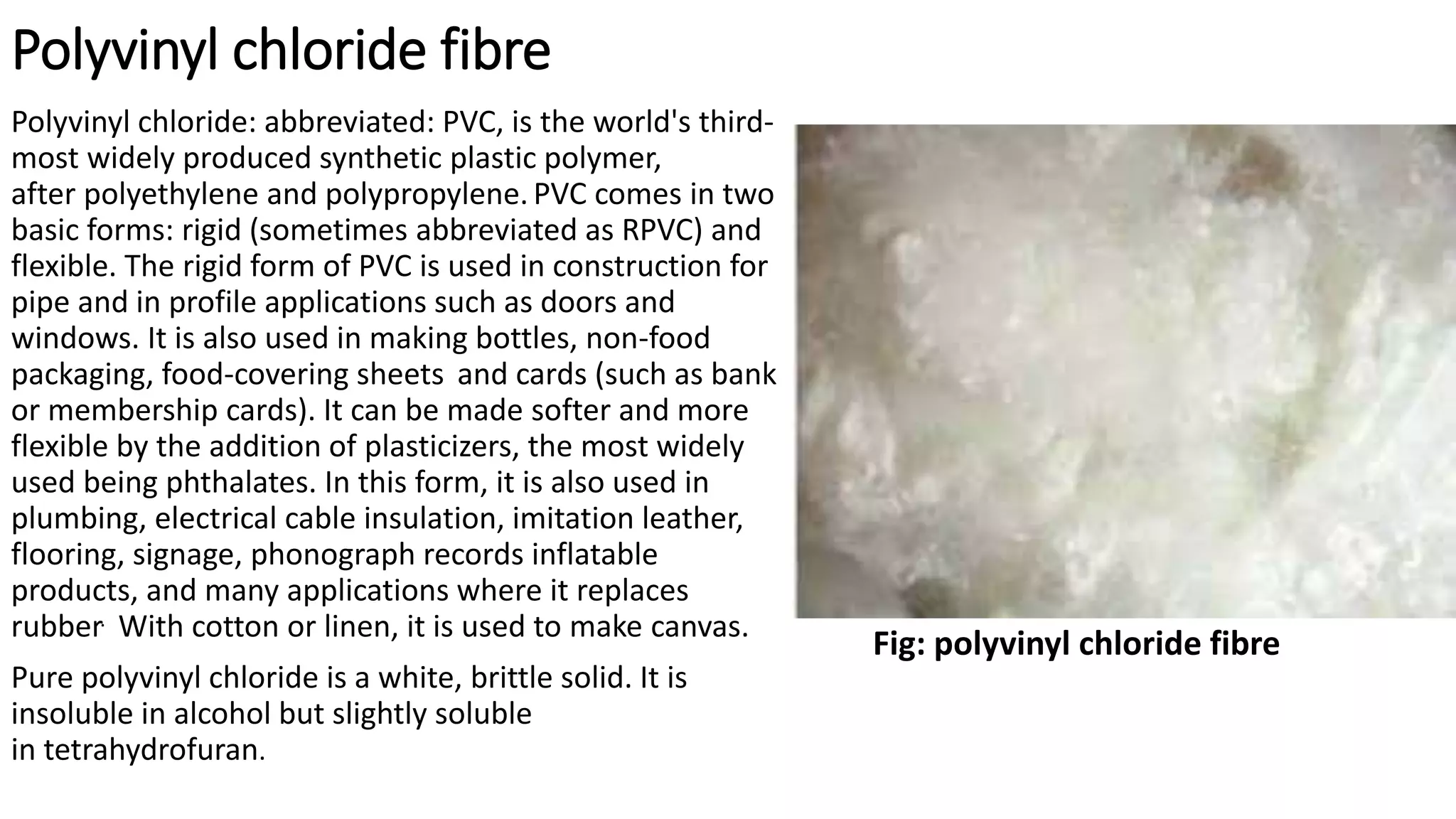
Polyvinyl chloride: abbreviated: PVC, is the world's third-
most widely produced synthetic plastic polymer,
after polyethylene and polypropylene. PVC comes in two
basic forms: rigid (sometimes abbreviated as RPVC) and
flexible. The rigid form of PVC is used in construction for
pipe and in profile applications such as doors and
windows. It is also used in making bottles, non-food
packaging, food-covering sheets and cards (such as bank
or membership cards). It can be made softer and more
flexible by the addition of plasticizers, the most widely
used being phthalates. In this form, it is also used in
plumbing, electrical cable insulation, imitation leather,
flooring, signage, phonograph records inflatable
products, and many applications where it replaces
rubber. With cotton or linen, it is used to make canvas.
Pure polyvinyl chloride is a white, brittle solid. It is
insoluble in alcohol but slightly soluble
in tetrahydrofuran.
Fig: polyvinyl chloride fibre
Polyvinyl chloride fibre structure
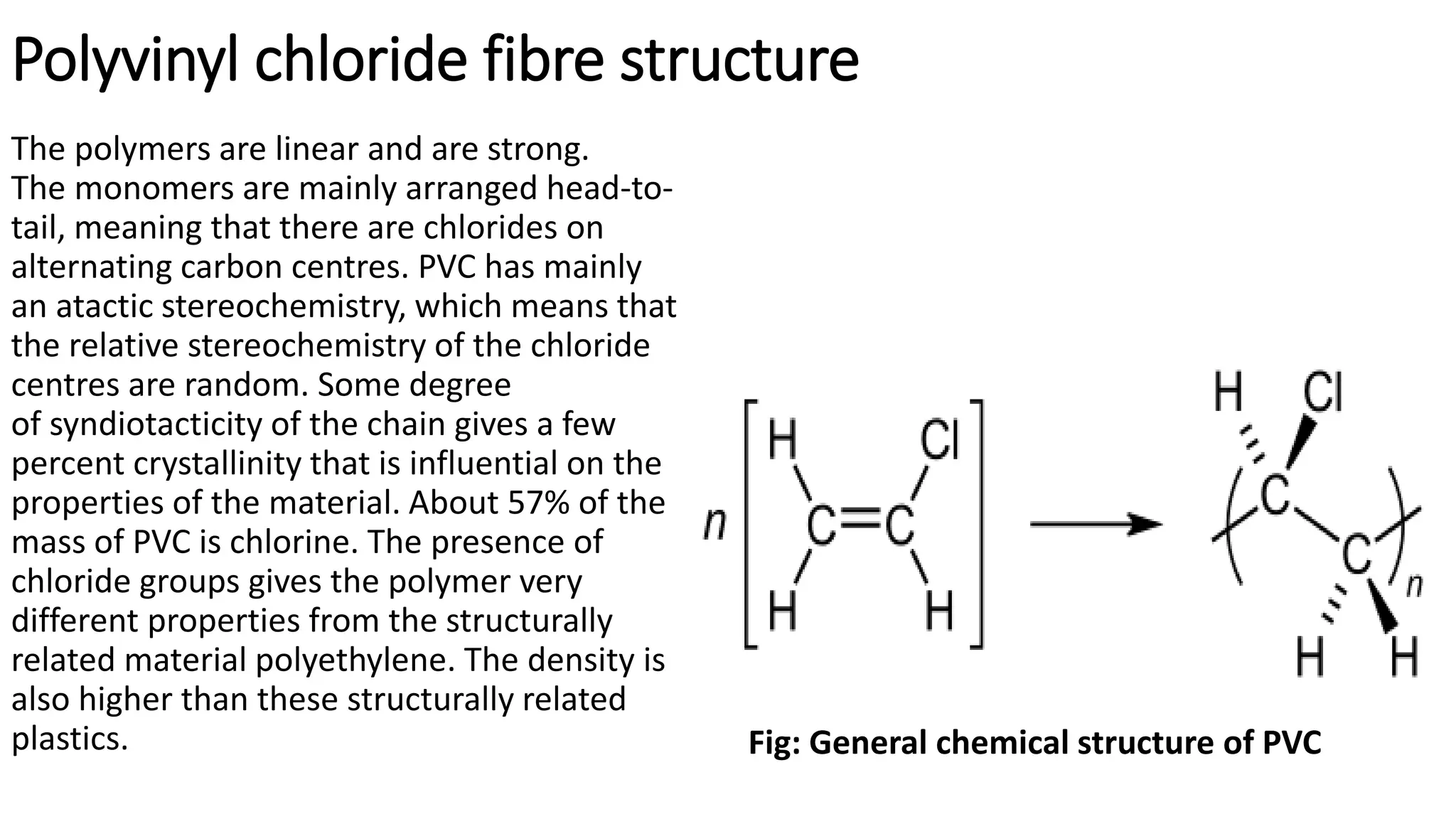
The polymers are linear and are strong.
The monomers are mainly arranged head-to-
tail, meaning that there are chlorides on
alternating carbon centres. PVC has mainly
an atactic stereochemistry, which means that
the relative stereochemistry of the chloride
centres are random. Some degree
of syndiotacticity of the chain gives a few
percent crystallinity that is influential on the
properties of the material. About 57% of the
mass of PVC is chlorine. The presence of
chloride groups gives the polymer very
different properties from the structurally
related material polyethylene. The density is
also higher than these structurally related
plastics. Fig: General chemical structure of PVC
Microstructure of PVC
The polymers are linear and are strong.
The monomers are mainly arranged head-to-tail,
meaning that there are chlorides on
alternating carbon centres. PVC has mainly
an atactic stereochemistry, which means that
the relative stereochemistry of the chloride
centres are random. Some degree
of syndiotacticity of the chain gives a few
percent crystallinity that is influential on the
properties of the material. About 57% of the
mass of PVC is chlorine. The presence of chloride
groups gives the polymer very different
properties from the structurally related
material polyethylene. The density is also higher
than these structurally
Fig: Microscopic view of PVC
Aramid fibre:
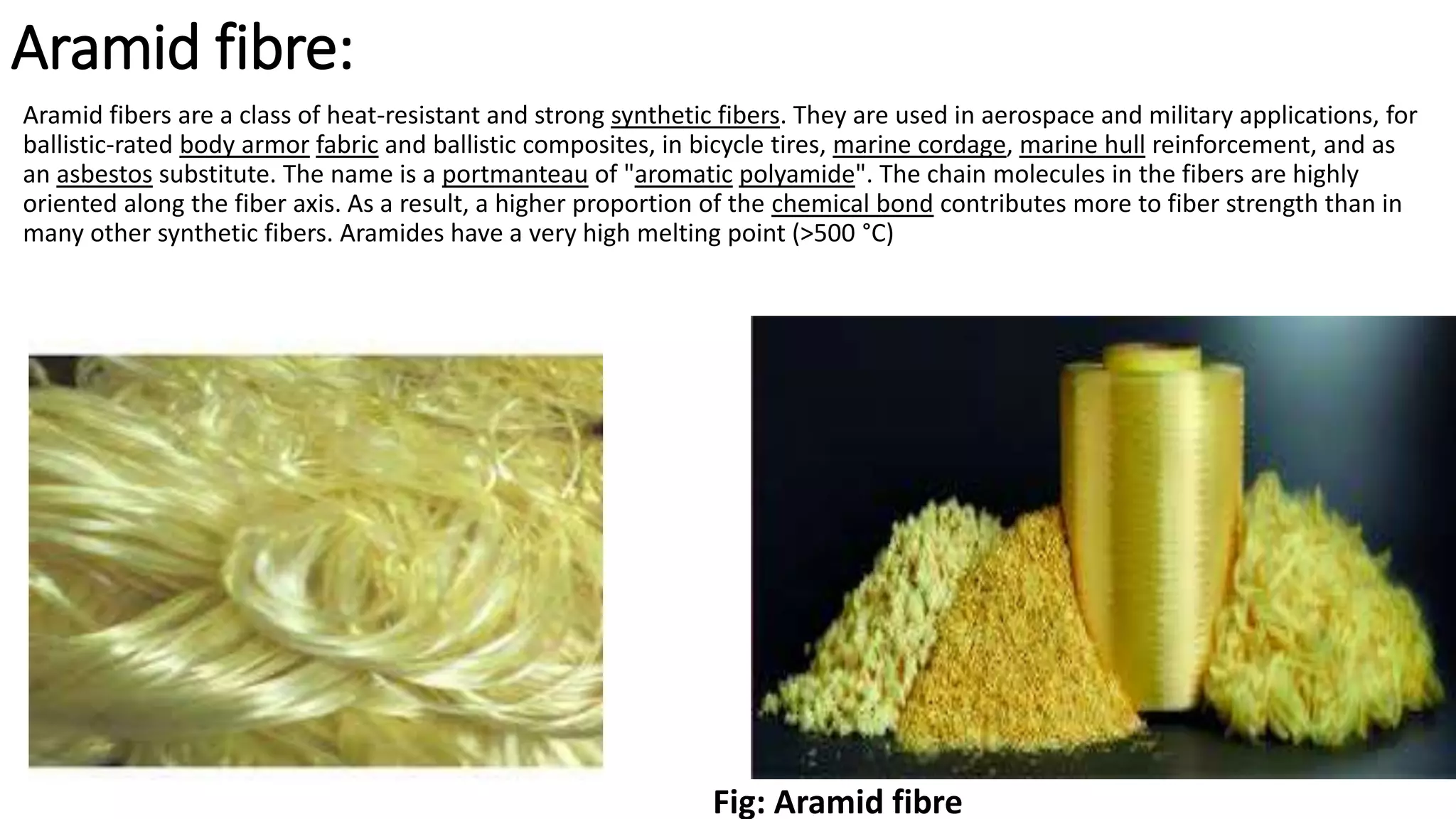
Aramid fibers are a class of heat-resistant and strong synthetic fibers. They are used in aerospace and military applications, for
ballistic-rated body armor fabric and ballistic composites, in bicycle tires, marine cordage, marine hull reinforcement, and as
an asbestos substitute. The name is a portmanteau of "aromatic polyamide". The chain molecules in the fibers are highly
oriented along the fiber axis. As a result, a higher proportion of the chemical bond contributes more to fiber strength than in
many other synthetic fibers. Aramides have a very high melting point (>500 °C)
Fig: Aramid fibre
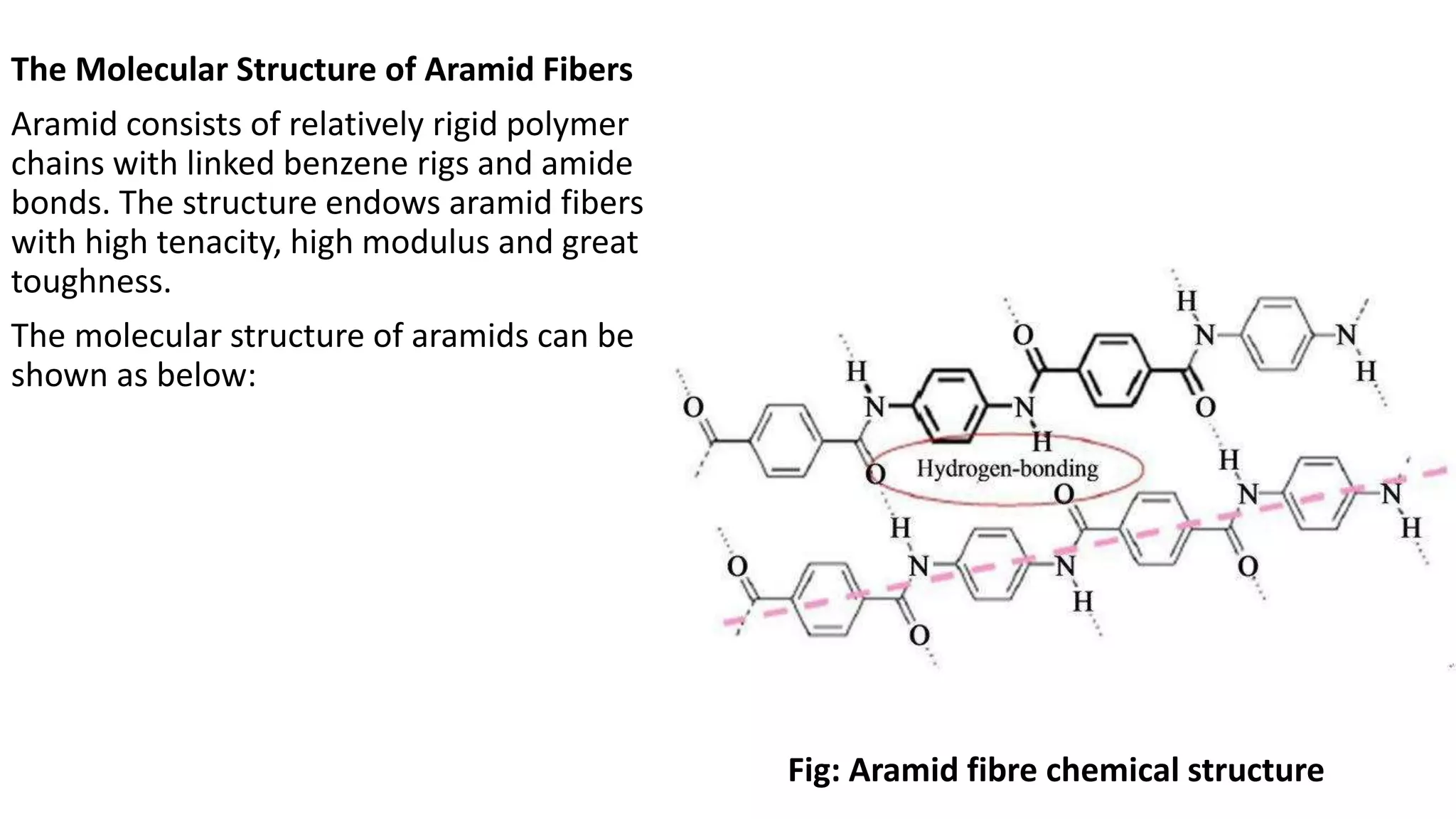
The Molecular Structure of Aramid Fibers
Aramid consists of relatively rigid polymer
chains with linked benzene rigs and amide
bonds. The structure endows aramid fibers
with high tenacity, high modulus and great
toughness.
The molecular structure of aramids can be
shown as below:
Fig: Aramid fibre chemical structure
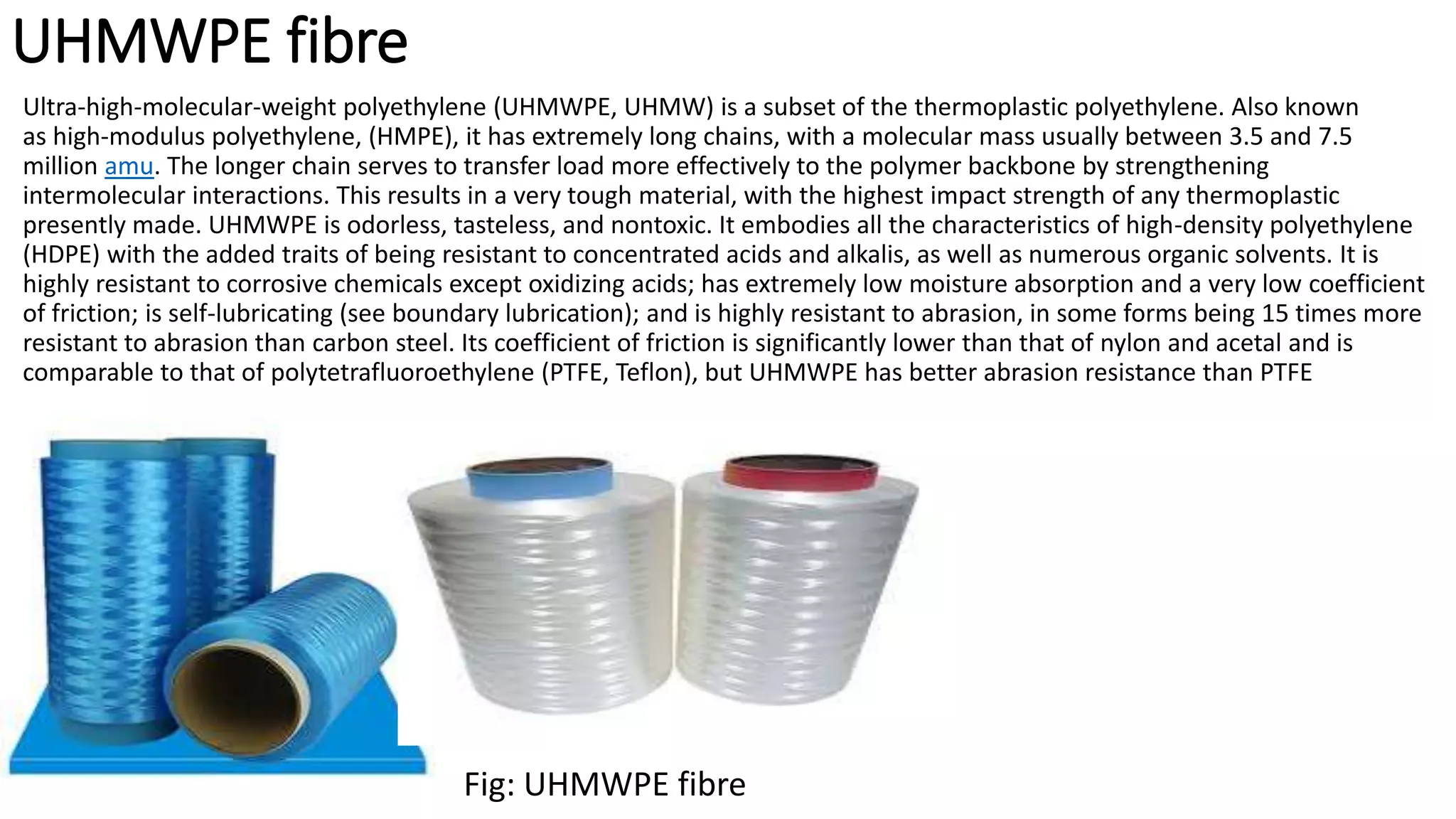
UHMWPE fibre
Ultra-high-molecular-weight polyethylene (UHMWPE, UHMW) is a subset of the thermoplastic polyethylene. Also known
as high-modulus polyethylene, (HMPE), it has extremely long chains, with a molecular mass usually between 3.5 and 7.5
million amu. The longer chain serves to transfer load more effectively to the polymer backbone by strengthening
intermolecular interactions. This results in a very tough material, with the highest impact strength of any thermoplastic
presently made. UHMWPE is odorless, tasteless, and nontoxic. It embodies all the characteristics of high-density polyethylene
(HDPE) with the added traits of being resistant to concentrated acids and alkalis, as well as numerous organic solvents. It is
highly resistant to corrosive chemicals except oxidizing acids; has extremely low moisture absorption and a very low coefficient
of friction; is self-lubricating (see boundary lubrication); and is highly resistant to abrasion, in some forms being 15 times more
resistant to abrasion than carbon steel. Its coefficient of friction is significantly lower than that of nylon and acetal and is
comparable to that of polytetrafluoroethylene (PTFE, Teflon), but UHMWPE has better abrasion resistance than PTFE
Fig: UHMWPE fibre
Microscopic view & Chemical Structure
Fig: Microscopic view of UHMWPE
Fig: Chemical structure
of UHMWPE
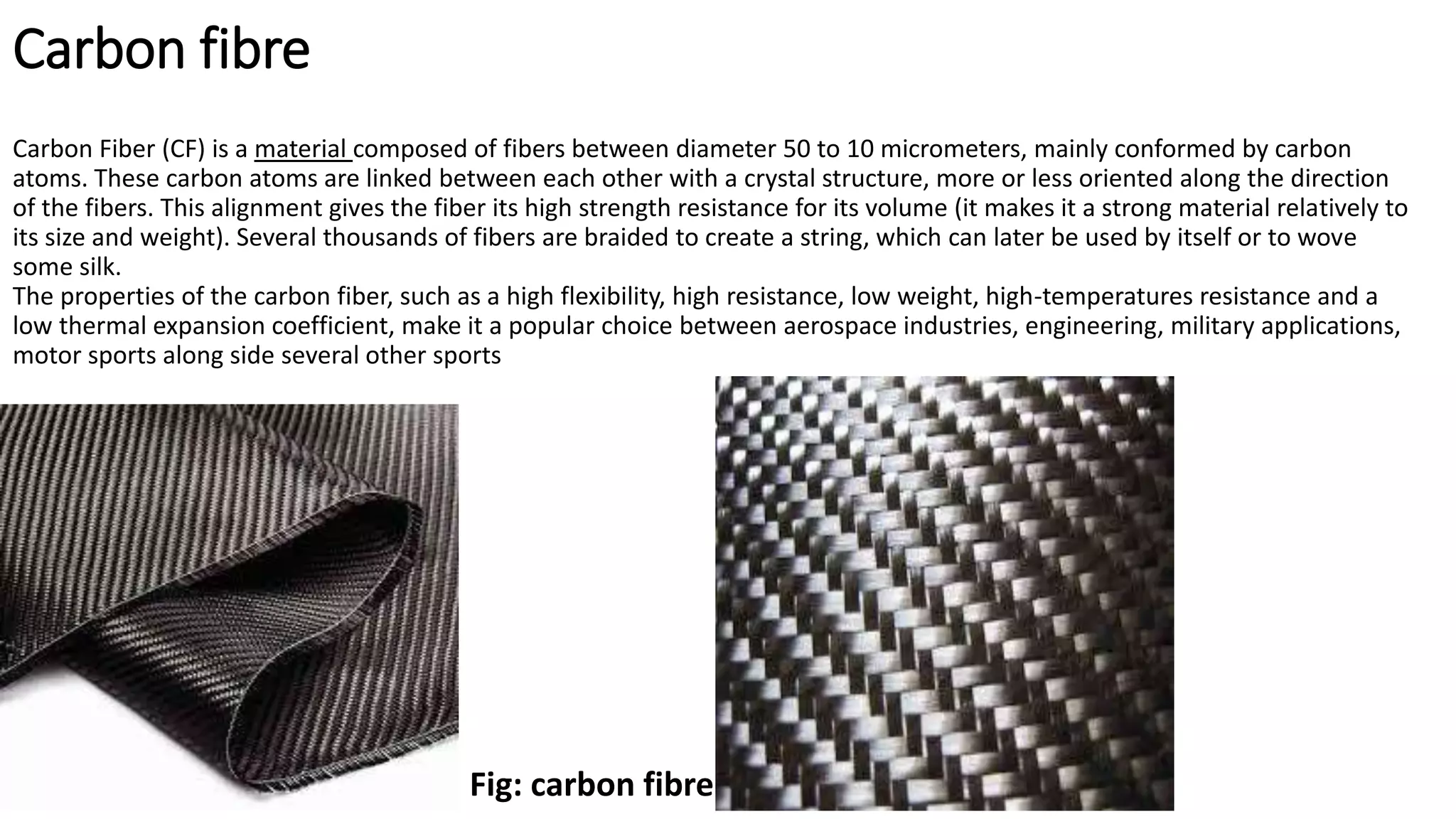
Carbon fibre
Carbon Fiber (CF) is a material composed of fibers between diameter 50 to 10 micrometers, mainly conformed by carbon
atoms. These carbon atoms are linked between each other with a crystal structure, more or less oriented along the direction
of the fibers. This alignment gives the fiber its high strength resistance for its volume (it makes it a strong material relatively to
its size and weight). Several thousands of fibers are braided to create a string, which can later be used by itself or to wove
some silk.
The properties of the carbon fiber, such as a high flexibility, high resistance, low weight, high-temperatures resistance and a
low thermal expansion coefficient, make it a popular choice between aerospace industries, engineering, military applications,
motor sports along side several other sports
Fig: carbon fibre
Carbon Fibre chemical structure:
The atomic structure of carbon fiber is similar to that of
graphite, consisting of sheets of carbon atoms (graphene
sheets) arranged in a regular hexagonal pattern, the difference
being in the way these sheets interlock. Graphite is a crystalline
material in which the sheets are stacked parallel to one another
in regular fashion. The intermolecular forces between the
sheets are relatively weak Van der Waals forces, giving graphite
its soft and brittle characteristics.
Carbon Fiber (CF) is a material composed of fibers between
diameter 50 to 10 micrometers, mainly conformed by carbon
atoms. These carbon atoms are linked between each other with
a crystal structure, more or less oriented along the direction of
the fibers. This alignment gives the fiber its high strength
resistance for its volume (it makes it a strong material relatively
to its size and weight). Several thousands of fibers are braided
to create a string, which can later be used by itself or to wove
some silk.
Fig: Carbon fibre bonding structure
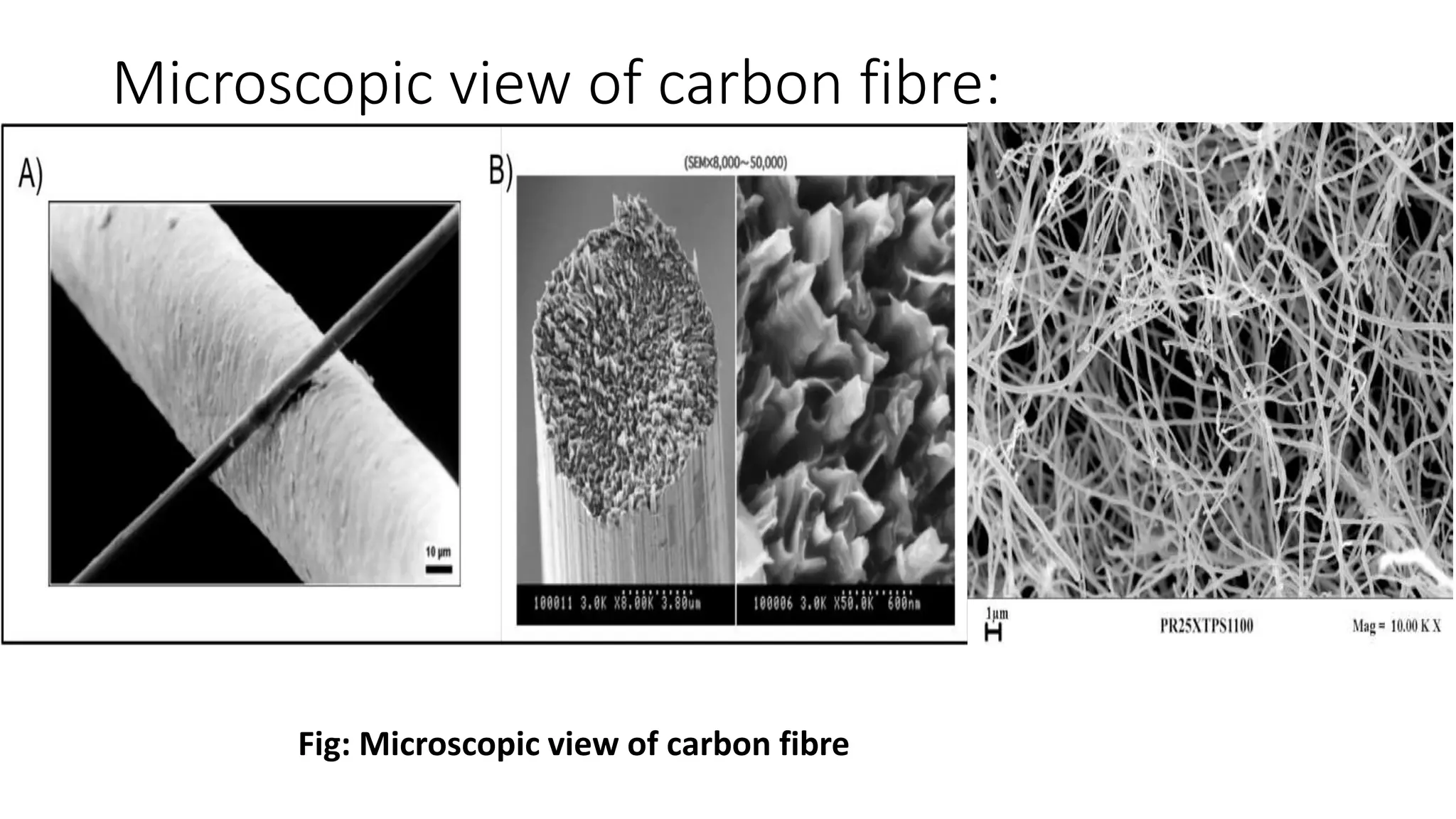
Microscopic view of carbon fibre:
Fig: Microscopic view of carbon fibre
GLASS FIBRE
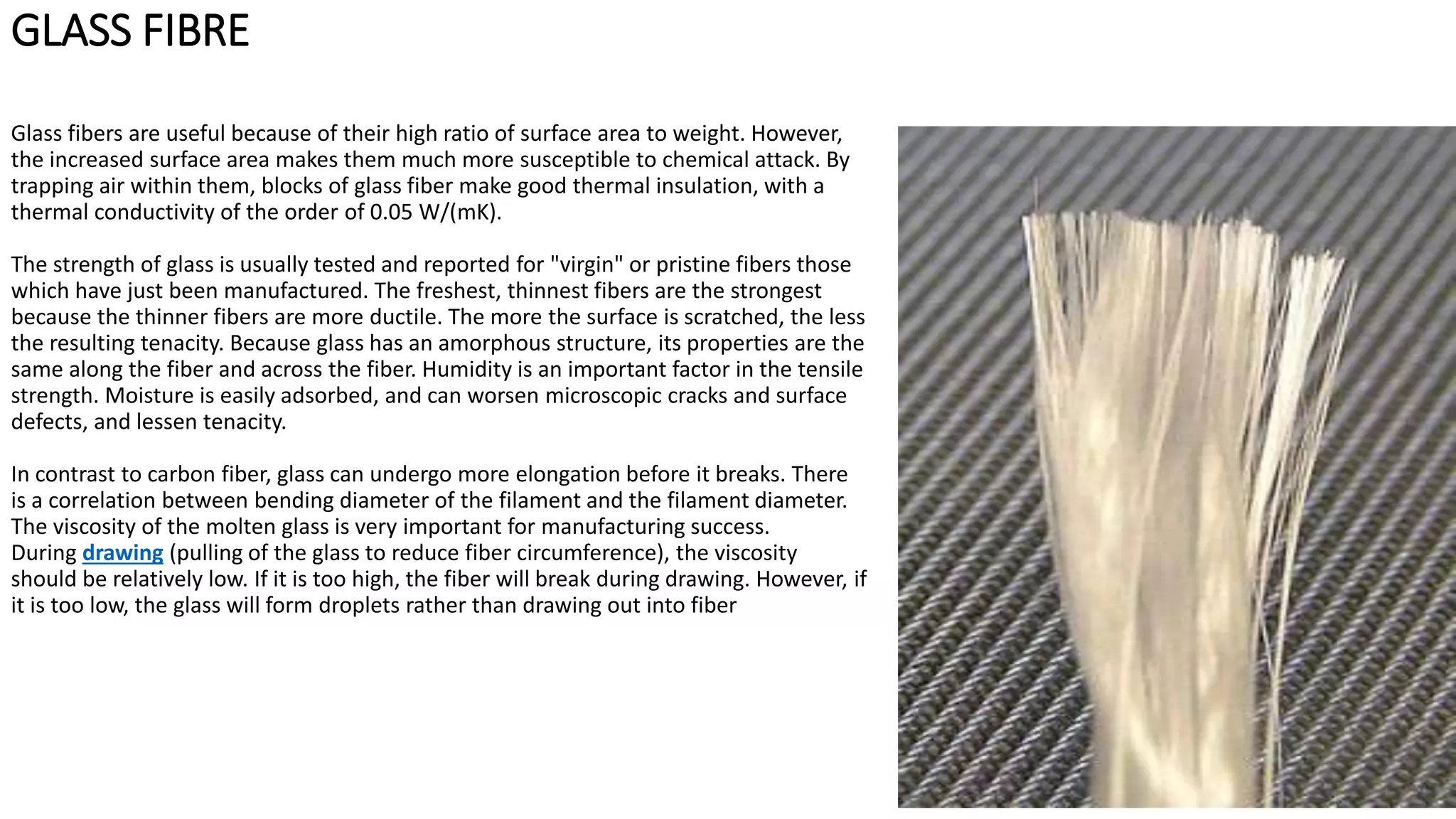
Glass fibers are useful because of their high ratio of surface area to weight. However,
the increased surface area makes them much more susceptible to chemical attack. By
trapping air within them, blocks of glass fiber make good thermal insulation, with a
thermal conductivity of the order of 0.05 W/(mK).
The strength of glass is usually tested and reported for "virgin" or pristine fibers those
which have just been manufactured. The freshest, thinnest fibers are the strongest
because the thinner fibers are more ductile. The more the surface is scratched, the less
the resulting tenacity. Because glass has an amorphous structure, its properties are the
same along the fiber and across the fiber. Humidity is an important factor in the tensile
strength. Moisture is easily adsorbed, and can worsen microscopic cracks and surface
defects, and lessen tenacity.
In contrast to carbon fiber, glass can undergo more elongation before it breaks. There
is a correlation between bending diameter of the filament and the filament diameter.
The viscosity of the molten glass is very important for manufacturing success.
During drawing (pulling of the glass to reduce fiber circumference), the viscosity
should be relatively low. If it is too high, the fiber will break during drawing. However, if
it is too low, the glass will form droplets rather than drawing out into fiber
Chemical structure of Glass fibre :
• Glass describes range of material made by fusing
together one or more of the oxides o silicon, boron or
phosphorus with certain oxide like potassium,
magnesium, calcium.
• Basic part of Glass fiber is Silica “SiO2”.
Fig: Glass fibre chemical bonding
Ceramic fibre
Ceramic fibers are a family of high-temperature fibers designed to be
used in a variety of industrial and commercial applications.
Manufactured from alumina silica materials, fibers are chemically
inert. Some of the
• unique properties these fibers offer are:
• High-temperature stability
• Low thermal conductivity
• Low heat storage
• Excellent thermal shock resistance
• Light weight
Microscopic view of Ceramic Fibre
Basic compositions of ceramic fiber
• SiO2 50-60 %
• Al2O3 30-50 %
• Na2O-H2O 0.1 %
• Fe2O3 0.04 %
• Leachable Chlorides - 10 ppm
STRUCTURE OF DIFFERENT FIBRE.pptx

STRUCTURE OF DIFFERENT FIBRE.pptx

  • 1.
    General Microstructure andMacrostructure of Textile Fibres Md Riazur Rahman ID: 2019210009 College of Textiles
  • 2.
    Contents • Cellulose fibrestructure • Protein fibre sturcutre • Polyester fibre structure • Polyamide fibre structure • Acrylic fibre structure • Polyvinyl chloride fibre structure • Vinylon fibre structure • Spandex fibre structure • Aramid fibre structure • UHMWPE fibre structure • Organic fibre structure (Carbon fibre glass fibre ceramic fibre)
  • 3.
    Cellulose fibre structure Celluloseis a polymer made of repeating glucose molecules attached end to end. A cellulose molecule may be from several hundred to over 10,000 glucose units long. Cellulose is similar in form to complex carbohydrates like starch and glycogen. These polysaccharides are also made from multiple subunits of glucose. The difference between cellulose and other complex carbohydrate molecules is how the glucose molecules are linked together. In addition, cellulose is a straight chain polymer, and each cellulose molecule is long and rod-like. This differs from starch, which is a coiled molecule. A result of these differences in structure is that, compared to starch and other carbohydrates, cellulose cannot be broken down into its glucose subunits by any enzymes produced by animals.
  • 4.
    Macro structure ofcotton FIG: COTTON FIBRE CROSS SECTION Under a microscope, a cotton fiber appears as a very fine, regular fiber. It ranges in length from about 10mm to 65 mm, depending upon the quality of the fiber. Cotton is a very fine fiber with little variation in fiber diameter; compared with wool for instance, its fiber diameter is not considered as critical a fiber dimension as its length. The fiber length to breadth ratio of cotton ranges from about 6000:1 for the longest and best types, to about 350:1 for the shortest and coarsest cotton types. The greater this ratio, the more readily can the cotton fibers be spun into yarn. Cotton fibers vary in colour from near white to light tan. Description of the micro structure of a cotton fiber: Cuticle : Cuticle is the very outside of a cotton fiber. In one word it is called the skin of the fiber. The cuticle is a wax like film covering the outer wall of the cotton fiber. Its main objective is to prevent the wall from any destruction Primary Cell Wall : The primary cell wall which is immediately underneath the cuticle is about 200 nm thick. It is composed of very fine threads of cellulose, called fibrils. The fibrils spiral at about 70 degree to the fiber axis. Secondary Cell Wall : Beneath the primary cell wall, there is the secondary cell wall, which forms the bulk of the fiber. Its fibrils are about 10 nm thick but of undefined length. Near the primary cell wall, the fibrils of the secondary cell wall spiral at about 20 degree to 30 degree to the fiber axis. Lumen : The hollow canal running the length of the fiber is called the lumen.
  • 5.
    Polymer system ofcotton FIG: COTTON FIBRE POLYMER STRUCTURE The cotton polymer is a linear, cellulose polymer. The repeating unit in the cotton polymer is cellobiose which consists of two glucose units. The cotton polymer system consists of about 5000 cellobiose units, that is its degree of polymerisation is about 5000. It is a very long, linear polymer, about 5000 nm in length and about 0.8 nm thick. Cotton is a crystalline fiber. Its polymer system is about 65 to 70 per cent crystalline and, correspondingly, about 35- 30 per cent amorphous. Therefore, the cotton polymers are, in the main, well oriented and probably no further apart than 0.5 nm, in the crystalline regions.
  • 6.
    Macro Structure ofa Cotton Fiber : Length : 10 mm to 50 mm Diameter: 11 um to 22 um Convolutions : Sixty per centimeter. (Creamy or brown.) Color : Generally White, may be Creamy or Brown. Length: Width: 6000:1 Light reflection: Low lusture, dull. Fig: Microscopic view of cotton fibre
  • 7.
    Protein Fibers. The proteinfibers are the fibers whose origin is protein. They are formed by the natural animal source through condensation of a (alpha)-amino acids to build repeating units of polyamide with many substituents on a (alpha)- carbon atom.. There are two major classes of natural protein fibers exist. They are as following • Keratin (hair or fur) and • Secreted (insect) fibers. In general, protein fibers have moderate strength, resiliency, and elasticity. Their moisture absorbency and transport characteristic is excellent. They do not produce static charge. While they are resistant to acids, they are easily attacked by bases and oxidizing agents. They tend to yellow color on exposure to sunlight due to oxidative attack. Example of protein fibers are wool, silk, mohair, cashmere etc. Fig: protin fibre
  • 8.
    Wool Fibre Structure Woolfiber also has a very complex physical structure, as shown schematically in Figure. A wool fiber is a biological material consisting of regions that are both chemically and physically different. The different parts of the wool fiber structure are given below. Cuticle On the outside of the wool fiber is an outer covering called epidermis or cuticle. This consists of a layer of horny, irregular scales, which cover the fiber. The thickness of the scales is about 0.5-1.0 micrometer. The number of scales varies greatly depending on the fineness of the fiber. The fine fibers such as merino have as many as 2000 scales per inch. A courser fiber has upto 700 scales per inch.. Cortex The cortex forms the main central (portion of fine wool fiber. It is built up from long, spindle-shaped cells, which provide strength and elasticity to the wool. The average length of cortical cells is about 80-110micro meter the average width 2-5micro meter and thickness is 1.2-2.6 micrometer. The microscopic study of the cortical cells have shown that they are built up of many tiny fibrils which are in term constructed of micro fibrils which are in the constructed of micro – fibrils. The internal cells of the cortex make up 90% of the wool fiber. There are two main categories of cortical cells -ortho-cortical cells and para-cortical cells. Cortical cell Macro fibril Matrix Micro fibril Fig: wool fibre cross section view
  • 9.
    CHEMICAL COMPOSITION OFWOOL FIBER keratin : 33% grease : 28% suint : 12% impurities : 26% mineral wat er : 01% Fig: wool fibre chemical bond
  • 10.
    Silk Fibre The rawsilk strand consists of two silk filaments encased by a protein called sericin. The thickness of the raw silk strand and its uneven and irregular surface are due to the coating of sericin, which gives raw silk a coarse handle.The ability of a silk cocoon to withstand prolonged exposure to weather shows that sericin is very weather resistant. However, is sericin is readily soluble in mild alkaline solution, and when it is removed the two shiny silk filaments composing the raw silk strand are revealed. Silk is very fine, regular, translucent filament. It may be up to 600 m long, but averages about 300 m in length. Depending upon the health, diet and state under which silk larvae extruded the silk filaments, their diameter may vary from 12 um to 30 um. This gives a fiber length to breadth ratio well in excess of 2000:1. The beauty and softness of silk's lustre is due to the triangular cross- section of the silk filament. As the silk filament is usually slightly twisted about itself, the angle of light reflection changes continuously. As a result, the intensity of the reflected light is broken, resulting in a soft, subdued lustre. Fig: silk fibre
  • 11.
    Micro-Structure of silkfibre: The silk-filament is a fine, coagulated stream of fibroin solution, and has no identifiable micro-structure. In this regard it resembles the man- made fibers. Fibroin is the chemical name for the protein which constitutes silk. The Polymer System The Silk Polymer The silk polymer is a linear, fibroin polymer. It differs fron the wool polymers as follows : 1. Silk is composed of sixteen different amino acids compared with the twenty amino acids of the wool polymer. Three of these sixteen amino acids, namely alanine, glycine and serine, make up about four-fifths of the silk polymers composition. 2. The silk polymers are not composed of any amino acids containing sulphur. Hence, the polymer system of silk does not contain any disulphide bonds. 3. The silk polymer occurs only in the beta-configuration. It is thought that silk polymer is about as long as (140 nm), or only slightly longer than the wool polymer, and about 0.9 nm thick. Silk may be considered to have the same composition as that of wool except that the silk polymer system contains no disulphide bonds. Fig: silk fibre cross section view
  • 12.
    Polyester fibre Polyester isa category of polymers that contain the ester functional group in their main chain. As a specific material, it most commonly refers to a type called polyethylene terephthalate (PET). Polyesters include naturally occurring chemicals, such as in the cutin of plant cuticles, as well as synthetics such as polybutyrate. Natural polyesters and a few synthetic ones are biodegradable but most synthetic polyesters are not. The material is used extensively in clothing. Fig: polyester fiber
  • 13.
    Chemical structure ofpolyester fibre: Polyester is currently defined as: "Long-chain polymers chemically composed of at least 85 percent by weight of an ester and a dihydric alcohol and a terephthalic acid." The name "polyester" refers to the linkage of several monomers (esters) within the fiber. Esters are formed when alcohol reacts with a carboxylic acid Fig: polyester fibre structural unit
  • 14.
    Microscopic view ofpolyester: Polyester is a smooth fiber with an even diameter. The fiber diameter usually ranges from 12-25 micrometers (10-15 denier). The undyed fiber is slightly off-white and partially transparent. The fibers are approximately 35% crystaline and 65% amorphous. Fig: Cross section & longitudinal view of a polyester fiber
  • 15.
    Crystaline structure ofpolyester fibre Fig: crystalline structure of polyester fibre
  • 16.
    Polyamide fibre structure Apolyamide is a macromolecule with repeating units linked by amide bonds. Polyamide, any polymer (substance composed of long, multiple-unit molecules) in which the repeating units in the molecular chain are linked together by amide groups. Amide groups have the general chemical formula CO-NH. They may be produced by the interaction of an amine (NH2) group and a carboxyl (CO2H) group, or they may be formed by the polymerization of amino acids or amino-acid derivatives (whose molecules contain both amino and carboxyl groups)Polyamides occur both naturally and artificially. Examples of naturally occurring polyamides are proteins, such as wool and silk. Artificially made polyamides can be made through step-growth polymerization or solid-phase synthesis yielding materials such as nylons, aramids, and sodium poly(aspartate). Fig: polyamide fibre
  • 17.
    Polyamide fibre structure Apolyamide is a macromolecule with repeating units linked by amide bonds. Polyamide, any polymer (substance composed of long, multiple-unit molecules) in which the repeating units in the molecular chain are linked together by amide groups. Amide groups have the general chemical formula CO- NH. They may be produced by the interaction of an amine (NH2) group and a carboxyl (CO2H) group, or they may be formed by the polymerization of amino acids or amino-acid derivatives (whose molecules contain both amino and carboxyl groups)Polyamides occur both naturally and artificially. Examples of naturally occurring polyamides are proteins, such as wool and silk. Artificially made polyamides can be made through step-growth polymerization or solid-phase synthesis yielding materials such as nylons, aramids, and sodium poly(aspartate). Fig : polyamide fibre
  • 18.
    Polyamide fibre chemicalstructure: Polyamide, any polymer in which the repeating units in the molecular chain are linked together by amide groups. Amide groups have the general chemical formula CO-NH. They may be produced by the interaction of an amine (NH2) group and a carboxyl (CO2H) group, or they may be formed by the polymerization of amino acids or amino-acid derivatives (whose molecules contain both amino and carboxyl groups). Fig: repeating unit of polamide fibre (aromatic polyamide)
  • 19.
    Acrylic fibre structure Acrylicfibers are synthetic fibers made from a polymer (polyacrylonitrile) with an average molecular weight of -100,000, about 1900 monomer units. For a fiber to be called "acrylic" in the US, the polymer must contain at least 85% acrylonitrile monomer. Typical comonomers are vinyl acetate or methyl acrylate. DuPont created the first acrylic fibers in 1941 and trademarked them under the name Orlon. It was first developed in the mid-1940s but was not produced in large quantities until the 1950s.. It is manufactured as a filament, then cut into short staple lengths similar to wool hairs, and spun into yarn. Fig: acrylic fibre
  • 20.
    Acrylic fibre chemicalstructure Fig: Acrylic fibre chemical bond The polymer is formed by free-radical polymerization in aqueous suspension. The fiber is produced by dissolving the polymer in a solvent such as N,N-dimethylformamide (DMF) or aqueous sodium thiocyanate, metering it through a multi-hole spinnerette and coagulating the resultant filaments in an aqueous solution of the same solvent (wet spinning) or evaporating the solvent in a stream of heated inert gas (dry spinning). Washing, stretching, drying and crimping complete the processing. Acrylic fibers are produced in a range of deniers, usually from 0.9 to 15, as cut staple or as a 500,000 to 1 million filament tow. End uses include sweaters, hats, hand-knitting yarns, socks, rugs, awnings, boat covers, and upholstery; the fiber is also used as "PAN" precursor for carbon fiber. Production of acrylic fibers is centered in the Far East, Turkey, India, Mexico, and South America, though a number of European producers still continue to operate, including Dralon and Fisipe. US producers have ended production (except for specialty uses such as in friction materials, gaskets, specialty papers, conductive, and stucco), though acrylic tow and staple are still spun into yarns
  • 21.
    Fig: Microscopic viewof acrylic fibre
  • 22.
    Polyvinyl chloride fibre Polyvinylchloride: abbreviated: PVC, is the world's third- most widely produced synthetic plastic polymer, after polyethylene and polypropylene. PVC comes in two basic forms: rigid (sometimes abbreviated as RPVC) and flexible. The rigid form of PVC is used in construction for pipe and in profile applications such as doors and windows. It is also used in making bottles, non-food packaging, food-covering sheets and cards (such as bank or membership cards). It can be made softer and more flexible by the addition of plasticizers, the most widely used being phthalates. In this form, it is also used in plumbing, electrical cable insulation, imitation leather, flooring, signage, phonograph records inflatable products, and many applications where it replaces rubber. With cotton or linen, it is used to make canvas. Pure polyvinyl chloride is a white, brittle solid. It is insoluble in alcohol but slightly soluble in tetrahydrofuran. Fig: polyvinyl chloride fibre
  • 23.
    Polyvinyl chloride fibrestructure The polymers are linear and are strong. The monomers are mainly arranged head-to- tail, meaning that there are chlorides on alternating carbon centres. PVC has mainly an atactic stereochemistry, which means that the relative stereochemistry of the chloride centres are random. Some degree of syndiotacticity of the chain gives a few percent crystallinity that is influential on the properties of the material. About 57% of the mass of PVC is chlorine. The presence of chloride groups gives the polymer very different properties from the structurally related material polyethylene. The density is also higher than these structurally related plastics. Fig: General chemical structure of PVC
  • 24.
    Microstructure of PVC Thepolymers are linear and are strong. The monomers are mainly arranged head-to-tail, meaning that there are chlorides on alternating carbon centres. PVC has mainly an atactic stereochemistry, which means that the relative stereochemistry of the chloride centres are random. Some degree of syndiotacticity of the chain gives a few percent crystallinity that is influential on the properties of the material. About 57% of the mass of PVC is chlorine. The presence of chloride groups gives the polymer very different properties from the structurally related material polyethylene. The density is also higher than these structurally Fig: Microscopic view of PVC
  • 25.
    Aramid fibre: Aramid fibersare a class of heat-resistant and strong synthetic fibers. They are used in aerospace and military applications, for ballistic-rated body armor fabric and ballistic composites, in bicycle tires, marine cordage, marine hull reinforcement, and as an asbestos substitute. The name is a portmanteau of "aromatic polyamide". The chain molecules in the fibers are highly oriented along the fiber axis. As a result, a higher proportion of the chemical bond contributes more to fiber strength than in many other synthetic fibers. Aramides have a very high melting point (>500 °C) Fig: Aramid fibre
  • 26.
    The Molecular Structureof Aramid Fibers Aramid consists of relatively rigid polymer chains with linked benzene rigs and amide bonds. The structure endows aramid fibers with high tenacity, high modulus and great toughness. The molecular structure of aramids can be shown as below: Fig: Aramid fibre chemical structure
  • 27.
    UHMWPE fibre Ultra-high-molecular-weight polyethylene(UHMWPE, UHMW) is a subset of the thermoplastic polyethylene. Also known as high-modulus polyethylene, (HMPE), it has extremely long chains, with a molecular mass usually between 3.5 and 7.5 million amu. The longer chain serves to transfer load more effectively to the polymer backbone by strengthening intermolecular interactions. This results in a very tough material, with the highest impact strength of any thermoplastic presently made. UHMWPE is odorless, tasteless, and nontoxic. It embodies all the characteristics of high-density polyethylene (HDPE) with the added traits of being resistant to concentrated acids and alkalis, as well as numerous organic solvents. It is highly resistant to corrosive chemicals except oxidizing acids; has extremely low moisture absorption and a very low coefficient of friction; is self-lubricating (see boundary lubrication); and is highly resistant to abrasion, in some forms being 15 times more resistant to abrasion than carbon steel. Its coefficient of friction is significantly lower than that of nylon and acetal and is comparable to that of polytetrafluoroethylene (PTFE, Teflon), but UHMWPE has better abrasion resistance than PTFE Fig: UHMWPE fibre
  • 28.
    Microscopic view &Chemical Structure Fig: Microscopic view of UHMWPE Fig: Chemical structure of UHMWPE
  • 29.
    Carbon fibre Carbon Fiber(CF) is a material composed of fibers between diameter 50 to 10 micrometers, mainly conformed by carbon atoms. These carbon atoms are linked between each other with a crystal structure, more or less oriented along the direction of the fibers. This alignment gives the fiber its high strength resistance for its volume (it makes it a strong material relatively to its size and weight). Several thousands of fibers are braided to create a string, which can later be used by itself or to wove some silk. The properties of the carbon fiber, such as a high flexibility, high resistance, low weight, high-temperatures resistance and a low thermal expansion coefficient, make it a popular choice between aerospace industries, engineering, military applications, motor sports along side several other sports Fig: carbon fibre
  • 30.
    Carbon Fibre chemicalstructure: The atomic structure of carbon fiber is similar to that of graphite, consisting of sheets of carbon atoms (graphene sheets) arranged in a regular hexagonal pattern, the difference being in the way these sheets interlock. Graphite is a crystalline material in which the sheets are stacked parallel to one another in regular fashion. The intermolecular forces between the sheets are relatively weak Van der Waals forces, giving graphite its soft and brittle characteristics. Carbon Fiber (CF) is a material composed of fibers between diameter 50 to 10 micrometers, mainly conformed by carbon atoms. These carbon atoms are linked between each other with a crystal structure, more or less oriented along the direction of the fibers. This alignment gives the fiber its high strength resistance for its volume (it makes it a strong material relatively to its size and weight). Several thousands of fibers are braided to create a string, which can later be used by itself or to wove some silk. Fig: Carbon fibre bonding structure
  • 31.
    Microscopic view ofcarbon fibre: Fig: Microscopic view of carbon fibre
  • 32.
    GLASS FIBRE Glass fibersare useful because of their high ratio of surface area to weight. However, the increased surface area makes them much more susceptible to chemical attack. By trapping air within them, blocks of glass fiber make good thermal insulation, with a thermal conductivity of the order of 0.05 W/(mK). The strength of glass is usually tested and reported for "virgin" or pristine fibers those which have just been manufactured. The freshest, thinnest fibers are the strongest because the thinner fibers are more ductile. The more the surface is scratched, the less the resulting tenacity. Because glass has an amorphous structure, its properties are the same along the fiber and across the fiber. Humidity is an important factor in the tensile strength. Moisture is easily adsorbed, and can worsen microscopic cracks and surface defects, and lessen tenacity. In contrast to carbon fiber, glass can undergo more elongation before it breaks. There is a correlation between bending diameter of the filament and the filament diameter. The viscosity of the molten glass is very important for manufacturing success. During drawing (pulling of the glass to reduce fiber circumference), the viscosity should be relatively low. If it is too high, the fiber will break during drawing. However, if it is too low, the glass will form droplets rather than drawing out into fiber
  • 33.
    Chemical structure ofGlass fibre : • Glass describes range of material made by fusing together one or more of the oxides o silicon, boron or phosphorus with certain oxide like potassium, magnesium, calcium. • Basic part of Glass fiber is Silica “SiO2”. Fig: Glass fibre chemical bonding
  • 34.
    Ceramic fibre Ceramic fibersare a family of high-temperature fibers designed to be used in a variety of industrial and commercial applications. Manufactured from alumina silica materials, fibers are chemically inert. Some of the • unique properties these fibers offer are: • High-temperature stability • Low thermal conductivity • Low heat storage • Excellent thermal shock resistance • Light weight
  • 35.
    Microscopic view ofCeramic Fibre Basic compositions of ceramic fiber • SiO2 50-60 % • Al2O3 30-50 % • Na2O-H2O 0.1 % • Fe2O3 0.04 % • Leachable Chlorides - 10 ppm