PRESENTED BY:-
Rakesh Kumar
MARUTI SUZUKI
HISTORY
 It was established in February 1981
 It commenced production in 1983 with Maruti 800
 It was renamed Maruti Suzuki India Ltd in 2007
 The headquarter are located at New Delhi
 The chairman of company is Mr. M.C Bhargava
 The CEO of the company- Mr. Shinzo Nakanishi
 Company’s 54.2% shares are owned by Japanese
Suzuki Motor Corporation.
CONT..
 Revenue:369.34 billion
 Net income :1681 billion
 The company has maintain in India a sales network of
802 centers in 555 cities and towns
 The company offers 15 brands and over 150 variants.
 It has over 9000 people working in it.
 The planning of company is to expand its manufacturing
capacity to 1.75 million from 1.2 million by the year
2013.
CONT.
 It is the first company to introduce
CNG vehicles
 It has service support to its customers
at 2740 workshops in 1335 cities and
towns of India
 It exports in Europe, Asia, Latin
America, Africa and Oceania.
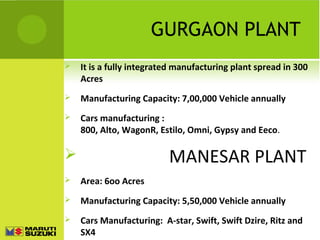
GURGAON PLANT
 It is a fully integrated manufacturing plant spread in 300
Acres
 Manufacturing Capacity: 7,00,000 Vehicle annually
 Cars manufacturing :
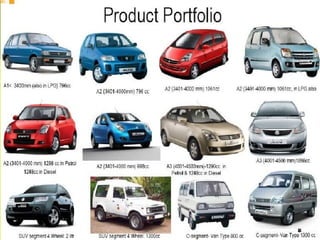
800, Alto, WagonR, Estilo, Omni, Gypsy and Eeco.
 MANESAR PLANT
 Area: 6oo Acres
 Manufacturing Capacity: 5,50,000 Vehicle annually
 Cars Manufacturing: A-star, Swift, Swift Dzire, Ritz and
SX4
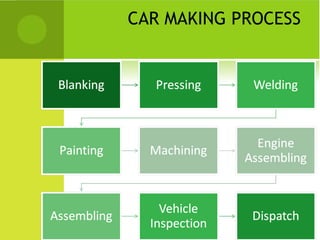
CAR MAKING PROCESS
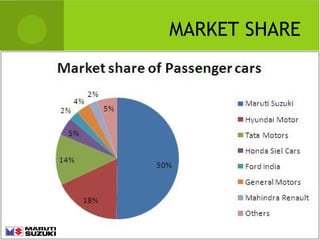
MARKET SHARE
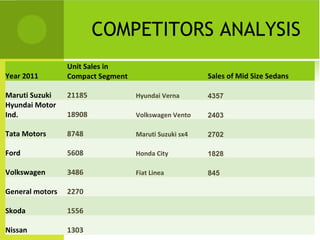
COMPETITORS ANALYSIS
Year 2011
Unit Sales in
Compact Segment Sales of Mid Size Sedans
Maruti Suzuki 21185 Hyundai Verna 4357
Hyundai Motor
Ind. 18908 Volkswagen Vento 2403
Tata Motors 8748 Maruti Suzuki sx4 2702
Ford 5608 Honda City 1828
Volkswagen 3486 Fiat Linea 845
General motors 2270
Skoda 1556
Nissan 1303
LEARNINGS &
CONCLUSION
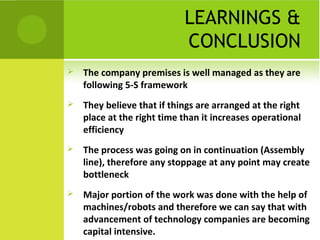
 The company premises is well managed as they are
following 5-S framework
 They believe that if things are arranged at the right
place at the right time than it increases operational
efficiency
 The process was going on in continuation (Assembly
line), therefore any stoppage at any point may create
bottleneck
 Major portion of the work was done with the help of
machines/robots and therefore we can say that with
advancement of technology companies are becoming
capital intensive.
maruti suzuki power point presentation

maruti suzuki power point presentation

  • 1.
  • 2.
    MARUTI SUZUKI HISTORY  Itwas established in February 1981  It commenced production in 1983 with Maruti 800  It was renamed Maruti Suzuki India Ltd in 2007  The headquarter are located at New Delhi  The chairman of company is Mr. M.C Bhargava  The CEO of the company- Mr. Shinzo Nakanishi  Company’s 54.2% shares are owned by Japanese Suzuki Motor Corporation.
  • 3.
    CONT..  Revenue:369.34 billion Net income :1681 billion  The company has maintain in India a sales network of 802 centers in 555 cities and towns  The company offers 15 brands and over 150 variants.  It has over 9000 people working in it.  The planning of company is to expand its manufacturing capacity to 1.75 million from 1.2 million by the year 2013.
  • 4.
    CONT.  It isthe first company to introduce CNG vehicles  It has service support to its customers at 2740 workshops in 1335 cities and towns of India  It exports in Europe, Asia, Latin America, Africa and Oceania.
  • 5.
    GURGAON PLANT  Itis a fully integrated manufacturing plant spread in 300 Acres  Manufacturing Capacity: 7,00,000 Vehicle annually  Cars manufacturing : 800, Alto, WagonR, Estilo, Omni, Gypsy and Eeco.  MANESAR PLANT  Area: 6oo Acres  Manufacturing Capacity: 5,50,000 Vehicle annually  Cars Manufacturing: A-star, Swift, Swift Dzire, Ritz and SX4
  • 7.
  • 8.
  • 9.
    COMPETITORS ANALYSIS Year 2011 UnitSales in Compact Segment Sales of Mid Size Sedans Maruti Suzuki 21185 Hyundai Verna 4357 Hyundai Motor Ind. 18908 Volkswagen Vento 2403 Tata Motors 8748 Maruti Suzuki sx4 2702 Ford 5608 Honda City 1828 Volkswagen 3486 Fiat Linea 845 General motors 2270 Skoda 1556 Nissan 1303
  • 10.
    LEARNINGS & CONCLUSION  Thecompany premises is well managed as they are following 5-S framework  They believe that if things are arranged at the right place at the right time than it increases operational efficiency  The process was going on in continuation (Assembly line), therefore any stoppage at any point may create bottleneck  Major portion of the work was done with the help of machines/robots and therefore we can say that with advancement of technology companies are becoming capital intensive.

Editor's Notes