LOVELY PROFESSIONAL UNIVERSITY
LOVELY SCHOOL OF BUSINESS AND APPLIED
ARTS
Presentation on:
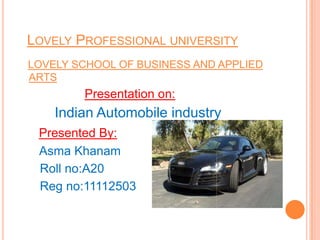
Indian Automobile industry
Presented By:
Asma Khanam
Roll no:A20
Reg no:11112503
SCHEME OF PRESENTATION
 Overview
 Production And Market
 Key Growth Drivers
 Market Share
 Position In World Production
 Domestic Production, Sales and Exports(2012)
 SWOT Analysis
 Future Projections
 Current Issues For Union Budget 2012-13
 Conclusion
 Suggestions
 References
OVERVIEW
 One of the major industrial sectors in India is the automobile
sector.
 Automobile Industry was delicensed in July 1991 with the
announcement of the New Industrial Policy.
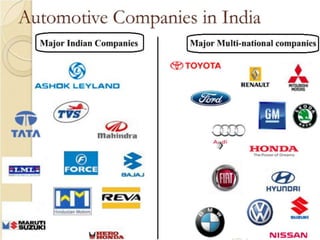
 The Indian Automobile Industry manufactures over 11 million
vehicles and exports about 1.5 million each year, annual
production of 3.9 million units(2011).
 Ranking:
 2nd largest two wheeler market in the world.
 3rd largest passenger car market in Asia & 10th Largest in the
world.
 4th largest tractor market in the world.
 5th largest commercial vehicle market in the world.
 5th largest bus & truck market in the world.
CONTD…..
• The monthly sale of passenger cars in India exceeds
100,000 units.
• Tata Motors is leading the commercial vehicle
segment with a market share of about 62%.
• Maruti Suzuki is leading the passenger vehicle
segment with a market share of 51.36%.
• Contribution of this industry to GDP was 2.77%
( 1992-1993) and 6.9 % (2011-12) in real terms.
• Employment in this industry is 787,7702 , out of
this 58% are in passenger car segment
(Confederation of Indian Industry).
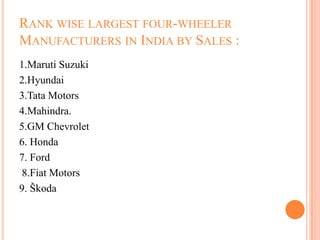
RANK WISE LARGEST FOUR-WHEELER
MANUFACTURERS IN INDIA BY SALES :
1.Maruti Suzuki
2.Hyundai
3.Tata Motors
4.Mahindra.
5.GM Chevrolet
6. Honda
7. Ford
8.Fiat Motors
9. Škoda
PRODUCTION AND MARKET
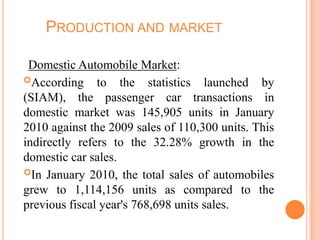
Domestic Automobile Market:
According to the statistics launched by
(SIAM), the passenger car transactions in
domestic market was 145,905 units in January
2010 against the 2009 sales of 110,300 units. This
indirectly refers to the 32.28% growth in the
domestic car sales.
In January 2010, the total sales of automobiles
grew to 1,114,156 units as compared to the
previous fiscal year's 768,698 units sales.
CONTD….
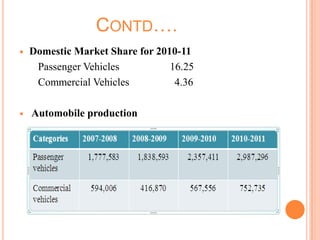
 Domestic Market Share for 2010-11
Passenger Vehicles 16.25
Commercial Vehicles 4.36
 Automobile production
KEY GROWTH DRIVERS
 Rising industrial and agricultural output.
 Rising per capita income.
 Favourable demographic distribution with rising
working population and middle class.
 Urbanization.
 Increasing disposable incomes in rural agri-sector
 Availability of a variety of vehicle models meeting
diverse needs and preferences.
 Greater affordability of vehicles.
 Easy finance schemes.
 Favourable government policies.
 Robust production.
MARKET SHARE
The key competitors on the market of this industry is ruled by
passenger automobile in India.
 The chief players in this segment are :
 Maruti Suzuki with market share of 51.36%
 Tata Motors with market share of 13.88%
 Hyundai with market share of 17.97%
 Mahindra and Mahindra with market share of 2.15%
 Others with market share of 16.83%
The commercial vehicles segment is dominated by leading
domestic players like:
 Tata Motors with a total market share of 62%,
 Ashok Leyland Ltd. with a total market share of 15%,
 M & M Ltd. with a total market share of 11%,
 Eicher Motors Ltd. with a total share of 6%, and others.
INDIA'S POSITION IN WORLD'S PRODUCTION
 Well-developed, globally competitive auto ancillary
industry .
 Established automobile testing and R&D centres.
 Among one of the lowest cost producers of steel in
the world.
 World’s second largest manufacturer of two
wheelers .
 Fifth largest manufacturer of commercial vehicles.
 Manufactures largest number of tractors in the
world.
 Ninth largest car manufacturer in world.
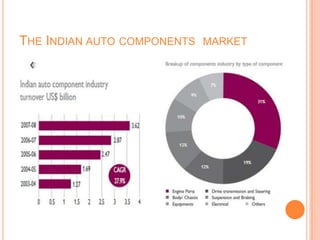
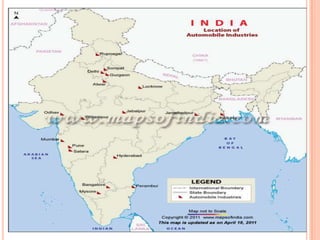
THE INDIAN AUTO COMPONENTS MARKET
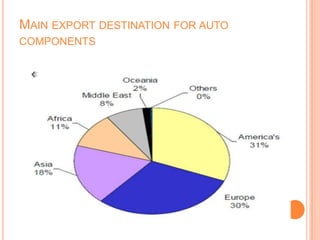
MAIN EXPORT DESTINATION FOR AUTO
COMPONENTS
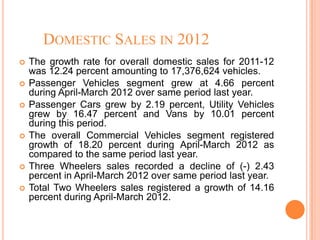
DOMESTIC SALES IN 2012
 The growth rate for overall domestic sales for 2011-12
was 12.24 percent amounting to 17,376,624 vehicles.
 Passenger Vehicles segment grew at 4.66 percent
during April-March 2012 over same period last year.
 Passenger Cars grew by 2.19 percent, Utility Vehicles
grew by 16.47 percent and Vans by 10.01 percent
during this period.
 The overall Commercial Vehicles segment registered
growth of 18.20 percent during April-March 2012 as
compared to the same period last year.
 Three Wheelers sales recorded a decline of (-) 2.43
percent in April-March 2012 over same period last year.
 Total Two Wheelers sales registered a growth of 14.16
percent during April-March 2012.
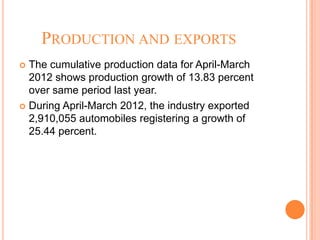
PRODUCTION AND EXPORTS
 The cumulative production data for April-March
2012 shows production growth of 13.83 percent
over same period last year.
 During April-March 2012, the industry exported
2,910,055 automobiles registering a growth of
25.44 percent.
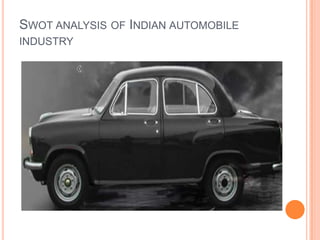
SWOT ANALYSIS OF INDIAN AUTOMOBILE
INDUSTRY
STRENGTHS
 Automobile Industry is established and Evergreen
Industry.
 India is the strongest player in small car segment.
 Indian companies are best cost innovators.
 Assembly line manufacturing and JIT inventory
management, the automotive industry has been
able to achieve significant gains in productivity.
 Exceptional human resource base.
 Government provides monetary assistance for
manufacturing units.
WEAKNESS
 India lacks proper infrastructural facilities.
 Poor sales service.
 The automotive sector lags behind other sectors
such an IT and financial services in
management, training, reward and retention.
 Too many taxes levied by government increase the
cost of production.
 Low productivity.
 Low investments in Research and Development
OPPORTUNITIES
 Small cars is a future.
 Green cars.
 Auto financing.
 Royalty through Patents.
 Reduction in Excise duty.
 Rural demand is rising.
 Income level is at a constant increase.
THREATS
 Global Crises.
 Companies not focusing on R&D are under great
risk.
 High competition from Foreign players.
 Lack of technology for Indian Companies.
 Increasing rates of interest.
 Rising cost of raw materials.
FUTURE TRENDS AND PROJECTIONS
Demand of four wheelers is expected
very high due to following factors:
• Improved life style of people
• Income of people
• Prices of four wheelers
• Price of fuel
• Family size
CURRENT ISSUES FOR UNION BUDGET 2013
 Excise duty on SUVs is hiked from 27 to 30%.
 The duty on high capacity motorcycles (800cc or more) has
been increased to 75% (from the existing 60%).
 The duty on second hand vehicles has been raised to 125%
(from 100%). The Indian government only allows the import
of right-hand-drive used cars that are up to 3 years old.
 Jawaharlal Nehru National Urban Renewal Mission
(JNNURM) is proposed to go up to Rs 14,873 crore from the
Rs 7,383 crore provided this year.
 Duty on CBU cars in this budget is 100 % (up from 75%).
 Cars like the Toyota Innova, Mahindra Scorpio & Tata Safari
are sure to suffer from price hikes of about Rs. 25,000 –
30,000.
CONCLUSION
The auto component industry was growing gradually
and was making significant developments in domestic
as well as in international market till 2006-07. The
internal barriers in the country and constraints at
international level had sluggish down the industry
growth, these barriers predominantly are hindrances
like – Tax structure especially the disparity in custom
and excise duties on the raw material of auto
components, and automobiles. The unavailability of
resources at reasonable cost for example-
Power, Skilled Labour, Technology etc is also a major
constraint. The challenges are mainly to overcome
with these hindrances and sustain into international
competition with other low cost countries.
SUGGESTIONS
 There is need to promote and sustain international
cooperation between Governments and industry.
 There is need for coordinated research and
development, standardization of designs and
broader technologies, effective cost cutting to
enhance affordability and loosening of trade
barriers across the globe.
 There should be separate measures, which require
addressing at the national and international levels.
CONTD…
 Single tax across the country is an ideal situation
and possibilities of this should be explored.
 Labour laws reforms to facilitate better productivity
and reduction in manpower costs as has already
been committed by the Government should be
expedited.
 Greater tax incentive on expenditure incurred on
research and development in automotive sector.
 Easier availability of market credit for funding
automobile acquisition is required.
REFERENCES
 Economic Survey 2012-13.
 Union Budget 2012-13.
 http://news.biharprabha.com/2013/02/how-budget-2013-will-
affect-indian-automobile-industry/
 http://cars.sulekha.com/expectations-of-auto-industry-from-
the-uni
 http://profit.ndtv.com/budget/news/auto/page-5on-
budget_car_news_3142
 http://www.siamindia.com/scripts/industrystatistics.aspx
 http://info.shine.com/Industry-
Information/Automobiles/783.aspx
 http://www.automatech.in/automobile-industry-
overview/industry-in-india.html
 http://www.automobileindia.com/consumer-guide/auto-
news.html
Automobile

Automobile

  • 1.
    LOVELY PROFESSIONAL UNIVERSITY LOVELYSCHOOL OF BUSINESS AND APPLIED ARTS Presentation on: Indian Automobile industry Presented By: Asma Khanam Roll no:A20 Reg no:11112503
  • 2.
    SCHEME OF PRESENTATION Overview  Production And Market  Key Growth Drivers  Market Share  Position In World Production  Domestic Production, Sales and Exports(2012)  SWOT Analysis  Future Projections  Current Issues For Union Budget 2012-13  Conclusion  Suggestions  References
  • 3.
    OVERVIEW  One ofthe major industrial sectors in India is the automobile sector.  Automobile Industry was delicensed in July 1991 with the announcement of the New Industrial Policy.  The Indian Automobile Industry manufactures over 11 million vehicles and exports about 1.5 million each year, annual production of 3.9 million units(2011).  Ranking:  2nd largest two wheeler market in the world.  3rd largest passenger car market in Asia & 10th Largest in the world.  4th largest tractor market in the world.  5th largest commercial vehicle market in the world.  5th largest bus & truck market in the world.
  • 4.
    CONTD….. • The monthlysale of passenger cars in India exceeds 100,000 units. • Tata Motors is leading the commercial vehicle segment with a market share of about 62%. • Maruti Suzuki is leading the passenger vehicle segment with a market share of 51.36%. • Contribution of this industry to GDP was 2.77% ( 1992-1993) and 6.9 % (2011-12) in real terms. • Employment in this industry is 787,7702 , out of this 58% are in passenger car segment (Confederation of Indian Industry).
  • 6.
    RANK WISE LARGESTFOUR-WHEELER MANUFACTURERS IN INDIA BY SALES : 1.Maruti Suzuki 2.Hyundai 3.Tata Motors 4.Mahindra. 5.GM Chevrolet 6. Honda 7. Ford 8.Fiat Motors 9. Škoda
  • 7.
    PRODUCTION AND MARKET DomesticAutomobile Market: According to the statistics launched by (SIAM), the passenger car transactions in domestic market was 145,905 units in January 2010 against the 2009 sales of 110,300 units. This indirectly refers to the 32.28% growth in the domestic car sales. In January 2010, the total sales of automobiles grew to 1,114,156 units as compared to the previous fiscal year's 768,698 units sales.
  • 8.
    CONTD….  Domestic MarketShare for 2010-11 Passenger Vehicles 16.25 Commercial Vehicles 4.36  Automobile production
  • 9.
    KEY GROWTH DRIVERS Rising industrial and agricultural output.  Rising per capita income.  Favourable demographic distribution with rising working population and middle class.  Urbanization.  Increasing disposable incomes in rural agri-sector  Availability of a variety of vehicle models meeting diverse needs and preferences.  Greater affordability of vehicles.  Easy finance schemes.  Favourable government policies.  Robust production.
  • 10.
    MARKET SHARE The keycompetitors on the market of this industry is ruled by passenger automobile in India.  The chief players in this segment are :  Maruti Suzuki with market share of 51.36%  Tata Motors with market share of 13.88%  Hyundai with market share of 17.97%  Mahindra and Mahindra with market share of 2.15%  Others with market share of 16.83% The commercial vehicles segment is dominated by leading domestic players like:  Tata Motors with a total market share of 62%,  Ashok Leyland Ltd. with a total market share of 15%,  M & M Ltd. with a total market share of 11%,  Eicher Motors Ltd. with a total share of 6%, and others.
  • 11.
    INDIA'S POSITION INWORLD'S PRODUCTION  Well-developed, globally competitive auto ancillary industry .  Established automobile testing and R&D centres.  Among one of the lowest cost producers of steel in the world.  World’s second largest manufacturer of two wheelers .  Fifth largest manufacturer of commercial vehicles.  Manufactures largest number of tractors in the world.  Ninth largest car manufacturer in world.
  • 12.
    THE INDIAN AUTOCOMPONENTS MARKET
  • 13.
    MAIN EXPORT DESTINATIONFOR AUTO COMPONENTS
  • 15.
    DOMESTIC SALES IN2012  The growth rate for overall domestic sales for 2011-12 was 12.24 percent amounting to 17,376,624 vehicles.  Passenger Vehicles segment grew at 4.66 percent during April-March 2012 over same period last year.  Passenger Cars grew by 2.19 percent, Utility Vehicles grew by 16.47 percent and Vans by 10.01 percent during this period.  The overall Commercial Vehicles segment registered growth of 18.20 percent during April-March 2012 as compared to the same period last year.  Three Wheelers sales recorded a decline of (-) 2.43 percent in April-March 2012 over same period last year.  Total Two Wheelers sales registered a growth of 14.16 percent during April-March 2012.
  • 16.
    PRODUCTION AND EXPORTS The cumulative production data for April-March 2012 shows production growth of 13.83 percent over same period last year.  During April-March 2012, the industry exported 2,910,055 automobiles registering a growth of 25.44 percent.
  • 17.
    SWOT ANALYSIS OFINDIAN AUTOMOBILE INDUSTRY
  • 18.
    STRENGTHS  Automobile Industryis established and Evergreen Industry.  India is the strongest player in small car segment.  Indian companies are best cost innovators.  Assembly line manufacturing and JIT inventory management, the automotive industry has been able to achieve significant gains in productivity.  Exceptional human resource base.  Government provides monetary assistance for manufacturing units.
  • 19.
    WEAKNESS  India lacksproper infrastructural facilities.  Poor sales service.  The automotive sector lags behind other sectors such an IT and financial services in management, training, reward and retention.  Too many taxes levied by government increase the cost of production.  Low productivity.  Low investments in Research and Development
  • 20.
    OPPORTUNITIES  Small carsis a future.  Green cars.  Auto financing.  Royalty through Patents.  Reduction in Excise duty.  Rural demand is rising.  Income level is at a constant increase.
  • 21.
    THREATS  Global Crises. Companies not focusing on R&D are under great risk.  High competition from Foreign players.  Lack of technology for Indian Companies.  Increasing rates of interest.  Rising cost of raw materials.
  • 22.
    FUTURE TRENDS ANDPROJECTIONS Demand of four wheelers is expected very high due to following factors: • Improved life style of people • Income of people • Prices of four wheelers • Price of fuel • Family size
  • 23.
    CURRENT ISSUES FORUNION BUDGET 2013  Excise duty on SUVs is hiked from 27 to 30%.  The duty on high capacity motorcycles (800cc or more) has been increased to 75% (from the existing 60%).  The duty on second hand vehicles has been raised to 125% (from 100%). The Indian government only allows the import of right-hand-drive used cars that are up to 3 years old.  Jawaharlal Nehru National Urban Renewal Mission (JNNURM) is proposed to go up to Rs 14,873 crore from the Rs 7,383 crore provided this year.  Duty on CBU cars in this budget is 100 % (up from 75%).  Cars like the Toyota Innova, Mahindra Scorpio & Tata Safari are sure to suffer from price hikes of about Rs. 25,000 – 30,000.
  • 24.
    CONCLUSION The auto componentindustry was growing gradually and was making significant developments in domestic as well as in international market till 2006-07. The internal barriers in the country and constraints at international level had sluggish down the industry growth, these barriers predominantly are hindrances like – Tax structure especially the disparity in custom and excise duties on the raw material of auto components, and automobiles. The unavailability of resources at reasonable cost for example- Power, Skilled Labour, Technology etc is also a major constraint. The challenges are mainly to overcome with these hindrances and sustain into international competition with other low cost countries.
  • 25.
    SUGGESTIONS  There isneed to promote and sustain international cooperation between Governments and industry.  There is need for coordinated research and development, standardization of designs and broader technologies, effective cost cutting to enhance affordability and loosening of trade barriers across the globe.  There should be separate measures, which require addressing at the national and international levels.
  • 26.
    CONTD…  Single taxacross the country is an ideal situation and possibilities of this should be explored.  Labour laws reforms to facilitate better productivity and reduction in manpower costs as has already been committed by the Government should be expedited.  Greater tax incentive on expenditure incurred on research and development in automotive sector.  Easier availability of market credit for funding automobile acquisition is required.
  • 27.
    REFERENCES  Economic Survey2012-13.  Union Budget 2012-13.  http://news.biharprabha.com/2013/02/how-budget-2013-will- affect-indian-automobile-industry/  http://cars.sulekha.com/expectations-of-auto-industry-from- the-uni  http://profit.ndtv.com/budget/news/auto/page-5on- budget_car_news_3142  http://www.siamindia.com/scripts/industrystatistics.aspx  http://info.shine.com/Industry- Information/Automobiles/783.aspx  http://www.automatech.in/automobile-industry- overview/industry-in-india.html  http://www.automobileindia.com/consumer-guide/auto- news.html