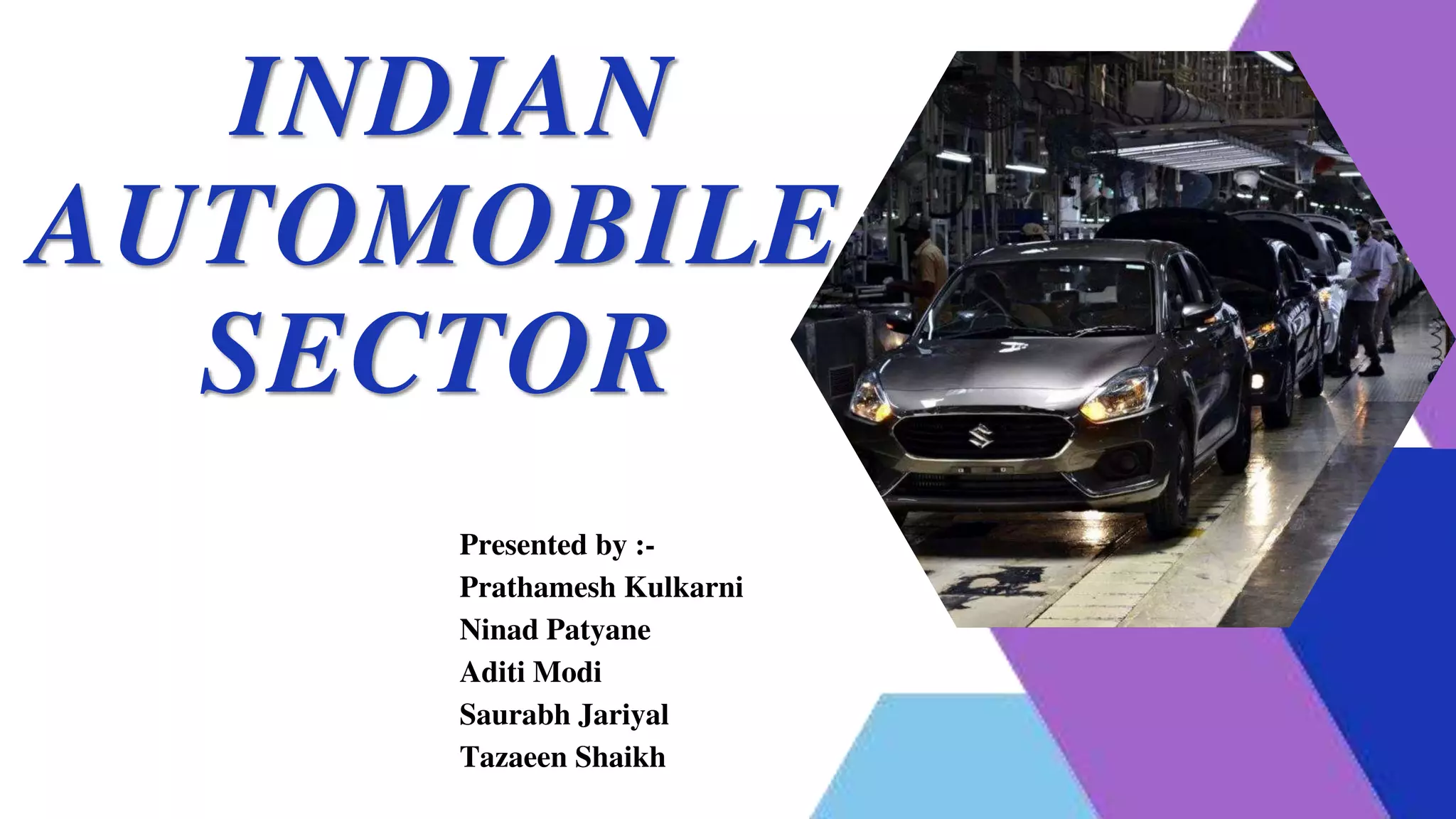
INDIAN
AUTOMOBILE
SECTOR
Presented by :-
Prathamesh Kulkarni
Ninad Patyane
Aditi Modi
Saurabh Jariyal
Tazaeen Shaikh
Introduction
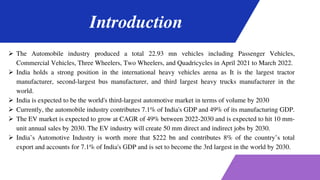
 The Automobile industry produced a total 22.93 mn vehicles including Passenger Vehicles,
Commercial Vehicles, Three Wheelers, Two Wheelers, and Quadricycles in April 2021 to March 2022.
 India holds a strong position in the international heavy vehicles arena as It is the largest tractor
manufacturer, second-largest bus manufacturer, and third largest heavy trucks manufacturer in the
world.
 India is expected to be the world's third-largest automotive market in terms of volume by 2030
 Currently, the automobile industry contributes 7.1% of India's GDP and 49% of its manufacturing GDP.
 The EV market is expected to grow at CAGR of 49% between 2022-2030 and is expected to hit 10 mm-
unit annual sales by 2030. The EV industry will create 50 mm direct and indirect jobs by 2030.
 India’s Automotive Industry is worth more that $222 bn and contributes 8% of the country’s total
export and accounts for 7.1% of India's GDP and is set to become the 3rd largest in the world by 2030.
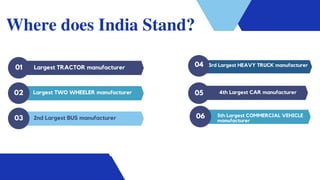
Where does India Stand?
01
02
03
04
Largest TRACTOR manufacturer
Largest TWO WHEELER manufacturer
2nd Largest BUS manufacturer
3rd Largest HEAVY TRUCK manufacturer
4th Largest CAR manufacturer
5th Largest COMMERCIAL VEHICLE
manufacturer
05
06
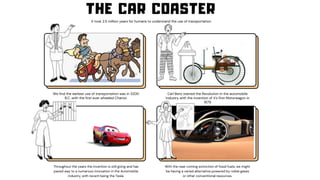
Carl Benz started the Revolution in the automobile
industry with the invention of it's first Motorwagon in
1879
1
2
3
THE CAR COASTER
It took 2.5 million years for humans to understand the use of transportation
We find the earliest use of transportation was in 3200
B.C. with the first ever wheeled Chariot.
Throughout the years the invention is still going and has
paved way to a numerous innovation in the Automobile
industry, with recent being the Tesla.
With the near coming extinction of fossil fuels, we might
be having a varied alternative powered by noble gases
or other conventional resources.
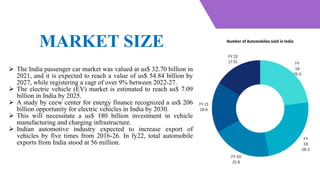
 The India passenger car market was valued at us$ 32.70 billion in
2021, and it is expected to reach a value of us$ 54.84 billion by
2027, while registering a cagr of over 9% between 2022-27.
 The electric vehicle (EV) market is estimated to reach us$ 7.09
billion in India by 2025.
 A study by ceew center for energy finance recognized a us$ 206
billion opportunity for electric vehicles in India by 2030.
 This will necessitate a us$ 180 billion investment in vehicle
manufacturing and charging infrastructure.
 Indian automotive industry expected to increase export of
vehicles by five times from 2016-26. In fy22, total automobile
exports from India stood at 56 million.
MARKET SIZE
FY
19
26.3
FY
18
25.0
FY 20
21.6
FY 21
18.6
FY 22
17.51
Number of Automobiles sold in India
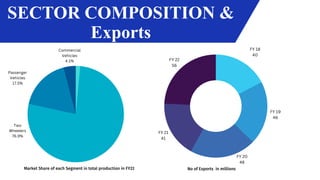
SECTOR COMPOSITION &
Exports
Two
Wheelers
76.9%
Passenger
Vehicles
17.5%
Commercial
Vehicles
4.1%
Market Share of each Segment in total production in FY22
FY 22
56
FY 20
48
FY 19
46
FY 21
41
FY 18
40
No of Exports in millions
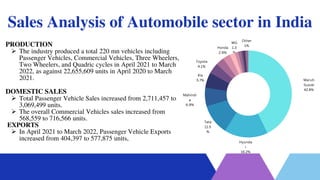
Sales Analysis of Automobile sector in India
PRODUCTION
 The industry produced a total 220 mn vehicles including
Passenger Vehicles, Commercial Vehicles, Three Wheelers,
Two Wheelers, and Quadric cycles in April 2021 to March
2022, as against 22,655,609 units in April 2020 to March
2021.
DOMESTIC SALES
 Total Passenger Vehicle Sales increased from 2,711,457 to
3,069,499 units.
 The overall Commercial Vehicles sales increased from
568,559 to 716,566 units.
EXPORTS
 In April 2021 to March 2022, Passenger Vehicle Exports
increased from 404,397 to 577,875 units,
Maruti
Suzuki
42.8%
Hyunda
i
16.2%
Tata
11.5
%
Mahindr
a
6.9%
Kia
5.7%
Toyota
4.1%
Honda
2.9%
MG
1.3
%
Other
1%
Investments in Automobile
Sector
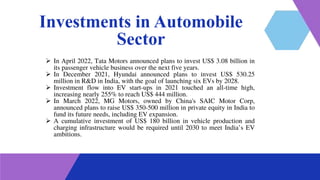
 In April 2022, Tata Motors announced plans to invest US$ 3.08 billion in
its passenger vehicle business over the next five years.
 In December 2021, Hyundai announced plans to invest US$ 530.25
million in R&D in India, with the goal of launching six EVs by 2028.
 Investment flow into EV start-ups in 2021 touched an all-time high,
increasing nearly 255% to reach US$ 444 million.
 In March 2022, MG Motors, owned by China's SAIC Motor Corp,
announced plans to raise US$ 350-500 million in private equity in India to
fund its future needs, including EV expansion.
 A cumulative investment of US$ 180 billion in vehicle production and
charging infrastructure would be required until 2030 to meet India’s EV
ambitions.
SWOT Analysis Of Automobile Sector
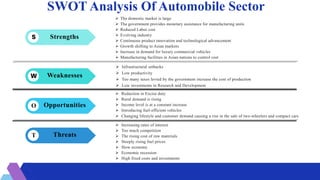
 The domestic market is large
 The government provides monetary assistance for manufacturing units
 Reduced Labor cost
 Evolving industry
 Continuous product innovation and technological advancement
 Growth shifting to Asian markets
 Increase in demand for luxury commercial vehicles
 Manufacturing facilities in Asian nations to control cost
 Infrastructural setbacks
 Low productivity
 Too many taxes levied by the government increase the cost of production
 Low investments in Research and Development
 Reduction in Excise duty
 Rural demand is rising
 Income level is at a constant increase
 Introducing fuel-efficient vehicles
 Changing lifestyle and customer demand causing a rise in the sale of two-wheelers and compact cars
 Increasing rates of interest
 Too much competition
 The rising cost of raw materials
 Steeply rising fuel prices
 Slow economy
 Economic recession
 High fixed costs and investments
Strengths
Weaknesses
Opportunities
Threats
O
T
Porters 5 Forces Model
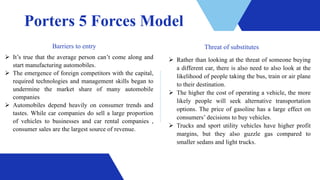
 It’s true that the average person can’t come along and
start manufacturing automobiles.
 The emergence of foreign competitors with the capital,
required technologies and management skills began to
undermine the market share of many automobile
companies
 Automobiles depend heavily on consumer trends and
tastes. While car companies do sell a large proportion
of vehicles to businesses and car rental companies ,
consumer sales are the largest source of revenue.
Barriers to entry
 Rather than looking at the threat of someone buying
a different car, there is also need to also look at the
likelihood of people taking the bus, train or air plane
to their destination.
 The higher the cost of operating a vehicle, the more
likely people will seek alternative transportation
options. The price of gasoline has a large effect on
consumers’ decisions to buy vehicles.
 Trucks and sport utility vehicles have higher profit
margins, but they also guzzle gas compared to
smaller sedans and light trucks.
Threat of substitutes
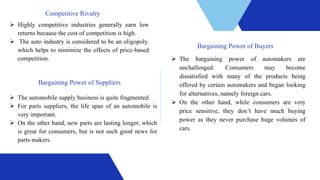
 Highly competitive industries generally earn low
returns because the cost of competition is high.
 The auto industry is considered to be an oligopoly.
which helps to minimize the effects of price-based
competition.
Competitive Rivalry
 The automobile supply business is quite fragmented.
 For parts suppliers, the life span of an automobile is
very important.
 On the other hand, new parts are lasting longer, which
is great for consumers, but is not such good news for
parts makers.
Bargaining Power of Suppliers
 The bargaining power of automakers are
unchallenged. Consumers may become
dissatisfied with many of the products being
offered by certain automakers and began looking
for alternatives, namely foreign cars.
 On the other hand, while consumers are very
price sensitive, they don’t have much buying
power as they never purchase huge volumes of
cars.
Bargaining Power of Buyers
PESTELAnalysis
PESTEL Analysis of the Indian Automobile Industry
 Political
 Economic
 Social
 Technological
 Environmental
 Legal
Political factors: -
 The Indian automobile industry has attracted many investors.
 All these are pooled in three main regions despite the expansive size of the country.
 The government has a hand in this because it has invested in the development of these regions.
Economic factors:-
 India has also been experiencing economic growth at an average 6% and the automobile industry
contributes 22% to the GDP of the country.
 This makes it a very important income generating activity for the country.
 This growth has rippled its way to create consumers as there is a huge growing middle class in India.
Social factors:-
 India is fast becoming an automobile industry hub because of its large population.
 This forms a bustling market for the manufacturers. The tastes of the populations may vary but
manufacturers always take note of the fast selling automobiles and create appropriate designs.
 For instance, in the past three years, there has been a surge of two-wheeler vehicles because of their
convenience in the country.
 Many automobile industries have created these vehicles for domestic consumers.
Technological factors:-
 The automobile industry has grown because there are several technological inventions.
 These are used not only in manufacture of the vehicles but also to reduce expenses for the vehicle
buyers.
 The government is also helping in research and development to ensure that both producers and
consumers are happy and encouraged to invest in the automobile industry.
Environmental factors:-
 Environmental factors have influenced automobile industry in India because more investors
are opting to manufacture environmental friendly vehicles.
 These include, vehicles that consume less fuels and emit less fumes. There are also some
investors that have chosen to manufacture the electric vehicle in a bid to conserve energy and
also the environment.
Legal factors:-
 Legal factors have played a role in the recent expansion of the Indian automobile industry.
 This is because the industry is extremely incentivized with investors being given 100%
foreign direct investment pass.
 There are also zero taxes for the investors who ship the cars to other countries from their
manufacturing bases in India.
 By easing the legal rules affecting the industry, the government of India has encouraged
varied automobile companies to set up shop in the country.
Future Of Indian Automobile
Sector
Electric Mobility and Green Energy:-
Electric mobility is regarded as a savior technology as it helps humankind tackle the challenges of
depleting fossil fuel reserves and rapidly deteriorating ambient air quality. Electrification is more relevant
for urban areas where charging facilities can be packed with other utilities and amenities.
Artificial Intelligence:-
AI-based vehicles are the pacesetters in the auto sector. The technology enables smart travel methods,
where vehicles do not need drivers and can work on software and sensors. These autonomous vehicles
focus on reducing the need for human drivers and make daily transport convenient and hassle-free.
Reference
 https://www.bestessayservices.com/blog/pestel-analysis-of-the-indian-automobile-industry/
 https://www.essaysauce.com/business-essays/porters-five-forces-model-automobile-industry-analyse-
investment/
 https://www.ibef.org/
 https://www.investindia.gov.in/sector/automobile
Indian Automobile Sector

Indian Automobile Sector

  • 1.
    INDIAN AUTOMOBILE SECTOR Presented by :- PrathameshKulkarni Ninad Patyane Aditi Modi Saurabh Jariyal Tazaeen Shaikh
  • 2.
    Introduction  The Automobileindustry produced a total 22.93 mn vehicles including Passenger Vehicles, Commercial Vehicles, Three Wheelers, Two Wheelers, and Quadricycles in April 2021 to March 2022.  India holds a strong position in the international heavy vehicles arena as It is the largest tractor manufacturer, second-largest bus manufacturer, and third largest heavy trucks manufacturer in the world.  India is expected to be the world's third-largest automotive market in terms of volume by 2030  Currently, the automobile industry contributes 7.1% of India's GDP and 49% of its manufacturing GDP.  The EV market is expected to grow at CAGR of 49% between 2022-2030 and is expected to hit 10 mm- unit annual sales by 2030. The EV industry will create 50 mm direct and indirect jobs by 2030.  India’s Automotive Industry is worth more that $222 bn and contributes 8% of the country’s total export and accounts for 7.1% of India's GDP and is set to become the 3rd largest in the world by 2030.
  • 3.
    Where does IndiaStand? 01 02 03 04 Largest TRACTOR manufacturer Largest TWO WHEELER manufacturer 2nd Largest BUS manufacturer 3rd Largest HEAVY TRUCK manufacturer 4th Largest CAR manufacturer 5th Largest COMMERCIAL VEHICLE manufacturer 05 06
  • 4.
    Carl Benz startedthe Revolution in the automobile industry with the invention of it's first Motorwagon in 1879 1 2 3 THE CAR COASTER It took 2.5 million years for humans to understand the use of transportation We find the earliest use of transportation was in 3200 B.C. with the first ever wheeled Chariot. Throughout the years the invention is still going and has paved way to a numerous innovation in the Automobile industry, with recent being the Tesla. With the near coming extinction of fossil fuels, we might be having a varied alternative powered by noble gases or other conventional resources.
  • 5.
     The Indiapassenger car market was valued at us$ 32.70 billion in 2021, and it is expected to reach a value of us$ 54.84 billion by 2027, while registering a cagr of over 9% between 2022-27.  The electric vehicle (EV) market is estimated to reach us$ 7.09 billion in India by 2025.  A study by ceew center for energy finance recognized a us$ 206 billion opportunity for electric vehicles in India by 2030.  This will necessitate a us$ 180 billion investment in vehicle manufacturing and charging infrastructure.  Indian automotive industry expected to increase export of vehicles by five times from 2016-26. In fy22, total automobile exports from India stood at 56 million. MARKET SIZE FY 19 26.3 FY 18 25.0 FY 20 21.6 FY 21 18.6 FY 22 17.51 Number of Automobiles sold in India
  • 6.
    SECTOR COMPOSITION & Exports Two Wheelers 76.9% Passenger Vehicles 17.5% Commercial Vehicles 4.1% MarketShare of each Segment in total production in FY22 FY 22 56 FY 20 48 FY 19 46 FY 21 41 FY 18 40 No of Exports in millions
  • 7.
    Sales Analysis ofAutomobile sector in India PRODUCTION  The industry produced a total 220 mn vehicles including Passenger Vehicles, Commercial Vehicles, Three Wheelers, Two Wheelers, and Quadric cycles in April 2021 to March 2022, as against 22,655,609 units in April 2020 to March 2021. DOMESTIC SALES  Total Passenger Vehicle Sales increased from 2,711,457 to 3,069,499 units.  The overall Commercial Vehicles sales increased from 568,559 to 716,566 units. EXPORTS  In April 2021 to March 2022, Passenger Vehicle Exports increased from 404,397 to 577,875 units, Maruti Suzuki 42.8% Hyunda i 16.2% Tata 11.5 % Mahindr a 6.9% Kia 5.7% Toyota 4.1% Honda 2.9% MG 1.3 % Other 1%
  • 8.
    Investments in Automobile Sector In April 2022, Tata Motors announced plans to invest US$ 3.08 billion in its passenger vehicle business over the next five years.  In December 2021, Hyundai announced plans to invest US$ 530.25 million in R&D in India, with the goal of launching six EVs by 2028.  Investment flow into EV start-ups in 2021 touched an all-time high, increasing nearly 255% to reach US$ 444 million.  In March 2022, MG Motors, owned by China's SAIC Motor Corp, announced plans to raise US$ 350-500 million in private equity in India to fund its future needs, including EV expansion.  A cumulative investment of US$ 180 billion in vehicle production and charging infrastructure would be required until 2030 to meet India’s EV ambitions.
  • 9.
    SWOT Analysis OfAutomobile Sector  The domestic market is large  The government provides monetary assistance for manufacturing units  Reduced Labor cost  Evolving industry  Continuous product innovation and technological advancement  Growth shifting to Asian markets  Increase in demand for luxury commercial vehicles  Manufacturing facilities in Asian nations to control cost  Infrastructural setbacks  Low productivity  Too many taxes levied by the government increase the cost of production  Low investments in Research and Development  Reduction in Excise duty  Rural demand is rising  Income level is at a constant increase  Introducing fuel-efficient vehicles  Changing lifestyle and customer demand causing a rise in the sale of two-wheelers and compact cars  Increasing rates of interest  Too much competition  The rising cost of raw materials  Steeply rising fuel prices  Slow economy  Economic recession  High fixed costs and investments Strengths Weaknesses Opportunities Threats O T
  • 10.
    Porters 5 ForcesModel  It’s true that the average person can’t come along and start manufacturing automobiles.  The emergence of foreign competitors with the capital, required technologies and management skills began to undermine the market share of many automobile companies  Automobiles depend heavily on consumer trends and tastes. While car companies do sell a large proportion of vehicles to businesses and car rental companies , consumer sales are the largest source of revenue. Barriers to entry  Rather than looking at the threat of someone buying a different car, there is also need to also look at the likelihood of people taking the bus, train or air plane to their destination.  The higher the cost of operating a vehicle, the more likely people will seek alternative transportation options. The price of gasoline has a large effect on consumers’ decisions to buy vehicles.  Trucks and sport utility vehicles have higher profit margins, but they also guzzle gas compared to smaller sedans and light trucks. Threat of substitutes
  • 11.
     Highly competitiveindustries generally earn low returns because the cost of competition is high.  The auto industry is considered to be an oligopoly. which helps to minimize the effects of price-based competition. Competitive Rivalry  The automobile supply business is quite fragmented.  For parts suppliers, the life span of an automobile is very important.  On the other hand, new parts are lasting longer, which is great for consumers, but is not such good news for parts makers. Bargaining Power of Suppliers  The bargaining power of automakers are unchallenged. Consumers may become dissatisfied with many of the products being offered by certain automakers and began looking for alternatives, namely foreign cars.  On the other hand, while consumers are very price sensitive, they don’t have much buying power as they never purchase huge volumes of cars. Bargaining Power of Buyers
  • 12.
    PESTELAnalysis PESTEL Analysis ofthe Indian Automobile Industry  Political  Economic  Social  Technological  Environmental  Legal Political factors: -  The Indian automobile industry has attracted many investors.  All these are pooled in three main regions despite the expansive size of the country.  The government has a hand in this because it has invested in the development of these regions. Economic factors:-  India has also been experiencing economic growth at an average 6% and the automobile industry contributes 22% to the GDP of the country.  This makes it a very important income generating activity for the country.  This growth has rippled its way to create consumers as there is a huge growing middle class in India.
  • 13.
    Social factors:-  Indiais fast becoming an automobile industry hub because of its large population.  This forms a bustling market for the manufacturers. The tastes of the populations may vary but manufacturers always take note of the fast selling automobiles and create appropriate designs.  For instance, in the past three years, there has been a surge of two-wheeler vehicles because of their convenience in the country.  Many automobile industries have created these vehicles for domestic consumers. Technological factors:-  The automobile industry has grown because there are several technological inventions.  These are used not only in manufacture of the vehicles but also to reduce expenses for the vehicle buyers.  The government is also helping in research and development to ensure that both producers and consumers are happy and encouraged to invest in the automobile industry.
  • 14.
    Environmental factors:-  Environmentalfactors have influenced automobile industry in India because more investors are opting to manufacture environmental friendly vehicles.  These include, vehicles that consume less fuels and emit less fumes. There are also some investors that have chosen to manufacture the electric vehicle in a bid to conserve energy and also the environment. Legal factors:-  Legal factors have played a role in the recent expansion of the Indian automobile industry.  This is because the industry is extremely incentivized with investors being given 100% foreign direct investment pass.  There are also zero taxes for the investors who ship the cars to other countries from their manufacturing bases in India.  By easing the legal rules affecting the industry, the government of India has encouraged varied automobile companies to set up shop in the country.
  • 15.
    Future Of IndianAutomobile Sector Electric Mobility and Green Energy:- Electric mobility is regarded as a savior technology as it helps humankind tackle the challenges of depleting fossil fuel reserves and rapidly deteriorating ambient air quality. Electrification is more relevant for urban areas where charging facilities can be packed with other utilities and amenities. Artificial Intelligence:- AI-based vehicles are the pacesetters in the auto sector. The technology enables smart travel methods, where vehicles do not need drivers and can work on software and sensors. These autonomous vehicles focus on reducing the need for human drivers and make daily transport convenient and hassle-free.
  • 16.