




Business Plan
For a
Coffee shop
BY ABHINAV TYAGI
PH-9971732636
Company profile
Company Logo
Company name- Crema Coffee co.
Startup Summary
About Crema coffee
Crema Coffee co is determined to become a daily necessity
for local coffee addicts and just a comfortable place to meet
friends or to read a book, all in one. With the growing
demand for high-quality coffee and great service, Crema
coffee will capitalize on its proximity to the Gautam Buddha
University campus to build a core group of repeat customers.
Java Culture will offer its customers the best prepared coffee
in the area that will be complimented with pastries, as well
as free books that its patrons can read to enjoy their visit.
Business plan
The company will operate a 1800 square foot coffee bar
within a walking distance from the Gautam Buddha University
campus. The owners have secured this location through a
three-year lease with an option for extending. They have also
provided ₹3,00,000 for start-up funds. The remaining capital
will be obtained through startup India loan scheme
Company ownership
The company is a limited liability partnership Abhinav
Tyagi owns 51% of the company. His cousin Anuj Tyagi
holds the other 49% stake in the company.
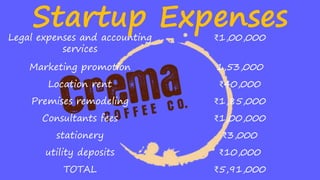
Startup ExpensesLegal expenses and accounting
services
₹1,00,000
Marketing promotion 1,53,000
Location rent ₹40,000
Premises remodeling ₹1,85,000
Consultants fees ₹1,00,000
stationery ₹3,000
utility deposits ₹10,000
TOTAL ₹5,91,000
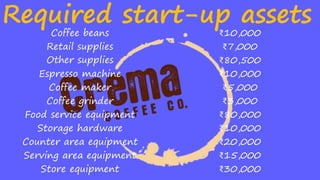
Required start-up assets
Coffee beans ₹10,000
Retail supplies ₹7,000
Other supplies ₹80,500
Espresso machine ₹10,000
Coffee maker ₹5,000
Coffee grinder ₹3,000
Food service equipment ₹80,000
Storage hardware ₹10,000
Counter area equipment ₹20,000
Serving area equipment ₹15,000
Store equipment ₹30,000
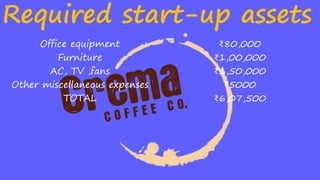
Office equipment ₹80,000
Furniture ₹1,00,000
AC, TV ,fans ₹1,50,000
Other miscellaneous expenses ₹5000
TOTAL ₹6,07,500
Required start-up assets
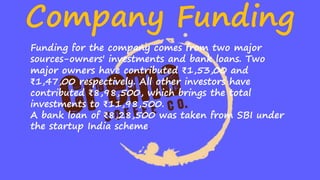
Company Funding
Funding for the company comes from two major
sources-owners' investments and bank loans. Two
major owners have contributed ₹1,53,00 and
₹1,47,00 respectively. All other investors have
contributed ₹8,98,500, which brings the total
investments to ₹11,98,500.
A bank loan of ₹8,28,500 was taken from SBI under
the startup India scheme.
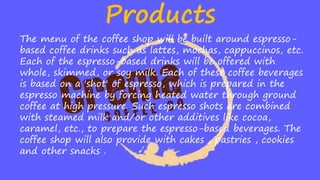
Products
The menu of the coffee shop will be built around espresso-
based coffee drinks such as lattes, mochas, cappuccinos, etc.
Each of the espresso-based drinks will be offered with
whole, skimmed, or soy milk. Each of these coffee beverages
is based on a 'shot' of espresso, which is prepared in the
espresso machine by forcing heated water through ground
coffee at high pressure. Such espresso shots are combined
with steamed milk and/or other additives like cocoa,
caramel, etc., to prepare the espresso-based beverages. The
coffee shop will also provide with cakes , pastries , cookies
and other snacks .
Crema coffee will focus its marketing activities on reaching
the University students and faculty, people working in
offices located close to the coffee shop and on sophisticated
teenagers. market research shows that these are the
customer groups that are most likely to buy coffee products.
Since coffee consumption is universal across different income
categories and mostly depends on the level of higher
education, proximity to the University campus will provide
access to the targeted customer audience.
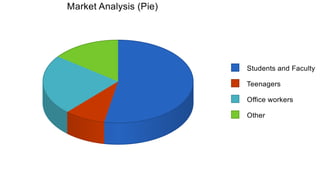
The chart and table below outline the total market potential
of coffee.
Market analysis
Personnel plan
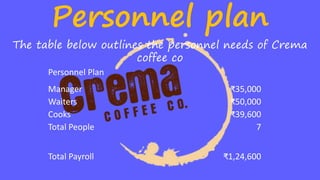
The table below outlines the personnel needs of Crema
coffee co
Personnel Plan
Manager ₹35,000
Waiters ₹50,000
Cooks ₹39,600
Total People 7
Total Payroll ₹1,24,600
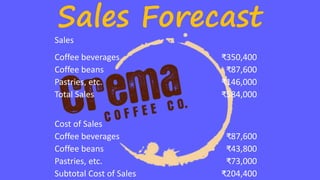
Sales
Coffee beverages ₹350,400
Coffee beans ₹87,600
Pastries, etc. ₹146,000
Total Sales ₹584,000
Cost of Sales
Coffee beverages ₹87,600
Coffee beans ₹43,800
Pastries, etc. ₹73,000
Subtotal Cost of Sales ₹204,400
Sales Forecast
Break even analysis
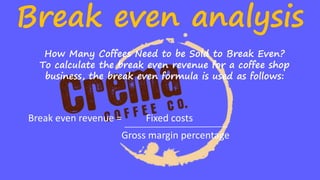
How Many Coffees Need to be Sold to Break Even?
To calculate the break even revenue for a coffee shop
business, the break even formula is used as follows:
Break even revenue = Fixed costs
Gross margin percentage
Break even analysis
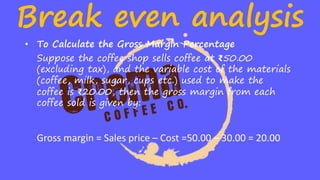
• To Calculate the Gross Margin Percentage
Suppose the coffee shop sells coffee at ₹50.00
(excluding tax), and the variable cost of the materials
(coffee, milk, sugar, cups etc.) used to make the
coffee is ₹20.00, then the gross margin from each
coffee sold is given by:
Gross margin = Sales price – Cost =50.00 – 30.00 = 20.00
Break even analysis
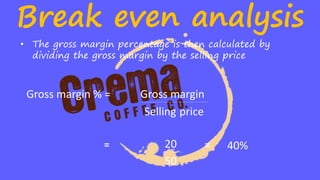
• The gross margin percentage is then calculated by
dividing the gross margin by the selling price
Gross margin % = Gross margin
Selling price
= 20
50
= 40%
Break even analysis
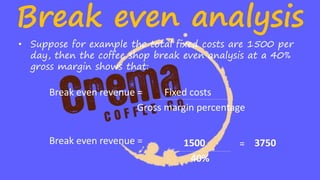
• Suppose for example the total fixed costs are 1500 per
day, then the coffee shop break even analysis at a 40%
gross margin shows that:
Break even revenue = Fixed costs
Gross margin percentage
Break even revenue = 1500
40%
= 3750
Break even analysis
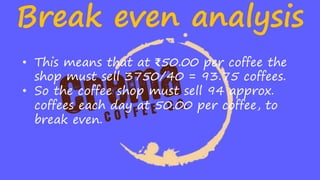
• This means that at ₹50.00 per coffee the
shop must sell 3750/40 = 93.75 coffees.
• So the coffee shop must sell 94 approx.
coffees each day at 50.00 per coffee, to
break even.
A presentation
By
Abhinav Tyagi

Cost ppt

  • 1.
    Business Plan For a Coffeeshop BY ABHINAV TYAGI PH-9971732636
  • 2.
  • 3.
  • 4.
    About Crema coffee CremaCoffee co is determined to become a daily necessity for local coffee addicts and just a comfortable place to meet friends or to read a book, all in one. With the growing demand for high-quality coffee and great service, Crema coffee will capitalize on its proximity to the Gautam Buddha University campus to build a core group of repeat customers. Java Culture will offer its customers the best prepared coffee in the area that will be complimented with pastries, as well as free books that its patrons can read to enjoy their visit.
  • 5.
    Business plan The companywill operate a 1800 square foot coffee bar within a walking distance from the Gautam Buddha University campus. The owners have secured this location through a three-year lease with an option for extending. They have also provided ₹3,00,000 for start-up funds. The remaining capital will be obtained through startup India loan scheme
  • 6.
    Company ownership The companyis a limited liability partnership Abhinav Tyagi owns 51% of the company. His cousin Anuj Tyagi holds the other 49% stake in the company.
  • 7.
    Startup ExpensesLegal expensesand accounting services ₹1,00,000 Marketing promotion 1,53,000 Location rent ₹40,000 Premises remodeling ₹1,85,000 Consultants fees ₹1,00,000 stationery ₹3,000 utility deposits ₹10,000 TOTAL ₹5,91,000
  • 8.
    Required start-up assets Coffeebeans ₹10,000 Retail supplies ₹7,000 Other supplies ₹80,500 Espresso machine ₹10,000 Coffee maker ₹5,000 Coffee grinder ₹3,000 Food service equipment ₹80,000 Storage hardware ₹10,000 Counter area equipment ₹20,000 Serving area equipment ₹15,000 Store equipment ₹30,000
  • 9.
    Office equipment ₹80,000 Furniture₹1,00,000 AC, TV ,fans ₹1,50,000 Other miscellaneous expenses ₹5000 TOTAL ₹6,07,500 Required start-up assets
  • 10.
    Company Funding Funding forthe company comes from two major sources-owners' investments and bank loans. Two major owners have contributed ₹1,53,00 and ₹1,47,00 respectively. All other investors have contributed ₹8,98,500, which brings the total investments to ₹11,98,500. A bank loan of ₹8,28,500 was taken from SBI under the startup India scheme.
  • 11.
    Products The menu ofthe coffee shop will be built around espresso- based coffee drinks such as lattes, mochas, cappuccinos, etc. Each of the espresso-based drinks will be offered with whole, skimmed, or soy milk. Each of these coffee beverages is based on a 'shot' of espresso, which is prepared in the espresso machine by forcing heated water through ground coffee at high pressure. Such espresso shots are combined with steamed milk and/or other additives like cocoa, caramel, etc., to prepare the espresso-based beverages. The coffee shop will also provide with cakes , pastries , cookies and other snacks .
  • 12.
    Crema coffee willfocus its marketing activities on reaching the University students and faculty, people working in offices located close to the coffee shop and on sophisticated teenagers. market research shows that these are the customer groups that are most likely to buy coffee products. Since coffee consumption is universal across different income categories and mostly depends on the level of higher education, proximity to the University campus will provide access to the targeted customer audience. The chart and table below outline the total market potential of coffee. Market analysis
  • 14.
    Personnel plan The tablebelow outlines the personnel needs of Crema coffee co Personnel Plan Manager ₹35,000 Waiters ₹50,000 Cooks ₹39,600 Total People 7 Total Payroll ₹1,24,600
  • 15.
    Sales Coffee beverages ₹350,400 Coffeebeans ₹87,600 Pastries, etc. ₹146,000 Total Sales ₹584,000 Cost of Sales Coffee beverages ₹87,600 Coffee beans ₹43,800 Pastries, etc. ₹73,000 Subtotal Cost of Sales ₹204,400 Sales Forecast
  • 16.
    Break even analysis HowMany Coffees Need to be Sold to Break Even? To calculate the break even revenue for a coffee shop business, the break even formula is used as follows: Break even revenue = Fixed costs Gross margin percentage
  • 17.
    Break even analysis •To Calculate the Gross Margin Percentage Suppose the coffee shop sells coffee at ₹50.00 (excluding tax), and the variable cost of the materials (coffee, milk, sugar, cups etc.) used to make the coffee is ₹20.00, then the gross margin from each coffee sold is given by: Gross margin = Sales price – Cost =50.00 – 30.00 = 20.00
  • 18.
    Break even analysis •The gross margin percentage is then calculated by dividing the gross margin by the selling price Gross margin % = Gross margin Selling price = 20 50 = 40%
  • 19.
    Break even analysis •Suppose for example the total fixed costs are 1500 per day, then the coffee shop break even analysis at a 40% gross margin shows that: Break even revenue = Fixed costs Gross margin percentage Break even revenue = 1500 40% = 3750
  • 20.
    Break even analysis •This means that at ₹50.00 per coffee the shop must sell 3750/40 = 93.75 coffees. • So the coffee shop must sell 94 approx. coffees each day at 50.00 per coffee, to break even.
  • 21.

Editor's Notes

  • #8 Legal expenses for obtaining licenses and permits as well as the accounting services totaling ₹1,00,000. Marketing promotion expenses for the opening of the coffee shop in the amount of ₹1,50,000 and as well as flyer printing (2,000 flyers at ₹75 per copy i.e. ₹3,000) for the total amount of ₹1,53,000. Location rent of ₹40,000 per month Premises remodeling in the amount of ₹1,85,000 Consultants fees of ₹1,00,000 paid to ABC Espresso Services for the help with setting up the coffee bar. Other start-up expenses including stationery (₹3,000) and phone and utility deposits (₹10,000).
  • #9 Start-up inventory of ₹5,37,500, which includes: Coffee beans (12 regular brands and five decaffeinated brands) - ₹10,000 Coffee filters, baked goods, salads, sandwiches, tea, beverages, etc. -₹80,500 Retail supplies (napkins, coffee bags, cleaning, etc.) - ₹7,000 Equipment: Espresso machine - ₹10,000 Coffee maker - ₹5,000 Coffee grinder - ₹3,000 Food service equipment (microwave, toasters, dishwasher, refrigerator, blender, etc.) - ₹80,000 Storage hardware (bins, utensil rack, shelves, food case) - ₹10,000 Counter area equipment (counter top, sink, ice machine, etc.) - ₹20,000 Serving area equipment (plates, glasses, flatware) - ₹15,000 Store equipment (cash register, security, ventilation, signage) - ₹30,000 Office equipment (PC, fax/printer, phone, furniture, file cabinets) - ₹10,000 Other miscellaneous expenses - ₹5000 Furniture – ₹1,00,000 AC, TV ,fans - ₹1,50,000
  • #17 One of the most important things to know when learning how to run a successful coffee shop or preparing a coffee shop business plan is how many coffees the business needs to sell each day in order to break even. With this figure to hand, it is possible to get an idea of the size of the premises needed, the number of coffee machines required and the number of staff necessary to operate the shop. At break even, the profit from the coffee shop will be zero. When people discuss break even or break even point, they are simply referring to the level of revenue needed to cover the costs of operating the coffee shop business.
  • #20 To carry out the coffee shop break even analysis and to calculate break even, the business now needs to calculate the total fixed costs of operating the coffee shop. The total fixed costs are basically any operating costs, including wages, salaries, rent, utilities etc. which were not included in the variable material costs used above