Cost Effectiveness
Analysis
1
Presenter
Santoshi Paudel
MPH 2023
SPH and CM
Prepared by: Santoshi Poudel
Cost Effectiveness Analysis (CEA)
• Cost-effectiveness analysis is a way to examine both the costs and
health outcomes of one or more interventions.
• The cost effectiveness analysis compares the cost (in monetary units)
of an intervention to its effectiveness as measured its outcome in
natural health units (e.g. years of life saved, cases prevented, etc.)
• It is the cost per health outcome unit achieved, for eg: the cost per
malaria case prevented or cost per life saved.
2
Prepared by: Santoshi Poudel
• CEA is applied in the areas where effect or outcome is measured in non
monetary terms (clinical areas as well as to evaluate health policies,
programs, and interventions). It can be applied to both service
providers and users.
• Mostly used in the situation where decision maker operating with a
given budget is considered limited range of options within given field
• We compute relative cost and effects (evaluated in relation to other
alternatives)
3
Cost Effectiveness Analysis (CEA)
Prepared by: Santoshi Poudel
Uses of CEA
• CEA can assist with the achievement of technical efficiency by helping with the
choice of an intervention or interventions based on the lowest cost per unit of
health benefit achieved.
• CEA can be used for allocative efficiency by choosing an intervention or
interventions to achieve the maximum benefits at the population or societal
level.
• CEA assists in prioritizing interventions by identifying those that provide the
most health benefit per amount spent.
• CEA is useful when the primary objective of the study is to identify the most
cost-effective strategy from a group of alternatives that can effectively meet a
common goal and are often competing for the same resources.
4
Prepared by: Santoshi Poudel
Estimates of CEA
1. Numerator: Cost of an intervention or program, and
2. Denominator: Measurement of effectiveness of health outcome
• Measurement of the effectiveness most often comes from:
Impact evaluation of the intervention or program,
And the choice of the outcome indicator depends on what the
evaluation could measure and/or the objectives of the program.
5
Prepared by: Santoshi Poudel
Dominance in CEA
a. Two options
• If option B is cheaper and generates
more benefits than option A we would
have no reason to choose option A
• B dominates A
b. More than two options
• B is extendedly dominated by A and C
6
Prepared by: Santoshi Poudel
Steps of Cost-Effectiveness Analysis
1. Identification of two or more alternatives/interventions
• Cost-effectiveness analysis requires the identification of two or more
intervention strategies.
• For example: we may wish to compare two types of diagnostic testing
for malaria (mutually exclusive interventions), or ARI treatment with
treatment of diarrhoea (independent interventions).
7
Prepared by: Santoshi Poudel
Steps of Cost-Effectiveness Analysis Contd..
2. Identification of perspectives
• Cost-effectiveness analysis also depends on the perspectives of the
decision maker.
• Whether the costing and evaluation is done from a standpoint of
specific beneficiary or health provider or from the overall societal
perspective should be clearly stated.
8
Prepared by: Santoshi Poudel
3. Determination of costs
• Detailed costing should be done for each intervention and should
include more than the direct costs alone.
• The total costs can be divided into following categories:
Direct costs specifically linked to health interventions
Cost expenditures associated with adverse events
Cost savings that accrue as a result of improved health outcome
• Cost-effectiveness analysis even assesses indirect, or opportunity costs.
9
Steps of Cost-Effectiveness Analysis Contd..
Prepared by: Santoshi Poudel
4. Determination of outcomes
• For cost-effectiveness analysis, the outcomes for both the alternatives
should be measures in a similar natural unit.
• For example in case of malaria diagnostic tests, the outcomes may be
measure in terms of number of true malaria cases identified.
• In case of ARI and diarrhoea treatment, the outcomes may be in
terms of number of child mortalities averted.
10
Steps of Cost-Effectiveness Analysis Contd..
Prepared by: Santoshi Poudel
5. Determination of a cost-effectiveness ratio
• Once costs and effectiveness are measured, a cost-effectiveness ratio is
determined.
• Cost effectiveness ratios typically come in the form of:
Average cost-effectiveness ratios (ACERs)= c/e
Incremental cost-effectiveness ratios (ICERs)
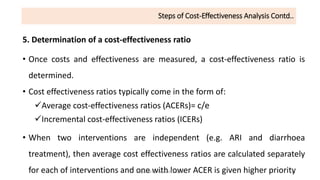
• When two interventions are independent (e.g. ARI and diarrhoea
treatment), then average cost effectiveness ratios are calculated separately
for each of interventions and one with lower ACER is given higher priority
11
Steps of Cost-Effectiveness Analysis Contd..
Prepared by: Santoshi Poudel
Incremental Cost Effectiveness Ratio:
• When most effective treatment option for a medical condition is also
the least expensive, then the choice is easy.
• But when most effective treatment option is also more expensive
then the choice is difficult and hence we have to measure ICER.
12
Steps of Cost-Effectiveness Analysis Contd..
Prepared by: Santoshi Poudel
5. Determination of a cost-effectiveness ratio
• When two interventions are mutually exclusive (e.g. two types of diagnostic
testing for malaria), then incremental cost effective ratio is calculated as
incremental costs of one program compared with the other, divided by the
incremental effects of one program compared with the other.
ICER = 𝛥c/𝛥e
= (c2 – c1) / (e2 – e1)
Where c= costs of treatment
e= effectiveness of interventions
13
Steps of Cost-Effectiveness Analysis Contd..
Prepared by: Santoshi Poudel
6. Decision making
• For independent interventions, they should be implemented in the
order of their ACER starting from the lowest ACER, until the budget is
exhausted.
• For mutually exclusive programs and fixed budget, first dominated
interventions are eliminated and the more effective interventions are
implemented until budget is exhausted.
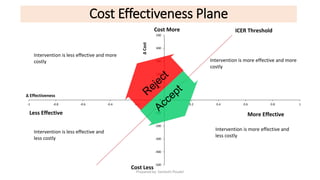
• The incremental cost effectiveness data is interpreted using a cost-
effectiveness plane.
14
Steps of Cost-Effectiveness Analysis Contd..
Prepared by: Santoshi Poudel
Cost Effectiveness Plane
15
-500
-400
-300
-200
-100
0
100
200
300
400
500
-1 -0.8 -0.6 -0.4 -0.2 0 0.2 0.4 0.6 0.8 1
Intervention is less effective and more
costly Intervention is more effective and more
costly
Intervention is less effective and
less costly
Intervention is more effective and
less costly
∆ Effectiveness
∆
Cost
Cost More
More Effective
Less Effective
Cost Less
ICER Threshold
Prepared by: Santoshi Poudel
If ICER is negative
It is called “dominated” and has two interpretation:
• Numerator is Negative: Intervention would save resources and should
be done (C1>C2)
• Denominator is Negative: researcher should report that the
intervention did not have the intended effect and should not
continue with a CEA study (e1>e2)
16
Steps of Cost-Effectiveness Analysis Contd..
Prepared by: Santoshi Poudel
If the ICER is positive:
17
Steps of Cost-Effectiveness Analysis Contd..
ICER< 1 unit of per
unit income
Prepared by: Santoshi Poudel
Example for understanding CEA calculation
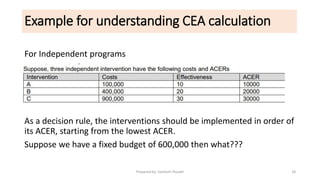
For Independent programs
As a decision rule, the interventions should be implemented in order of
its ACER, starting from the lowest ACER.
Suppose we have a fixed budget of 600,000 then what???
18
Prepared by: Santoshi Poudel
• For mutually exclusive programs
Step 1
Step 2
19
Prepared by: Santoshi Poudel
• Step 3
• Suppose we have a fixed budget of 8,000 (millions).
• However, although intervention D has highest ICER, it cannot be
implemented at given budget. Therefore, intervention B is selected
20
Prepared by: Santoshi Poudel
Limitations of CEA
• It does not provide information about whether or not to expand/ scale up
the program.
• It doesn’t take into account the social desirability of health outcome.
• It overlooks the equity aspect of the intervention.
• It provides the information about technical efficiency rather than allocative
efficiency.
• It cannot compare interventions which have differing consequences
(outcomes).
• It is difficult to make policy decision based only on the comparison of the
cost-effectiveness ratios.
• CEA cannot compare programmes with different goals.
21
Prepared by: Santoshi Poudel
Quick review of CEA decision
Case I: New treatment is more expensive and less effective
Don’t adopt new treatment
Case 2: New treatment is less expensive and more effective
Adopt new treatment
Case III: New treatment is less expensive and less effective
In medicine we generally consider more effective treatment so we
can ignore new treatment
Case IV: New treatment is more expensive and more effective
Calculate ICER, identify the best option considering the available
resources
22
Prepared by: Santoshi Poudel
Advantages of cost-benefit analysis over CEA/CUA
• CBA answers the questions whether a program/goal is worth
achieving given the social opportunity cost of all the resources
consumed.
• CBA converts all costs and benefits to money and is not restricted to
comparing programmes between different sectors. It can inform the
resource allocation decisions both within and between the sectors of
economy. CEA/ CUA is necessarily restricted to the comparison of
health care programmes that produce similar units of outcome.
• Cost-effectiveness analysis/ cost utility analysis address mainly
questions of production efficiency with outcomes restricted to health
benefits. In contrast, CBA is broader in scope and able to inform
questions of allocative efficiency.
23
Prepared by: Santoshi Poudel
24
Area CB analysis Cost effectiveness
Definition An ideal method for comparing all social cost
and consequences access different program or
intervention.
It compare intervention which are broadly
similar and adopts a narrower view points.
Objectives Systematic calculation all cost and
consequences occurring to society to society
from different options and expression in
monetary value.
To identifying the most efficient way of
achieving the objectives.
Focus It focuses on comparing the costs and benefits
of different interventions to determine their
overall economic desirability
It focus on identifying the intervention that
achieves a given outcome at the lowest cost
Areas Use in Pharmaceutical industries, factories,
industries
Used in Randomized Clinical Trial (CRCT)
Duration It takes several years It is of short duration
Use on
health care
At executive level of government i.e. at
decision making level
• Selecting the most cost effective intervention
for health outcomes
• Evaluation of activities under the program
Measures Benefit cost rati, Net Benefit In terms of ICER
Prepared by: Santoshi Poudel
References
• https://www.cdc.gov/policy/polaris/economics/cost-
effectiveness/index.html
• Guide to Fundamentals of Economic Evaluation in Public Health_ms-
19-162.pdf
• cost effectiveness analysis.pdf
• https://www.ncbi.nlm.nih.gov/books/NBK436886/
• https://www.cdc.gov/dhdsp/programs/spha/economic_evaluation/d
ocs/podcast_iv.pdf
• https://ihatepsm.com/blog/difference-bw-cost-benefit-and-cost-
effective-analysis
25
Prepared by: Santoshi Poudel
26
Prepared by: Santoshi Poudel

Cost effectiveness Analysis_Economic Evaluation.pdf

  • 1.
    Cost Effectiveness Analysis 1 Presenter Santoshi Paudel MPH2023 SPH and CM Prepared by: Santoshi Poudel
  • 2.
    Cost Effectiveness Analysis(CEA) • Cost-effectiveness analysis is a way to examine both the costs and health outcomes of one or more interventions. • The cost effectiveness analysis compares the cost (in monetary units) of an intervention to its effectiveness as measured its outcome in natural health units (e.g. years of life saved, cases prevented, etc.) • It is the cost per health outcome unit achieved, for eg: the cost per malaria case prevented or cost per life saved. 2 Prepared by: Santoshi Poudel
  • 3.
    • CEA isapplied in the areas where effect or outcome is measured in non monetary terms (clinical areas as well as to evaluate health policies, programs, and interventions). It can be applied to both service providers and users. • Mostly used in the situation where decision maker operating with a given budget is considered limited range of options within given field • We compute relative cost and effects (evaluated in relation to other alternatives) 3 Cost Effectiveness Analysis (CEA) Prepared by: Santoshi Poudel
  • 4.
    Uses of CEA •CEA can assist with the achievement of technical efficiency by helping with the choice of an intervention or interventions based on the lowest cost per unit of health benefit achieved. • CEA can be used for allocative efficiency by choosing an intervention or interventions to achieve the maximum benefits at the population or societal level. • CEA assists in prioritizing interventions by identifying those that provide the most health benefit per amount spent. • CEA is useful when the primary objective of the study is to identify the most cost-effective strategy from a group of alternatives that can effectively meet a common goal and are often competing for the same resources. 4 Prepared by: Santoshi Poudel
  • 5.
    Estimates of CEA 1.Numerator: Cost of an intervention or program, and 2. Denominator: Measurement of effectiveness of health outcome • Measurement of the effectiveness most often comes from: Impact evaluation of the intervention or program, And the choice of the outcome indicator depends on what the evaluation could measure and/or the objectives of the program. 5 Prepared by: Santoshi Poudel
  • 6.
    Dominance in CEA a.Two options • If option B is cheaper and generates more benefits than option A we would have no reason to choose option A • B dominates A b. More than two options • B is extendedly dominated by A and C 6 Prepared by: Santoshi Poudel
  • 7.
    Steps of Cost-EffectivenessAnalysis 1. Identification of two or more alternatives/interventions • Cost-effectiveness analysis requires the identification of two or more intervention strategies. • For example: we may wish to compare two types of diagnostic testing for malaria (mutually exclusive interventions), or ARI treatment with treatment of diarrhoea (independent interventions). 7 Prepared by: Santoshi Poudel
  • 8.
    Steps of Cost-EffectivenessAnalysis Contd.. 2. Identification of perspectives • Cost-effectiveness analysis also depends on the perspectives of the decision maker. • Whether the costing and evaluation is done from a standpoint of specific beneficiary or health provider or from the overall societal perspective should be clearly stated. 8 Prepared by: Santoshi Poudel
  • 9.
    3. Determination ofcosts • Detailed costing should be done for each intervention and should include more than the direct costs alone. • The total costs can be divided into following categories: Direct costs specifically linked to health interventions Cost expenditures associated with adverse events Cost savings that accrue as a result of improved health outcome • Cost-effectiveness analysis even assesses indirect, or opportunity costs. 9 Steps of Cost-Effectiveness Analysis Contd.. Prepared by: Santoshi Poudel
  • 10.
    4. Determination ofoutcomes • For cost-effectiveness analysis, the outcomes for both the alternatives should be measures in a similar natural unit. • For example in case of malaria diagnostic tests, the outcomes may be measure in terms of number of true malaria cases identified. • In case of ARI and diarrhoea treatment, the outcomes may be in terms of number of child mortalities averted. 10 Steps of Cost-Effectiveness Analysis Contd.. Prepared by: Santoshi Poudel
  • 11.
    5. Determination ofa cost-effectiveness ratio • Once costs and effectiveness are measured, a cost-effectiveness ratio is determined. • Cost effectiveness ratios typically come in the form of: Average cost-effectiveness ratios (ACERs)= c/e Incremental cost-effectiveness ratios (ICERs) • When two interventions are independent (e.g. ARI and diarrhoea treatment), then average cost effectiveness ratios are calculated separately for each of interventions and one with lower ACER is given higher priority 11 Steps of Cost-Effectiveness Analysis Contd.. Prepared by: Santoshi Poudel
  • 12.
    Incremental Cost EffectivenessRatio: • When most effective treatment option for a medical condition is also the least expensive, then the choice is easy. • But when most effective treatment option is also more expensive then the choice is difficult and hence we have to measure ICER. 12 Steps of Cost-Effectiveness Analysis Contd.. Prepared by: Santoshi Poudel
  • 13.
    5. Determination ofa cost-effectiveness ratio • When two interventions are mutually exclusive (e.g. two types of diagnostic testing for malaria), then incremental cost effective ratio is calculated as incremental costs of one program compared with the other, divided by the incremental effects of one program compared with the other. ICER = 𝛥c/𝛥e = (c2 – c1) / (e2 – e1) Where c= costs of treatment e= effectiveness of interventions 13 Steps of Cost-Effectiveness Analysis Contd.. Prepared by: Santoshi Poudel
  • 14.
    6. Decision making •For independent interventions, they should be implemented in the order of their ACER starting from the lowest ACER, until the budget is exhausted. • For mutually exclusive programs and fixed budget, first dominated interventions are eliminated and the more effective interventions are implemented until budget is exhausted. • The incremental cost effectiveness data is interpreted using a cost- effectiveness plane. 14 Steps of Cost-Effectiveness Analysis Contd.. Prepared by: Santoshi Poudel
  • 15.
    Cost Effectiveness Plane 15 -500 -400 -300 -200 -100 0 100 200 300 400 500 -1-0.8 -0.6 -0.4 -0.2 0 0.2 0.4 0.6 0.8 1 Intervention is less effective and more costly Intervention is more effective and more costly Intervention is less effective and less costly Intervention is more effective and less costly ∆ Effectiveness ∆ Cost Cost More More Effective Less Effective Cost Less ICER Threshold Prepared by: Santoshi Poudel
  • 16.
    If ICER isnegative It is called “dominated” and has two interpretation: • Numerator is Negative: Intervention would save resources and should be done (C1>C2) • Denominator is Negative: researcher should report that the intervention did not have the intended effect and should not continue with a CEA study (e1>e2) 16 Steps of Cost-Effectiveness Analysis Contd.. Prepared by: Santoshi Poudel
  • 17.
    If the ICERis positive: 17 Steps of Cost-Effectiveness Analysis Contd.. ICER< 1 unit of per unit income Prepared by: Santoshi Poudel
  • 18.
    Example for understandingCEA calculation For Independent programs As a decision rule, the interventions should be implemented in order of its ACER, starting from the lowest ACER. Suppose we have a fixed budget of 600,000 then what??? 18 Prepared by: Santoshi Poudel
  • 19.
    • For mutuallyexclusive programs Step 1 Step 2 19 Prepared by: Santoshi Poudel
  • 20.
    • Step 3 •Suppose we have a fixed budget of 8,000 (millions). • However, although intervention D has highest ICER, it cannot be implemented at given budget. Therefore, intervention B is selected 20 Prepared by: Santoshi Poudel
  • 21.
    Limitations of CEA •It does not provide information about whether or not to expand/ scale up the program. • It doesn’t take into account the social desirability of health outcome. • It overlooks the equity aspect of the intervention. • It provides the information about technical efficiency rather than allocative efficiency. • It cannot compare interventions which have differing consequences (outcomes). • It is difficult to make policy decision based only on the comparison of the cost-effectiveness ratios. • CEA cannot compare programmes with different goals. 21 Prepared by: Santoshi Poudel
  • 22.
    Quick review ofCEA decision Case I: New treatment is more expensive and less effective Don’t adopt new treatment Case 2: New treatment is less expensive and more effective Adopt new treatment Case III: New treatment is less expensive and less effective In medicine we generally consider more effective treatment so we can ignore new treatment Case IV: New treatment is more expensive and more effective Calculate ICER, identify the best option considering the available resources 22 Prepared by: Santoshi Poudel
  • 23.
    Advantages of cost-benefitanalysis over CEA/CUA • CBA answers the questions whether a program/goal is worth achieving given the social opportunity cost of all the resources consumed. • CBA converts all costs and benefits to money and is not restricted to comparing programmes between different sectors. It can inform the resource allocation decisions both within and between the sectors of economy. CEA/ CUA is necessarily restricted to the comparison of health care programmes that produce similar units of outcome. • Cost-effectiveness analysis/ cost utility analysis address mainly questions of production efficiency with outcomes restricted to health benefits. In contrast, CBA is broader in scope and able to inform questions of allocative efficiency. 23 Prepared by: Santoshi Poudel
  • 24.
    24 Area CB analysisCost effectiveness Definition An ideal method for comparing all social cost and consequences access different program or intervention. It compare intervention which are broadly similar and adopts a narrower view points. Objectives Systematic calculation all cost and consequences occurring to society to society from different options and expression in monetary value. To identifying the most efficient way of achieving the objectives. Focus It focuses on comparing the costs and benefits of different interventions to determine their overall economic desirability It focus on identifying the intervention that achieves a given outcome at the lowest cost Areas Use in Pharmaceutical industries, factories, industries Used in Randomized Clinical Trial (CRCT) Duration It takes several years It is of short duration Use on health care At executive level of government i.e. at decision making level • Selecting the most cost effective intervention for health outcomes • Evaluation of activities under the program Measures Benefit cost rati, Net Benefit In terms of ICER Prepared by: Santoshi Poudel
  • 25.
    References • https://www.cdc.gov/policy/polaris/economics/cost- effectiveness/index.html • Guideto Fundamentals of Economic Evaluation in Public Health_ms- 19-162.pdf • cost effectiveness analysis.pdf • https://www.ncbi.nlm.nih.gov/books/NBK436886/ • https://www.cdc.gov/dhdsp/programs/spha/economic_evaluation/d ocs/podcast_iv.pdf • https://ihatepsm.com/blog/difference-bw-cost-benefit-and-cost- effective-analysis 25 Prepared by: Santoshi Poudel
  • 26.