TOPIC:
•COST AND
COST
CURVE
Concept of Costs of Production:
The cost of production of an individual firm operating
in a market has an important influence on the market
supply of a commodity. It is very necessary to have a
clear idea about the concept of cost of production
and then proceed to study the cost curves.
Nominal Cost :
The cost may be nominal cost or real cost. Nominal cost
is the money cost of production. It is also called expenses
of production. These expenses are important from the
point of view of the producer. He must make sure that the
price of the product in the long run, covers these
expenses including normal profit other wise he can not
afford to carry on the business.
Real Cost :
Attempts have been mate to establish cost on
a real basis. The real cost of production have
been variously interpreted. Adam smith regarded
pains and sacrifices of labor as real cost.
Opportunity Cost :
The Austrian school of economists and their followers
gave a new concept of real costs. According to them,
the real cost of production of a given commodity is the
next best alternative sacrificed in order to obtain that
commodity. It is also called opportunity cost or
displacement cost.
Money cost and the real
cost do not coincide :
It is very seldom that the real cost of a commodity may be equal to
the money cost. As Marshall puts it, “If the purchasing power of
money in terms of effort remained about constant and if the rate of
remuneration for waiting has remained about constant, then the
money measure of costs cores ponds to real costs; but such a
correspondence is never to be assumed lightly.
Thus, there is a very little connection between money costs and real
costs. The two can never be equal is a world of change, as our world is,
whether we consider the long period or the short period. The value of
land depends on scarcity. The question of cost in terms of effort and
sacrifice in this case does not arise. The earning of cinema stars,
professors, coolies, sweepers, peasants, businessmen etc. Selfdom
correspond to the respective efforts and sacrifices undergone by each
class.
Economic Cost :
By economic costs is meant those payment
which must be received by resource owners
in order to ensure that they will continue to
supply them in the process of production.
Economic cost = Accounting cost + Implicit cost
Accounting Cost :
Accounting cost or contractual cash payments which the firms makes to
Other factor Owner`s for purchasing or hiring the various factors are also
known as accounting cost.
Implicit Cost :
Implicit costs are costs of self owned and self-compiled resources such
as salary of proprietor or return on the entrepreneur’s own investment.
Explicit Cost :
Explicit cost are the paid out costs i.e. payments made for productive
resources purchased or hired by the firm. They consist of the salaries
and wages paid to the employees, prices of raw and semi-finished
materials, overhead costs and payments into depreciation and sinking
fund.
Significance of Opportunity Cost :
There are competing demands (depending upon the marginal
utility of the consumers) for the same resources. Since these
resources are scarce, certain demands are satisfied only at the
sacrifice of other demands. The resources tend to move from
those uses in which their demand price (marginal utility to the
consumers in the aggregate) is lower to those in which it is higher
until they tent to be distributed in various uses (for the production
of various commodities and services) in such a way as to
equalize their marginal utilities in the various uses.SW
Application of Opportunity Cost Doctrine :
The opportunity cost doctrine has a wide application in the field of
economic theory. It applies to the determination of values both
internally and internationally. It is also applies to income
distribution.
• Limitations of those Application :
• Specific : It does not apply to productive
services which are specific. A specific faction
has no alternative use. Its opportunity cost
therefore zero. Hence the payment made to this
factor is of the nature of rent.
• Factors not Homogeneous : Besides it
should remembered that units of productive
service are rarely homogeneous. This obstructs
their transfer.
• Wrong assumption : Moreover, the theory
is based on perfect competition which seldom
exists.
Conclusion :
In spite of all these limitations and
complications the theory of cost, theory
of opportunity cost is the most
acceptable one at present.
Meaning of short run and long
run:
Short run is a period of time within which the firm can vary its
output by varying only the amount of variable factors. Such as
labor and raw materials.
The short run is a period of time in which only variable factors
can be varied, while fixed factors remain the same.
Long run is a period of time during which the quantities of all
factors, variable as well as fixed, can be adjusted. In the long
run output can be increased by increasing capital equipment or
by increasing the size of the existing plant or by building a new
plant of a greater productive capacity.
Short run fixed and Variable Costs
Short run fixed costs :
Fixed costs are the costs which are fixed and do
not vary with the output in the same way. It is also
called supplementary costs. They include rent of
the factory building interest on capital, salaries of
permanent employed staff etc.
Short run variable Costs :
Variable costs are costs which increase with the
increase of production. The costs are called prime
costs. These cost include the cost of raw materials
used in making of the commodity as well as the
costs of casual or daily labor employed.
Cost of production of a firm
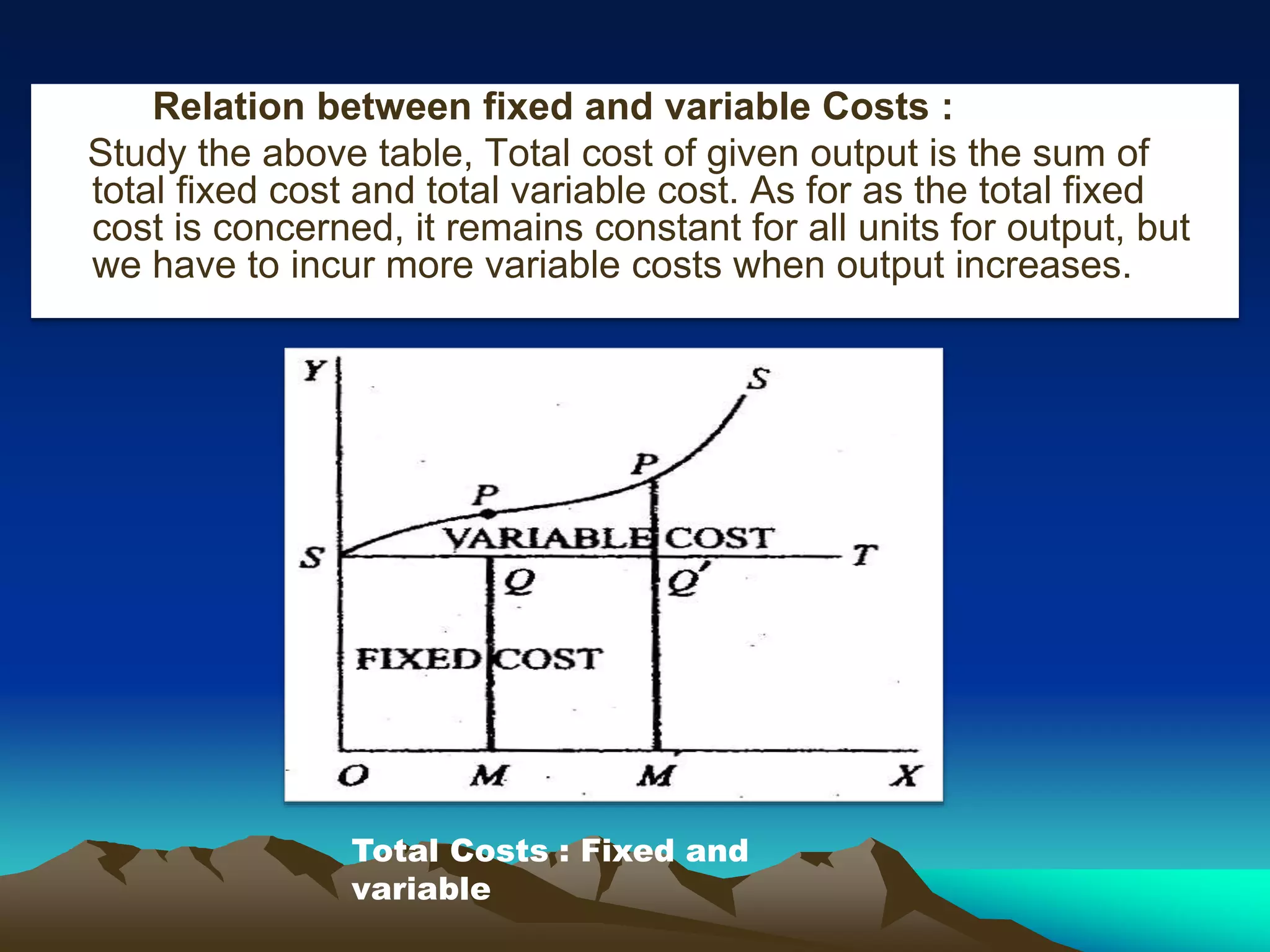
Relation between fixed and variable Costs :
Study the above table, Total cost of given output is the sum of
total fixed cost and total variable cost. As for as the total fixed
cost is concerned, it remains constant for all units for output, but
we have to incur more variable costs when output increases.
Total Costs : Fixed and
variable
Short run : Total Average and Marginal costs
Total Costs : Total costs is the sum of fixed and variable costs.
Total Costs (TC) = Fixed Costs (FC) + Variable Costs (VC)
Relation between Marginal and Average Costs :
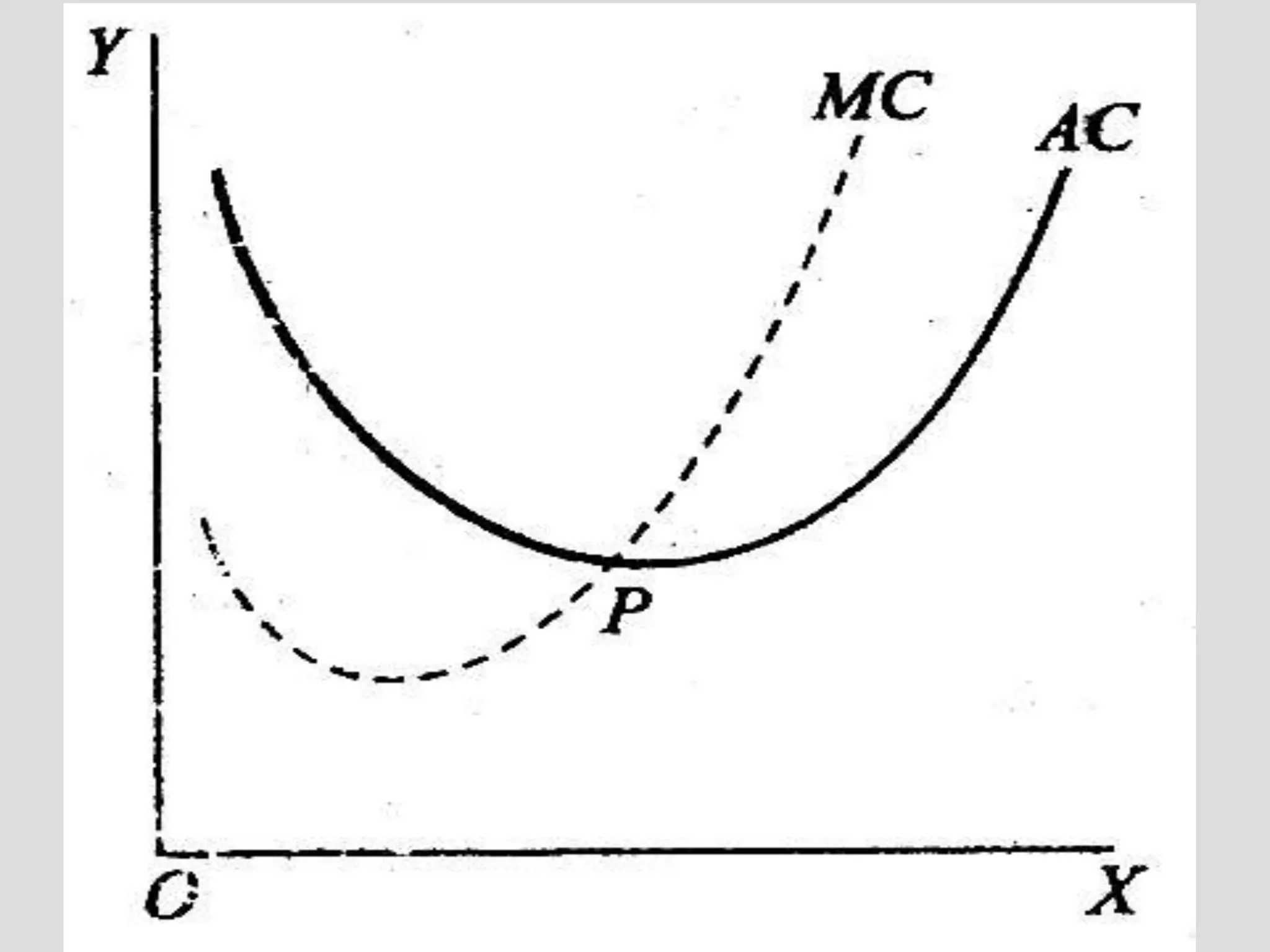
There are similar relation holds between marginal and average cost. It can be seen
that average variable cost continues to decline so long as the marginal cost is below it,
but it starts rising at the point where MC Crosses AVC. The marginal cost will always
rise more sharply than the average variable costs.
Long- Run Average Costs curves.
Long run is a period of time during which the quantities of all factors,
variable as well as fixed can be adjusted. Thus in the long run out put can
be increased by increasing capital equipment or by increasing the size of
the existing plant or by building a new plant of a greater productive
capacity.
WHY LAC CURVES ARE FLATTER?
Cost and Cost Curve
Cost and Cost Curve
Cost and Cost Curve
Cost and Cost Curve
Cost and Cost Curve
Cost and Cost Curve
Cost and Cost Curve

Cost and Cost Curve

  • 1.
  • 2.
    Concept of Costsof Production: The cost of production of an individual firm operating in a market has an important influence on the market supply of a commodity. It is very necessary to have a clear idea about the concept of cost of production and then proceed to study the cost curves. Nominal Cost : The cost may be nominal cost or real cost. Nominal cost is the money cost of production. It is also called expenses of production. These expenses are important from the point of view of the producer. He must make sure that the price of the product in the long run, covers these expenses including normal profit other wise he can not afford to carry on the business.
  • 3.
    Real Cost : Attemptshave been mate to establish cost on a real basis. The real cost of production have been variously interpreted. Adam smith regarded pains and sacrifices of labor as real cost. Opportunity Cost : The Austrian school of economists and their followers gave a new concept of real costs. According to them, the real cost of production of a given commodity is the next best alternative sacrificed in order to obtain that commodity. It is also called opportunity cost or displacement cost.
  • 4.
    Money cost andthe real cost do not coincide : It is very seldom that the real cost of a commodity may be equal to the money cost. As Marshall puts it, “If the purchasing power of money in terms of effort remained about constant and if the rate of remuneration for waiting has remained about constant, then the money measure of costs cores ponds to real costs; but such a correspondence is never to be assumed lightly. Thus, there is a very little connection between money costs and real costs. The two can never be equal is a world of change, as our world is, whether we consider the long period or the short period. The value of land depends on scarcity. The question of cost in terms of effort and sacrifice in this case does not arise. The earning of cinema stars, professors, coolies, sweepers, peasants, businessmen etc. Selfdom correspond to the respective efforts and sacrifices undergone by each class.
  • 5.
    Economic Cost : Byeconomic costs is meant those payment which must be received by resource owners in order to ensure that they will continue to supply them in the process of production. Economic cost = Accounting cost + Implicit cost
  • 6.
    Accounting Cost : Accountingcost or contractual cash payments which the firms makes to Other factor Owner`s for purchasing or hiring the various factors are also known as accounting cost.
  • 7.
    Implicit Cost : Implicitcosts are costs of self owned and self-compiled resources such as salary of proprietor or return on the entrepreneur’s own investment. Explicit Cost : Explicit cost are the paid out costs i.e. payments made for productive resources purchased or hired by the firm. They consist of the salaries and wages paid to the employees, prices of raw and semi-finished materials, overhead costs and payments into depreciation and sinking fund.
  • 8.
    Significance of OpportunityCost : There are competing demands (depending upon the marginal utility of the consumers) for the same resources. Since these resources are scarce, certain demands are satisfied only at the sacrifice of other demands. The resources tend to move from those uses in which their demand price (marginal utility to the consumers in the aggregate) is lower to those in which it is higher until they tent to be distributed in various uses (for the production of various commodities and services) in such a way as to equalize their marginal utilities in the various uses.SW Application of Opportunity Cost Doctrine : The opportunity cost doctrine has a wide application in the field of economic theory. It applies to the determination of values both internally and internationally. It is also applies to income distribution.
  • 9.
    • Limitations ofthose Application : • Specific : It does not apply to productive services which are specific. A specific faction has no alternative use. Its opportunity cost therefore zero. Hence the payment made to this factor is of the nature of rent. • Factors not Homogeneous : Besides it should remembered that units of productive service are rarely homogeneous. This obstructs their transfer. • Wrong assumption : Moreover, the theory is based on perfect competition which seldom exists.
  • 10.
    Conclusion : In spiteof all these limitations and complications the theory of cost, theory of opportunity cost is the most acceptable one at present.
  • 11.
    Meaning of shortrun and long run: Short run is a period of time within which the firm can vary its output by varying only the amount of variable factors. Such as labor and raw materials. The short run is a period of time in which only variable factors can be varied, while fixed factors remain the same. Long run is a period of time during which the quantities of all factors, variable as well as fixed, can be adjusted. In the long run output can be increased by increasing capital equipment or by increasing the size of the existing plant or by building a new plant of a greater productive capacity.
  • 12.
    Short run fixedand Variable Costs Short run fixed costs : Fixed costs are the costs which are fixed and do not vary with the output in the same way. It is also called supplementary costs. They include rent of the factory building interest on capital, salaries of permanent employed staff etc. Short run variable Costs : Variable costs are costs which increase with the increase of production. The costs are called prime costs. These cost include the cost of raw materials used in making of the commodity as well as the costs of casual or daily labor employed.
  • 13.
  • 14.
    Relation between fixedand variable Costs : Study the above table, Total cost of given output is the sum of total fixed cost and total variable cost. As for as the total fixed cost is concerned, it remains constant for all units for output, but we have to incur more variable costs when output increases. Total Costs : Fixed and variable
  • 15.
    Short run :Total Average and Marginal costs Total Costs : Total costs is the sum of fixed and variable costs. Total Costs (TC) = Fixed Costs (FC) + Variable Costs (VC)
  • 16.
    Relation between Marginaland Average Costs : There are similar relation holds between marginal and average cost. It can be seen that average variable cost continues to decline so long as the marginal cost is below it, but it starts rising at the point where MC Crosses AVC. The marginal cost will always rise more sharply than the average variable costs.
  • 18.
    Long- Run AverageCosts curves. Long run is a period of time during which the quantities of all factors, variable as well as fixed can be adjusted. Thus in the long run out put can be increased by increasing capital equipment or by increasing the size of the existing plant or by building a new plant of a greater productive capacity.
  • 19.
    WHY LAC CURVESARE FLATTER?