Presented By
JYOTHI B O
1DA16MBA12
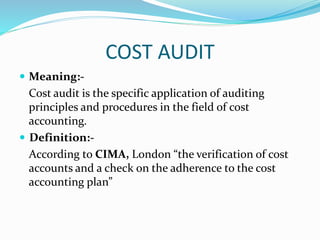
COST AUDIT
 Meaning:-
Cost audit is the specific application of auditing
principles and procedures in the field of cost
accounting.
 Definition:-
According to CIMA, London “the verification of cost
accounts and a check on the adherence to the cost
accounting plan”
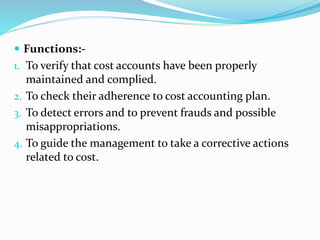
 Functions:-
1. To verify that cost accounts have been properly
maintained and complied.
2. To check their adherence to cost accounting plan.
3. To detect errors and to prevent frauds and possible
misappropriations.
4. To guide the management to take a corrective actions
related to cost.
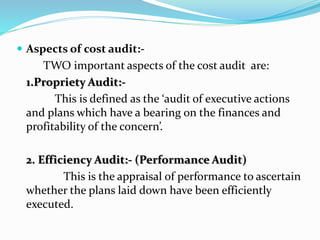
 Aspects of cost audit:-
TWO important aspects of the cost audit are:
1.Propriety Audit:-
This is defined as the ‘audit of executive actions
and plans which have a bearing on the finances and
profitability of the concern’.
2. Efficiency Audit:- (Performance Audit)
This is the appraisal of performance to ascertain
whether the plans laid down have been efficiently
executed.
 Advantages of cost audit:-
To Management:
1.To detection errors, frauds, irregularities and
inconsistencies.
2.Data becomes more reliable thereby improving the quality
of cost reports.
3.Improves the effectiveness of cost control and cost
reduction schemes.
4. Audited cost data is better suited for inter-firm
comparison.
5.Cost auditors are usually expert and experienced cost
accountants or cost consultants so that they may suggests
changes to overcome any weaknesses in the systems and
procedures
To Shareholders:
1.Cost audit highlights the efficiency of the management
in the utilization of the resources of the business.
2.Cost audit enables the shareholders to determine
whether or not they are getting a fair return on their
investment.
To Consumers:
The consumers get the advantage of fair price for the
products of the company. This is because cost audit
reveals the true cost of products & price is generally
based on such costs.
To Government:
1.It provides true cost figures to the government for
fixing the prices of goods to prevent undue profiteering.
2.The data is taken to be more reliable for providing
protection to certain industries in public interest.
3.It contributes to the betterment of national economy.
4. This helps the government in taking effective steps for
improving productivity.
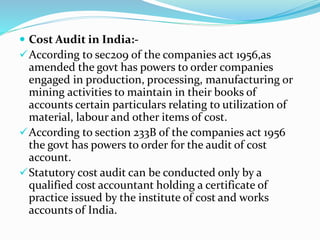
 Cost Audit in India:-
According to sec209 of the companies act 1956,as
amended the govt has powers to order companies
engaged in production, processing, manufacturing or
mining activities to maintain in their books of
accounts certain particulars relating to utilization of
material, labour and other items of cost.
According to section 233B of the companies act 1956
the govt has powers to order for the audit of cost
account.
Statutory cost audit can be conducted only by a
qualified cost accountant holding a certificate of
practice issued by the institute of cost and works
accounts of India.
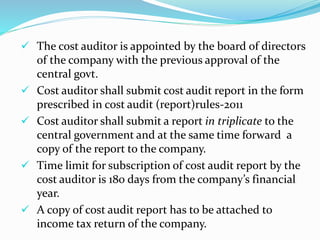
 The cost auditor is appointed by the board of directors
of the company with the previous approval of the
central govt.
 Cost auditor shall submit cost audit report in the form
prescribed in cost audit (report)rules-2011
 Cost auditor shall submit a report in triplicate to the
central government and at the same time forward a
copy of the report to the company.
 Time limit for subscription of cost audit report by the
cost auditor is 180 days from the company’s financial
year.
 A copy of cost audit report has to be attached to
income tax return of the company.
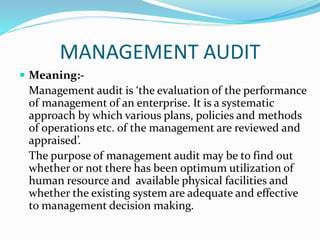
MANAGEMENT AUDIT
 Meaning:-
Management audit is ‘the evaluation of the performance
of management of an enterprise. It is a systematic
approach by which various plans, policies and methods
of operations etc. of the management are reviewed and
appraised’.
The purpose of management audit may be to find out
whether or not there has been optimum utilization of
human resource and available physical facilities and
whether the existing system are adequate and effective
to management decision making.
 Definition:-
According to the British Institute of Management
“Management audit is a systematic, comprehensive,
critical appraisal of the organization structure,
management practices and methods conducted
normally by external, independent persons. Its primary
objectives is to motivate management to take action
which lead to increased efficiency and profitability of
the organization.”
 features:-
1.Purey voluntary audit
2.Performed by any management expert or a team of
experts
3.It is an audit of managerial policies and their
adequacies to meet corporate objectives
4.It may be ordered by the management on an ad-hoc
basis for a specific purpose
5. Management auditor has to report to the management
6.Management auditor makes recommendations for
improvement in managerial performance.
 Objectives :-
1.To identify the overall objectives of a business enterprise
and to see that these objectives are being fulfilled in
actual practice.
2.To ensure optimum utilization of human resource and
available physical facilities.
3.To see that management is efficient at levels of
operations.
4.To suggest improved and better methods of managerial
operations.
5.To point out weak spots in the organization structure
and in internal control system and suggesting possible
improvements.
6.To see that enterprise is successful in adopting itself to
technologies changes.
7.To anticipate problems and suggests remedies to solve
them in time.
8.To see that return on capital employed is satisfactory
and to help improve profitability.
Cost & mgt audit ppt

Cost & mgt audit ppt

  • 1.
  • 2.
    COST AUDIT  Meaning:- Costaudit is the specific application of auditing principles and procedures in the field of cost accounting.  Definition:- According to CIMA, London “the verification of cost accounts and a check on the adherence to the cost accounting plan”
  • 3.
     Functions:- 1. Toverify that cost accounts have been properly maintained and complied. 2. To check their adherence to cost accounting plan. 3. To detect errors and to prevent frauds and possible misappropriations. 4. To guide the management to take a corrective actions related to cost.
  • 4.
     Aspects ofcost audit:- TWO important aspects of the cost audit are: 1.Propriety Audit:- This is defined as the ‘audit of executive actions and plans which have a bearing on the finances and profitability of the concern’. 2. Efficiency Audit:- (Performance Audit) This is the appraisal of performance to ascertain whether the plans laid down have been efficiently executed.
  • 5.
     Advantages ofcost audit:- To Management: 1.To detection errors, frauds, irregularities and inconsistencies. 2.Data becomes more reliable thereby improving the quality of cost reports. 3.Improves the effectiveness of cost control and cost reduction schemes. 4. Audited cost data is better suited for inter-firm comparison. 5.Cost auditors are usually expert and experienced cost accountants or cost consultants so that they may suggests changes to overcome any weaknesses in the systems and procedures
  • 6.
    To Shareholders: 1.Cost audithighlights the efficiency of the management in the utilization of the resources of the business. 2.Cost audit enables the shareholders to determine whether or not they are getting a fair return on their investment. To Consumers: The consumers get the advantage of fair price for the products of the company. This is because cost audit reveals the true cost of products & price is generally based on such costs.
  • 7.
    To Government: 1.It providestrue cost figures to the government for fixing the prices of goods to prevent undue profiteering. 2.The data is taken to be more reliable for providing protection to certain industries in public interest. 3.It contributes to the betterment of national economy. 4. This helps the government in taking effective steps for improving productivity.
  • 10.
     Cost Auditin India:- According to sec209 of the companies act 1956,as amended the govt has powers to order companies engaged in production, processing, manufacturing or mining activities to maintain in their books of accounts certain particulars relating to utilization of material, labour and other items of cost. According to section 233B of the companies act 1956 the govt has powers to order for the audit of cost account. Statutory cost audit can be conducted only by a qualified cost accountant holding a certificate of practice issued by the institute of cost and works accounts of India.
  • 11.
     The costauditor is appointed by the board of directors of the company with the previous approval of the central govt.  Cost auditor shall submit cost audit report in the form prescribed in cost audit (report)rules-2011  Cost auditor shall submit a report in triplicate to the central government and at the same time forward a copy of the report to the company.  Time limit for subscription of cost audit report by the cost auditor is 180 days from the company’s financial year.  A copy of cost audit report has to be attached to income tax return of the company.
  • 12.
    MANAGEMENT AUDIT  Meaning:- Managementaudit is ‘the evaluation of the performance of management of an enterprise. It is a systematic approach by which various plans, policies and methods of operations etc. of the management are reviewed and appraised’. The purpose of management audit may be to find out whether or not there has been optimum utilization of human resource and available physical facilities and whether the existing system are adequate and effective to management decision making.
  • 13.
     Definition:- According tothe British Institute of Management “Management audit is a systematic, comprehensive, critical appraisal of the organization structure, management practices and methods conducted normally by external, independent persons. Its primary objectives is to motivate management to take action which lead to increased efficiency and profitability of the organization.”
  • 14.
     features:- 1.Purey voluntaryaudit 2.Performed by any management expert or a team of experts 3.It is an audit of managerial policies and their adequacies to meet corporate objectives 4.It may be ordered by the management on an ad-hoc basis for a specific purpose 5. Management auditor has to report to the management 6.Management auditor makes recommendations for improvement in managerial performance.
  • 15.
     Objectives :- 1.Toidentify the overall objectives of a business enterprise and to see that these objectives are being fulfilled in actual practice. 2.To ensure optimum utilization of human resource and available physical facilities. 3.To see that management is efficient at levels of operations. 4.To suggest improved and better methods of managerial operations. 5.To point out weak spots in the organization structure and in internal control system and suggesting possible improvements.
  • 16.
    6.To see thatenterprise is successful in adopting itself to technologies changes. 7.To anticipate problems and suggests remedies to solve them in time. 8.To see that return on capital employed is satisfactory and to help improve profitability.