COST ACCOUNTING
Dr. Bharti
Cost
◦“Cost is the amount of resource given up in
exchange for some goods and services. The resource
given up are money and money’s equivalent
expressed in monetary units
Cost Accounting
◦Cost accounting is the formal system of accounting by
mean which cost are ascertained for the product and
services and record in the books of accounts.
◦Cost accounting is concerned with recording, classifying
and summarizing cost for determination of cost of products
or services, planning, controlling and reducing such costs
and furnishing of information to management for decision
making
Cost Accountancy
◦Cost accountancy” as the application of costing and cost
accounting principles, method and techniques to the science,
art and practice of cost control and the ascertainment of
profitability.
◦ Cost accountancy is concerned with the formulation of
principles, methods and techniques to be applied for
ascertaining cost and profit.
◦.
Objectives of Cost Accounting
• Ascertainment of cost
• Cost Control
• Guide to business policy such as make or buy, introduction of new
product
• Determination of Cost
• Decision Making
• To compare the actual figure of cost with estimates figures
COST CONCEPT
Cost Unit –It is a unit of product, service or time in terms of which costs
are ascertained or expressed. It is a unit of measurement. It is unit of
measurement of cost.
Responsibility Centers – is the unit or function of an organization under
the control of a manager who has direct responsibility for its
performance. E.g.Cost Center, Revenue Center, Profit Center, Investment
Center.
Cost Object – any product, service, process or activity for which aseparate
measurement of cost is required. For e.g. Car, Taxi service, weaving
process,purchasing raw material etc.
COST CONCEPT
Cost Center – Is alocation, person or item of equipment for which costs may be
ascertained and usedfor the purposesof cost control.
Cost Centre is defined as a function or department within a
company which is not directly going to generate revenues and profits
to the company but is still incurring expenses to the company for its
operations. It is very much, unlike a profit centre, whose actions will
directly result in the profits to the company
Types of Cost Centre
◦ Personal CostCenter – person or group of persons
◦ Impersonal CostCenter – location or equipment
◦ Production CostCenter – where actual production takesplace
◦ Service CostCenter – departments which render service to other cost centers
ADV
ANTAGES/OBJ.OFCOSTACCOUNTING
◦ Helpsin ascertainment ofcost , Helpsin control ofcost
◦ Helpsin decisionmaking (makeor buy, retain or replace, continue or shut down, acceptor reject orders,etc)
◦ Helpsin fixing sellingprices
◦ Helpsin inventory control
◦ Helpsin costreduction
◦ Helpsin measurement ofefficiency
◦ Helpsin preparation of budget
◦ Helpsin identifying unprofitableactivities
◦ Helpsin identifying materiallosses,helpincomparison,
LIMITATIONS OF COST ACCOUNTING
• Cost Accounting is Unnecessary
• Cost Accounting System cannot be adopted by Small Business Concerns
• Cost Accounting System is Very Costly
• Costing Results are Misleading
• Reduces flexibility and process improvement in a company.
• Restriction on innovation.
• Requirement of skillful personnel to set standards.
• Lack of Uniformity
FINANCIALACCOUNTING
◦ Financial Accounting: It is “the art of recording, classifying and summarizing in a
significant manner and in terms of money, transactions and events, which are in
part at least, of afinancial characterand interpreting the resultsthereof”
The information supplied by financial accounting is summarized in the following
statements, generallyat the end of anyear:
◦ P& LAccount BalanceSheet
◦ CashFlowStatement
LIMITATIONS OF FINANCIAL
ACCOUNTING
1. Historicalinnature
2. Only highlight the overall performance
3. Noperformanceappraisal
4. Nomaterial controlsystem
5. Nolabour costcontrol
6. Noproper classificationofcosts
7. No Analysisof Losses
8. Inadequateinformation of price fixation
9. Nocostcomparison
10. Fails to provide usefuldatatomanagement
LIMITATIONS OF FINANCIAL
ACCOUNTING
1. Shows only overallperformance
2. Historical innature
3. Noperformanceappraisal
4. Nomaterial controlsystem
5. Nolabour costcontrol
6. Noproper classification ofcosts
7. Noanalysisof losses
8. Inadequateinformation of pricefixation
9. Nocostcomparison
10. Failsto provide useful data tomanagement
Importance of Cost Accounting
◦ 1. Controlling costs: Cost accounting helps the management foresee the cost price
and selling price of a product or a service, which helps them formulate business
policies. With cost value as a reference, the management can come up with techniques
to control costs with an aim to achieve maximum profitability.
◦ 2. Determining the total per-unit cost: Cost accounting techniques help in
determining the total per-unit cost of a product or a service, so that the business can
fix the selling price for it.
◦ 3. Showing profitable and non-profitable activities: This information helps the
management put an end to non-profitable activities while developing and expanding
the profitable ones.
◦ 4. Comparing costs over time
Installing Cost Accounting System
◦ Steps of Cost Accounting system
1. Objectives to be Achieved
2. Study the Product
3. Study the Organization
4. Deciding the Structure of Cost Accounts 5. Selecting
the Cost Rates
6. Introduction of the System
7. A Follow-up.
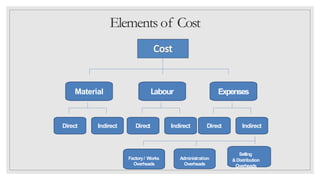
Elements of COST
◦ In order to interpret the term cost correctly and to ascertain the costwith respect to the costcenters, the
costattached with the manufacturingprocess maybesubdivided,known as elementofCost.
(A) Material
(B) Labour
(C) Expenses
Elements of Cost
Material
Direct Indirect
Labour
Direct Indirect
Expenses
Direct Indirect
Selling
&Distribution
Overheads
Administration
Overheads
Factory/ Works
Overheads
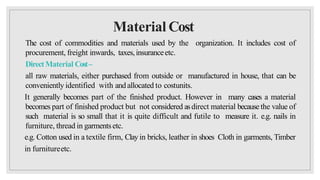
Material Cost
The cost of commodities and materials used by the organization. It includes cost of
procurement, freight inwards, taxes,insuranceetc.
DirectMaterial Cost–
all raw materials, either purchased from outside or manufactured in house, that can be
conveniently identified with andallocated to costunits.
It generally becomes part of the finished product. However in many cases a material
becomes part of finished product but not considered asdirect material because the value of
such material is so small that it is quite difficult and futile to measure it. e.g. nails in
furniture, thread in garmentsetc.
e.g. Cotton used in a textile firm, Clay in bricks, leather in shoes Cloth in garments, Timber
in furnitureetc.
Indirect Material
◦ Indirect materials are materials used in the production process,
but which cannot be linked to a specific product or job. ... Thus,
they are consumed as part of the production process, but are not
integrated in substantial amounts into a product or job. Examples of
indirect materials are: Cleaning supplies.
Direct Labour Cost
◦
Direct labor cost is wages that are incurred in order to produce goods or
provide services to customers. ... Direct labor costs are most commonly
associated with products in a job costing environment, where the
production staff is expected to record the time they spend working on
various jobs
Indirect labor
◦ Indirect labor is the cost of any labor that supports the production
process, but which is not directly involved in the active conversion of
materials into finished products. Examples of indirect labor positions are:
Production supervisor. Purchasing staff.
Expenses
◦ Direct expense is an expense incurred that varies directly with changes in
the volume of a cost object. A cost object is any item for which you are
measuring expenses, such as products, product lines, services, sales regions,
employees, and customers. ... The materials used to construct a product for
sale.
◦Indirect Expenses
Indirect expenses are those expenses that are incurred to
operate a business as a whole or a segment of a business,
and so cannot be directly associated with a cost object, such
as a product, service, or customer. ... Examples of indirect
expenses are: Accounting, audit, and legal fees
Cost sheet
◦Cost sheet statement is used to determine the total cost of
goods produced in a specific Period and per unit cost
◦Cost incurred at various stages from manufacturing of
products to the stage of making it saleable are shown.
◦It is prepared for short period say for three and six months
while production continuous
◦It shows costing data in analytical manner
◦It present the costing data on unit basis
◦It is used for the purpose of cost determination, cost
comparison, Pricing, Cost control and cost estimation
Cost Account
◦ Cost Account is ledger account maintained in the cost ledger on the
principle of double entry
◦ Cost accounting are kept accounting period as whole and prepared when
the production is complete
◦ Cost account present the cost without analysis
◦ Cost account does not depict per unit cost
◦ cost account maintain the record of actual cost incurred for the purpose
of preparing costing Profit and Loss account
Cost sheet and Statement of Cost
◦ Cost sheet or Statement of Cost presenting the cost analysis on per unit
basis and total cost figures and both terms used interchangeably.

Cost acounting

  • 1.
  • 2.
    Cost ◦“Cost is theamount of resource given up in exchange for some goods and services. The resource given up are money and money’s equivalent expressed in monetary units
  • 3.
    Cost Accounting ◦Cost accountingis the formal system of accounting by mean which cost are ascertained for the product and services and record in the books of accounts. ◦Cost accounting is concerned with recording, classifying and summarizing cost for determination of cost of products or services, planning, controlling and reducing such costs and furnishing of information to management for decision making
  • 4.
    Cost Accountancy ◦Cost accountancy”as the application of costing and cost accounting principles, method and techniques to the science, art and practice of cost control and the ascertainment of profitability. ◦ Cost accountancy is concerned with the formulation of principles, methods and techniques to be applied for ascertaining cost and profit. ◦.
  • 5.
    Objectives of CostAccounting • Ascertainment of cost • Cost Control • Guide to business policy such as make or buy, introduction of new product • Determination of Cost • Decision Making • To compare the actual figure of cost with estimates figures
  • 6.
    COST CONCEPT Cost Unit–It is a unit of product, service or time in terms of which costs are ascertained or expressed. It is a unit of measurement. It is unit of measurement of cost. Responsibility Centers – is the unit or function of an organization under the control of a manager who has direct responsibility for its performance. E.g.Cost Center, Revenue Center, Profit Center, Investment Center. Cost Object – any product, service, process or activity for which aseparate measurement of cost is required. For e.g. Car, Taxi service, weaving process,purchasing raw material etc.
  • 7.
    COST CONCEPT Cost Center– Is alocation, person or item of equipment for which costs may be ascertained and usedfor the purposesof cost control. Cost Centre is defined as a function or department within a company which is not directly going to generate revenues and profits to the company but is still incurring expenses to the company for its operations. It is very much, unlike a profit centre, whose actions will directly result in the profits to the company
  • 8.
    Types of CostCentre ◦ Personal CostCenter – person or group of persons ◦ Impersonal CostCenter – location or equipment ◦ Production CostCenter – where actual production takesplace ◦ Service CostCenter – departments which render service to other cost centers
  • 9.
    ADV ANTAGES/OBJ.OFCOSTACCOUNTING ◦ Helpsin ascertainmentofcost , Helpsin control ofcost ◦ Helpsin decisionmaking (makeor buy, retain or replace, continue or shut down, acceptor reject orders,etc) ◦ Helpsin fixing sellingprices ◦ Helpsin inventory control ◦ Helpsin costreduction ◦ Helpsin measurement ofefficiency ◦ Helpsin preparation of budget ◦ Helpsin identifying unprofitableactivities ◦ Helpsin identifying materiallosses,helpincomparison,
  • 10.
    LIMITATIONS OF COSTACCOUNTING • Cost Accounting is Unnecessary • Cost Accounting System cannot be adopted by Small Business Concerns • Cost Accounting System is Very Costly • Costing Results are Misleading • Reduces flexibility and process improvement in a company. • Restriction on innovation. • Requirement of skillful personnel to set standards. • Lack of Uniformity
  • 11.
    FINANCIALACCOUNTING ◦ Financial Accounting:It is “the art of recording, classifying and summarizing in a significant manner and in terms of money, transactions and events, which are in part at least, of afinancial characterand interpreting the resultsthereof” The information supplied by financial accounting is summarized in the following statements, generallyat the end of anyear: ◦ P& LAccount BalanceSheet ◦ CashFlowStatement
  • 12.
    LIMITATIONS OF FINANCIAL ACCOUNTING 1.Historicalinnature 2. Only highlight the overall performance 3. Noperformanceappraisal 4. Nomaterial controlsystem 5. Nolabour costcontrol 6. Noproper classificationofcosts 7. No Analysisof Losses 8. Inadequateinformation of price fixation 9. Nocostcomparison 10. Fails to provide usefuldatatomanagement
  • 13.
    LIMITATIONS OF FINANCIAL ACCOUNTING 1.Shows only overallperformance 2. Historical innature 3. Noperformanceappraisal 4. Nomaterial controlsystem 5. Nolabour costcontrol 6. Noproper classification ofcosts 7. Noanalysisof losses 8. Inadequateinformation of pricefixation 9. Nocostcomparison 10. Failsto provide useful data tomanagement
  • 14.
    Importance of CostAccounting ◦ 1. Controlling costs: Cost accounting helps the management foresee the cost price and selling price of a product or a service, which helps them formulate business policies. With cost value as a reference, the management can come up with techniques to control costs with an aim to achieve maximum profitability. ◦ 2. Determining the total per-unit cost: Cost accounting techniques help in determining the total per-unit cost of a product or a service, so that the business can fix the selling price for it. ◦ 3. Showing profitable and non-profitable activities: This information helps the management put an end to non-profitable activities while developing and expanding the profitable ones. ◦ 4. Comparing costs over time
  • 15.
    Installing Cost AccountingSystem ◦ Steps of Cost Accounting system 1. Objectives to be Achieved 2. Study the Product 3. Study the Organization 4. Deciding the Structure of Cost Accounts 5. Selecting the Cost Rates 6. Introduction of the System 7. A Follow-up.
  • 16.
    Elements of COST ◦In order to interpret the term cost correctly and to ascertain the costwith respect to the costcenters, the costattached with the manufacturingprocess maybesubdivided,known as elementofCost. (A) Material (B) Labour (C) Expenses
  • 17.
    Elements of Cost Material DirectIndirect Labour Direct Indirect Expenses Direct Indirect Selling &Distribution Overheads Administration Overheads Factory/ Works Overheads
  • 18.
    Material Cost The costof commodities and materials used by the organization. It includes cost of procurement, freight inwards, taxes,insuranceetc. DirectMaterial Cost– all raw materials, either purchased from outside or manufactured in house, that can be conveniently identified with andallocated to costunits. It generally becomes part of the finished product. However in many cases a material becomes part of finished product but not considered asdirect material because the value of such material is so small that it is quite difficult and futile to measure it. e.g. nails in furniture, thread in garmentsetc. e.g. Cotton used in a textile firm, Clay in bricks, leather in shoes Cloth in garments, Timber in furnitureetc.
  • 19.
    Indirect Material ◦ Indirectmaterials are materials used in the production process, but which cannot be linked to a specific product or job. ... Thus, they are consumed as part of the production process, but are not integrated in substantial amounts into a product or job. Examples of indirect materials are: Cleaning supplies.
  • 20.
    Direct Labour Cost ◦ Directlabor cost is wages that are incurred in order to produce goods or provide services to customers. ... Direct labor costs are most commonly associated with products in a job costing environment, where the production staff is expected to record the time they spend working on various jobs
  • 21.
    Indirect labor ◦ Indirectlabor is the cost of any labor that supports the production process, but which is not directly involved in the active conversion of materials into finished products. Examples of indirect labor positions are: Production supervisor. Purchasing staff.
  • 22.
    Expenses ◦ Direct expenseis an expense incurred that varies directly with changes in the volume of a cost object. A cost object is any item for which you are measuring expenses, such as products, product lines, services, sales regions, employees, and customers. ... The materials used to construct a product for sale.
  • 23.
    ◦Indirect Expenses Indirect expensesare those expenses that are incurred to operate a business as a whole or a segment of a business, and so cannot be directly associated with a cost object, such as a product, service, or customer. ... Examples of indirect expenses are: Accounting, audit, and legal fees
  • 24.
    Cost sheet ◦Cost sheetstatement is used to determine the total cost of goods produced in a specific Period and per unit cost ◦Cost incurred at various stages from manufacturing of products to the stage of making it saleable are shown. ◦It is prepared for short period say for three and six months while production continuous
  • 25.
    ◦It shows costingdata in analytical manner ◦It present the costing data on unit basis ◦It is used for the purpose of cost determination, cost comparison, Pricing, Cost control and cost estimation
  • 26.
    Cost Account ◦ CostAccount is ledger account maintained in the cost ledger on the principle of double entry ◦ Cost accounting are kept accounting period as whole and prepared when the production is complete ◦ Cost account present the cost without analysis ◦ Cost account does not depict per unit cost ◦ cost account maintain the record of actual cost incurred for the purpose of preparing costing Profit and Loss account
  • 27.
    Cost sheet andStatement of Cost ◦ Cost sheet or Statement of Cost presenting the cost analysis on per unit basis and total cost figures and both terms used interchangeably.