COST
ACCOUNTING
Basics
Cost Accounting
Meaning:
• Cost Accounting is the classifying, recording and appropriate allocation of
expenditure for the determination of the costs of products or services, and for the
presentation of suitably arranged data for the purposes of control and guidance of
management.
• It includes the ascertainment of the cost of the every order, job, contract, process,
service or unit as may be appropriate.
• It deals with the cost of products, selling and distribution,
• It is thus the provision of such analysis and classification of expenditure as will
enable the total cost of any particular unit of products or services to be ascertained
with reasonable degree of accuracy and at the same time to disclose exactly how
such total cost is constituted so as to control and reduce its cost.
’
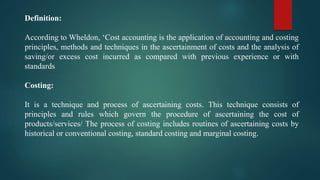
Definition:
According to Wheldon, ‘Cost accounting is the application of accounting and costing
principles, methods and techniques in the ascertainment of costs and the analysis of
saving/or excess cost incurred as compared with previous experience or with
standards
Costing:
It is a technique and process of ascertaining costs. This technique consists of
principles and rules which govern the procedure of ascertaining the cost of
products/services/ The process of costing includes routines of ascertaining costs by
historical or conventional costing, standard costing and marginal costing.
Cost Accountancy:
• It is the application of costing and cost accounting principles, methods and
techniques to the science, art and practice of cost control and ascertainment of
profitability.
• Thus cost accountancy is the science, art and practice of a cost accountant.
Scope of Cost Accountancy:
i. Cost Ascertainment : Collection and analysis of expenses, the measurement of
production of the different products at the different stages of manufacture and
the linking up of production with expenses
ii. Cost Accounting : the process of accounting for cost which begins with
recording of expenditure and ends with preparation of statistical data.
iii. Cost Control: Guidance and regulation by executive action of the costs of
operating of an undertaking. Standard costing, Budgetary control, proper
presentation and reporting of cost data and cost unit
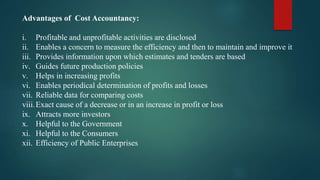
Advantages of Cost Accountancy:
i. Profitable and unprofitable activities are disclosed
ii. Enables a concern to measure the efficiency and then to maintain and improve it
iii. Provides information upon which estimates and tenders are based
iv. Guides future production policies
v. Helps in increasing profits
vi. Enables periodical determination of profits and losses
vii. Reliable data for comparing costs
viii.Exact cause of a decrease or in an increase in profit or loss
ix. Attracts more investors
x. Helpful to the Government
xi. Helpful to the Consumers
xii. Efficiency of Public Enterprises
Financial Accounting and Cost Accounting:
• Both financial and cost accounting are the branches of accounting whose main object is
to provide information by recording the business transactions systematically and
scientifically so that it may serve the purpose of the management for policy formulation
and controlling and to provide necessary protection to the outsiders.
• Both are based on double entry system and their roles are supplementary.
• The ordinary trading account is a locked storehouse of most valuable information, to
which cost system is the key.
• In case of financial accounting stress is on the ascertainment and presentation of profits
earned or losses incurred in the business.
• Due to this reason, in financial accounting the transactions are recorded, classified and
analysed in a subjective manner, i.e., according to the nature of expenditure. They do not
provide the information on the relative effectiveness of products, processes, human
resources, equipments and other factors of production. The provision of accounting and
financial data at macro level does not provide tools for indepth analysis for performance
in terms of cost efficiency. Thus, Financial accounting treats costs very broadly, while
cost accounting does this in much greater detail.
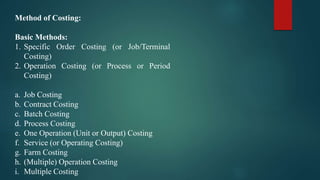
Method of Costing:
Basic Methods:
1. Specific Order Costing (or Job/Terminal
Costing)
2. Operation Costing (or Process or Period
Costing)
a. Job Costing
b. Contract Costing
c. Batch Costing
d. Process Costing
e. One Operation (Unit or Output) Costing
f. Service (or Operating Costing)
g. Farm Costing
h. (Multiple) Operation Costing
i. Multiple Costing
Terms:
i. Direct Materials : Directly identified and charges
a. All raw materials
b. Materials specifically purchased for a specific job
c. Parts or components purchased or produced
d. Primary packing materials
ii. Direct Labour: Directly identifiable labour
a. Labour engaged on the actual production of the product
b. Labour engaged in aiding the manufacture by way of supervision,
maintanence
c. Inspectors, analysts etc.,
iii. Direct Expenses : Identifiable to particular cost centre directlhy
a. Royalty
b. Excise dury
c. Hire charges etc.,
iv. Overheads: Aggregate of indirect materials, indirect labour and other expenses including services as cannot
conveniently charges to specified cost units
a. Manufacturing or Production or Works Overhead
-- Depreciation, electricity charges, coal and fuel charges, rent, rates and taxes on works, office printing,
stationary, postage etc.,
b. Administration overhead
-- office rent, light, heat, salaries and wages of clerks, secretaries and accountants, credit approval, cash
collection and treasurer’s department
c. Selling overhead
-- Salesmen’s salaries,, showroom expenses, advertisement charges, fancy packing charges, samples and free
gifts.
d. Distribution overhead
--Warehouse rent, warehour staff salaries, insurance, expenses on transport, losses and dagames in transit,
repairing and reconditioning and wastage
e. Research and Development Expeneses:
-- new improved products, new application of materials or products, new implementation of decision
Overheads Classification:
i. Indirect materials
a. Stores used in maintenance of machinery,
buildings etc.,
b. Stores used by the service department
c. Materials which due to their cost being small
i. Indirect Labour
a. Supervisors
b. Maintenance workers
c. Departmental coolies
i. Indirect Expenses
a. rent, rates, municipal taxes, general
manager’s salary, canteen and welfare expenses.
Cost Sheet:
i. Statement designed to show the output of a particular
accounting period along with break-up costs
ii. The data are collected from various statements of
accounts which have been written in cost accounts
iii. It is a memorandum statement
Advantages:
i. Discloses the total cost and cost per unit
ii. Enables a manufacturer to keep a close watch and
control over cost of production
iii. Provides a comparative study with past results and
standard costs
iv. Formulate a definite useful production policy
v. Helps in fixing accurate selling price
vi. Minimise the cost production
vii. Submit quotations

Cost Accounting Basics.pptx

  • 1.
  • 2.
    Cost Accounting Meaning: • CostAccounting is the classifying, recording and appropriate allocation of expenditure for the determination of the costs of products or services, and for the presentation of suitably arranged data for the purposes of control and guidance of management. • It includes the ascertainment of the cost of the every order, job, contract, process, service or unit as may be appropriate. • It deals with the cost of products, selling and distribution, • It is thus the provision of such analysis and classification of expenditure as will enable the total cost of any particular unit of products or services to be ascertained with reasonable degree of accuracy and at the same time to disclose exactly how such total cost is constituted so as to control and reduce its cost. ’
  • 3.
    Definition: According to Wheldon,‘Cost accounting is the application of accounting and costing principles, methods and techniques in the ascertainment of costs and the analysis of saving/or excess cost incurred as compared with previous experience or with standards Costing: It is a technique and process of ascertaining costs. This technique consists of principles and rules which govern the procedure of ascertaining the cost of products/services/ The process of costing includes routines of ascertaining costs by historical or conventional costing, standard costing and marginal costing.
  • 4.
    Cost Accountancy: • Itis the application of costing and cost accounting principles, methods and techniques to the science, art and practice of cost control and ascertainment of profitability. • Thus cost accountancy is the science, art and practice of a cost accountant. Scope of Cost Accountancy: i. Cost Ascertainment : Collection and analysis of expenses, the measurement of production of the different products at the different stages of manufacture and the linking up of production with expenses ii. Cost Accounting : the process of accounting for cost which begins with recording of expenditure and ends with preparation of statistical data. iii. Cost Control: Guidance and regulation by executive action of the costs of operating of an undertaking. Standard costing, Budgetary control, proper presentation and reporting of cost data and cost unit
  • 5.
    Advantages of CostAccountancy: i. Profitable and unprofitable activities are disclosed ii. Enables a concern to measure the efficiency and then to maintain and improve it iii. Provides information upon which estimates and tenders are based iv. Guides future production policies v. Helps in increasing profits vi. Enables periodical determination of profits and losses vii. Reliable data for comparing costs viii.Exact cause of a decrease or in an increase in profit or loss ix. Attracts more investors x. Helpful to the Government xi. Helpful to the Consumers xii. Efficiency of Public Enterprises
  • 6.
    Financial Accounting andCost Accounting: • Both financial and cost accounting are the branches of accounting whose main object is to provide information by recording the business transactions systematically and scientifically so that it may serve the purpose of the management for policy formulation and controlling and to provide necessary protection to the outsiders. • Both are based on double entry system and their roles are supplementary. • The ordinary trading account is a locked storehouse of most valuable information, to which cost system is the key. • In case of financial accounting stress is on the ascertainment and presentation of profits earned or losses incurred in the business. • Due to this reason, in financial accounting the transactions are recorded, classified and analysed in a subjective manner, i.e., according to the nature of expenditure. They do not provide the information on the relative effectiveness of products, processes, human resources, equipments and other factors of production. The provision of accounting and financial data at macro level does not provide tools for indepth analysis for performance in terms of cost efficiency. Thus, Financial accounting treats costs very broadly, while cost accounting does this in much greater detail.
  • 7.
    Method of Costing: BasicMethods: 1. Specific Order Costing (or Job/Terminal Costing) 2. Operation Costing (or Process or Period Costing) a. Job Costing b. Contract Costing c. Batch Costing d. Process Costing e. One Operation (Unit or Output) Costing f. Service (or Operating Costing) g. Farm Costing h. (Multiple) Operation Costing i. Multiple Costing
  • 8.
    Terms: i. Direct Materials: Directly identified and charges a. All raw materials b. Materials specifically purchased for a specific job c. Parts or components purchased or produced d. Primary packing materials ii. Direct Labour: Directly identifiable labour a. Labour engaged on the actual production of the product b. Labour engaged in aiding the manufacture by way of supervision, maintanence c. Inspectors, analysts etc., iii. Direct Expenses : Identifiable to particular cost centre directlhy a. Royalty b. Excise dury c. Hire charges etc.,
  • 9.
    iv. Overheads: Aggregateof indirect materials, indirect labour and other expenses including services as cannot conveniently charges to specified cost units a. Manufacturing or Production or Works Overhead -- Depreciation, electricity charges, coal and fuel charges, rent, rates and taxes on works, office printing, stationary, postage etc., b. Administration overhead -- office rent, light, heat, salaries and wages of clerks, secretaries and accountants, credit approval, cash collection and treasurer’s department c. Selling overhead -- Salesmen’s salaries,, showroom expenses, advertisement charges, fancy packing charges, samples and free gifts. d. Distribution overhead --Warehouse rent, warehour staff salaries, insurance, expenses on transport, losses and dagames in transit, repairing and reconditioning and wastage e. Research and Development Expeneses: -- new improved products, new application of materials or products, new implementation of decision
  • 10.
    Overheads Classification: i. Indirectmaterials a. Stores used in maintenance of machinery, buildings etc., b. Stores used by the service department c. Materials which due to their cost being small i. Indirect Labour a. Supervisors b. Maintenance workers c. Departmental coolies i. Indirect Expenses a. rent, rates, municipal taxes, general manager’s salary, canteen and welfare expenses.
  • 11.
    Cost Sheet: i. Statementdesigned to show the output of a particular accounting period along with break-up costs ii. The data are collected from various statements of accounts which have been written in cost accounts iii. It is a memorandum statement Advantages: i. Discloses the total cost and cost per unit ii. Enables a manufacturer to keep a close watch and control over cost of production iii. Provides a comparative study with past results and standard costs iv. Formulate a definite useful production policy v. Helps in fixing accurate selling price vi. Minimise the cost production vii. Submit quotations