MANAGEMENT ACCOUNTING
COST CONCEPTS AND CLASSIFICATIONS
DR. ALOK DIXIT
IIM, LUCKNOW
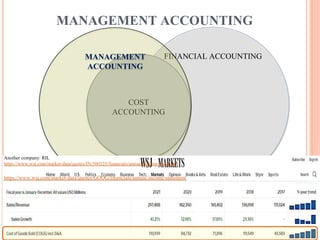
MANAGEMENT ACCOUNTING
FINANCIAL ACCOUNTING
COST
ACCOUNTING
MANAGEMENT
ACCOUNTING
Another company: RIL
https://www.wsj.com/market-data/quotes/IN/500325/financials/annual/income-statement
https://www.wsj.com/market-data/quotes/GOOG/financials/annual/income-statement
SOME DECISION-MAKING SITUATIONS AND SOURCE OF
INFORMATION
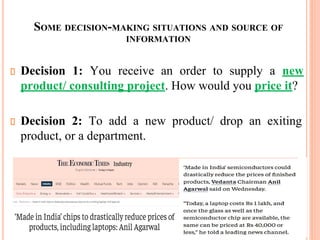
Decision 1: You receive an order to supply a new
product/ consulting project. How would you price it?
Decision 2: To add a new product/ drop an exiting
product, or a department.
OTHER DECISION-MAKING SITUATIONS
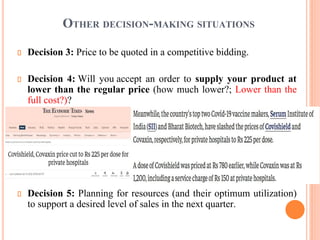
Decision 3: Price to be quoted in a competitive bidding.
Decision 4: Will you accept an order to supply your product at
lower than the regular price (how much lower?; Lower than the
full cost?)?
Decision 5: Planning for resources (and their optimum utilization)
to support a desired level of sales in the next quarter.
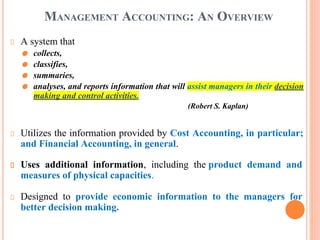
MANAGEMENT ACCOUNTING: AN OVERVIEW
A system that
⚫ collects,
⚫ classifies,
⚫ summaries,
⚫ analyses, and reports information that will assist managers in their decision
making and control activities.
(Robert S. Kaplan)
Utilizes the information provided by Cost Accounting, in particular;
and Financial Accounting, in general.
Uses additional information, including the product demand and
measures of physical capacities.
Designed to provide economic information to the managers for
better decision making.
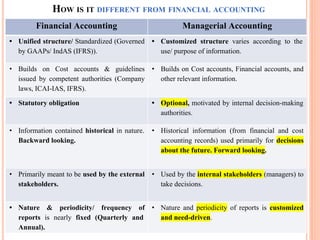
HOW IS IT DIFFERENT FROM FINANCIAL ACCOUNTING
Financial Accounting Managerial Accounting
• Unified structure/ Standardized (Governed
by GAAPs/ IndAS (IFRS)).
• Customized structure varies according to the
use/ purpose of information.
• Builds on Cost accounts & guidelines
issued by competent authorities (Company
laws, ICAI-IAS, IFRS).
• Builds on Cost accounts, Financial accounts, and
other relevant information.
• Statutory obligation • Optional, motivated by internal decision-making
authorities.
• Information contained historical in nature.
Backward looking.
• Historical information (from financial and cost
accounting records) used primarily for decisions
about the future. Forward looking.
• Primarily meant to be used by the external
stakeholders.
• Used by the internal stakeholders (managers) to
take decisions.
• Nature & periodicity/ frequency of
reports is nearly fixed (Quarterly and
Annual).
• Nature and periodicity of reports is customized
and need-driven.
COST ACCOUNTING
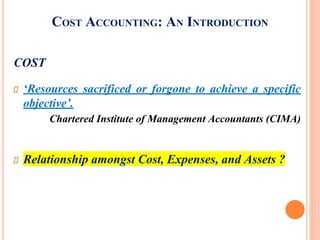
COST ACCOUNTING: AN INTRODUCTION
COST
‘Resources sacrificed or forgone to achieve a specific
objective’.
Chartered Institute of Management Accountants (CIMA)
Relationship amongst Cost, Expenses, and Assets ?
RELATIONSHIP AMONGST COST, EXPENSES, AND ASSETS ?
You manufacture a product that consumes 3 Kg of raw material
per unit. Assume that you purchased 15000 Kg. of raw materials
@ Rs. 10 per Kg. in the beginning of Quarter 3.
Scenario 1: At the end of the quarter, you manufactured 5000
units (as planned) of the product.
Scenario 2: In addition to the information in scenario 1, assume
that all the products manufactured during the quarter were sold
on credit.
Scenario 3: Now assume that you manufactured 4000 units of
the product and 3500 were sold.
COST ACCOUNTING
Cost Accounting consists of techniques and processes of
ascertaining cost. It involves three steps:
⚫ Identification & collection of the cost data,
⚫ Classification of costs,
⚫ Assignment (tracing and allocation) of costs to the cost
object(s) (product/ service/ job/ process/ cost center).
WHY COST ACCOUNTING?
How would you determine COGS per unit?
Suppose you could sell only 90% of your production (at the end of an
accounting period).
How would you determine the profit?
(Inventory valuation)
What if, only 80% of the output is completed and sold, the remaining 20% is
in progress.
How would you determine the profit?
(Inventory valuation)
WHY COST ACCOUNTING?
A factory produces two products. Product 1 is
labor-intensive, and Product 2 is machine-intensive.
How would you determine their cost per unit?
(Overhead allocation)
WHY COST ACCOUNTING?
IS IT MANDATORY?
Maintaining of COST RECORDS, AND AUDIT is
MANDATORY for specified industries.
Companies (Cost Records and Audit) rules, 2014
COST CLASSIFICATIONS
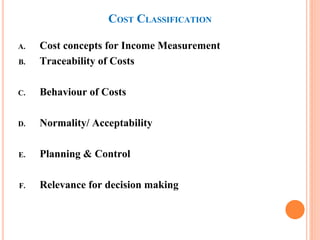
COST CLASSIFICATION
A. Cost concepts for Income Measurement
B. Traceability of Costs
C. Behaviour of Costs
D. Normality/ Acceptability
E. Planning & Control
F. Relevance for decision making
Classification of costs
for
Income Measurement
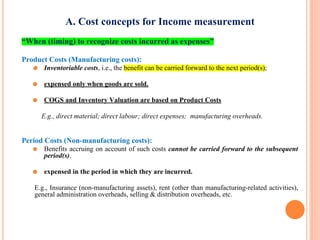
A. Cost concepts for Income measurement
“When (timing) to recognize costs incurred as expenses”
Product Costs (Manufacturing costs):
⚫ Inventoriable costs, i.e., the benefit can be carried forward to the next period(s);
⚫ expensed only when goods are sold.
⚫ COGS and Inventory Valuation are based on Product Costs
E.g., direct material; direct labour; direct expenses; manufacturing overheads.
Period Costs (Non-manufacturing costs):
⚫ Benefits accruing on account of such costs cannot be carried forward to the subsequent
period(s).
⚫ expensed in the period in which they are incurred.
E.g., Insurance (non-manufacturing assets), rent (other than manufacturing-related activities),
general administration overheads, selling & distribution overheads, etc.
2-17
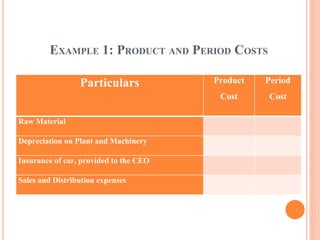
EXAMPLE 1: PRODUCT AND PERIOD COSTS
Particulars Product
Cost
Period
Cost
Raw Material
Depreciation on Plant and Machinery
Insurance of car, provided to the CEO
Sales and Distribution expenses
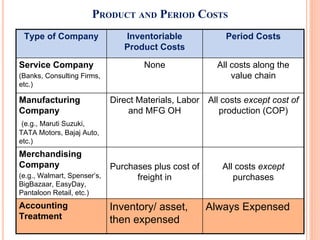
PRODUCT AND PERIOD COSTS
Type of Company Inventoriable
Product Costs
Period Costs
Service Company
(Banks, Consulting Firms,
etc.)
None All costs along the
value chain
Manufacturing
Company
(e.g., Maruti Suzuki,
TATA Motors, Bajaj Auto,
etc.)
Direct Materials, Labor
and MFG OH
All costs except cost of
production (COP)
Merchandising
Company
(e.g., Walmart, Spenser’s,
BigBazaar, EasyDay,
Pantaloon Retail, etc.)
Purchases plus cost of
freight in
All costs except
purchases
Accounting
Treatment
Inventory/ asset,
then expensed
Always Expensed
Classification of costs
based on
Traceability of Costs
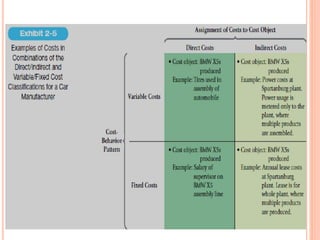
COST CLASSIFICATION & TRACEABILITY
B. TRACEABILITY OF COSTS
Based on traceability of a cost, it can be classified as:
⚫ Direct Cost
⚫ Indirect Cost
The costs are classified as direct or indirect costs with
reference to a cost object@
.
Note: For example, salary to accounts officer is direct cost at Accounts
Department level (cost center level); however, it is an indirect cost while
arriving at cost of the products or services produced by the firm.
@ A cost object is anything for which a manager wants a separate
measurement of cost.
DIRECT COSTS
Direct Costs can be identified exclusively and wholly with a
cost object (cost unit or cost center) in an economically
feasible (cost-effective*) way.
For example,
⚫ Direct material (Bill of Materials): Raw material, i.e., wheat flour
in a bakery firm; batteries, tyres, engine in an automobile company,
etc.
⚫ Direct labour: Wages paid to employees directly engaged in
production process/ wages paid as per piece rate system/ hourly
rate, and salary paid to the employees working on a specific project/
consulting assignment.
*Materiality of ‘costs to be classified’ is important. Is the cost
worth tracing?
INDIRECT COSTS
Indirect Costs are those cannot be identified wholly &
exclusively with a cost object (cost unit or cost centre) in an
economical way. However, these costs do benefit the cost
object.
Example,
⚫ Indirect material (lubricants, detergents, cotton wastes, etc.),
⚫ Indirect labour (salary of GM factory, shop (assembly line)
manager, salary to the accounts department, wages paid to
sweeper, security guard, gardener, etc.)
⚫ Other Overheads (SGA, Selling and General Administration;
other non-operating expenses)
INDIRECT COSTS
All indirect costs are, collectively, referred to as ‘OVERHEADS’.
Overheads are typically classified as:
⚫ Manufacturing/ Factory Overheads;
⚫ Non-manufacturing Overheads
Pose challenges before manages as they are not exclusively
identifiable with a cost object;
Overheads consume significant amount of money and efforts as
these need to be absorbed (on some logical criteria) in the unit cost
of product/ service.
INDIRECT COSTS
Note:
When the employees are performing their usual functions -
they are benefiting the whole business, their salaries are
considered as indirect costs.
However, if the same employees are deployed on a specific
project and that work is the sole focus of their job for several
days/ weeks/ months, their wages or salaries will be
considered a direct cost at the project-level.
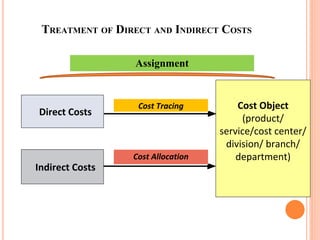
TREATMENT OF DIRECT AND INDIRECT COSTS
Direct Costs
Indirect Costs
Cost Object
(product/
service/cost center/
division/ branch/
department)
Cost Tracing
Cost Allocation
Assignment
COST OF CONSULTING
https://www.rocketblocks.me/guide/business-model.php
B. Classification of costs
based on
Behaviour of Costs
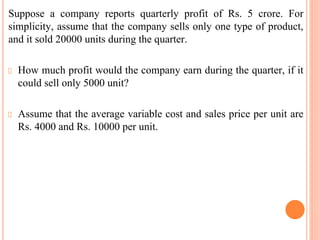
Suppose a company reports quarterly profit of Rs. 5 crore. For
simplicity, assume that the company sells only one type of product,
and it sold 20000 units during the quarter.
How much profit would the company earn during the quarter, if it
could sell only 5000 unit?
Assume that the average variable cost and sales price per unit are
Rs. 4000 and Rs. 10000 per unit.
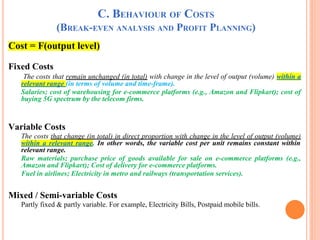
C. BEHAVIOUR OF COSTS
(BREAK-EVEN ANALYSIS AND PROFIT PLANNING)
Cost = F(output level)
Fixed Costs
The costs that remain unchanged (in total) with change in the level of output (volume) within a
relevant range (in terms of volume and time-frame).
Salaries; cost of warehousing for e-commerce platforms (e.g., Amazon and Flipkart); cost of
buying 5G spectrum by the telecom firms.
Variable Costs
The costs that change (in total) in direct proportion with change in the level of output (volume)
within a relevant range. In other words, the variable cost per unit remains constant within
relevant range.
Raw materials; purchase price of goods available for sale on e-commerce platforms (e.g.,
Amazon and Flipkart); Cost of delivery for e-commerce platforms.
Fuel in airlines; Electricity in metro and railways (transportation services).
Mixed / Semi-variable Costs
Partly fixed & partly variable. For example, Electricity Bills, Postpaid mobile bills.
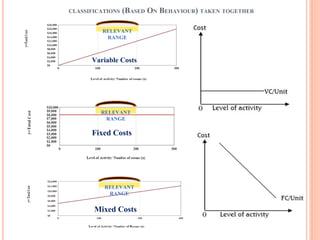
CLASSIFICATIONS (BASED ON BEHAVIOUR) TAKEN TOGETHER
RELEVANT
RANGE
RELEVANT
RANGE
RELEVANT
RANGE
Variable Costs
Fixed Costs
Mixed Costs
C. Classification of costs
based on
Normality & Abnormality
Assume that the one unit of finished o/p takes, on average, 2 hours of the
assembly department that assembles this product only (direct labour). The
department has five employees, and the CTC per employee is Rs. 4.375
lac per year.
On average, these employees work for 250 days in a year, and 8 hours a
day. During the day, the employees are entitled to have a Lunch/Tea break
of 1 hour.
How much direct labour cost would you charge to this product?
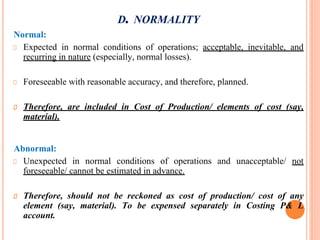
D. NORMALITY
Normal:
Expected in normal conditions of operations; acceptable, inevitable, and
recurring in nature (especially, normal losses).
Foreseeable with reasonable accuracy, and therefore, planned.
Therefore, are included in Cost of Production/ elements of cost (say,
material).
Abnormal:
Unexpected in normal conditions of operations and unacceptable/ not
foreseeable/ cannot be estimated in advance.
Therefore, should not be reckoned as cost of production/ cost of any
element (say, material). To be expensed separately in Costing P& L
account.
COST CLASSIFICATION EXERCISE
E. Classification of costs
for
Planning & Control
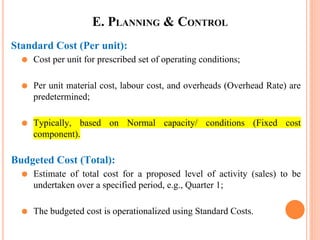
E. PLANNING & CONTROL
Standard Cost (Per unit):
⚫ Cost per unit for prescribed set of operating conditions;
⚫ Per unit material cost, labour cost, and overheads (Overhead Rate) are
predetermined;
⚫ Typically, based on Normal capacity/ conditions (Fixed cost
component).
Budgeted Cost (Total):
⚫ Estimate of total cost for a proposed level of activity (sales) to be
undertaken over a specified period, e.g., Quarter 1;
⚫ The budgeted cost is operationalized using Standard Costs.
F. Classification of costs
based on
Relevance for Decision Making
(based on the context)
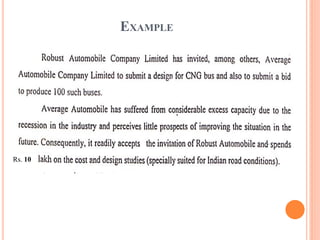
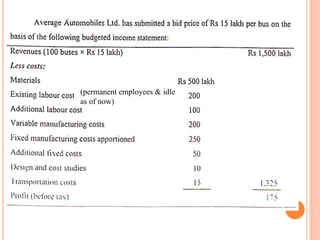
EXAMPLE
Rs. 10
(permanent employees & idle
as of now)
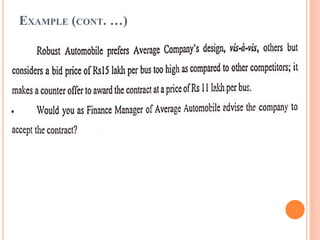
EXAMPLE (CONT. …)
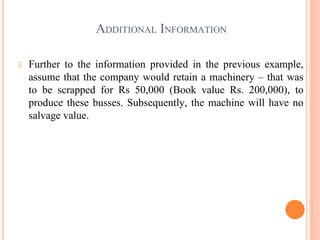
ADDITIONAL INFORMATION
Further to the information provided in the previous example,
assume that the company would retain a machinery – that was
to be scrapped for Rs 50,000 (Book value Rs. 200,000), to
produce these busses. Subsequently, the machine will have no
salvage value.
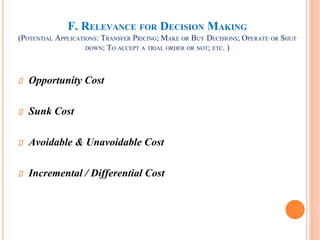
F. RELEVANCE FOR DECISION MAKING
(POTENTIAL APPLICATIONS: TRANSFER PRICING; MAKE OR BUY DECISIONS; OPERATE OR SHUT
DOWN; TO ACCEPT A TRIAL ORDER OR NOT; ETC. )
Opportunity Cost
Sunk Cost
Avoidable & Unavoidable Cost
Incremental / Differential Cost
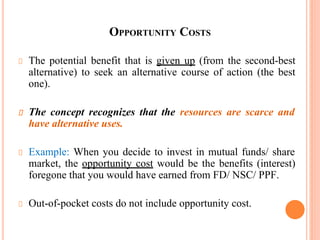
OPPORTUNITY COSTS
The potential benefit that is given up (from the second-best
alternative) to seek an alternative course of action (the best
one).
The concept recognizes that the resources are scarce and
have alternative uses.
Example: When you decide to invest in mutual funds/ share
market, the opportunity cost would be the benefits (interest)
foregone that you would have earned from FD/ NSC/ PPF.
Out-of-pocket costs do not include opportunity cost.
46
SUNK COSTS
The costs that have been incurred well before the decision
under consideration. It cannot be changed/recovered,
irrespective of the present/ future decision (s).
Examples: (i) cost of marketing research, (ii) payment to a
project advisory co. for evaluating a project, (iii) Book value
of an old machinery (with no salvage value/ net of the salvage
value) in a replacement decision, etc.
IRRELEVANT FOR DECISION MAKING
AVOIDABLE AND UNAVOIDABLE COSTS
Avoidable cost is the cost that can be saved in case the proposed
activity is dropped.
For example, a special equipment/ machinery that needs to be purchased if the
company decides to accept a project/ product line/ branch.
Note: Relevant for decision making.
Unavoidable costs are those costs which remain intact irrespective of
the decision to go or not to go for proposed activity.
For example, apportioning of the existing overheads to a proposed activity, say,
Salary paid to the CEO, CFO & COO of a company, Factory Rent, and
Insurance apportioned across the departments, etc.
Note: irrelevant for decision making.
INCREMENTAL / DIFFERENTIAL COSTS
Represents change in the amount of ‘costs exclusively on account
of the decision under consideration’ (e.g., to increase/ decrease
the level of activity/ adding or dropping a new product/
moving to automation-replacement decisions, etc.).
Examples: Purchasing a new machinery for the new project,
hiring a specialized employee for the new project, etc.
RELEVANT FOR DECISION MAKING
(useful tool for decision making; choosing between the
alternatives)
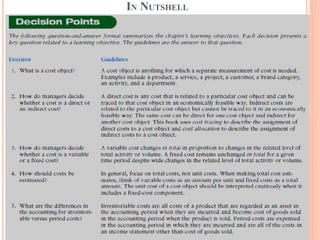
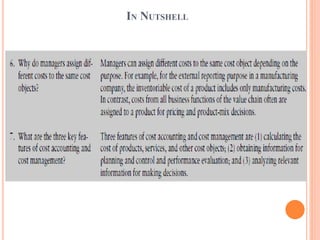
IN NUTSHELL
IN NUTSHELL
READINGS FROM THE TEXTBOOK
Chapter 2, Managerial Accounting by Hilton and Platt, 13e
⚫ Introduction to the term, Cost: pp. 37-39
⚫ Cost classifications: pp. 48-60, Basic Cost Management Concepts:
Different Costs for different purposes
⚫ Costs in Service industry: 59-61
Problems 1 and 2; Exercises: 2-28 and 2-45
THANK YOU

Management Accounting materials for practice

  • 1.
    MANAGEMENT ACCOUNTING COST CONCEPTSAND CLASSIFICATIONS DR. ALOK DIXIT IIM, LUCKNOW
  • 2.
    MANAGEMENT ACCOUNTING FINANCIAL ACCOUNTING COST ACCOUNTING MANAGEMENT ACCOUNTING Anothercompany: RIL https://www.wsj.com/market-data/quotes/IN/500325/financials/annual/income-statement https://www.wsj.com/market-data/quotes/GOOG/financials/annual/income-statement
  • 3.
    SOME DECISION-MAKING SITUATIONSAND SOURCE OF INFORMATION Decision 1: You receive an order to supply a new product/ consulting project. How would you price it? Decision 2: To add a new product/ drop an exiting product, or a department.
  • 4.
    OTHER DECISION-MAKING SITUATIONS Decision3: Price to be quoted in a competitive bidding. Decision 4: Will you accept an order to supply your product at lower than the regular price (how much lower?; Lower than the full cost?)? Decision 5: Planning for resources (and their optimum utilization) to support a desired level of sales in the next quarter.
  • 5.
    MANAGEMENT ACCOUNTING: ANOVERVIEW A system that ⚫ collects, ⚫ classifies, ⚫ summaries, ⚫ analyses, and reports information that will assist managers in their decision making and control activities. (Robert S. Kaplan) Utilizes the information provided by Cost Accounting, in particular; and Financial Accounting, in general. Uses additional information, including the product demand and measures of physical capacities. Designed to provide economic information to the managers for better decision making.
  • 6.
    HOW IS ITDIFFERENT FROM FINANCIAL ACCOUNTING Financial Accounting Managerial Accounting • Unified structure/ Standardized (Governed by GAAPs/ IndAS (IFRS)). • Customized structure varies according to the use/ purpose of information. • Builds on Cost accounts & guidelines issued by competent authorities (Company laws, ICAI-IAS, IFRS). • Builds on Cost accounts, Financial accounts, and other relevant information. • Statutory obligation • Optional, motivated by internal decision-making authorities. • Information contained historical in nature. Backward looking. • Historical information (from financial and cost accounting records) used primarily for decisions about the future. Forward looking. • Primarily meant to be used by the external stakeholders. • Used by the internal stakeholders (managers) to take decisions. • Nature & periodicity/ frequency of reports is nearly fixed (Quarterly and Annual). • Nature and periodicity of reports is customized and need-driven.
  • 7.
  • 8.
    COST ACCOUNTING: ANINTRODUCTION COST ‘Resources sacrificed or forgone to achieve a specific objective’. Chartered Institute of Management Accountants (CIMA) Relationship amongst Cost, Expenses, and Assets ?
  • 9.
    RELATIONSHIP AMONGST COST,EXPENSES, AND ASSETS ? You manufacture a product that consumes 3 Kg of raw material per unit. Assume that you purchased 15000 Kg. of raw materials @ Rs. 10 per Kg. in the beginning of Quarter 3. Scenario 1: At the end of the quarter, you manufactured 5000 units (as planned) of the product. Scenario 2: In addition to the information in scenario 1, assume that all the products manufactured during the quarter were sold on credit. Scenario 3: Now assume that you manufactured 4000 units of the product and 3500 were sold.
  • 10.
    COST ACCOUNTING Cost Accountingconsists of techniques and processes of ascertaining cost. It involves three steps: ⚫ Identification & collection of the cost data, ⚫ Classification of costs, ⚫ Assignment (tracing and allocation) of costs to the cost object(s) (product/ service/ job/ process/ cost center).
  • 11.
    WHY COST ACCOUNTING? Howwould you determine COGS per unit? Suppose you could sell only 90% of your production (at the end of an accounting period). How would you determine the profit? (Inventory valuation) What if, only 80% of the output is completed and sold, the remaining 20% is in progress. How would you determine the profit? (Inventory valuation)
  • 12.
    WHY COST ACCOUNTING? Afactory produces two products. Product 1 is labor-intensive, and Product 2 is machine-intensive. How would you determine their cost per unit? (Overhead allocation)
  • 13.
    WHY COST ACCOUNTING? ISIT MANDATORY? Maintaining of COST RECORDS, AND AUDIT is MANDATORY for specified industries. Companies (Cost Records and Audit) rules, 2014
  • 14.
  • 15.
    COST CLASSIFICATION A. Costconcepts for Income Measurement B. Traceability of Costs C. Behaviour of Costs D. Normality/ Acceptability E. Planning & Control F. Relevance for decision making
  • 16.
  • 17.
    A. Cost conceptsfor Income measurement “When (timing) to recognize costs incurred as expenses” Product Costs (Manufacturing costs): ⚫ Inventoriable costs, i.e., the benefit can be carried forward to the next period(s); ⚫ expensed only when goods are sold. ⚫ COGS and Inventory Valuation are based on Product Costs E.g., direct material; direct labour; direct expenses; manufacturing overheads. Period Costs (Non-manufacturing costs): ⚫ Benefits accruing on account of such costs cannot be carried forward to the subsequent period(s). ⚫ expensed in the period in which they are incurred. E.g., Insurance (non-manufacturing assets), rent (other than manufacturing-related activities), general administration overheads, selling & distribution overheads, etc. 2-17
  • 18.
    EXAMPLE 1: PRODUCTAND PERIOD COSTS Particulars Product Cost Period Cost Raw Material Depreciation on Plant and Machinery Insurance of car, provided to the CEO Sales and Distribution expenses
  • 19.
    PRODUCT AND PERIODCOSTS Type of Company Inventoriable Product Costs Period Costs Service Company (Banks, Consulting Firms, etc.) None All costs along the value chain Manufacturing Company (e.g., Maruti Suzuki, TATA Motors, Bajaj Auto, etc.) Direct Materials, Labor and MFG OH All costs except cost of production (COP) Merchandising Company (e.g., Walmart, Spenser’s, BigBazaar, EasyDay, Pantaloon Retail, etc.) Purchases plus cost of freight in All costs except purchases Accounting Treatment Inventory/ asset, then expensed Always Expensed
  • 20.
    Classification of costs basedon Traceability of Costs
  • 21.
  • 22.
    B. TRACEABILITY OFCOSTS Based on traceability of a cost, it can be classified as: ⚫ Direct Cost ⚫ Indirect Cost The costs are classified as direct or indirect costs with reference to a cost object@ . Note: For example, salary to accounts officer is direct cost at Accounts Department level (cost center level); however, it is an indirect cost while arriving at cost of the products or services produced by the firm. @ A cost object is anything for which a manager wants a separate measurement of cost.
  • 23.
    DIRECT COSTS Direct Costscan be identified exclusively and wholly with a cost object (cost unit or cost center) in an economically feasible (cost-effective*) way. For example, ⚫ Direct material (Bill of Materials): Raw material, i.e., wheat flour in a bakery firm; batteries, tyres, engine in an automobile company, etc. ⚫ Direct labour: Wages paid to employees directly engaged in production process/ wages paid as per piece rate system/ hourly rate, and salary paid to the employees working on a specific project/ consulting assignment. *Materiality of ‘costs to be classified’ is important. Is the cost worth tracing?
  • 24.
    INDIRECT COSTS Indirect Costsare those cannot be identified wholly & exclusively with a cost object (cost unit or cost centre) in an economical way. However, these costs do benefit the cost object. Example, ⚫ Indirect material (lubricants, detergents, cotton wastes, etc.), ⚫ Indirect labour (salary of GM factory, shop (assembly line) manager, salary to the accounts department, wages paid to sweeper, security guard, gardener, etc.) ⚫ Other Overheads (SGA, Selling and General Administration; other non-operating expenses)
  • 25.
    INDIRECT COSTS All indirectcosts are, collectively, referred to as ‘OVERHEADS’. Overheads are typically classified as: ⚫ Manufacturing/ Factory Overheads; ⚫ Non-manufacturing Overheads Pose challenges before manages as they are not exclusively identifiable with a cost object; Overheads consume significant amount of money and efforts as these need to be absorbed (on some logical criteria) in the unit cost of product/ service.
  • 26.
    INDIRECT COSTS Note: When theemployees are performing their usual functions - they are benefiting the whole business, their salaries are considered as indirect costs. However, if the same employees are deployed on a specific project and that work is the sole focus of their job for several days/ weeks/ months, their wages or salaries will be considered a direct cost at the project-level.
  • 27.
    TREATMENT OF DIRECTAND INDIRECT COSTS Direct Costs Indirect Costs Cost Object (product/ service/cost center/ division/ branch/ department) Cost Tracing Cost Allocation Assignment
  • 28.
  • 29.
    B. Classification ofcosts based on Behaviour of Costs
  • 30.
    Suppose a companyreports quarterly profit of Rs. 5 crore. For simplicity, assume that the company sells only one type of product, and it sold 20000 units during the quarter. How much profit would the company earn during the quarter, if it could sell only 5000 unit? Assume that the average variable cost and sales price per unit are Rs. 4000 and Rs. 10000 per unit.
  • 31.
    C. BEHAVIOUR OFCOSTS (BREAK-EVEN ANALYSIS AND PROFIT PLANNING) Cost = F(output level) Fixed Costs The costs that remain unchanged (in total) with change in the level of output (volume) within a relevant range (in terms of volume and time-frame). Salaries; cost of warehousing for e-commerce platforms (e.g., Amazon and Flipkart); cost of buying 5G spectrum by the telecom firms. Variable Costs The costs that change (in total) in direct proportion with change in the level of output (volume) within a relevant range. In other words, the variable cost per unit remains constant within relevant range. Raw materials; purchase price of goods available for sale on e-commerce platforms (e.g., Amazon and Flipkart); Cost of delivery for e-commerce platforms. Fuel in airlines; Electricity in metro and railways (transportation services). Mixed / Semi-variable Costs Partly fixed & partly variable. For example, Electricity Bills, Postpaid mobile bills.
  • 32.
    CLASSIFICATIONS (BASED ONBEHAVIOUR) TAKEN TOGETHER RELEVANT RANGE RELEVANT RANGE RELEVANT RANGE Variable Costs Fixed Costs Mixed Costs
  • 34.
    C. Classification ofcosts based on Normality & Abnormality
  • 35.
    Assume that theone unit of finished o/p takes, on average, 2 hours of the assembly department that assembles this product only (direct labour). The department has five employees, and the CTC per employee is Rs. 4.375 lac per year. On average, these employees work for 250 days in a year, and 8 hours a day. During the day, the employees are entitled to have a Lunch/Tea break of 1 hour. How much direct labour cost would you charge to this product?
  • 36.
    D. NORMALITY Normal: Expected innormal conditions of operations; acceptable, inevitable, and recurring in nature (especially, normal losses). Foreseeable with reasonable accuracy, and therefore, planned. Therefore, are included in Cost of Production/ elements of cost (say, material). Abnormal: Unexpected in normal conditions of operations and unacceptable/ not foreseeable/ cannot be estimated in advance. Therefore, should not be reckoned as cost of production/ cost of any element (say, material). To be expensed separately in Costing P& L account.
  • 37.
  • 38.
    E. Classification ofcosts for Planning & Control
  • 39.
    E. PLANNING &CONTROL Standard Cost (Per unit): ⚫ Cost per unit for prescribed set of operating conditions; ⚫ Per unit material cost, labour cost, and overheads (Overhead Rate) are predetermined; ⚫ Typically, based on Normal capacity/ conditions (Fixed cost component). Budgeted Cost (Total): ⚫ Estimate of total cost for a proposed level of activity (sales) to be undertaken over a specified period, e.g., Quarter 1; ⚫ The budgeted cost is operationalized using Standard Costs.
  • 40.
    F. Classification ofcosts based on Relevance for Decision Making (based on the context)
  • 41.
  • 42.
    (permanent employees &idle as of now)
  • 43.
  • 44.
    ADDITIONAL INFORMATION Further tothe information provided in the previous example, assume that the company would retain a machinery – that was to be scrapped for Rs 50,000 (Book value Rs. 200,000), to produce these busses. Subsequently, the machine will have no salvage value.
  • 45.
    F. RELEVANCE FORDECISION MAKING (POTENTIAL APPLICATIONS: TRANSFER PRICING; MAKE OR BUY DECISIONS; OPERATE OR SHUT DOWN; TO ACCEPT A TRIAL ORDER OR NOT; ETC. ) Opportunity Cost Sunk Cost Avoidable & Unavoidable Cost Incremental / Differential Cost
  • 46.
    OPPORTUNITY COSTS The potentialbenefit that is given up (from the second-best alternative) to seek an alternative course of action (the best one). The concept recognizes that the resources are scarce and have alternative uses. Example: When you decide to invest in mutual funds/ share market, the opportunity cost would be the benefits (interest) foregone that you would have earned from FD/ NSC/ PPF. Out-of-pocket costs do not include opportunity cost. 46
  • 47.
    SUNK COSTS The coststhat have been incurred well before the decision under consideration. It cannot be changed/recovered, irrespective of the present/ future decision (s). Examples: (i) cost of marketing research, (ii) payment to a project advisory co. for evaluating a project, (iii) Book value of an old machinery (with no salvage value/ net of the salvage value) in a replacement decision, etc. IRRELEVANT FOR DECISION MAKING
  • 48.
    AVOIDABLE AND UNAVOIDABLECOSTS Avoidable cost is the cost that can be saved in case the proposed activity is dropped. For example, a special equipment/ machinery that needs to be purchased if the company decides to accept a project/ product line/ branch. Note: Relevant for decision making. Unavoidable costs are those costs which remain intact irrespective of the decision to go or not to go for proposed activity. For example, apportioning of the existing overheads to a proposed activity, say, Salary paid to the CEO, CFO & COO of a company, Factory Rent, and Insurance apportioned across the departments, etc. Note: irrelevant for decision making.
  • 49.
    INCREMENTAL / DIFFERENTIALCOSTS Represents change in the amount of ‘costs exclusively on account of the decision under consideration’ (e.g., to increase/ decrease the level of activity/ adding or dropping a new product/ moving to automation-replacement decisions, etc.). Examples: Purchasing a new machinery for the new project, hiring a specialized employee for the new project, etc. RELEVANT FOR DECISION MAKING (useful tool for decision making; choosing between the alternatives)
  • 50.
  • 51.
  • 52.
    READINGS FROM THETEXTBOOK Chapter 2, Managerial Accounting by Hilton and Platt, 13e ⚫ Introduction to the term, Cost: pp. 37-39 ⚫ Cost classifications: pp. 48-60, Basic Cost Management Concepts: Different Costs for different purposes ⚫ Costs in Service industry: 59-61 Problems 1 and 2; Exercises: 2-28 and 2-45
  • 53.