© ABCC Australia 2015 new-physics.com
Cosmic Adventure 3.07
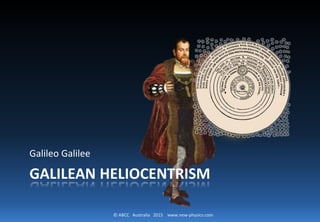
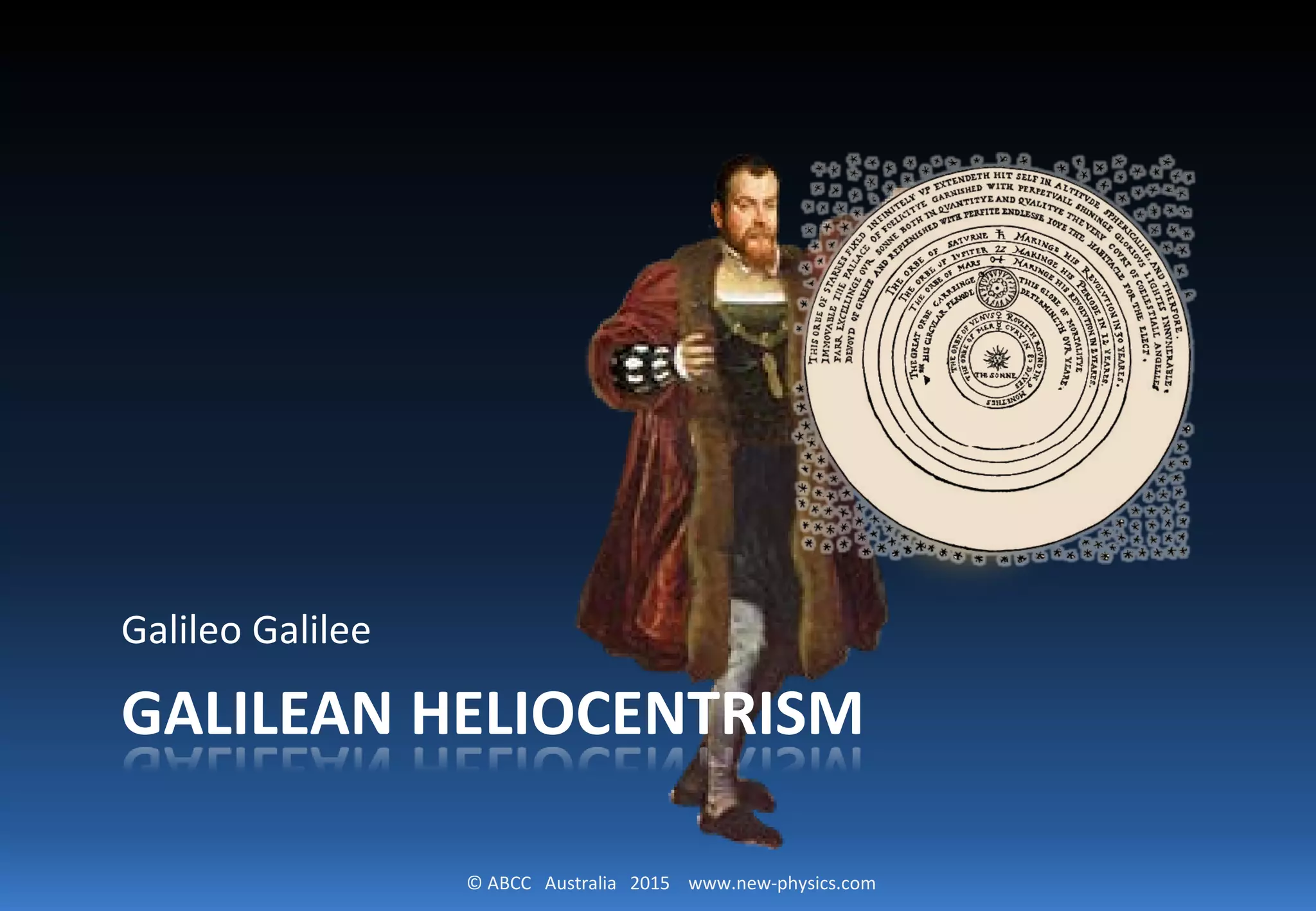
GALILEAN TELESCOPIC ASTRONOMY
© ABCC Australia 2015 new-physics.com
Galileo Galilee
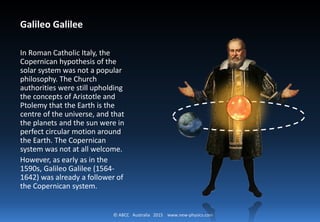
In Roman Catholic Italy, the Copernican
hypothesis of the solar system was not a
popular philosophy. The Church
authorities were still upholding the
concepts of Aristotle and Ptolemy that
the Earth is the centre of the universe,
and that the planets and the sun were in
perfect circular motion around the
Earth. The Copernican system was not at
all welcome. However, as early as in the
1590s, Galileo Galilee (1564-1642) was
already a follower of the Copernican
system.
© ABCC Australia 2015 new-physics.com
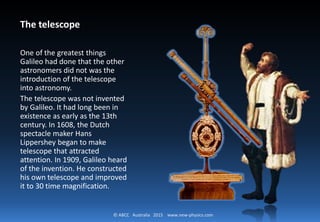
The Galilean Telescope
One of the greatest things Galileo had
done that the other astronomers did not
was the introduction of the telescope into
astronomy.
The telescope was not invented by Galileo.
It had long been in existence as early as
the 13th century. In 1608, the Dutch
spectacle maker Hans Lippershey began to
make telescope that attracted attention. In
1909, Galileo heard of the invention. He
constructed his own telescope and
improved it to 30 time magnification.
© ABCC Australia 2015 new-physics.com
First Powered Eyes on the Sky
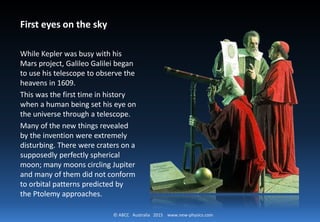
While Kepler was busy with his Mars project,
Galileo Galilei began to use his telescope to
observe the heavens in 1609.
This was the first time in history when a
human being set his eye on the universe
through a telescope.
Many of the new things revealed by the
invention were extremely disturbing. There
were craters on a supposedly perfectly
spherical moon; many moons circling Jupiter
and many of them did not conform to orbital
patterns predicted by the Ptolemy approaches.
© ABCC Australia 2015 new-physics.com
The Satellites of Jupiter
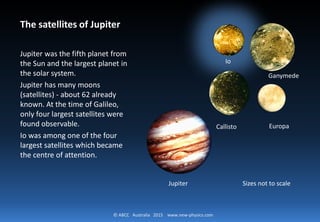
Jupiter was the fifth planet from
the Sun and the largest planet in
the solar system.
Jupiter has many moons
(satellites) - about 62 already
known. At the time of Galileo,
only four largest satellites were
found observable.
Io was among one of the four
largest satellites which became
the centre of attention.
Callisto
Io
Ganymede
Europa
Jupiter Sizes not to scale
© ABCC Australia 2015 new-physics.com
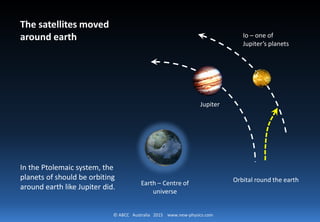
The satellites moved
around earth
In the Ptolemaic system, the
planets of should be orbiting
around earth like Jupiter did.
Jupiter
Orbital round the earthEarth – Centre of
universe
Io – one of
Jupiter’s planets
© ABCC Australia 2015 new-physics.com
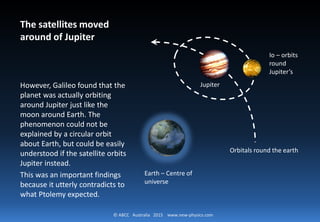
The satellites moved around of Jupiter
However, Galileo found that
the planet was actually
orbiting around Jupiter just
like the moon around Earth.
The phenomenon could not be
explained by a circular orbit
about Earth, but could be
easily understood if the
satellite orbits Jupiter instead.
This was an important findings
because it utterly contradicts
to what Ptolemy expected.
Jupiter
Orbitals round the earth
Earth – Centre of
universe
Io – orbits
round
Jupiter’s
© ABCC Australia 2015 new-physics.com
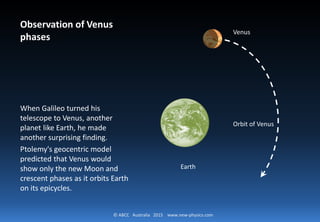
Observation of Venus phases
When Galileo turned his
telescope to Venus, another
planet like Earth, he made
another surprising finding.
Ptolemy's geocentric model
predicted that Venus would
show only the new Moon
and crescent phases as it
orbits Earth on its epicycles.
Venus
Earth
Orbit of Venus
© ABCC Australia 2015 new-physics.com
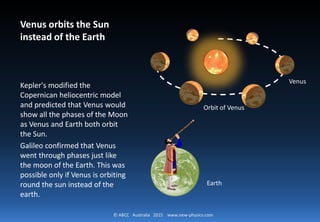
Venus orbits the Sun instead of the Earth
Kepler's modified the
Copernican heliocentric model
and predicted that Venus would
show all the phases of the
Moon as Venus and Earth both
orbit the Sun.
Galileo confirmed that Venus
went through phases just like
the moon of the Earth. This was
possible only if Venus is
orbiting round the sun instead
of the earth.
Venus
Earth
Orbit of Venus
© ABCC Australia 2015 new-physics.com
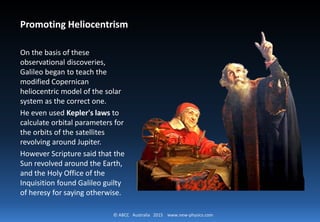
Promoting Heliocentrism
On the basis of these
observational discoveries, Galileo
began to teach the modified
Copernican heliocentric model of
the solar system as the correct
one. He even used Kepler's laws to
calculate orbital parameters for
the orbits of the satellites
revolving around Jupiter.
However Scripture said that the
Sun revolved around the Earth,
and the Holy Office of the
Inquisition found Galileo guilty of
heresy for saying otherwise.
© ABCC Australia 2015 new-physics.com
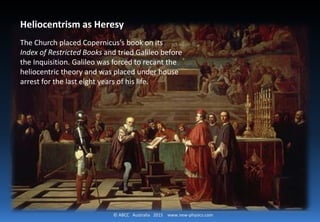
Heliocentrism as Heresy
The Church placed Copernicus's book on its Index
of Restricted Books and tried Galileo before the
Inquisition. Galileo was forced to recant the
heliocentric theory and was placed under house
arrest for the last eight years of his life.
© ABCC Australia 2015 new-physics.com
THE MILKY WAY UNIVERSE
To be continued on Cosmic Adventure 3.08

CA 3.07 Galileo's Telescope

  • 1.
    © ABCC Australia2015 new-physics.com Cosmic Adventure 3.07 GALILEAN TELESCOPIC ASTRONOMY
  • 2.
    © ABCC Australia2015 new-physics.com Galileo Galilee In Roman Catholic Italy, the Copernican hypothesis of the solar system was not a popular philosophy. The Church authorities were still upholding the concepts of Aristotle and Ptolemy that the Earth is the centre of the universe, and that the planets and the sun were in perfect circular motion around the Earth. The Copernican system was not at all welcome. However, as early as in the 1590s, Galileo Galilee (1564-1642) was already a follower of the Copernican system.
  • 3.
    © ABCC Australia2015 new-physics.com The Galilean Telescope One of the greatest things Galileo had done that the other astronomers did not was the introduction of the telescope into astronomy. The telescope was not invented by Galileo. It had long been in existence as early as the 13th century. In 1608, the Dutch spectacle maker Hans Lippershey began to make telescope that attracted attention. In 1909, Galileo heard of the invention. He constructed his own telescope and improved it to 30 time magnification.
  • 4.
    © ABCC Australia2015 new-physics.com First Powered Eyes on the Sky While Kepler was busy with his Mars project, Galileo Galilei began to use his telescope to observe the heavens in 1609. This was the first time in history when a human being set his eye on the universe through a telescope. Many of the new things revealed by the invention were extremely disturbing. There were craters on a supposedly perfectly spherical moon; many moons circling Jupiter and many of them did not conform to orbital patterns predicted by the Ptolemy approaches.
  • 5.
    © ABCC Australia2015 new-physics.com The Satellites of Jupiter Jupiter was the fifth planet from the Sun and the largest planet in the solar system. Jupiter has many moons (satellites) - about 62 already known. At the time of Galileo, only four largest satellites were found observable. Io was among one of the four largest satellites which became the centre of attention. Callisto Io Ganymede Europa Jupiter Sizes not to scale
  • 6.
    © ABCC Australia2015 new-physics.com The satellites moved around earth In the Ptolemaic system, the planets of should be orbiting around earth like Jupiter did. Jupiter Orbital round the earthEarth – Centre of universe Io – one of Jupiter’s planets
  • 7.
    © ABCC Australia2015 new-physics.com The satellites moved around of Jupiter However, Galileo found that the planet was actually orbiting around Jupiter just like the moon around Earth. The phenomenon could not be explained by a circular orbit about Earth, but could be easily understood if the satellite orbits Jupiter instead. This was an important findings because it utterly contradicts to what Ptolemy expected. Jupiter Orbitals round the earth Earth – Centre of universe Io – orbits round Jupiter’s
  • 8.
    © ABCC Australia2015 new-physics.com Observation of Venus phases When Galileo turned his telescope to Venus, another planet like Earth, he made another surprising finding. Ptolemy's geocentric model predicted that Venus would show only the new Moon and crescent phases as it orbits Earth on its epicycles. Venus Earth Orbit of Venus
  • 9.
    © ABCC Australia2015 new-physics.com Venus orbits the Sun instead of the Earth Kepler's modified the Copernican heliocentric model and predicted that Venus would show all the phases of the Moon as Venus and Earth both orbit the Sun. Galileo confirmed that Venus went through phases just like the moon of the Earth. This was possible only if Venus is orbiting round the sun instead of the earth. Venus Earth Orbit of Venus
  • 10.
    © ABCC Australia2015 new-physics.com Promoting Heliocentrism On the basis of these observational discoveries, Galileo began to teach the modified Copernican heliocentric model of the solar system as the correct one. He even used Kepler's laws to calculate orbital parameters for the orbits of the satellites revolving around Jupiter. However Scripture said that the Sun revolved around the Earth, and the Holy Office of the Inquisition found Galileo guilty of heresy for saying otherwise.
  • 11.
    © ABCC Australia2015 new-physics.com Heliocentrism as Heresy The Church placed Copernicus's book on its Index of Restricted Books and tried Galileo before the Inquisition. Galileo was forced to recant the heliocentric theory and was placed under house arrest for the last eight years of his life.
  • 12.
    © ABCC Australia2015 new-physics.com THE MILKY WAY UNIVERSE To be continued on Cosmic Adventure 3.08