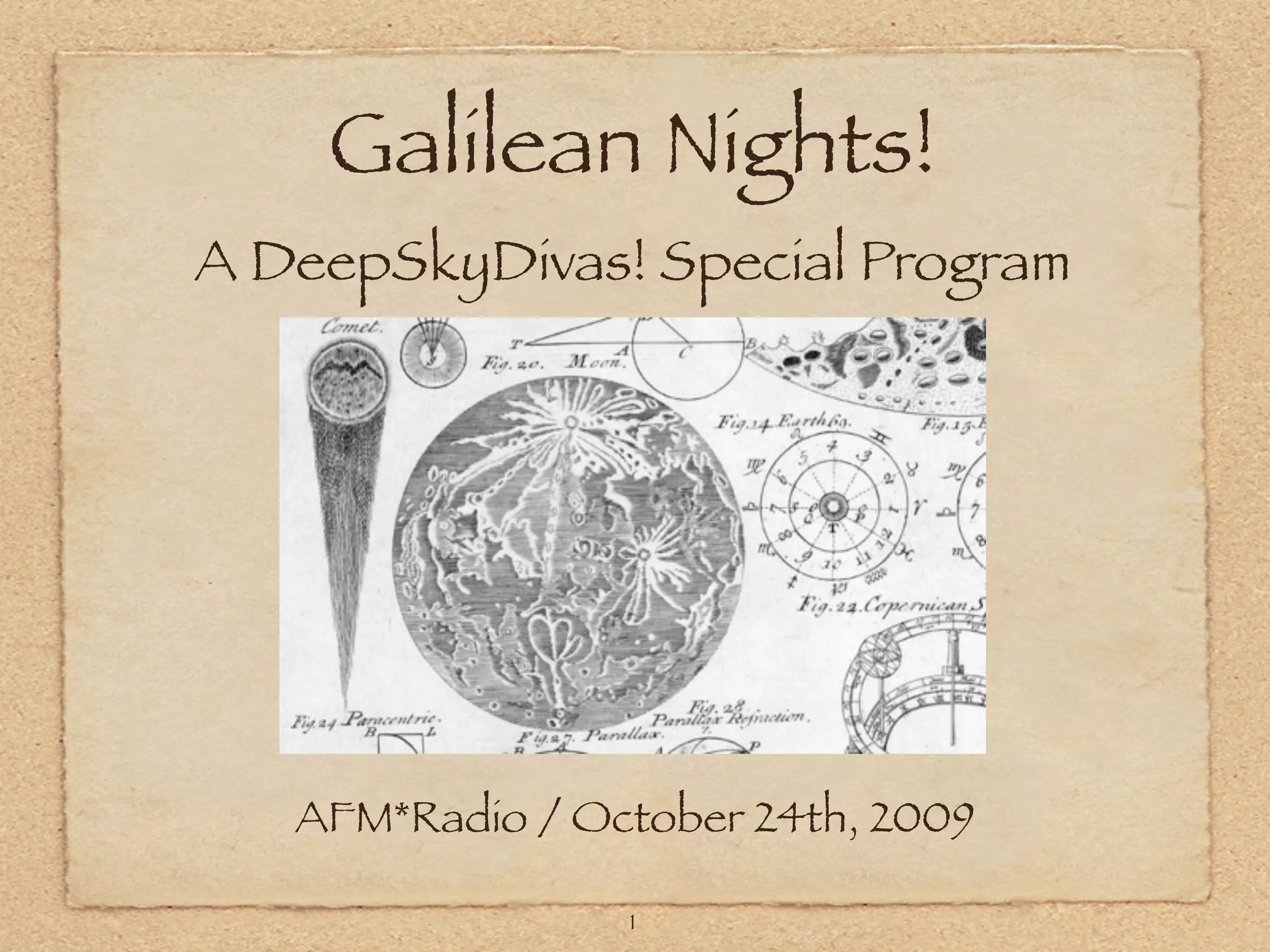
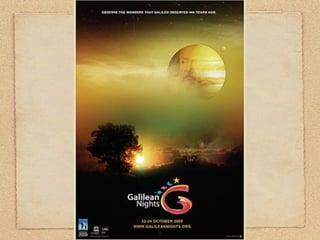
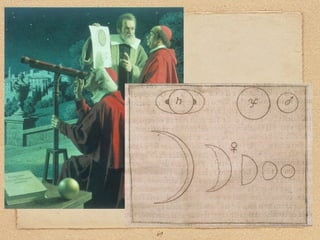
Galilean Nights!
A DeepSkyDivas! Special Program


   AFM*Radio / October 24th, 2009

                 1
2
IYA 2009 & Galilean Nights
     October 22-24 2009
Rediscovering our place in the
Universe.
Inspire us to look up, and in the
process, become a more peaceful
and cooperative planet.
Celebrate Galileo and the dawning
of modern astronomy and science.


                          3
IYA 2009
UNESCO & IAU global effort endorsed by
the UN & the International Council of
Science
Sponsoring and facilitating a series of local,
national, regional, and international events
Creating a partnership between
professional & amateur astronomers,
educators and space enthusiasts for public


                         4
5
6
Galilean Nights
Celebrates the 400th
anniversary of Galileo’s
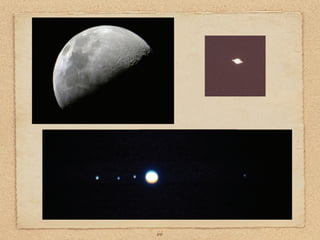
observations of Jupiter and
its moons.1
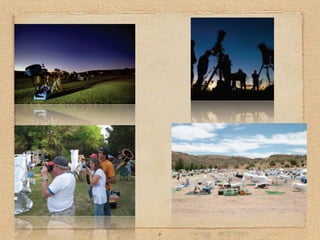
           Sidewalk astronomy
           around the world: 1150
           events in 86 countries.
           Onsite and remote
1Galileo   actually recorded his first jovian moon observations in January, 1610.


                                                                                   7
8
9
[T]here are infinite worlds both like and
   unlike this world of ours ... we must
   believe that in all worlds there are
   living creatures and plants and other
   things we see in this world....
            Epicurus (341-270 BC)


                            11
13
St. Augustine: On the Literal
      Interpretation of Genesis

“Even a non-Christian knows something about the
earth, the heavens, and the other elements of this
world… it is a disgraceful and dangerous thing for
an infidel to hear a Christian, presumably giving the
meaning of Holy Scripture, talking nonsense about
these things.” (AD 408)

                          14
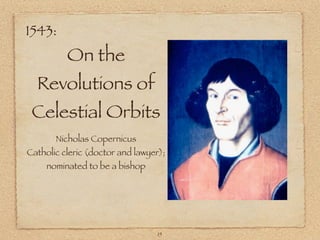
1543:
          On the
  Revolutions of
 Celestial Orbits
       Nicholas Copernicus
Catholic cleric (doctor and lawyer);
     nominated to be a bishop


                                  15
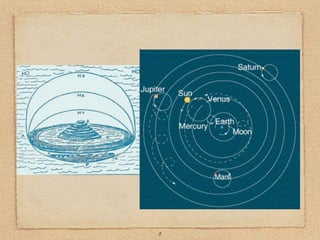
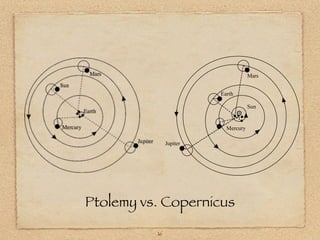
Mars


                         Earth

                                     Sun


                           Mercury

               Jupiter


Ptolemy vs. Copernicus

          16
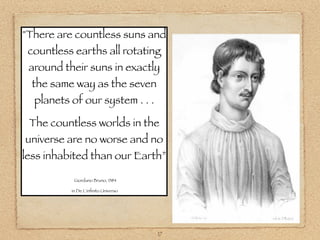
"There are countless suns and
 countless earths all rotating
 around their suns in exactly
  the same way as the seven
  planets of our system . . .

 The countless worlds in the
universe are no worse and no
less inhabited than our Earth”

           Giordano Bruno, 1584

          in De L'infinito Universo


                                     17
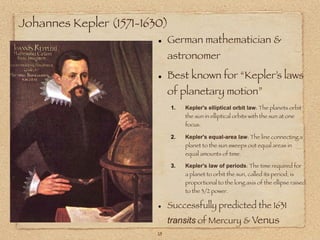
Johannes Kepler (1571-1630)
                         • German mathematician &
                           astronomer

                         • Best known for “Kepler’s laws
                           of planetary motion”
                              1.   Kepler's elliptical orbit law: The planets orbit
                                   the sun in elliptical orbits with the sun at one
                                   focus.

                              2.   Kepler's equal-area law: The line connecting a
                                   planet to the sun sweeps out equal areas in
                                   equal amounts of time.

                              3.   Kepler's law of periods: The time required for
                                   a planet to orbit the sun, called its period, is
                                   proportional to the long axis of the ellipse raised
                                   to the 3/2 power.


                         • Successfully predicted the 1631
                              transits of Mercury & Venus
                         18
The lead-up
1453 The Ottoman Turks conquer Constantinople

1492 Christopher Columbus discovers America

1517 Martin Luther’s 95 theses; Protestant Reformation begins

1543 Copernicus: On the Revolutions of the Heavenly Spheres

1545-1563 The Council of Trent called to deal with Protestantism

1564 Galileo is born in Pisa

1571 Johannes Kepler is born

                               19
Galileo


          20
21
22
23
24
25
26
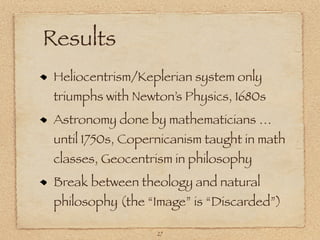
Results
 Heliocentrism/Keplerian system only
 triumphs with Newton’s Physics, 1680s
 Astronomy done by mathematicians …
 until 1750s, Copernicanism taught in math
 classes, Geocentrism in philosophy
 Break between theology and natural
 philosophy (the “Image” is “Discarded”)

                   27
Fr. Riccioli’s 1652 map of the Moon
(based on the observations of Fr. Grimaldi)

                                      28
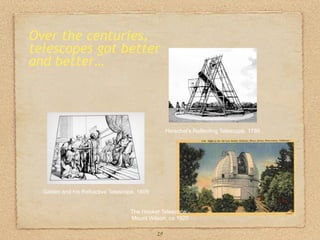
Over the centuries,
telescopes got better
and better…


                                                    Herschel’s Reflecting Telescope, 1789


  Galileo and his Refractive Telescope, 1609


                                    The Hooker Telescope -
                                    Mount Wilson, ca 1920

                                               29
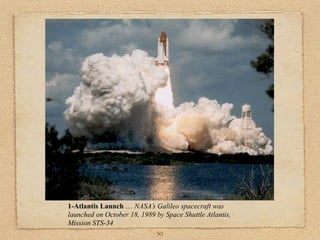
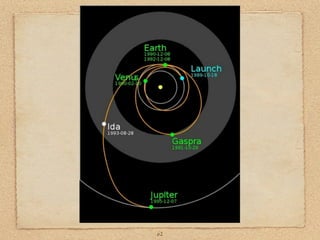
1-Atlantis Launch … NASA’s Galileo spacecraft was
launched on October 18, 1989 by Space Shuttle Atlantis,
Mission STS-34
                              30
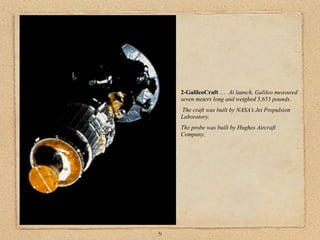
2-GalileoCraft … At launch, Galileo measured
     seven meters long and weighed 5,653 pounds.
     The craft was built by NASA’s Jet Propulsion
     Laboratory.
     The probe was built by Hughes Aircraft
     Company.


31
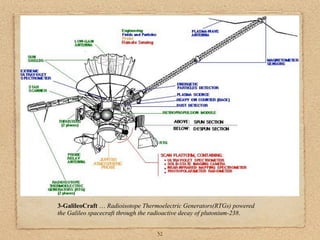
3-GalileoCraft … Radioisotope Thermoelectric Generators(RTGs) powered
the Galileo spacecraft through the radioactive decay of plutonium-238.


                                   32
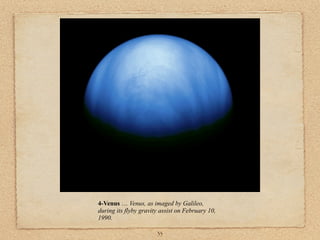
4-Venus … Venus, as imaged by Galileo,
during its flyby gravity assist on February 10,
1990.

                       33
5-Earth1 … The Earth, as imaged by Galileo
during its flyby gravity assist on December 8,
1990.

                        34
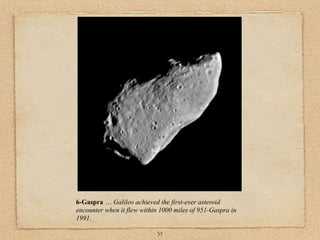
6-Gaspra … Galileo achieved the first-ever asteroid
encounter when it flew within 1000 miles of 951-Gaspra in
1991.

                            35
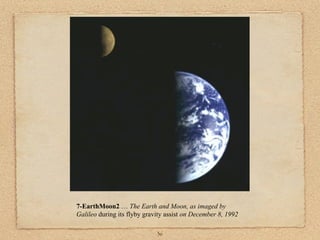
7-EarthMoon2 … The Earth and Moon, as imaged by
Galileo during its flyby gravity assist on December 8, 1992

                             36
8-IdaDactyl … NASA’s Galileo spacecraft made the first discovery of an
asteroid moon when it flew within 1,500 miles of asteroid 243-Ida in 1993.
The small moon, Dactyl, is an S-type object measuring just 1.4 km in diameter.


                                      37
38
39
40
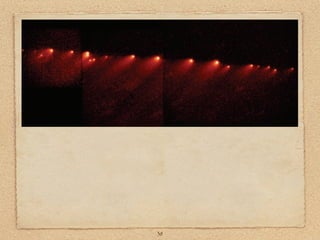
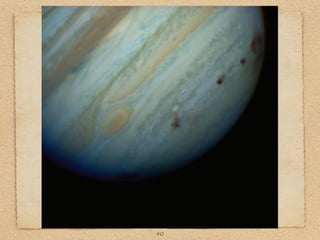
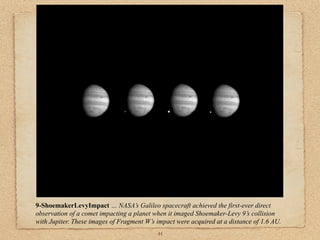
9-ShoemakerLevyImpact … NASA’s Galileo spacecraft achieved the first-ever direct
observation of a comet impacting a planet when it imaged Shoemaker-Levy 9’s collision
with Jupiter. These images of Fragment W’s impact were acquired at a distance of 1.6 AU.
                                           41
42
43
10-GalileoProbeImage … The Galileo Probe
weighed 335 kilograms and measured 1.3 meters
across.


                       44
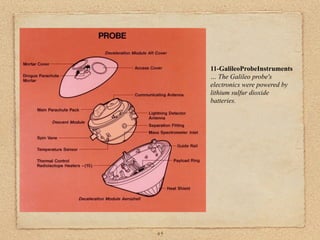
11-GalileoProbeInstruments
     … The Galileo probe's
     electronics were powered by
     lithium sulfur dioxide
     batteries.


45
12-GalileoHeatShield … The Galileo probe’s heat shield lost 80kg(of
its total 152kg) during its supersonic entry into Jupiter’s atmosphere.


                                  46
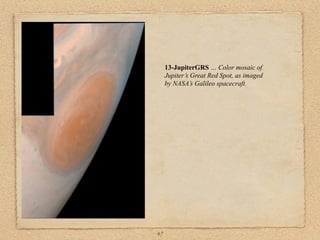
13-JupiterGRS … Color mosaic of
     Jupiter’s Great Red Spot, as imaged
     by NASA’s Galileo spacecraft.


47
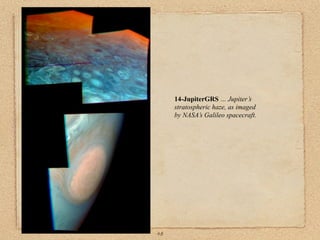
14-JupiterGRS … Jupiter’s
     stratospheric haze, as imaged
     by NASA’s Galileo spacecraft.


48
15-JupiterAurora … Jupiter’s Nightside Aurora,
as imaged by NASA’s Galileo spacecraft.


                      49
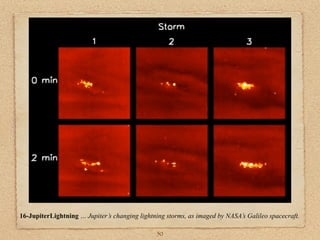
16-JupiterLightning … Jupiter’s changing lightning storms, as imaged by NASA’s Galileo spacecraft.

                                                50
17-JupiterBeltZones …
     “True” Color Mosaic of
     Jupiter’s Belt-Zone
     Boundary, as imaged by
     NASA’s Galileo spacecraft.


51
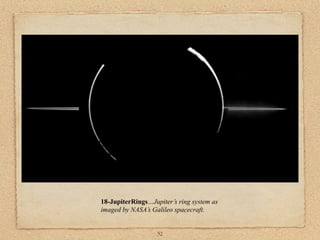
18-JupiterRings…Jupiter’s ring system as
imaged by NASA’s Galileo spacecraft.


                   52
20-IoTvashtar …Io’s active Tvashtar Catena,
as imaged by Galileo in 1999 and 2000.


                    53
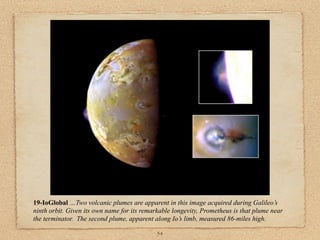
19-IoGlobal …Two volcanic plumes are apparent in this image acquired during Galileo’s
ninth orbit. Given its own name for its remarkable longevity, Prometheus is that plume near
the terminator. The second plume, apparent along Io’s limb, measured 86-miles high.

                                             54
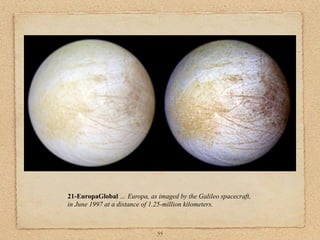
21-EuropaGlobal … Europa, as imaged by the Galileo spacecraft,
in June 1997 at a distance of 1.25-million kilometers.


                              55
22-EuropaFeatures … Europa’s fascinating surface features, as imaged by NASA’s Galileo spacecraft.

                                                56
23-CallistoGlobal …Callisto, as imaged by the Galileo spacecraft, in May 2001.

                                     57
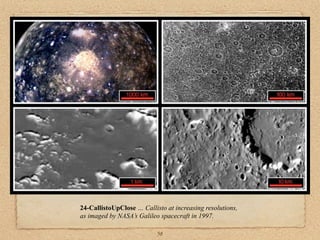
24-CallistoUpClose … Callisto at increasing resolutions,
as imaged by NASA’s Galileo spacecraft in 1997.

                           58
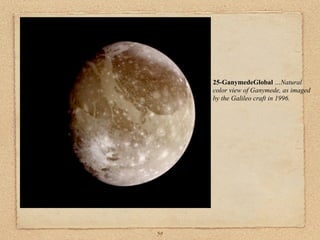
25-GanymedeGlobal …Natural
     color view of Ganymede, as imaged
     by the Galileo craft in 1996.


59
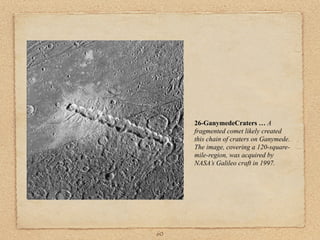
26-GanymedeCraters … A
     fragmented comet likely created
     this chain of craters on Ganymede.
     The image, covering a 120-square-
     mile-region, was acquired by
     NASA’s Galileo craft in 1997.


60
27-GalileoMissionPatch …


           61
62
www.galileoscope.org

www.galileoscope.org


         63
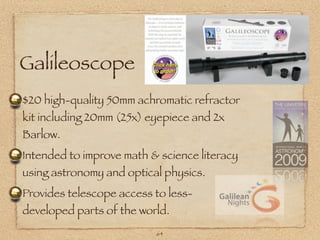
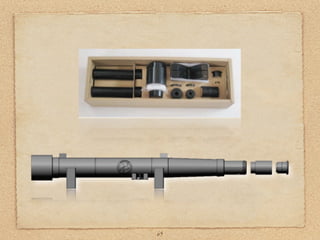
Galileoscope
$20 high-quality 50mm achromatic refractor
kit including 20mm (25x) eyepiece and 2x
Barlow.
Intended to improve math & science literacy
using astronomy and optical physics.
Provides telescope access to less-
developed parts of the world.
                          64
65
66
67
68
69

Afm Deep Sky Divas- Galileo Nights 10-24-09

  • 1.
    Galilean Nights! A DeepSkyDivas!Special Program AFM*Radio / October 24th, 2009 1
  • 2.
  • 3.
    IYA 2009 &Galilean Nights October 22-24 2009 Rediscovering our place in the Universe. Inspire us to look up, and in the process, become a more peaceful and cooperative planet. Celebrate Galileo and the dawning of modern astronomy and science. 3
  • 4.
    IYA 2009 UNESCO &IAU global effort endorsed by the UN & the International Council of Science Sponsoring and facilitating a series of local, national, regional, and international events Creating a partnership between professional & amateur astronomers, educators and space enthusiasts for public 4
  • 5.
  • 6.
  • 7.
    Galilean Nights Celebrates the400th anniversary of Galileo’s observations of Jupiter and its moons.1 Sidewalk astronomy around the world: 1150 events in 86 countries. Onsite and remote 1Galileo actually recorded his first jovian moon observations in January, 1610. 7
  • 8.
  • 9.
  • 11.
    [T]here are infiniteworlds both like and unlike this world of ours ... we must believe that in all worlds there are living creatures and plants and other things we see in this world.... Epicurus (341-270 BC) 11
  • 13.
  • 14.
    St. Augustine: Onthe Literal Interpretation of Genesis “Even a non-Christian knows something about the earth, the heavens, and the other elements of this world… it is a disgraceful and dangerous thing for an infidel to hear a Christian, presumably giving the meaning of Holy Scripture, talking nonsense about these things.” (AD 408) 14
  • 15.
    1543: On the Revolutions of Celestial Orbits Nicholas Copernicus Catholic cleric (doctor and lawyer); nominated to be a bishop 15
  • 16.
    Mars Earth Sun Mercury Jupiter Ptolemy vs. Copernicus 16
  • 17.
    "There are countlesssuns and countless earths all rotating around their suns in exactly the same way as the seven planets of our system . . . The countless worlds in the universe are no worse and no less inhabited than our Earth” Giordano Bruno, 1584 in De L'infinito Universo 17
  • 18.
    Johannes Kepler (1571-1630) • German mathematician & astronomer • Best known for “Kepler’s laws of planetary motion” 1. Kepler's elliptical orbit law: The planets orbit the sun in elliptical orbits with the sun at one focus. 2. Kepler's equal-area law: The line connecting a planet to the sun sweeps out equal areas in equal amounts of time. 3. Kepler's law of periods: The time required for a planet to orbit the sun, called its period, is proportional to the long axis of the ellipse raised to the 3/2 power. • Successfully predicted the 1631 transits of Mercury & Venus 18
  • 19.
    The lead-up 1453 TheOttoman Turks conquer Constantinople 1492 Christopher Columbus discovers America 1517 Martin Luther’s 95 theses; Protestant Reformation begins 1543 Copernicus: On the Revolutions of the Heavenly Spheres 1545-1563 The Council of Trent called to deal with Protestantism 1564 Galileo is born in Pisa 1571 Johannes Kepler is born 19
  • 20.
  • 21.
  • 22.
  • 23.
  • 24.
  • 25.
  • 26.
  • 27.
    Results Heliocentrism/Keplerian systemonly triumphs with Newton’s Physics, 1680s Astronomy done by mathematicians … until 1750s, Copernicanism taught in math classes, Geocentrism in philosophy Break between theology and natural philosophy (the “Image” is “Discarded”) 27
  • 28.
    Fr. Riccioli’s 1652map of the Moon (based on the observations of Fr. Grimaldi) 28
  • 29.
    Over the centuries, telescopesgot better and better… Herschel’s Reflecting Telescope, 1789 Galileo and his Refractive Telescope, 1609 The Hooker Telescope - Mount Wilson, ca 1920 29
  • 30.
    1-Atlantis Launch …NASA’s Galileo spacecraft was launched on October 18, 1989 by Space Shuttle Atlantis, Mission STS-34 30
  • 31.
    2-GalileoCraft … Atlaunch, Galileo measured seven meters long and weighed 5,653 pounds. The craft was built by NASA’s Jet Propulsion Laboratory. The probe was built by Hughes Aircraft Company. 31
  • 32.
    3-GalileoCraft … RadioisotopeThermoelectric Generators(RTGs) powered the Galileo spacecraft through the radioactive decay of plutonium-238. 32
  • 33.
    4-Venus … Venus,as imaged by Galileo, during its flyby gravity assist on February 10, 1990. 33
  • 34.
    5-Earth1 … TheEarth, as imaged by Galileo during its flyby gravity assist on December 8, 1990. 34
  • 35.
    6-Gaspra … Galileoachieved the first-ever asteroid encounter when it flew within 1000 miles of 951-Gaspra in 1991. 35
  • 36.
    7-EarthMoon2 … TheEarth and Moon, as imaged by Galileo during its flyby gravity assist on December 8, 1992 36
  • 37.
    8-IdaDactyl … NASA’sGalileo spacecraft made the first discovery of an asteroid moon when it flew within 1,500 miles of asteroid 243-Ida in 1993. The small moon, Dactyl, is an S-type object measuring just 1.4 km in diameter. 37
  • 38.
  • 39.
  • 40.
  • 41.
    9-ShoemakerLevyImpact … NASA’sGalileo spacecraft achieved the first-ever direct observation of a comet impacting a planet when it imaged Shoemaker-Levy 9’s collision with Jupiter. These images of Fragment W’s impact were acquired at a distance of 1.6 AU. 41
  • 42.
  • 43.
  • 44.
    10-GalileoProbeImage … TheGalileo Probe weighed 335 kilograms and measured 1.3 meters across. 44
  • 45.
    11-GalileoProbeInstruments … The Galileo probe's electronics were powered by lithium sulfur dioxide batteries. 45
  • 46.
    12-GalileoHeatShield … TheGalileo probe’s heat shield lost 80kg(of its total 152kg) during its supersonic entry into Jupiter’s atmosphere. 46
  • 47.
    13-JupiterGRS … Colormosaic of Jupiter’s Great Red Spot, as imaged by NASA’s Galileo spacecraft. 47
  • 48.
    14-JupiterGRS … Jupiter’s stratospheric haze, as imaged by NASA’s Galileo spacecraft. 48
  • 49.
    15-JupiterAurora … Jupiter’sNightside Aurora, as imaged by NASA’s Galileo spacecraft. 49
  • 50.
    16-JupiterLightning … Jupiter’schanging lightning storms, as imaged by NASA’s Galileo spacecraft. 50
  • 51.
    17-JupiterBeltZones … “True” Color Mosaic of Jupiter’s Belt-Zone Boundary, as imaged by NASA’s Galileo spacecraft. 51
  • 52.
    18-JupiterRings…Jupiter’s ring systemas imaged by NASA’s Galileo spacecraft. 52
  • 53.
    20-IoTvashtar …Io’s activeTvashtar Catena, as imaged by Galileo in 1999 and 2000. 53
  • 54.
    19-IoGlobal …Two volcanicplumes are apparent in this image acquired during Galileo’s ninth orbit. Given its own name for its remarkable longevity, Prometheus is that plume near the terminator. The second plume, apparent along Io’s limb, measured 86-miles high. 54
  • 55.
    21-EuropaGlobal … Europa,as imaged by the Galileo spacecraft, in June 1997 at a distance of 1.25-million kilometers. 55
  • 56.
    22-EuropaFeatures … Europa’sfascinating surface features, as imaged by NASA’s Galileo spacecraft. 56
  • 57.
    23-CallistoGlobal …Callisto, asimaged by the Galileo spacecraft, in May 2001. 57
  • 58.
    24-CallistoUpClose … Callistoat increasing resolutions, as imaged by NASA’s Galileo spacecraft in 1997. 58
  • 59.
    25-GanymedeGlobal …Natural color view of Ganymede, as imaged by the Galileo craft in 1996. 59
  • 60.
    26-GanymedeCraters … A fragmented comet likely created this chain of craters on Ganymede. The image, covering a 120-square- mile-region, was acquired by NASA’s Galileo craft in 1997. 60
  • 61.
  • 62.
  • 63.
  • 64.
    Galileoscope $20 high-quality 50mmachromatic refractor kit including 20mm (25x) eyepiece and 2x Barlow. Intended to improve math & science literacy using astronomy and optical physics. Provides telescope access to less- developed parts of the world. 64
  • 65.
  • 66.
  • 67.
  • 68.
  • 69.