Rett Clinic: Clinical
Research Overview
Tim Benke, M.D., Ph.D.
Prof. Pediatrics, Neurology, Otolaryngology and
Pharmacology
University of Colorado School of Medicine and
Medical Director, Rett Clinic
Research Director, Neurosciences Institute
Children’s Hospital Colorado
Tristen Dinkel, BSN RN; Rett Clinic Coordinator
Scott Demarest, MD
Disclosures
R21 NS101288(Benke)
NIH/NINDS
Exploratory determination of the role of L-type calcium
channels in mediating abnormal plasticity and behavior
after early life seizures Role: PI.
Ponzio Family Chair in Neurology Research
Children’s Hospital Colorado Foundation
Questcor Pharmaceuticals (Benke)
Whole-exome sequencing and ACTH responsiveness in
Infantile Spasms
Role: PI.
U54 HD061222 (Percy)
NICHD
Rett syndrome, MECP2 Duplication Disorder, and Rett-
related Disorders Natural History.
Role: Site Director, Co-I, 5212 sub-protocol CoI.
Rett Clinic at Children’s Hospital Colorado (Benke)
Rocky Mountain Rett Association
Role: PI/Medical Director
CDKL5 Center of Excellence (Benke)
International Foundation for CDKL5 Research
Role: PI
CURE (Traynelis). Functional and clinical evaluations of
glutamate receptor mutations in epileptic
encephalopathies.
Role: site PI
Scientific Advisory
Avexis, Neuren/Acadia, Marinus, Ovid/Takeda
IRSF, LouLou, IFCR, GRIN2B, CureGRIN, GW, LGS
Topics today
• Clinical trials 101
• Clinical trials in the Rett Clinic
• Rett
• CDKL5 Deficiency Disorder
• FOXG1
• MECP2 Duplication Syndrome
Clinical Trials: Basics (101)
What is a clinical study? Clinical trial?
A process by which subjects consent to participate in a
defined study designed to produce information that can be
used to understand (study) or help (trial) the population as
a whole. This data is peer-reviewed and published to
advance the knowledge and effective and safe treatments
of the disease. Trials are interventions.
You do not HAVE to participate in a clinical trial unless you
WANT to participate: participating involves consent (in
some cases using de-identified data you “opt out” versus
“opt in”)
A review board must approve the trial before any subjects
are contacted or enrolled; international rules of standards
and ethics are applied.
Clinical Trials: Phases
Phase 1: Testing healthy volunteers, multiple doses. May
be in patients with advanced stages of a disease or diseases
with no known treatments.
Phase 2: Testing on patients for efficacy and safety
Phase 3: Confirmatory: Testing on patients for efficacy,
effectiveness, and safety
Clinical trials: Types
Placebo controlled: a placebo is used to make sure the effects
are real. Patients with epilepsy can see a 25% reduction in
seizures with a placebo
Randomized: Who gets placebo or drug is a flip of the coin.
Double blind: Subjects and Study personnel do not know who is
getting drug.
Open Label: everyone getting drug
Cross-over: Those getting drug then get placebo and vice-versa.
Usually Randomized and Double blind too
Extension: access to drug after trial ends (usually an open label
continuation of the trial)
Clinical trials: Other
Gold standard: randomized, double-blind, placebo
Screening visit: first visit to make sure subject meets
inclusion/exclusion criteria
Inclusion/exclusion criteria: usually age, weight, disease specifics,
other medication use, recent trial experience, etc
Duration: The duration of treatment during the trial
Endpoints/Outcomes: The measurables to determine safety and
efficacy
Clinical trials: Where to get information?
Facebook?
Email?
Internet?
Blogs?
Me? I do not endorse any particular trial though will
participate in some.
Trust but verify! The only real sources:
Clinicaltrials.Gov
Company website
The consent form for the study
The study investigator(s), after IRB approval
The NIH-funded Natural History Study (NHS)
• NIH-funded Natural History Study of Rett and Rett-related
disorders has followed over 1000 patients through 2013
• MECP2, CDKL5, FOXG1
• Genotype/phenotype, Epilepsy, GI, Scoliosis, life-expectancy:
published standards
• Funding through: 9/2020 (not renewed)
 5211: parent protocol
 5212: neurophysiological biomarkers
 5213: genetic and metabolic biomarkers
 5214: Behavioral analyses
• Study visits occur separately from regular Rett Clinic
• Biomarker: objective measure of disease severity or predictive
of disease progression or response to treatment
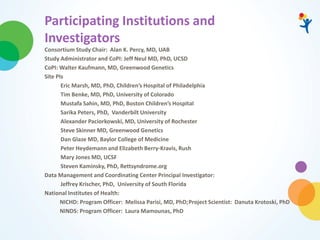
Participating Institutions and
Investigators
Consortium Study Chair: Alan K. Percy, MD, UAB
Study Administrator and CoPI: Jeff Neul MD, PhD, UCSD
CoPI: Walter Kaufmann, MD, Greenwood Genetics
Site PIs
Eric Marsh, MD, PhD, Children’s Hospital of Philadelphia
Tim Benke, MD, PhD, University of Colorado
Mustafa Sahin, MD, PhD, Boston Children’s Hospital
Sarika Peters, PhD, Vanderbilt University
Alexander Paciorkowski, MD, University of Rochester
Steve Skinner MD, Greenwood Genetics
Dan Glaze MD, Baylor College of Medicine
Peter Heydemann and Elizabeth Berry-Kravis, Rush
Mary Jones MD, UCSF
Steven Kaminsky, PhD, Rettsyndrome.org
Data Management and Coordinating Center Principal Investigator:
Jeffrey Krischer, PhD, University of South Florida
National Institutes of Health:
NICHD: Program Officer: Melissa Parisi, MD, PhD;Project Scientist: Danuta Krotoski, PhD
NINDS: Program Officer: Laura Mamounas, PhD
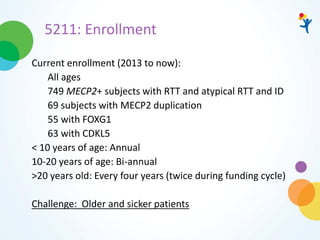
5211: Enrollment
Current enrollment (2013 to now):
All ages
749 MECP2+ subjects with RTT and atypical RTT and ID
69 subjects with MECP2 duplication
55 with FOXG1
63 with CDKL5
< 10 years of age: Annual
10-20 years of age: Bi-annual
>20 years old: Every four years (twice during funding cycle)
Challenge: Older and sicker patients
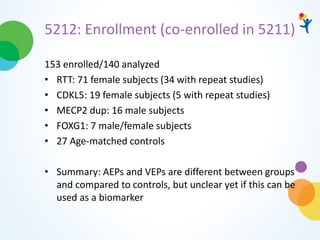
5212: Enrollment (co-enrolled in 5211)
153 enrolled/140 analyzed
• RTT: 71 female subjects (34 with repeat studies)
• CDKL5: 19 female subjects (5 with repeat studies)
• MECP2 dup: 16 male subjects
• FOXG1: 7 male/female subjects
• 27 Age-matched controls
• Summary: AEPs and VEPs are different between groups
and compared to controls, but unclear yet if this can be
used as a biomarker
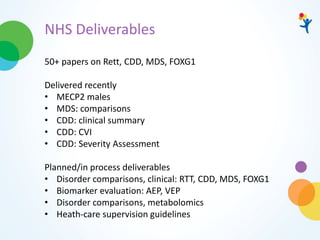
NHS Deliverables
50+ papers on Rett, CDD, MDS, FOXG1
Delivered recently
• MECP2 males
• MDS: comparisons
• CDD: clinical summary
• CDD: CVI
• CDD: Severity Assessment
Planned/in process deliverables
• Disorder comparisons, clinical: RTT, CDD, MDS, FOXG1
• Biomarker evaluation: AEP, VEP
• Disorder comparisons, metabolomics
• Heath-care supervision guidelines
Rett: Ketamine
“A Randomized, Double-blind, Placebo-controlled, Cross-
over Study to Assess the Safety, Tolerability and Efficacy of
Oral Ketamine for Patients With Rett Syndrome”
Ketamine, phase 2: 5 days drug/placebo; wash-out; 5 days
drug/placebo; wash-out (8-10 weeks total)
6-12 years old. Pre-menarche.
Primary endpoint: safety; Secondary: CGI-I, MBA, RSBQ, etc
Goal: 48 subjects; local 4+, active
Rett: GW-CBD
“A Randomized, Double-blind, Placebo-controlled Trial to
Investigate the Efficacy and Safety of Cannabidiol Oral
Solution (GWP42003-P, CBD-OS) in Patients With Rett
Syndrome”
CBD, phase 3, 40 weeks treatment
2-18 years old. > 9 kg.
Primary endpoint: RSBQ and CGI-I
Goal: 252 subjects; local 10+, startup
Rett: Trofinetide
From the company website
“In the fourth quarter of 2019, we plan to initiate the LAVENDER 12-
week Phase 3, double-blind, randomized, placebo-controlled study to
evaluate efficacy and safety of trofinetide and placebo in approximately
180 females ages 5 to 20 years with Rett syndrome. Half of the study
participants will receive trofinetide and half will receive placebo. The
study will use the Rett Syndrome Behaviour Questionnaire (RSBQ), a
caregiver assessment and the Clinical Global Impression Scale-
Improvement (CGI-I), a clinician assessment of the improvement of Rett
syndrome as co-primary efficacy endpoints.
The LAVENDER Phase 3 study will be followed by LILAC, a 40-week
open-label extension study. All participants completing the 12-week
LAVENDER study may be eligible to enroll in the LILAC study, in which all
study participants will receive trofinetide and followed to evaluate long
term tolerability and safety of the drug.
Trofinetide has been granted Fast Track Status and Orphan Drug
Designation for Rett syndrome in the U.S. and Orphan Drug Designation
for Rett syndrome in Europe.”
Local goal: 10+, start-up
Rett: Anavex
“A Double-Blind, Randomized, Placebo-Controlled, Dose
Titration Study of ANAVEX2-73 in Patients With Rett
Syndrome”
Anavex2-73, phase 2: 7 weeks treatment , 12 week open
label extenstion
18+ age
Primary endpoint: safety, pharmacokinetics; Secondary:
CGI-I, RSBQ
Goal: 15 subjects; local: not participating
Rett: Sarizotan
“A Randomised, Double-Blind, Placebo-Controlled 6-month
Study to Evaluate the Efficacy, Safety, and Tolerability of
Sarizotan in Patients With Rett Syndrome With Respiratory
Symptoms”
Active, not recruiting, not participating
Rett: Gene Therapy
From Avexis/Novartis Press release:
https://reverserett.org/avexis-novartis-release-statement-on-avxs-201/
“Due to the data integrity concerns related to a specific animal testing
procedure used in the development of Zolgensma and included in the
application, we have decided to also review data quality and
compliance with the preclinical work performed for AVXS-201, our Rett
Syndrome gene therapy candidate. Out of caution, and to ensure that
we have a robust data package for the FDA we have chosen to repeat
and add additional pivotal preclinical studies as well as new quality
controls. Once these studies are completed, we will submit the revised
IND (investigational new drug application) to the FDA with the goal of
rapidly progressing to clinical trials in Rett Syndrome patients. We
expect that conducting these additional studies and completing the IND
will take until the middle of 2020. At that time we will be in a position
to provide further updates to the Rett Syndrome community.”
Local: we hope so
CDD: Ganaxalone
“Study of adjunctive ganaxalone treatment in Children and
Young Adults with CDKL5 deficiency disorder (Marigold)”
• Positive GABA-R allosteric modulator
• Phase 3
• Recruiting
• Marinus Pharmaceuticals
• Double blind-placebo controlled: baseline, 17 week add-
on (placebo or ganaxalone), open-label with ganaxalone
• Primary endpoint: reduction in seizures
• Goal: 100 participants (age 2yo-21yo)
• Local: 5 (5 more by end of year), active/participating
CDD: TAK-935 (OV935)
“A multicenter, open-label, pilot study of TAK-935 (OV935) in
participants with 15Q Duplication Syndrome of Cyclin-Dependent
Kinase-Like 5 (CDKL5) Deficiency Disorder (ARCADE STUDY)
• 24Cholesterol hydroxylase inhibitor: reduces expression of
NMDARs
• Phase 2
• Takeda/Ovid Therapeutics
• Open label: baseline, 20 week treatment, open label
extension
• Primary endpoint: reduction in seizures
• Goal: 30 participants (15 with CDD, age 2yo to 35 yo)
• Local: 2 participants (5 more by end of year), active,
participating
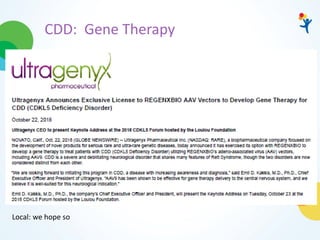
CDD: Gene Therapy
Local: we hope so
Topics today
• Clinical trials 101
• Clinical trials in the Rett Clinic
• Rett
• CDKL5 Deficiency Disorder
• FOXG1
• MECP2 Duplication Syndrome
Clinical Research Overview

Clinical Research Overview

  • 1.
    Rett Clinic: Clinical ResearchOverview Tim Benke, M.D., Ph.D. Prof. Pediatrics, Neurology, Otolaryngology and Pharmacology University of Colorado School of Medicine and Medical Director, Rett Clinic Research Director, Neurosciences Institute Children’s Hospital Colorado Tristen Dinkel, BSN RN; Rett Clinic Coordinator Scott Demarest, MD
  • 2.
    Disclosures R21 NS101288(Benke) NIH/NINDS Exploratory determinationof the role of L-type calcium channels in mediating abnormal plasticity and behavior after early life seizures Role: PI. Ponzio Family Chair in Neurology Research Children’s Hospital Colorado Foundation Questcor Pharmaceuticals (Benke) Whole-exome sequencing and ACTH responsiveness in Infantile Spasms Role: PI. U54 HD061222 (Percy) NICHD Rett syndrome, MECP2 Duplication Disorder, and Rett- related Disorders Natural History. Role: Site Director, Co-I, 5212 sub-protocol CoI. Rett Clinic at Children’s Hospital Colorado (Benke) Rocky Mountain Rett Association Role: PI/Medical Director CDKL5 Center of Excellence (Benke) International Foundation for CDKL5 Research Role: PI CURE (Traynelis). Functional and clinical evaluations of glutamate receptor mutations in epileptic encephalopathies. Role: site PI Scientific Advisory Avexis, Neuren/Acadia, Marinus, Ovid/Takeda IRSF, LouLou, IFCR, GRIN2B, CureGRIN, GW, LGS
  • 3.
    Topics today • Clinicaltrials 101 • Clinical trials in the Rett Clinic • Rett • CDKL5 Deficiency Disorder • FOXG1 • MECP2 Duplication Syndrome
  • 4.
    Clinical Trials: Basics(101) What is a clinical study? Clinical trial? A process by which subjects consent to participate in a defined study designed to produce information that can be used to understand (study) or help (trial) the population as a whole. This data is peer-reviewed and published to advance the knowledge and effective and safe treatments of the disease. Trials are interventions. You do not HAVE to participate in a clinical trial unless you WANT to participate: participating involves consent (in some cases using de-identified data you “opt out” versus “opt in”) A review board must approve the trial before any subjects are contacted or enrolled; international rules of standards and ethics are applied.
  • 5.
    Clinical Trials: Phases Phase1: Testing healthy volunteers, multiple doses. May be in patients with advanced stages of a disease or diseases with no known treatments. Phase 2: Testing on patients for efficacy and safety Phase 3: Confirmatory: Testing on patients for efficacy, effectiveness, and safety
  • 6.
    Clinical trials: Types Placebocontrolled: a placebo is used to make sure the effects are real. Patients with epilepsy can see a 25% reduction in seizures with a placebo Randomized: Who gets placebo or drug is a flip of the coin. Double blind: Subjects and Study personnel do not know who is getting drug. Open Label: everyone getting drug Cross-over: Those getting drug then get placebo and vice-versa. Usually Randomized and Double blind too Extension: access to drug after trial ends (usually an open label continuation of the trial)
  • 7.
    Clinical trials: Other Goldstandard: randomized, double-blind, placebo Screening visit: first visit to make sure subject meets inclusion/exclusion criteria Inclusion/exclusion criteria: usually age, weight, disease specifics, other medication use, recent trial experience, etc Duration: The duration of treatment during the trial Endpoints/Outcomes: The measurables to determine safety and efficacy
  • 8.
    Clinical trials: Whereto get information? Facebook? Email? Internet? Blogs? Me? I do not endorse any particular trial though will participate in some. Trust but verify! The only real sources: Clinicaltrials.Gov Company website The consent form for the study The study investigator(s), after IRB approval
  • 9.
    The NIH-funded NaturalHistory Study (NHS) • NIH-funded Natural History Study of Rett and Rett-related disorders has followed over 1000 patients through 2013 • MECP2, CDKL5, FOXG1 • Genotype/phenotype, Epilepsy, GI, Scoliosis, life-expectancy: published standards • Funding through: 9/2020 (not renewed)  5211: parent protocol  5212: neurophysiological biomarkers  5213: genetic and metabolic biomarkers  5214: Behavioral analyses • Study visits occur separately from regular Rett Clinic • Biomarker: objective measure of disease severity or predictive of disease progression or response to treatment
  • 10.
    Participating Institutions and Investigators ConsortiumStudy Chair: Alan K. Percy, MD, UAB Study Administrator and CoPI: Jeff Neul MD, PhD, UCSD CoPI: Walter Kaufmann, MD, Greenwood Genetics Site PIs Eric Marsh, MD, PhD, Children’s Hospital of Philadelphia Tim Benke, MD, PhD, University of Colorado Mustafa Sahin, MD, PhD, Boston Children’s Hospital Sarika Peters, PhD, Vanderbilt University Alexander Paciorkowski, MD, University of Rochester Steve Skinner MD, Greenwood Genetics Dan Glaze MD, Baylor College of Medicine Peter Heydemann and Elizabeth Berry-Kravis, Rush Mary Jones MD, UCSF Steven Kaminsky, PhD, Rettsyndrome.org Data Management and Coordinating Center Principal Investigator: Jeffrey Krischer, PhD, University of South Florida National Institutes of Health: NICHD: Program Officer: Melissa Parisi, MD, PhD;Project Scientist: Danuta Krotoski, PhD NINDS: Program Officer: Laura Mamounas, PhD
  • 11.
    5211: Enrollment Current enrollment(2013 to now): All ages 749 MECP2+ subjects with RTT and atypical RTT and ID 69 subjects with MECP2 duplication 55 with FOXG1 63 with CDKL5 < 10 years of age: Annual 10-20 years of age: Bi-annual >20 years old: Every four years (twice during funding cycle) Challenge: Older and sicker patients
  • 12.
    5212: Enrollment (co-enrolledin 5211) 153 enrolled/140 analyzed • RTT: 71 female subjects (34 with repeat studies) • CDKL5: 19 female subjects (5 with repeat studies) • MECP2 dup: 16 male subjects • FOXG1: 7 male/female subjects • 27 Age-matched controls • Summary: AEPs and VEPs are different between groups and compared to controls, but unclear yet if this can be used as a biomarker
  • 13.
    NHS Deliverables 50+ paperson Rett, CDD, MDS, FOXG1 Delivered recently • MECP2 males • MDS: comparisons • CDD: clinical summary • CDD: CVI • CDD: Severity Assessment Planned/in process deliverables • Disorder comparisons, clinical: RTT, CDD, MDS, FOXG1 • Biomarker evaluation: AEP, VEP • Disorder comparisons, metabolomics • Heath-care supervision guidelines
  • 14.
    Rett: Ketamine “A Randomized,Double-blind, Placebo-controlled, Cross- over Study to Assess the Safety, Tolerability and Efficacy of Oral Ketamine for Patients With Rett Syndrome” Ketamine, phase 2: 5 days drug/placebo; wash-out; 5 days drug/placebo; wash-out (8-10 weeks total) 6-12 years old. Pre-menarche. Primary endpoint: safety; Secondary: CGI-I, MBA, RSBQ, etc Goal: 48 subjects; local 4+, active
  • 15.
    Rett: GW-CBD “A Randomized,Double-blind, Placebo-controlled Trial to Investigate the Efficacy and Safety of Cannabidiol Oral Solution (GWP42003-P, CBD-OS) in Patients With Rett Syndrome” CBD, phase 3, 40 weeks treatment 2-18 years old. > 9 kg. Primary endpoint: RSBQ and CGI-I Goal: 252 subjects; local 10+, startup
  • 16.
    Rett: Trofinetide From thecompany website “In the fourth quarter of 2019, we plan to initiate the LAVENDER 12- week Phase 3, double-blind, randomized, placebo-controlled study to evaluate efficacy and safety of trofinetide and placebo in approximately 180 females ages 5 to 20 years with Rett syndrome. Half of the study participants will receive trofinetide and half will receive placebo. The study will use the Rett Syndrome Behaviour Questionnaire (RSBQ), a caregiver assessment and the Clinical Global Impression Scale- Improvement (CGI-I), a clinician assessment of the improvement of Rett syndrome as co-primary efficacy endpoints. The LAVENDER Phase 3 study will be followed by LILAC, a 40-week open-label extension study. All participants completing the 12-week LAVENDER study may be eligible to enroll in the LILAC study, in which all study participants will receive trofinetide and followed to evaluate long term tolerability and safety of the drug. Trofinetide has been granted Fast Track Status and Orphan Drug Designation for Rett syndrome in the U.S. and Orphan Drug Designation for Rett syndrome in Europe.” Local goal: 10+, start-up
  • 17.
    Rett: Anavex “A Double-Blind,Randomized, Placebo-Controlled, Dose Titration Study of ANAVEX2-73 in Patients With Rett Syndrome” Anavex2-73, phase 2: 7 weeks treatment , 12 week open label extenstion 18+ age Primary endpoint: safety, pharmacokinetics; Secondary: CGI-I, RSBQ Goal: 15 subjects; local: not participating
  • 18.
    Rett: Sarizotan “A Randomised,Double-Blind, Placebo-Controlled 6-month Study to Evaluate the Efficacy, Safety, and Tolerability of Sarizotan in Patients With Rett Syndrome With Respiratory Symptoms” Active, not recruiting, not participating
  • 19.
    Rett: Gene Therapy FromAvexis/Novartis Press release: https://reverserett.org/avexis-novartis-release-statement-on-avxs-201/ “Due to the data integrity concerns related to a specific animal testing procedure used in the development of Zolgensma and included in the application, we have decided to also review data quality and compliance with the preclinical work performed for AVXS-201, our Rett Syndrome gene therapy candidate. Out of caution, and to ensure that we have a robust data package for the FDA we have chosen to repeat and add additional pivotal preclinical studies as well as new quality controls. Once these studies are completed, we will submit the revised IND (investigational new drug application) to the FDA with the goal of rapidly progressing to clinical trials in Rett Syndrome patients. We expect that conducting these additional studies and completing the IND will take until the middle of 2020. At that time we will be in a position to provide further updates to the Rett Syndrome community.” Local: we hope so
  • 20.
    CDD: Ganaxalone “Study ofadjunctive ganaxalone treatment in Children and Young Adults with CDKL5 deficiency disorder (Marigold)” • Positive GABA-R allosteric modulator • Phase 3 • Recruiting • Marinus Pharmaceuticals • Double blind-placebo controlled: baseline, 17 week add- on (placebo or ganaxalone), open-label with ganaxalone • Primary endpoint: reduction in seizures • Goal: 100 participants (age 2yo-21yo) • Local: 5 (5 more by end of year), active/participating
  • 21.
    CDD: TAK-935 (OV935) “Amulticenter, open-label, pilot study of TAK-935 (OV935) in participants with 15Q Duplication Syndrome of Cyclin-Dependent Kinase-Like 5 (CDKL5) Deficiency Disorder (ARCADE STUDY) • 24Cholesterol hydroxylase inhibitor: reduces expression of NMDARs • Phase 2 • Takeda/Ovid Therapeutics • Open label: baseline, 20 week treatment, open label extension • Primary endpoint: reduction in seizures • Goal: 30 participants (15 with CDD, age 2yo to 35 yo) • Local: 2 participants (5 more by end of year), active, participating
  • 22.
  • 23.
    Topics today • Clinicaltrials 101 • Clinical trials in the Rett Clinic • Rett • CDKL5 Deficiency Disorder • FOXG1 • MECP2 Duplication Syndrome