PAROLE AND PROBATION
ADMINISTRATION
FACTS ON PROBATION
DISTINCT PHASES OF PROBATION
1. Selection of offenders for probation
This phase is known as the post-sentence investigation of
Court referrals. This covers the period after conviction but
before the grant of probation.
2. Supervision and Treatment of Selected Offenders
This phase covers the period following the grant of probation
but before termination of the case thru successful completion
of the probation period or revocation and commitment to a
jail or prison.
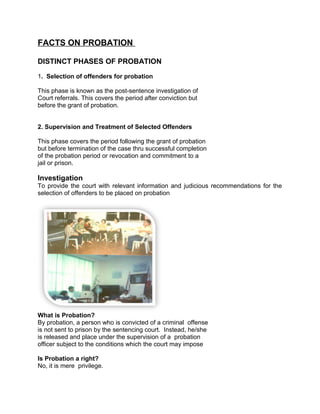
Investigation
To provide the court with relevant information and judicious recommendations for the
selection of offenders to be placed on probation
What is Probation?
By probation, a person who is convicted of a criminal offense
is not sent to prison by the sentencing court. Instead, he/she
is released and place under the supervision of a probation
officer subject to the conditions which the court may impose
Is Probation a right?
No, it is mere privilege.
Who cannot be granted Probation? Those:
 sentenced to serve a prison term of more than six (6) years;
 convicted of any crime against the national security or the public order;
 previously convicted of an offense which is punished by imprisonment of
more than 30 days and/or a fine of Php 200.00 or more;
 who have once been placed on probation under this law;
 already serving sentence;
Who cannot be granted Probation? Those:
 sentenced to a probationable penalty but appealed the same;
 convicted of an offense against the Omnibus Election Code and Wage
Rationalization Act; and
 convicted of illicit trafficking or pushing of Dangerous Act.
Will Probation be automatically granted to one
Whose sentence is six (6) years or less?
No, the application may be denied by the court if:
 after determination, he/she is in need of rehabilitation which could be
provided by prison/jail;
 risk that the offender will likely commit another crime; and
 depreciate the seriousness of the crime committed.
Where shall an application for Probation be filed?
The application shall be filed with the court that tried
and sentenced the offender.
When should an application for Probation be filed?
Anytime before the offender starts serving his sentence
but within fifteen (15) days from the promulgation or
notice of the judgment of conviction.
May an offender be released from confinement while
his application for Probation is pending?
Yes, the applicant may be released under the bail he posted
in the criminal case, or under recognizance.
How many times can one be granted Probation?
Only once.
How long is the period of Probation?
Not more than two (2) years if the sentence of the offender
is one (1) year or less; and not more than six (6) years if the
sentence is more than one (1) year.
Supervision
To effect the rehabilitation and reintegration of the probationers as productive, law-
abiding and socially responsible members of the community.
Conditions of Probation
 Mandatory
 Discretionary
What will happen if a probationer violates the
conditions of Probation?
The court may modify the conditions of probation or revoke
the same. If the violation is serious, the court may order the
probationer to serve his prison sentence. The probationer may
also be arrested and criminally prosecuted if the violation
is a criminal offense.
REHABILITATION PROGRAM
It is an individualized community-based three pronged approach to crime
prevention and treatment of offenders with Restorative Justice as its
philosophical foundation, Therapeutic Community as the treatment
modality, and Volunteers as lead community resource
LAUNCHING
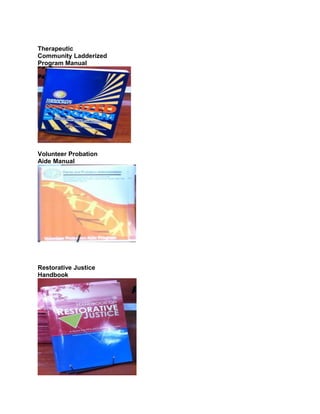
Therapeutic
Community Ladderized
Program Manual
Volunteer Probation
Aide Manual
Restorative Justice
Handbook
Therapeutic
Community Ladderized
Program Manual
Volunteer Probation
Aide Manual
Restorative Justice
Handbook
Total Probation Caseload Handled (2009-2013)
Year Investigation Supervision
2009 9,624 34,050
2010 7,034 29,523
2011 8,634 30,385
2012 8,810 29,768
2013 9,187 29,236
Average 8,658 30,592
Total Probation Caseload Handled = Carry-Over + New Referrals
Received
Total New Referrals Received (2009-2013)
Year Investigation Supervision
2009 9,045 9,393
2010 6,453 6,785
2011 8,208 8,421
2012 8,202 7,696
2013 8,620 8,583
Total 40,528 40,878
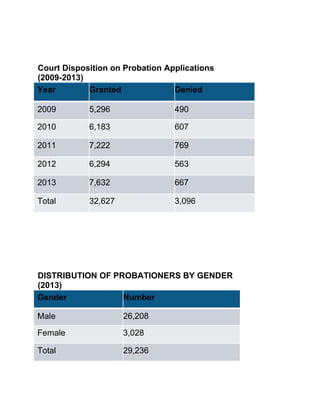
Court Disposition on Probation Applications
(2009-2013)
Year Granted Denied
2009 5,296 490
2010 6,183 607
2011 7,222 769
2012 6,294 563
2013 7,632 667
Total 32,627 3,096
DISTRIBUTION OF PROBATIONERS BY GENDER
(2013)
Gender Number
Male 26,208
Female 3,028
Total 29,236
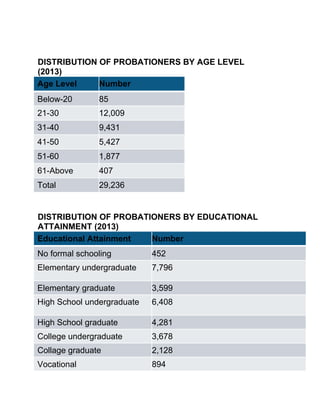
DISTRIBUTION OF PROBATIONERS BY AGE LEVEL
(2013)
Age Level Number
Below-20 85
21-30 12,009
31-40 9,431
41-50 5,427
51-60 1,877
61-Above 407
Total 29,236
DISTRIBUTION OF PROBATIONERS BY EDUCATIONAL
ATTAINMENT (2013)
Educational Attainment Number
No formal schooling 452
Elementary undergraduate 7,796
Elementary graduate 3,599
High School undergraduate 6,408
High School graduate 4,281
College undergraduate 3,678
Collage graduate 2,128
Vocational 894
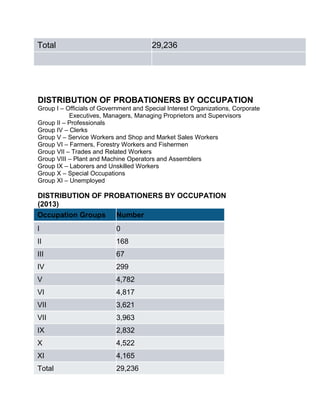
Total 29,236
DISTRIBUTION OF PROBATIONERS BY OCCUPATION
Group I – Officials of Government and Special Interest Organizations, Corporate
Executives, Managers, Managing Proprietors and Supervisors
Group II – Professionals
Group IV – Clerks
Group V – Service Workers and Shop and Market Sales Workers
Group VI – Farmers, Forestry Workers and Fishermen
Group VII – Trades and Related Workers
Group VIII – Plant and Machine Operators and Assemblers
Group IX – Laborers and Unskilled Workers
Group X – Special Occupations
Group XI – Unemployed
DISTRIBUTION OF PROBATIONERS BY OCCUPATION
(2013)
Occupation Groups Number
I 0
II 168
III 67
IV 299
V 4,782
VI 4,817
VII 3,621
VII 3,963
IX 2,832
X 4,522
XI 4,165
Total 29,236
DISTRIBUTION OF PROBATIONERS BY FAMILY ECONOMIC STATUS
(2013)
Family Economic Status Number
More than Adequate 700
Adequate 5,460
Inadequate 18,796
Below Poverty Level 4,280
Total 29,236
More than Adequate – the family income is more than sufficient for the basic
requirements of its members
Adequate- the family income is equal to the basic requirements of the family
Inadequate – the family income is above the poverty level but insufficient for the family’s
basic needs, considering the social standing of its members
Below Poverty Level – monthly family income below Php 6,274.00 for a family of five
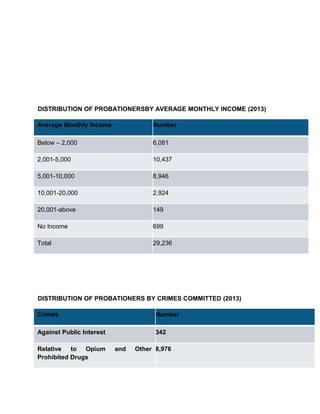
DISTRIBUTION OF PROBATIONERSBY AVERAGE MONTHLY INCOME (2013)
Average Monthly Income Number
Below – 2,000 6,081
2,001-5,000 10,437
5,001-10,000 8,946
10,001-20,000 2,924
20,001-above 149
No Income 699
Total 29,236
DISTRIBUTION OF PROBATIONERS BY CRIMES COMMITTED (2013)
Crimes Number
Against Public Interest 342
Relative to Opium and Other
Prohibited Drugs
8,976
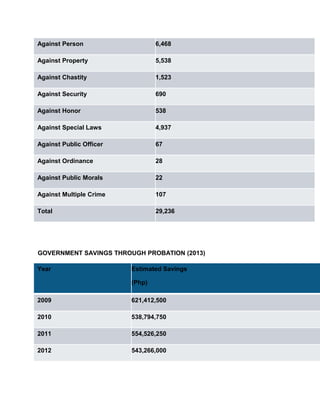
Against Person 6,468
Against Property 5,538
Against Chastity 1,523
Against Security 690
Against Honor 538
Against Special Laws 4,937
Against Public Officer 67
Against Ordinance 28
Against Public Morals 22
Against Multiple Crime 107
Total 29,236
GOVERNMENT SAVINGS THROUGH PROBATION (2013)
Year Estimated Savings
(Php)
2009 621,412,500
2010 538,794,750
2011 554,526,250
2012 543,266,000
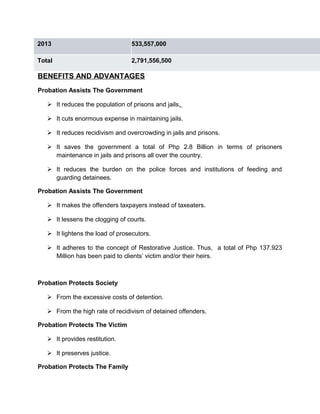
2013 533,557,000
Total 2,791,556,500
BENEFITS AND ADVANTAGES
Probation Assists The Government
 It reduces the population of prisons and jails.
 It cuts enormous expense in maintaining jails.
 It reduces recidivism and overcrowding in jails and prisons.
 It saves the government a total of Php 2.8 Billion in terms of prisoners
maintenance in jails and prisons all over the country.
 It reduces the burden on the police forces and institutions of feeding and
guarding detainees.
Probation Assists The Government
 It makes the offenders taxpayers instead of taxeaters.
 It lessens the clogging of courts.
 It lightens the load of prosecutors.
 It adheres to the concept of Restorative Justice. Thus, a total of Php 137.923
Million has been paid to clients’ victim and/or their heirs.
Probation Protects Society
 From the excessive costs of detention.
 From the high rate of recidivism of detained offenders.
Probation Protects The Victim
 It provides restitution.
 It preserves justice.
Probation Protects The Family
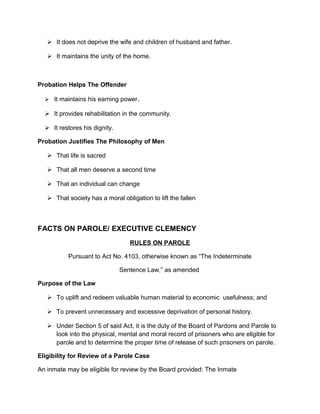
 It does not deprive the wife and children of husband and father.
 It maintains the unity of the home.
Probation Helps The Offender
 It maintains his earning power.
 It provides rehabilitation in the community.
 It restores his dignity.
Probation Justifies The Philosophy of Men
 That life is sacred
 That all men deserve a second time
 That an individual can change
 That society has a moral obligation to lift the fallen
FACTS ON PAROLE/ EXECUTIVE CLEMENCY
RULES ON PAROLE
Pursuant to Act No. 4103, otherwise known as “The Indeterminate
Sentence Law,” as amended
Purpose of the Law
 To uplift and redeem valuable human material to economic usefulness; and
 To prevent unnecessary and excessive deprivation of personal history.
 Under Section 5 of said Act, it is the duty of the Board of Pardons and Parole to
look into the physical, mental and moral record of prisoners who are eligible for
parole and to determine the proper time of release of such prisoners on parole.
Eligibility for Review of a Parole Case
An inmate may be eligible for review by the Board provided: The Inmate
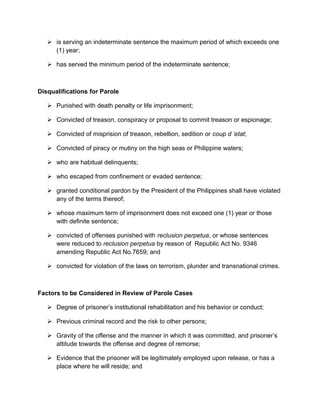
 is serving an indeterminate sentence the maximum period of which exceeds one
(1) year;
 has served the minimum period of the indeterminate sentence;
Disqualifications for Parole
 Punished with death penalty or life imprisonment;
 Convicted of treason, conspiracy or proposal to commit treason or espionage;
 Convicted of misprision of treason, rebellion, sedition or coup d ‘etat;
 Convicted of piracy or mutiny on the high seas or Philippine waters;
 who are habitual delinquents;
 who escaped from confinement or evaded sentence;
 granted conditional pardon by the President of the Philippines shall have violated
any of the terms thereof;
 whose maximum term of imprisonment does not exceed one (1) year or those
with definite sentence;
 convicted of offenses punished with reclusion perpetua, or whose sentences
were reduced to reclusion perpetua by reason of Republic Act No. 9346
amending Republic Act No.7659; and
 convicted for violation of the laws on terrorism, plunder and transnational crimes.
Factors to be Considered in Review of Parole Cases
 Degree of prisoner’s institutional rehabilitation and his behavior or conduct;
 Previous criminal record and the risk to other persons;
 Gravity of the offense and the manner in which it was committed, and prisoner’s
attitude towards the offense and degree of remorse;
 Evidence that the prisoner will be legitimately employed upon release, or has a
place where he will reside; and
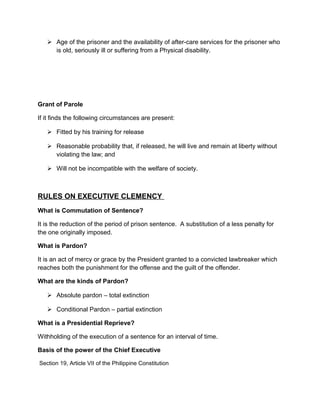
 Age of the prisoner and the availability of after-care services for the prisoner who
is old, seriously ill or suffering from a Physical disability.
Grant of Parole
If it finds the following circumstances are present:
 Fitted by his training for release
 Reasonable probability that, if released, he will live and remain at liberty without
violating the law; and
 Will not be incompatible with the welfare of society.
RULES ON EXECUTIVE CLEMENCY
What is Commutation of Sentence?
It is the reduction of the period of prison sentence. A substitution of a less penalty for
the one originally imposed.
What is Pardon?
It is an act of mercy or grace by the President granted to a convicted lawbreaker which
reaches both the punishment for the offense and the guilt of the offender.
What are the kinds of Pardon?
 Absolute pardon – total extinction
 Conditional Pardon – partial extinction
What is a Presidential Reprieve?
Withholding of the execution of a sentence for an interval of time.
Basis of the power of the Chief Executive
Section 19, Article VII of the Philippine Constitution
“Except in case of impeachment or otherwise required provided therein, the President may
grant reprieves, commutations, and pardons and remit fines and forfeitures, after conviction by
final judgment.”
Basis of the Board of Pardons and Parole power in recommending to the
President the grant of Executive Clemency
Executive Order No. 83, dated January 11, 1937
RULES ON EXECUTIVE CLEMENCY
 Served at least one-third (1/3) of the definite or aggregate prison term
 Served at least one-half of the minimum of the indeterminate prison term or
aggregated of the minimum of the indeterminate
Qualifications for Conditional Pardon
 Served at least one-half (1/2) of the maximum of the original Indeterminate
and/or definite prison term
Qualifications for Absolute Pardon
 Served his/her maximum sentence
 Granted final release and discharge
 Granted court termination of probation
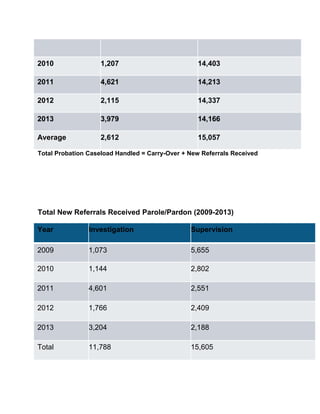
Total Probation Caseload Handled = Carry-Over + New Referrals Received
Total Parole/Pardon Caseload Handled (2009-2013)
Year Investigation Supervision
2009 1,140 18,164
2010 1,207 14,403
2011 4,621 14,213
2012 2,115 14,337
2013 3,979 14,166
Average 2,612 15,057
Total Probation Caseload Handled = Carry-Over + New Referrals Received
Total New Referrals Received Parole/Pardon (2009-2013)
Year Investigation Supervision
2009 1,073 5,655
2010 1,144 2,802
2011 4,601 2,551
2012 1,766 2,409
2013 3,204 2,188
Total 11,788 15,605
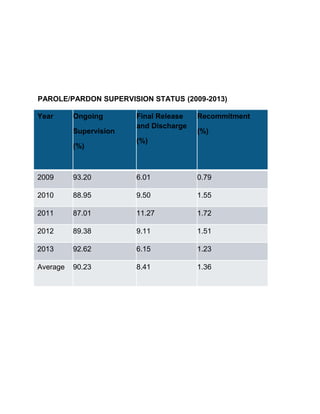
PAROLE/PARDON SUPERVISION STATUS (2009-2013)
Year Ongoing
Supervision
(%)
Final Release
and Discharge
(%)
Recommitment
(%)
2009 93.20 6.01 0.79
2010 88.95 9.50 1.55
2011 87.01 11.27 1.72
2012 89.38 9.11 1.51
2013 92.62 6.15 1.23
Average 90.23 8.41 1.36
(09) parole and probation administration(word)

(09) parole and probation administration(word)

  • 1.
  • 2.
    FACTS ON PROBATION DISTINCTPHASES OF PROBATION 1. Selection of offenders for probation This phase is known as the post-sentence investigation of Court referrals. This covers the period after conviction but before the grant of probation. 2. Supervision and Treatment of Selected Offenders This phase covers the period following the grant of probation but before termination of the case thru successful completion of the probation period or revocation and commitment to a jail or prison. Investigation To provide the court with relevant information and judicious recommendations for the selection of offenders to be placed on probation What is Probation? By probation, a person who is convicted of a criminal offense is not sent to prison by the sentencing court. Instead, he/she is released and place under the supervision of a probation officer subject to the conditions which the court may impose Is Probation a right? No, it is mere privilege.
  • 3.
    Who cannot begranted Probation? Those:  sentenced to serve a prison term of more than six (6) years;  convicted of any crime against the national security or the public order;  previously convicted of an offense which is punished by imprisonment of more than 30 days and/or a fine of Php 200.00 or more;  who have once been placed on probation under this law;  already serving sentence; Who cannot be granted Probation? Those:  sentenced to a probationable penalty but appealed the same;  convicted of an offense against the Omnibus Election Code and Wage Rationalization Act; and  convicted of illicit trafficking or pushing of Dangerous Act. Will Probation be automatically granted to one Whose sentence is six (6) years or less? No, the application may be denied by the court if:  after determination, he/she is in need of rehabilitation which could be provided by prison/jail;  risk that the offender will likely commit another crime; and  depreciate the seriousness of the crime committed. Where shall an application for Probation be filed? The application shall be filed with the court that tried and sentenced the offender. When should an application for Probation be filed? Anytime before the offender starts serving his sentence but within fifteen (15) days from the promulgation or notice of the judgment of conviction. May an offender be released from confinement while his application for Probation is pending? Yes, the applicant may be released under the bail he posted in the criminal case, or under recognizance. How many times can one be granted Probation? Only once. How long is the period of Probation? Not more than two (2) years if the sentence of the offender is one (1) year or less; and not more than six (6) years if the sentence is more than one (1) year.
  • 4.
    Supervision To effect therehabilitation and reintegration of the probationers as productive, law- abiding and socially responsible members of the community. Conditions of Probation  Mandatory  Discretionary What will happen if a probationer violates the conditions of Probation? The court may modify the conditions of probation or revoke the same. If the violation is serious, the court may order the probationer to serve his prison sentence. The probationer may also be arrested and criminally prosecuted if the violation is a criminal offense. REHABILITATION PROGRAM It is an individualized community-based three pronged approach to crime prevention and treatment of offenders with Restorative Justice as its philosophical foundation, Therapeutic Community as the treatment modality, and Volunteers as lead community resource
  • 5.
    LAUNCHING Therapeutic Community Ladderized Program Manual VolunteerProbation Aide Manual Restorative Justice Handbook
  • 6.
    Therapeutic Community Ladderized Program Manual VolunteerProbation Aide Manual Restorative Justice Handbook
  • 7.
    Total Probation CaseloadHandled (2009-2013) Year Investigation Supervision 2009 9,624 34,050 2010 7,034 29,523 2011 8,634 30,385 2012 8,810 29,768 2013 9,187 29,236 Average 8,658 30,592 Total Probation Caseload Handled = Carry-Over + New Referrals Received Total New Referrals Received (2009-2013) Year Investigation Supervision 2009 9,045 9,393 2010 6,453 6,785 2011 8,208 8,421 2012 8,202 7,696 2013 8,620 8,583 Total 40,528 40,878
  • 8.
    Court Disposition onProbation Applications (2009-2013) Year Granted Denied 2009 5,296 490 2010 6,183 607 2011 7,222 769 2012 6,294 563 2013 7,632 667 Total 32,627 3,096 DISTRIBUTION OF PROBATIONERS BY GENDER (2013) Gender Number Male 26,208 Female 3,028 Total 29,236
  • 9.
    DISTRIBUTION OF PROBATIONERSBY AGE LEVEL (2013) Age Level Number Below-20 85 21-30 12,009 31-40 9,431 41-50 5,427 51-60 1,877 61-Above 407 Total 29,236 DISTRIBUTION OF PROBATIONERS BY EDUCATIONAL ATTAINMENT (2013) Educational Attainment Number No formal schooling 452 Elementary undergraduate 7,796 Elementary graduate 3,599 High School undergraduate 6,408 High School graduate 4,281 College undergraduate 3,678 Collage graduate 2,128 Vocational 894
  • 10.
    Total 29,236 DISTRIBUTION OFPROBATIONERS BY OCCUPATION Group I – Officials of Government and Special Interest Organizations, Corporate Executives, Managers, Managing Proprietors and Supervisors Group II – Professionals Group IV – Clerks Group V – Service Workers and Shop and Market Sales Workers Group VI – Farmers, Forestry Workers and Fishermen Group VII – Trades and Related Workers Group VIII – Plant and Machine Operators and Assemblers Group IX – Laborers and Unskilled Workers Group X – Special Occupations Group XI – Unemployed DISTRIBUTION OF PROBATIONERS BY OCCUPATION (2013) Occupation Groups Number I 0 II 168 III 67 IV 299 V 4,782 VI 4,817 VII 3,621 VII 3,963 IX 2,832 X 4,522 XI 4,165 Total 29,236
  • 11.
    DISTRIBUTION OF PROBATIONERSBY FAMILY ECONOMIC STATUS (2013) Family Economic Status Number More than Adequate 700 Adequate 5,460 Inadequate 18,796 Below Poverty Level 4,280 Total 29,236 More than Adequate – the family income is more than sufficient for the basic requirements of its members Adequate- the family income is equal to the basic requirements of the family Inadequate – the family income is above the poverty level but insufficient for the family’s basic needs, considering the social standing of its members Below Poverty Level – monthly family income below Php 6,274.00 for a family of five
  • 12.
    DISTRIBUTION OF PROBATIONERSBYAVERAGE MONTHLY INCOME (2013) Average Monthly Income Number Below – 2,000 6,081 2,001-5,000 10,437 5,001-10,000 8,946 10,001-20,000 2,924 20,001-above 149 No Income 699 Total 29,236 DISTRIBUTION OF PROBATIONERS BY CRIMES COMMITTED (2013) Crimes Number Against Public Interest 342 Relative to Opium and Other Prohibited Drugs 8,976
  • 13.
    Against Person 6,468 AgainstProperty 5,538 Against Chastity 1,523 Against Security 690 Against Honor 538 Against Special Laws 4,937 Against Public Officer 67 Against Ordinance 28 Against Public Morals 22 Against Multiple Crime 107 Total 29,236 GOVERNMENT SAVINGS THROUGH PROBATION (2013) Year Estimated Savings (Php) 2009 621,412,500 2010 538,794,750 2011 554,526,250 2012 543,266,000
  • 14.
    2013 533,557,000 Total 2,791,556,500 BENEFITSAND ADVANTAGES Probation Assists The Government  It reduces the population of prisons and jails.  It cuts enormous expense in maintaining jails.  It reduces recidivism and overcrowding in jails and prisons.  It saves the government a total of Php 2.8 Billion in terms of prisoners maintenance in jails and prisons all over the country.  It reduces the burden on the police forces and institutions of feeding and guarding detainees. Probation Assists The Government  It makes the offenders taxpayers instead of taxeaters.  It lessens the clogging of courts.  It lightens the load of prosecutors.  It adheres to the concept of Restorative Justice. Thus, a total of Php 137.923 Million has been paid to clients’ victim and/or their heirs. Probation Protects Society  From the excessive costs of detention.  From the high rate of recidivism of detained offenders. Probation Protects The Victim  It provides restitution.  It preserves justice. Probation Protects The Family
  • 15.
     It doesnot deprive the wife and children of husband and father.  It maintains the unity of the home. Probation Helps The Offender  It maintains his earning power.  It provides rehabilitation in the community.  It restores his dignity. Probation Justifies The Philosophy of Men  That life is sacred  That all men deserve a second time  That an individual can change  That society has a moral obligation to lift the fallen FACTS ON PAROLE/ EXECUTIVE CLEMENCY RULES ON PAROLE Pursuant to Act No. 4103, otherwise known as “The Indeterminate Sentence Law,” as amended Purpose of the Law  To uplift and redeem valuable human material to economic usefulness; and  To prevent unnecessary and excessive deprivation of personal history.  Under Section 5 of said Act, it is the duty of the Board of Pardons and Parole to look into the physical, mental and moral record of prisoners who are eligible for parole and to determine the proper time of release of such prisoners on parole. Eligibility for Review of a Parole Case An inmate may be eligible for review by the Board provided: The Inmate
  • 16.
     is servingan indeterminate sentence the maximum period of which exceeds one (1) year;  has served the minimum period of the indeterminate sentence; Disqualifications for Parole  Punished with death penalty or life imprisonment;  Convicted of treason, conspiracy or proposal to commit treason or espionage;  Convicted of misprision of treason, rebellion, sedition or coup d ‘etat;  Convicted of piracy or mutiny on the high seas or Philippine waters;  who are habitual delinquents;  who escaped from confinement or evaded sentence;  granted conditional pardon by the President of the Philippines shall have violated any of the terms thereof;  whose maximum term of imprisonment does not exceed one (1) year or those with definite sentence;  convicted of offenses punished with reclusion perpetua, or whose sentences were reduced to reclusion perpetua by reason of Republic Act No. 9346 amending Republic Act No.7659; and  convicted for violation of the laws on terrorism, plunder and transnational crimes. Factors to be Considered in Review of Parole Cases  Degree of prisoner’s institutional rehabilitation and his behavior or conduct;  Previous criminal record and the risk to other persons;  Gravity of the offense and the manner in which it was committed, and prisoner’s attitude towards the offense and degree of remorse;  Evidence that the prisoner will be legitimately employed upon release, or has a place where he will reside; and
  • 17.
     Age ofthe prisoner and the availability of after-care services for the prisoner who is old, seriously ill or suffering from a Physical disability. Grant of Parole If it finds the following circumstances are present:  Fitted by his training for release  Reasonable probability that, if released, he will live and remain at liberty without violating the law; and  Will not be incompatible with the welfare of society. RULES ON EXECUTIVE CLEMENCY What is Commutation of Sentence? It is the reduction of the period of prison sentence. A substitution of a less penalty for the one originally imposed. What is Pardon? It is an act of mercy or grace by the President granted to a convicted lawbreaker which reaches both the punishment for the offense and the guilt of the offender. What are the kinds of Pardon?  Absolute pardon – total extinction  Conditional Pardon – partial extinction What is a Presidential Reprieve? Withholding of the execution of a sentence for an interval of time. Basis of the power of the Chief Executive Section 19, Article VII of the Philippine Constitution
  • 18.
    “Except in caseof impeachment or otherwise required provided therein, the President may grant reprieves, commutations, and pardons and remit fines and forfeitures, after conviction by final judgment.” Basis of the Board of Pardons and Parole power in recommending to the President the grant of Executive Clemency Executive Order No. 83, dated January 11, 1937 RULES ON EXECUTIVE CLEMENCY  Served at least one-third (1/3) of the definite or aggregate prison term  Served at least one-half of the minimum of the indeterminate prison term or aggregated of the minimum of the indeterminate Qualifications for Conditional Pardon  Served at least one-half (1/2) of the maximum of the original Indeterminate and/or definite prison term Qualifications for Absolute Pardon  Served his/her maximum sentence  Granted final release and discharge  Granted court termination of probation Total Probation Caseload Handled = Carry-Over + New Referrals Received Total Parole/Pardon Caseload Handled (2009-2013) Year Investigation Supervision 2009 1,140 18,164
  • 19.
    2010 1,207 14,403 20114,621 14,213 2012 2,115 14,337 2013 3,979 14,166 Average 2,612 15,057 Total Probation Caseload Handled = Carry-Over + New Referrals Received Total New Referrals Received Parole/Pardon (2009-2013) Year Investigation Supervision 2009 1,073 5,655 2010 1,144 2,802 2011 4,601 2,551 2012 1,766 2,409 2013 3,204 2,188 Total 11,788 15,605
  • 20.
    PAROLE/PARDON SUPERVISION STATUS(2009-2013) Year Ongoing Supervision (%) Final Release and Discharge (%) Recommitment (%) 2009 93.20 6.01 0.79 2010 88.95 9.50 1.55 2011 87.01 11.27 1.72 2012 89.38 9.11 1.51 2013 92.62 6.15 1.23 Average 90.23 8.41 1.36