Training – The Corporate Perspective
The Goal … The goal of any training is to  enable people  who are delivering work to be skilled to a level of proficiency in the work they are delivering, which can bring out the desired level of output, both qualitatively, and quantitatively. Is this happening?
What we see today Inadequate skills Skills mismatch Inadequate training Improper perspectives
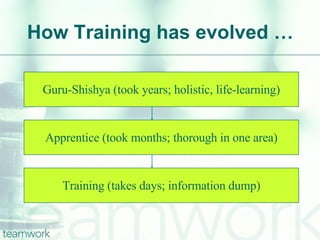
How Training has evolved … Guru-Shishya (took years; holistic, life-learning) Apprentice (took months; thorough in one area) Training (takes days; information dump)
What trainees get Information dump Little or no context building No understanding of bigger picture Far less than thorough understanding
Training approach Hurried trainings Throw a training at the problem, and the problem will go away Have to spend the budget, so need to do trainings Keyword search in catalogue to identify training needs
The Issue … Not much understanding of the business problem. Training requirement Business problem No step before the TNA
An Example … A developer is having trouble understanding what the client is saying … Send him to training on Communications Skills. Maybe the problem is that he doesn’t understand the business perspective of the technology?
Adding to this … The long tail of training … More and more people need more and more trainings in more and more niches or technologies.    Training professionals need to understand more and more about more and more niches or technologies.
Adding to the tail … Too many technologies Distributed workforce Lack of post-training engagement
Some solutions … Expertise location as a tool to be available to training professionals Virtual worlds to enable the organization to reach a distributed workforce engaged in different niches Collaboration/web 2.0 tools to enable collaboration, to generate post-training engagement

Corporate Training

  • 1.
    Training – TheCorporate Perspective
  • 2.
    The Goal …The goal of any training is to enable people who are delivering work to be skilled to a level of proficiency in the work they are delivering, which can bring out the desired level of output, both qualitatively, and quantitatively. Is this happening?
  • 3.
    What we seetoday Inadequate skills Skills mismatch Inadequate training Improper perspectives
  • 4.
    How Training hasevolved … Guru-Shishya (took years; holistic, life-learning) Apprentice (took months; thorough in one area) Training (takes days; information dump)
  • 5.
    What trainees getInformation dump Little or no context building No understanding of bigger picture Far less than thorough understanding
  • 6.
    Training approach Hurriedtrainings Throw a training at the problem, and the problem will go away Have to spend the budget, so need to do trainings Keyword search in catalogue to identify training needs
  • 7.
    The Issue …Not much understanding of the business problem. Training requirement Business problem No step before the TNA
  • 8.
    An Example …A developer is having trouble understanding what the client is saying … Send him to training on Communications Skills. Maybe the problem is that he doesn’t understand the business perspective of the technology?
  • 9.
    Adding to this… The long tail of training … More and more people need more and more trainings in more and more niches or technologies.  Training professionals need to understand more and more about more and more niches or technologies.
  • 10.
    Adding to thetail … Too many technologies Distributed workforce Lack of post-training engagement
  • 11.
    Some solutions …Expertise location as a tool to be available to training professionals Virtual worlds to enable the organization to reach a distributed workforce engaged in different niches Collaboration/web 2.0 tools to enable collaboration, to generate post-training engagement