
Making Use of Corporate Foresight 
Lessons learnt from Industrial Practise 
Djordje Pinter and Karl-Heinz Leitner 
XXV ISPIM Conference, 
Dublin, Ireland: 8-11 June 2014 
Djordje Pinter | Research Fellow | Innovation Systems Department 
Research, Technology and Innovation Policy Unit
Motivation and Research Questions 
1. Motivation 
• Increasing corporate challenges due to more dynamics and 
complexity; e.g. the reduction of product cycles 
• The need for a corporate foresight capability to manage future 
uncertainties is widely acknowledged. 
2. Research Gap 
• Little knowledge is established about the effects, impacts and best 
practise of foresight activities (e.g. Wilkinson and Kuplers, 2013) 
• Little conceptual work is published for theory building and testing of 
corporate foresight (e.g. Paliokaitė & Pačėsa 2014) 
3. Research Questions 
• What is known about the effects and impacts of foresight activities? 
• Which propositions regarding corporate foresight can be developed 
by integrating literature from foresight methodology, change 
management, concept of champions, dynamic capabilities and 
innovation theories like disruptive technologies?
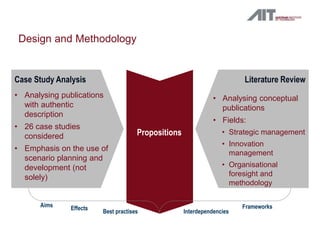
Design and Methodology 
• Analysing publications 
Propositions 
Best practises Interdependencies 
with authentic 
description 
• 26 case studies 
considered 
• Emphasis on the use of 
scenario planning and 
development (not 
solely) 
Literature Review 
Effects Frameworks 
Aims 
 Dachverbände 
Case Study Analysis 
• Analysing conceptual 
publications 
• Fields: 
• Strategic management 
• Innovation 
management 
• Organisational 
foresight and 
methodology
Selected Cases
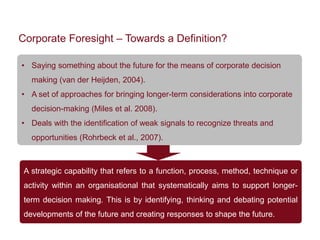
Corporate Foresight – Towards a Definition? 
• Saying something about the future for the means of corporate decision 
making (van der Heijden, 2004). 
• A set of approaches for bringing longer-term considerations into corporate 
decision-making (Miles et al. 2008). 
• Deals with the identification of weak signals to recognize threats and 
opportunities (Rohrbeck et al., 2007). 
A strategic capability that refers to a function, process, method, technique or 
activity within an organisational that systematically aims to support longer-term 
decision making. This is by identifying, thinking and debating potential 
developments of the future and creating responses to shape the future.
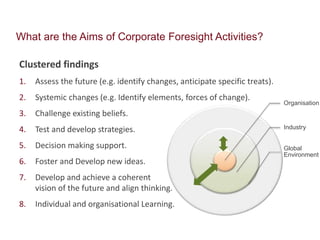
What are the Aims of Corporate Foresight Activities? 
Clustered findings 
1. Assess the future (e.g. identify changes, anticipate specific treats). 
2. Systemic changes (e.g. Identify elements, forces of change). 
3. Challenge existing beliefs. 
4. Test and develop strategies. 
5. Decision making support. 
6. Foster and Develop new ideas. 
7. Develop and achieve a coherent 
vision of the future and align thinking. 
8. Individual and organisational Learning. 
Organisation 
Industry 
Global 
Environment
Selected Effects and Impacts 
1. Corporate foresight activities increase the ability to anticipate 
changes (e.g. anticipating political, environmental and 
economic results). 
2. Corporate foresight activities foster new ideas and products 
(e.g. Identifying new businesses opportunities/markets). 
3. Corporate foresight activities can save costs. 
4. Corporate foresight activities support organisational learning. 
5. Corporate foresight activities support communication. 
6. Corporate foresight activities enhance strategic thinking.
Developed Propositions I 
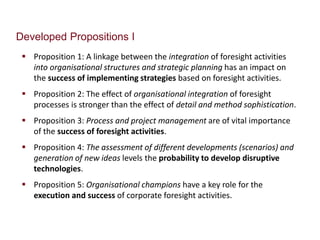
 Proposition 1: A linkage between the integration of foresight activities 
into organisational structures and strategic planning has an impact on 
the success of implementing strategies based on foresight activities. 
 Proposition 2: The effect of organisational integration of foresight 
processes is stronger than the effect of detail and method sophistication. 
 Proposition 3: Process and project management are of vital importance 
of the success of foresight activities. 
 Proposition 4: The assessment of different developments (scenarios) and 
generation of new ideas levels the probability to develop disruptive 
technologies. 
 Proposition 5: Organisational champions have a key role for the 
execution and success of corporate foresight activities.
Developed Propositions II 
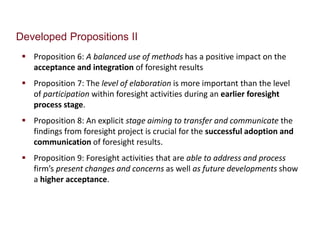
 Proposition 6: A balanced use of methods has a positive impact on the 
acceptance and integration of foresight results 
 Proposition 7: The level of elaboration is more important than the level 
of participation within foresight activities during an earlier foresight 
process stage. 
 Proposition 8: An explicit stage aiming to transfer and communicate the 
findings from foresight project is crucial for the successful adoption and 
communication of foresight results. 
 Proposition 9: Foresight activities that are able to address and process 
firm’s present changes and concerns as well as future developments show 
a higher acceptance.
Summary 
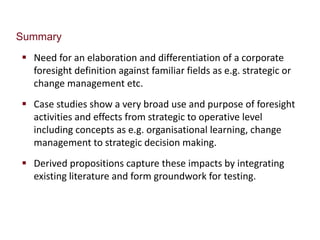
 Need for an elaboration and differentiation of a corporate 
foresight definition against familiar fields as e.g. strategic or 
change management etc. 
 Case studies show a very broad use and purpose of foresight 
activities and effects from strategic to operative level 
including concepts as e.g. organisational learning, change 
management to strategic decision making. 
 Derived propositions capture these impacts by integrating 
existing literature and form groundwork for testing.
AIT Austrian Institute of Technology 
Comments and contact is welcome 
Djordje Pinter 
Austrian Institute of Technology 
Foresight & Policy Development 
Djordje.pinter.fl@ait.ac.at

Making Use of Corporate Foresight

  • 1.
    Making Use ofCorporate Foresight Lessons learnt from Industrial Practise Djordje Pinter and Karl-Heinz Leitner XXV ISPIM Conference, Dublin, Ireland: 8-11 June 2014 Djordje Pinter | Research Fellow | Innovation Systems Department Research, Technology and Innovation Policy Unit
  • 2.
    Motivation and ResearchQuestions 1. Motivation • Increasing corporate challenges due to more dynamics and complexity; e.g. the reduction of product cycles • The need for a corporate foresight capability to manage future uncertainties is widely acknowledged. 2. Research Gap • Little knowledge is established about the effects, impacts and best practise of foresight activities (e.g. Wilkinson and Kuplers, 2013) • Little conceptual work is published for theory building and testing of corporate foresight (e.g. Paliokaitė & Pačėsa 2014) 3. Research Questions • What is known about the effects and impacts of foresight activities? • Which propositions regarding corporate foresight can be developed by integrating literature from foresight methodology, change management, concept of champions, dynamic capabilities and innovation theories like disruptive technologies?
  • 3.
    Design and Methodology • Analysing publications Propositions Best practises Interdependencies with authentic description • 26 case studies considered • Emphasis on the use of scenario planning and development (not solely) Literature Review Effects Frameworks Aims  Dachverbände Case Study Analysis • Analysing conceptual publications • Fields: • Strategic management • Innovation management • Organisational foresight and methodology
  • 4.
  • 5.
    Corporate Foresight –Towards a Definition? • Saying something about the future for the means of corporate decision making (van der Heijden, 2004). • A set of approaches for bringing longer-term considerations into corporate decision-making (Miles et al. 2008). • Deals with the identification of weak signals to recognize threats and opportunities (Rohrbeck et al., 2007). A strategic capability that refers to a function, process, method, technique or activity within an organisational that systematically aims to support longer-term decision making. This is by identifying, thinking and debating potential developments of the future and creating responses to shape the future.
  • 6.
    What are theAims of Corporate Foresight Activities? Clustered findings 1. Assess the future (e.g. identify changes, anticipate specific treats). 2. Systemic changes (e.g. Identify elements, forces of change). 3. Challenge existing beliefs. 4. Test and develop strategies. 5. Decision making support. 6. Foster and Develop new ideas. 7. Develop and achieve a coherent vision of the future and align thinking. 8. Individual and organisational Learning. Organisation Industry Global Environment
  • 7.
    Selected Effects andImpacts 1. Corporate foresight activities increase the ability to anticipate changes (e.g. anticipating political, environmental and economic results). 2. Corporate foresight activities foster new ideas and products (e.g. Identifying new businesses opportunities/markets). 3. Corporate foresight activities can save costs. 4. Corporate foresight activities support organisational learning. 5. Corporate foresight activities support communication. 6. Corporate foresight activities enhance strategic thinking.
  • 8.
    Developed Propositions I  Proposition 1: A linkage between the integration of foresight activities into organisational structures and strategic planning has an impact on the success of implementing strategies based on foresight activities.  Proposition 2: The effect of organisational integration of foresight processes is stronger than the effect of detail and method sophistication.  Proposition 3: Process and project management are of vital importance of the success of foresight activities.  Proposition 4: The assessment of different developments (scenarios) and generation of new ideas levels the probability to develop disruptive technologies.  Proposition 5: Organisational champions have a key role for the execution and success of corporate foresight activities.
  • 9.
    Developed Propositions II  Proposition 6: A balanced use of methods has a positive impact on the acceptance and integration of foresight results  Proposition 7: The level of elaboration is more important than the level of participation within foresight activities during an earlier foresight process stage.  Proposition 8: An explicit stage aiming to transfer and communicate the findings from foresight project is crucial for the successful adoption and communication of foresight results.  Proposition 9: Foresight activities that are able to address and process firm’s present changes and concerns as well as future developments show a higher acceptance.
  • 10.
    Summary  Needfor an elaboration and differentiation of a corporate foresight definition against familiar fields as e.g. strategic or change management etc.  Case studies show a very broad use and purpose of foresight activities and effects from strategic to operative level including concepts as e.g. organisational learning, change management to strategic decision making.  Derived propositions capture these impacts by integrating existing literature and form groundwork for testing.
  • 11.
    AIT Austrian Instituteof Technology Comments and contact is welcome Djordje Pinter Austrian Institute of Technology Foresight & Policy Development Djordje.pinter.fl@ait.ac.at

Editor's Notes

  • #4 inductive and deductive research design Published empirical experience, surveys or empirical work are analysed and lessons learned are summarised. literature in similar fields and some early stage theoretical frameworks for foresight, we develop propositions for the successful deployment of foresight methods. Analysed cases include publications dealing with foresight activities in companies such as British Airways, Levi Strauss, General Electric, Ericsson Inc., and AT&T.
  • #8 Foresight methods can be integrated into organisations in many ways The size of organisations using scenarios is broad, as well as the depth of topics handled. Scenario planning is often perceived as a management development tool to broaden managers’ view on the environmental systems and strategic response, Managers prefer to meet future challenges with the existing organizational structure An ideal setting of methodological execution consists of seven to ten participants, undertaking a 2-days’ workshop with the integration of management at a suitable location (barriers for creativity) The development of scenarios takes regularly less than 12 months and 6 months for the majority of cases Amount of work and time necessary is underestimated Even though participation is a key success factor, during some process stages elaboration of ideas is more important
  • #9 Prop4: foster creativity and ideas (e.g. KRONE case, Ringland, 1998), enhances planning and strategic thinking by creating mental models of the future (van der Heijden, 2005). Glick et al. (2012) statistically tested empirical survey and provide positive evidence. Can explore opportunities for innovation (Sarpong and Maclean, 2011) and enhance the innovativeness (Hiltunen, 2009) flexibility and agility of firms. Also provide opportunities to identify risks, the combination of these to potential impacts lead to the proposition.