INTERVIEWS
By:
Faizan Ahmed Khan
IMS Lucknow University
MBA(IB) 1st YEAR
Why Interview?
To evaluate a potential
employee by an employer for
prospective employment in
the company or organization.
During this process, the
employer hopes to determine
whether or not the applicant is
suitable for the role.
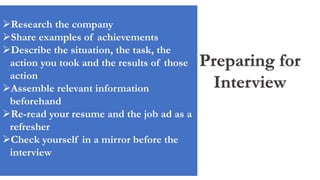
Preparing for
Interview
Research the company
Share examples of achievements
Describe the situation, the task, the
action you took and the results of those
action
Assemble relevant information
beforehand
Re-read your resume and the job ad as a
refresher
Check yourself in a mirror before the
interview
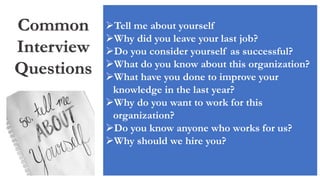
Common
Interview
Questions
Tell me about yourself
Why did you leave your last job?
Do you consider yourself as successful?
What do you know about this organization?
What have you done to improve your
knowledge in the last year?
Why do you want to work for this
organization?
Do you know anyone who works for us?
Why should we hire you?
Interview
Communication
Skills
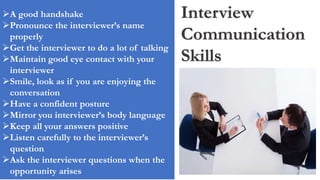
A good handshake
Pronounce the interviewer’s name
properly
Get the interviewer to do a lot of talking
Maintain good eye contact with your
interviewer
Smile, look as if you are enjoying the
conversation
Have a confident posture
Mirror you interviewer’s body language
Keep all your answers positive
Listen carefully to the interviewer’s
question
Ask the interviewer questions when the
opportunity arises
Types of Interviews
Behavioral
Interview
Stress
Interview
Technical
Interview
Phone
Interview
Group
Interview
Behavioral
Interview
A common type of job interview in the
modern workplace is the behavioral interview
or behavioral event interview, also called a
competency-based interview.
This type of interview is based on the notion
that a job candidate’s previous behaviors are
the best indicators of future performance.
In the behavioral interviews, the interviewer’s
asks candidates to recall specific instances
where they were faced with a set of
circumstances, and how they reacted.
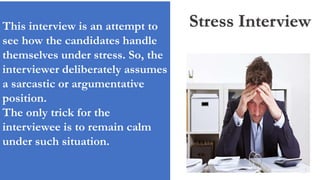
Stress InterviewThis interview is an attempt to
see how the candidates handle
themselves under stress. So, the
interviewer deliberately assumes
a sarcastic or argumentative
position.
The only trick for the
interviewee is to remain calm
under such situation.
Technical
Interview
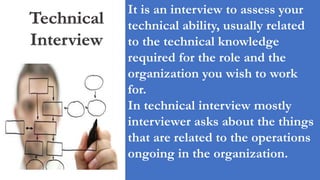
It is an interview to assess your
technical ability, usually related
to the technical knowledge
required for the role and the
organization you wish to work
for.
In technical interview mostly
interviewer asks about the things
that are related to the operations
ongoing in the organization.
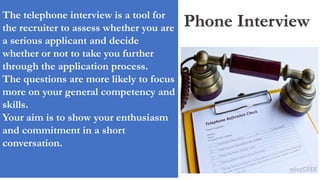
Phone InterviewThe telephone interview is a tool for
the recruiter to assess whether you are
a serious applicant and decide
whether or not to take you further
through the application process.
The questions are more likely to focus
more on your general competency and
skills.
Your aim is to show your enthusiasm
and commitment in a short
conversation.
Group
Interview
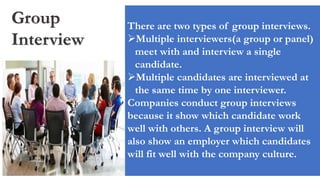
There are two types of group interviews.
Multiple interviewers(a group or panel)
meet with and interview a single
candidate.
Multiple candidates are interviewed at
the same time by one interviewer.
Companies conduct group interviews
because it show which candidate work
well with others. A group interview will
also show an employer which candidates
will fit well with the company culture.
Interview Ethics
Body
Language
Dressing
Sense
Interview
Caveats
Closing
Interview
Body
Language
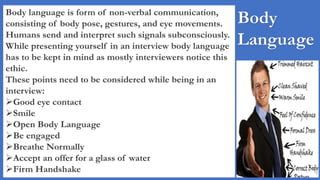
Body language is form of non-verbal communication,
consisting of body pose, gestures, and eye movements.
Humans send and interpret such signals subconsciously.
While presenting yourself in an interview body language
has to be kept in mind as mostly interviewers notice this
ethic.
These points need to be considered while being in an
interview:
Good eye contact
Smile
Open Body Language
Be engaged
Breathe Normally
Accept an offer for a glass of water
Firm Handshake
Interview
Caveats
Being too friendly.
Not listening to questions carefully.
Saying “we” instead of referring to your
own achievements.
Making very general statements which
lack substance.
Being over enthusiastic.
Being poorly prepared.
Speaking slowly
Knowing nothing about the company to
whom you are talking.
Making derogatory remarks about your
previous employers.
Dressing
Sense
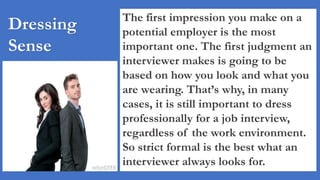
The first impression you make on a
potential employer is the most
important one. The first judgment an
interviewer makes is going to be
based on how you look and what you
are wearing. That’s why, in many
cases, it is still important to dress
professionally for a job interview,
regardless of the work environment.
So strict formal is the best what an
interviewer always looks for.
Closing the
Interview
The purpose of the interview is to help
you (as well as the company) determine
if the position will be right for you.
Prepare questions and ask the
interviewer these when asked to do so.
Ask (if you haven’t been told) what the
process will be after the interview has
been completed, or when they would be
prepared to make a decision.
Leave the interviewer with a good
impression – smile and a firm
handshake.
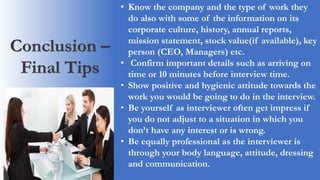
Conclusion –
Final Tips
• Know the company and the type of work they
do also with some of the information on its
corporate culture, history, annual reports,
mission statement, stock value(if available), key
person (CEO, Managers) etc.
• Confirm important details such as arriving on
time or 10 minutes before interview time.
• Show positive and hygienic attitude towards the
work you would be going to do in the interview.
• Be yourself as interviewer often get impress if
you do not adjust to a situation in which you
don’t have any interest or is wrong.
• Be equally professional as the interviewer is
through your body language, attitude, dressing
and communication.
Thank You

Interview

  • 1.
    INTERVIEWS By: Faizan Ahmed Khan IMSLucknow University MBA(IB) 1st YEAR
  • 2.
    Why Interview? To evaluatea potential employee by an employer for prospective employment in the company or organization. During this process, the employer hopes to determine whether or not the applicant is suitable for the role.
  • 3.
    Preparing for Interview Research thecompany Share examples of achievements Describe the situation, the task, the action you took and the results of those action Assemble relevant information beforehand Re-read your resume and the job ad as a refresher Check yourself in a mirror before the interview
  • 4.
    Common Interview Questions Tell me aboutyourself Why did you leave your last job? Do you consider yourself as successful? What do you know about this organization? What have you done to improve your knowledge in the last year? Why do you want to work for this organization? Do you know anyone who works for us? Why should we hire you?
  • 5.
    Interview Communication Skills A good handshake Pronouncethe interviewer’s name properly Get the interviewer to do a lot of talking Maintain good eye contact with your interviewer Smile, look as if you are enjoying the conversation Have a confident posture Mirror you interviewer’s body language Keep all your answers positive Listen carefully to the interviewer’s question Ask the interviewer questions when the opportunity arises
  • 6.
  • 7.
    Behavioral Interview A common typeof job interview in the modern workplace is the behavioral interview or behavioral event interview, also called a competency-based interview. This type of interview is based on the notion that a job candidate’s previous behaviors are the best indicators of future performance. In the behavioral interviews, the interviewer’s asks candidates to recall specific instances where they were faced with a set of circumstances, and how they reacted.
  • 8.
    Stress InterviewThis interviewis an attempt to see how the candidates handle themselves under stress. So, the interviewer deliberately assumes a sarcastic or argumentative position. The only trick for the interviewee is to remain calm under such situation.
  • 9.
    Technical Interview It is aninterview to assess your technical ability, usually related to the technical knowledge required for the role and the organization you wish to work for. In technical interview mostly interviewer asks about the things that are related to the operations ongoing in the organization.
  • 10.
    Phone InterviewThe telephoneinterview is a tool for the recruiter to assess whether you are a serious applicant and decide whether or not to take you further through the application process. The questions are more likely to focus more on your general competency and skills. Your aim is to show your enthusiasm and commitment in a short conversation.
  • 11.
    Group Interview There are twotypes of group interviews. Multiple interviewers(a group or panel) meet with and interview a single candidate. Multiple candidates are interviewed at the same time by one interviewer. Companies conduct group interviews because it show which candidate work well with others. A group interview will also show an employer which candidates will fit well with the company culture.
  • 12.
  • 13.
    Body Language Body language isform of non-verbal communication, consisting of body pose, gestures, and eye movements. Humans send and interpret such signals subconsciously. While presenting yourself in an interview body language has to be kept in mind as mostly interviewers notice this ethic. These points need to be considered while being in an interview: Good eye contact Smile Open Body Language Be engaged Breathe Normally Accept an offer for a glass of water Firm Handshake
  • 14.
    Interview Caveats Being too friendly. Notlistening to questions carefully. Saying “we” instead of referring to your own achievements. Making very general statements which lack substance. Being over enthusiastic. Being poorly prepared. Speaking slowly Knowing nothing about the company to whom you are talking. Making derogatory remarks about your previous employers.
  • 15.
    Dressing Sense The first impressionyou make on a potential employer is the most important one. The first judgment an interviewer makes is going to be based on how you look and what you are wearing. That’s why, in many cases, it is still important to dress professionally for a job interview, regardless of the work environment. So strict formal is the best what an interviewer always looks for.
  • 16.
    Closing the Interview The purposeof the interview is to help you (as well as the company) determine if the position will be right for you. Prepare questions and ask the interviewer these when asked to do so. Ask (if you haven’t been told) what the process will be after the interview has been completed, or when they would be prepared to make a decision. Leave the interviewer with a good impression – smile and a firm handshake.
  • 17.
    Conclusion – Final Tips •Know the company and the type of work they do also with some of the information on its corporate culture, history, annual reports, mission statement, stock value(if available), key person (CEO, Managers) etc. • Confirm important details such as arriving on time or 10 minutes before interview time. • Show positive and hygienic attitude towards the work you would be going to do in the interview. • Be yourself as interviewer often get impress if you do not adjust to a situation in which you don’t have any interest or is wrong. • Be equally professional as the interviewer is through your body language, attitude, dressing and communication.
  • 18.