Copyright © 2015 Pearson Education, Ltd. All Rights Reserved.
Public Relations:
Strategies and Tactics
11th Edition, Global Edition
Dennis L. Wilcox Glen T. Cameron Bryan H. Reber
This multimedia product and its contents are protected under copyright law. The following are prohibited by law:
•any public performance or display, including transmission of any image over a network;
•preparation of any derivative work, including the extraction, in whole or in part, of any images;
•any rental, lease, or lending of the program.
Copyright © 2015 Pearson Education, Ltd. All Rights Reserved.
Chapter 17
Communicating Corporate Affairs
Copyright © 2015 Pearson Education, Ltd. All Rights Reserved.
Chapter 17 Objectives
 Describe the role of public relations in
corporations
 Explain how media relations contributes to the
success of corporations
 Understand the crucial roles of the customer, the
investor, and the employee in the corporate
communication program
 Describe the main supportive functions of public
relations for corporate marketing efforts
 Explain the environmental relations process
 Define corporate philanthropy and the part
public relations plays in corporate giving
Copyright © 2015 Pearson Education, Ltd. All Rights Reserved.
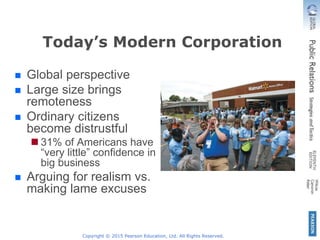
Today’s Modern Corporation
 Global perspective
 Large size brings
remoteness
 Ordinary citizens
become distrustful
 31% of Americans have
“very little” confidence in
big business
 Arguing for realism vs.
making lame excuses
Copyright © 2015 Pearson Education, Ltd. All Rights Reserved.
The Role of Public Relations
 Extensive, negative publicity about
corporations require companies to make
a special effort to regain public credibility
 Corporate social responsibility (CSR)
 Adopt ethical principles
 Pursue transparency and disclosure
 Make trust a fundamental precept of
corporate governance
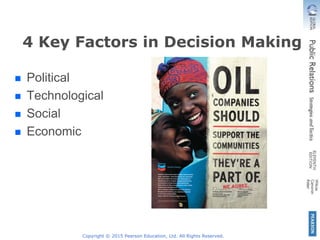
4 Key Factors in Decision Making
 Political
 Technological
 Social
 Economic
Copyright © 2015 Pearson Education, Ltd. All Rights Reserved.
Media Relations
 Media are a major source of public information
and perceptions about the business world and
individual companies
 Executives are defensive about how journalists
cover their business
 Journalists complain about the flow of
information, lack of cooperation, and other
issues
 PR professionals must
 Interpret their companies and clients to the media
 Show their chief executive how open, friendly media
relations can serve their interests
Copyright © 2015 Pearson Education, Ltd. All Rights Reserved.
Customer Relations
 Customer service is the front line of public
relations
 Incidents can severely damage a company’s
reputation and erode public trust in its products
and services
 Corporations are realizing that customer
relations serves as a public relations barometer
 Many public relations departments now regularly
monitor customer feedback in a variety of ways
to determine what policies and communication
strategies need to be revised
Copyright © 2015 Pearson Education, Ltd. All Rights Reserved.
Customer Relations, cont.
 Sharing of information is valuable for getting
public relations professionals involved in
 Active listening
 Strategizing on what steps a company should take to
ensure a good reputation among customers
 Pay attention to consumer surveys
 A dissatisfied customer can often be mollified by
prompt and courteous attention to his or her
complaint
Copyright © 2015 Pearson Education, Ltd. All Rights Reserved.
Reaching Diverse Markets
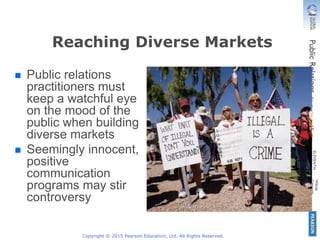
 Public relations
practitioners must
keep a watchful eye
on the mood of the
public when building
diverse markets
 Seemingly innocent,
positive
communication
programs may stir
controversy
Copyright © 2015 Pearson Education, Ltd. All Rights Reserved.
Consumer Activism
DO
 Work with those
interested in solutions
 Offer transparency
 Turn suggestions into
action
DON’T
 Get emotional
 Agree to work with
anyone making
threats
 Expect immediate
results
Consumer Boycotts
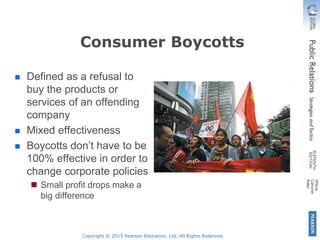
 Defined as a refusal to
buy the products or
services of an offending
company
 Mixed effectiveness
 Boycotts don’t have to be
100% effective in order to
change corporate policies
 Small profit drops make a
big difference
Copyright © 2015 Pearson Education, Ltd. All Rights Reserved.
Employee Relations
 The organization’s “ambassadors”
 The public relations and human resources
departments concentrate on communicating with
employees just as vigorously as it does on
delivering the corporate story to the outside
world
 Public relations professionals often are involved
in counseling
 What employee policies should be created
 How they should be implemented and communicated
Employee Relations, cont.
 Working Mother on
employee policy
 Telecommuting
 Paid maternity leave
 Health screening
 On-site flu vaccination
 Nutrition counseling
 Layoffs
 Major PR challenge
 NEVER announce to
media before
informing employees
 Hesitation hurts
morale
 Programs to cushion
the blow
Copyright © 2015 Pearson Education, Ltd. All Rights Reserved.
Investor Relations
 Investor relations (IR) is
at the center
communicating a
company’s health and
wealth to shareholders
and prospective investors
 Combine the disciplines
of communications and
finance to accurately
portray a company’s
prospects from an
investment standpoint
 Some key audiences
 Financial analysts
 Individuals and institutional
investors
 Shareholders
 Prospective shareholders
 The financial media
Copyright © 2015 Pearson Education, Ltd. All Rights Reserved.
Marketing Communications
 Many companies use the tools and tactics of
public relations to support the marketing and
sales objectives
 In many cases, this is coordinated with a
company’s messages in advertising, marketing,
direct mail, and promotion
 This has led to the concept of integrated
marketing communications (IMC)
 Product Publicity and Product Placement
(Chapter 14)
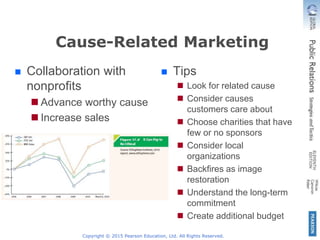
Cause-Related Marketing
 Collaboration with
nonprofits
 Advance worthy cause
 Increase sales
 Tips
 Look for related cause
 Consider causes
customers care about
 Choose charities that have
few or no sponsors
 Consider local
organizations
 Backfires as image
restoration
 Understand the long-term
commitment
 Create additional budget
Copyright © 2015 Pearson Education, Ltd. All Rights Reserved.
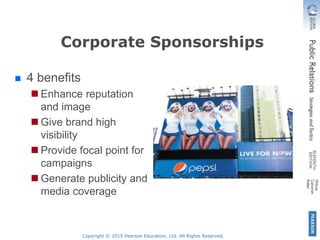
Corporate Sponsorships
 4 benefits
 Enhance reputation
and image
 Give brand high
visibility
 Provide focal point for
campaigns
 Generate publicity and
media coverage
Copyright © 2015 Pearson Education, Ltd. All Rights Reserved.
Viral Marketing
 Enhance or maintain
reputation
 Power of “Word of
Mouth” (WOM)
 Purposes of viral
marketing
 Stimulate impulse
purchases
 Pass-it-on techniques
 Catchy hook
 Financial incentives
 Make use of new
technologies
 Concerns
 Too easily recognized
as commercial
 Deceptive and
unethical?
Copyright © 2015 Pearson Education, Ltd. All Rights Reserved.
Environmental Relations
 Trend toward cooperation between NGOs
and corporations
 Many companies now
Issue annual corporate responsibility reports
Work with environmental groups to clean up
the environment, preserve wilderness areas,
and restore exploited natural resources
 Environmental sustainability difficult to
measure
Copyright © 2015 Pearson Education, Ltd. All Rights Reserved.
Corporate Philanthropy
 The donation of funds, products, and services to
various causes
 Common organizational goals
 Demonstrate community goodwill
 Enhance reputation as a good citizen
 Building relationships with key audiences
 Increasing employee and customer loyalty
 Publicity is good, bragging is not
Corporate Philanthropy, cont.
 “Strategic Philanthropy”
 Strengthened reputation
and brand recognition
 Increased media
opportunities
 Improved community and
government relations
 Employee recruitment and
retention
 Enhanced marketing
 Access to R&D
 Increased profits
 Limitations
 Can’t offset major scandals
 Can’t erase public concern
about unsafe products
 Special interests groups
may oppose the effort
 Consider which special
interest groups are most
influential
Copyright © 2015 Pearson Education, Ltd. All Rights Reserved.

11thEd_Wilcox_PPT_Chapter17.ppt

  • 1.
    Copyright © 2015Pearson Education, Ltd. All Rights Reserved. Public Relations: Strategies and Tactics 11th Edition, Global Edition Dennis L. Wilcox Glen T. Cameron Bryan H. Reber This multimedia product and its contents are protected under copyright law. The following are prohibited by law: •any public performance or display, including transmission of any image over a network; •preparation of any derivative work, including the extraction, in whole or in part, of any images; •any rental, lease, or lending of the program.
  • 2.
    Copyright © 2015Pearson Education, Ltd. All Rights Reserved. Chapter 17 Communicating Corporate Affairs
  • 3.
    Copyright © 2015Pearson Education, Ltd. All Rights Reserved. Chapter 17 Objectives  Describe the role of public relations in corporations  Explain how media relations contributes to the success of corporations  Understand the crucial roles of the customer, the investor, and the employee in the corporate communication program  Describe the main supportive functions of public relations for corporate marketing efforts  Explain the environmental relations process  Define corporate philanthropy and the part public relations plays in corporate giving
  • 4.
    Copyright © 2015Pearson Education, Ltd. All Rights Reserved. Today’s Modern Corporation  Global perspective  Large size brings remoteness  Ordinary citizens become distrustful  31% of Americans have “very little” confidence in big business  Arguing for realism vs. making lame excuses
  • 5.
    Copyright © 2015Pearson Education, Ltd. All Rights Reserved. The Role of Public Relations  Extensive, negative publicity about corporations require companies to make a special effort to regain public credibility  Corporate social responsibility (CSR)  Adopt ethical principles  Pursue transparency and disclosure  Make trust a fundamental precept of corporate governance
  • 6.
    4 Key Factorsin Decision Making  Political  Technological  Social  Economic Copyright © 2015 Pearson Education, Ltd. All Rights Reserved.
  • 7.
    Copyright © 2015Pearson Education, Ltd. All Rights Reserved. Media Relations  Media are a major source of public information and perceptions about the business world and individual companies  Executives are defensive about how journalists cover their business  Journalists complain about the flow of information, lack of cooperation, and other issues  PR professionals must  Interpret their companies and clients to the media  Show their chief executive how open, friendly media relations can serve their interests
  • 8.
    Copyright © 2015Pearson Education, Ltd. All Rights Reserved. Customer Relations  Customer service is the front line of public relations  Incidents can severely damage a company’s reputation and erode public trust in its products and services  Corporations are realizing that customer relations serves as a public relations barometer  Many public relations departments now regularly monitor customer feedback in a variety of ways to determine what policies and communication strategies need to be revised
  • 9.
    Copyright © 2015Pearson Education, Ltd. All Rights Reserved. Customer Relations, cont.  Sharing of information is valuable for getting public relations professionals involved in  Active listening  Strategizing on what steps a company should take to ensure a good reputation among customers  Pay attention to consumer surveys  A dissatisfied customer can often be mollified by prompt and courteous attention to his or her complaint
  • 10.
    Copyright © 2015Pearson Education, Ltd. All Rights Reserved. Reaching Diverse Markets  Public relations practitioners must keep a watchful eye on the mood of the public when building diverse markets  Seemingly innocent, positive communication programs may stir controversy
  • 11.
    Copyright © 2015Pearson Education, Ltd. All Rights Reserved. Consumer Activism DO  Work with those interested in solutions  Offer transparency  Turn suggestions into action DON’T  Get emotional  Agree to work with anyone making threats  Expect immediate results
  • 12.
    Consumer Boycotts  Definedas a refusal to buy the products or services of an offending company  Mixed effectiveness  Boycotts don’t have to be 100% effective in order to change corporate policies  Small profit drops make a big difference Copyright © 2015 Pearson Education, Ltd. All Rights Reserved.
  • 13.
    Copyright © 2015Pearson Education, Ltd. All Rights Reserved. Employee Relations  The organization’s “ambassadors”  The public relations and human resources departments concentrate on communicating with employees just as vigorously as it does on delivering the corporate story to the outside world  Public relations professionals often are involved in counseling  What employee policies should be created  How they should be implemented and communicated
  • 14.
    Employee Relations, cont. Working Mother on employee policy  Telecommuting  Paid maternity leave  Health screening  On-site flu vaccination  Nutrition counseling  Layoffs  Major PR challenge  NEVER announce to media before informing employees  Hesitation hurts morale  Programs to cushion the blow Copyright © 2015 Pearson Education, Ltd. All Rights Reserved.
  • 15.
    Copyright © 2015Pearson Education, Ltd. All Rights Reserved. Investor Relations  Investor relations (IR) is at the center communicating a company’s health and wealth to shareholders and prospective investors  Combine the disciplines of communications and finance to accurately portray a company’s prospects from an investment standpoint  Some key audiences  Financial analysts  Individuals and institutional investors  Shareholders  Prospective shareholders  The financial media
  • 16.
    Copyright © 2015Pearson Education, Ltd. All Rights Reserved. Marketing Communications  Many companies use the tools and tactics of public relations to support the marketing and sales objectives  In many cases, this is coordinated with a company’s messages in advertising, marketing, direct mail, and promotion  This has led to the concept of integrated marketing communications (IMC)  Product Publicity and Product Placement (Chapter 14)
  • 17.
    Cause-Related Marketing  Collaborationwith nonprofits  Advance worthy cause  Increase sales  Tips  Look for related cause  Consider causes customers care about  Choose charities that have few or no sponsors  Consider local organizations  Backfires as image restoration  Understand the long-term commitment  Create additional budget Copyright © 2015 Pearson Education, Ltd. All Rights Reserved.
  • 18.
    Corporate Sponsorships  4benefits  Enhance reputation and image  Give brand high visibility  Provide focal point for campaigns  Generate publicity and media coverage Copyright © 2015 Pearson Education, Ltd. All Rights Reserved.
  • 19.
    Viral Marketing  Enhanceor maintain reputation  Power of “Word of Mouth” (WOM)  Purposes of viral marketing  Stimulate impulse purchases  Pass-it-on techniques  Catchy hook  Financial incentives  Make use of new technologies  Concerns  Too easily recognized as commercial  Deceptive and unethical? Copyright © 2015 Pearson Education, Ltd. All Rights Reserved.
  • 20.
    Copyright © 2015Pearson Education, Ltd. All Rights Reserved. Environmental Relations  Trend toward cooperation between NGOs and corporations  Many companies now Issue annual corporate responsibility reports Work with environmental groups to clean up the environment, preserve wilderness areas, and restore exploited natural resources  Environmental sustainability difficult to measure
  • 21.
    Copyright © 2015Pearson Education, Ltd. All Rights Reserved. Corporate Philanthropy  The donation of funds, products, and services to various causes  Common organizational goals  Demonstrate community goodwill  Enhance reputation as a good citizen  Building relationships with key audiences  Increasing employee and customer loyalty  Publicity is good, bragging is not
  • 22.
    Corporate Philanthropy, cont. “Strategic Philanthropy”  Strengthened reputation and brand recognition  Increased media opportunities  Improved community and government relations  Employee recruitment and retention  Enhanced marketing  Access to R&D  Increased profits  Limitations  Can’t offset major scandals  Can’t erase public concern about unsafe products  Special interests groups may oppose the effort  Consider which special interest groups are most influential Copyright © 2015 Pearson Education, Ltd. All Rights Reserved.