ICF- Accredited Coach Training
For Mental Health Professionals
Andrew Neitlich David Brendel
Center for Executive Coaching Leading Minds Executive & Personal Coaching
www.centerforexecutivecoaching.com www.LeadingMindsExecutiveCoaching.com
941-539-9623 617-932-1548
andrewneitlich@yahoo.com david@drdavidbrendel.com
 Executive Coaching Defined
 Why Coaching Matters
 The Opportunity for Mental Health Professionals
 Quick Coaching Content
 Illustrative Coaching Conversations
 Situational Foundations
 Situational Coaching Models
 Business Models
Agenda
www.centerforexecutivecoaching.com
 Executive Coaching is an efficient, high-impact process that helps high-performing people in
leadership roles improve results in ways that are sustained over time.
 It is efficient because, unlike traditional consulting assignments, it does not require invasive
processes, large outside teams, and lengthy reports and analyses to get results.
 It is a high-impact process because Executive Coaches typically work with clients in short
meetings (i.e., 30 minutes per session). During this time, the coach and client can generate
important insights, gain clarity, focus, and make decisions to improve performance.
 Executive Coaching works with high-performing people in leadership roles. It is not
therapy, meant to “fix” a person. As an Executive Coach, your clients are already highly
functioning, successful people. Like any of us, they need support from time to time in order
to perform better.
 Finally, your goal as an Executive Coach is to improve results in ways that are
sustainable over time. Your clients want some sort of outcome, usually related to improved
profits, career success, organizational effectiveness, or career and personal satisfaction. If
you aren’t helping your clients get results, you aren’t doing your job. At the same time,
coaching is about helping people improve their own capabilities and effectiveness, so that
the results and performance improvements last. To use the time-worn and famous quote,
you are teaching people to fish, not feeding them for a day.
What Is
Executive Coaching?
www.centerforexecutivecoaching.com
Why
Coaching
Matters
www.centerforexecutivecoaching.com
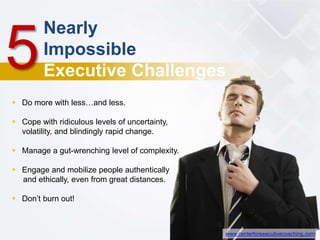
Nearly
Impossible
Executive Challenges
5
 Do more with less…and less.
 Cope with ridiculous levels of uncertainty,
volatility, and blindingly rapid change.
 Manage a gut-wrenching level of complexity.
 Engage and mobilize people authentically
and ethically, even from great distances.
 Don’t burn out!
www.centerforexecutivecoaching.com
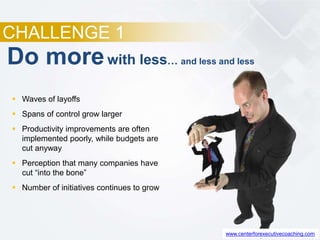
CHALLENGE 1
 Waves of layoffs
 Spans of control grow larger
 Productivity improvements are often
implemented poorly, while budgets are
cut anyway
 Perception that many companies have
cut “into the bone”
 Number of initiatives continues to grow
Do morewith less… and less and less
www.centerforexecutivecoaching.com
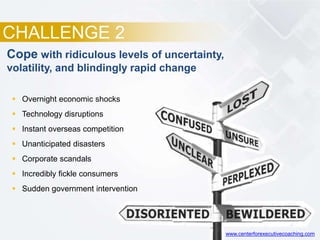
CHALLENGE 2
Cope with ridiculous levels of uncertainty,
volatility, and blindingly rapid change
 Overnight economic shocks
 Technology disruptions
 Instant overseas competition
 Unanticipated disasters
 Corporate scandals
 Incredibly fickle consumers
 Sudden government intervention
www.centerforexecutivecoaching.com
CHALLENGE 3
Manage gut-wrenching levels of complexity
 Vertical and/or horizontal layers
 Multiple bosses
 Global and cross-cultural mobilization
 Everyone wants to be included
 Uncertainty
 Information overload
 Changes in laws and regulatory
requirements
 New technologies
www.centerforexecutivecoaching.com
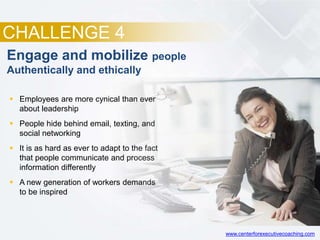
CHALLENGE 4
Engage and mobilize people
Authentically and ethically
 Employees are more cynical than ever
about leadership
 People hide behind email, texting, and
social networking
 It is as hard as ever to adapt to the fact
that people communicate and process
information differently
 A new generation of workers demands
to be inspired
www.centerforexecutivecoaching.com
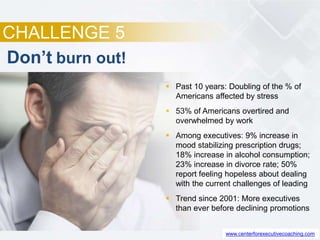
CHALLENGE 5
Don’t burn out!
 Past 10 years: Doubling of the % of
Americans affected by stress
 53% of Americans overtired and
overwhelmed by work
 Among executives: 9% increase in
mood stabilizing prescription drugs;
18% increase in alcohol consumption;
23% increase in divorce rate; 50%
report feeling hopeless about dealing
with the current challenges of leading
 Trend since 2001: More executives
than ever before declining promotions
www.centerforexecutivecoaching.com
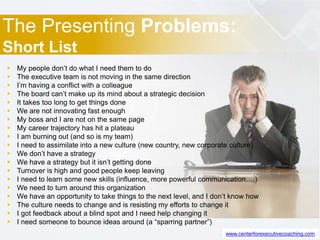
The Presenting Problems:
Short List
 My people don’t do what I need them to do
 The executive team is not moving in the same direction
 I’m having a conflict with a colleague
 The board can’t make up its mind about a strategic decision
 It takes too long to get things done
 We are not innovating fast enough
 My boss and I are not on the same page
 My career trajectory has hit a plateau
 I am burning out (and so is my team)
 I need to assimilate into a new culture (new country, new corporate culture)
 We don’t have a strategy
 We have a strategy but it isn’t getting done
 Turnover is high and good people keep leaving
 I need to learn some new skills (influence, more powerful communication….)
 We need to turn around this organization
 We have an opportunity to take things to the next level, and I don’t know how
 The culture needs to change and is resisting my efforts to change it
 I got feedback about a blind spot and I need help changing it
 I need someone to bounce ideas around (a “sparring partner”)
www.centerforexecutivecoaching.com
Why Executive Coaching
Is So Powerful
 Unlike training and development programs, where 85% of content
is forgotten in two weeks, coaching provides lasting impact and
sustainable improvements
 Proven process emphasizes ongoing reinforcement and
measurable results, and moves forwards towards continuous
improvements in performance
 Content provides a set of tools and distinctions for lasting impact
 Focus on data and metrics, so that our clients get accurate insights
and we are all moving towards the same goals
 Coaching emphasizes a holistic look at each client, including both
behaviors and perceptions
www.centerforexecutivecoaching.com
Executive Coaching
Offers Proven ROI (when done right)
 Studies consistently show an
average return of between $4.30 and $7.90 for $1 invested
in executive coaching.
 Coaching is used as standard leadership development for elite executives and
talented up-and-comers.
 Training combined with coaching increases
productivity by an average of 86% (VS
22%with training alone).
 Fast Company: 92% of leaders being
coached say they plan to use a coach again
www.centerforexecutivecoaching.com
And Clear
Benefits
 Productivity (reported by 53% of executives)
 Quality
 Organizational strength
 Improved customer service and reduced
customer complaints
 Improved retention, especially among those
receiving coaching
 Cost reduction and bottom-line profitability
(22%)
Companies that provide coaching
report these benefits (Source: ICF):
www.centerforexecutivecoaching.com
And Clear
Benefits
 Improved working relationships with direct
reports (reported by 77%)
 Improved working relationships with
immediate supervisors
 Better teamwork
 Improved working relationships with peers
 Greater job satisfaction (61%)
 Reduction in conflicts
 Improved organizational commitment
 Stronger client relationships
Executives who received coaching
received these benefits:
www.centerforexecutivecoaching.com
Some ICF Statistics
 17,000 members
 10,274 credentialed coaches
 2,039 more credentialed coaches than last year same time
 Studies showing credentialed coaches earn more
www.centerforexecutivecoaching.com
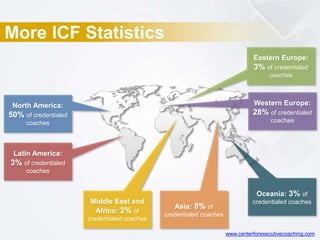
More ICF Statistics
North America:
50% of credentialed
coaches
Latin America:
3% of credentialed
coaches
Eastern Europe:
3% of credentialed
coaches
Western Europe:
28% of credentialed
coaches
Asia: 8% of
credentialed coaches
Middle East and
Africa: 2% of
credentialed coaches
Oceania: 3% of
credentialed coaches
www.centerforexecutivecoaching.com
Many Niches
 Industry (e.g. hospital executives, insurance executives)
 Wide open space in that small- to mid-sized company range
 Function (CFO, CIO, CMO, physician leader)
 Demographic (women, baby boomers)
 Psychographic (Christian business owners)
 Generational (e.g., Millenials)
 Situational (conflicts, influence, change leadership, succession
planning for family-owned businesses, strategic planning)
 Combinations of above are strongest
www.centerforexecutivecoaching.com
Many Openings
 Assessments
 Facilitation
 Consulting
 Retreats
 Strategic Planning
 Team Development
 Training
 Even Interim Management
www.centerforexecutivecoaching.com
Many Lightweights
 You can succeed with some sort of edge given your training,
credentials, and experience
 Still too many people hanging a shingle with no skills or substance
 Lots of “woo woo” style coaching
 Lots of circular questioning that still causes executives to call coaching
“an expensive waste of time”
www.centerforexecutivecoaching.com
So Long As You
 Have solid tools, methods, and frameworks
 Track progress start to finish
 Develop some core competencies to meet standards
 Are comfortable being in two businesses – coaching and business
development
www.centerforexecutivecoaching.com
The
Opportunity
For Mental
Health
Professionals
www.centerforexecutivecoaching.com
ar
Mental Health Professionals
Are Poised for Success as
Professional Coaches…
…but they need good training
to build and succeed in a
coaching practice
www.centerforexecutivecoaching.com
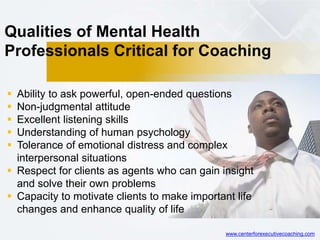
Qualities of Mental Health
Professionals Critical for Coaching
 Ability to ask powerful, open-ended questions
 Non-judgmental attitude
 Excellent listening skills
 Understanding of human psychology
 Tolerance of emotional distress and complex
interpersonal situations
 Respect for clients as agents who can gain insight
and solve their own problems
 Capacity to motivate clients to make important life
changes and enhance quality of life
www.centerforexecutivecoaching.com
6 Obstacles to Success for Mental Health
Professionals Becoming Coaches
 1) Need to avoid “diagnosing” or pathologizing
 2) Focus must be on strengths and “positive
psychology”
 3) Learning curve regarding the language and
customs of the business world
 4) Must feel confident and stand “shoulder to
shoulder” with CEOs
 5) Selling coaching services is different than
receiving patient referrals
 6) Billing for services is different in coaching
practice
www.centerforexecutivecoaching.com
Solid Training and ICF-Certification Yield
Success
 All coaches must develop core competencies of
practice
 ICF is the current standard bearer for quality in
the field
 Mental health professionals have additional
opportunities and needs
 Coach certification combined with mental health
experience can set you apart
 How best to obtain coach training and experience
tailored to your particular background and needs?
www.centerforexecutivecoaching.com
Training Program:
Joint Offering of the CEC and
Leading Minds Executive & Personal Coaching
 Didactic materials and books
 Tele-calls
 Individual mentoring sessions
 Review and feedback of recorded coaching
sessions
 Opportunity to attend group seminars for further
training and networking
 ICF mentor coaching
 CEC certification
 Fast track opportunity for ICF certification
www.centerforexecutivecoaching.com
Quick Coach
Content
www.centerforexecutivecoaching.com
The Seven
Orientations
 Relationships
 Outcomes
 Possibility
 Stand for the client’s
commitments and aspirations
 Equal footing
 Dialogue
 Build capacity
www.centerforexecutivecoaching.com
The Three
Domains
1. Content: What
2. Process: How
3. Context: Ways of Being
GREAT coaching almost always
includes conversations about context:
the client’s attitudes, behaviors, and
ways of relating with others.
www.centerforexecutivecoaching.com
The Three Levels Of
Coaching
 Level I: Ask powerful, open-ended questions in the hopes
that the client will have insights (active inquiry)
 Level II: Bring high-impact frameworks to focus on specific
situations
 Level III: Become a thought leader by developing your own
frameworks
www.centerforexecutivecoaching.com
The Three Levels Of
Coaching
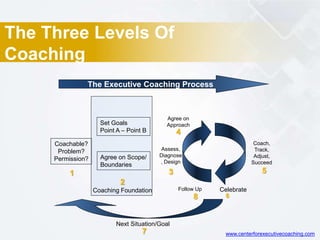
Coachable?
Problem?
Permission?
Assess,
Diagnose
, Design
Agree on
Approach
Celebrate
Follow Up
Coach,
Track,
Adjust,
Succeed
Next Situation/Goal
The Executive Coaching Process
1 3
4
5
6
7
8
Set Goals
Point A – Point B
Agree on Scope/
Boundaries
2
Coaching Foundation
www.centerforexecutivecoaching.com
Typical Agenda
Over Time
 Set scope, boundaries, objectives
 Weekly sessions:
 The overall coaching topic(s)
 Coaching about current issues
 Introduce topics via a curriculum as
appropriate
 Continue weekly sessions if client has
ongoing issues; or shift to monthly, then
quarterly sessions if client is on
“maintenance”
Core Agenda
 Conduct assessment, as appropriate
(which can be a value-add service in
exchange for 6 month or longer
contract)
 Perhaps identify opportunity to work
with executive team, lead retreat,
conduct training, consult….
 (As appropriate): Conduct assessments
every 6-12 months to confirm progress
and identify new issues; keep client
moving forward
In Parallel
www.centerforexecutivecoaching.com
A Few Illustrative
Executive Coaching
Conversations
www.centerforexecutivecoaching.com
Key Coaching
Conversations
 Active Inquiry
 Appreciative Inquiry
 Listen/Confirm Understanding/Reflect
 Accountability
 Acknowledge
 Share Stories
 Move the Conversation Forward
 Set Context
 Introduce a Framework, Tool, Exercise,
or Distinction
 Establish/Re-establish Coachability
www.centerforexecutivecoaching.com
1. Active inquiry
Introduce what you will do
 For 10-20 minutes, I’ll ask you open-ended questions.
The goal is to have you come up with some insights
about the issue and how to resolve it. Then I’ll ask you
what insights you had, ask permission to share any
insights I might have, and we can go from there.
Ask open ended questions with the goal of having the
client generate insights
 What, where, when, how, who and (carefully) why
 Be sure to listen actively and confirm understanding
 Go for high-voltage questions that have some “juice”
 Ask the client to summarize one or more insights he
had, and what he will do about them
 Ask permission to share your own insight
www.centerforexecutivecoaching.com
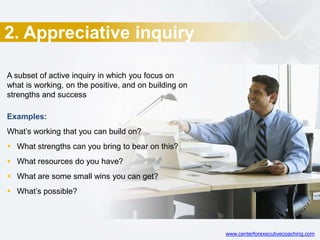
2. Appreciative inquiry
A subset of active inquiry in which you focus on
what is working, on the positive, and on building on
strengths and success
Examples:
What’s working that you can build on?
 What strengths can you bring to bear on this?
 What resources do you have?
 What are some small wins you can get?
 What’s possible?
www.centerforexecutivecoaching.com
3. Listen/Confirm
Understanding/Reflect
Basic: Confirm intellectual understanding
Advanced: Reflect back the emotions
 “This must be frustrating for you…”
 “If I were in your shoes, I’d be excited, too”
Advanced: Listening for something
 Commitment
 Blind spot
 Accountability
 Coachability
 Opportunity to use a coaching tool
 Etc.
www.centerforexecutivecoaching.com
4. Accountability
 Call them on their behavior when they don’t do
what they said they would do
 Question their commitment
• Is this really important to you?
 Take time during the coaching session to get
the work done
 Go below the surface to explore limiting
perceptions or other obstacles keeping them
from taking their word
www.centerforexecutivecoaching.com
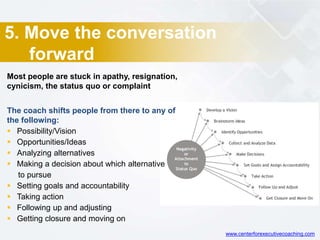
5. Move the conversation
forward
Most people are stuck in apathy, resignation,
cynicism, the status quo or complaint
The coach shifts people from there to any of
the following:
 Possibility/Vision
 Opportunities/Ideas
 Analyzing alternatives
 Making a decision about which alternative
to pursue
 Setting goals and accountability
 Taking action
 Following up and adjusting
 Getting closure and moving on
www.centerforexecutivecoaching.com
Situational Foundations:
Behavioral And Perceptual Coaching
www.centerforexecutivecoaching.com
Behavioral
Coaching
Can address a behavioral blind spot that is derailing the client’s career, or be an
excellent way to pick one thing to be better while improving the culture
Choose one behavior that is simple, relevant, and easy to measure (smiling,
making eye contact, acknowledging employees, letting people finish their
sentence without interrupting).
Build a support structure to make the new behavior a habit, including: feedback,
tracking progress, notes, affirmations, stress reduction tactics, pre-planning,
AAA, and other tools from applied cognitive behavioral research
www.centerforexecutivecoaching.com
Perceptual
Coaching
 Identify and reframe a limiting belief, and the new
perception and associated behaviors habitual
 Examples:
 I can’t trust my people
 Conflict is bad
 I need to be the hero
 Everything needs to be perfect
 I would rather be “X” than successful
www.centerforexecutivecoaching.com
Situational Coaching
Frameworks
 Personal domains
 Strategic planning
 Executive dashboard
 Engage and mobilize employees
 Manage time
 Conflict resolution
 Communicate simply and powerfully
 Power base strategy
 Change management
 Influence skills/politics of idea
acceptance
 Create a high-performance culture
 Success planning
 Thinking comprehensively and
systematically about issues
 Performance improvement
 Career transition/First 90 days
www.centerforexecutivecoaching.com
Business
Models
www.centerforexecutivecoaching.com
Time For Dollars
To Firm Builder
 1-2 Days: Marketing
 1 Day: Writing/Product Development
 2-3 Days: Coaching
• 2 Days = 12 client sessions
 12 clients X $X per month (priced by
engagement)
 3 Days = 18 client sessions
 More than 3 Days: Add a coach, and then
another, and another. Take 33% as a marketing
fee. Many coaches can’t market, and will happily
work 4-5 days per week for you. Create passive
income. Build leverage...
www.centerforexecutivecoaching.com
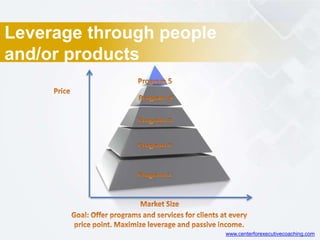
Leverage through people
and/or products
www.centerforexecutivecoaching.com
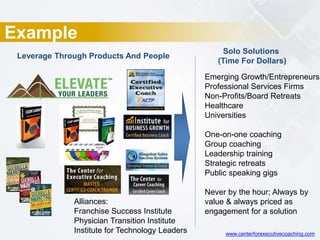
Example
Alliances:
Franchise Success Institute
Physician Transition Institute
Institute for Technology Leaders
Leverage Through Products And People
Solo Solutions
(Time For Dollars)
Emerging Growth/Entrepreneurs
Professional Services Firms
Non-Profits/Board Retreats
Healthcare
Universities
One-on-one coaching
Group coaching
Leadership training
Strategic retreats
Public speaking gigs
Never by the hour; Always by
value & always priced as
engagement for a solution
www.centerforexecutivecoaching.com
ICF- Accredited Coach Training
For Mental Health Professionals
Andrew Neitlich David Brendel
Center for Executive Coaching Leading Minds Executive & Personal Coaching
www.centerforexecutivecoaching.com www.LeadingMindsExecutiveCoaching.com
941-539-9623 617-932-1548
andrewneitlich@yahoo.com david@drdavidbrendel.com

mental health guide free

  • 1.
    ICF- Accredited CoachTraining For Mental Health Professionals Andrew Neitlich David Brendel Center for Executive Coaching Leading Minds Executive & Personal Coaching www.centerforexecutivecoaching.com www.LeadingMindsExecutiveCoaching.com 941-539-9623 617-932-1548 andrewneitlich@yahoo.com david@drdavidbrendel.com
  • 2.
     Executive CoachingDefined  Why Coaching Matters  The Opportunity for Mental Health Professionals  Quick Coaching Content  Illustrative Coaching Conversations  Situational Foundations  Situational Coaching Models  Business Models Agenda www.centerforexecutivecoaching.com
  • 3.
     Executive Coachingis an efficient, high-impact process that helps high-performing people in leadership roles improve results in ways that are sustained over time.  It is efficient because, unlike traditional consulting assignments, it does not require invasive processes, large outside teams, and lengthy reports and analyses to get results.  It is a high-impact process because Executive Coaches typically work with clients in short meetings (i.e., 30 minutes per session). During this time, the coach and client can generate important insights, gain clarity, focus, and make decisions to improve performance.  Executive Coaching works with high-performing people in leadership roles. It is not therapy, meant to “fix” a person. As an Executive Coach, your clients are already highly functioning, successful people. Like any of us, they need support from time to time in order to perform better.  Finally, your goal as an Executive Coach is to improve results in ways that are sustainable over time. Your clients want some sort of outcome, usually related to improved profits, career success, organizational effectiveness, or career and personal satisfaction. If you aren’t helping your clients get results, you aren’t doing your job. At the same time, coaching is about helping people improve their own capabilities and effectiveness, so that the results and performance improvements last. To use the time-worn and famous quote, you are teaching people to fish, not feeding them for a day. What Is Executive Coaching? www.centerforexecutivecoaching.com
  • 4.
  • 5.
    Nearly Impossible Executive Challenges 5  Domore with less…and less.  Cope with ridiculous levels of uncertainty, volatility, and blindingly rapid change.  Manage a gut-wrenching level of complexity.  Engage and mobilize people authentically and ethically, even from great distances.  Don’t burn out! www.centerforexecutivecoaching.com
  • 6.
    CHALLENGE 1  Wavesof layoffs  Spans of control grow larger  Productivity improvements are often implemented poorly, while budgets are cut anyway  Perception that many companies have cut “into the bone”  Number of initiatives continues to grow Do morewith less… and less and less www.centerforexecutivecoaching.com
  • 7.
    CHALLENGE 2 Cope withridiculous levels of uncertainty, volatility, and blindingly rapid change  Overnight economic shocks  Technology disruptions  Instant overseas competition  Unanticipated disasters  Corporate scandals  Incredibly fickle consumers  Sudden government intervention www.centerforexecutivecoaching.com
  • 8.
    CHALLENGE 3 Manage gut-wrenchinglevels of complexity  Vertical and/or horizontal layers  Multiple bosses  Global and cross-cultural mobilization  Everyone wants to be included  Uncertainty  Information overload  Changes in laws and regulatory requirements  New technologies www.centerforexecutivecoaching.com
  • 9.
    CHALLENGE 4 Engage andmobilize people Authentically and ethically  Employees are more cynical than ever about leadership  People hide behind email, texting, and social networking  It is as hard as ever to adapt to the fact that people communicate and process information differently  A new generation of workers demands to be inspired www.centerforexecutivecoaching.com
  • 10.
    CHALLENGE 5 Don’t burnout!  Past 10 years: Doubling of the % of Americans affected by stress  53% of Americans overtired and overwhelmed by work  Among executives: 9% increase in mood stabilizing prescription drugs; 18% increase in alcohol consumption; 23% increase in divorce rate; 50% report feeling hopeless about dealing with the current challenges of leading  Trend since 2001: More executives than ever before declining promotions www.centerforexecutivecoaching.com
  • 11.
    The Presenting Problems: ShortList  My people don’t do what I need them to do  The executive team is not moving in the same direction  I’m having a conflict with a colleague  The board can’t make up its mind about a strategic decision  It takes too long to get things done  We are not innovating fast enough  My boss and I are not on the same page  My career trajectory has hit a plateau  I am burning out (and so is my team)  I need to assimilate into a new culture (new country, new corporate culture)  We don’t have a strategy  We have a strategy but it isn’t getting done  Turnover is high and good people keep leaving  I need to learn some new skills (influence, more powerful communication….)  We need to turn around this organization  We have an opportunity to take things to the next level, and I don’t know how  The culture needs to change and is resisting my efforts to change it  I got feedback about a blind spot and I need help changing it  I need someone to bounce ideas around (a “sparring partner”) www.centerforexecutivecoaching.com
  • 12.
    Why Executive Coaching IsSo Powerful  Unlike training and development programs, where 85% of content is forgotten in two weeks, coaching provides lasting impact and sustainable improvements  Proven process emphasizes ongoing reinforcement and measurable results, and moves forwards towards continuous improvements in performance  Content provides a set of tools and distinctions for lasting impact  Focus on data and metrics, so that our clients get accurate insights and we are all moving towards the same goals  Coaching emphasizes a holistic look at each client, including both behaviors and perceptions www.centerforexecutivecoaching.com
  • 13.
    Executive Coaching Offers ProvenROI (when done right)  Studies consistently show an average return of between $4.30 and $7.90 for $1 invested in executive coaching.  Coaching is used as standard leadership development for elite executives and talented up-and-comers.  Training combined with coaching increases productivity by an average of 86% (VS 22%with training alone).  Fast Company: 92% of leaders being coached say they plan to use a coach again www.centerforexecutivecoaching.com
  • 14.
    And Clear Benefits  Productivity(reported by 53% of executives)  Quality  Organizational strength  Improved customer service and reduced customer complaints  Improved retention, especially among those receiving coaching  Cost reduction and bottom-line profitability (22%) Companies that provide coaching report these benefits (Source: ICF): www.centerforexecutivecoaching.com
  • 15.
    And Clear Benefits  Improvedworking relationships with direct reports (reported by 77%)  Improved working relationships with immediate supervisors  Better teamwork  Improved working relationships with peers  Greater job satisfaction (61%)  Reduction in conflicts  Improved organizational commitment  Stronger client relationships Executives who received coaching received these benefits: www.centerforexecutivecoaching.com
  • 16.
    Some ICF Statistics 17,000 members  10,274 credentialed coaches  2,039 more credentialed coaches than last year same time  Studies showing credentialed coaches earn more www.centerforexecutivecoaching.com
  • 17.
    More ICF Statistics NorthAmerica: 50% of credentialed coaches Latin America: 3% of credentialed coaches Eastern Europe: 3% of credentialed coaches Western Europe: 28% of credentialed coaches Asia: 8% of credentialed coaches Middle East and Africa: 2% of credentialed coaches Oceania: 3% of credentialed coaches www.centerforexecutivecoaching.com
  • 18.
    Many Niches  Industry(e.g. hospital executives, insurance executives)  Wide open space in that small- to mid-sized company range  Function (CFO, CIO, CMO, physician leader)  Demographic (women, baby boomers)  Psychographic (Christian business owners)  Generational (e.g., Millenials)  Situational (conflicts, influence, change leadership, succession planning for family-owned businesses, strategic planning)  Combinations of above are strongest www.centerforexecutivecoaching.com
  • 19.
    Many Openings  Assessments Facilitation  Consulting  Retreats  Strategic Planning  Team Development  Training  Even Interim Management www.centerforexecutivecoaching.com
  • 20.
    Many Lightweights  Youcan succeed with some sort of edge given your training, credentials, and experience  Still too many people hanging a shingle with no skills or substance  Lots of “woo woo” style coaching  Lots of circular questioning that still causes executives to call coaching “an expensive waste of time” www.centerforexecutivecoaching.com
  • 21.
    So Long AsYou  Have solid tools, methods, and frameworks  Track progress start to finish  Develop some core competencies to meet standards  Are comfortable being in two businesses – coaching and business development www.centerforexecutivecoaching.com
  • 22.
  • 23.
    ar Mental Health Professionals ArePoised for Success as Professional Coaches… …but they need good training to build and succeed in a coaching practice www.centerforexecutivecoaching.com
  • 24.
    Qualities of MentalHealth Professionals Critical for Coaching  Ability to ask powerful, open-ended questions  Non-judgmental attitude  Excellent listening skills  Understanding of human psychology  Tolerance of emotional distress and complex interpersonal situations  Respect for clients as agents who can gain insight and solve their own problems  Capacity to motivate clients to make important life changes and enhance quality of life www.centerforexecutivecoaching.com
  • 25.
    6 Obstacles toSuccess for Mental Health Professionals Becoming Coaches  1) Need to avoid “diagnosing” or pathologizing  2) Focus must be on strengths and “positive psychology”  3) Learning curve regarding the language and customs of the business world  4) Must feel confident and stand “shoulder to shoulder” with CEOs  5) Selling coaching services is different than receiving patient referrals  6) Billing for services is different in coaching practice www.centerforexecutivecoaching.com
  • 26.
    Solid Training andICF-Certification Yield Success  All coaches must develop core competencies of practice  ICF is the current standard bearer for quality in the field  Mental health professionals have additional opportunities and needs  Coach certification combined with mental health experience can set you apart  How best to obtain coach training and experience tailored to your particular background and needs? www.centerforexecutivecoaching.com
  • 27.
    Training Program: Joint Offeringof the CEC and Leading Minds Executive & Personal Coaching  Didactic materials and books  Tele-calls  Individual mentoring sessions  Review and feedback of recorded coaching sessions  Opportunity to attend group seminars for further training and networking  ICF mentor coaching  CEC certification  Fast track opportunity for ICF certification www.centerforexecutivecoaching.com
  • 28.
  • 29.
    The Seven Orientations  Relationships Outcomes  Possibility  Stand for the client’s commitments and aspirations  Equal footing  Dialogue  Build capacity www.centerforexecutivecoaching.com
  • 30.
    The Three Domains 1. Content:What 2. Process: How 3. Context: Ways of Being GREAT coaching almost always includes conversations about context: the client’s attitudes, behaviors, and ways of relating with others. www.centerforexecutivecoaching.com
  • 31.
    The Three LevelsOf Coaching  Level I: Ask powerful, open-ended questions in the hopes that the client will have insights (active inquiry)  Level II: Bring high-impact frameworks to focus on specific situations  Level III: Become a thought leader by developing your own frameworks www.centerforexecutivecoaching.com
  • 32.
    The Three LevelsOf Coaching Coachable? Problem? Permission? Assess, Diagnose , Design Agree on Approach Celebrate Follow Up Coach, Track, Adjust, Succeed Next Situation/Goal The Executive Coaching Process 1 3 4 5 6 7 8 Set Goals Point A – Point B Agree on Scope/ Boundaries 2 Coaching Foundation www.centerforexecutivecoaching.com
  • 33.
    Typical Agenda Over Time Set scope, boundaries, objectives  Weekly sessions:  The overall coaching topic(s)  Coaching about current issues  Introduce topics via a curriculum as appropriate  Continue weekly sessions if client has ongoing issues; or shift to monthly, then quarterly sessions if client is on “maintenance” Core Agenda  Conduct assessment, as appropriate (which can be a value-add service in exchange for 6 month or longer contract)  Perhaps identify opportunity to work with executive team, lead retreat, conduct training, consult….  (As appropriate): Conduct assessments every 6-12 months to confirm progress and identify new issues; keep client moving forward In Parallel www.centerforexecutivecoaching.com
  • 34.
    A Few Illustrative ExecutiveCoaching Conversations www.centerforexecutivecoaching.com
  • 35.
    Key Coaching Conversations  ActiveInquiry  Appreciative Inquiry  Listen/Confirm Understanding/Reflect  Accountability  Acknowledge  Share Stories  Move the Conversation Forward  Set Context  Introduce a Framework, Tool, Exercise, or Distinction  Establish/Re-establish Coachability www.centerforexecutivecoaching.com
  • 36.
    1. Active inquiry Introducewhat you will do  For 10-20 minutes, I’ll ask you open-ended questions. The goal is to have you come up with some insights about the issue and how to resolve it. Then I’ll ask you what insights you had, ask permission to share any insights I might have, and we can go from there. Ask open ended questions with the goal of having the client generate insights  What, where, when, how, who and (carefully) why  Be sure to listen actively and confirm understanding  Go for high-voltage questions that have some “juice”  Ask the client to summarize one or more insights he had, and what he will do about them  Ask permission to share your own insight www.centerforexecutivecoaching.com
  • 37.
    2. Appreciative inquiry Asubset of active inquiry in which you focus on what is working, on the positive, and on building on strengths and success Examples: What’s working that you can build on?  What strengths can you bring to bear on this?  What resources do you have?  What are some small wins you can get?  What’s possible? www.centerforexecutivecoaching.com
  • 38.
    3. Listen/Confirm Understanding/Reflect Basic: Confirmintellectual understanding Advanced: Reflect back the emotions  “This must be frustrating for you…”  “If I were in your shoes, I’d be excited, too” Advanced: Listening for something  Commitment  Blind spot  Accountability  Coachability  Opportunity to use a coaching tool  Etc. www.centerforexecutivecoaching.com
  • 39.
    4. Accountability  Callthem on their behavior when they don’t do what they said they would do  Question their commitment • Is this really important to you?  Take time during the coaching session to get the work done  Go below the surface to explore limiting perceptions or other obstacles keeping them from taking their word www.centerforexecutivecoaching.com
  • 40.
    5. Move theconversation forward Most people are stuck in apathy, resignation, cynicism, the status quo or complaint The coach shifts people from there to any of the following:  Possibility/Vision  Opportunities/Ideas  Analyzing alternatives  Making a decision about which alternative to pursue  Setting goals and accountability  Taking action  Following up and adjusting  Getting closure and moving on www.centerforexecutivecoaching.com
  • 41.
    Situational Foundations: Behavioral AndPerceptual Coaching www.centerforexecutivecoaching.com
  • 42.
    Behavioral Coaching Can address abehavioral blind spot that is derailing the client’s career, or be an excellent way to pick one thing to be better while improving the culture Choose one behavior that is simple, relevant, and easy to measure (smiling, making eye contact, acknowledging employees, letting people finish their sentence without interrupting). Build a support structure to make the new behavior a habit, including: feedback, tracking progress, notes, affirmations, stress reduction tactics, pre-planning, AAA, and other tools from applied cognitive behavioral research www.centerforexecutivecoaching.com
  • 43.
    Perceptual Coaching  Identify andreframe a limiting belief, and the new perception and associated behaviors habitual  Examples:  I can’t trust my people  Conflict is bad  I need to be the hero  Everything needs to be perfect  I would rather be “X” than successful www.centerforexecutivecoaching.com
  • 44.
    Situational Coaching Frameworks  Personaldomains  Strategic planning  Executive dashboard  Engage and mobilize employees  Manage time  Conflict resolution  Communicate simply and powerfully  Power base strategy  Change management  Influence skills/politics of idea acceptance  Create a high-performance culture  Success planning  Thinking comprehensively and systematically about issues  Performance improvement  Career transition/First 90 days www.centerforexecutivecoaching.com
  • 45.
  • 46.
    Time For Dollars ToFirm Builder  1-2 Days: Marketing  1 Day: Writing/Product Development  2-3 Days: Coaching • 2 Days = 12 client sessions  12 clients X $X per month (priced by engagement)  3 Days = 18 client sessions  More than 3 Days: Add a coach, and then another, and another. Take 33% as a marketing fee. Many coaches can’t market, and will happily work 4-5 days per week for you. Create passive income. Build leverage... www.centerforexecutivecoaching.com
  • 47.
    Leverage through people and/orproducts www.centerforexecutivecoaching.com
  • 48.
    Example Alliances: Franchise Success Institute PhysicianTransition Institute Institute for Technology Leaders Leverage Through Products And People Solo Solutions (Time For Dollars) Emerging Growth/Entrepreneurs Professional Services Firms Non-Profits/Board Retreats Healthcare Universities One-on-one coaching Group coaching Leadership training Strategic retreats Public speaking gigs Never by the hour; Always by value & always priced as engagement for a solution www.centerforexecutivecoaching.com
  • 49.
    ICF- Accredited CoachTraining For Mental Health Professionals Andrew Neitlich David Brendel Center for Executive Coaching Leading Minds Executive & Personal Coaching www.centerforexecutivecoaching.com www.LeadingMindsExecutiveCoaching.com 941-539-9623 617-932-1548 andrewneitlich@yahoo.com david@drdavidbrendel.com