Coaching for
Leader
www.humanikaconsulting.com
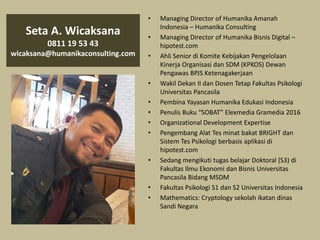
Seta A. Wicaksana
0811 19 53 43
wicaksana@humanikaconsulting.com
• Managing Director of Humanika Amanah
Indonesia – Humanika Consulting
• Managing Director of Humanika Bisnis Digital –
hipotest.com
• Ahli Senior di Komite Kebijakan Pengelolaan
Kinerja Organisasi dan SDM (KPKOS) Dewan
Pengawas BPJS Ketenagakerjaan
• Wakil Dekan II dan Dosen Tetap Fakultas Psikologi
Universitas Pancasila
• Pembina Yayasan Humanika Edukasi Indonesia
• Penulis Buku “SOBAT” Elexmedia Gramedia 2016
• Organizational Development Expertise
• Pengembang Alat Tes minat bakat BRIGHT dan
Sistem Tes Psikologi berbasis aplikasi di
hipotest.com
• Sedang mengikuti tugas belajar Doktoral (S3) di
Fakultas Ilmu Ekonomi dan Bisnis Universitas
Pancasila Bidang MSDM
• Fakultas Psikologi S1 dan S2 Universitas Indonesia
• Mathematics: Cryptology sekolah ikatan dinas
Sandi Negara
“People will have the greatest
influence on productivity, excellence,
and quality, but only if leaders can
empower employees and give them
more autonomy while maintaining
effective accountability.”
~ The Coach: Creating Partnerships
for a Competitive Edge
Coaching: An
Important
Aspect of
Leadership
• In today’s business environment, coaching plays a vital role due to
a greater appreciation of the value of an organization’s knowledge
and human capital.
• To achieve critical results and remain competitive, organizations
see coaching not only as a means to shape individual performance
but also, increasingly, as a means to build broader organizational
capacity.
• The top desired skill for front-line managers is coaching, according
to a recent survey in Chief Learning Officer Magazine. What makes
a good coach - and how can you improve your coaching skills, and
advance your career in the process?
The Personal
Benefits of
Coaching
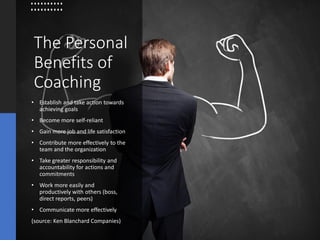
• Establish and take action towards
achieving goals
• Become more self-reliant
• Gain more job and life satisfaction
• Contribute more effectively to the
team and the organization
• Take greater responsibility and
accountability for actions and
commitments
• Work more easily and
productively with others (boss,
direct reports, peers)
• Communicate more effectively
(source: Ken Blanchard Companies)
The Benefits of Coaching in
Organizations
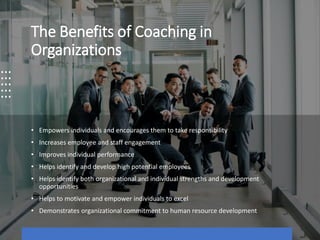
• Empowers individuals and encourages them to take responsibility
• Increases employee and staff engagement
• Improves individual performance
• Helps identify and develop high potential employees
• Helps identify both organizational and individual strengths and development
opportunities
• Helps to motivate and empower individuals to excel
• Demonstrates organizational commitment to human resource development
Research Talk
• Do you want to inspire your employees, or instruct them?
Consider this instructive statistic: Gallup says 86% of
employees think that their bosses are uninspiring.
• When executed properly, coaching provides greater intrinsic
motivation - in other words, inspiring the self-directed
willingness to try new things and make new discoveries.
According to McKinsey, when employees find greater intrinsic
motivation, they are 32% more committed to their work and
46% more satisfied with their jobs.
Research
Talk
• Coaching in organization and
leadership settings is also an
invaluable tool for developing people
across a wide range of needs.
• The benefits of coaching are many;
80% of people who receive coaching
report increased self-confidence, and
over 70% benefit from improved work
performance, relationships, and more
effective communication skills.
• 86% of companies report that they
recouped their investment on
coaching and more
(source: ICF 2009).
ASSUMPTIONS
OF
SUCCESSFUL
COACHING
• The coachee already has the answers – This means that the coach is there as a
guide rather than a problem solver.
• The coach is a catalyst – While they do not create the change in the coachee, they
are an assistant to helping them move forward.
• The coachee is accountable within the coaching process– The coach creates the
foundation, but the coachee must do the work.
• The coach is passionate about assisting in the change process – They are driven to
see the client succeed.
• The coaching process is built on trust – All coaching conversations are confidential
and the coach/client relationship is highly respected.
“Coaching aims to connect people in
genuinely meaningful ways and with
deeper understanding to spark
thoughts and ideas. It generates
positive, long-term feelings of
mutual respect and interest. It also
creates mental images and pictures
of success. The goal of coaching is to
engage all the senses as efforts are
aligned and synchronized.”
~ Steven J. Stowell, Ph.D.
How to
Become a
Better
Coach
1. Become A
Better Listener
• Employees who feel their voice is heard
are 4.6 times more likely to feel
empowered to do their best work,
according to this Salesforce survey
featured in Forbes.
• At least 50% of every conversation is
listening...unless, of course, you're a
manager who's passing out instructions.
• Listening is the often-forgotten skill that
managers lack.
• According to Chief Learning Officer,
effective coaches understand how to
listen at a deeper level.
• What would happen if your team felt
that you were really listening to them?
Doesn't mean you have to grant wishes,
or let the inmates run the asylum.
• But hearing other viewpoints can shape
your own, as well as impacting the
effectiveness of the entire organization.
2. Reject a
Premise, Get a
Promise
• We all have a premise, if you will, that reflects
how we see the world.
• That premise (also called a perspective, or point
of view) is the reason we move forward, or stay
stuck.
• Coaches challenge the premise, with the words of
Nelson Mandela: "It seems impossible, until it's
done". There are many things in my life that
looked impossible: driving a car, getting married,
tying my shoes...Yet, here we are.
• An effective coach practices self-leadership, to
recognize that we all have limiting beliefs.
• Luckily, when those beliefs are seen and
understood objectively, a new viewpoint
emerges.
• Can you help your team to leave a limiting
premise behind? Will they commit and agree to
new behavior? Because if the commitment comes
from them, you're headed in the direction of new
results.
3. Safety and The
Biggest Promise
You Can Keep
• Can you listen to your employees or clients without judgement, no matter what comes out
of their mouths? That's tricky! The impulse to correct, fix and change is a strong one in
effective managers. And I can relate! Luckily, my approach today is different - because of my
experience as a transformational coach.
• Coaches realize what managers don't: There's no such thing as constructive criticism. The
only thing that criticism constructs is defensiveness. Maybe after you reflect on the
criticism you can make something of it, but criticism doesn't create an atmosphere of
safety.
• In other words, the sense that we can say and explore anything, without fear of retribution,
criticism or correction. That kind of safety is vital to new ideas. Can you offer that
environment to your team? If not, it's understandable. But maybe some objectivity is
what's required - an objective outside resource to help coach you to new results. Because
processing information without judgement is critical to helping people see things afresh.
• The objectives for the coach and the manager can be exactly the same, but the approach is
completely different. When clients see new possibilities, new promises take shape.
Masterful coaches create a safe environment for new ideas - and sometimes, that role
can't be filled by a manager.
4. Finding Talent
In Others
• Another key component to good coaching is identifying
talents in others and properly leveraging them to better
the company and the employee’s career.
• Finding and developing talent is one of the most
important jobs a leader takes on – the very future of the
organization depends on it.
5. Creating a
Motivational
Workplace
• The bottom line for most employees is that they want to use their
abilities to the fullest, connect with coworkers and achieve a level of
autonomy so they can direct their own efforts. Providing a workplace
that can help employees achieve those goals is an important part of
coaching.
• But doing so requires focused, intelligent effort that creates job
satisfaction, trust, learning opportunities and the freedom to be
creative.
• Focusing on these issues can lead to better coaching within your
workplace and a motivated, satisfied staff who one day will be ready to
step up and take on a wider range of organizational responsibilities.
Nothing else a leader does has such a lasting impact.
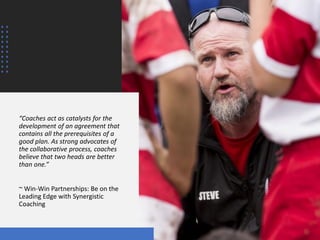
“Coaches act as catalysts for the
development of an agreement that
contains all the prerequisites of a
good plan. As strong advocates of
the collaborative process, coaches
believe that two heads are better
than one.”
~ Win-Win Partnerships: Be on the
Leading Edge with Synergistic
Coaching
Learning and Giving for
Better Indonesiawww.humanikaconsulting.com

Coaching for Leader

  • 1.
  • 2.
    Seta A. Wicaksana 081119 53 43 wicaksana@humanikaconsulting.com • Managing Director of Humanika Amanah Indonesia – Humanika Consulting • Managing Director of Humanika Bisnis Digital – hipotest.com • Ahli Senior di Komite Kebijakan Pengelolaan Kinerja Organisasi dan SDM (KPKOS) Dewan Pengawas BPJS Ketenagakerjaan • Wakil Dekan II dan Dosen Tetap Fakultas Psikologi Universitas Pancasila • Pembina Yayasan Humanika Edukasi Indonesia • Penulis Buku “SOBAT” Elexmedia Gramedia 2016 • Organizational Development Expertise • Pengembang Alat Tes minat bakat BRIGHT dan Sistem Tes Psikologi berbasis aplikasi di hipotest.com • Sedang mengikuti tugas belajar Doktoral (S3) di Fakultas Ilmu Ekonomi dan Bisnis Universitas Pancasila Bidang MSDM • Fakultas Psikologi S1 dan S2 Universitas Indonesia • Mathematics: Cryptology sekolah ikatan dinas Sandi Negara
  • 3.
    “People will havethe greatest influence on productivity, excellence, and quality, but only if leaders can empower employees and give them more autonomy while maintaining effective accountability.” ~ The Coach: Creating Partnerships for a Competitive Edge
  • 4.
    Coaching: An Important Aspect of Leadership •In today’s business environment, coaching plays a vital role due to a greater appreciation of the value of an organization’s knowledge and human capital. • To achieve critical results and remain competitive, organizations see coaching not only as a means to shape individual performance but also, increasingly, as a means to build broader organizational capacity. • The top desired skill for front-line managers is coaching, according to a recent survey in Chief Learning Officer Magazine. What makes a good coach - and how can you improve your coaching skills, and advance your career in the process?
  • 5.
    The Personal Benefits of Coaching •Establish and take action towards achieving goals • Become more self-reliant • Gain more job and life satisfaction • Contribute more effectively to the team and the organization • Take greater responsibility and accountability for actions and commitments • Work more easily and productively with others (boss, direct reports, peers) • Communicate more effectively (source: Ken Blanchard Companies)
  • 6.
    The Benefits ofCoaching in Organizations • Empowers individuals and encourages them to take responsibility • Increases employee and staff engagement • Improves individual performance • Helps identify and develop high potential employees • Helps identify both organizational and individual strengths and development opportunities • Helps to motivate and empower individuals to excel • Demonstrates organizational commitment to human resource development
  • 7.
    Research Talk • Doyou want to inspire your employees, or instruct them? Consider this instructive statistic: Gallup says 86% of employees think that their bosses are uninspiring. • When executed properly, coaching provides greater intrinsic motivation - in other words, inspiring the self-directed willingness to try new things and make new discoveries. According to McKinsey, when employees find greater intrinsic motivation, they are 32% more committed to their work and 46% more satisfied with their jobs.
  • 8.
    Research Talk • Coaching inorganization and leadership settings is also an invaluable tool for developing people across a wide range of needs. • The benefits of coaching are many; 80% of people who receive coaching report increased self-confidence, and over 70% benefit from improved work performance, relationships, and more effective communication skills. • 86% of companies report that they recouped their investment on coaching and more (source: ICF 2009).
  • 9.
    ASSUMPTIONS OF SUCCESSFUL COACHING • The coacheealready has the answers – This means that the coach is there as a guide rather than a problem solver. • The coach is a catalyst – While they do not create the change in the coachee, they are an assistant to helping them move forward. • The coachee is accountable within the coaching process– The coach creates the foundation, but the coachee must do the work. • The coach is passionate about assisting in the change process – They are driven to see the client succeed. • The coaching process is built on trust – All coaching conversations are confidential and the coach/client relationship is highly respected.
  • 10.
    “Coaching aims toconnect people in genuinely meaningful ways and with deeper understanding to spark thoughts and ideas. It generates positive, long-term feelings of mutual respect and interest. It also creates mental images and pictures of success. The goal of coaching is to engage all the senses as efforts are aligned and synchronized.” ~ Steven J. Stowell, Ph.D.
  • 11.
  • 12.
    1. Become A BetterListener • Employees who feel their voice is heard are 4.6 times more likely to feel empowered to do their best work, according to this Salesforce survey featured in Forbes. • At least 50% of every conversation is listening...unless, of course, you're a manager who's passing out instructions. • Listening is the often-forgotten skill that managers lack. • According to Chief Learning Officer, effective coaches understand how to listen at a deeper level. • What would happen if your team felt that you were really listening to them? Doesn't mean you have to grant wishes, or let the inmates run the asylum. • But hearing other viewpoints can shape your own, as well as impacting the effectiveness of the entire organization.
  • 13.
    2. Reject a Premise,Get a Promise • We all have a premise, if you will, that reflects how we see the world. • That premise (also called a perspective, or point of view) is the reason we move forward, or stay stuck. • Coaches challenge the premise, with the words of Nelson Mandela: "It seems impossible, until it's done". There are many things in my life that looked impossible: driving a car, getting married, tying my shoes...Yet, here we are. • An effective coach practices self-leadership, to recognize that we all have limiting beliefs. • Luckily, when those beliefs are seen and understood objectively, a new viewpoint emerges. • Can you help your team to leave a limiting premise behind? Will they commit and agree to new behavior? Because if the commitment comes from them, you're headed in the direction of new results.
  • 14.
    3. Safety andThe Biggest Promise You Can Keep • Can you listen to your employees or clients without judgement, no matter what comes out of their mouths? That's tricky! The impulse to correct, fix and change is a strong one in effective managers. And I can relate! Luckily, my approach today is different - because of my experience as a transformational coach. • Coaches realize what managers don't: There's no such thing as constructive criticism. The only thing that criticism constructs is defensiveness. Maybe after you reflect on the criticism you can make something of it, but criticism doesn't create an atmosphere of safety. • In other words, the sense that we can say and explore anything, without fear of retribution, criticism or correction. That kind of safety is vital to new ideas. Can you offer that environment to your team? If not, it's understandable. But maybe some objectivity is what's required - an objective outside resource to help coach you to new results. Because processing information without judgement is critical to helping people see things afresh. • The objectives for the coach and the manager can be exactly the same, but the approach is completely different. When clients see new possibilities, new promises take shape. Masterful coaches create a safe environment for new ideas - and sometimes, that role can't be filled by a manager.
  • 15.
    4. Finding Talent InOthers • Another key component to good coaching is identifying talents in others and properly leveraging them to better the company and the employee’s career. • Finding and developing talent is one of the most important jobs a leader takes on – the very future of the organization depends on it.
  • 17.
    5. Creating a Motivational Workplace •The bottom line for most employees is that they want to use their abilities to the fullest, connect with coworkers and achieve a level of autonomy so they can direct their own efforts. Providing a workplace that can help employees achieve those goals is an important part of coaching. • But doing so requires focused, intelligent effort that creates job satisfaction, trust, learning opportunities and the freedom to be creative. • Focusing on these issues can lead to better coaching within your workplace and a motivated, satisfied staff who one day will be ready to step up and take on a wider range of organizational responsibilities. Nothing else a leader does has such a lasting impact.
  • 18.
    “Coaches act ascatalysts for the development of an agreement that contains all the prerequisites of a good plan. As strong advocates of the collaborative process, coaches believe that two heads are better than one.” ~ Win-Win Partnerships: Be on the Leading Edge with Synergistic Coaching
  • 20.
    Learning and Givingfor Better Indonesiawww.humanikaconsulting.com