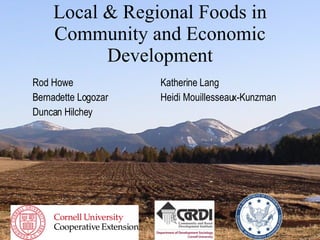
Local & Regional Foods in Community and Economic Development Rod Howe Katherine Lang Bernadette Logozar  Heidi Mouillesseaux-Kunzman Duncan Hilchey
NCRFI Starting Points Growing interest in local and regional food enterprises in Northern NY CCE Associations providing programmatic support for local/regional food businesses and consumers  CaRDI’s approach to Community and Economic Development assumes they go hand in hand EDA University Center funding Lang, 2007
NCRFI Objectives: Promote community and economic development in NNY through research-based support for local/regional foods initiatives Assessment of local/regional food impacts in NNY Development of regional community Outreach and Training Regionally coordinated activities Build on the NCRFI to promote regional community and economic development more generally . Lang, 2007
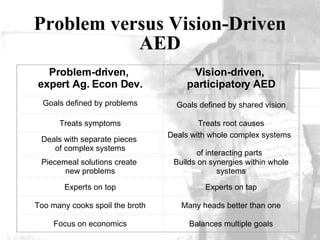
Problem versus Vision-Driven AED Problem-driven,  expert Ag. Econ Dev. Vision-driven,  participatory AED Goals defined by problems Goals defined by shared vision Treats symptoms Treats root causes Deals with separate pieces  of complex systems Deals with whole complex systems  of interacting parts Piecemeal solutions create  new problems Builds on synergies within whole systems Experts on top Experts on tap Too many cooks spoil the broth Many heads better than one Focus on economics Balances multiple goals
What are local/regional  food initiatives? Production and Consumption Lang, 2007
Agricultural economic development Increased profit making opportunities, financial and community support for agriculture. Marketing and Enterprise Development, Essex County Farmland Protection Plan. Actively seek and develop new opportunities to expand markets for local production, and to expand local production for these markets , Agricultural and Farmland Protection Plan for Clinton County.  Agricultural Market Development Initiative, St. Lawrence County Agricultural Development Plan. Lang, 2007
Examples Regional identity marketing Economic development strategy that “brings together agriculture, tourism, value-adding, and direct marketing [in a way that] capitalizes on a wide range of unique products from a geographically and culturally defined area.” Value-added Transforming a raw, undifferentiated agricultural product into a prepared item which consumers can more readily use. Demonstrating to customers shared values, social or environmental Lang, 2007 Source: Green, J. and D. Hilchey (2002).  Growing Home: A guide to Reconnecting Agriculture, Food and Communities. Community , Food and Agriculture Program, Cornell University.
How does it happen? Agritourism Direct marketing Retail sales Direct wholesale Wholesale Contract Cooperative Lang, 2007 Source: Green, J. and D. Hilchey (2002).  Growing Home: A guide to Reconnecting Agriculture, Food and Communities. Community , Food and Agriculture Program, Cornell University.
NCRFI Project Components Outreach and Networking Training Research Lang, 2007
Project Components Outreach and Networking Database of community and economic development professionals The Role of Adirondack-North Country Foods in Community and Economic Development Regional  Website and List Serv Follow-up presentations to community and economic development professionals Regular local/regional food press releases Lang, 2007
Project Components Training Implemented conference: “The Role of Adirondack-North Country Foods in Community and Economic Development” Three regional trainings on marketing & innovation Food Processing Identified   Farm to School (happening Nov. 17) Farmland Protection and Municipal Farmland Planning Production Skills Marketing Skills Lang, 2007
Research Methods Literature Review Secondary data analysis Primary data collection Lang, 2007
Secondary Data Analysis (based on data from Clinton, Essex, Franklin, Jefferson, Lewis, and St. Lawrence counties) Lang, 2007
Regional AG and FS Indicators Why indicators and benchmarking? Success depends on:  Consistency of data quality Commitment to update and refresh Limitations: Availability of data/use of proxies Errors in data collection Subjective interpretation of data
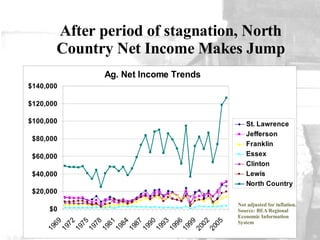
After period of stagnation, North Country Net Income Makes Jump Not adjusted for inflation. Source: BEA Regional Economic Information System
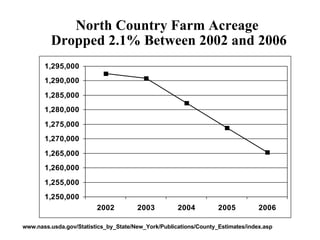
North Country Farm Acreage  Dropped 2.1% Between 2002 and 2006 www.nass.usda.gov/Statistics_by_State/New_York/Publications/County_Estimates/index.asp
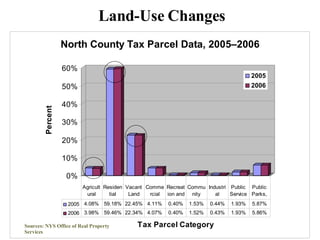
Land-Use Changes Sources: NYS Office of Real Property Services
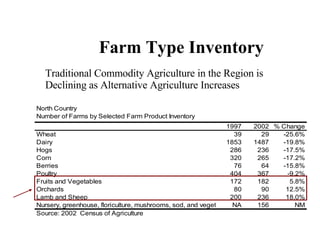
Farm Type Inventory Traditional Commodity Agriculture in the Region is Declining as Alternative Agriculture Increases
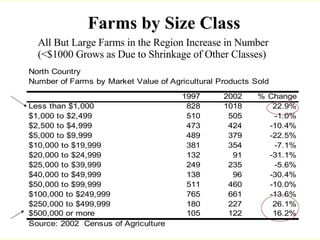
Farms by Size Class All But Large Farms in the Region Increase in Number (<$1000 Grows as Due to Shrinkage of Other Classes)
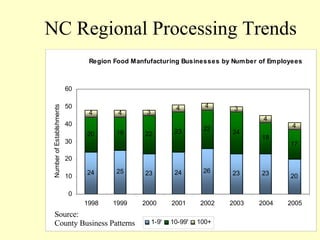
NC Regional Processing Trends Source:  County Business Patterns
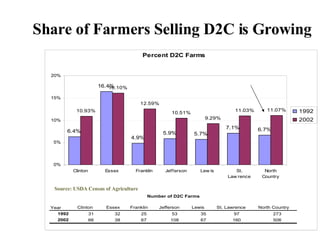
Share of Farmers Selling D2C is Growing Source: USDA Census of Agriculture
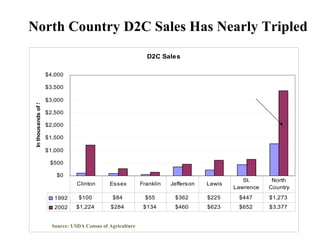
North Country D2C Sales Has Nearly Tripled Source: USDA Census of Agriculture
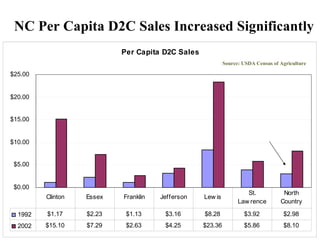
NC Per Capita D2C Sales Increased Significantly Source: USDA Census of Agriculture
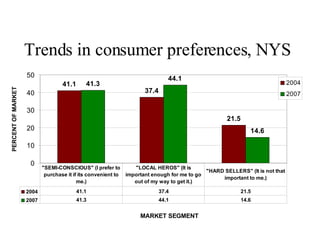
Trends in consumer preferences, NYS Lang, 2007 MARKET SEGMENT
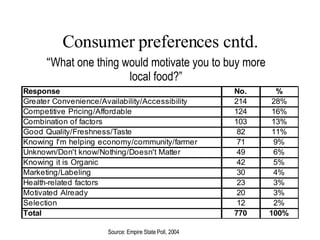
Consumer preferences cntd. Lang, 2007 Source: Empire State Poll, 2004 “ What one thing would motivate you to buy more local food?”
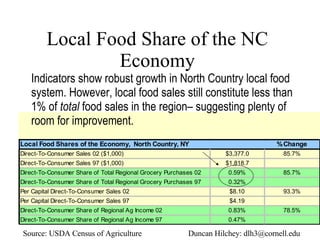
Local Food Share of the NC Economy Indicators show robust growth in North Country local food system. However, local food sales still constitute less than 1% of  total  food sales in the region– suggesting plenty of room for improvement. Duncan Hilchey: dlh3@cornell.edu Source: USDA Census of Agriculture
For More Information on AED Indicators and Benchmarking Duncan Hilchey AED Specialist 607-255-4413 dlh3 @cornell.edu
Lang, 2007 Primary Data Analysis: Interviews & Questionnaire
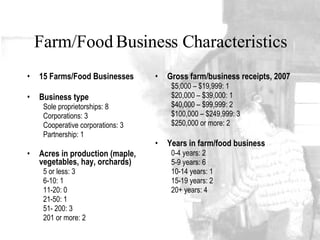
Farm/Food Business Characteristics 15 Farms/Food Businesses Business type Sole proprietorships: 8 Corporations: 3 Cooperative corporations: 3 Partnership: 1 Acres in production (maple, vegetables, hay, orchards) 5 or less: 3 6-10: 1 11-20: 0 21-50: 1 51- 200: 3 201 or more: 2 Gross farm/business receipts, 2007 $5,000 – $19,999: 1 $20,000 – $39,000: 1 $40,000 – $99,999: 2 $100,000 – $249,999: 3 $250,000 or more: 2 Years in farm/food business 0-4 years: 2 5-9 years: 6 10-14 years: 1 15-19 years: 2 20+ years: 4 Lang, 2007
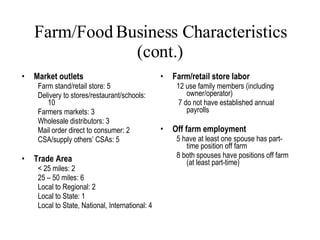
Farm/Food Business Characteristics (cont.) Market outlets Farm stand/retail store: 5 Delivery to stores/restaurant/schools: 10 Farmers markets: 3 Wholesale distributors: 3 Mail order direct to consumer: 2 CSA/supply others’ CSAs: 5 Trade Area < 25 miles: 2  25 – 50 miles: 6 Local to Regional: 2 Local to State: 1 Local to State, National, International: 4 Farm/retail store labor 12 use family members (including owner/operator) 7 do not have established annual payrolls Off farm employment 5 have at least one spouse has part-time position off farm 8 both spouses have positions off farm (at least part-time) Lang, 2007
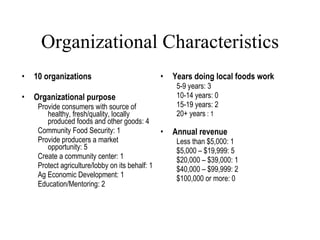
Organizational Characteristics 10 organizations Organizational purpose Provide consumers with source of healthy, fresh/quality, locally produced foods and other goods: 4 Community Food Security: 1 Provide producers a market opportunity: 5 Create a community center: 1 Protect agriculture/lobby on its behalf: 1 Ag Economic Development: 1 Education/Mentoring: 2 Years doing local foods work 5-9 years: 3 10-14 years: 0 15-19 years: 2 20+ years  : 1 Annual revenue Less than $5,000: 1 $5,000 – $19,999: 5 $20,000 – $39,000: 1 $40,000 – $99,999: 2 $100,000 or more: 0 Lang, 2007
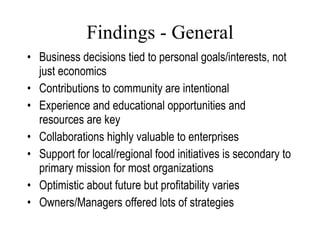
Findings - General Business decisions tied to personal goals/interests, not just economics Contributions to community are intentional Experience and educational opportunities and resources are key Collaborations highly valuable to enterprises Support for local/regional food initiatives is secondary to primary mission for most organizations Optimistic about future but profitability varies  Owners/Managers offered lots of strategies Lang, 2007
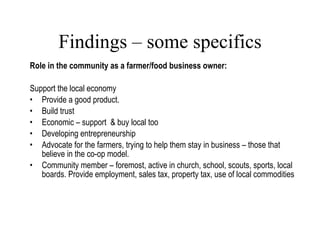
Findings – some specifics Role in the community as a farmer/food business owner: Support the local economy Provide a good product. Build trust Economic – support  & buy local too  Developing entrepreneurship Advocate for the farmers, trying to help them stay in business – those that believe in the co-op model. Community member – foremost, active in church, school, scouts, sports, local boards. Provide employment, sales tax, property tax, use of local commodities Lang, 2007
Findings – some specifics cont. Role in the community as a farmer/food business owner: Protect local resources Maintaining open space Protecting resources (seeds and livestock varieties, land, property rights, etc.) for local food production.  Returning fallow land to production/protecting water Responsible land stewardship (low chemical, erosion control, soil health) Maintaining agricultural knowledge base (practical/sensible passed on from experience)  Support and develop local food systems Meet the local community’s need/demand for local products Help build model for local production – consumption Be a role model for other communities. Promote public health Education Lang, 2007
Findings – some specifics, cntd. General feelings on profitability of direct marketing/local foods business: We are still not making a profit; We are working on niche markets in order not to always have to compete with large national companies. It’s been improving.  There’s as much if not more opportunity for growth in direct marketing than in wholesale apples. Took 10 years to be independent of outside job.  Profitability has been improving each year. Profitability has been improving – diversification has provided new opportunities, hard work – but positive outcomes and satisfying. Lang, 2007
Findings – some specifics, cntd. Impacts of your organizational work in support of local/regional food initiatives on the  individuals  and  communities  in the region you serve: Farm Viability -Having a successful market place encourages new people to start farming and start their own business with food and other local ag products.  Consumer Awareness/Access - Heightened awareness re: benefits of local food and of local food sources. Environmental – Food does not travel as far from farm to table (or hoof to mouth). Health – Developing healthy habits  Lang, 2007
Findings – some specifics, cntd. Identified future needs: Consumer education More farms to produce local supply Infrastructure  Collaboration Additional ‘support groups’ Reform of regulatory issues More information on institutional sales  Lang, 2007
Recommendations Specific to Enhancing: Farm and Food Businesses Community and Economic Development Both Businesses and Communities  Lang, 2007
Next Steps Share report broadly Share personally with local officials & community/economic developers Facilitate development of a regional plan Pursue further research to fill in knowledge gaps Use research to monitor and evaluate progress Lang, 2007
Contributors http://www.nnyagdev.org/ncrf-home.htm CaRDI Rod Howe (607) 255-2170  [email_address] Heidi Mouillesseaux-Kunzman (607) 255-0417 [email_address] Clinton County Amy Ivy  (518) 561-7450  [email_address] Essex County Anita Deming (518) 962-4810  [email_address] Hamilton County Nancy Welch (518) 548-6191 [email_address] Jefferson County Rosalind Cook (315) 788-8450  [email_address] Lewis County   Dolores DeSalvo (315) 376-5270 [email_address] Lang, 2007 Northern NY Agriculture Program Dave Smith [email_address] St. Lawrence County   Katherine Lang (315) 379-9192 [email_address] Franklin County Bernadette Logozar (518) 483-7403 [email_address]

Cornell Presentation

  • 1.
    Local & RegionalFoods in Community and Economic Development Rod Howe Katherine Lang Bernadette Logozar Heidi Mouillesseaux-Kunzman Duncan Hilchey
  • 2.
    NCRFI Starting PointsGrowing interest in local and regional food enterprises in Northern NY CCE Associations providing programmatic support for local/regional food businesses and consumers CaRDI’s approach to Community and Economic Development assumes they go hand in hand EDA University Center funding Lang, 2007
  • 3.
    NCRFI Objectives: Promotecommunity and economic development in NNY through research-based support for local/regional foods initiatives Assessment of local/regional food impacts in NNY Development of regional community Outreach and Training Regionally coordinated activities Build on the NCRFI to promote regional community and economic development more generally . Lang, 2007
  • 4.
    Problem versus Vision-DrivenAED Problem-driven, expert Ag. Econ Dev. Vision-driven, participatory AED Goals defined by problems Goals defined by shared vision Treats symptoms Treats root causes Deals with separate pieces of complex systems Deals with whole complex systems of interacting parts Piecemeal solutions create new problems Builds on synergies within whole systems Experts on top Experts on tap Too many cooks spoil the broth Many heads better than one Focus on economics Balances multiple goals
  • 5.
    What are local/regional food initiatives? Production and Consumption Lang, 2007
  • 6.
    Agricultural economic developmentIncreased profit making opportunities, financial and community support for agriculture. Marketing and Enterprise Development, Essex County Farmland Protection Plan. Actively seek and develop new opportunities to expand markets for local production, and to expand local production for these markets , Agricultural and Farmland Protection Plan for Clinton County. Agricultural Market Development Initiative, St. Lawrence County Agricultural Development Plan. Lang, 2007
  • 7.
    Examples Regional identitymarketing Economic development strategy that “brings together agriculture, tourism, value-adding, and direct marketing [in a way that] capitalizes on a wide range of unique products from a geographically and culturally defined area.” Value-added Transforming a raw, undifferentiated agricultural product into a prepared item which consumers can more readily use. Demonstrating to customers shared values, social or environmental Lang, 2007 Source: Green, J. and D. Hilchey (2002). Growing Home: A guide to Reconnecting Agriculture, Food and Communities. Community , Food and Agriculture Program, Cornell University.
  • 8.
    How does ithappen? Agritourism Direct marketing Retail sales Direct wholesale Wholesale Contract Cooperative Lang, 2007 Source: Green, J. and D. Hilchey (2002). Growing Home: A guide to Reconnecting Agriculture, Food and Communities. Community , Food and Agriculture Program, Cornell University.
  • 9.
    NCRFI Project ComponentsOutreach and Networking Training Research Lang, 2007
  • 10.
    Project Components Outreachand Networking Database of community and economic development professionals The Role of Adirondack-North Country Foods in Community and Economic Development Regional Website and List Serv Follow-up presentations to community and economic development professionals Regular local/regional food press releases Lang, 2007
  • 11.
    Project Components TrainingImplemented conference: “The Role of Adirondack-North Country Foods in Community and Economic Development” Three regional trainings on marketing & innovation Food Processing Identified Farm to School (happening Nov. 17) Farmland Protection and Municipal Farmland Planning Production Skills Marketing Skills Lang, 2007
  • 12.
    Research Methods LiteratureReview Secondary data analysis Primary data collection Lang, 2007
  • 13.
    Secondary Data Analysis(based on data from Clinton, Essex, Franklin, Jefferson, Lewis, and St. Lawrence counties) Lang, 2007
  • 14.
    Regional AG andFS Indicators Why indicators and benchmarking? Success depends on: Consistency of data quality Commitment to update and refresh Limitations: Availability of data/use of proxies Errors in data collection Subjective interpretation of data
  • 15.
    After period ofstagnation, North Country Net Income Makes Jump Not adjusted for inflation. Source: BEA Regional Economic Information System
  • 16.
    North Country FarmAcreage Dropped 2.1% Between 2002 and 2006 www.nass.usda.gov/Statistics_by_State/New_York/Publications/County_Estimates/index.asp
  • 17.
    Land-Use Changes Sources:NYS Office of Real Property Services
  • 18.
    Farm Type InventoryTraditional Commodity Agriculture in the Region is Declining as Alternative Agriculture Increases
  • 19.
    Farms by SizeClass All But Large Farms in the Region Increase in Number (<$1000 Grows as Due to Shrinkage of Other Classes)
  • 20.
    NC Regional ProcessingTrends Source: County Business Patterns
  • 21.
    Share of FarmersSelling D2C is Growing Source: USDA Census of Agriculture
  • 22.
    North Country D2CSales Has Nearly Tripled Source: USDA Census of Agriculture
  • 23.
    NC Per CapitaD2C Sales Increased Significantly Source: USDA Census of Agriculture
  • 24.
    Trends in consumerpreferences, NYS Lang, 2007 MARKET SEGMENT
  • 25.
    Consumer preferences cntd.Lang, 2007 Source: Empire State Poll, 2004 “ What one thing would motivate you to buy more local food?”
  • 26.
    Local Food Shareof the NC Economy Indicators show robust growth in North Country local food system. However, local food sales still constitute less than 1% of total food sales in the region– suggesting plenty of room for improvement. Duncan Hilchey: dlh3@cornell.edu Source: USDA Census of Agriculture
  • 27.
    For More Informationon AED Indicators and Benchmarking Duncan Hilchey AED Specialist 607-255-4413 dlh3 @cornell.edu
  • 28.
    Lang, 2007 PrimaryData Analysis: Interviews & Questionnaire
  • 29.
    Farm/Food Business Characteristics15 Farms/Food Businesses Business type Sole proprietorships: 8 Corporations: 3 Cooperative corporations: 3 Partnership: 1 Acres in production (maple, vegetables, hay, orchards) 5 or less: 3 6-10: 1 11-20: 0 21-50: 1 51- 200: 3 201 or more: 2 Gross farm/business receipts, 2007 $5,000 – $19,999: 1 $20,000 – $39,000: 1 $40,000 – $99,999: 2 $100,000 – $249,999: 3 $250,000 or more: 2 Years in farm/food business 0-4 years: 2 5-9 years: 6 10-14 years: 1 15-19 years: 2 20+ years: 4 Lang, 2007
  • 30.
    Farm/Food Business Characteristics(cont.) Market outlets Farm stand/retail store: 5 Delivery to stores/restaurant/schools: 10 Farmers markets: 3 Wholesale distributors: 3 Mail order direct to consumer: 2 CSA/supply others’ CSAs: 5 Trade Area < 25 miles: 2 25 – 50 miles: 6 Local to Regional: 2 Local to State: 1 Local to State, National, International: 4 Farm/retail store labor 12 use family members (including owner/operator) 7 do not have established annual payrolls Off farm employment 5 have at least one spouse has part-time position off farm 8 both spouses have positions off farm (at least part-time) Lang, 2007
  • 31.
    Organizational Characteristics 10organizations Organizational purpose Provide consumers with source of healthy, fresh/quality, locally produced foods and other goods: 4 Community Food Security: 1 Provide producers a market opportunity: 5 Create a community center: 1 Protect agriculture/lobby on its behalf: 1 Ag Economic Development: 1 Education/Mentoring: 2 Years doing local foods work 5-9 years: 3 10-14 years: 0 15-19 years: 2 20+ years : 1 Annual revenue Less than $5,000: 1 $5,000 – $19,999: 5 $20,000 – $39,000: 1 $40,000 – $99,999: 2 $100,000 or more: 0 Lang, 2007
  • 32.
    Findings - GeneralBusiness decisions tied to personal goals/interests, not just economics Contributions to community are intentional Experience and educational opportunities and resources are key Collaborations highly valuable to enterprises Support for local/regional food initiatives is secondary to primary mission for most organizations Optimistic about future but profitability varies Owners/Managers offered lots of strategies Lang, 2007
  • 33.
    Findings – somespecifics Role in the community as a farmer/food business owner: Support the local economy Provide a good product. Build trust Economic – support & buy local too Developing entrepreneurship Advocate for the farmers, trying to help them stay in business – those that believe in the co-op model. Community member – foremost, active in church, school, scouts, sports, local boards. Provide employment, sales tax, property tax, use of local commodities Lang, 2007
  • 34.
    Findings – somespecifics cont. Role in the community as a farmer/food business owner: Protect local resources Maintaining open space Protecting resources (seeds and livestock varieties, land, property rights, etc.) for local food production. Returning fallow land to production/protecting water Responsible land stewardship (low chemical, erosion control, soil health) Maintaining agricultural knowledge base (practical/sensible passed on from experience) Support and develop local food systems Meet the local community’s need/demand for local products Help build model for local production – consumption Be a role model for other communities. Promote public health Education Lang, 2007
  • 35.
    Findings – somespecifics, cntd. General feelings on profitability of direct marketing/local foods business: We are still not making a profit; We are working on niche markets in order not to always have to compete with large national companies. It’s been improving. There’s as much if not more opportunity for growth in direct marketing than in wholesale apples. Took 10 years to be independent of outside job. Profitability has been improving each year. Profitability has been improving – diversification has provided new opportunities, hard work – but positive outcomes and satisfying. Lang, 2007
  • 36.
    Findings – somespecifics, cntd. Impacts of your organizational work in support of local/regional food initiatives on the individuals and communities in the region you serve: Farm Viability -Having a successful market place encourages new people to start farming and start their own business with food and other local ag products. Consumer Awareness/Access - Heightened awareness re: benefits of local food and of local food sources. Environmental – Food does not travel as far from farm to table (or hoof to mouth). Health – Developing healthy habits Lang, 2007
  • 37.
    Findings – somespecifics, cntd. Identified future needs: Consumer education More farms to produce local supply Infrastructure Collaboration Additional ‘support groups’ Reform of regulatory issues More information on institutional sales Lang, 2007
  • 38.
    Recommendations Specific toEnhancing: Farm and Food Businesses Community and Economic Development Both Businesses and Communities Lang, 2007
  • 39.
    Next Steps Sharereport broadly Share personally with local officials & community/economic developers Facilitate development of a regional plan Pursue further research to fill in knowledge gaps Use research to monitor and evaluate progress Lang, 2007
  • 40.
    Contributors http://www.nnyagdev.org/ncrf-home.htm CaRDIRod Howe (607) 255-2170 [email_address] Heidi Mouillesseaux-Kunzman (607) 255-0417 [email_address] Clinton County Amy Ivy (518) 561-7450 [email_address] Essex County Anita Deming (518) 962-4810 [email_address] Hamilton County Nancy Welch (518) 548-6191 [email_address] Jefferson County Rosalind Cook (315) 788-8450 [email_address] Lewis County Dolores DeSalvo (315) 376-5270 [email_address] Lang, 2007 Northern NY Agriculture Program Dave Smith [email_address] St. Lawrence County Katherine Lang (315) 379-9192 [email_address] Franklin County Bernadette Logozar (518) 483-7403 [email_address]

Editor's Notes

  • #2 A project of the Cornell Cooperative Extension Associations of Clinton, Essex, Franklin, Hamilton, Jefferson, Lewis and St. Lawrence counties and the Economic Development Administration University Center at Cornell’s Community and Rural Development Institute (CaRDI) Using the New York State Adirondack-North Country Regional Foods Initiative (NCRFI) as a case study this workshop will address the positive ways in which local food businesses and community-based initiatives can contribute to regional economic and social well-being.  The initiatives partnership included campus-based faculty and staff, seven Cornell Cooperative Extension Associations in the region, community and economic development professionals and state and local government officials, with the understanding that the local food sector might serve as a starting point for broader community and economic development.