Local Food Assessment & Economic Development


 Presenter: Leslie Schaller   leslies@acenetworks.org
Why People Want Local
 Food quality

 Greater food safety and traceability

 Reducing one’s food footprint

 Creating and retaining businesses and livelihoods

 Greater social cohesion and sense of community
Favorable Trends
• Buy Local, Buy Fresh ---- Branding

• Local is the new organic

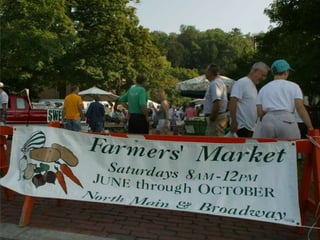
• Exponential growth of farmers markets

• Celebrating Rural & Regional Flavor

• Country is re-examining our values

• Foodies and ‘locavores’ spread the word

• $$$ for infrastructure on the way -- USDA
Local food opportunities
  Demand and supply for local food has grown in
   recent years despite the recession

  In 2011, over 85% of consumers reported that they
   choose a grocery store on whether or not they
   stock local food

  In 2011 there were over 7,000 farmers markets
   compared to 340 in 1970 & more than 4,000 CSAs

  The USDA estimates local food sales to reach $7
   billion in 2012
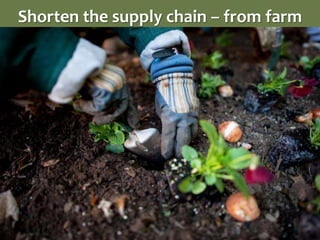
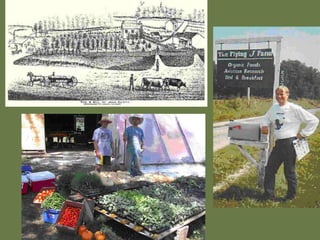
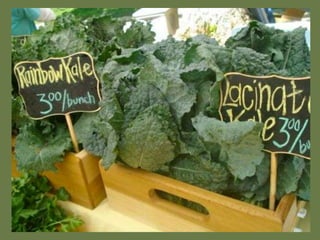
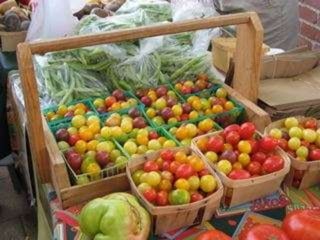
Shorten the supply chain – from farm
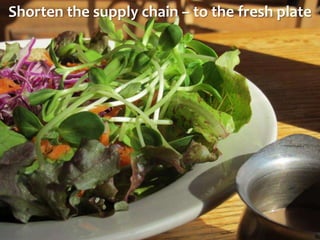
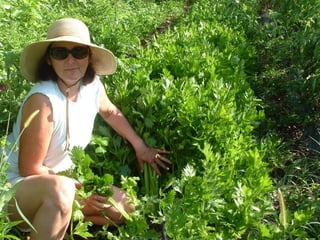
Shorten the supply chain – to the fresh plate
What is the recipe for
 local food system
 economic impact?
Food Brand Strategy
 Brand strategy interdependent with business
  development services and food sector incubation

 Brands are market driven by supply chain demand &
  consumer education

 Brands rooted in local value chain model as theory of
  change

 Brands provide perceived value for entrepreneurs to
  participate in training & evaluation
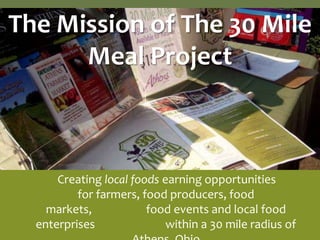
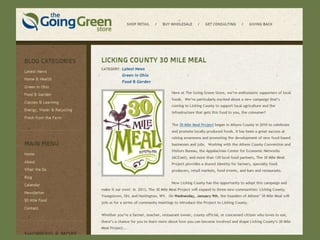
The Mission of The 30 Mile
      Meal Project


      Creating local foods earning opportunities
          for farmers, food producers, food
    markets,            food events and local food
  enterprises               within a 30 mile radius of
 Recognizable identity within the region
 Effective marketing tools that drive collaboration
  & new partnerships
 Created buzz in the region as food economy
  strategy
 Opportunity for peer networks & licensing of
  brand strategy
 Multiple public & private funding streams to
  prototype 30 Mile Meal efforts
Replicating the 30 Mile Meal
     Our first 30 Mile Meal Pioneers:
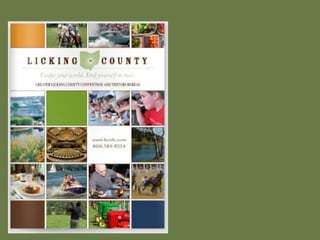
           Licking County, Ohio
       Huntington, West Virginia
            Youngstown, Ohio
What We’ve
 Learned
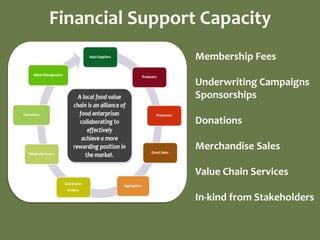
Financial Support Capacity
                 Membership Fees

                 Underwriting Campaigns
                 Sponsorships

                 Donations

                 Merchandise Sales

                 Value Chain Services

                 In-kind from Stakeholders
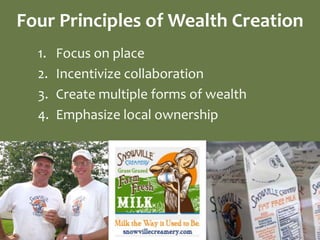
Four Principles of Wealth Creation
  1.   Focus on place
  2.   Incentivize collaboration
  3.   Create multiple forms of wealth
  4.   Emphasize local ownership
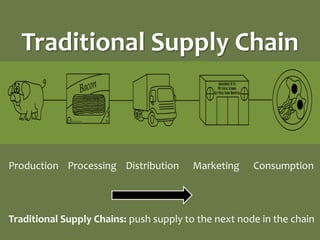
Traditional Supply Chain


Production Processing Distribution      Marketing     Consumption


Traditional Supply Chains: push supply to the next node in the chain
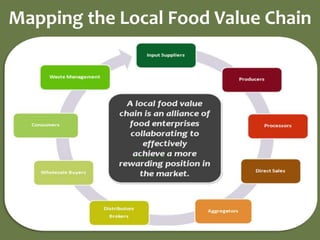
Mapping the Local Food Value Chain
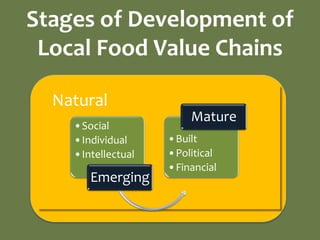
Stages of Development of
 Local Food Value Chains

  Natural
                        Mature
    •Social
    •Individual     •Built
    •Intellectual   •Political
                    •Financial
       Emerging
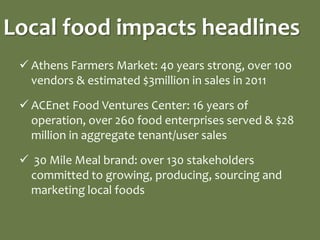
Local food impacts headlines
  Athens Farmers Market: 40 years strong, over 100
   vendors & estimated $3million in sales in 2011

  ACEnet Food Ventures Center: 16 years of
   operation, over 260 food enterprises served & $28
   million in aggregate tenant/user sales

  30 Mile Meal brand: over 130 stakeholders
  committed to growing, producing, sourcing and
  marketing local foods
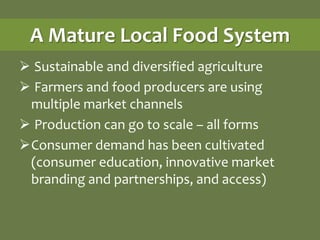
A Mature Local Food System
 Sustainable and diversified agriculture
 Farmers and food producers are using
 multiple market channels
 Production can go to scale – all forms
Consumer demand has been cultivated
 (consumer education, innovative market
 branding and partnerships, and access)
Collaborating for mutual benefit
 The wealth creation approach is not about charity but about
  meeting market needs. Making economic connections in ways
  that create mutual benefit

 It emphasizes the values that areas naturally share with external
  markets. These might be clean water, healthy food, vibrant
  families, healthy soil, reduced energy use, etc.

 Creating economic connections based on shared values leads
  naturally to mutual benefit. Value chains can create win-win
  situations for everyone along the chain

 The focus of this approach is on how people in low-wealth places
  can benefit from the wealth they help to create
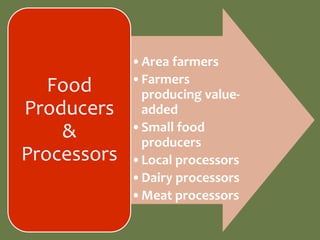
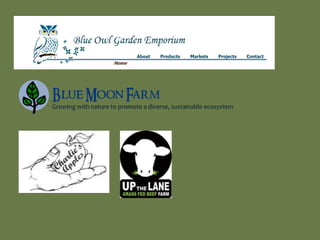
•Area farmers
             •Farmers
   Food       producing value-
Producers     added
    &        •Small food
              producers
Processors   •Local processors
             •Dairy processors
             •Meat processors
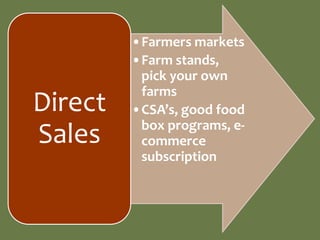
•Farmers markets
         •Farm stands,
          pick your own
          farms
Direct   •CSA’s, good food
          box programs, e-
Sales     commerce
          subscription
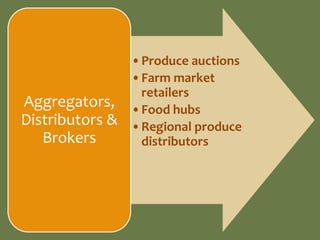
•Produce auctions
                 •Farm market
                  retailers
Aggregators,     •Food hubs
Distributors &   •Regional produce
   Brokers        distributors
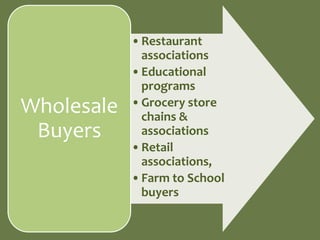
• Restaurant
              associations
            • Educational
              programs
Wholesale   • Grocery store
              chains &
 Buyers       associations
            • Retail
              associations,
            • Farm to School
              buyers
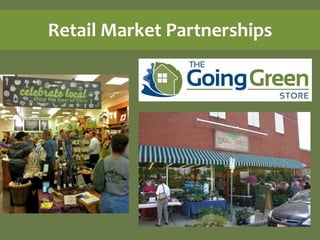
Retail Market Partnerships
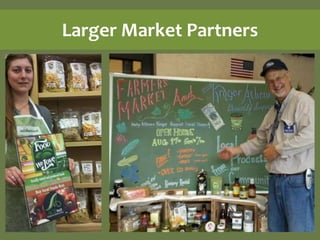
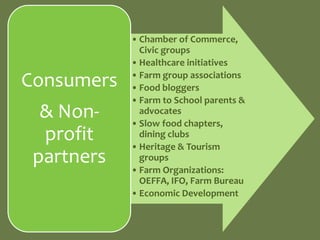
Larger Market Partners
• Chamber of Commerce,
              Civic groups
            • Healthcare initiatives
            • Farm group associations
Consumers   • Food bloggers
            • Farm to School parents &
  & Non-      advocates
            • Slow food chapters,
  profit      dining clubs
            • Heritage & Tourism
 partners     groups
            • Farm Organizations:
              OEFFA, IFO, Farm Bureau
            • Economic Development
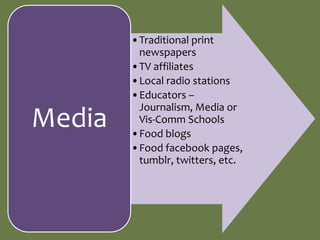
•Traditional print
         newspapers
        •TV affiliates
        •Local radio stations
        •Educators –
         Journalism, Media or
Media    Vis-Comm Schools
        •Food blogs
        •Food facebook pages,
         tumblr, twitters, etc.
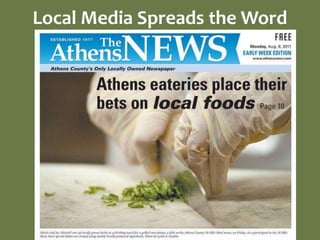
Local Media Spreads the Word
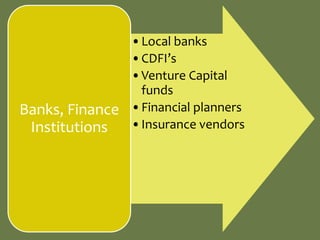
•Local banks
               •CDFI’s
               •Venture Capital
                funds
Banks, Finance •Financial planners
 Institutions •Insurance vendors
Emphasizing investment
  for long-term gain
 Much of traditional development focuses on
  short-term consumption: how much money
  people have to buy things today

 A focus exclusively on consumption cannot
  build a sustainable system

 Continual reinvestment in assets is necessary to
  produce tomorrow’s income
Mapping Our Local Assets
 Each of communities have unique assets
 Assets vary between emerging &
 established food economies
 Often assessment starts with stakeholders
 in the inner circle of the value chain
 Support stakeholders of equal importance
 to the viability of the brand program

Morning session w leslie

  • 1.
    Local Food Assessment& Economic Development Presenter: Leslie Schaller leslies@acenetworks.org
  • 2.
    Why People WantLocal Food quality Greater food safety and traceability Reducing one’s food footprint Creating and retaining businesses and livelihoods Greater social cohesion and sense of community
  • 5.
    Favorable Trends • BuyLocal, Buy Fresh ---- Branding • Local is the new organic • Exponential growth of farmers markets • Celebrating Rural & Regional Flavor • Country is re-examining our values • Foodies and ‘locavores’ spread the word • $$$ for infrastructure on the way -- USDA
  • 6.
    Local food opportunities  Demand and supply for local food has grown in recent years despite the recession  In 2011, over 85% of consumers reported that they choose a grocery store on whether or not they stock local food  In 2011 there were over 7,000 farmers markets compared to 340 in 1970 & more than 4,000 CSAs  The USDA estimates local food sales to reach $7 billion in 2012
  • 8.
    Shorten the supplychain – from farm
  • 9.
    Shorten the supplychain – to the fresh plate
  • 10.
    What is therecipe for local food system economic impact?
  • 11.
    Food Brand Strategy Brand strategy interdependent with business development services and food sector incubation  Brands are market driven by supply chain demand & consumer education  Brands rooted in local value chain model as theory of change  Brands provide perceived value for entrepreneurs to participate in training & evaluation
  • 12.
    The Mission ofThe 30 Mile Meal Project Creating local foods earning opportunities for farmers, food producers, food markets, food events and local food enterprises within a 30 mile radius of
  • 13.
     Recognizable identitywithin the region  Effective marketing tools that drive collaboration & new partnerships  Created buzz in the region as food economy strategy  Opportunity for peer networks & licensing of brand strategy  Multiple public & private funding streams to prototype 30 Mile Meal efforts
  • 14.
    Replicating the 30Mile Meal Our first 30 Mile Meal Pioneers: Licking County, Ohio Huntington, West Virginia Youngstown, Ohio
  • 15.
  • 16.
    Financial Support Capacity Membership Fees Underwriting Campaigns Sponsorships Donations Merchandise Sales Value Chain Services In-kind from Stakeholders
  • 17.
    Four Principles ofWealth Creation 1. Focus on place 2. Incentivize collaboration 3. Create multiple forms of wealth 4. Emphasize local ownership
  • 18.
    Traditional Supply Chain ProductionProcessing Distribution Marketing Consumption Traditional Supply Chains: push supply to the next node in the chain
  • 19.
    Mapping the LocalFood Value Chain
  • 20.
    Stages of Developmentof Local Food Value Chains Natural Mature •Social •Individual •Built •Intellectual •Political •Financial Emerging
  • 21.
    Local food impactsheadlines  Athens Farmers Market: 40 years strong, over 100 vendors & estimated $3million in sales in 2011  ACEnet Food Ventures Center: 16 years of operation, over 260 food enterprises served & $28 million in aggregate tenant/user sales  30 Mile Meal brand: over 130 stakeholders committed to growing, producing, sourcing and marketing local foods
  • 22.
    A Mature LocalFood System  Sustainable and diversified agriculture  Farmers and food producers are using multiple market channels  Production can go to scale – all forms Consumer demand has been cultivated (consumer education, innovative market branding and partnerships, and access)
  • 23.
    Collaborating for mutualbenefit  The wealth creation approach is not about charity but about meeting market needs. Making economic connections in ways that create mutual benefit  It emphasizes the values that areas naturally share with external markets. These might be clean water, healthy food, vibrant families, healthy soil, reduced energy use, etc.  Creating economic connections based on shared values leads naturally to mutual benefit. Value chains can create win-win situations for everyone along the chain  The focus of this approach is on how people in low-wealth places can benefit from the wealth they help to create
  • 24.
    •Area farmers •Farmers Food producing value- Producers added & •Small food producers Processors •Local processors •Dairy processors •Meat processors
  • 32.
    •Farmers markets •Farm stands, pick your own farms Direct •CSA’s, good food box programs, e- Sales commerce subscription
  • 34.
    •Produce auctions •Farm market retailers Aggregators, •Food hubs Distributors & •Regional produce Brokers distributors
  • 35.
    • Restaurant associations • Educational programs Wholesale • Grocery store chains & Buyers associations • Retail associations, • Farm to School buyers
  • 36.
  • 37.
  • 39.
    • Chamber ofCommerce, Civic groups • Healthcare initiatives • Farm group associations Consumers • Food bloggers • Farm to School parents & & Non- advocates • Slow food chapters, profit dining clubs • Heritage & Tourism partners groups • Farm Organizations: OEFFA, IFO, Farm Bureau • Economic Development
  • 40.
    •Traditional print newspapers •TV affiliates •Local radio stations •Educators – Journalism, Media or Media Vis-Comm Schools •Food blogs •Food facebook pages, tumblr, twitters, etc.
  • 42.
  • 43.
    •Local banks •CDFI’s •Venture Capital funds Banks, Finance •Financial planners Institutions •Insurance vendors
  • 70.
    Emphasizing investment for long-term gain  Much of traditional development focuses on short-term consumption: how much money people have to buy things today  A focus exclusively on consumption cannot build a sustainable system  Continual reinvestment in assets is necessary to produce tomorrow’s income
  • 71.
    Mapping Our LocalAssets  Each of communities have unique assets  Assets vary between emerging & established food economies  Often assessment starts with stakeholders in the inner circle of the value chain  Support stakeholders of equal importance to the viability of the brand program

Editor's Notes

  • #7 Value chain overview
  • #19 Comparing traditional supply chain
  • #22 Value chain overview
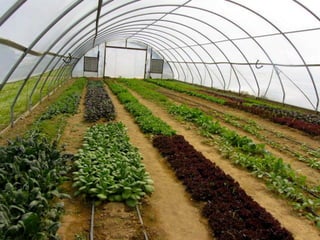
  • #23 What production looks like