Market Forces
C R E AT I N G J O B S T H R O U G H P U B L I C I N V E S T M E N T
     IN LOC AL AND REGIONAL FOOD SYSTEMS
Market Forces
CREATING JOBS THROUGH PUBLIC INVESTMENT
   IN LOCAL AND REGIONAL FOOD SYSTEMS


              Jeffrey K. O’Hara


              AUGUST 2011
ii   UNION OF CONCERNED SCIENTISTS


           © 2011 Union of Concerned Scientists
           All rights reserved

           Je rey K. O’Hara is an agricultural economist in the Union
           of Concerned Scientists Food and Environment Program.

              e Union of Concerned Scientists (UCS) is the leading science-based
           nonpro t working for a healthy environment and a safer world. UCS
           combines independent scienti c research and citizen action to develop
           innovative practical solutions and to secure responsible changes in
           government policy, corporate practices, and consumer choices.

              e goal of the UCS Food and Environment Program is a food system
           that encourages innovative and environmentally sustainable ways to
           produce high-quality, safe, and a ordable food while ensuring that
           citizens have a voice in how their food is grown.

           More information is available on the UCS website at www.ucsusa.org/
           food_and_agriculture.

             is report is available in PDF format on the UCS website
           (www.ucsusa.org/publications) or may be obtained from:

                UCS Publications
                2 Brattle Square
                Cambridge, MA 02238-9105

           Or, email pubs@ucsusa.org or call (617) 547-5552.


           Design:
           DG Communications, Acton, MA
           www.Nonpro tDesign.com

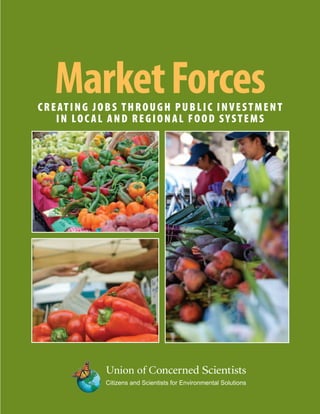
           Cover images:
           (top left & right) © iStockphoto.com/Bruce Block;
           (lower left) © iStockphoto.com/Eric Delmar

           Printed on recycled paper
MARKET FORCES   iii


Table of Contents
Figures and Tables                                                                        iv
Acknowledgments                                                                            v


E X E C U T I V E S U M M A RY                                                            1

CHAPTER 1
Description of Local Food Systems                                                         6
Types of Direct Marketing                                                                 6
Demand for Local Food                                                                     7
Supply of Local Food                                                                      7
Farmers Markets                                                                           9
Community-Supported Agriculture                                                          10
Local and Regional Food Systems Have Scalability Challenges                              10


CHAPTER 2
Supporting Local and Regional Food Systems Is Sound Policy                               14
Objectives of Government                                                                 14
Local and Regional Food Systems Can Support Public Objectives                            14
Local and Regional Food Systems and Food Security                                        15


CHAPTER 3
Local and Regional Food Systems Provide Positive Regional Economic Impacts               16
Quantifying the Economic Impacts of an Industry or Sector                                16
Direct Marketing Can Foster Regional Economic Development                                17
Local and Regional Food Systems Can Result in Sector-Specific Economic Growth            18
Economic Impacts of Farm-to-School Programs                                              21
Farmers Markets Can Increase Sales at Neighboring Businesses                             21
Local and Regional Food Systems Can Increase Business Innovation and Entrepreneurship    22
Responses to Arguments against Supporting Local-Food-System Development                  22
iv   UNION OF CONCERNED SCIENTISTS


     CHAPTER 4
     Local and Regional Food Systems Can Have Positive Social, Health, and Environmental Impacts           23
     Local Food Systems Can Promote Healthier Food-Product Choices                                         23
     Local Food Systems Can Reduce the Environmental Footprint of Our Overall Food System                  25
     Local Food Systems Can Promote Community Interaction                                                  26


     CHAPTER 5
     Investing in Local and Regional Food Systems and Creating Jobs                                        27
     Initial Funding Can Help New Farmers Markets Succeed                                                  27
     Programs that Support Local and Regional Food Systems                                                 28
     Determining the Economic Implications of Supporting Farmers Markets                                   30


     CHAPTER 6
     Conclusions and Policy Recommendations                                                                32


     REFERENCES                                                                                            34


     F I G U R E S A N D TA B L E S
     Figures
     ES-1. U.S. Farmers Market Locations, 2010                                                              5
     1. Small Farms Account for a Greater Proportion of Agricultural Product Sales from Direct Marketing    8
     2. Products Sold by Vendors at Farmers Markets                                                         8
     3. Percentage of Farmers Markets with Labeled Products                                                 9
     4. The Number of Farmers Markets in the United States Has Increased Rapidly                            9
     5. Marketing Assistance Needs Identified by Farmers Market Vendors                                    12
     6. Food Products Sold at Food Hubs                                                                    13
     7. U.S. Principal Operator by Age: Farmers Are Aging                                                  16
     8. U.S. Agricultural Acreage by Product: Fruits and Vegetables Account for a Small Fraction of Land   19


     Tables
     1. States with the Greatest Number of Farmers Markets Per Capita                                      10
     2. Economic Impacts of Farmers Markets                                                                18
     3. Economic Impacts of Increased Fruit and Vegetable Consumption                                      20
     4. Potential Employment Impacts of Reauthorizing the Federal Farmers Market Promotion Program         31
MARKET FORCES   v


Acknowledgments
   is report was made possible in part through the generous support
of the David B. Gold Foundation, the New York Community Trust, the
Clif Bar Family Foundation, the Tomchin Family Charitable Foundation,
the Deer Creek Foundation, and UCS members.

For their reviews of the report, the author would like to thank David
Swenson of Iowa State University, David Hughes of Clemson University,
Larry Lev of Oregon State University, and Stacy Miller of the Farmers
Market Coalition. e time involved in reviewing a paper of this length
is considerable, and their comments and suggestions greatly improved it.

At UCS, the author thanks Margaret Mellon and Karen Perry Stillerman
for the many useful suggestions they provided. eir advice, encouragement,
and helpful editing in uenced the report’s nal form.

We would also like to thank Steven J. Marcus for copyediting the report
and David Gerratt for his design and layout.

   e opinions and information contained in this report, being the sole
responsibility of the author, do not necessarily re ect those of the
foundations that supported it or the individuals who reviewed and
commented on it.
MARKET FORCES                                1


Executive Summary


                                                                                                                        © iStockphoto.com/Bruce Block
When strolling through a local farmers market you may      surprising data on their potential to create jobs in those
well be struck by the many ways in which the food          communities. Finally, the report addresses some chal-
o ered for sale di ers from typical mass-produced and      lenges that local and regional food systems must meet
-marketed food products. For starters, healthful pro-      if they are to grow further, and it recommends public
duce items dominate the farmers market, and they are       policies that could help promote and expand these
typically fresher and more avorful than supermarket        systems in the future.
produce. Moreover, the presence of the farmers puts a
face on who grew the food and re ects where and how        THE RISE OF LOCAL AND REGIONAL
it was grown.                                              FOOD SYSTEMS
    Less apparent to the casual shopper, however, are      Markets for locally and regionally produced food are
the important economic bene ts that farmers mar-           now ubiquitous across the United States. Most of them
kets—and the local and regional food systems behind        emerged over the last several decades through the tire-
them—can provide to rural and urban communities            less e orts of entrepreneurs, community organizers,
alike. In this report, the Union of Concerned Scientists   farmers, and food and farm policy advocates. In par-
(UCS) explores the recent remarkable growth of             ticular, farmers markets and community-supported
farmers markets and other manifestations of local and      agriculture systems (CSAs)—in which consumers
regional food systems, describes key features of these     buy shares of local farm harvests in advance and then
systems, evaluates their economic and other impacts        routinely reap the bene ts in the form of fresh food—
on the communities in which they operate, and o ers        have expanded rapidly and are now established as family-

                   Conservative estimates by the U.S. Department of
              Agriculture (USDA) suggest that more than 136,000 farms are
                 currently selling food products directly to consumers.
2   UNION OF CONCERNED SCIENTISTS


          The USDA, in its “MyPlate” dietary                          through direct consumer marketing channels reached
                                                                      $1.2 billion in 2007.
          guidelines, recommends that Americans                              e demand for local food has been driven by
          eat significantly more fruits and                           consumers who wish to support local farms and other
                                                                      businesses, to purchase healthful food that is fresh and
          vegetables; in many regions, local
                                                                      tends to be sustainably produced, to interact with
          farmers could grow a substantial                            farmers, and to learn more about the food they grow
          portion of this additional produce.                         and that consumers eat. e enthusiasm for local and
                                                                      regional foods has also arisen, at least in part, as a back-
                                                                      lash against the de ciencies of our consolidated food
                                                                      production, processing, and distribution system.
          shopping venues in many cities and towns. Schools,             Local and regional food-product sales often occur
          restaurants, supermarkets, and other mainstream insti-      through direct marketing channels. For example, a
          tutions are also buying food from local farmers. As a       farmer could sell food products either directly to a
          result, innovative farmers are able to develop and expand   consumer, such as at a farmers market, at a roadside
          businesses that generate income in rural communities.       stand, or through a CSA; or directly to a retail institu-
              Most of these markets were independently conceived      tion, such as a restaurant, grocery store, or school.
          as grassroots initiatives, and as such each of them con-    Farmers who sell their food through direct marketing
          tributes uniquely to its community. ese achievements        channels tend to operate smaller farms with a variety
          have been particularly remarkable in that they have         of products, such as fruits and vegetables; engage in
          been mostly self-su cient—realized without the gov-         entrepreneurial activities; and follow environmentally
          ernment subsidies that the increasingly consolidated        sustainable production practices. ese farmers can of-
          mainstream food system receives.                            ten earn greater pro ts by selling their products through
                 is report shows that local and regional food sys-    local food systems than by selling them to a wholesaler
          tems could expand further, with the potential for cre-      in the consolidated food system. In addition, the op-
          ating tens of thousands of jobs in rural communities—       portunity to interact with consumers provides these
          many of which are struggling economically—and               farmers with rsthand information on the demand
          in urban communities as well. For example, the U.S.         for their products.
          Department of Agriculture (USDA), in its “MyPlate”
          dietary guidelines, recommends that Americans eat           2. The economic, environmental, and
          signi cantly more fruits and vegetables; in many re-        health impacts of local and regional food
          gions, local farmers could grow a substantial portion       systems depend on how consumers’
          of this additional produce in peak growing season. Re-      purchasing decisions are altered.
          gional food systems could also increase market access          ere are a multitude of reasons for seeking local and
          for regional meat and dairy producers, thereby helping      regional alternatives to the current consolidated U.S.
          to foster competition in markets that have experienced      food system. For one thing, that system accounts for
          signi cant consolidation in recent decades. Overall, the    16 percent of the country’s energy use and is a signi -
          expansion of local and regional food systems could          cant contributor to climate change. For another, the
          complement the nation’s existing mechanisms for food        overconsumption of unhealthful processed foods con-
          production, distribution, and consumption. Greater          tributes to Americans’ increased rates of weight gain
          investment in local and regional food systems would         and obesity, which have considerable health conse-
          thus be an essential step for agriculture policies that     quences and large associated societal costs.
          seek to support such economic activity.                        Fresh fruits and vegetables are particularly well suited
              Among the report’s major ndings are:                    to distribution through direct marketing because they
                                                                      are mostly unprocessed. Communities could see health
          1. Local and regional food systems are an                   bene ts if patrons of local-food markets consequently
          expanding part of our food system.                          ate more of these healthful but underconsumed items.
          Local and regional food-product markets have grown             ere could also be environmental bene ts from re-
          rapidly in recent years and have become entrenched.         duced energy usage if diets shifted to eating unprocessed
             e number of farmers markets in the United States         food as a substitute for heavily processed foods.
          increased from just 340 in 1970 to more than 7,000             While more research is needed to demonstrate how
          today, and there are now more than 4,000 CSAs. e            consumers’ shopping behavior may be altered as a result
          USDA reports that the sales of agricultural products        of buying foods produced nearby, available evidence
MARKET FORCES   3


                                                                                                                                © iStockphoto.com/Bruce Block
Modest public funding for 100 to                            labor, have little access to capital, and are nonpro t in-
                                                            stitutions. Even a small amount of support could help
500 otherwise-unsuccessful farmers                          a farmers market become stabilized through, say, the
markets a year could create as many as                      hiring of a market manager, the installation of an elec-
                                                            tronic bene t transfer machine, and outreach e orts.
13,500 jobs over a five-year period.                        For example, modest public funding for 100 to 500
                                                            otherwise-unsuccessful farmers markets a year could
suggests that local and regional food systems could help    create as many as 13,500 jobs over a ve-year period.
promote the consumption of these products.                      Local and regional food systems could also lead to
                                                            job growth through other marketing channels—for
3. Local and regional food systems can have                 example, when greater consumption of fresh fruits and
positive e ects on regional economies.                      vegetables draws on produce supplied locally or region-
   e expansion of local and regional food systems sup-      ally. Various studies have suggested that this phenom-
ports employment, incomes, and output in rural com-         enon could lead to thousands more jobs in the Midwest
munities. Direct marketing channels, such as farmers        alone, even if land allocated to fruits and vegetables
markets, stimulate rural economies because a greater        displaced some production of corn and soybeans. ese
percentage of the sales revenue is retained locally. Fur-   kinds of positive economic results could also occur in
ther, farmers may purchase equipment and raw mate-          other geographic regions or for other food-product
rials from local suppliers. Such transactions increase      sectors, such as meat and dairy.
labor and consequently household incomes, which re-
sult in additional spending. An important nding from        4. Local and regional food systems have
the literature is that under various scenarios, further     scalability challenges, some of which can
expansion of local and regional food systems has the        be addressed through public policy.
potential to create tens of thousands of additional jobs.   While local and regional food systems have become
    One approach to increasing local and regional food-     more prominent, several challenges remain that could
product sales is to support the development of direct       hinder further development. ere are geographic
marketing channels. Such support is invaluable because      and seasonal limitations—owing to climate variation
establishing a local-food market, such as a farmers mar-    and soil attributes—on the extent to which local and
ket, can be a daunting exercise—many farmers markets        regional food systems can be established. ere also
are community-based and -initiated, rely on volunteer       must be an appropriate balance of urban populations
4   UNION OF CONCERNED SCIENTISTS


          and rural land to ensure that there is both an adequate                                 that they provide to larger-scale commodity crop
          demand and su cient supply. Such balance is particu-                                    farmers. More scale-appropriate mechanisms for pro-
          larly important for meat and dairy products, which                                      viding whole-farm revenue insurance and credit, for
          may require scale for production.                                                       example, would be helpful to many small farmers who
              Moreover, while direct consumer marketing has been                                  produce food for local and regional consumption.
          a common method to date for selling locally produced                                       Some of these challenges (among the aforemen-
          food, it too can have scale limitations. Local institu-                                 tioned and elsewhere) could be addressed through
          tions, processing infrastructure, or regulations may                                    forward-thinking policies and sound investments re-
          be inadequate—e.g., lacking su cient capacity—for                                       lated to farms, food, and local development. We now
          allowing local and regional food systems to prosper.                                    identify such public policy solutions.
             us the cultivation of additional institutional arrange-
          ments, which has occurred with schools but could also                                   RECOMMENDATIONS
          apply to mainstream supermarkets and other sectors,                                     While the number and in uence of local and regional
          is important. Speci cally, innovations such as “food                                    food systems have grown substantially, many issues
          hubs”—locations at which farmers can drop o local-                                      must be resolved if they are to continue increasing in
          ly produced food and distributors and consumers can                                     scale and become more integrated into the existing food
          pick it up—are promising options.                                                       system. Further, future e orts to expand local and re-
              An additional challenge is that existing USDA pro-                                  gional food systems should aim to complement and
          grams may be inadequate for providing the same type                                     reinforce—not substitute for—already established
          of support and assistance to local-food-system farmers                                  local-food-market institutions, such as farmers markets
                                                                                                  or CSAs.
                                                                                                     Speci cally, the Union of Concerned Scientists
                                                                                                  recommends that:

                                                                                                  Congress and the USDA, in coordination with
                                                                                                  other relevant agencies, should increase funding
                                                                                                  for programs that support local and regional
                                                                                                  food systems.
                                                                                                     ree types of programs, if funded at increased levels,
                                                                                                  could foster the continued growth of local and region-
                                                                                                  al food systems: (1) rural development programs that
                                                                                                  provide funds for investing in infrastructure to support
                                                                                                  local and regional food systems; (2) programs that of-
                                                                                                  fer assistance to farmers market managers, schools, and
                                                                                                  other local-food-system administrators; and (3) nutri-
                                                                                                  tion programs that provide nancial assistance to low-
                                                                                                  income consumers who wish to purchase healthful food
                                                                                                  at local-food markets.
                                                                                                      Moreover, among the multiple federal agencies that
                                                                                                  administer the various programs that support and
                                                                                                  promote local food systems, continued and improved
                                                                                                  coordination is critically important. By organizing pro-
                                                                                                  grams within one title in the federal farm bill, Congress
                                                                                                  could e ectively bring together these seemingly dis-
                                                                                                  parate programs while also raising the pro le of local
                                                                                                  and regional food systems.

                                                                                                  The USDA, together with academic and other
                                                                       © iStockphoto/Thinkstock


                                                                                                  policy institutes, should raise the level of research
                                                                                                  on the impacts of local and regional food systems,
                                                                                                  particularly regarding their expansion.
                                                                                                  Funding more research for local and regional food sys-
                                                                                                  tems is essential for e ective future agricultural policy,
MARKET FORCES       5


Figure ES-1. U.S. Farmers Market Locations, 2010


                                                                                                                                     Source: Agricultural Marketing Service 2010.
This map shows the distribution of thousands of farmers markets across the country, in all 50 states and the District of Columbia.

and obtaining more precise data on marketing channels         commodities, would be bene cial. In addition, ensur-
for local and regional food sales is especially important.    ing that farmers selling through local food systems have
Other research priorities include the study of how the        access to a ordable credit, either from Farm Credit
installation of farmers markets and other local-food          System banks or from state nancing authorities, could
outlets in uences consumers’ shopping habits relative         allow these farmers to develop and expand their
to their behavior in the absence of such markets, and         businesses. Lastly, cost-share programs that provide as-
the e ects on low-income people of nutrition programs         sistance to organic farmers in obtaining certi cation
that facilitate patronage of farmers markets.                 could also help them sell food products in local and
   In addition, research on the feasibility of establish-     regional markets.
ing local and regional food systems on a greater scale
in speci ed areas would help identify where some of           Local governments and community organizations
the most signi cant economic impacts could be real-           should foster local capacity to help implement
ized. Such research would feature comparisons of the          local and regional food-system plans.
potential regional supply (based, for example, on soil           e establishment of local and regional food systems
characteristics, land availability, and climate conditions)   requires a good deal of local e ort and coordination.
with the potential demand (based on population, con-          When funding is available, there must be evidence that
sumer preferences, and income). is line of research           local capacity is su cient to absorb it and that local
could also illuminate the land-use implications of local      food initiatives have reasonable prospects for success.
food systems geared to increase production of fruits,         In addition, assistance should be provided to prospec-
vegetables, or other food products.                           tive applicants for developing business plans, conduct-
                                                              ing outreach, and seeking funding opportunities.
Congress and the USDA should restructure the
safety net and ensure credit accessibility for                Farmers market administrators should support
local-food-system farmers.                                    the realization of farmers market certi cation
Many attributes of existing agricultural programs are         standards.
not well suited to supporting farms and other produc-            e development of certi cation standards by farmers
ers that market their food within localized systems.          market administrators could help ensure the integrity
For example, insurance focused on single crops, as is         of direct-to-consumer marketing systems. Standards
typical, is not convenient for farmers growing a suc-         provide con dence to consumers that vendors are
cession of vegetables throughout the growing season.          involved in the production of the food they sell and
   us the development of whole-farm revenue insur-            are undertaking environmentally sustainable produc-
ance, as an alternative to crop insurance for speci ed        tion practices.
6   UNION OF CONCERNED SCIENTISTS


          CHAPTER 1

          Description of Local Food Systems


                                                                                                                                 © iStockphoto.com/Bruce Block


          As major segments of the U.S. industrialized food sys-    TYPES OF DIRECT MARKETING
          tem have consolidated and become increasingly remote          ere are multiple de nitions of local and regional food
          from consumers, an alternative food system—one that       systems. Certain federal programs de ne them as sys-
          offers locally produced food—has emerged. This            tems that market food either less than 400 miles from
          section describes the various types of such direct mar-   its origin or within the state where it was produced.
          keting mechanisms, why some consumers demand              Local food systems are also associated with marketing
          locally produced food, the kinds of farmers that pro-     arrangements whereby farmers sell products directly to
          duce and sell it, the marketing channels used and the     a consumer or retailer without using a wholesale sup-
          institutions involved, and obstacles that must be over-   plier. Although “direct marketing” is often used as a
          come for local and regional food systems to increase      proxy for “local food systems”—because it is easier to
          their sales and also to become more integrated into the   de ne and measure, and also because there is consid-
          existing food system.                                     erable overlap at present—the two concepts are distinct.
MARKET FORCES   7


Food sold via direct marketing does not have to be                        • Lack of awareness of the existence of local food
locally produced, and vice versa.                                           markets
    One type of direct marketing involves a farmer sell-                  • Inaccessibility, inconvenience, or lack of proximity
ing food directly to consumers—at a roadside stand,                       • Higher prices (whether perceived or actual) for
U-pick operation, or farmers market, for example, or                        locally produced food
through subscription programs known as community-                         • Lack of variety of food, or too-small quantities
supported agriculture (CSA). A New York study found
that full-time direct marketing farmers used a variety                    Food retailers have additional challenges associated with
of direct marketing channels, while part-time direct                      purchasing local food, such as in ordering, delivery,
marketing farmers reported a greater percentage of sales                  and reliability. Nonetheless, for retailers and consum-
in farmers markets (Lyson, Gillespie, and Hilchey                         ers alike, the obstacles cited are not associated with the
1995). In 2007, 136,817 farms sold agricultural prod-                     desirability of the food product.
ucts directly to individuals for human consumption,
with sales totaling $1.2 billion (USDA 2009, Table                        SUPPLY OF LOCAL FOOD
58), although challenges associated with measuring                        Some farmers can obtain greater revenue by selling food
direct marketing sales suggest that this number is un-                    via direct marketing in local markets than by selling
derstated (e.g., Brown 2002). e reported number of                        food to wholesalers. at is, direct marketing allows
farms engaged in direct consumer marketing in 2007                        local food producers to retain most, if not all, of the
represented a 17 percent increase from 2002. Although                     revenue from the retail sale of their product; they can
6 percent of all farms are involved in direct consumer                    receive up to seven times greater net revenue on a per-
sales, they account for only 0.4 percent of total agri-                   unit basis from selling locally than in conventional
cultural sales.                                                           markets (King et al. 2010). ese advantages can have
    Instead of selling directly to consumers, farmers                     important nancial implications for farmers, as mar-
could sell food directly to either a retail facility or                   keting costs accounted for 84 percent of the U.S. retail
food service institution, thus bypassing the wholesale                    sales value of food products in 2008 (Canning 2011).
distribution system. For example, a farmer could sell                     However, they must also market the product them-
products directly to a grocery store, restaurant, hospi-                  selves, which can incur unpaid labor costs of 13 per-
tal, or school. Institutional marketing is generally more                 cent to 62 percent of the retail price (King et al. 2010).
feasible for a group of farmers, which underscores the                    Some consumers may be willing to pay a higher price
importance of developing cooperative structures.                          for locally produced food, although food products will
                                                                          generally need to have other attributes, such as being
DEMAND FOR LOCAL FOOD                                                     grown through sustainable production practices, to
   ere are various reasons why some consumers and re-                     receive a premium (King et al. 2010). Farmers may also
tailers are purchasing locally produced food. According                   engage in direct marketing for the opportunity to
to a recent literature review (Martinez et al. 2010),                     socially interact with consumers and retain indepen-
these buyers:                                                             dence from intermediary purchasers, processors, and
• Believe local food is fresher                                           retailers. Finally, a major bene t of direct marketing is
• Believe local food is of better quality                                 that farmers can obtain rsthand, real-time feedback
• Want to support local businesses and producers                          about products that customers desire, and then can
• Want to know the source of the food                                     adapt their business accordingly.
• Want food with greater nutritional value                                   Who are the farmers who supply food to local
• Prefer food grown through environmentally                               food markets? We discuss four characteristics of these
    sustainable practices (e.g., organic)                                 farmers, using direct consumer marketing as a proxy
• Enjoy the shopping experience                                           for local food sales.
• Can obtain a greater variety of food
• Can pay lower prices                                                    Farmers Who Engage in Direct Consumer
                                                                          Marketing Tend to Operate Smaller1 Farms
As reported by the same researchers, the largest ob-                      Figure 1 (p. 8) shows that farms of fewer than 50
stacles that consumers cite for not buying local food                     acres account for 29 percent of U.S. direct consumer-
include:                                                                  marketing agricultural sales, but only 2 percent of total

1   “Smaller” may apply either to farm revenue or acreage. Starr et al. (2003) and Hunt (2007), in case studies in Colorado and Maine,
    respectively, found that direct marketing farmers produced their food on small-acreage farms.
8   UNION OF CONCERNED SCIENTISTS


          Figure 1. Small Farms Account for a Greater                                                                                farmers accounted for 57 percent of the value of direct
          Proportion of Agricultural Product Sales                                                                                   consumer marketing sales (USDA 2009).
          from Direct Marketing
          100%                                                                                                                       Farmers Who Engage in Direct Consumer Mar-
           90%                                                                                                                       keting Tend to be Fruit and Vegetable Producers
           80%                                                                                                                       Fruits and vegetables are well suited to direct market-
           70%
                                                                                                                                     ing because they require little processing. Vegetable/
                                                                                                                                     melon and fruit/tree-nut producers each account for
           60%
                                                                                                                                     28 percent of the value of all agricultural products sold
           50%
                                                                                                                                     via direct consumer marketing (USDA 2009). Forty-
           40%
                                                                                                                                     four percent of all vegetable and melon producers sell
           30%
                                                                                                                                     directly to consumers, as do 17 percent of fruit and nut
           20%                                                                                                                       producers, but only 7 percent of livestock producers
           10%                                                                                                                       and 2 percent of those growing non-fruit-or-vegetable
            0%                                                                                                                       crops (grains, for example) seek direct consumer sales
                                 Direct Marketing                                          Total Sales
                                                                                                                                     (Martinez et al. 2010). Figure 2 shows that 92 percent
               1,000 acres or more                            50 to 999 acres                       1 to 49 acres                    of farmers markets have vendors who sell fresh fruits
          Source: USDA 2009.
                                                                                                                                     and vegetables, while 45 percent of vendors at farmers
                                                                                                                                     markets sell fresh fruits and vegetables.
          agricultural sales, and these percentages are respec-
          tively 62 percent and 30 percent for farms of 50 to 999                                                                    Farmers Who Engage in Direct Consumer
          acres. Similarly, according to the USDA’s 2007 Cen-                                                                        Marketing Tend to Engage in Environmentally
          sus of Agriculture, farmers with less than $250,000 in                                                                     Sustainable Production Practices2
          annual sales represented 96 percent of the farms that                                                                      Figure 3 shows that common product labels at farmers
          engaged in direct consumer marketing, and those                                                                            markets include “locally grown,” “organic,” “chemical-


          Figure 2. Products Sold by Vendors at Farmers Markets
                          100%
                          90%
                                                                                                                                                                    % of U.S. farmers markets
                          80%                                                                                                                                       selling selected products
                          70%                                                                                                                                       % of U.S. vendors selling selected
                                                                                                                                                                    products at farmers markets
                          60%
                          50%
                          40%

                          30%
                          20%
                          10%

                             0%
                                              es                       s              es                     s             g                    y              ds             ds                       y                 d        r
                                           bl                   er                  rv                   od             kin               ltr                 o              o                   air                 fo
                                                                                                                                                                                                                        o      he
                                       et
                                          a                   ow                es
                                                                                   e              go               or                 po
                                                                                                                                         u                 fo             fo                    d
                                                                                                                                                                                                                  ea         Ot
                                                                                              d                                                        d              d                      or                  s
                                   ve
                                      g
                                                         nd                   pr            ke                   dw             to
                                                                                                                                  r                 re              se                 ilk                  or
                                                       a                  d            Ba                   oo                                 ep
                                                                                                                                                  a              es                M
                              nd                    bs                 an                                 rw                  ea             Pr                oc                                   Fis
                                                                                                                                                                                                        h
                             a                  r                 s,                                                     M                                   Pr
                       its                He                   ut                                   ts
                                                                                                         o
                    fru                                      ,n                                af
                h                                          ey                                Cr
             es                                        n
           Fr                                       Ho
          Source: Ragland and Tropp 2009.


           2   See also Starr et al. 2003 and Hunt 2007.
MARKET FORCES                   9


free” or “pesticide-free,” “natural,” “pasture-raised/free-                Figure 3. Percentage of Farmers Markets
range,” and “hormone-free” or “antibiotic-free.” ese                       with Labeled Products
labels are intended for education and marketing pur-                        70%
poses, as consumers use this information to decide
whether to purchase food.                                                   60%
    Local food markets are particularly important for                       50%
organic producers. More than 17 percent of USDA-                            40%
organic products are sold through direct consumer and
                                                                            30%
retail marketing (USDA 2010; USDA 2009). Organ-
ic direct-marketing farmers earned 75 percent on aver-                      20%
age more than their nonorganic counterparts, and they                       10%
sold a larger quantity of commodities than organic                                        0%
farmers who did not engage in direct marketing                                                                      y                             e/                            d/               /         r
                                                                                                                 all n          ic                            al                              ee        he
                                                                                                              oc ow           an               re
                                                                                                                                            l-f free        ur              ise            -fr free   Ot
(Martinez et al. 2010). In any case, organic farming                                                         L r           rg                            at              ra              e
                                                                                                                         O               ica e-        N              e- e             on ic-
has important implications for supporting more food                                                            g
                                                                                                                                     emticid                     st ur rang         r m iot
production: 78 percent of organic farmers stated in                                                                                Ch es                      Pa ree-           Ho ntib
                                                                                                                                    p                           f                  a
2008 that they intended to maintain or expand their                        Source: Ragland and Tropp 2009.
organic operations over the next ve years.3
                                                                           Figure 4. The Number of Farmers Markets in
Farmers Who Engage in Direct Consumer                                      the United States Has Increased Rapidly
Marketing Tend to Operate Diverse Farms and                                                                 8,000
Undertake Entrepreneurial Activities
Small farms with direct sales often grow multiple prod-                                                     7,000
                                                                          Number of U.S. Farmers’ Markets


ucts (Starr et al. 2003). Farms that engage in direct
                                                                                                            6,000
marketing with no additional on-farm entrepreneurial
activities earn $6,844 in average direct sales per farm,                                                    5,000
but farms that engage in three additional on-farm en-
                                                                                                            4,000
trepreneurial activities earn $28,651 (Martinez et al.
2010). Small farms involved in direct marketing con-                                                        3,000
stitute 28 percent of farmers that produce on-farm
value-added goods such as processed products; such                                                          2,000
farms also constitute 33 percent of participants in CSAs                                                    1,000
and 49 percent of organic producers (Martinez et al.
2010). Farmers market vendors have expanded exist-                                                              0
ing product lines, begun additional processing, devel-
                                                                                                                    94

                                                                                                                    96

                                                                                                                    98

                                                                                                                    00

                                                                                                                    02

                                                                                                                    04

                                                                                                                    06

                                                                                                                    08

                                                                                                                   09

                                                                                                                   10

                                                                                                                   11
                                                                                                                 19

                                                                                                                 19

                                                                                                                 19

                                                                                                                 20

                                                                                                                 20

                                                                                                                 20

                                                                                                                 20

                                                                                                                 20

                                                                                                                 20

                                                                                                                 20

                                                                                                                 20
oped mailing lists, made new business contacts, and                        Source: USDA 2011b.
sharpened their customer relations, merchandising, and
pricing skills (Feenstra et al. 2003).                                     designed to allow farmers to directly sell their products
                                                                           to consumers.
FARMERS MARKETS                                                               Farmers markets once constituted a conventional
We examine farmers markets in more detail in this sec-                     channel for selling fresh food in the United States,
tion because of their role as a potential keystone of                      particularly in cities. roughout the early and middle
emerging local food systems (Gillespie et al. 2007),                       parts of the twentieth century, the number of farmers
their unique role in facilitating direct marketing—sales                   markets decreased as the food system consolidated, in-
at farmers markets exceeded $1 billion in 2005 (Rag-                       terstate highways were developed, and large irriga-
land and Tropp 2009)—and the superior data about                           tion projects allowed produce to be grown far away
farmers markets in comparison to other local food mar-                     from consumers. By 1970, only 340 farmers markets
kets. While no consistent legal de nition of farmers                       were left in the country (Brown 2001). is trend has
markets yet exists (Briggs et al. 2010), they are gen-                     reversed itself in recent decades, however. Figure 4
erally conceptualized as structured market settings                        indicates that the number of farmers markets in the


3   Online at www.agcensus.usda.gov/Publications/2007/Online_Highlights/Fact_Sheets/organics.pdf, accessed July 2, 2011.
10   UNION OF CONCERNED SCIENTISTS


           Table 1. States with the Greatest Number                             rules requiring that vendors sell products that they
           of Farmers Markets Per Capita                                        produce themselves (Ragland and Tropp 2009).

                                                       # of Farmers             COMMUNITY SUPPORTED AGRICULTURE
               Rank              State                   Markets                A CSA system is traditionally an arrangement whereby
                1              Vermont                       84
                                                                                a consumer purchases a “share” of on-farm produce
                                                                                from a farmer early in the year and receives a weekly
                2           North Dakota                     56                 delivery of fresh produce throughout the growing sea-
                3                Iowa                       232
                                                                                son (e.g., UCS 2009; Brown and Miller 2008). Fruits
                                                                                and vegetables typically predominate, though other
                4          New Hampshire                     90                 farm products can be included as well. e bene ts to
                5               Hawaii                       83
                                                                                farmers are that they receive payment for their prod-
                                                                                ucts earlier in the calendar year before harvest, they can
                6               Maine                        77                 mitigate the e ects of price or production risks that
                7             Wyoming                        30
                                                                                could occur during the growing season, and by having
                                                                                completed their marketing before growing season they
                8              Montana                       48                 can focus exclusively on production. Consumers may
                9          Washington, DC                    28
                                                                                prefer this approach because it enables them to support
                                                                                local farmers, obtain food that may be fresher than
                10               Idaho                       65                 store-bought, and learn more information from farm-
                                                                                ers about how the food is grown. CSA models have
                                                                                evolved over time, and some now do not require that
                                                                                consumers buy a share in advance or allow customized
           United States grew to 1,755 by 1994 and reached 6,132                ordering. One directory estimates that there are cur-
           by 2010, and there are currently 7,146 operating farm-               rently over 4,000 CSAs in the United States.5
           ers markets.
               Table 1 shows the states with the greatest number                LOCAL AND REGIONAL FOOD SYSTEMS
           of farmers markets on a per-capita basis and demon-                  HAVE SCALABILITY CHALLENGES
           strates that farmers markets can occur in regions of the             While local and regional food systems are experiencing
           country that do not have large urban centers. Many of                growing sales volume, barriers exist to increasing their
           these states are located in the Midwest (Iowa, North                 scale. In this section we discuss some of the most
           Dakota), northern New England (Maine, New Hamp-                      serious barriers: challenges pertaining to geographic
           shire, and Vermont), and the Rocky Mountain West                     limitations; impediments to the e ectiveness of direct
           (Idaho, Montana, and Wyoming). is nonurban-                          marketing; inadequate institutions, infrastructure, and
           occurrence phenomenon also holds at the county                       regulations for facilitating local and regional food
           level, as rural areas have a greater density of farmers              systems; and inadequate agricultural programs for
           markets on a per-capita basis than do urban areas.4                  assisting local-food-system farmers.
           However, these ndings do not imply that there are
           higher per-capita purchases of local food in rural areas.            Geographic Limitations
               A farmers market can be administered by some                     Geographic limitations suggest that food systems could
           other organization or else become its own organization.              be more e ective at regional levels than at exclusively
              e level and sophistication of a farmers market bureau-            local levels (e.g., Clancy and Ruhf 2010). First, region-
           cracy is generally proportional to its size (Stephenson,             al systems can expand product availability throughout
           Lev, and Brewer 2007). Forty to 45 percent of member                 the year as a result of varying growing seasons within
           associations in the Farmers Market Coalition are reg-                a region. is local variation can also help mitigate
           istered as 501(c)(3) nonpro t organizations (Briggs et               seasonal bottlenecks at processing facilities by having
           al. 2010). Most farmers markets are operated on a                    utilization occur over a longer period. Seasonal uc-
           seasonal basis (consistent with the growing season),                 tuations in demand for particular products may exist
           tend to be in an outdoor public location, and establish              as well.


           4   See map online at www.ers.usda.gov/AmberWaves/December10/Indicators/On eMap.htm, accessed July 2, 2011.
           5   Online at www.localharvest.org/csa, accessed July 3, 2011.
MARKET FORCES            11


    Second, while farmers markets are well established
in some rural areas, regional food markets may be bet-
ter for products that require scale for production. In
particular, the construction of processing facilities, such
as slaughterhouses and dairy bottling plants, incur xed
costs that require a su cient customer base to ensure
they are economical—and rural areas may have too few
consumers to purchase the resulting products. On the
other hand, in localities that are predominately urban
there may be insu cient land to grow food because
agriculture may not be pro table on land that is rela-
tively expensive.
       e solution appears to lie between these two ex-
tremes. Local and regional food systems may have their
greatest opportunity for scale in regions that have ur-
ban population centers with close proximity to rural
areas boasting available farmland (Timmons and Wang
2010). Eighty-four percent of the farms that engage
in direct marketing are in metropolitan counties or in
rural counties adjacent to metro counties, and direct-
sales revenue per farm increases as farms become closer
to metro regions (Martinez et al. 2010).
    Research that identi ed regions with the greatest
scope for local and regional food systems could be in-
valuable in supporting regional economic development.
Such research is needed to identify regions that have
both the capability to supply local food (i.e., they have
the appropriate climate and available farmland with
the needed soil characteristics) and su cient demand                                                                            © Claire Bloomberg/Bloomberg Photography

to support local food purchases (i.e., metropolitan                       the net number of farmers markets in Oregon increased
areas with su cient population, income, and con-                          by 30, with 62 new markets opening and 32 markets
sumer preferences). e undertaking of such research                        closing (Stephenson, Lev, and Brewer 2008).
projects is a priority.                                                      Such turnover is not surprising, as establishing a
                                                                          farmers market can be a daunting task. Critical deci-
Challenges Associated with Direct Marketing                               sions involve market viability; vendor standards;
Direct consumer marketing has grown over the past                         market administration; risk management associated
15 years and may continue to grow in the near future,                     with insurance, liability, permitting, taxes, and regula-
though limitations exist on the extent to which the                       tion; marketing and outreach; and market infrastruc-
numbers of farmers markets and other direct consumer                      ture investments.6 Other direct consumer marketing
marketing channels can increase (e.g., Ragland and                        barriers include meeting food safety and processing
Tropp 2009). ese limitations arise because the de-                        regulations, facilitating payments for low-income pa-
centralized and uncoordinated nature of local food                        trons with coupons, and understanding local zoning
markets sometimes presents logistical, awareness, and                     rules and business permit requirements (Tropp and
accessibility challenges to consumers.                                    Barham 2008). Figure 5 (p. 12) summarizes challenges
                                                                          that farmers market vendors have identi ed with respect
Farmers markets                                                           to the administration of markets once they are es-
While the net number of farmers markets has increased                     tablished. ese challenges include advertising and
dramatically over the past 20 years, there can be con-                    publicity, local-food promotion campaigns, consumer
siderable ux, with markets opening and closing on a                       targeting, displays, information on customer prefer-
continuing basis. For example, between 1998 and 2005                      ences and demographics, and business plan development.


6   Online at farmersmarketcoalition.org/managerfaqs/#marketingsta , accessed July 3, 2011.
12     UNION OF CONCERNED SCIENTISTS


Figure 5. Marketing Assistance Needs Identi ed                                                  larly critical institutional channel to fostering greater
by Farmers Market Vendors                                                                       product sales is through mainstream supermarkets
90%
                                                                                                (King, Gomez, and DiGiacomo 2010). e lack of
                                                                                                  nancial support, time, and infrastructure are the most
80%
                                                                                                common barriers that farmers face in direct marketing
70%
                                                                                                to institutions, implying that farmer co-ops or other
60%                                                                                             such groups may be essential to addressing these chal-
50%                                                                                             lenges (Martinez et al. 2010; Vogt and Kaiser 2008).
40%                                                                                             However, aggregation of food from di erent farmers
30%                                                                                             can lead to obstacles in identifying the source of the
20%
                                                                                                food, should that be necessary (Martinez et al. 2010).
10%
                                                                                                Food hubs
  0%
                d            n             g                    g            g             s    A food hub is a drop-o point for farmers and a pick-
             an y          io s         tin rs              sin           tin ch         es g
            g licit      ot ign       ge me              di             ke ear       sin nin    up location for distributors and customers. It permits
         in           om pa          r                 n             ar            Bu lan
      tis ub        Pr am         Ta nsu            ha              M res                       the purchase of source-identi ed local and regional
   ver p              c            co          e rc                                 p
Ad                                           M                                                  food, coordinates supply-chain logistics, and is a facil-
                                                                                                ity for food to be stored, lightly processed, and pack-
Source: Ragland and Tropp 2009.
                                                                                                aged so that it can be sold under the hub’s regional
                                                                                                label. As such, food hubs contribute to the expansion
                       Farmers market organizers or institutions may                            of local and regional food markets.
                   charge vendor fees to cover the costs associated with                               e USDA has identi ed more than 100 food hubs
                   market administration, but breaking even on costs can                        (USDA 2011a), many of which are legally organized
                   be challenging, particularly in the early years of estab-                    by nonpro t groups or public-sector entities. Sixty per-
                   lishment. Most farmers markets operate on shoestring                         cent of these food hubs have been operating less than
                   budgets, with the median annual operating budget                               ve years and on average they have 13 employees each.
                   being about $2,000. As a consequence, 59 percent of                          Food hub customers include restaurants, grocery stores,
                   farmers markets rely exclusively on volunteer workers,                       colleges or universities, food cooperatives, distributors,
                   and 39 percent have a paid manager with no other                             school food-service providers, and multi-farm CSAs.
                   employees (Ragland and Tropp 2009). In some loca-                            Figure 6 shows that while fresh produce is the most
                   tions, extension-service personnel ll the management                         frequent product sold at food hubs, at least 60 percent
                   function at no charge. Nevertheless, having a paid                           also sell eggs, dairy, poultry, and meat. Innovative mar-
                   manager is an important sign that the farmers market                         keting arrangements could be encouraged as food hubs
                   is nancially viable, as mean sales at markets with                           expand. For example, virtual supermarkets could allow
                   paid managers are ve times higher than at those with                         consumers to order food products online from a local
                   unpaid managers (Ragland and Tropp 2009).                                    farmer and pick them up the following day.
                       Meat and poultry also have unique direct consumer
                   marketing challenges. Consumers may have food safe-                          Local Capacity to Support Local and
                   ty concerns about meat in an open-air market or may                          Regional Food Systems
                   lack a cooler for transporting frozen meat products (Lev                        ree types of capacity must be fostered to ensure that
                   and Gwin 2010). Also, operating a meat processing                            sales of local and regional food products are increased.
                   and distribution facility requires specialized skills that                   First, appropriate expertise and technical assistance are
                   di er from those of farming; this fact can make prob-                        key assets for developing local food markets (Martinez
                   lematic the successful implementation of a farmer-                           et al. 2010). For example, given the extensive outreach
                   owned slaughterhouse cooperative.                                            e ort that local and regional food systems must under-
                                                                                                take, some regions have developed food plans that doc-
                   Facilitating institutional sales                                             ument the constituent networks, relationships, and
                   Farm-to-school initiatives help schools invest in infra-                     coordination mechanisms required. Innovative pro-
                   structure and capacity building to position themselves                       posals such as those outlined in the Iowa Local Food
                   to buy healthful food from local farmers. Analogous                          & Farm Plan, the Local Food Assessment for Northern
                   opportunities for local food systems could be explored                       Virginia, and a northeast Ohio report, e 25% Shift,
                   in collaboration with other institutions, such as the                        address the capacities needed to help ensure the
                   military, prisons, food banks, and hospitals. A particu-                     successful implementation of such plans.
MARKET FORCES                               13


    Second, the presence of adequate infrastructure is a                     Figure 6. Food Products Sold at Food Hubs
basic need for local-food-system development (Marti-                         100%
nez et al. 2010). A challenge to integrating local pro-
                                                                               90%
cessing facilities, such as local slaughterhouses and dairy
                                                                               80%
bottling plants, into direct marketing is the fact that
many have been closed in recent decades because of                             70%
consolidation trends (Martinez 2007). In some areas,                           60%
operating e ciencies could be low at existing facilities                       50%
because of seasonal bottlenecks (NGFN 2011).                                   40%
       ird, food safety regulations must ensure that                           30%
local and regional food systems can be supported. e                            20%
2010 Food Safety Modernization Act allows small farms                          10%
engaged in direct marketing to be exempt from fed-                              0%
eral requirements, and states are currently developing


                                                                                         uc sh


                                                                                                                                                      ne s/
                                                                                                      gs


                                                                                                              iry


                                                                                                                          try


                                                                                                                                       t


                                                                                                                                                         ns
                                                                                                                                     ea


                                                                                                                                                   ho rve
                                                                                           e


                                                                                                                                                        y
guidelines on the products and production scales that


                                                                                       od re


                                                                                                                                               ai
                                                                                                   Eg


                                                                                                            Da


                                                                                                                        ul


                                                                                                                                   M


                                                                                                                                             Gr
                                                                                     pr F


                                                                                                                      Po


                                                                                                                                                      e
                                                                                                                                                   es
allow smaller food producers to use their own kitchens


                                                                                                                                                 Pr
rather than a certi ed commercial kitchen.7 However,                         Source: USDA 2011a.

because not all states have developed regulations, there
may be some confusion among the direct marketing                             local food markets. First, because these farmers often
vendors who must ascertain the jurisdictions, require-                       produce multiple types of food products on their farms,
ments, and enforcement procedures that apply to them                         insurance that is o ered only for a select number of
(Tropp and Barham 2008). A recent positive regula-                           commodity crops may be inadequate. Insurance
tory development for local and regional food systems                         based on whole-farm revenue would be a far more
is a new USDA rule that allows state-inspected meat                          appropriate safety net for these types of producers.
and poultry meeting federal guidelines to be shipped                         Second, diversified farmers on smaller farms may
across state lines.                                                          have inadequate access to credit, particularly if Farm
                                                                             Credit System banks or regional nancing authorities
Inadequate Support for Local-Food-System                                     are not oriented to providing smaller loans.8 And third,
Farmers                                                                      having organic certi cation can be an important mar-
   e focus of U.S. agricultural policy is to promote                         keting attribute for producers who engage in direct
the production of select commodity crops. In many                            marketing, but it can be expensive to obtain. Organic
respects, programs that support commodity crop pro-                          cost-share programs could be very helpful to farmers
ducers are not conducive for farmers who sell through                        in this regard.
                                                                                                                                                      © iStockphoto.com/ Leonsbox


7   Online at farmersmarketcoalition.org/states-advocate-for-legislation-and-regulation-to-support-home-based-micro-processing/, accessed July 3, 2011.
8   Online at sustainableagriculture.net/blog/farm-credit-hearing/, accessed July 3, 2011.
14   UNION OF CONCERNED SCIENTISTS


           CHAPTER 2

           Supporting Local and Regional Food
           Systems Is Sound Policy
           OBJECTIVES OF GOVERNMENT                                                 industrial agriculture generates. Annual costs of envi-
           An important role of government is to attempt to en-                     ronmental and health externalities in the United States
           sure that markets operate e ciently so that societal                     from agricultural production are estimated between
           welfare is maximized. Although unregulated markets                       $5.7 billion and $16.9 billion (Tegtmeier and Du y 2004).
           can maximize aggregate welfare in theory, the condi-                         Whether local and regional food systems reduce the
           tions under which they are ine cient may warrant                         social cost of food depends on their comparison with
           government intervention. Speci c conditions (e.g., Sti-                  the private production costs, subsidies, and externali-
           glitz 2000) that can lead to ine cient markets include:                  ties of food products in the highly consolidated food
           1. Failure of competition. ere must be a large                           system. Measuring these factors is di cult, and they
               number of buyers and sellers, with low entry and                     are likely to vary regionally, seasonally, and by food
               exit barriers, of a product so that rms cannot                       product. Not all food can be produced locally in all
               individually in uence market prices.                                 locations, and consumers may buy some food products
           2. Public goods. Goods that are nonrivalrous9 and                        from local farmers but other food products from nonlo-
               nonexcludable10 will be underprovided by private                     cal sources. us a critical research objective is to con-
               markets, given the potential for “free-riding”                       sider the implications of integrating local and regional
               (when someone consumes a good or service                             food products to a greater extent into our current con-
               without paying for it).                                              solidated food system.
           3. Externality. When a transaction a ects an                                    ere are multiple concepts of a “local or regional
               individual not involved in the transaction, an                       food system,” and they are often confounding. A nar-
               externality has occurred. Pollution is an example                    row approach to quantifying the net incremental
               of a negative externality.                                           bene ts of local and regional food systems is to assess
           4. Incomplete markets. When a private market                             the implications of proximity of local consumption and
               does not provide a good or service that consumers                    production if there was no change in diet for the
               are willing to purchase, it is said to be incomplete.                consumers who purchased locally produced food.
           5. Information failures                                                  However, there are attributes of local and regional
           6. Unemployment, in ation, and disequilibrium                            food systems that are not associated with geographic
                                                                                    proximity. For example, the food-product mix in local
           LOCAL AND REGIONAL FOOD SYSTEMS                                          and regional food markets di ers from that of con-
           CAN SUPPORT PUBLIC OBJECTIVES                                            ventional food markets. Local food-product sales are
           External costs in the U.S. consolidated food system                      associated with a greater percentage of fruits and
           arise from the billions of dollars of taxpayer subsidies—                vegetables and the use of sustainable agricultural
           directed to commodity crop producers, for example—                       production practices.
           that are allocated annually to support that system.                          Calculating the bene ts of integrating local and re-
           Such costs also include the negative externalities that                  gional food products into the conventional food system


           9 “Nonrivalrous” implies that if one person consumes the good, this does not reduce the ability of other people to consume the good.
           10 “Nonexcludable” implies that it is di cult or impossible to prevent someone from consuming the good.
MARKET FORCES   15


involves determining how the shopping habits of local
food consumers di ers from what they would have
purchased without access to locally produced food. is
is necessary because consumers of local food may end
up consuming di erent food products as a consequence
of their patronage. For example, suppose a consumer
purchases a bag of apples at a farmers market. If he or
she had not done so, does this imply that the consum-
er would have otherwise purchased nonlocal apples at
a supermarket, purchased a di erent food product at
a supermarket, eaten a meal at a fast-food restaurant,
or made no other purchase? Understanding the impli-
cations of this question helps us appreciate the relative
bene ts that local food systems provide.
       e consolidated food system has increased con-
sumer access to some fruits and vegetables for high- and
middle-income people, as it can allow them to buy
food products that may not otherwise be geographi-
cally or seasonally available. However, fruits and veg-
etables remain underconsumed in the United States
(Wells and Buzby 2008). As we evaluate policy designed
to increase fruit and vegetable consumption from
either local or nonlocal sources, it is critical to know


                                                                                                                              © iStockphoto.com/Christopher Futcher
whether local markets generate more of such consump-
tion vis-à-vis conventional markets. Regional food sys-
tems can also increase market access for regional meat
and dairy producers, thereby helping to foster com-
petition in markets that have experienced signi cant
vertical and horizontal consolidation in recent decades.
    Research to date indicates that positive regional eco-
nomic impacts from local food systems can arise under
di erent scenarios of consumer shopping behavior. In
addition, while more systematic e orts at examining          LOCAL AND REGIONAL FOOD SYSTEMS
such behavior are under way, available evidence              AND FOOD SECURITY
suggests that local and regional food systems can help       One possible public benefit of local and regional
promote the consumption of more healthful food—              food systems that we do not thoroughly evaluate, but
a step in the right direction for our food system. Based     mention for completeness, is food security. A consoli-
on the six criteria listed above, we believe that the        dated food system implies that food contamination
following aspects of local and regional food systems         could be spread quickly and rapidly, while di use local
justify their public support:                                and regional food systems could o er greater diver-
• Local and regional food systems can provide                sification against an outbreak (but possibly entail
    regional employment opportunities for farmers            food safety oversight that is more challenging). e
    and economic development in local communities.           extent to which local and regional food systems pro-
• Local and regional food systems have the                   vide greater food security is important to evaluate in
    potential to reduce the environmental footprint          future research.
    of our overall food system.                                  A second form of food security that local and re-
• Local and regional food systems can promote                gional food systems could address is adaptability to
    healthier eating habits—for example, by                  climate change. Increased temperatures can mean that
    encouraging greater consumption of fruits                regions that produced signi cant quantities of fruits
    and vegetables.                                          and vegetables in the past may no longer be capable of
• Local and regional food systems promote commu-             doing so under arid conditions. us promoting a more
    nity development by fostering greater connections        diversi ed agricultural system can contribute to food-
    among urban and rural populations.                       security objectives.
16                  UNION OF CONCERNED SCIENTISTS


                                          CHAPTER 3

                                          Local and Regional Food Systems Provide
                                          Positive Regional Economic Impacts
                                          A critical objective for a community is to promote                         QUANTIFYING THE ECONOMIC IMPACTS
                                          investments that provide sustainable economic pros-                        OF AN INDUSTRY OR SECTOR
                                          perity and employment for its residents. Economic                          Economic impact analysis provides an estimate of the
                                          development is a particularly critical priority in rural                   local or regional expenditures that arise from the exis-
                                          communities (e.g., Vilsack 2010).                                          tence of a market. While its ndings do not indicate
                                             If the United States wishes to sustain agricultural                     whether a market is economically e cient, as discussed
                                          production in the future, one priority is to foster                        in the previous section, economic impact analysis is
                                          markets for new farmers, as the country’s farmers are                      used to measure changes in regional economic growth,
                                          collectively aging. Figure 7, a histogram of principal                     employment, and income. e value of goods and
                                          operators by age, shows that 30 percent of farmers are                     services sold by a business, or the “direct” e ect of a
                                          older than 65 years of age. In 2007, the average age of                    market, is just one component of the market’s econ-
                                          the principal farm operator was 57 years—an increase                       omic impacts. e business must also purchase inputs
                                          of two years from 2002 and seven years from 1978.                          to produce its goods, and these expenditures are the
                                          Meanwhile, among new farmers, direct consumer                              “indirect” e ects of a market. Direct and indirect
                                          marketing channels loom large: 40 percent of farmers                       e ects lead to increases in labor and capital income
                                          engaged in direct marketing have fewer than 10 years                       in households. is results in additional expenditures
                                          of experience (Martinez et al. 2010).                                      by households, which are the “induced” e ects of a
                                                                                                                     particular market.
                                                                                                                            e “economic multiplier” of a market is a measure
Figure 7. U.S. Principal Operator by Age:
                                                                                                                     of the increase in economic activity that occurs as a
Farmers Are Aging                                                                                                    consequence of direct market sales.11 Local food sys-
                                700,000                                                                              tems may have other desirable attributes from a com-
                                                                                                                     munity development perspective, such as durability,
Number of Principal Operators


                                600,000
                                                                                                                     that the comparison of multipliers alone would not
                                500,000                                                                              reveal (Meter 2010). Nonetheless, multipliers do pro-
                                                                                                                     vide a common framework across which comparisons
                                400,000                                                                              in development projects can be evaluated.
                                                                                                                        Research that establishes the economic impacts of
                                300,000
                                                                                                                     farmers markets has been based on input-output (I-O)
                                200,000                                                                              models, which establish economic linkages between
                                                                                                                     the outputs of one sector and the inputs of another
                                100,000                                                                              (e.g., Hughes 2003). To undertake such an analysis,
                                     0                                                                               farmers market researchers administer surveys of
                                          Under 25       35     45                55         65         75           farmers markets within a speci ed region, such as a
                                           25   to 34    to    to 54             to 64      to 74     years          state, and they then rely on model parameters to de-
                                          years years 44 years years             years      years      and
                                                                                                      over           termine the economic impacts of the farmers markets
Source: USDA 2009.


                                          11   e fraction for determining a multiplier is thus the sum of direct, indirect, and induced e ects divided by direct e ects.
MARKET FORCES   17


                                                                                                                               © iStockphoto/Thinkstock
on other industries for which primary data have not          scenario, a greater percentage of revenue is retained
been collected. IMPLAN is a commonly used I-O                locally relative to food sold through the wholesale dis-
model for this purpose.                                      tribution system. e fraction of expenditures retained
   I-O models are more accurate for evaluating the           locally for purchases through nondirect marketing
economic impacts of smaller markets that would not           channels can depend on the season, as some mainstream
cause relative price changes. Price- exible regional         suppliers buy local products during certain times of the
models, such as REMI or a Regional Computable                year but not others, and also can depend on the extent
General Equilibrium (CGE) Model, are alternatives to         to which mainstream suppliers rely on local businesses,
IMPLAN. ese general equilibrium models can ex-               as retail distribution can often be undertaken at local
plicitly account for changes in relative prices due to the   levels (King et al. 2010).
changes in supply or demand that an initial investment           Myles and Hood (2010); Otto (2010); Henneberry,
can subsequently cause. Although this approach is            Whitacre, and Agustini (2009); and Hughes et al. (2008)
preferable for larger sectors, modeling these e ects can     all used IMPLAN and survey data to estimate statewide
also make the calculation of results less transparent.       economic impacts of farmers markets. ese studies
                                                             evaluated farmers markets in Mississippi, Iowa, Okla-
DIRECT MARKETING CAN FOSTER                                  homa, and West Virginia, respectively. Henneberry,
REGIONAL ECONOMIC DEVELOPMENT                                Whitacre, and Agustini; Otto; and Myles and Hood
   e localized economic impacts of local food systems        calculated the gross economic impacts of farmers mar-
can be greater than those of conventional markets. If        kets, as they did not deduct the economic impacts of
food is purchased directly from a local farmer, then         purchases that were displaced by farmers market pur-
most, if not all, of the resulting revenue is retained       chases. Hughes et al. assumed that expenditures at West
locally. If food at a retail institution is purchased        Virginia farmers markets displaced expenditures at West
directly from a local farmer, then the retail facility       Virginia grocery stores, building material stores, and
retains a percentage of the sale proceeds and the rest       garden supply stores. Calculating displaced purchases
of the money accrues to the farmer. Under either             that arise from a farmers market is the correct approach
18   UNION OF CONCERNED SCIENTISTS


           Table 2. Economic Impacts of Farmers Markets

                                                                                      Henneberry, Whitacre,
                                                      Hughes et al. (2008)             and Agustini (2009)        Otto (2010)

            State                                         West Virginia                      Oklahoma                Iowa

            # of Farmers Markets in Survey                     34                                21                   152

            Survey Respondents                              Vendors                          Consumers            Consumers

            Regional Modeling System                        IMPLAN                            IMPLAN                IMPLAN

            Increase in Employment                 Gross 119 jobs; net 82 jobs                113 jobs              576 jobs

                                                                                                                    $59.4
            Increase in Gross Output           Gross $2.4 million; net $1.1 million          $5.9 million
                                                                                                                    million

                                                                                                                    $17.8
            Increase in Personal Income        Gross $0.7 million; net $0.2 million          $2.2 million
                                                                                                                    million

            Output Multiplier                             Not reported                          1.78                  1.55


           for determining its net economic impacts, though re-          21 farmers markets in Oklahoma led to a gross
           search is lacking on the displaced expenditures that          increase of 113 jobs, $5.9 million in output (with
           arise from shopping at a farmers market per se.               a multiplier of 1.78), and a $2.2 million increase
              Survey results can vary depending on whether               in income.
           consumers or producers are surveyed. Henneberry,            • Otto found that 152 farmers markets in Iowa
           Whitacre, and Agustini surveyed farmers market con-           led to a gross increase of 576 jobs, a $59.4 million
           sumers, whereas Hughes et al. and Miles and Hood              increase in output (with a multiplier of 1.55),
           surveyed farmers market vendors. Otto surveyed both           and a $17.8 million increase in income.
           consumers and producers, nding that consumer sur-           • Myles and Hood found that 26 farmers markets
           veys reported $38.4 million in 2009 farmers market            in Mississippi led to a gross increase of 16 jobs, a
           sales while producers reported only $11.2 million. Otto       $1.6 million increase in output (with a multiplier
           regarded the consumer survey data as more accurate            of 1.7), and a $0.2 million increase in income.
           and thus used those data. Such a wide disparity between       Unlike the other studies, Myles and Hood reported
           estimates demonstrates the challenges associated with         only the direct and indirect economic impacts and
           collecting direct marketing data, the importance of           did not include any induced e ects. us their
           well-designed surveys, and the caution that should be           ndings are not listed in the summary table.
           taken in interpreting survey results.
              Given the researchers’ di ering assumptions and          Another metric is to calculate the number of jobs cre-
           methodologies, the work of Henneberry, Whitacre,            ated per farmers market. Henneberry, Whitacre, and
           and Agustini and of Otto may represent an upper             Agustini report 5.4 jobs per farmers market, Otto 2010
           bound on the economic impacts that farmers markets          reported 3.8 jobs per market, and Hughes et al. report-
           could provide, whereas Hughes et al. constitutes a          ed 3.5 gross jobs (2.4 net jobs) per market. All these
           lower bound. Despite these di erences, all the studies      estimates included both full-time and part-time jobs.
           found that farmers markets have positive statewide eco-     Because many jobs in agriculture are part-time, Hughes
           nomic impacts. e results are summarized in Table 2.         et al. converted their job estimates to full-time equiva-
           Speci cally:                                                lents, nding a gross increase of 69 full-time-equivalent
           • Hughes et al. found that 34 farmers markets in            jobs and a net increase of 43 full-time-equivalent jobs.
              West Virginia led to a gross increase of 119 jobs
              (net increase of 82 jobs), a gross increase of           LOCAL AND REGIONAL FOOD SYSTEMS
              $2.4 million in output (net increase of $1.1 mil-        CAN RESULT IN SECTOR SPECIFIC
              lion), and a gross increase in personal income           ECONOMIC GROWTH
              of $0.7 million (net increase of $0.2 million).          Other studies have examined what the sector-speci c
           • Henneberry, Whitacre, and Agustini found that             economic impacts might be if the demand for locally
MARKET FORCES                                     19


produced food were to increase. ese impacts were           Figure 8. U.S. Agricultural Acreage by
largely related to fruits and vegetables, as these food    Product: Fruits and Vegetables Account
groups are underconsumed relative to dietary recom-        for a Small Fraction of Land
mendations and are conducive to direct marketing, but                2%
such research could have been undertaken for other
food products as well. e studies showed that positive
economic impacts would result in fruit- and vegetable-                 14%                                 Animal
producing regions if consumption were to align with                                                        Oilseed
dietary recommendations, and that the impacts would                                                        and grain
be even greater if the produce were sold through direct                              55%                   Other crops
                                                                   29%
consumer marketing channels. Although the focus
                                                                                                           Fruits and
of these studies was to examine local purchases of                                                         vegetables
fruits and vegetables, positive economic impacts would
occur as well if this demand increase came from non-                                                  Source: USDA 2009.

local sources.
   Measuring the hypothetical economic impacts of
increased fruit and vegetable consumption involves de-        Other important determinations include yields on
termining whether these foods’ increased production        fruits and vegetables that are not commercially grown;
would displace commodity crop production or some           the extent to which locally grown fruits and vegetables
other agricultural practice on existing farmland, or       are already being consumed locally or regionally;
whether increased production would occur on new            seasonal growing patterns, storability, and seasonal uc-
farmland. If the former were the case, job displacement    tuations in demand; whether the products are sold via
from the corn and soybean sectors would have to be         direct marketing channels or through grocery stores;
explicitly taken into consideration. In either scenario,   how the products compete with nonlocal food in the
however, any land-use impacts associated with increased    market; the extent to which production and retailing
fruit and vegetable production would likely be modest,     infrastructure exist to support local food production
as only 21 million acres of land in U.S. farms is cur-     and consumption; and the extent to which transpor-
rently used for such production. As Figure 8 shows,        tation costs can help identify the appropriate spatial
fruits and vegetables account for only 2 percent of the    scale. In addition, signi cant increases in fruit and vege-
country’s farm acreage.                                    table consumption could result from changes in relative


                                                                                                                           © iStockphoto.com/Michael Krinke
20   UNION OF CONCERNED SCIENTISTS


Table 3. Economic Impacts of Increased Fruit and Vegetable (F&V) Consumption
                            Swenson (2010)                     Swenson (2010)                  Connor et al. (2008)             Cantrell et al. (2006)

 Geographic Region          Six Midwest states                 Large metropolitan              Michigan                         Michigan
                            independently                      areas within 150 miles
                                                               of farms in six Midwest
                                                               states

 Data                       USDA Census, Iowa                  USDA Census, Iowa               USDA Census,                     NASS Michigan data
                            Produce Market                     Produce Market                  NASS, Michigan State
                            Calculator                         Calculator                      extension data

 Regional                   IMPLAN                             IMPLAN                          IMPLAN                           REMI
 Modeling System

 Land Use                   Existing crop                      Existing crop                   Existing crop                    No land change;
                            production                         production                      production                       considered increasing
                                                                                                                                fresh F&V sales vs.
                                                                                                                                processed sales

 Local F&V                  Increase in seasonal               Increase in seasonal            2.15-fold increase in            Corresponding
 Consumption                demand for 100 percent             demand for 100                  fruit; 1.79-fold increase        demand increase for
                            local produce                      percent local produce           in vegetables                    fresh F&V production

 Seasonal                   Varied by product (25              Varied by product (25           Varied by product                Not applicable
 Restrictions               percent or 50 percent)             percent or 50 percent)

 Marketing                  No direct marketing                No direct                       Not stated                       Threefold fresh F&V
 Channels                                                      marketing                                                        direct-marketed;
                                                                                                                                1.5-fold to 2-fold fresh
                                                                                                                                F&V wholesale

 Increase in                Net 6,724 jobs                     Net 4,802 jobs                  Net 1,780 jobs                   Gross 1,889 jobs
 Employment

 Increase in                Net $985 million                   Net $710 million                Not reported                     Not reported
 Gross Output

 Increase in                Net $336 million                   Net $242 million                Net $211 million                 Gross $187 million
 Personal Income

 Output Multiplier          1.71                               Not reported                    Not reported                     Not reported


             prices that the use of IMPLAN or some other standard                            scenario the net impacts were 6,724 jobs,
             I-O model would not capture.                                                    $985 million in output, and $336 million in in-
                Studies that have examined this issue, which are sum-                        come. Under the second scenario, there were net
             marized in Table 3, include:                                                    impacts of 4,802 jobs, $710 million in output,
             !" Swenson (2010) estimated the economic impacts                                and $242 million in income. Fruit and vegetable
                of increasing the seasonal production of fresh                               production resulted in a 6.7-fold increase in
                fruits and vegetables in Illinois, Indiana, Iowa,                            labor income and a 3.6-fold increase in jobs for
                Michigan, Minnesota, and Wisconsin on existing                               an equivalent acreage of cropland in corn and
                corn and soybean cropland under two scenarios:                               soybean production. Swenson also conducted a
                statewide demands are satis ed by producers                                  sensitivity analysis by assuming that 50 percent
                within that state, and a metropolitan regional                               of this increase was sold via direct marketing;
                market obtains produce from farms within a 150-                              under such a condition the increase in employ-
                mile radius.12 Swenson found that under the rst                              ment could be much greater.

             12      e ndings quantify the total value that would arise if consumption were at these levels and do not attempt to net out any portion of local
                  fruit and vegetable consumption that is already occurring.
MARKET FORCES           21


• Connor et al. (2008) estimated the economic
  impacts of Michigan residents consuming fruits
  and vegetables according to USDA guidelines,
  and whether the increase in the supply of fruits
  and vegetables would occur from Michigan pro-
  ducers when seasonally available. Assuming that
  the increase in production would occur on exist-
  ing commodity crop acreage, the authors deter-
  mined a net increase of 1,780 jobs within the
  state and a net increase of $211 million in income.
• Cantrell et al. (2006) found that if Michigan
  farmers sold fresh fruits and vegetables in place
  of what they currently sell as processed, this
  would result in a gross increase of 1,889 jobs and
  $187 million in after-tax income. To obtain this
  result, the authors assumed that there would be
  a tripling of the amount of fresh fruits and vege-
  tables sold via direct marketing and a 1.5- to
  2-fold increase in the amount of fresh fruits
  and vegetables sold in wholesale markets.
• Jetter et al. (2004) found that pro ts to fruit
  and vegetable growers would be $460 million if
  California consumers were to increase their con-
  sumption of fruits and vegetables to ve servings
  per day, and would be $1.5 billion if consumption
  increased to seven servings per day. e authors’                                                                      © iStockphoto.com/Michael DeLeon
  results depended on a model linking the supply
  and demand at various stages in the food system.         development projects. is occurs, for example, when
     e resulting estimates strictly quanti ed the          consumers visit an outdoor farmers market—say, in a
  pro ts to producers but did not include any other        central location of a city or town—and subsequently
  potential bene ts associated with increased fruit        patronize neighboring shops that they would not have
  and vegetable consumption, such as improved              otherwise considered. ese spillover e ects have not
  health outcomes.                                         been quanti ed in most I-O modeling e orts.
                                                                 e Sticky Economy Evaluation Device (SEED)
ECONOMIC IMPACTS OF FARM TO SCHOOL                         was created by marketumbrella.org as a survey technique
PROGRAMS                                                   for farmers market operators. It allows them not only
Tuck et al. (2010) found that if central Minnesota         to obtain self-reported customer and sales information
schools sourced all available farm products locally,       related to the farmers market itself but also to estimate
the gross output in the region would increase $323,000     customer spending at neighboring stores. For example,
to $427,000 with modest employment implications            SEED calculated that the gross economic impact of
(two new jobs). e increase in output would be great-       one market, the Crescent City Farmers Market in New
est if schools paid farmers current-market food prices     Orleans, was $10 million in 2010.
(the payo in direct and indirect economic e ects              In a survey of towns in Oregon, Lev, Brewer, and
would outweigh the negative induced e ects of house-       Stephenson (2003) found that farmers markets were
holds paying higher prices for school lunches). e          the primary reason why patrons visited small towns on
gross increase in output would be least if schools paid    weekends (88 percent and 78 percent in two such towns),
farmers the same prices that they currently pay for food   and also why they visited larger cities on weekdays
at schools.                                                (45 percent in Eugene and 24 percent in Portland).
                                                              e authors found that the spending of farmers mar-
FARMERS MARKETS CAN INCREASE SALES                         ket patrons at neighboring stores depended on the
AT NEIGHBORING BUSINESSES                                  proximity of those stores and on the degree of overlap
Farmers markets often transcend their immediate pur-       between their business hours and those of the farmers
pose and e ectively become community economic              market. Further research on this topic, especially in
22   UNION OF CONCERNED SCIENTISTS


           estimating the net economic effect on any given                            solidation of our food system. Lusk and Norwood do
           neighborhood of installing a farmers market there, is                      acknowledge that local food can be superior with re-
           warranted.                                                                 gard to freshness and quality. ese desirable attributes
                                                                                      are important reasons why local- and regional-food-
           LOCAL AND REGIONAL FOOD SYSTEMS                                            system sales have increased in recent years. However,
           CAN INCREASE BUSINESS INNOVATION                                           even controlling for all other attributes of food-product
           AND ENTREPRENEURSHIP                                                       quality, some consumers value the product’s source;
           As noted in a previous section, local food systems can                     di erentiating local food from nonlocal food can in-
           foster business innovation and entrepreneurship among                        uence their decision to buy.
           farmers (Martinez et al. 2010; Feenstra et al. 2003;                           Second, available evidence suggests that buying food
           Lyson, Gillespie, and Hilchey 1995). e economic                            at farmers markets is more a ordable than buying
           impacts of these enhanced entrepreneurship skills have                     food at supermarkets for many products during peak
           not yet been quanti ed.                                                    growing season. Claro (2011) found that grocery stores
                                                                                      in Vermont had lower prices than farmers markets only
           RESPONSES TO ARGUMENTS AGAINST                                             for six of the 14 conventional food products in his
           SUPPORTING LOCAL FOOD SYSTEM                                               sample,13 and also that most organic food was less ex-
           DEVELOPMENT                                                                pensive at farmers markets than at grocery stores. Pirog
           Some critics claim that the notion that local food sys-                    and McCann (2009) found as well that many types of
           tems promote local economic development “violates                          locally produced food in Iowa could cost less than
           the core economic principles taught in every introduc-                     their nonlocal counterparts. Both studies were under-
           tory economics class” (Lusk and Norwood 2011). ese                         taken during the summer, when farmers markets tend
           authors are correct in arguing that national policy to                     to be open, and it is not clear how the costs of locally
           expand local and regional food markets should take                         produced food compare with those of nonlocal food
           national impacts into account; this would include                          in other seasons.
           evaluating costs to regions and sectors that might be                          Lusk and Norwood’s claim that spending locally
           disadvantaged under such an expansion. However,                            does not help the local economy is based on “long-run”
           contrary to the authors’ assertions, programs that                         assumptions. e authors presuppose that if the resi-
           invest in infrastructure and institutions for local food                   dents of a community are importing food from out-
           producers are intended to expand, not restrict, con-                       side the region, those individuals must have su cient
           sumer selection.                                                           income streams, from wages earned in some higher-
              Lusk and Norwood premise their arguments on an                          valued industry, to do this. Lusk and Norwood assume
           unattributed claim that “local food is generally more                      that the economy is at full employment, so that work-
           expensive than nonlocal food of the same quality.”                         ers can move without cost to nd employment between
              ere are two problems with this statement. First, the                    industries. Of course, these conditions frequently do
           authors implicitly assume that local food markets can                      not hold, and the “long run” can be a grossly inappro-
           only be supported through mandates or large subsi-                         priate lens for contemplating the welfare impacts of
           dies, when actually these markets have arisen with                         economic development projects, particularly since pro-
           modest government support. e authors also fail to                          viding economic development in rural America is such
           acknowledge, as have other critiques of local food sys-                    an important policy priority. us the claim that local
           tems (O’Rourke 2009), the distortionary role that the                      expenditures do not help the local economy does not
           U.S. government has played in subsidizing the con-                         hold up under scrutiny.


           13 Nine of the 14 conventional food products had lower prices, although in three of these cases the di erences were not statistically signi cant.
MARKET FORCES                                23


CHAPTER 4

Local and Regional Food Systems Can
Have Positive Social, Health, and
Environmental Impacts


                                                                                                                                                © iStockphoto.com/James Tutor


LOCAL FOOD SYSTEMS CAN PROMOTE                                            (Finkelstein et al. 2009). Many factors have contrib-
HEALTHIER FOOD PRODUCT CHOICES                                            uted to this problematic trend, but the solution, at least
Promoting Healthier Eating Habits Is                                      in part, involves an increased consumption of more
an Important Social Objective                                             healthful foods, particularly fruits and vegetables.14
Weight gain and obesity increases among U.S. adults                          External cues, such as those that result from mar-
over the past several decades have led to signi cant                      keting, packaging, and display, can have a strong in u-
diagnostic and treatment costs, decreased productivity,                   ence on how shoppers select their food (Just, Mancino,
and premature deaths. Annual medical costs attribut-                      and Wansink 2007). Grocery stores and farmers mar-
able to obesity are estimated at $147 billion annually                    kets are marked by altogether di erent strategies in this


14 Further background on these issues is available online at www.ers.usda.gov/Brie ng/DietQuality/DietaryPatterns.htm, accessed July 5, 2011.
24   UNION OF CONCERNED SCIENTISTS


           regard. For example, farmers market organizations are                        way to collect better information on whether and how
           unlike supermarkets in that they typically do not sell                       local-food markets alter consumers’ shopping behavior.
           their own “store brand” products. Consumers at farm-                         Meanwhile, methodologies for use by farmers market
           ers markets or CSAs can obtain rsthand information                           administrators, such as the Food Environment Evalu-
           about the food being o ered if they discuss with the                         ation Device (FEED) developed by marketumbrella.
           producer the practices employed and the associated                           org,16 can be a useful way to obtain anecdotal informa-
           environmental and health bene ts; the result can be                          tion on any linkages between the patronization of
           healthier food consumption choices. Other local-food                         farmers markets and the improvement of human health.
           initiatives, such as farm-to-school programs—which                           In a survey of farmers market customers in New
           assist school districts in developing networks to pur-                       Orleans, 83 percent reported that the market had
           chase healthful food from local farmers—can help to                          changed the way they shopped and 74 percent said it
           increase students’ awareness of food, improve their                          had introduced them to new foods.
           eating habits, and reduce childhood obesity.                                     Some researchers have used targeted interventions
               People with higher incomes and education levels                          to see how consumers’ shopping habits change after
           tend to eat healthier. While a uent individuals may                          exposure to locally produced food. In one experiment,
           have su cient access to fresh fruits and vegetables,                         such food was o ered to employees at di erent work-
           many of those with low incomes do not. “Food deserts”                        sites periodically over a summer, with the result that a
           refer to the inability of people living in low-income neigh-                 signi cant number of them increased their local-food
           borhoods to obtain healthful and a ordable food—they                         purchases in the four weeks thereafter (Ross et al. 1999).
           lack ready access to a supermarket or discount retailer—                        e nonrandomized nature of such studies, however,
           even though they live in a well-populated geographic                         can limit the ability to draw general conclusions from
           area (Ver Ploeg et al. 2009).                                                them (e.g., Seymour et al. 2004), so further research
               Local food markets can provide access to healthful                       on this topic is warranted.
           food in instances where supermarkets or discount re-                             Research into dietary habits of low-income people
           tailers do not. ere are numerous challenges to install-                      in particular has focused on the implications of target-
           ing a farmers market in a low-income neighborhood,                           ed subsidies for fresh and healthful food. For example,
           including those related to outreach, awareness, and                          low-income families that had previously participated
           accessibility, and residents often assume that prices at                     in a farmers market nutrition program were more like-
           farmers markets will be high. us practitioners tend                          ly to subsequently return to farmers markets to buy
           to believe that local food markets at such locations                         fruits and vegetables (Racine Vaughn, and Laditka
           will not generally be viable without nancial support                         2010). In a di erent experiment, when subjects main-
           (e.g., Markowitz 2010; Grace et al. 2008; Fisher 1999).                      tained an increased consumption of fruits and vege-
           As a step in that direction, many large cities have                          tables for another six months after a six-month subsidy
           begun hiring food policy directors to promote the ac-                        had been removed, farmers market participants con-
           cessibility of fresh and healthful foods, particularly in                    sumed greater quantities of fruits and vegetables than
           low-income neighborhoods, to support and facilitate                          did supermarket patrons (Herman et al. 2008). e
           community-based gardens, and to assist regional farmers                      Wholesome Wave Foundation reports that redemption
           who sell their products at farmers markets, public                           rates for Supplemental Nutrition Assistance Program
           markets, or similar venues.                                                  (SNAP) bene ts, formerly known as “food stamps,”
                                                                                        increased 300 percent subsequent to the implementa-
           Available Evidence Suggests Local Food Systems                               tion of matching bonus-incentive vouchers for SNAP
           Can Promote Healthier Eating Habits among                                    redemption, and an increase in patronage was retained
           Low-Income People15                                                          when the program was withdrawn (Schumacher et al.
           It stands to reason that because local food systems gen-                     2009). More research into the e ectiveness of these
           erally feature healthful foods such as fruits and vege-                      bonus-incentive programs is ongoing.
           tables, shoppers exposed to these products may increase                          A recent review suggests that, although other studies
           their consumption of them. Focused e orts are under                          have reported positive ndings, additional research on


           15 It is also possible that product freshness arising from local production could result in greater nutrient content in the food.
              We do not explore this connection here, as con rming research has not yet been done (Martinez et al. 2010).
           16 Online at farmersmarketcoalition.org/feed-and-other-evaluation-tools-can-give-markets-insight-into-operations-and-impacts,
              accessed June 20, 2011.
MARKET FORCES   25


this topic is needed to ensure that the results are gen-
eralizable (McCormack et al. 2010). Speci cally, the
reviewers identi ed no studies that examined whether
access to farmers markets changed shopping habits in
the absence of coupons or vouchers. us the research
was more relevant for low-income people who receive
such vouchers. e Herman et al. study justi es ensur-
ing that existing programs that provide assistance to
low-income people, such as SNAP or the Women,
Infants, and Children program (WIC), be structured
to allow low-income people to redeem their bene ts
at local-food markets, as will be discussed in the fol-
lowing section. However, high- and middle-income
individuals do not receive such vouchers, so it is less
clear how local-food-market accessibility alters their
eating habits.
    An important research initiative under way in
Hampden County, Massachusetts, is the Healthy In-
centives Pilot (HIP). HIP’s objective is to test how a
point-of-sale nancial incentive (equal to 30 percent
of SNAP expenditures) on eligible fruits and vegetables
will in uence the food shopping expenditures of low-
income individuals. e study will randomly assign


                                                                                                                              © iStockphoto.com/Larry Lawhead
SNAP bene ciaries in the region to experimental and
control groups, and all SNAP-authorized retail outlets
in the county will be eligible to participate. Because
farmers markets are included among these eligible re-
tail outlets, it will be important to determine whether
consumer behavior is systematically di erent at those
markets. HIP is scheduled to be completed in 2013.
                                                             processed food to relatively unprocessed food (e.g.,
LOCAL FOOD SYSTEMS CAN REDUCE                                Garnett 2011; Weber and Matthews 2008). For ex-
THE ENVIRONMENTAL FOOTPRINT                                  ample, 2002 U.S. per-capita energy ows for snacks,
OF OUR OVERALL FOOD SYSTEM                                   baking, sugar, and fats were almost three times those
The Current U.S. Food System Has a                           of fresh and processed fruits and vegetables across
Signi cant Environmental Footprint                           all stages of the food production system (Canning et
   e consolidated food system results in considerable        al. 2010).
environmental damage, and many of the sources of
these adverse impacts are inadequately regulated.            Local Food Systems Have the Potential to
Major environmental problems caused by agriculture           Facilitate a More Environmentally Sustainable
production include emissions of heat-trapping gases,         Food System
ammonia, particulates, and odors; impairment of lakes        Existing research has not conclusively established at a
and rivers from sediment and nutrient runo ; extensive       general level whether local food systems o er net en-
use of surface water and groundwater; and adverse im-        vironmental bene ts (Martinez et al. 2010). ere are
pacts on soil quality, wildlife, grasslands, and wetlands.   multiple pollutants to consider, although most research
   Heat-trapping emissions also arise from the extensive     to date has focused on energy use. Distance from farm
energy requirements of food processing, transportation,      to market is not the most important metric of food-
storage, and preparation. In 2007, food-related energy       system energy use, as it accounts for only a modest
use accounted for 16 percent of the U.S. energy budget       component of the system’s energy budget (e.g., Weber
(Canning et al. 2010). Some of the greatest opportu-         and Matthews 2008). While signi cant energy savings
nities in the food system for mitigating heat-trapping       can arise from producing food locally, ndings from
emissions are in the signi cant energy savings that          existing studies—which compared food-system energy
would result if consumption were largely shifted from        use in a particular market for identical food products
26   UNION OF CONCERNED SCIENTISTS


           from two di erent distances—were customized to the                           social capital (e.g., Putnam 2000). Speci cally, the
           particular situation and therefore not generalizable.                        shopping experiences at direct marketing venues such
               However, as discussed earlier, shoppers may con-                         as farmers markets provide more opportunity for in-
           sume di erent food products as a result of shopping at                       teraction between vendors and consumers. Some 40
           farmers markets than they otherwise would. us there                          percent to 45 percent of member associations of the
           can be signi cant energy savings from local food sys-                        Farmers Market Coalition are registered as 501(c)(3)
           tems if consumers shift their consumption to food that                       nonpro t organizations (Briggs et al. 2010), and many
           is unprocessed or less processed—that is, to the food                        others provide the services of a 501(c)(3) but may not
           products o ered through local-food markets. Research                         have obtained such registration from the Internal Rev-
           that examines how shopping behavior is altered is there-                     enue Service. In order to become a 501(c)(3), an insti-
           fore essential for determining both health and environ-                      tution must show evidence of o ering public bene ts—
           mental impacts. Additionally, the positive ndings                            e.g., educational or charitable—where “charitable” can
           identi ed in the previous section are applicable for                         include providing relief for the poor, lessening the
           identifying environmental bene ts as well.                                   burdens of government, or preventing community
               Local food systems are also an important market                          deterioration.18 Examples of the public bene ts that
           outlet for food that is produced in an environmentally                       farmers markets in particular can provide include
           sustainable fashion (e.g., organic). As discussed earlier,                   bonus-incentive or gleaning programs, the hosting of
           many farmers market vendors—and direct marketing                             health sessions and dissemination of informational
           vendors in general—engage in environmentally sus-                            materials, and establishment of an organized central
           tainable production practices, and other producers have                      location that facilitates community engagement.
           suggested they would be willing to use more environ-                            Sommer, Herrick, and Sommer (1981) found that
           mentally sustainable practices if consumers demanded                         75 percent of shoppers at farmers markets arrived in
           them (Hunt 2007).                                                            groups while 84 percent of supermarket customers
               Local food systems also have land-use implications.                      came alone. e authors also found that whereas only
               ey provide market access for farmers, particularly                       9 percent of customers in chain supermarkets had a
           young and beginning farmers, which helps ensure that                         social interaction with another customer and 14 per-
           land remains in agricultural production. is preserves                        cent had a social interaction with an employee, the
           the bene cial attributes of farmland, particularly if                        respective percentages for farmers markets were 63 per-
           the land would otherwise be developed; if operated                           cent and 42 percent. Hunt (2007) found that the social
           in accordance with best management practices, farm-                          interactions associated with farmers markets, such as
           land provides many important environmental bene-                             interacting with vendors, going with other family mem-
             ts, including wildlife habitat, wetlands protection,                       bers, and enjoying the shopping experience, were crit-
           water ltration and recharge, and sequestration of heat-                      ical factors in consumers’ willingness to patronize these
           trapping gases.                                                              venues. Farmers market managers in the mid-Atlantic
               It could also be the case that less food is wasted or                    have enumerated important bene ts that their markets
           discarded in direct marketing systems. First, a greater                      provide, such as creating a hub of social activity in a
           proportion of vendors’ products may be consumed by                           public space, fostering a sense of community, and in-
           shoppers in local-food markets than by being sold                            creasing customer awareness of food and its origins
           through a wholesaler. In addition, unsold produce at                         (Oberholtzer and Grow 2003).
           farmers markets is often converted into value-added                             Research has not yet quanti ed the value of this
           products or composted, and many farmers markets                              greater social connectedness resulting from local and
           have implemented gleaning programs with local food                           regional food systems, though nonmarket valuation
           banks.17 ese observations are anecdotal, however;                            techniques could be used to address the issue. For ex-
           more research on food waste is needed.                                       ample, investigators could examine whether real-estate
                                                                                        property values in municipalities with farmers markets
           LOCAL FOOD SYSTEMS CAN PROMOTE                                               were greater than those without them, or a contingent-
           COMMUNITY INTERACTION                                                        valuation study could reveal how much people would
           Revitalizing social connectedness and civic engagement                       be willing to pay to help install a farmers market in a
           is a community development priority because it creates                       public location.


           17 Online at farmersmarketcoalition.org/joinus/faq, accessed July 5, 2011.
           18 Online at farmersmarketcoalition.org/501c3, accessed July 5, 2011.
MARKET FORCES                              27


CHAPTER 5

Investing in Local and Regional Food
Systems and Creating Jobs
INITIAL FUNDING CAN HELP FARMERS                                          market is capable of covering its operating costs. A
MARKETS SUCCEED                                                           farmers market does not have the access to capital
As discussed earlier, the recent rapid growth in the                      that a publicly traded grocery store or a discount retail
number of farmers markets obscures the challenges                         chain enjoys, and their companies often receive tax
associated with establishing one. It can be di cult to                    credits or subsidies when installing a retail outlet or
  nance and implement a new farmers market accord-                        distribution center.19
ing to a standard business model because many of them                        A critical factor for a new farmers market is initial
are community-based and -initiated, rely on volunteer                     funding, which allows the organization to increase its
labor, and are nonpro t institutions. It takes months,                    probability of success by undertaking marketing and
if not years, to set up a farmers market, and once it                     related activities that enable it to earn greater revenue.
is in place several more years may elapse before the                         is revenue enables the farmers market to make its


                                                                                                                                       © Lisa Helfert Photography


19 For example, see www.walmartsubsidywatch.org, accessed July 5, 2011.
28   UNION OF CONCERNED SCIENTISTS


           own additional investments as required, and the pro-                                    existing programs either present access challenges to
           cess becomes self-sustaining and growth-inducing. Ini-                                  low-income people or are funded at low levels. If these
           tial funding sources for farmers markets have included                                  individuals are to patronize local-food markets in sub-
           nonpro t organizations, foundations, municipal and                                      stantial numbers, far greater access must be provided
           state governments, farmers market associations, and                                     to them. In addition, given the numerous administra-
           trade or business associations. Markets that are already                                tive challenges associated with these programs (e.g.,
           well established tend to depend exclusively on vendor                                   Briggs et al. 2010; Tessman and Fisher 2009), there
           fees (Ragland and Tropp 2009).                                                          is an important need to standardize them so as to
                                                                                                   facilitate bene ts redemption.
           PROGRAMS THAT SUPPORT LOCAL AND
           REGIONAL FOOD SYSTEMS                                                                   Farmers market nutrition programs
           Initiatives that support local food systems include                                        e Women, Infants, and Children Farmers Market
           nutrition-based programs for low-income people, pro-                                    Nutrition Program (WIC FMNP) and Senior Farmers
           grams that assist farmers markets and other local-food                                  Market Nutrition Program (SFMNP) are federal pro-
           institutions, and programs that farmers can use to                                      grams administered by state governments that provide
           supply local food.                                                                      coupons to economically disadvantaged groups so that
                                                                                                   they can purchase unprocessed fruits, vegetables, and
           Nutrition-Based Programs for Low-Income                                                 herbs at farmers markets, roadside stands, CSA pro-
           People Can Help Support Local Food Systems                                              grams, or other direct marketing channels. Twenty
           In this subsection, we brie y highlight federal programs                                million dollars were appropriated for WIC FMNP in
           that facilitate low-income people’s patronage of farm-                                  2010, with individual bene ts capped at $30 per re-
           ers markets. In particular, we discuss two nutrition                                    cipient annually. SFMNP is funded at $20.6 million
           programs that are exclusively designed to promote local-                                per year, and in 2009 more than 809,000 recipients
           food consumption, two larger nutrition programs that                                    received SFMNP coupons for an average of $23 per
           can o er bene ts for redemption at local-food institu-                                  recipient annually (after deducting for administrative
           tions, and bonus-incentive programs designed to stim-                                   costs). ese gures are much too low, as noted above.
           ulate more spending at farmers markets. All these
                                                                                                   Supplemental Nutrition Assistance Program
                                                                                                       e Supplemental Nutrition Assistance Program (SNAP)
                                                                                                   historically issued paper-based stamps or coupons. In
                                                                                                   the late 1990s, state governments went exclusively elec-
                                                                                                   tronic, installing an electronic bene t transfer (EBT)
                                                                                                   system in which bene ts are authorized on plastic deb-
                                                                                                   it cards. us in order for vendors at any given farmers
                                                                                                   market to accept SNAP, the facility needed an EBT
                                                                                                   machine. Not surprisingly, the redemption of SNAP
                                                                                                   bene ts at farmers markets plummeted after this change
                                                                                                   to the EBT system took place.
                                                                                                       Some progress has since been made to increase the
                                                                                                   use of SNAP bene ts at farmers markets. In 2010,
                                                                                                   SNAP redemptions amounted to $7.5 million (an in-
                                                                                                   crease of 74 percent from 2009) as a total of 1,611
                                                                                                   farmers markets accepted SNAP (up from 936 farmers
                                                                                                   markets in 2009) (USDA 2011c). Although this growth
                                                                      © Lisa Helfert Photography


                                                                                                   was critical, it only amounted to 0.012 percent of the
                                                                                                   SNAP bene ts that were redeemed in 2010, and 74
                                                                                                   percent of farmers markets still do not accept SNAP.
                                                                                                       us enhancing low-income individuals’ ability to
                                                                                                   redeem SNAP coupons at farmers markets remains
                                                                                                   an urgent priority. Some Farmers Market Promotion
           Ensuring food nutrition subsidies, such as SNAP and
           WIC, can be redeemed at local-food markets not only                                     Program funds (this program is discussed below) are
           helps low-income consumers buy more fresh fruits and                                    being used to support the installation of EBT machines
           vegetables but also helps local food systems expand.                                    in farmers markets, and the USDA has separately
MARKET FORCES   29


requested an additional $4 million from Congress for
the same purpose.

WIC cash value vouchers
   e Special Supplemental Nutrition Program for Women,
Infants, and Children (WIC) facilitates access to nutri-
tious foods and provides related education to low-income
families at nutritional risk. As part of this program, the
USDA’s Food and Nutrition Service issues electronic
cash value vouchers (CVVs), which are $8 per month
for women and $6 per month for children, so that re-
cipients can purchase fruits and vegetables. e USDA
has allowed farmers markets to be considered eligible,
though this determination is made on a state-by-state
basis. At approximately $500 million per year, WIC
CVV is much larger than WIC FMNP, so even if a
small percentage of CVVs were redeemed at farmers
markets this could be a signi cant stimulus to local
food systems. Much more progress needs to occur at the
state level to provide low-income people with this
option. As of late 2009, only 21 states allowed farmers
to be vendors within this program (Briggs et al. 2010;
Tessman and Fisher 2009).

Bonus-incentive programs
Innovative bonus-incentive programs have been imple-
mented that provide SNAP recipients with matching


                                                                                                                                    © Lisa Helfert Photography
funds when they patronize farmers markets (e.g.,
Winch 2008). In so doing, they double the amount
that their SNAP bene ts entitle them to spend. e
objective of these programs, funded largely by local
governments, foundations, and advocacy organizations,
is to nancially assist low-income people to shop at
farmers markets. Given such positive impacts, as we
previously discussed, these programs should be insti-        among young producers. FMPP is oversubscribed: in
tutionalized and funded by the federal government            2010 the USDA received 509 FMPP applications re-
(e.g., Pollan 2008).                                         questing $36.9 million, and it awarded only 77 grants
                                                             for a total of $4.1 million.2 Also, the FMPP is scheduled
Programs that Support Market Institutions                    to expire at the end of 2012 unless it is reauthorized.
for Local and Regional Food
Farmers Market Promotion Program                             Community Food Projects grants
The USDA’s Farmers Market Promotion Program                     e USDA’s Community Food Projects Competitive
(FMPP) provides nonconstruction grants to improve            Grant Program (CFPCGP) is another source of fund-
and expand not only farmers markets but also roadside        ing for local-food venues. While the program’s main
stands, CSA programs, and other producer-to-consumer         objective is to increase food security in low-income
marketing venues. e FMPP awarded 291 grants for              communities, funding for food hubs and other local-
$14.5 million from 2006 through 2010, and it has allo-       food institutions has been administered by the Healthy
cated $10 million per year for 2011 and 2012. e              Urban Food Enterprise Development Center, whose
FMPP requires that a minimum of 10 percent of each           objective is “to support greater access to healthy a ord-
grant be used for EBT installation projects. Most grants     able food in communities across the country.”
have been awarded to nonpro ts and local governments
for the purpose of assisting economically disadvantaged      20 Online at www.ams.usda.gov/AMSv1.0/get le?dDocName=
communities and promoting professional development              STELPRDC5089103, accessed July 6, 2011.
30   UNION OF CONCERNED SCIENTISTS


                                                                                                                        Generally, these rural development programs are mod-
                                                                                                                        estly funded, and many of them have multiple objec-
                                                                                                                        tives besides promoting local and regional food systems.
                                                                                                                        In addition to the USDA, other federal government
                                                                                                                        agencies also have programs that can foster local and
                                                                                                                        regional food systems. ey include the Community
                                                                                                                        Development Financial Institutions Fund at the U.S.
                                                                                                                        Department of Treasury, the O ce of Community
                                                                                                                        Services at the U.S. Department of Health and Human
                                                                                                                        Services, and programs administered by the U.S. De-
                                                                                                                        partment of Housing and Urban Development and
                                                                                                                        the Small Business Administration.


                                                                                     © iStockphoto.com/John MacKenzie
                                                                                                                        DETERMINING THE ECONOMIC
                                                                                                                        IMPLICATIONS OF SUPPORTING
                                                                                                                        FARMERS MARKETS
                                                                                                                        A critical policy question is: How many jobs would be
                                                                                                                        created if local food systems were publicly supported?
                                                                                                                        Determining the answer is not straightforward. Al-
                                                                                                                        though the existing evidence from the aforementioned
                                                                                                                        federal local and regional food programs is positive—
                                                                                                                        indeed, potentially transformative25—the USDA does
           Farm-to-School programs                                                                                      not conduct formal evaluations of their e ectiveness.
              e USDA’s Farm-to-School programs are designed                                                                 Estimating the future employment implications of
           to stimulate the demand for locally produced food as                                                         reauthorizing these programs for farmers markets, for
           well. e recent Child Nutrition Reauthorization man-                                                          example, ideally requires knowing the number of
           dated $40 million in funding over eight years to help                                                        farmers markets that would be successful with nancial
           schools and nonprofit organizations invest in in-                                                            support but would otherwise not be. FMPP awardees
           frastructure and logistics so that they can purchase                                                         in 2010 received an average of $53,247 per farmers
           healthful food from local farmers. e USDA also                                                               market. We assume that this amount is su cient to make
           modi ed its procurement procedures to allow schools                                                          either a new or existing farmers market viable, as it is
           to demonstrate preference for local farmers, which pre-                                                      more than 25 times greater than the median annual
           viously was not allowed.                                                                                     farmers market’s operating expense. Such a grant would
                                                                                                                        assist an organization in hiring a paid market manager,
           Rural Development Programs                                                                                   installing an EBT machine, and undertaking advertis-
              ese programs, designed to foster the development                                                          ing and marketing e orts.
           of infrastructure, institutions, and capacity to support                                                         We present below our estimates of the employment
           local and regional food systems, are outlined in Fitzger-                                                    that could result from reauthorizing the FMPP. e two
           ald, Evans, and Daniel (2010), Martinez et al. (2010),                                                       critical parameters (for which we provide ranges) are:
           Becker (2006), and websites administered by the Farmers
           Market Coalition,21 the USDA’s Food and Nutrition                                                            • The number of jobs that are created per farmers
           Service,22 the USDA’s Agricultural Marketing Service,23                                                        market. We earlier demonstrated that 5.4 was an
           and the USDA’s Know Your Farmer, Know Your Food.24                                                             upper-bound estimate of the number of jobs created


           21   Online at www.farmersmarketcoalition.org/resources/home/items/11-funding-and-grants, accessed July 6, 2011.
           22   Online at www.fns.usda.gov/snap/ebt/fm-scrip-Grant_Resources.htm, accessed July 6, 2011.
           23   Online at www.ams.usda.gov/AMSv1.0/get le?dDocName=STELDEV3100937&acct=frmrdirmkt, accessed July 6, 2011.
           24   Online at www.usda.gov/wps/portal/usda/knowyourfarmer?navtype=KYF&navid=KYF_GRANTS, accessed July 6, 2011.
           25   For example, see the National Sustainable Agriculture Coalition’s webpages for the Value-Added Producer Grants Program, the Rural
                Microentrepreneur Assistance Program, and the Community Food Project Grants Program, respectively, at: sustainableagriculture.net/
                publications/grassrootsguide/local-food-systems-rural-development/value-added-producer-grants/, accessed July 6, 2011; sustainableagriculture.
                net/publications/grassrootsguide/local-food-systems-rural-development/rural-micro-entrepeneur-assistance/, accessed July 6, 2011; and sustainable
                agriculture.net/publications/grassrootsguide/local-food-systems-rural-development/community-food-project-grants/, accessed July 6, 2011.
MARKET FORCES   31


Table 4. Potential Employment Impacts of Reauthorizing the Federal Farmers Market
Promotion Program

                                 Case 1: Higher      Case 2: Lower Job     Case 3: Higher      Case 4: Lower Job
                               Job Growth, More       Growth, More          Job Growth,         Growth, Fewer
                                    Markets              Markets           Fewer Markets           Markets

 Jobs per Farmers Market               5.4                   2.4                 5.4                  2.4

 # of Farmers Markets                  500                  500                  100                  100

 Number of Years                        5                    5                    5                    5

 Total Jobs Created                  13,500                 6,000               2,700                1,200


   per farmers market, while 2.4 was a more conser-         1,200 to 13,500 jobs created through the reauthoriza-
   vative estimate. We use them here, as they are the       tion of the FMPP. Case 1 is the most optimistic of the
   only two such estimates published in peer-reviewed       four scenarios, as it uses the higher estimates of jobs
   journals. Caution must be taken, however, when           per market and number of markets that could be sup-
   extrapolating regional employment estimates to cal-      ported. Case 4, which uses the two lower estimates, is
   culate national impacts, as there is no evidence that    the most conservative estimate.
   the job implications of farmers markets in, say, Okla-      Supporting the development of local-food-market
   homa or West Virginia are representative of the job      institutions is not the only way in which local and
   growth that could be expected in other regions.          regional food-system jobs can be created. We also
   More research on the economic impacts of local           previously showed that increasing local demand for
   food systems in those other regions would make           certain products could result in significant job
   such calculations more reliable. Two additional rea-     growth, and that this increase in sales would not nec-
   sons for using a range of parameters are that, as        essarily need to occur through direct marketing chan-
   previously mentioned, the underlying studies used        nels. For example, research has demonstrated that
   different survey methodologies and they made             increases in local demand for fruits and vegetables
   di erent assumptions about sales that would have         in the Midwest, if supplied locally, could result in a
   occurred in the absence of a market.                     net increase of thousands of jobs, both through
                                                            conventional marketing and direct marketing chan-
• The number of new or existing markets that                nels, in that region. us supporting local food
  could be supported and that would not be suc-             systems through the various programs outlined in
  cessful without such support. For an upper-               this chapter—including the rural development pro-
  bound estimate, we assume that 500 markets could          grams that could be used to invest in infrastruc-
  be funded annually, as this corresponds to the            ture and institutions that help make the needed
  number of FMPP applicants in 2010. For a more con-        increase in production feasible—could potentially
  servative estimate we assume 100, as it approximate-      lead to the creation nationwide of tens of thousands
  ly corresponds to the number of FMPP awardees             of jobs both through direct and nondirect market-
  in 2010.                                                  ing channels.

Over a ve-year period, which is typically a farm bill’s
length of authorization, Table 4 shows an increase of
32   UNION OF CONCERNED SCIENTISTS


           CHAPTER 6

           Conclusions and Policy
           Recommendations


                                                                                                                                 © iStockphoto/Thinkstock


           Local and regional food systems are here to stay. With     Local and regional food systems can especially increase
           more than 7,000 farmers markets, 4,000 CSAs, 100           employment, income, and output in rural areas, help
           food hubs, and a growing interest in reestablishing        address “food desert” challenges in cities’ lower-income
           appropriate infrastructure, local and regional food sys-   neighborhoods, foster civic engagement, and enhance
           tems have expanded and are now an entrenched part          urban-rural connections. More research is needed on
           of our overall food system.                                local and regional food systems’ environmental and
              Local and regional food systems can provide posi-       health impacts, but if they cause a food consumption
           tive economic, social, health, and environmental im-       shift to more fruits and vegetables, these impacts may
           pacts. According to our estimates, reauthorizing the       be positive and signi cant.
           USDA’s Farmers Market Promotion Program (FMPP)                Barriers exist, however, that can hamper the devel-
           alone has the potential to provide between 1,200 and       opment of local and regional food systems. First,
           13,500 jobs, and supporting other local-food-system        geographic limitations can restrict the consumption or
           programs has the potential to create thousands more.       production of local food. Second, the decentralized and
MARKET FORCES   33


uncoordinated nature of local-food markets some-              potential regional supply (based, for example, on soil
times presents logistical, awareness, and accessibility       characteristics, land availability, and climate conditions)
challenges to consumers. ird, existing institutions,          with the potential demand (based on population, con-
infrastructure, or regulations that are geared to the con-    sumer preferences, and income). is line of research
solidated food system can hamper local-food sales. And        could also illuminate the land-use implications of local
lastly, existing safety nets developed to protect farmers     food systems geared to increased production of fruits,
from adverse nancial situations are inadequate for            vegetables, or other food products.
farmers who sell their products in local-food markets.
    Our recommendations, o ered below, aim to over-           Congress and the USDA should restructure
come these and other barriers and to support and              the safety net and ensure credit accessibility
promote local and regional food systems.                      for local-food-system farmers.
                                                              Many attributes of existing agricultural programs are
Congress and the USDA, in coordination with                   not well suited to supporting farms and other pro-
other relevant agencies, should maintain or                   ducers that market their food within localized food
increase the funding for programs that support                systems. For example, insurance focused on single
local and regional food systems.                              crops, as is typical, is not convenient for farmers grow-
   ese programs are of three types: (1) rural development     ing a succession of vegetables throughout the growing
programs that provide funds for investing in infrastruc-      season. us the development of whole-farm revenue
ture to support local and regional food systems; (2)          insurance, as an alternative to crop insurance for spec-
programs that o er assistance to farmers market man-          i ed commodities, would be bene cial. In addition,
agers, schools, and other local-food-system administrators;   ensuring that farmers selling through local food sys-
and (3) nutrition programs that provide nancial assis-        tems have access to affordable credit, either from
tance to low-income consumers who wish to purchase            Farm Credit System banks or from state nancing
healthful food at local-food markets.                         authorities, could allow these farmers to develop and
   Moreover, among the multiple federal agencies that         expand their businesses. Lastly, cost-share programs
administer the various programs that support and              that provide assistance to organic farmers in obtaining
promote local food systems, continued and improved            certi cation could also help them sell food products in
coordination is critically important. By organizing pro-      local and regional markets.
grams within one title in the federal farm bill, Congress
could e ectively bring together these seemingly dis-          Local governments and community organizations
parate programs while also raising the pro le of local        should foster local capacity to help implement
and regional food systems.                                    local and regional food-system plans.
                                                                 e establishment of local and regional food systems
The USDA, together with academic and other                    requires a good deal of local e ort and coordination.
policy institutes, should raise the level of research         When funding is available, there must be evidence that
on the impacts of local and regional food systems,            local capacity is su cient to absorb it and that local
particularly regarding their expansion.                       food initiatives have reasonable prospects for success.
Funding more research for local and regional food sys-        In addition, assistance should be provided to prospec-
tems is essential for e ective future agricultural policy,    tive applicants for developing business plans, conduct-
and obtaining more precise data on marketing chan-            ing outreach, and seeking funding opportunities.
nels for local and regional food sales is especially im-
portant. Other research priorities include the study          Farmers market administrators should
of how the installation of farmers markets and other          support the realization of farmers market
local-food outlets in uences consumers’ shopping hab-         certi cation standards.
its relative to their behavior in the absence of such mar-       e development of certi cation standards by farmers
kets, and the e ects on low-income people of nutrition        market administrators and directors could help ensure
programs that encourage patronage of farmers markets.         the integrity of direct-to-consumer marketing systems.
    In addition, research on the feasibility of establish-    Standards provide con dence to consumers that ven-
ing local and regional food systems on a greater scale        dors are involved in the production of the food they
in speci ed areas would help identify where some of           sell and are undertaking environmentally sustainable
the most signi cant economic impacts could be real-           production practices.
ized. Such research would feature comparisons of the
34   UNION OF CONCERNED SCIENTISTS


           References
           Agricultural Marketing Service. 2010. National map of            Fisher, A. 1999. Hot peppers and parking lot peaches: Evaluating
           farmers markets. Washington, DC: U.S. Department of Agri-        farmers’ markets in low income communities. Portland, OR:
           culture. Online at http://apps.ams.usda.gov/FarmersMarkets/      Community Food Security Coalition.
           farmersmarketsmap.jpg, accessed July 22, 2011.
                                                                            Fitzgerald, K., L. Evans, and J. Daniel. 2010. Guide to federal
           Becker, G.S. 2006. Farmers markets: e USDA role.                 funding for local and regional food systems. Washington, DC:
           RS21652. Washington, DC: Congressional Research Service.         National Sustainable Agriculture Coalition.

           Briggs, S., A. Fisher, M. Lott, S. Miller, and N. Tessman.       Garnett, T. 2011. Where are the best opportunities for reduc-
           2010. Real food, real choice: Connecting SNAP recipients         ing greenhouse gas emission in the food system (including
           with farmers markets. Portland, OR and Martinsburg, WV:          the food chain)? Food Policy 36(Supplement 1): S23–S32.
           Community Food Security Coalition and Farmers Market
                                                                            Gillespie, G., D.L. Hilchey, C.C. Hinrichs, and G. Feenstra.
           Coalition.
                                                                            2007. Farmers markets as keystones in rebuilding local and
           Brown, A. 2002. Farmers market research 1940–2000:               regional food systems. In Remaking the North American food
           An inventory and review. American Journal of Alternative         system: Strategies for sustainability, edited by C.C. Hinrichs
           Agriculture 17(4):167–176.                                       and T.A. Lyson. Lincoln and London: University of Nebraska
                                                                            Press, 65–83.
           Brown, A. 2001. Counting farmers markets. American
           Geographical Society 91(4):655–674.                              Grace, C., T. Grace, N. Becker, and J. Lyden. 2008. Barriers
                                                                            to using urban farmers markets: An investigation of food
           Brown, C., and S. Miller. 2008. e impacts of local markets:      stamp clients’ perceptions. Journal of Hunger and Environ-
           A review of research on farmers markets and community            mental Nutrition 2(1):55–75.
           supported agriculture (CSA). American Journal of Agricultural
           Economics 90(5):1296–1302.                                       Henneberry, S.R., B. Whitacre, and H.N. Agustini. 2009.
                                                                            An evaluation of the economic impacts of Oklahoma farmers
           Canning, P. 2011. A revised and expanded food dollar series:     markets. Journal of Food Distribution Research 40(3):64–78.
           A better understanding of our food costs. ERR 114. Washington,
           DC: USDA Economic Research Service.                              Herman, D.R., G.G. Harrison, A.A. A , and E. Jenks.
                                                                            2008. E ect of a targeted subsidy on intake of fruits and
           Canning, P., A. Charles, S. Huang, K.R. Polenske, and A.         vegetables among low-income women in the special supple-
           Waters. 2010. Energy use in the U.S. food system. ERR 94.        mental nutrition program for women, infants, and children.
           Washington, DC: USDA Economic Research Service.                  American Journal of Public Health 98(1):1–8.

           Cantrell, P., D. Conner, G. Erickcek, and M.W. Hamm.             Hughes, D.W. 2003. Policy uses of economic multiplier
           2006. Eat fresh and grow jobs, Michigan. Traverse City, MI:      and impact analysis. Choices 18(2):25–30.
           Michigan Land Use Institute.
                                                                            Hughes, D.W., C. Brown, S. Miller, and T. McConnell. 2008.
           Clancy, K., and K. Ruhf. 2010. Is local enough? Some             Evaluating the economic impact of farmers markets using
           arguments for regional food systems. Choices 24(1).              an opportunity cost framework. Journal of Agricultural and
                                                                            Applied Economics 40(1):253–265.
           Claro, J. 2011. Vermont farmers markets and grocery stores:
           A price comparison. Richmond, VT: Northeast Organic              Hunt, A.R. 2007. Consumer interactions and in uences
           Farming Association of Vermont.                                  on farmers market vendors. Renewable Agriculture and Food
                                                                            Systems 22(1):54–66.
           Connor, D.S., W.A. Knudson, M.W. Hamm, and H.C.
           Peterson. 2008. e food system as an economic driver:             Jetter, K.M., J.A. Chalfant, and D.A. Summer. 2004. An
           Strategies and applications for Michigan. Journal of Hunger      analysis of the costs and bene ts to consumers and growers from
           & Environmental Nutrition 3(4):371–383.                          the consumption of recommended amounts and types of fruits and
                                                                            vegetables for cancer prevention. Final report prepared for the
           Feenstra, G.W., C.C. Lewis, C.C. Hinrichs, G.W. Gillespie,       California Department of Health Services, Cancer Prevention
           Jr., and D. Hilchey. 2003. Entrepreneurial outcomes and          and Nutrition Section. Davis, CA: University of California
           enterprise size in U.S. retail farmers markets. American         Agricultural Issues Center.
           Journal of Alternative Agriculture 18(1):46–55.
                                                                            Just, D.R., L. Mancino, and B. Wansink. 2007. Could behavioral
           Finkelstein, E.A., J.G. Trogdon, J.W. Cohen, and W. Dietz.       economics help improve diet quality for nutrition assistance
           2009. Annual medical spending attributable to obesity:           program participants? Washington, DC: USDA Economic
           Payer- and service-speci c estimates. Health A airs              Research Service, 43.
           22(5):w822–w831.
MARKET FORCES   35


King, R.P., M.I. Gomez, and G. DiGiacomo. 2010.                    National Good Food Network (NGFN). 2011. e economics
Can local food go mainstream? Choices 25(1).                       of regional meat. Online at ngfn.org/resources/ngfn-cluster-calls/
                                                                   the-economics-of-regional-meat, accessed July 3, 2011.
King, R.P., M.S. Hand, G. DiGiacomo, K. Clancy, M.I.
Gomez, S.D. Hardesty, L. Lev, and E.W. McLaughlin. 2010.           Oberholtzer, L., and S. Grow. 2003. Producer-only farmers
Comparing the structure, size, and performance of local and        markets in the mid-Atlantic region: A survey of market managers.
mainstream food supply chains. ERR 99. Washington, DC:             Arlington, VA: Henry A. Wallace Center for Agricultural &
USDA Economic Research Service.                                    Environmental Policy at Winrock International.

Leopold Center for Sustainable Agriculture. 2011. Iowa local       O’Rourke, D. 2009. Lowdown on buying local. Pullman,
food & farm plan: Report to the Iowa legislature. Ames, IA.        WA: Belrose, Inc.

Lev, L., L. Brewer, and G. Stephenson. 2003. Research              Otto, D. 2010. Consumers, vendors, and the economic
brief: How do farmers markets a ect neighboring businesses?        importance of Iowa farmers markets: An economic impact
Oregon small farms technical report number 16. Corvallis,          survey analysis. Ames, IA: Strategic Economics Group.
OR: Oregon State University Extension Service.
                                                                   Pirog, R., and N. McCann. 2009. Is local food more expensive?
Lev, L., and L. Gwin. 2010. Filling in the gaps: Eight things      A consumer price perspective on local and non-local foods purchased
to recognize about farm-direct marketing. Choices 25(1).           in Iowa. Ames, IA: Leopold Center for Sustainable Agriculture.

Lusk, J.L., and F.B. Norwood. 2011. e locavore’s dilemma:          Pollan, M. 2008. e food issue: Farmer in chief. New York
Why pineapples shouldn’t be grown in North Dakota. Featured        Times Magazine, October 9. Online at www.nytimes.com/
article in the Library of Economics and Liberty. Online at         2008/10/12/magazine/12policy-t.html, accessed July 7, 2009.
www.econlib.org/library/Columns/y2011/LuskNorwoodlocavore.
html, accessed July 7, 2011.                                       Putnam, R.D. 2000. Bowling alone: e collapse and revival
                                                                   of American community. New York, NY: Simon & Schuster.
Lyson, T.A., G.W. Gillespie, Jr., and D. Hilchey. 1995.
Farmers markets and the local community: Bridging the formal       Racine, E.F., A.S. Vaughn, and S.B. Laditka. 2010. Farmers
and informal economy. American Journal of Alternative              market use among African-American women participating in
Agriculture 10(3):108–113.                                         the special supplemental nutrition program for women, in-
                                                                   fants, and children. Journal of the American Dietetic Association
Markowitz, L. 2010. Expanding access and alternatives:             110(3):441–446.
Building farmers markets in low-income communities.
Food and Foodways 18(1):66–80.                                     Ragland, E., and D. Tropp. 2009. USDA national farmers
                                                                   market manager survey 2006. Washington, DC: USDA
Martinez, S.W. 2007. e U.S. food marketing system:                 Agricultural Marketing Service.
Recent developments, 1997–2006. ERR 42. Washington,
DC: USDA Economic Research Service.                                Ross, N.J., M.D. Anderson, J.P. Goldberg, R. Houser, and B.
                                                                   L. Rogers. 1999. Trying and buying locally grown produce at
Martinez, S., M. Hand, M. Da Pra, S. Pollack, K. Ralston,          the workplace: Results of a marketing intervention. American
T. Smith, S. Vogel, S. Clark, L. Lohr, S. Low, and C. Newman.      Journal of Alternative Agriculture 14(4):171–179.
2010. Local food systems: Concepts, impacts, and issues. ERR 97.
Washington, DC: USDA Economic Research Service.                    Schumacher, A., R. Winch, and A. Park. 2009. Fresh, local,
                                                                   a ordable: Nutrition incentives at farmers markets, 2009 update.
Masi, B., L. Schaller, and M.H. Shuman. 2010. e 25 percent         New York, NY: Wholesome Wave Charitable Ventures.
shift: e bene ts of food localization for northeast Ohio & how
to realize them. Cleveland, OH: Cleveland Foundation.              Seymour, J.D., A.L. Yaroch, M. Serdula, H.M. Blanck, and
                                                                   L.K. Khan. 2004. Impact of nutrition environmental inter-
McCormack, L.A., M.N. Laska, N.I. Larson, and M. Story.            ventions on point-of-purchase behavior in adults: A review.
2010. Review of the nutritional implications of farmers            Preventative Medicine 39(Supplement 2):S108–S136.
markets and community gardens: A call for evaluation and
research e orts. Journal of the American Dietetic Association      Sommer, R., J. Herrick, and T.R. Sommer. 1981. e
110(3):399–408.                                                    behavioral ecology of supermarkets and farmers markets.
                                                                   Journal of Environmental Psychology 1(1):13–19.
Monke, J. 2010. Previewing the next farm bill: Unfunded
and early-expiring provisions. R41433. Washington, D.C.:           Starr, A., A. Card, C. Benepe, G. Auld, D. Lamm, K. Smith,
Congressional Research Service.                                    and K. Wilken. 2003. Sustaining local agriculture: Barriers
                                                                   and opportunities to direct marketing between farms and
Meter, K. 2010. Learning how to multiply. Journal of Agricul-      restaurants in Colorado. Agriculture and Human Values
ture, Food Systems, and Community Development 1(2):9–12.           20(3):301–321.

Myles, A., and K. Hood. 2010. Economic impact of farmers
markets in Mississippi. Publication 2582. Mississippi State,
MS: Mississippi State University Extension Service.
36   UNION OF CONCERNED SCIENTISTS


           Stephenson, G., L. Lev, and L. Brewer. 2008. “I’m getting        U.S. Department of Agriculture (USDA). 2011b. Farmers
           desperate”: What we know about farmers markets that fail.        markets and local food marketing. Online at www.ams.usda.
           Renewable Agriculture and Food Systems 23(3):188–199.            gov/AMSv1.0/ams.fetchTemplateData.do?template=TemplateS&
                                                                            navID=WholesaleandFarmersMarkets&leftNav=Wholesaleand
           Stephenson, G., L. Lev, and L. Brewer. 2007. Understanding       FarmersMarkets&page=WFMFarmersMarketGrowth&
           the link between farmers market size and management organiza-    description=Farmers%20Market%20Growth&acct=frmrdirmkt.
           tion. Special report number 1082-E. Corvallis, OR: Oregon        And: Farmers markets search. Online at apps.ams.usda.gov/
           State University Extension Service.                              FarmersMarkets, accessed July 8, 2011.
           Stiglitz, J.E. 2000. Economics of the public sector. ird         U.S. Department of Agriculture (USDA). 2011c. Supple-
           edition. New York, NY: W.W. Norton & Company.                    mental Nutrition Assistance Program Bene t Redemption
                                                                            Division 2010 annual report. Washington, DC.
           Swenson, D. 2010. Selected measures of the economic values
           of increased fruit and vegetable production and consumption in   U.S. Department of Agriculture (USDA). 2010. 2008
           the upper Midwest. Ames, IA: Leopold Center for Sustainable      organic production survey. Volume 3, part 2. Washington, DC.
           Agriculture.
                                                                            U.S. Department of Agriculture (USDA). 2009. 2007 census
           Tegtmeier, E.M., and M.D. Du y. 2004. External costs             of agriculture: Summary and state data. Volume 1, part 51.
           of agricultural production in the United States. International   Washington, DC.
           Journal of Agricultural Sustainability 2(1):1–20.
                                                                            Ver Ploeg, M., V. Breneman, T. Farrigan, K. Hamrick, D.
           Tessman, N., and A. Fisher. 2009. State implementation of the    Hopkins, P. Kaufman, B.L. Lin, M. Nord, T. Smith, R.
           new WIC produce package: Opportunities and barriers for WIC      Williams, K. Kinnison, C. Olander, A. Singh, and E. Tucker-
           clients to use their bene ts at farmers markets. Portland, OR:   manty. 2009. Access to a ordable and nutritious food: Measuring
           Community Food Security Coalition.                               and understanding food deserts and their consequences. Report
                                                                            to Congress, AP-036. Washington, DC: USDA Economic
           Timmons, D., and Q. Wang. 2010. Direct food sales in the         Research Service.
           United States: Evidence from state and county-level data.
           Journal of Sustainable Agriculture 34(2):229–240.                Vilsack, T.J. 2010. Testimony before the Senate Committee
                                                                            on Agriculture, Nutrition, and Forestry. June 30.
           Tropp, D., and J. Barham. 2008. National farmers market
           summit proceedings report. Washington, DC: USDA                  Vogt, R.A., and L.L. Kaiser. 2008. Still a time to act:
           Agricultural Marketing Service.                                  A review of institutional marketing of regionally grown food.
                                                                            Agriculture and Human Values 25(2):241–255.
           Tuck, B., M. Haynes, R. King, and R. Pesch. 2010. e
           economic impact of farm-to-school lunch programs: A central      Weber, C.L., and H.S. Matthews. 2008. Food-miles and the
           Minnesota example. St. Paul, MN: University of Minnesota         relative climate impacts of food choices in the United States.
           Extension.                                                       Environmental Science & Technology 42(10):3508–3513.
           Union of Concerned Scientists (UCS). 2009. Community             Wells, H.F., and J.C. Buzby. 2008. Dietary assessment of
           supported agriculture for meat and eggs: Smart choices for       major trends in U.S. food consumption, 1970–2005. Economic
           U.S. food production. Cambridge, MA.                             information bulletin number 33. Washington, DC: USDA
                                                                            Economic Research Service.
           U.S. Department of Agriculture (USDA). 2011a. USDA
           identi es infrastructure and economic opportunities for          Winch, R. 2008. Nutrition incentives at farmers markets:
           regional producers; food hubs emerging as viable business        Bringing fresh, healthy, local foods within reach. Washington,
           model supporting regional food systems. Online at www.           DC: Freshfarm Markets.
           ams.usda.gov/AMSv1.0/ams.fetchTemplateData.do?template=
           TemplateU&navID=LatestReleases&page=Newsroom&topNav=
           Help&leftNav=null&rightNav1=LatestReleases&rightNav2=
           &resultType=Details&dDocName=STELPRDC5090467&dID
           =147873&wf=false&description=USDA+Identi es+Infrastructure
           +and+Economic+Opportunities+for+Regional++Producers%3B
           +Food+Hubs+Emerging+as+Viable+Business+Model+Supporting
           +Regional+Food+Systems, accessed July 14, 2011.
(left) © iStockphoto.com; (center top) © Michelle Stapleton Photography; (center bottom) © iStockphoto.com/Willie B. Thomas; (right) © iStockphoto.com/Sean Locke


                                                             Market Forces
                                                      CREATING JOBS THROUGH PUBLIC INVESTMENT IN
                                                           LOCAL AND REGIONAL FOOD SYSTEMS


         L
                        ocal and regional food systems in the United States are booming: farmers markets have increased from
                        just 340 in 1970 to more than 7,000 today, farmers have teamed up with nearby consumers in more than
                        4,000 community-supported agriculture (CSA) arrangements, and sales of agricultural products through
         direct marketing channels reached $1.2 billion in 2007. These systems, with their social, environmental, and
         public health benefits, have arisen as a result of consumers’ increased concern about where their food comes
         from and how it is grown, and have often relied on volunteer labor with little or no funding.

         In this report, the Union of Concerned Scientists examines the economic potential of public policies that direct
         more support toward local food systems. We conclude that further growth in this innovative, entrepreneurial
         sector has the potential to create tens of thousands of new jobs. For example, modest public funding for 100 to
         500 otherwise-unsuccessful farmers markets a year could create as many as 13,500 jobs over a five-year period.

         The federal farm bill and other policy mechanisms offer substantial opportunities to strengthen and expand
         local food systems. It’s an investment we can’t afford not to make.


                                                      The Union of Concerned Scientists is the leading science-based nonpro t working for a healthy
                                                      environment and a safer world.
                                                      This report is available online (in PDF format) at www.ucsusa.org/marketforces.
Citizens and Scientists for Environmental Solutions

                                                      National Headquarters                   Washington, DC, Office                     West Coast Office                          Midwest Office
         Printed on recycled paper                    Two Brattle Square                      1825 K St. NW, Suite 800                 2397 Shattuck Ave., Suite 203            One N. LaSalle St., Suite 1904
         using vegetable-based inks                   Cambridge, MA 02138-3780                Washington, DC 20006-1232                Berkeley, CA 94704-1567                  Chicago, IL 60602-4064
 © August 2011                                        Phone: (617) 547-5552                   Phone: (202) 223-6133                    Phone: (510) 843-1872                    Phone: (312) 578-1750
 Union of Concerned Scientists                        Fax: (617) 864-9405                     Fax: (202) 223-6162                      Fax: (510) 843-3785                      Fax: (312) 578-1751

Market Forces Report

  • 1.
    Market Forces C RE AT I N G J O B S T H R O U G H P U B L I C I N V E S T M E N T IN LOC AL AND REGIONAL FOOD SYSTEMS
  • 3.
    Market Forces CREATING JOBSTHROUGH PUBLIC INVESTMENT IN LOCAL AND REGIONAL FOOD SYSTEMS Jeffrey K. O’Hara AUGUST 2011
  • 4.
    ii UNION OF CONCERNED SCIENTISTS © 2011 Union of Concerned Scientists All rights reserved Je rey K. O’Hara is an agricultural economist in the Union of Concerned Scientists Food and Environment Program. e Union of Concerned Scientists (UCS) is the leading science-based nonpro t working for a healthy environment and a safer world. UCS combines independent scienti c research and citizen action to develop innovative practical solutions and to secure responsible changes in government policy, corporate practices, and consumer choices. e goal of the UCS Food and Environment Program is a food system that encourages innovative and environmentally sustainable ways to produce high-quality, safe, and a ordable food while ensuring that citizens have a voice in how their food is grown. More information is available on the UCS website at www.ucsusa.org/ food_and_agriculture. is report is available in PDF format on the UCS website (www.ucsusa.org/publications) or may be obtained from: UCS Publications 2 Brattle Square Cambridge, MA 02238-9105 Or, email pubs@ucsusa.org or call (617) 547-5552. Design: DG Communications, Acton, MA www.Nonpro tDesign.com Cover images: (top left & right) © iStockphoto.com/Bruce Block; (lower left) © iStockphoto.com/Eric Delmar Printed on recycled paper
  • 5.
    MARKET FORCES iii Table of Contents Figures and Tables iv Acknowledgments v E X E C U T I V E S U M M A RY 1 CHAPTER 1 Description of Local Food Systems 6 Types of Direct Marketing 6 Demand for Local Food 7 Supply of Local Food 7 Farmers Markets 9 Community-Supported Agriculture 10 Local and Regional Food Systems Have Scalability Challenges 10 CHAPTER 2 Supporting Local and Regional Food Systems Is Sound Policy 14 Objectives of Government 14 Local and Regional Food Systems Can Support Public Objectives 14 Local and Regional Food Systems and Food Security 15 CHAPTER 3 Local and Regional Food Systems Provide Positive Regional Economic Impacts 16 Quantifying the Economic Impacts of an Industry or Sector 16 Direct Marketing Can Foster Regional Economic Development 17 Local and Regional Food Systems Can Result in Sector-Specific Economic Growth 18 Economic Impacts of Farm-to-School Programs 21 Farmers Markets Can Increase Sales at Neighboring Businesses 21 Local and Regional Food Systems Can Increase Business Innovation and Entrepreneurship 22 Responses to Arguments against Supporting Local-Food-System Development 22
  • 6.
    iv UNION OF CONCERNED SCIENTISTS CHAPTER 4 Local and Regional Food Systems Can Have Positive Social, Health, and Environmental Impacts 23 Local Food Systems Can Promote Healthier Food-Product Choices 23 Local Food Systems Can Reduce the Environmental Footprint of Our Overall Food System 25 Local Food Systems Can Promote Community Interaction 26 CHAPTER 5 Investing in Local and Regional Food Systems and Creating Jobs 27 Initial Funding Can Help New Farmers Markets Succeed 27 Programs that Support Local and Regional Food Systems 28 Determining the Economic Implications of Supporting Farmers Markets 30 CHAPTER 6 Conclusions and Policy Recommendations 32 REFERENCES 34 F I G U R E S A N D TA B L E S Figures ES-1. U.S. Farmers Market Locations, 2010 5 1. Small Farms Account for a Greater Proportion of Agricultural Product Sales from Direct Marketing 8 2. Products Sold by Vendors at Farmers Markets 8 3. Percentage of Farmers Markets with Labeled Products 9 4. The Number of Farmers Markets in the United States Has Increased Rapidly 9 5. Marketing Assistance Needs Identified by Farmers Market Vendors 12 6. Food Products Sold at Food Hubs 13 7. U.S. Principal Operator by Age: Farmers Are Aging 16 8. U.S. Agricultural Acreage by Product: Fruits and Vegetables Account for a Small Fraction of Land 19 Tables 1. States with the Greatest Number of Farmers Markets Per Capita 10 2. Economic Impacts of Farmers Markets 18 3. Economic Impacts of Increased Fruit and Vegetable Consumption 20 4. Potential Employment Impacts of Reauthorizing the Federal Farmers Market Promotion Program 31
  • 7.
    MARKET FORCES v Acknowledgments is report was made possible in part through the generous support of the David B. Gold Foundation, the New York Community Trust, the Clif Bar Family Foundation, the Tomchin Family Charitable Foundation, the Deer Creek Foundation, and UCS members. For their reviews of the report, the author would like to thank David Swenson of Iowa State University, David Hughes of Clemson University, Larry Lev of Oregon State University, and Stacy Miller of the Farmers Market Coalition. e time involved in reviewing a paper of this length is considerable, and their comments and suggestions greatly improved it. At UCS, the author thanks Margaret Mellon and Karen Perry Stillerman for the many useful suggestions they provided. eir advice, encouragement, and helpful editing in uenced the report’s nal form. We would also like to thank Steven J. Marcus for copyediting the report and David Gerratt for his design and layout. e opinions and information contained in this report, being the sole responsibility of the author, do not necessarily re ect those of the foundations that supported it or the individuals who reviewed and commented on it.
  • 9.
    MARKET FORCES 1 Executive Summary © iStockphoto.com/Bruce Block When strolling through a local farmers market you may surprising data on their potential to create jobs in those well be struck by the many ways in which the food communities. Finally, the report addresses some chal- o ered for sale di ers from typical mass-produced and lenges that local and regional food systems must meet -marketed food products. For starters, healthful pro- if they are to grow further, and it recommends public duce items dominate the farmers market, and they are policies that could help promote and expand these typically fresher and more avorful than supermarket systems in the future. produce. Moreover, the presence of the farmers puts a face on who grew the food and re ects where and how THE RISE OF LOCAL AND REGIONAL it was grown. FOOD SYSTEMS Less apparent to the casual shopper, however, are Markets for locally and regionally produced food are the important economic bene ts that farmers mar- now ubiquitous across the United States. Most of them kets—and the local and regional food systems behind emerged over the last several decades through the tire- them—can provide to rural and urban communities less e orts of entrepreneurs, community organizers, alike. In this report, the Union of Concerned Scientists farmers, and food and farm policy advocates. In par- (UCS) explores the recent remarkable growth of ticular, farmers markets and community-supported farmers markets and other manifestations of local and agriculture systems (CSAs)—in which consumers regional food systems, describes key features of these buy shares of local farm harvests in advance and then systems, evaluates their economic and other impacts routinely reap the bene ts in the form of fresh food— on the communities in which they operate, and o ers have expanded rapidly and are now established as family- Conservative estimates by the U.S. Department of Agriculture (USDA) suggest that more than 136,000 farms are currently selling food products directly to consumers.
  • 10.
    2 UNION OF CONCERNED SCIENTISTS The USDA, in its “MyPlate” dietary through direct consumer marketing channels reached $1.2 billion in 2007. guidelines, recommends that Americans e demand for local food has been driven by eat significantly more fruits and consumers who wish to support local farms and other businesses, to purchase healthful food that is fresh and vegetables; in many regions, local tends to be sustainably produced, to interact with farmers could grow a substantial farmers, and to learn more about the food they grow portion of this additional produce. and that consumers eat. e enthusiasm for local and regional foods has also arisen, at least in part, as a back- lash against the de ciencies of our consolidated food production, processing, and distribution system. shopping venues in many cities and towns. Schools, Local and regional food-product sales often occur restaurants, supermarkets, and other mainstream insti- through direct marketing channels. For example, a tutions are also buying food from local farmers. As a farmer could sell food products either directly to a result, innovative farmers are able to develop and expand consumer, such as at a farmers market, at a roadside businesses that generate income in rural communities. stand, or through a CSA; or directly to a retail institu- Most of these markets were independently conceived tion, such as a restaurant, grocery store, or school. as grassroots initiatives, and as such each of them con- Farmers who sell their food through direct marketing tributes uniquely to its community. ese achievements channels tend to operate smaller farms with a variety have been particularly remarkable in that they have of products, such as fruits and vegetables; engage in been mostly self-su cient—realized without the gov- entrepreneurial activities; and follow environmentally ernment subsidies that the increasingly consolidated sustainable production practices. ese farmers can of- mainstream food system receives. ten earn greater pro ts by selling their products through is report shows that local and regional food sys- local food systems than by selling them to a wholesaler tems could expand further, with the potential for cre- in the consolidated food system. In addition, the op- ating tens of thousands of jobs in rural communities— portunity to interact with consumers provides these many of which are struggling economically—and farmers with rsthand information on the demand in urban communities as well. For example, the U.S. for their products. Department of Agriculture (USDA), in its “MyPlate” dietary guidelines, recommends that Americans eat 2. The economic, environmental, and signi cantly more fruits and vegetables; in many re- health impacts of local and regional food gions, local farmers could grow a substantial portion systems depend on how consumers’ of this additional produce in peak growing season. Re- purchasing decisions are altered. gional food systems could also increase market access ere are a multitude of reasons for seeking local and for regional meat and dairy producers, thereby helping regional alternatives to the current consolidated U.S. to foster competition in markets that have experienced food system. For one thing, that system accounts for signi cant consolidation in recent decades. Overall, the 16 percent of the country’s energy use and is a signi - expansion of local and regional food systems could cant contributor to climate change. For another, the complement the nation’s existing mechanisms for food overconsumption of unhealthful processed foods con- production, distribution, and consumption. Greater tributes to Americans’ increased rates of weight gain investment in local and regional food systems would and obesity, which have considerable health conse- thus be an essential step for agriculture policies that quences and large associated societal costs. seek to support such economic activity. Fresh fruits and vegetables are particularly well suited Among the report’s major ndings are: to distribution through direct marketing because they are mostly unprocessed. Communities could see health 1. Local and regional food systems are an bene ts if patrons of local-food markets consequently expanding part of our food system. ate more of these healthful but underconsumed items. Local and regional food-product markets have grown ere could also be environmental bene ts from re- rapidly in recent years and have become entrenched. duced energy usage if diets shifted to eating unprocessed e number of farmers markets in the United States food as a substitute for heavily processed foods. increased from just 340 in 1970 to more than 7,000 While more research is needed to demonstrate how today, and there are now more than 4,000 CSAs. e consumers’ shopping behavior may be altered as a result USDA reports that the sales of agricultural products of buying foods produced nearby, available evidence
  • 11.
    MARKET FORCES 3 © iStockphoto.com/Bruce Block Modest public funding for 100 to labor, have little access to capital, and are nonpro t in- stitutions. Even a small amount of support could help 500 otherwise-unsuccessful farmers a farmers market become stabilized through, say, the markets a year could create as many as hiring of a market manager, the installation of an elec- tronic bene t transfer machine, and outreach e orts. 13,500 jobs over a five-year period. For example, modest public funding for 100 to 500 otherwise-unsuccessful farmers markets a year could suggests that local and regional food systems could help create as many as 13,500 jobs over a ve-year period. promote the consumption of these products. Local and regional food systems could also lead to job growth through other marketing channels—for 3. Local and regional food systems can have example, when greater consumption of fresh fruits and positive e ects on regional economies. vegetables draws on produce supplied locally or region- e expansion of local and regional food systems sup- ally. Various studies have suggested that this phenom- ports employment, incomes, and output in rural com- enon could lead to thousands more jobs in the Midwest munities. Direct marketing channels, such as farmers alone, even if land allocated to fruits and vegetables markets, stimulate rural economies because a greater displaced some production of corn and soybeans. ese percentage of the sales revenue is retained locally. Fur- kinds of positive economic results could also occur in ther, farmers may purchase equipment and raw mate- other geographic regions or for other food-product rials from local suppliers. Such transactions increase sectors, such as meat and dairy. labor and consequently household incomes, which re- sult in additional spending. An important nding from 4. Local and regional food systems have the literature is that under various scenarios, further scalability challenges, some of which can expansion of local and regional food systems has the be addressed through public policy. potential to create tens of thousands of additional jobs. While local and regional food systems have become One approach to increasing local and regional food- more prominent, several challenges remain that could product sales is to support the development of direct hinder further development. ere are geographic marketing channels. Such support is invaluable because and seasonal limitations—owing to climate variation establishing a local-food market, such as a farmers mar- and soil attributes—on the extent to which local and ket, can be a daunting exercise—many farmers markets regional food systems can be established. ere also are community-based and -initiated, rely on volunteer must be an appropriate balance of urban populations
  • 12.
    4 UNION OF CONCERNED SCIENTISTS and rural land to ensure that there is both an adequate that they provide to larger-scale commodity crop demand and su cient supply. Such balance is particu- farmers. More scale-appropriate mechanisms for pro- larly important for meat and dairy products, which viding whole-farm revenue insurance and credit, for may require scale for production. example, would be helpful to many small farmers who Moreover, while direct consumer marketing has been produce food for local and regional consumption. a common method to date for selling locally produced Some of these challenges (among the aforemen- food, it too can have scale limitations. Local institu- tioned and elsewhere) could be addressed through tions, processing infrastructure, or regulations may forward-thinking policies and sound investments re- be inadequate—e.g., lacking su cient capacity—for lated to farms, food, and local development. We now allowing local and regional food systems to prosper. identify such public policy solutions. us the cultivation of additional institutional arrange- ments, which has occurred with schools but could also RECOMMENDATIONS apply to mainstream supermarkets and other sectors, While the number and in uence of local and regional is important. Speci cally, innovations such as “food food systems have grown substantially, many issues hubs”—locations at which farmers can drop o local- must be resolved if they are to continue increasing in ly produced food and distributors and consumers can scale and become more integrated into the existing food pick it up—are promising options. system. Further, future e orts to expand local and re- An additional challenge is that existing USDA pro- gional food systems should aim to complement and grams may be inadequate for providing the same type reinforce—not substitute for—already established of support and assistance to local-food-system farmers local-food-market institutions, such as farmers markets or CSAs. Speci cally, the Union of Concerned Scientists recommends that: Congress and the USDA, in coordination with other relevant agencies, should increase funding for programs that support local and regional food systems. ree types of programs, if funded at increased levels, could foster the continued growth of local and region- al food systems: (1) rural development programs that provide funds for investing in infrastructure to support local and regional food systems; (2) programs that of- fer assistance to farmers market managers, schools, and other local-food-system administrators; and (3) nutri- tion programs that provide nancial assistance to low- income consumers who wish to purchase healthful food at local-food markets. Moreover, among the multiple federal agencies that administer the various programs that support and promote local food systems, continued and improved coordination is critically important. By organizing pro- grams within one title in the federal farm bill, Congress could e ectively bring together these seemingly dis- parate programs while also raising the pro le of local and regional food systems. The USDA, together with academic and other © iStockphoto/Thinkstock policy institutes, should raise the level of research on the impacts of local and regional food systems, particularly regarding their expansion. Funding more research for local and regional food sys- tems is essential for e ective future agricultural policy,
  • 13.
    MARKET FORCES 5 Figure ES-1. U.S. Farmers Market Locations, 2010 Source: Agricultural Marketing Service 2010. This map shows the distribution of thousands of farmers markets across the country, in all 50 states and the District of Columbia. and obtaining more precise data on marketing channels commodities, would be bene cial. In addition, ensur- for local and regional food sales is especially important. ing that farmers selling through local food systems have Other research priorities include the study of how the access to a ordable credit, either from Farm Credit installation of farmers markets and other local-food System banks or from state nancing authorities, could outlets in uences consumers’ shopping habits relative allow these farmers to develop and expand their to their behavior in the absence of such markets, and businesses. Lastly, cost-share programs that provide as- the e ects on low-income people of nutrition programs sistance to organic farmers in obtaining certi cation that facilitate patronage of farmers markets. could also help them sell food products in local and In addition, research on the feasibility of establish- regional markets. ing local and regional food systems on a greater scale in speci ed areas would help identify where some of Local governments and community organizations the most signi cant economic impacts could be real- should foster local capacity to help implement ized. Such research would feature comparisons of the local and regional food-system plans. potential regional supply (based, for example, on soil e establishment of local and regional food systems characteristics, land availability, and climate conditions) requires a good deal of local e ort and coordination. with the potential demand (based on population, con- When funding is available, there must be evidence that sumer preferences, and income). is line of research local capacity is su cient to absorb it and that local could also illuminate the land-use implications of local food initiatives have reasonable prospects for success. food systems geared to increase production of fruits, In addition, assistance should be provided to prospec- vegetables, or other food products. tive applicants for developing business plans, conduct- ing outreach, and seeking funding opportunities. Congress and the USDA should restructure the safety net and ensure credit accessibility for Farmers market administrators should support local-food-system farmers. the realization of farmers market certi cation Many attributes of existing agricultural programs are standards. not well suited to supporting farms and other produc- e development of certi cation standards by farmers ers that market their food within localized systems. market administrators could help ensure the integrity For example, insurance focused on single crops, as is of direct-to-consumer marketing systems. Standards typical, is not convenient for farmers growing a suc- provide con dence to consumers that vendors are cession of vegetables throughout the growing season. involved in the production of the food they sell and us the development of whole-farm revenue insur- are undertaking environmentally sustainable produc- ance, as an alternative to crop insurance for speci ed tion practices.
  • 14.
    6 UNION OF CONCERNED SCIENTISTS CHAPTER 1 Description of Local Food Systems © iStockphoto.com/Bruce Block As major segments of the U.S. industrialized food sys- TYPES OF DIRECT MARKETING tem have consolidated and become increasingly remote ere are multiple de nitions of local and regional food from consumers, an alternative food system—one that systems. Certain federal programs de ne them as sys- offers locally produced food—has emerged. This tems that market food either less than 400 miles from section describes the various types of such direct mar- its origin or within the state where it was produced. keting mechanisms, why some consumers demand Local food systems are also associated with marketing locally produced food, the kinds of farmers that pro- arrangements whereby farmers sell products directly to duce and sell it, the marketing channels used and the a consumer or retailer without using a wholesale sup- institutions involved, and obstacles that must be over- plier. Although “direct marketing” is often used as a come for local and regional food systems to increase proxy for “local food systems”—because it is easier to their sales and also to become more integrated into the de ne and measure, and also because there is consid- existing food system. erable overlap at present—the two concepts are distinct.
  • 15.
    MARKET FORCES 7 Food sold via direct marketing does not have to be • Lack of awareness of the existence of local food locally produced, and vice versa. markets One type of direct marketing involves a farmer sell- • Inaccessibility, inconvenience, or lack of proximity ing food directly to consumers—at a roadside stand, • Higher prices (whether perceived or actual) for U-pick operation, or farmers market, for example, or locally produced food through subscription programs known as community- • Lack of variety of food, or too-small quantities supported agriculture (CSA). A New York study found that full-time direct marketing farmers used a variety Food retailers have additional challenges associated with of direct marketing channels, while part-time direct purchasing local food, such as in ordering, delivery, marketing farmers reported a greater percentage of sales and reliability. Nonetheless, for retailers and consum- in farmers markets (Lyson, Gillespie, and Hilchey ers alike, the obstacles cited are not associated with the 1995). In 2007, 136,817 farms sold agricultural prod- desirability of the food product. ucts directly to individuals for human consumption, with sales totaling $1.2 billion (USDA 2009, Table SUPPLY OF LOCAL FOOD 58), although challenges associated with measuring Some farmers can obtain greater revenue by selling food direct marketing sales suggest that this number is un- via direct marketing in local markets than by selling derstated (e.g., Brown 2002). e reported number of food to wholesalers. at is, direct marketing allows farms engaged in direct consumer marketing in 2007 local food producers to retain most, if not all, of the represented a 17 percent increase from 2002. Although revenue from the retail sale of their product; they can 6 percent of all farms are involved in direct consumer receive up to seven times greater net revenue on a per- sales, they account for only 0.4 percent of total agri- unit basis from selling locally than in conventional cultural sales. markets (King et al. 2010). ese advantages can have Instead of selling directly to consumers, farmers important nancial implications for farmers, as mar- could sell food directly to either a retail facility or keting costs accounted for 84 percent of the U.S. retail food service institution, thus bypassing the wholesale sales value of food products in 2008 (Canning 2011). distribution system. For example, a farmer could sell However, they must also market the product them- products directly to a grocery store, restaurant, hospi- selves, which can incur unpaid labor costs of 13 per- tal, or school. Institutional marketing is generally more cent to 62 percent of the retail price (King et al. 2010). feasible for a group of farmers, which underscores the Some consumers may be willing to pay a higher price importance of developing cooperative structures. for locally produced food, although food products will generally need to have other attributes, such as being DEMAND FOR LOCAL FOOD grown through sustainable production practices, to ere are various reasons why some consumers and re- receive a premium (King et al. 2010). Farmers may also tailers are purchasing locally produced food. According engage in direct marketing for the opportunity to to a recent literature review (Martinez et al. 2010), socially interact with consumers and retain indepen- these buyers: dence from intermediary purchasers, processors, and • Believe local food is fresher retailers. Finally, a major bene t of direct marketing is • Believe local food is of better quality that farmers can obtain rsthand, real-time feedback • Want to support local businesses and producers about products that customers desire, and then can • Want to know the source of the food adapt their business accordingly. • Want food with greater nutritional value Who are the farmers who supply food to local • Prefer food grown through environmentally food markets? We discuss four characteristics of these sustainable practices (e.g., organic) farmers, using direct consumer marketing as a proxy • Enjoy the shopping experience for local food sales. • Can obtain a greater variety of food • Can pay lower prices Farmers Who Engage in Direct Consumer Marketing Tend to Operate Smaller1 Farms As reported by the same researchers, the largest ob- Figure 1 (p. 8) shows that farms of fewer than 50 stacles that consumers cite for not buying local food acres account for 29 percent of U.S. direct consumer- include: marketing agricultural sales, but only 2 percent of total 1 “Smaller” may apply either to farm revenue or acreage. Starr et al. (2003) and Hunt (2007), in case studies in Colorado and Maine, respectively, found that direct marketing farmers produced their food on small-acreage farms.
  • 16.
    8 UNION OF CONCERNED SCIENTISTS Figure 1. Small Farms Account for a Greater farmers accounted for 57 percent of the value of direct Proportion of Agricultural Product Sales consumer marketing sales (USDA 2009). from Direct Marketing 100% Farmers Who Engage in Direct Consumer Mar- 90% keting Tend to be Fruit and Vegetable Producers 80% Fruits and vegetables are well suited to direct market- 70% ing because they require little processing. Vegetable/ melon and fruit/tree-nut producers each account for 60% 28 percent of the value of all agricultural products sold 50% via direct consumer marketing (USDA 2009). Forty- 40% four percent of all vegetable and melon producers sell 30% directly to consumers, as do 17 percent of fruit and nut 20% producers, but only 7 percent of livestock producers 10% and 2 percent of those growing non-fruit-or-vegetable 0% crops (grains, for example) seek direct consumer sales Direct Marketing Total Sales (Martinez et al. 2010). Figure 2 shows that 92 percent 1,000 acres or more 50 to 999 acres 1 to 49 acres of farmers markets have vendors who sell fresh fruits Source: USDA 2009. and vegetables, while 45 percent of vendors at farmers markets sell fresh fruits and vegetables. agricultural sales, and these percentages are respec- tively 62 percent and 30 percent for farms of 50 to 999 Farmers Who Engage in Direct Consumer acres. Similarly, according to the USDA’s 2007 Cen- Marketing Tend to Engage in Environmentally sus of Agriculture, farmers with less than $250,000 in Sustainable Production Practices2 annual sales represented 96 percent of the farms that Figure 3 shows that common product labels at farmers engaged in direct consumer marketing, and those markets include “locally grown,” “organic,” “chemical- Figure 2. Products Sold by Vendors at Farmers Markets 100% 90% % of U.S. farmers markets 80% selling selected products 70% % of U.S. vendors selling selected products at farmers markets 60% 50% 40% 30% 20% 10% 0% es s es s g y ds ds y d r bl er rv od kin ltr o o air fo o he et a ow es e go or po u fo fo d ea Ot d d d or s ve g nd pr ke dw to r re se ilk or a d Ba oo ep a es M nd bs an rw ea Pr oc Fis h a r s, M Pr its He ut ts o fru ,n af h ey Cr es n Fr Ho Source: Ragland and Tropp 2009. 2 See also Starr et al. 2003 and Hunt 2007.
  • 17.
    MARKET FORCES 9 free” or “pesticide-free,” “natural,” “pasture-raised/free- Figure 3. Percentage of Farmers Markets range,” and “hormone-free” or “antibiotic-free.” ese with Labeled Products labels are intended for education and marketing pur- 70% poses, as consumers use this information to decide whether to purchase food. 60% Local food markets are particularly important for 50% organic producers. More than 17 percent of USDA- 40% organic products are sold through direct consumer and 30% retail marketing (USDA 2010; USDA 2009). Organ- ic direct-marketing farmers earned 75 percent on aver- 20% age more than their nonorganic counterparts, and they 10% sold a larger quantity of commodities than organic 0% farmers who did not engage in direct marketing y e/ d/ / r all n ic al ee he oc ow an re l-f free ur ise -fr free Ot (Martinez et al. 2010). In any case, organic farming L r rg at ra e O ica e- N e- e on ic- has important implications for supporting more food g emticid st ur rang r m iot production: 78 percent of organic farmers stated in Ch es Pa ree- Ho ntib p f a 2008 that they intended to maintain or expand their Source: Ragland and Tropp 2009. organic operations over the next ve years.3 Figure 4. The Number of Farmers Markets in Farmers Who Engage in Direct Consumer the United States Has Increased Rapidly Marketing Tend to Operate Diverse Farms and 8,000 Undertake Entrepreneurial Activities Small farms with direct sales often grow multiple prod- 7,000 Number of U.S. Farmers’ Markets ucts (Starr et al. 2003). Farms that engage in direct 6,000 marketing with no additional on-farm entrepreneurial activities earn $6,844 in average direct sales per farm, 5,000 but farms that engage in three additional on-farm en- 4,000 trepreneurial activities earn $28,651 (Martinez et al. 2010). Small farms involved in direct marketing con- 3,000 stitute 28 percent of farmers that produce on-farm value-added goods such as processed products; such 2,000 farms also constitute 33 percent of participants in CSAs 1,000 and 49 percent of organic producers (Martinez et al. 2010). Farmers market vendors have expanded exist- 0 ing product lines, begun additional processing, devel- 94 96 98 00 02 04 06 08 09 10 11 19 19 19 20 20 20 20 20 20 20 20 oped mailing lists, made new business contacts, and Source: USDA 2011b. sharpened their customer relations, merchandising, and pricing skills (Feenstra et al. 2003). designed to allow farmers to directly sell their products to consumers. FARMERS MARKETS Farmers markets once constituted a conventional We examine farmers markets in more detail in this sec- channel for selling fresh food in the United States, tion because of their role as a potential keystone of particularly in cities. roughout the early and middle emerging local food systems (Gillespie et al. 2007), parts of the twentieth century, the number of farmers their unique role in facilitating direct marketing—sales markets decreased as the food system consolidated, in- at farmers markets exceeded $1 billion in 2005 (Rag- terstate highways were developed, and large irriga- land and Tropp 2009)—and the superior data about tion projects allowed produce to be grown far away farmers markets in comparison to other local food mar- from consumers. By 1970, only 340 farmers markets kets. While no consistent legal de nition of farmers were left in the country (Brown 2001). is trend has markets yet exists (Briggs et al. 2010), they are gen- reversed itself in recent decades, however. Figure 4 erally conceptualized as structured market settings indicates that the number of farmers markets in the 3 Online at www.agcensus.usda.gov/Publications/2007/Online_Highlights/Fact_Sheets/organics.pdf, accessed July 2, 2011.
  • 18.
    10 UNION OF CONCERNED SCIENTISTS Table 1. States with the Greatest Number rules requiring that vendors sell products that they of Farmers Markets Per Capita produce themselves (Ragland and Tropp 2009). # of Farmers COMMUNITY SUPPORTED AGRICULTURE Rank State Markets A CSA system is traditionally an arrangement whereby 1 Vermont 84 a consumer purchases a “share” of on-farm produce from a farmer early in the year and receives a weekly 2 North Dakota 56 delivery of fresh produce throughout the growing sea- 3 Iowa 232 son (e.g., UCS 2009; Brown and Miller 2008). Fruits and vegetables typically predominate, though other 4 New Hampshire 90 farm products can be included as well. e bene ts to 5 Hawaii 83 farmers are that they receive payment for their prod- ucts earlier in the calendar year before harvest, they can 6 Maine 77 mitigate the e ects of price or production risks that 7 Wyoming 30 could occur during the growing season, and by having completed their marketing before growing season they 8 Montana 48 can focus exclusively on production. Consumers may 9 Washington, DC 28 prefer this approach because it enables them to support local farmers, obtain food that may be fresher than 10 Idaho 65 store-bought, and learn more information from farm- ers about how the food is grown. CSA models have evolved over time, and some now do not require that consumers buy a share in advance or allow customized United States grew to 1,755 by 1994 and reached 6,132 ordering. One directory estimates that there are cur- by 2010, and there are currently 7,146 operating farm- rently over 4,000 CSAs in the United States.5 ers markets. Table 1 shows the states with the greatest number LOCAL AND REGIONAL FOOD SYSTEMS of farmers markets on a per-capita basis and demon- HAVE SCALABILITY CHALLENGES strates that farmers markets can occur in regions of the While local and regional food systems are experiencing country that do not have large urban centers. Many of growing sales volume, barriers exist to increasing their these states are located in the Midwest (Iowa, North scale. In this section we discuss some of the most Dakota), northern New England (Maine, New Hamp- serious barriers: challenges pertaining to geographic shire, and Vermont), and the Rocky Mountain West limitations; impediments to the e ectiveness of direct (Idaho, Montana, and Wyoming). is nonurban- marketing; inadequate institutions, infrastructure, and occurrence phenomenon also holds at the county regulations for facilitating local and regional food level, as rural areas have a greater density of farmers systems; and inadequate agricultural programs for markets on a per-capita basis than do urban areas.4 assisting local-food-system farmers. However, these ndings do not imply that there are higher per-capita purchases of local food in rural areas. Geographic Limitations A farmers market can be administered by some Geographic limitations suggest that food systems could other organization or else become its own organization. be more e ective at regional levels than at exclusively e level and sophistication of a farmers market bureau- local levels (e.g., Clancy and Ruhf 2010). First, region- cracy is generally proportional to its size (Stephenson, al systems can expand product availability throughout Lev, and Brewer 2007). Forty to 45 percent of member the year as a result of varying growing seasons within associations in the Farmers Market Coalition are reg- a region. is local variation can also help mitigate istered as 501(c)(3) nonpro t organizations (Briggs et seasonal bottlenecks at processing facilities by having al. 2010). Most farmers markets are operated on a utilization occur over a longer period. Seasonal uc- seasonal basis (consistent with the growing season), tuations in demand for particular products may exist tend to be in an outdoor public location, and establish as well. 4 See map online at www.ers.usda.gov/AmberWaves/December10/Indicators/On eMap.htm, accessed July 2, 2011. 5 Online at www.localharvest.org/csa, accessed July 3, 2011.
  • 19.
    MARKET FORCES 11 Second, while farmers markets are well established in some rural areas, regional food markets may be bet- ter for products that require scale for production. In particular, the construction of processing facilities, such as slaughterhouses and dairy bottling plants, incur xed costs that require a su cient customer base to ensure they are economical—and rural areas may have too few consumers to purchase the resulting products. On the other hand, in localities that are predominately urban there may be insu cient land to grow food because agriculture may not be pro table on land that is rela- tively expensive. e solution appears to lie between these two ex- tremes. Local and regional food systems may have their greatest opportunity for scale in regions that have ur- ban population centers with close proximity to rural areas boasting available farmland (Timmons and Wang 2010). Eighty-four percent of the farms that engage in direct marketing are in metropolitan counties or in rural counties adjacent to metro counties, and direct- sales revenue per farm increases as farms become closer to metro regions (Martinez et al. 2010). Research that identi ed regions with the greatest scope for local and regional food systems could be in- valuable in supporting regional economic development. Such research is needed to identify regions that have both the capability to supply local food (i.e., they have the appropriate climate and available farmland with the needed soil characteristics) and su cient demand © Claire Bloomberg/Bloomberg Photography to support local food purchases (i.e., metropolitan the net number of farmers markets in Oregon increased areas with su cient population, income, and con- by 30, with 62 new markets opening and 32 markets sumer preferences). e undertaking of such research closing (Stephenson, Lev, and Brewer 2008). projects is a priority. Such turnover is not surprising, as establishing a farmers market can be a daunting task. Critical deci- Challenges Associated with Direct Marketing sions involve market viability; vendor standards; Direct consumer marketing has grown over the past market administration; risk management associated 15 years and may continue to grow in the near future, with insurance, liability, permitting, taxes, and regula- though limitations exist on the extent to which the tion; marketing and outreach; and market infrastruc- numbers of farmers markets and other direct consumer ture investments.6 Other direct consumer marketing marketing channels can increase (e.g., Ragland and barriers include meeting food safety and processing Tropp 2009). ese limitations arise because the de- regulations, facilitating payments for low-income pa- centralized and uncoordinated nature of local food trons with coupons, and understanding local zoning markets sometimes presents logistical, awareness, and rules and business permit requirements (Tropp and accessibility challenges to consumers. Barham 2008). Figure 5 (p. 12) summarizes challenges that farmers market vendors have identi ed with respect Farmers markets to the administration of markets once they are es- While the net number of farmers markets has increased tablished. ese challenges include advertising and dramatically over the past 20 years, there can be con- publicity, local-food promotion campaigns, consumer siderable ux, with markets opening and closing on a targeting, displays, information on customer prefer- continuing basis. For example, between 1998 and 2005 ences and demographics, and business plan development. 6 Online at farmersmarketcoalition.org/managerfaqs/#marketingsta , accessed July 3, 2011.
  • 20.
    12 UNION OF CONCERNED SCIENTISTS Figure 5. Marketing Assistance Needs Identi ed larly critical institutional channel to fostering greater by Farmers Market Vendors product sales is through mainstream supermarkets 90% (King, Gomez, and DiGiacomo 2010). e lack of nancial support, time, and infrastructure are the most 80% common barriers that farmers face in direct marketing 70% to institutions, implying that farmer co-ops or other 60% such groups may be essential to addressing these chal- 50% lenges (Martinez et al. 2010; Vogt and Kaiser 2008). 40% However, aggregation of food from di erent farmers 30% can lead to obstacles in identifying the source of the 20% food, should that be necessary (Martinez et al. 2010). 10% Food hubs 0% d n g g g s A food hub is a drop-o point for farmers and a pick- an y io s tin rs sin tin ch es g g licit ot ign ge me di ke ear sin nin up location for distributors and customers. It permits in om pa r n ar Bu lan tis ub Pr am Ta nsu ha M res the purchase of source-identi ed local and regional ver p c co e rc p Ad M food, coordinates supply-chain logistics, and is a facil- ity for food to be stored, lightly processed, and pack- Source: Ragland and Tropp 2009. aged so that it can be sold under the hub’s regional label. As such, food hubs contribute to the expansion Farmers market organizers or institutions may of local and regional food markets. charge vendor fees to cover the costs associated with e USDA has identi ed more than 100 food hubs market administration, but breaking even on costs can (USDA 2011a), many of which are legally organized be challenging, particularly in the early years of estab- by nonpro t groups or public-sector entities. Sixty per- lishment. Most farmers markets operate on shoestring cent of these food hubs have been operating less than budgets, with the median annual operating budget ve years and on average they have 13 employees each. being about $2,000. As a consequence, 59 percent of Food hub customers include restaurants, grocery stores, farmers markets rely exclusively on volunteer workers, colleges or universities, food cooperatives, distributors, and 39 percent have a paid manager with no other school food-service providers, and multi-farm CSAs. employees (Ragland and Tropp 2009). In some loca- Figure 6 shows that while fresh produce is the most tions, extension-service personnel ll the management frequent product sold at food hubs, at least 60 percent function at no charge. Nevertheless, having a paid also sell eggs, dairy, poultry, and meat. Innovative mar- manager is an important sign that the farmers market keting arrangements could be encouraged as food hubs is nancially viable, as mean sales at markets with expand. For example, virtual supermarkets could allow paid managers are ve times higher than at those with consumers to order food products online from a local unpaid managers (Ragland and Tropp 2009). farmer and pick them up the following day. Meat and poultry also have unique direct consumer marketing challenges. Consumers may have food safe- Local Capacity to Support Local and ty concerns about meat in an open-air market or may Regional Food Systems lack a cooler for transporting frozen meat products (Lev ree types of capacity must be fostered to ensure that and Gwin 2010). Also, operating a meat processing sales of local and regional food products are increased. and distribution facility requires specialized skills that First, appropriate expertise and technical assistance are di er from those of farming; this fact can make prob- key assets for developing local food markets (Martinez lematic the successful implementation of a farmer- et al. 2010). For example, given the extensive outreach owned slaughterhouse cooperative. e ort that local and regional food systems must under- take, some regions have developed food plans that doc- Facilitating institutional sales ument the constituent networks, relationships, and Farm-to-school initiatives help schools invest in infra- coordination mechanisms required. Innovative pro- structure and capacity building to position themselves posals such as those outlined in the Iowa Local Food to buy healthful food from local farmers. Analogous & Farm Plan, the Local Food Assessment for Northern opportunities for local food systems could be explored Virginia, and a northeast Ohio report, e 25% Shift, in collaboration with other institutions, such as the address the capacities needed to help ensure the military, prisons, food banks, and hospitals. A particu- successful implementation of such plans.
  • 21.
    MARKET FORCES 13 Second, the presence of adequate infrastructure is a Figure 6. Food Products Sold at Food Hubs basic need for local-food-system development (Marti- 100% nez et al. 2010). A challenge to integrating local pro- 90% cessing facilities, such as local slaughterhouses and dairy 80% bottling plants, into direct marketing is the fact that many have been closed in recent decades because of 70% consolidation trends (Martinez 2007). In some areas, 60% operating e ciencies could be low at existing facilities 50% because of seasonal bottlenecks (NGFN 2011). 40% ird, food safety regulations must ensure that 30% local and regional food systems can be supported. e 20% 2010 Food Safety Modernization Act allows small farms 10% engaged in direct marketing to be exempt from fed- 0% eral requirements, and states are currently developing uc sh ne s/ gs iry try t ns ea ho rve e y guidelines on the products and production scales that od re ai Eg Da ul M Gr pr F Po e es allow smaller food producers to use their own kitchens Pr rather than a certi ed commercial kitchen.7 However, Source: USDA 2011a. because not all states have developed regulations, there may be some confusion among the direct marketing local food markets. First, because these farmers often vendors who must ascertain the jurisdictions, require- produce multiple types of food products on their farms, ments, and enforcement procedures that apply to them insurance that is o ered only for a select number of (Tropp and Barham 2008). A recent positive regula- commodity crops may be inadequate. Insurance tory development for local and regional food systems based on whole-farm revenue would be a far more is a new USDA rule that allows state-inspected meat appropriate safety net for these types of producers. and poultry meeting federal guidelines to be shipped Second, diversified farmers on smaller farms may across state lines. have inadequate access to credit, particularly if Farm Credit System banks or regional nancing authorities Inadequate Support for Local-Food-System are not oriented to providing smaller loans.8 And third, Farmers having organic certi cation can be an important mar- e focus of U.S. agricultural policy is to promote keting attribute for producers who engage in direct the production of select commodity crops. In many marketing, but it can be expensive to obtain. Organic respects, programs that support commodity crop pro- cost-share programs could be very helpful to farmers ducers are not conducive for farmers who sell through in this regard. © iStockphoto.com/ Leonsbox 7 Online at farmersmarketcoalition.org/states-advocate-for-legislation-and-regulation-to-support-home-based-micro-processing/, accessed July 3, 2011. 8 Online at sustainableagriculture.net/blog/farm-credit-hearing/, accessed July 3, 2011.
  • 22.
    14 UNION OF CONCERNED SCIENTISTS CHAPTER 2 Supporting Local and Regional Food Systems Is Sound Policy OBJECTIVES OF GOVERNMENT industrial agriculture generates. Annual costs of envi- An important role of government is to attempt to en- ronmental and health externalities in the United States sure that markets operate e ciently so that societal from agricultural production are estimated between welfare is maximized. Although unregulated markets $5.7 billion and $16.9 billion (Tegtmeier and Du y 2004). can maximize aggregate welfare in theory, the condi- Whether local and regional food systems reduce the tions under which they are ine cient may warrant social cost of food depends on their comparison with government intervention. Speci c conditions (e.g., Sti- the private production costs, subsidies, and externali- glitz 2000) that can lead to ine cient markets include: ties of food products in the highly consolidated food 1. Failure of competition. ere must be a large system. Measuring these factors is di cult, and they number of buyers and sellers, with low entry and are likely to vary regionally, seasonally, and by food exit barriers, of a product so that rms cannot product. Not all food can be produced locally in all individually in uence market prices. locations, and consumers may buy some food products 2. Public goods. Goods that are nonrivalrous9 and from local farmers but other food products from nonlo- nonexcludable10 will be underprovided by private cal sources. us a critical research objective is to con- markets, given the potential for “free-riding” sider the implications of integrating local and regional (when someone consumes a good or service food products to a greater extent into our current con- without paying for it). solidated food system. 3. Externality. When a transaction a ects an ere are multiple concepts of a “local or regional individual not involved in the transaction, an food system,” and they are often confounding. A nar- externality has occurred. Pollution is an example row approach to quantifying the net incremental of a negative externality. bene ts of local and regional food systems is to assess 4. Incomplete markets. When a private market the implications of proximity of local consumption and does not provide a good or service that consumers production if there was no change in diet for the are willing to purchase, it is said to be incomplete. consumers who purchased locally produced food. 5. Information failures However, there are attributes of local and regional 6. Unemployment, in ation, and disequilibrium food systems that are not associated with geographic proximity. For example, the food-product mix in local LOCAL AND REGIONAL FOOD SYSTEMS and regional food markets di ers from that of con- CAN SUPPORT PUBLIC OBJECTIVES ventional food markets. Local food-product sales are External costs in the U.S. consolidated food system associated with a greater percentage of fruits and arise from the billions of dollars of taxpayer subsidies— vegetables and the use of sustainable agricultural directed to commodity crop producers, for example— production practices. that are allocated annually to support that system. Calculating the bene ts of integrating local and re- Such costs also include the negative externalities that gional food products into the conventional food system 9 “Nonrivalrous” implies that if one person consumes the good, this does not reduce the ability of other people to consume the good. 10 “Nonexcludable” implies that it is di cult or impossible to prevent someone from consuming the good.
  • 23.
    MARKET FORCES 15 involves determining how the shopping habits of local food consumers di ers from what they would have purchased without access to locally produced food. is is necessary because consumers of local food may end up consuming di erent food products as a consequence of their patronage. For example, suppose a consumer purchases a bag of apples at a farmers market. If he or she had not done so, does this imply that the consum- er would have otherwise purchased nonlocal apples at a supermarket, purchased a di erent food product at a supermarket, eaten a meal at a fast-food restaurant, or made no other purchase? Understanding the impli- cations of this question helps us appreciate the relative bene ts that local food systems provide. e consolidated food system has increased con- sumer access to some fruits and vegetables for high- and middle-income people, as it can allow them to buy food products that may not otherwise be geographi- cally or seasonally available. However, fruits and veg- etables remain underconsumed in the United States (Wells and Buzby 2008). As we evaluate policy designed to increase fruit and vegetable consumption from either local or nonlocal sources, it is critical to know © iStockphoto.com/Christopher Futcher whether local markets generate more of such consump- tion vis-à-vis conventional markets. Regional food sys- tems can also increase market access for regional meat and dairy producers, thereby helping to foster com- petition in markets that have experienced signi cant vertical and horizontal consolidation in recent decades. Research to date indicates that positive regional eco- nomic impacts from local food systems can arise under di erent scenarios of consumer shopping behavior. In addition, while more systematic e orts at examining LOCAL AND REGIONAL FOOD SYSTEMS such behavior are under way, available evidence AND FOOD SECURITY suggests that local and regional food systems can help One possible public benefit of local and regional promote the consumption of more healthful food— food systems that we do not thoroughly evaluate, but a step in the right direction for our food system. Based mention for completeness, is food security. A consoli- on the six criteria listed above, we believe that the dated food system implies that food contamination following aspects of local and regional food systems could be spread quickly and rapidly, while di use local justify their public support: and regional food systems could o er greater diver- • Local and regional food systems can provide sification against an outbreak (but possibly entail regional employment opportunities for farmers food safety oversight that is more challenging). e and economic development in local communities. extent to which local and regional food systems pro- • Local and regional food systems have the vide greater food security is important to evaluate in potential to reduce the environmental footprint future research. of our overall food system. A second form of food security that local and re- • Local and regional food systems can promote gional food systems could address is adaptability to healthier eating habits—for example, by climate change. Increased temperatures can mean that encouraging greater consumption of fruits regions that produced signi cant quantities of fruits and vegetables. and vegetables in the past may no longer be capable of • Local and regional food systems promote commu- doing so under arid conditions. us promoting a more nity development by fostering greater connections diversi ed agricultural system can contribute to food- among urban and rural populations. security objectives.
  • 24.
    16 UNION OF CONCERNED SCIENTISTS CHAPTER 3 Local and Regional Food Systems Provide Positive Regional Economic Impacts A critical objective for a community is to promote QUANTIFYING THE ECONOMIC IMPACTS investments that provide sustainable economic pros- OF AN INDUSTRY OR SECTOR perity and employment for its residents. Economic Economic impact analysis provides an estimate of the development is a particularly critical priority in rural local or regional expenditures that arise from the exis- communities (e.g., Vilsack 2010). tence of a market. While its ndings do not indicate If the United States wishes to sustain agricultural whether a market is economically e cient, as discussed production in the future, one priority is to foster in the previous section, economic impact analysis is markets for new farmers, as the country’s farmers are used to measure changes in regional economic growth, collectively aging. Figure 7, a histogram of principal employment, and income. e value of goods and operators by age, shows that 30 percent of farmers are services sold by a business, or the “direct” e ect of a older than 65 years of age. In 2007, the average age of market, is just one component of the market’s econ- the principal farm operator was 57 years—an increase omic impacts. e business must also purchase inputs of two years from 2002 and seven years from 1978. to produce its goods, and these expenditures are the Meanwhile, among new farmers, direct consumer “indirect” e ects of a market. Direct and indirect marketing channels loom large: 40 percent of farmers e ects lead to increases in labor and capital income engaged in direct marketing have fewer than 10 years in households. is results in additional expenditures of experience (Martinez et al. 2010). by households, which are the “induced” e ects of a particular market. e “economic multiplier” of a market is a measure Figure 7. U.S. Principal Operator by Age: of the increase in economic activity that occurs as a Farmers Are Aging consequence of direct market sales.11 Local food sys- 700,000 tems may have other desirable attributes from a com- munity development perspective, such as durability, Number of Principal Operators 600,000 that the comparison of multipliers alone would not 500,000 reveal (Meter 2010). Nonetheless, multipliers do pro- vide a common framework across which comparisons 400,000 in development projects can be evaluated. Research that establishes the economic impacts of 300,000 farmers markets has been based on input-output (I-O) 200,000 models, which establish economic linkages between the outputs of one sector and the inputs of another 100,000 (e.g., Hughes 2003). To undertake such an analysis, 0 farmers market researchers administer surveys of Under 25 35 45 55 65 75 farmers markets within a speci ed region, such as a 25 to 34 to to 54 to 64 to 74 years state, and they then rely on model parameters to de- years years 44 years years years years and over termine the economic impacts of the farmers markets Source: USDA 2009. 11 e fraction for determining a multiplier is thus the sum of direct, indirect, and induced e ects divided by direct e ects.
  • 25.
    MARKET FORCES 17 © iStockphoto/Thinkstock on other industries for which primary data have not scenario, a greater percentage of revenue is retained been collected. IMPLAN is a commonly used I-O locally relative to food sold through the wholesale dis- model for this purpose. tribution system. e fraction of expenditures retained I-O models are more accurate for evaluating the locally for purchases through nondirect marketing economic impacts of smaller markets that would not channels can depend on the season, as some mainstream cause relative price changes. Price- exible regional suppliers buy local products during certain times of the models, such as REMI or a Regional Computable year but not others, and also can depend on the extent General Equilibrium (CGE) Model, are alternatives to to which mainstream suppliers rely on local businesses, IMPLAN. ese general equilibrium models can ex- as retail distribution can often be undertaken at local plicitly account for changes in relative prices due to the levels (King et al. 2010). changes in supply or demand that an initial investment Myles and Hood (2010); Otto (2010); Henneberry, can subsequently cause. Although this approach is Whitacre, and Agustini (2009); and Hughes et al. (2008) preferable for larger sectors, modeling these e ects can all used IMPLAN and survey data to estimate statewide also make the calculation of results less transparent. economic impacts of farmers markets. ese studies evaluated farmers markets in Mississippi, Iowa, Okla- DIRECT MARKETING CAN FOSTER homa, and West Virginia, respectively. Henneberry, REGIONAL ECONOMIC DEVELOPMENT Whitacre, and Agustini; Otto; and Myles and Hood e localized economic impacts of local food systems calculated the gross economic impacts of farmers mar- can be greater than those of conventional markets. If kets, as they did not deduct the economic impacts of food is purchased directly from a local farmer, then purchases that were displaced by farmers market pur- most, if not all, of the resulting revenue is retained chases. Hughes et al. assumed that expenditures at West locally. If food at a retail institution is purchased Virginia farmers markets displaced expenditures at West directly from a local farmer, then the retail facility Virginia grocery stores, building material stores, and retains a percentage of the sale proceeds and the rest garden supply stores. Calculating displaced purchases of the money accrues to the farmer. Under either that arise from a farmers market is the correct approach
  • 26.
    18 UNION OF CONCERNED SCIENTISTS Table 2. Economic Impacts of Farmers Markets Henneberry, Whitacre, Hughes et al. (2008) and Agustini (2009) Otto (2010) State West Virginia Oklahoma Iowa # of Farmers Markets in Survey 34 21 152 Survey Respondents Vendors Consumers Consumers Regional Modeling System IMPLAN IMPLAN IMPLAN Increase in Employment Gross 119 jobs; net 82 jobs 113 jobs 576 jobs $59.4 Increase in Gross Output Gross $2.4 million; net $1.1 million $5.9 million million $17.8 Increase in Personal Income Gross $0.7 million; net $0.2 million $2.2 million million Output Multiplier Not reported 1.78 1.55 for determining its net economic impacts, though re- 21 farmers markets in Oklahoma led to a gross search is lacking on the displaced expenditures that increase of 113 jobs, $5.9 million in output (with arise from shopping at a farmers market per se. a multiplier of 1.78), and a $2.2 million increase Survey results can vary depending on whether in income. consumers or producers are surveyed. Henneberry, • Otto found that 152 farmers markets in Iowa Whitacre, and Agustini surveyed farmers market con- led to a gross increase of 576 jobs, a $59.4 million sumers, whereas Hughes et al. and Miles and Hood increase in output (with a multiplier of 1.55), surveyed farmers market vendors. Otto surveyed both and a $17.8 million increase in income. consumers and producers, nding that consumer sur- • Myles and Hood found that 26 farmers markets veys reported $38.4 million in 2009 farmers market in Mississippi led to a gross increase of 16 jobs, a sales while producers reported only $11.2 million. Otto $1.6 million increase in output (with a multiplier regarded the consumer survey data as more accurate of 1.7), and a $0.2 million increase in income. and thus used those data. Such a wide disparity between Unlike the other studies, Myles and Hood reported estimates demonstrates the challenges associated with only the direct and indirect economic impacts and collecting direct marketing data, the importance of did not include any induced e ects. us their well-designed surveys, and the caution that should be ndings are not listed in the summary table. taken in interpreting survey results. Given the researchers’ di ering assumptions and Another metric is to calculate the number of jobs cre- methodologies, the work of Henneberry, Whitacre, ated per farmers market. Henneberry, Whitacre, and and Agustini and of Otto may represent an upper Agustini report 5.4 jobs per farmers market, Otto 2010 bound on the economic impacts that farmers markets reported 3.8 jobs per market, and Hughes et al. report- could provide, whereas Hughes et al. constitutes a ed 3.5 gross jobs (2.4 net jobs) per market. All these lower bound. Despite these di erences, all the studies estimates included both full-time and part-time jobs. found that farmers markets have positive statewide eco- Because many jobs in agriculture are part-time, Hughes nomic impacts. e results are summarized in Table 2. et al. converted their job estimates to full-time equiva- Speci cally: lents, nding a gross increase of 69 full-time-equivalent • Hughes et al. found that 34 farmers markets in jobs and a net increase of 43 full-time-equivalent jobs. West Virginia led to a gross increase of 119 jobs (net increase of 82 jobs), a gross increase of LOCAL AND REGIONAL FOOD SYSTEMS $2.4 million in output (net increase of $1.1 mil- CAN RESULT IN SECTOR SPECIFIC lion), and a gross increase in personal income ECONOMIC GROWTH of $0.7 million (net increase of $0.2 million). Other studies have examined what the sector-speci c • Henneberry, Whitacre, and Agustini found that economic impacts might be if the demand for locally
  • 27.
    MARKET FORCES 19 produced food were to increase. ese impacts were Figure 8. U.S. Agricultural Acreage by largely related to fruits and vegetables, as these food Product: Fruits and Vegetables Account groups are underconsumed relative to dietary recom- for a Small Fraction of Land mendations and are conducive to direct marketing, but 2% such research could have been undertaken for other food products as well. e studies showed that positive economic impacts would result in fruit- and vegetable- 14% Animal producing regions if consumption were to align with Oilseed dietary recommendations, and that the impacts would and grain be even greater if the produce were sold through direct 55% Other crops 29% consumer marketing channels. Although the focus Fruits and of these studies was to examine local purchases of vegetables fruits and vegetables, positive economic impacts would occur as well if this demand increase came from non- Source: USDA 2009. local sources. Measuring the hypothetical economic impacts of increased fruit and vegetable consumption involves de- Other important determinations include yields on termining whether these foods’ increased production fruits and vegetables that are not commercially grown; would displace commodity crop production or some the extent to which locally grown fruits and vegetables other agricultural practice on existing farmland, or are already being consumed locally or regionally; whether increased production would occur on new seasonal growing patterns, storability, and seasonal uc- farmland. If the former were the case, job displacement tuations in demand; whether the products are sold via from the corn and soybean sectors would have to be direct marketing channels or through grocery stores; explicitly taken into consideration. In either scenario, how the products compete with nonlocal food in the however, any land-use impacts associated with increased market; the extent to which production and retailing fruit and vegetable production would likely be modest, infrastructure exist to support local food production as only 21 million acres of land in U.S. farms is cur- and consumption; and the extent to which transpor- rently used for such production. As Figure 8 shows, tation costs can help identify the appropriate spatial fruits and vegetables account for only 2 percent of the scale. In addition, signi cant increases in fruit and vege- country’s farm acreage. table consumption could result from changes in relative © iStockphoto.com/Michael Krinke
  • 28.
    20 UNION OF CONCERNED SCIENTISTS Table 3. Economic Impacts of Increased Fruit and Vegetable (F&V) Consumption Swenson (2010) Swenson (2010) Connor et al. (2008) Cantrell et al. (2006) Geographic Region Six Midwest states Large metropolitan Michigan Michigan independently areas within 150 miles of farms in six Midwest states Data USDA Census, Iowa USDA Census, Iowa USDA Census, NASS Michigan data Produce Market Produce Market NASS, Michigan State Calculator Calculator extension data Regional IMPLAN IMPLAN IMPLAN REMI Modeling System Land Use Existing crop Existing crop Existing crop No land change; production production production considered increasing fresh F&V sales vs. processed sales Local F&V Increase in seasonal Increase in seasonal 2.15-fold increase in Corresponding Consumption demand for 100 percent demand for 100 fruit; 1.79-fold increase demand increase for local produce percent local produce in vegetables fresh F&V production Seasonal Varied by product (25 Varied by product (25 Varied by product Not applicable Restrictions percent or 50 percent) percent or 50 percent) Marketing No direct marketing No direct Not stated Threefold fresh F&V Channels marketing direct-marketed; 1.5-fold to 2-fold fresh F&V wholesale Increase in Net 6,724 jobs Net 4,802 jobs Net 1,780 jobs Gross 1,889 jobs Employment Increase in Net $985 million Net $710 million Not reported Not reported Gross Output Increase in Net $336 million Net $242 million Net $211 million Gross $187 million Personal Income Output Multiplier 1.71 Not reported Not reported Not reported prices that the use of IMPLAN or some other standard scenario the net impacts were 6,724 jobs, I-O model would not capture. $985 million in output, and $336 million in in- Studies that have examined this issue, which are sum- come. Under the second scenario, there were net marized in Table 3, include: impacts of 4,802 jobs, $710 million in output, !" Swenson (2010) estimated the economic impacts and $242 million in income. Fruit and vegetable of increasing the seasonal production of fresh production resulted in a 6.7-fold increase in fruits and vegetables in Illinois, Indiana, Iowa, labor income and a 3.6-fold increase in jobs for Michigan, Minnesota, and Wisconsin on existing an equivalent acreage of cropland in corn and corn and soybean cropland under two scenarios: soybean production. Swenson also conducted a statewide demands are satis ed by producers sensitivity analysis by assuming that 50 percent within that state, and a metropolitan regional of this increase was sold via direct marketing; market obtains produce from farms within a 150- under such a condition the increase in employ- mile radius.12 Swenson found that under the rst ment could be much greater. 12 e ndings quantify the total value that would arise if consumption were at these levels and do not attempt to net out any portion of local fruit and vegetable consumption that is already occurring.
  • 29.
    MARKET FORCES 21 • Connor et al. (2008) estimated the economic impacts of Michigan residents consuming fruits and vegetables according to USDA guidelines, and whether the increase in the supply of fruits and vegetables would occur from Michigan pro- ducers when seasonally available. Assuming that the increase in production would occur on exist- ing commodity crop acreage, the authors deter- mined a net increase of 1,780 jobs within the state and a net increase of $211 million in income. • Cantrell et al. (2006) found that if Michigan farmers sold fresh fruits and vegetables in place of what they currently sell as processed, this would result in a gross increase of 1,889 jobs and $187 million in after-tax income. To obtain this result, the authors assumed that there would be a tripling of the amount of fresh fruits and vege- tables sold via direct marketing and a 1.5- to 2-fold increase in the amount of fresh fruits and vegetables sold in wholesale markets. • Jetter et al. (2004) found that pro ts to fruit and vegetable growers would be $460 million if California consumers were to increase their con- sumption of fruits and vegetables to ve servings per day, and would be $1.5 billion if consumption increased to seven servings per day. e authors’ © iStockphoto.com/Michael DeLeon results depended on a model linking the supply and demand at various stages in the food system. development projects. is occurs, for example, when e resulting estimates strictly quanti ed the consumers visit an outdoor farmers market—say, in a pro ts to producers but did not include any other central location of a city or town—and subsequently potential bene ts associated with increased fruit patronize neighboring shops that they would not have and vegetable consumption, such as improved otherwise considered. ese spillover e ects have not health outcomes. been quanti ed in most I-O modeling e orts. e Sticky Economy Evaluation Device (SEED) ECONOMIC IMPACTS OF FARM TO SCHOOL was created by marketumbrella.org as a survey technique PROGRAMS for farmers market operators. It allows them not only Tuck et al. (2010) found that if central Minnesota to obtain self-reported customer and sales information schools sourced all available farm products locally, related to the farmers market itself but also to estimate the gross output in the region would increase $323,000 customer spending at neighboring stores. For example, to $427,000 with modest employment implications SEED calculated that the gross economic impact of (two new jobs). e increase in output would be great- one market, the Crescent City Farmers Market in New est if schools paid farmers current-market food prices Orleans, was $10 million in 2010. (the payo in direct and indirect economic e ects In a survey of towns in Oregon, Lev, Brewer, and would outweigh the negative induced e ects of house- Stephenson (2003) found that farmers markets were holds paying higher prices for school lunches). e the primary reason why patrons visited small towns on gross increase in output would be least if schools paid weekends (88 percent and 78 percent in two such towns), farmers the same prices that they currently pay for food and also why they visited larger cities on weekdays at schools. (45 percent in Eugene and 24 percent in Portland). e authors found that the spending of farmers mar- FARMERS MARKETS CAN INCREASE SALES ket patrons at neighboring stores depended on the AT NEIGHBORING BUSINESSES proximity of those stores and on the degree of overlap Farmers markets often transcend their immediate pur- between their business hours and those of the farmers pose and e ectively become community economic market. Further research on this topic, especially in
  • 30.
    22 UNION OF CONCERNED SCIENTISTS estimating the net economic effect on any given solidation of our food system. Lusk and Norwood do neighborhood of installing a farmers market there, is acknowledge that local food can be superior with re- warranted. gard to freshness and quality. ese desirable attributes are important reasons why local- and regional-food- LOCAL AND REGIONAL FOOD SYSTEMS system sales have increased in recent years. However, CAN INCREASE BUSINESS INNOVATION even controlling for all other attributes of food-product AND ENTREPRENEURSHIP quality, some consumers value the product’s source; As noted in a previous section, local food systems can di erentiating local food from nonlocal food can in- foster business innovation and entrepreneurship among uence their decision to buy. farmers (Martinez et al. 2010; Feenstra et al. 2003; Second, available evidence suggests that buying food Lyson, Gillespie, and Hilchey 1995). e economic at farmers markets is more a ordable than buying impacts of these enhanced entrepreneurship skills have food at supermarkets for many products during peak not yet been quanti ed. growing season. Claro (2011) found that grocery stores in Vermont had lower prices than farmers markets only RESPONSES TO ARGUMENTS AGAINST for six of the 14 conventional food products in his SUPPORTING LOCAL FOOD SYSTEM sample,13 and also that most organic food was less ex- DEVELOPMENT pensive at farmers markets than at grocery stores. Pirog Some critics claim that the notion that local food sys- and McCann (2009) found as well that many types of tems promote local economic development “violates locally produced food in Iowa could cost less than the core economic principles taught in every introduc- their nonlocal counterparts. Both studies were under- tory economics class” (Lusk and Norwood 2011). ese taken during the summer, when farmers markets tend authors are correct in arguing that national policy to to be open, and it is not clear how the costs of locally expand local and regional food markets should take produced food compare with those of nonlocal food national impacts into account; this would include in other seasons. evaluating costs to regions and sectors that might be Lusk and Norwood’s claim that spending locally disadvantaged under such an expansion. However, does not help the local economy is based on “long-run” contrary to the authors’ assertions, programs that assumptions. e authors presuppose that if the resi- invest in infrastructure and institutions for local food dents of a community are importing food from out- producers are intended to expand, not restrict, con- side the region, those individuals must have su cient sumer selection. income streams, from wages earned in some higher- Lusk and Norwood premise their arguments on an valued industry, to do this. Lusk and Norwood assume unattributed claim that “local food is generally more that the economy is at full employment, so that work- expensive than nonlocal food of the same quality.” ers can move without cost to nd employment between ere are two problems with this statement. First, the industries. Of course, these conditions frequently do authors implicitly assume that local food markets can not hold, and the “long run” can be a grossly inappro- only be supported through mandates or large subsi- priate lens for contemplating the welfare impacts of dies, when actually these markets have arisen with economic development projects, particularly since pro- modest government support. e authors also fail to viding economic development in rural America is such acknowledge, as have other critiques of local food sys- an important policy priority. us the claim that local tems (O’Rourke 2009), the distortionary role that the expenditures do not help the local economy does not U.S. government has played in subsidizing the con- hold up under scrutiny. 13 Nine of the 14 conventional food products had lower prices, although in three of these cases the di erences were not statistically signi cant.
  • 31.
    MARKET FORCES 23 CHAPTER 4 Local and Regional Food Systems Can Have Positive Social, Health, and Environmental Impacts © iStockphoto.com/James Tutor LOCAL FOOD SYSTEMS CAN PROMOTE (Finkelstein et al. 2009). Many factors have contrib- HEALTHIER FOOD PRODUCT CHOICES uted to this problematic trend, but the solution, at least Promoting Healthier Eating Habits Is in part, involves an increased consumption of more an Important Social Objective healthful foods, particularly fruits and vegetables.14 Weight gain and obesity increases among U.S. adults External cues, such as those that result from mar- over the past several decades have led to signi cant keting, packaging, and display, can have a strong in u- diagnostic and treatment costs, decreased productivity, ence on how shoppers select their food (Just, Mancino, and premature deaths. Annual medical costs attribut- and Wansink 2007). Grocery stores and farmers mar- able to obesity are estimated at $147 billion annually kets are marked by altogether di erent strategies in this 14 Further background on these issues is available online at www.ers.usda.gov/Brie ng/DietQuality/DietaryPatterns.htm, accessed July 5, 2011.
  • 32.
    24 UNION OF CONCERNED SCIENTISTS regard. For example, farmers market organizations are way to collect better information on whether and how unlike supermarkets in that they typically do not sell local-food markets alter consumers’ shopping behavior. their own “store brand” products. Consumers at farm- Meanwhile, methodologies for use by farmers market ers markets or CSAs can obtain rsthand information administrators, such as the Food Environment Evalu- about the food being o ered if they discuss with the ation Device (FEED) developed by marketumbrella. producer the practices employed and the associated org,16 can be a useful way to obtain anecdotal informa- environmental and health bene ts; the result can be tion on any linkages between the patronization of healthier food consumption choices. Other local-food farmers markets and the improvement of human health. initiatives, such as farm-to-school programs—which In a survey of farmers market customers in New assist school districts in developing networks to pur- Orleans, 83 percent reported that the market had chase healthful food from local farmers—can help to changed the way they shopped and 74 percent said it increase students’ awareness of food, improve their had introduced them to new foods. eating habits, and reduce childhood obesity. Some researchers have used targeted interventions People with higher incomes and education levels to see how consumers’ shopping habits change after tend to eat healthier. While a uent individuals may exposure to locally produced food. In one experiment, have su cient access to fresh fruits and vegetables, such food was o ered to employees at di erent work- many of those with low incomes do not. “Food deserts” sites periodically over a summer, with the result that a refer to the inability of people living in low-income neigh- signi cant number of them increased their local-food borhoods to obtain healthful and a ordable food—they purchases in the four weeks thereafter (Ross et al. 1999). lack ready access to a supermarket or discount retailer— e nonrandomized nature of such studies, however, even though they live in a well-populated geographic can limit the ability to draw general conclusions from area (Ver Ploeg et al. 2009). them (e.g., Seymour et al. 2004), so further research Local food markets can provide access to healthful on this topic is warranted. food in instances where supermarkets or discount re- Research into dietary habits of low-income people tailers do not. ere are numerous challenges to install- in particular has focused on the implications of target- ing a farmers market in a low-income neighborhood, ed subsidies for fresh and healthful food. For example, including those related to outreach, awareness, and low-income families that had previously participated accessibility, and residents often assume that prices at in a farmers market nutrition program were more like- farmers markets will be high. us practitioners tend ly to subsequently return to farmers markets to buy to believe that local food markets at such locations fruits and vegetables (Racine Vaughn, and Laditka will not generally be viable without nancial support 2010). In a di erent experiment, when subjects main- (e.g., Markowitz 2010; Grace et al. 2008; Fisher 1999). tained an increased consumption of fruits and vege- As a step in that direction, many large cities have tables for another six months after a six-month subsidy begun hiring food policy directors to promote the ac- had been removed, farmers market participants con- cessibility of fresh and healthful foods, particularly in sumed greater quantities of fruits and vegetables than low-income neighborhoods, to support and facilitate did supermarket patrons (Herman et al. 2008). e community-based gardens, and to assist regional farmers Wholesome Wave Foundation reports that redemption who sell their products at farmers markets, public rates for Supplemental Nutrition Assistance Program markets, or similar venues. (SNAP) bene ts, formerly known as “food stamps,” increased 300 percent subsequent to the implementa- Available Evidence Suggests Local Food Systems tion of matching bonus-incentive vouchers for SNAP Can Promote Healthier Eating Habits among redemption, and an increase in patronage was retained Low-Income People15 when the program was withdrawn (Schumacher et al. It stands to reason that because local food systems gen- 2009). More research into the e ectiveness of these erally feature healthful foods such as fruits and vege- bonus-incentive programs is ongoing. tables, shoppers exposed to these products may increase A recent review suggests that, although other studies their consumption of them. Focused e orts are under have reported positive ndings, additional research on 15 It is also possible that product freshness arising from local production could result in greater nutrient content in the food. We do not explore this connection here, as con rming research has not yet been done (Martinez et al. 2010). 16 Online at farmersmarketcoalition.org/feed-and-other-evaluation-tools-can-give-markets-insight-into-operations-and-impacts, accessed June 20, 2011.
  • 33.
    MARKET FORCES 25 this topic is needed to ensure that the results are gen- eralizable (McCormack et al. 2010). Speci cally, the reviewers identi ed no studies that examined whether access to farmers markets changed shopping habits in the absence of coupons or vouchers. us the research was more relevant for low-income people who receive such vouchers. e Herman et al. study justi es ensur- ing that existing programs that provide assistance to low-income people, such as SNAP or the Women, Infants, and Children program (WIC), be structured to allow low-income people to redeem their bene ts at local-food markets, as will be discussed in the fol- lowing section. However, high- and middle-income individuals do not receive such vouchers, so it is less clear how local-food-market accessibility alters their eating habits. An important research initiative under way in Hampden County, Massachusetts, is the Healthy In- centives Pilot (HIP). HIP’s objective is to test how a point-of-sale nancial incentive (equal to 30 percent of SNAP expenditures) on eligible fruits and vegetables will in uence the food shopping expenditures of low- income individuals. e study will randomly assign © iStockphoto.com/Larry Lawhead SNAP bene ciaries in the region to experimental and control groups, and all SNAP-authorized retail outlets in the county will be eligible to participate. Because farmers markets are included among these eligible re- tail outlets, it will be important to determine whether consumer behavior is systematically di erent at those markets. HIP is scheduled to be completed in 2013. processed food to relatively unprocessed food (e.g., LOCAL FOOD SYSTEMS CAN REDUCE Garnett 2011; Weber and Matthews 2008). For ex- THE ENVIRONMENTAL FOOTPRINT ample, 2002 U.S. per-capita energy ows for snacks, OF OUR OVERALL FOOD SYSTEM baking, sugar, and fats were almost three times those The Current U.S. Food System Has a of fresh and processed fruits and vegetables across Signi cant Environmental Footprint all stages of the food production system (Canning et e consolidated food system results in considerable al. 2010). environmental damage, and many of the sources of these adverse impacts are inadequately regulated. Local Food Systems Have the Potential to Major environmental problems caused by agriculture Facilitate a More Environmentally Sustainable production include emissions of heat-trapping gases, Food System ammonia, particulates, and odors; impairment of lakes Existing research has not conclusively established at a and rivers from sediment and nutrient runo ; extensive general level whether local food systems o er net en- use of surface water and groundwater; and adverse im- vironmental bene ts (Martinez et al. 2010). ere are pacts on soil quality, wildlife, grasslands, and wetlands. multiple pollutants to consider, although most research Heat-trapping emissions also arise from the extensive to date has focused on energy use. Distance from farm energy requirements of food processing, transportation, to market is not the most important metric of food- storage, and preparation. In 2007, food-related energy system energy use, as it accounts for only a modest use accounted for 16 percent of the U.S. energy budget component of the system’s energy budget (e.g., Weber (Canning et al. 2010). Some of the greatest opportu- and Matthews 2008). While signi cant energy savings nities in the food system for mitigating heat-trapping can arise from producing food locally, ndings from emissions are in the signi cant energy savings that existing studies—which compared food-system energy would result if consumption were largely shifted from use in a particular market for identical food products
  • 34.
    26 UNION OF CONCERNED SCIENTISTS from two di erent distances—were customized to the social capital (e.g., Putnam 2000). Speci cally, the particular situation and therefore not generalizable. shopping experiences at direct marketing venues such However, as discussed earlier, shoppers may con- as farmers markets provide more opportunity for in- sume di erent food products as a result of shopping at teraction between vendors and consumers. Some 40 farmers markets than they otherwise would. us there percent to 45 percent of member associations of the can be signi cant energy savings from local food sys- Farmers Market Coalition are registered as 501(c)(3) tems if consumers shift their consumption to food that nonpro t organizations (Briggs et al. 2010), and many is unprocessed or less processed—that is, to the food others provide the services of a 501(c)(3) but may not products o ered through local-food markets. Research have obtained such registration from the Internal Rev- that examines how shopping behavior is altered is there- enue Service. In order to become a 501(c)(3), an insti- fore essential for determining both health and environ- tution must show evidence of o ering public bene ts— mental impacts. Additionally, the positive ndings e.g., educational or charitable—where “charitable” can identi ed in the previous section are applicable for include providing relief for the poor, lessening the identifying environmental bene ts as well. burdens of government, or preventing community Local food systems are also an important market deterioration.18 Examples of the public bene ts that outlet for food that is produced in an environmentally farmers markets in particular can provide include sustainable fashion (e.g., organic). As discussed earlier, bonus-incentive or gleaning programs, the hosting of many farmers market vendors—and direct marketing health sessions and dissemination of informational vendors in general—engage in environmentally sus- materials, and establishment of an organized central tainable production practices, and other producers have location that facilitates community engagement. suggested they would be willing to use more environ- Sommer, Herrick, and Sommer (1981) found that mentally sustainable practices if consumers demanded 75 percent of shoppers at farmers markets arrived in them (Hunt 2007). groups while 84 percent of supermarket customers Local food systems also have land-use implications. came alone. e authors also found that whereas only ey provide market access for farmers, particularly 9 percent of customers in chain supermarkets had a young and beginning farmers, which helps ensure that social interaction with another customer and 14 per- land remains in agricultural production. is preserves cent had a social interaction with an employee, the the bene cial attributes of farmland, particularly if respective percentages for farmers markets were 63 per- the land would otherwise be developed; if operated cent and 42 percent. Hunt (2007) found that the social in accordance with best management practices, farm- interactions associated with farmers markets, such as land provides many important environmental bene- interacting with vendors, going with other family mem- ts, including wildlife habitat, wetlands protection, bers, and enjoying the shopping experience, were crit- water ltration and recharge, and sequestration of heat- ical factors in consumers’ willingness to patronize these trapping gases. venues. Farmers market managers in the mid-Atlantic It could also be the case that less food is wasted or have enumerated important bene ts that their markets discarded in direct marketing systems. First, a greater provide, such as creating a hub of social activity in a proportion of vendors’ products may be consumed by public space, fostering a sense of community, and in- shoppers in local-food markets than by being sold creasing customer awareness of food and its origins through a wholesaler. In addition, unsold produce at (Oberholtzer and Grow 2003). farmers markets is often converted into value-added Research has not yet quanti ed the value of this products or composted, and many farmers markets greater social connectedness resulting from local and have implemented gleaning programs with local food regional food systems, though nonmarket valuation banks.17 ese observations are anecdotal, however; techniques could be used to address the issue. For ex- more research on food waste is needed. ample, investigators could examine whether real-estate property values in municipalities with farmers markets LOCAL FOOD SYSTEMS CAN PROMOTE were greater than those without them, or a contingent- COMMUNITY INTERACTION valuation study could reveal how much people would Revitalizing social connectedness and civic engagement be willing to pay to help install a farmers market in a is a community development priority because it creates public location. 17 Online at farmersmarketcoalition.org/joinus/faq, accessed July 5, 2011. 18 Online at farmersmarketcoalition.org/501c3, accessed July 5, 2011.
  • 35.
    MARKET FORCES 27 CHAPTER 5 Investing in Local and Regional Food Systems and Creating Jobs INITIAL FUNDING CAN HELP FARMERS market is capable of covering its operating costs. A MARKETS SUCCEED farmers market does not have the access to capital As discussed earlier, the recent rapid growth in the that a publicly traded grocery store or a discount retail number of farmers markets obscures the challenges chain enjoys, and their companies often receive tax associated with establishing one. It can be di cult to credits or subsidies when installing a retail outlet or nance and implement a new farmers market accord- distribution center.19 ing to a standard business model because many of them A critical factor for a new farmers market is initial are community-based and -initiated, rely on volunteer funding, which allows the organization to increase its labor, and are nonpro t institutions. It takes months, probability of success by undertaking marketing and if not years, to set up a farmers market, and once it related activities that enable it to earn greater revenue. is in place several more years may elapse before the is revenue enables the farmers market to make its © Lisa Helfert Photography 19 For example, see www.walmartsubsidywatch.org, accessed July 5, 2011.
  • 36.
    28 UNION OF CONCERNED SCIENTISTS own additional investments as required, and the pro- existing programs either present access challenges to cess becomes self-sustaining and growth-inducing. Ini- low-income people or are funded at low levels. If these tial funding sources for farmers markets have included individuals are to patronize local-food markets in sub- nonpro t organizations, foundations, municipal and stantial numbers, far greater access must be provided state governments, farmers market associations, and to them. In addition, given the numerous administra- trade or business associations. Markets that are already tive challenges associated with these programs (e.g., well established tend to depend exclusively on vendor Briggs et al. 2010; Tessman and Fisher 2009), there fees (Ragland and Tropp 2009). is an important need to standardize them so as to facilitate bene ts redemption. PROGRAMS THAT SUPPORT LOCAL AND REGIONAL FOOD SYSTEMS Farmers market nutrition programs Initiatives that support local food systems include e Women, Infants, and Children Farmers Market nutrition-based programs for low-income people, pro- Nutrition Program (WIC FMNP) and Senior Farmers grams that assist farmers markets and other local-food Market Nutrition Program (SFMNP) are federal pro- institutions, and programs that farmers can use to grams administered by state governments that provide supply local food. coupons to economically disadvantaged groups so that they can purchase unprocessed fruits, vegetables, and Nutrition-Based Programs for Low-Income herbs at farmers markets, roadside stands, CSA pro- People Can Help Support Local Food Systems grams, or other direct marketing channels. Twenty In this subsection, we brie y highlight federal programs million dollars were appropriated for WIC FMNP in that facilitate low-income people’s patronage of farm- 2010, with individual bene ts capped at $30 per re- ers markets. In particular, we discuss two nutrition cipient annually. SFMNP is funded at $20.6 million programs that are exclusively designed to promote local- per year, and in 2009 more than 809,000 recipients food consumption, two larger nutrition programs that received SFMNP coupons for an average of $23 per can o er bene ts for redemption at local-food institu- recipient annually (after deducting for administrative tions, and bonus-incentive programs designed to stim- costs). ese gures are much too low, as noted above. ulate more spending at farmers markets. All these Supplemental Nutrition Assistance Program e Supplemental Nutrition Assistance Program (SNAP) historically issued paper-based stamps or coupons. In the late 1990s, state governments went exclusively elec- tronic, installing an electronic bene t transfer (EBT) system in which bene ts are authorized on plastic deb- it cards. us in order for vendors at any given farmers market to accept SNAP, the facility needed an EBT machine. Not surprisingly, the redemption of SNAP bene ts at farmers markets plummeted after this change to the EBT system took place. Some progress has since been made to increase the use of SNAP bene ts at farmers markets. In 2010, SNAP redemptions amounted to $7.5 million (an in- crease of 74 percent from 2009) as a total of 1,611 farmers markets accepted SNAP (up from 936 farmers markets in 2009) (USDA 2011c). Although this growth © Lisa Helfert Photography was critical, it only amounted to 0.012 percent of the SNAP bene ts that were redeemed in 2010, and 74 percent of farmers markets still do not accept SNAP. us enhancing low-income individuals’ ability to redeem SNAP coupons at farmers markets remains an urgent priority. Some Farmers Market Promotion Ensuring food nutrition subsidies, such as SNAP and WIC, can be redeemed at local-food markets not only Program funds (this program is discussed below) are helps low-income consumers buy more fresh fruits and being used to support the installation of EBT machines vegetables but also helps local food systems expand. in farmers markets, and the USDA has separately
  • 37.
    MARKET FORCES 29 requested an additional $4 million from Congress for the same purpose. WIC cash value vouchers e Special Supplemental Nutrition Program for Women, Infants, and Children (WIC) facilitates access to nutri- tious foods and provides related education to low-income families at nutritional risk. As part of this program, the USDA’s Food and Nutrition Service issues electronic cash value vouchers (CVVs), which are $8 per month for women and $6 per month for children, so that re- cipients can purchase fruits and vegetables. e USDA has allowed farmers markets to be considered eligible, though this determination is made on a state-by-state basis. At approximately $500 million per year, WIC CVV is much larger than WIC FMNP, so even if a small percentage of CVVs were redeemed at farmers markets this could be a signi cant stimulus to local food systems. Much more progress needs to occur at the state level to provide low-income people with this option. As of late 2009, only 21 states allowed farmers to be vendors within this program (Briggs et al. 2010; Tessman and Fisher 2009). Bonus-incentive programs Innovative bonus-incentive programs have been imple- mented that provide SNAP recipients with matching © Lisa Helfert Photography funds when they patronize farmers markets (e.g., Winch 2008). In so doing, they double the amount that their SNAP bene ts entitle them to spend. e objective of these programs, funded largely by local governments, foundations, and advocacy organizations, is to nancially assist low-income people to shop at farmers markets. Given such positive impacts, as we previously discussed, these programs should be insti- among young producers. FMPP is oversubscribed: in tutionalized and funded by the federal government 2010 the USDA received 509 FMPP applications re- (e.g., Pollan 2008). questing $36.9 million, and it awarded only 77 grants for a total of $4.1 million.2 Also, the FMPP is scheduled Programs that Support Market Institutions to expire at the end of 2012 unless it is reauthorized. for Local and Regional Food Farmers Market Promotion Program Community Food Projects grants The USDA’s Farmers Market Promotion Program e USDA’s Community Food Projects Competitive (FMPP) provides nonconstruction grants to improve Grant Program (CFPCGP) is another source of fund- and expand not only farmers markets but also roadside ing for local-food venues. While the program’s main stands, CSA programs, and other producer-to-consumer objective is to increase food security in low-income marketing venues. e FMPP awarded 291 grants for communities, funding for food hubs and other local- $14.5 million from 2006 through 2010, and it has allo- food institutions has been administered by the Healthy cated $10 million per year for 2011 and 2012. e Urban Food Enterprise Development Center, whose FMPP requires that a minimum of 10 percent of each objective is “to support greater access to healthy a ord- grant be used for EBT installation projects. Most grants able food in communities across the country.” have been awarded to nonpro ts and local governments for the purpose of assisting economically disadvantaged 20 Online at www.ams.usda.gov/AMSv1.0/get le?dDocName= communities and promoting professional development STELPRDC5089103, accessed July 6, 2011.
  • 38.
    30 UNION OF CONCERNED SCIENTISTS Generally, these rural development programs are mod- estly funded, and many of them have multiple objec- tives besides promoting local and regional food systems. In addition to the USDA, other federal government agencies also have programs that can foster local and regional food systems. ey include the Community Development Financial Institutions Fund at the U.S. Department of Treasury, the O ce of Community Services at the U.S. Department of Health and Human Services, and programs administered by the U.S. De- partment of Housing and Urban Development and the Small Business Administration. © iStockphoto.com/John MacKenzie DETERMINING THE ECONOMIC IMPLICATIONS OF SUPPORTING FARMERS MARKETS A critical policy question is: How many jobs would be created if local food systems were publicly supported? Determining the answer is not straightforward. Al- though the existing evidence from the aforementioned federal local and regional food programs is positive— indeed, potentially transformative25—the USDA does Farm-to-School programs not conduct formal evaluations of their e ectiveness. e USDA’s Farm-to-School programs are designed Estimating the future employment implications of to stimulate the demand for locally produced food as reauthorizing these programs for farmers markets, for well. e recent Child Nutrition Reauthorization man- example, ideally requires knowing the number of dated $40 million in funding over eight years to help farmers markets that would be successful with nancial schools and nonprofit organizations invest in in- support but would otherwise not be. FMPP awardees frastructure and logistics so that they can purchase in 2010 received an average of $53,247 per farmers healthful food from local farmers. e USDA also market. We assume that this amount is su cient to make modi ed its procurement procedures to allow schools either a new or existing farmers market viable, as it is to demonstrate preference for local farmers, which pre- more than 25 times greater than the median annual viously was not allowed. farmers market’s operating expense. Such a grant would assist an organization in hiring a paid market manager, Rural Development Programs installing an EBT machine, and undertaking advertis- ese programs, designed to foster the development ing and marketing e orts. of infrastructure, institutions, and capacity to support We present below our estimates of the employment local and regional food systems, are outlined in Fitzger- that could result from reauthorizing the FMPP. e two ald, Evans, and Daniel (2010), Martinez et al. (2010), critical parameters (for which we provide ranges) are: Becker (2006), and websites administered by the Farmers Market Coalition,21 the USDA’s Food and Nutrition • The number of jobs that are created per farmers Service,22 the USDA’s Agricultural Marketing Service,23 market. We earlier demonstrated that 5.4 was an and the USDA’s Know Your Farmer, Know Your Food.24 upper-bound estimate of the number of jobs created 21 Online at www.farmersmarketcoalition.org/resources/home/items/11-funding-and-grants, accessed July 6, 2011. 22 Online at www.fns.usda.gov/snap/ebt/fm-scrip-Grant_Resources.htm, accessed July 6, 2011. 23 Online at www.ams.usda.gov/AMSv1.0/get le?dDocName=STELDEV3100937&acct=frmrdirmkt, accessed July 6, 2011. 24 Online at www.usda.gov/wps/portal/usda/knowyourfarmer?navtype=KYF&navid=KYF_GRANTS, accessed July 6, 2011. 25 For example, see the National Sustainable Agriculture Coalition’s webpages for the Value-Added Producer Grants Program, the Rural Microentrepreneur Assistance Program, and the Community Food Project Grants Program, respectively, at: sustainableagriculture.net/ publications/grassrootsguide/local-food-systems-rural-development/value-added-producer-grants/, accessed July 6, 2011; sustainableagriculture. net/publications/grassrootsguide/local-food-systems-rural-development/rural-micro-entrepeneur-assistance/, accessed July 6, 2011; and sustainable agriculture.net/publications/grassrootsguide/local-food-systems-rural-development/community-food-project-grants/, accessed July 6, 2011.
  • 39.
    MARKET FORCES 31 Table 4. Potential Employment Impacts of Reauthorizing the Federal Farmers Market Promotion Program Case 1: Higher Case 2: Lower Job Case 3: Higher Case 4: Lower Job Job Growth, More Growth, More Job Growth, Growth, Fewer Markets Markets Fewer Markets Markets Jobs per Farmers Market 5.4 2.4 5.4 2.4 # of Farmers Markets 500 500 100 100 Number of Years 5 5 5 5 Total Jobs Created 13,500 6,000 2,700 1,200 per farmers market, while 2.4 was a more conser- 1,200 to 13,500 jobs created through the reauthoriza- vative estimate. We use them here, as they are the tion of the FMPP. Case 1 is the most optimistic of the only two such estimates published in peer-reviewed four scenarios, as it uses the higher estimates of jobs journals. Caution must be taken, however, when per market and number of markets that could be sup- extrapolating regional employment estimates to cal- ported. Case 4, which uses the two lower estimates, is culate national impacts, as there is no evidence that the most conservative estimate. the job implications of farmers markets in, say, Okla- Supporting the development of local-food-market homa or West Virginia are representative of the job institutions is not the only way in which local and growth that could be expected in other regions. regional food-system jobs can be created. We also More research on the economic impacts of local previously showed that increasing local demand for food systems in those other regions would make certain products could result in significant job such calculations more reliable. Two additional rea- growth, and that this increase in sales would not nec- sons for using a range of parameters are that, as essarily need to occur through direct marketing chan- previously mentioned, the underlying studies used nels. For example, research has demonstrated that different survey methodologies and they made increases in local demand for fruits and vegetables di erent assumptions about sales that would have in the Midwest, if supplied locally, could result in a occurred in the absence of a market. net increase of thousands of jobs, both through conventional marketing and direct marketing chan- • The number of new or existing markets that nels, in that region. us supporting local food could be supported and that would not be suc- systems through the various programs outlined in cessful without such support. For an upper- this chapter—including the rural development pro- bound estimate, we assume that 500 markets could grams that could be used to invest in infrastruc- be funded annually, as this corresponds to the ture and institutions that help make the needed number of FMPP applicants in 2010. For a more con- increase in production feasible—could potentially servative estimate we assume 100, as it approximate- lead to the creation nationwide of tens of thousands ly corresponds to the number of FMPP awardees of jobs both through direct and nondirect market- in 2010. ing channels. Over a ve-year period, which is typically a farm bill’s length of authorization, Table 4 shows an increase of
  • 40.
    32 UNION OF CONCERNED SCIENTISTS CHAPTER 6 Conclusions and Policy Recommendations © iStockphoto/Thinkstock Local and regional food systems are here to stay. With Local and regional food systems can especially increase more than 7,000 farmers markets, 4,000 CSAs, 100 employment, income, and output in rural areas, help food hubs, and a growing interest in reestablishing address “food desert” challenges in cities’ lower-income appropriate infrastructure, local and regional food sys- neighborhoods, foster civic engagement, and enhance tems have expanded and are now an entrenched part urban-rural connections. More research is needed on of our overall food system. local and regional food systems’ environmental and Local and regional food systems can provide posi- health impacts, but if they cause a food consumption tive economic, social, health, and environmental im- shift to more fruits and vegetables, these impacts may pacts. According to our estimates, reauthorizing the be positive and signi cant. USDA’s Farmers Market Promotion Program (FMPP) Barriers exist, however, that can hamper the devel- alone has the potential to provide between 1,200 and opment of local and regional food systems. First, 13,500 jobs, and supporting other local-food-system geographic limitations can restrict the consumption or programs has the potential to create thousands more. production of local food. Second, the decentralized and
  • 41.
    MARKET FORCES 33 uncoordinated nature of local-food markets some- potential regional supply (based, for example, on soil times presents logistical, awareness, and accessibility characteristics, land availability, and climate conditions) challenges to consumers. ird, existing institutions, with the potential demand (based on population, con- infrastructure, or regulations that are geared to the con- sumer preferences, and income). is line of research solidated food system can hamper local-food sales. And could also illuminate the land-use implications of local lastly, existing safety nets developed to protect farmers food systems geared to increased production of fruits, from adverse nancial situations are inadequate for vegetables, or other food products. farmers who sell their products in local-food markets. Our recommendations, o ered below, aim to over- Congress and the USDA should restructure come these and other barriers and to support and the safety net and ensure credit accessibility promote local and regional food systems. for local-food-system farmers. Many attributes of existing agricultural programs are Congress and the USDA, in coordination with not well suited to supporting farms and other pro- other relevant agencies, should maintain or ducers that market their food within localized food increase the funding for programs that support systems. For example, insurance focused on single local and regional food systems. crops, as is typical, is not convenient for farmers grow- ese programs are of three types: (1) rural development ing a succession of vegetables throughout the growing programs that provide funds for investing in infrastruc- season. us the development of whole-farm revenue ture to support local and regional food systems; (2) insurance, as an alternative to crop insurance for spec- programs that o er assistance to farmers market man- i ed commodities, would be bene cial. In addition, agers, schools, and other local-food-system administrators; ensuring that farmers selling through local food sys- and (3) nutrition programs that provide nancial assis- tems have access to affordable credit, either from tance to low-income consumers who wish to purchase Farm Credit System banks or from state nancing healthful food at local-food markets. authorities, could allow these farmers to develop and Moreover, among the multiple federal agencies that expand their businesses. Lastly, cost-share programs administer the various programs that support and that provide assistance to organic farmers in obtaining promote local food systems, continued and improved certi cation could also help them sell food products in coordination is critically important. By organizing pro- local and regional markets. grams within one title in the federal farm bill, Congress could e ectively bring together these seemingly dis- Local governments and community organizations parate programs while also raising the pro le of local should foster local capacity to help implement and regional food systems. local and regional food-system plans. e establishment of local and regional food systems The USDA, together with academic and other requires a good deal of local e ort and coordination. policy institutes, should raise the level of research When funding is available, there must be evidence that on the impacts of local and regional food systems, local capacity is su cient to absorb it and that local particularly regarding their expansion. food initiatives have reasonable prospects for success. Funding more research for local and regional food sys- In addition, assistance should be provided to prospec- tems is essential for e ective future agricultural policy, tive applicants for developing business plans, conduct- and obtaining more precise data on marketing chan- ing outreach, and seeking funding opportunities. nels for local and regional food sales is especially im- portant. Other research priorities include the study Farmers market administrators should of how the installation of farmers markets and other support the realization of farmers market local-food outlets in uences consumers’ shopping hab- certi cation standards. its relative to their behavior in the absence of such mar- e development of certi cation standards by farmers kets, and the e ects on low-income people of nutrition market administrators and directors could help ensure programs that encourage patronage of farmers markets. the integrity of direct-to-consumer marketing systems. In addition, research on the feasibility of establish- Standards provide con dence to consumers that ven- ing local and regional food systems on a greater scale dors are involved in the production of the food they in speci ed areas would help identify where some of sell and are undertaking environmentally sustainable the most signi cant economic impacts could be real- production practices. ized. Such research would feature comparisons of the
  • 42.
    34 UNION OF CONCERNED SCIENTISTS References Agricultural Marketing Service. 2010. National map of Fisher, A. 1999. Hot peppers and parking lot peaches: Evaluating farmers markets. Washington, DC: U.S. Department of Agri- farmers’ markets in low income communities. Portland, OR: culture. Online at http://apps.ams.usda.gov/FarmersMarkets/ Community Food Security Coalition. farmersmarketsmap.jpg, accessed July 22, 2011. Fitzgerald, K., L. Evans, and J. Daniel. 2010. Guide to federal Becker, G.S. 2006. Farmers markets: e USDA role. funding for local and regional food systems. Washington, DC: RS21652. Washington, DC: Congressional Research Service. National Sustainable Agriculture Coalition. Briggs, S., A. Fisher, M. Lott, S. Miller, and N. Tessman. Garnett, T. 2011. Where are the best opportunities for reduc- 2010. Real food, real choice: Connecting SNAP recipients ing greenhouse gas emission in the food system (including with farmers markets. Portland, OR and Martinsburg, WV: the food chain)? Food Policy 36(Supplement 1): S23–S32. Community Food Security Coalition and Farmers Market Gillespie, G., D.L. Hilchey, C.C. Hinrichs, and G. Feenstra. Coalition. 2007. Farmers markets as keystones in rebuilding local and Brown, A. 2002. Farmers market research 1940–2000: regional food systems. In Remaking the North American food An inventory and review. American Journal of Alternative system: Strategies for sustainability, edited by C.C. Hinrichs Agriculture 17(4):167–176. and T.A. Lyson. Lincoln and London: University of Nebraska Press, 65–83. Brown, A. 2001. Counting farmers markets. American Geographical Society 91(4):655–674. Grace, C., T. Grace, N. Becker, and J. Lyden. 2008. Barriers to using urban farmers markets: An investigation of food Brown, C., and S. Miller. 2008. e impacts of local markets: stamp clients’ perceptions. Journal of Hunger and Environ- A review of research on farmers markets and community mental Nutrition 2(1):55–75. supported agriculture (CSA). American Journal of Agricultural Economics 90(5):1296–1302. Henneberry, S.R., B. Whitacre, and H.N. Agustini. 2009. An evaluation of the economic impacts of Oklahoma farmers Canning, P. 2011. A revised and expanded food dollar series: markets. Journal of Food Distribution Research 40(3):64–78. A better understanding of our food costs. ERR 114. Washington, DC: USDA Economic Research Service. Herman, D.R., G.G. Harrison, A.A. A , and E. Jenks. 2008. E ect of a targeted subsidy on intake of fruits and Canning, P., A. Charles, S. Huang, K.R. Polenske, and A. vegetables among low-income women in the special supple- Waters. 2010. Energy use in the U.S. food system. ERR 94. mental nutrition program for women, infants, and children. Washington, DC: USDA Economic Research Service. American Journal of Public Health 98(1):1–8. Cantrell, P., D. Conner, G. Erickcek, and M.W. Hamm. Hughes, D.W. 2003. Policy uses of economic multiplier 2006. Eat fresh and grow jobs, Michigan. Traverse City, MI: and impact analysis. Choices 18(2):25–30. Michigan Land Use Institute. Hughes, D.W., C. Brown, S. Miller, and T. McConnell. 2008. Clancy, K., and K. Ruhf. 2010. Is local enough? Some Evaluating the economic impact of farmers markets using arguments for regional food systems. Choices 24(1). an opportunity cost framework. Journal of Agricultural and Applied Economics 40(1):253–265. Claro, J. 2011. Vermont farmers markets and grocery stores: A price comparison. Richmond, VT: Northeast Organic Hunt, A.R. 2007. Consumer interactions and in uences Farming Association of Vermont. on farmers market vendors. Renewable Agriculture and Food Systems 22(1):54–66. Connor, D.S., W.A. Knudson, M.W. Hamm, and H.C. Peterson. 2008. e food system as an economic driver: Jetter, K.M., J.A. Chalfant, and D.A. Summer. 2004. An Strategies and applications for Michigan. Journal of Hunger analysis of the costs and bene ts to consumers and growers from & Environmental Nutrition 3(4):371–383. the consumption of recommended amounts and types of fruits and vegetables for cancer prevention. Final report prepared for the Feenstra, G.W., C.C. Lewis, C.C. Hinrichs, G.W. Gillespie, California Department of Health Services, Cancer Prevention Jr., and D. Hilchey. 2003. Entrepreneurial outcomes and and Nutrition Section. Davis, CA: University of California enterprise size in U.S. retail farmers markets. American Agricultural Issues Center. Journal of Alternative Agriculture 18(1):46–55. Just, D.R., L. Mancino, and B. Wansink. 2007. Could behavioral Finkelstein, E.A., J.G. Trogdon, J.W. Cohen, and W. Dietz. economics help improve diet quality for nutrition assistance 2009. Annual medical spending attributable to obesity: program participants? Washington, DC: USDA Economic Payer- and service-speci c estimates. Health A airs Research Service, 43. 22(5):w822–w831.
  • 43.
    MARKET FORCES 35 King, R.P., M.I. Gomez, and G. DiGiacomo. 2010. National Good Food Network (NGFN). 2011. e economics Can local food go mainstream? Choices 25(1). of regional meat. Online at ngfn.org/resources/ngfn-cluster-calls/ the-economics-of-regional-meat, accessed July 3, 2011. King, R.P., M.S. Hand, G. DiGiacomo, K. Clancy, M.I. Gomez, S.D. Hardesty, L. Lev, and E.W. McLaughlin. 2010. Oberholtzer, L., and S. Grow. 2003. Producer-only farmers Comparing the structure, size, and performance of local and markets in the mid-Atlantic region: A survey of market managers. mainstream food supply chains. ERR 99. Washington, DC: Arlington, VA: Henry A. Wallace Center for Agricultural & USDA Economic Research Service. Environmental Policy at Winrock International. Leopold Center for Sustainable Agriculture. 2011. Iowa local O’Rourke, D. 2009. Lowdown on buying local. Pullman, food & farm plan: Report to the Iowa legislature. Ames, IA. WA: Belrose, Inc. Lev, L., L. Brewer, and G. Stephenson. 2003. Research Otto, D. 2010. Consumers, vendors, and the economic brief: How do farmers markets a ect neighboring businesses? importance of Iowa farmers markets: An economic impact Oregon small farms technical report number 16. Corvallis, survey analysis. Ames, IA: Strategic Economics Group. OR: Oregon State University Extension Service. Pirog, R., and N. McCann. 2009. Is local food more expensive? Lev, L., and L. Gwin. 2010. Filling in the gaps: Eight things A consumer price perspective on local and non-local foods purchased to recognize about farm-direct marketing. Choices 25(1). in Iowa. Ames, IA: Leopold Center for Sustainable Agriculture. Lusk, J.L., and F.B. Norwood. 2011. e locavore’s dilemma: Pollan, M. 2008. e food issue: Farmer in chief. New York Why pineapples shouldn’t be grown in North Dakota. Featured Times Magazine, October 9. Online at www.nytimes.com/ article in the Library of Economics and Liberty. Online at 2008/10/12/magazine/12policy-t.html, accessed July 7, 2009. www.econlib.org/library/Columns/y2011/LuskNorwoodlocavore. html, accessed July 7, 2011. Putnam, R.D. 2000. Bowling alone: e collapse and revival of American community. New York, NY: Simon & Schuster. Lyson, T.A., G.W. Gillespie, Jr., and D. Hilchey. 1995. Farmers markets and the local community: Bridging the formal Racine, E.F., A.S. Vaughn, and S.B. Laditka. 2010. Farmers and informal economy. American Journal of Alternative market use among African-American women participating in Agriculture 10(3):108–113. the special supplemental nutrition program for women, in- fants, and children. Journal of the American Dietetic Association Markowitz, L. 2010. Expanding access and alternatives: 110(3):441–446. Building farmers markets in low-income communities. Food and Foodways 18(1):66–80. Ragland, E., and D. Tropp. 2009. USDA national farmers market manager survey 2006. Washington, DC: USDA Martinez, S.W. 2007. e U.S. food marketing system: Agricultural Marketing Service. Recent developments, 1997–2006. ERR 42. Washington, DC: USDA Economic Research Service. Ross, N.J., M.D. Anderson, J.P. Goldberg, R. Houser, and B. L. Rogers. 1999. Trying and buying locally grown produce at Martinez, S., M. Hand, M. Da Pra, S. Pollack, K. Ralston, the workplace: Results of a marketing intervention. American T. Smith, S. Vogel, S. Clark, L. Lohr, S. Low, and C. Newman. Journal of Alternative Agriculture 14(4):171–179. 2010. Local food systems: Concepts, impacts, and issues. ERR 97. Washington, DC: USDA Economic Research Service. Schumacher, A., R. Winch, and A. Park. 2009. Fresh, local, a ordable: Nutrition incentives at farmers markets, 2009 update. Masi, B., L. Schaller, and M.H. Shuman. 2010. e 25 percent New York, NY: Wholesome Wave Charitable Ventures. shift: e bene ts of food localization for northeast Ohio & how to realize them. Cleveland, OH: Cleveland Foundation. Seymour, J.D., A.L. Yaroch, M. Serdula, H.M. Blanck, and L.K. Khan. 2004. Impact of nutrition environmental inter- McCormack, L.A., M.N. Laska, N.I. Larson, and M. Story. ventions on point-of-purchase behavior in adults: A review. 2010. Review of the nutritional implications of farmers Preventative Medicine 39(Supplement 2):S108–S136. markets and community gardens: A call for evaluation and research e orts. Journal of the American Dietetic Association Sommer, R., J. Herrick, and T.R. Sommer. 1981. e 110(3):399–408. behavioral ecology of supermarkets and farmers markets. Journal of Environmental Psychology 1(1):13–19. Monke, J. 2010. Previewing the next farm bill: Unfunded and early-expiring provisions. R41433. Washington, D.C.: Starr, A., A. Card, C. Benepe, G. Auld, D. Lamm, K. Smith, Congressional Research Service. and K. Wilken. 2003. Sustaining local agriculture: Barriers and opportunities to direct marketing between farms and Meter, K. 2010. Learning how to multiply. Journal of Agricul- restaurants in Colorado. Agriculture and Human Values ture, Food Systems, and Community Development 1(2):9–12. 20(3):301–321. Myles, A., and K. Hood. 2010. Economic impact of farmers markets in Mississippi. Publication 2582. Mississippi State, MS: Mississippi State University Extension Service.
  • 44.
    36 UNION OF CONCERNED SCIENTISTS Stephenson, G., L. Lev, and L. Brewer. 2008. “I’m getting U.S. Department of Agriculture (USDA). 2011b. Farmers desperate”: What we know about farmers markets that fail. markets and local food marketing. Online at www.ams.usda. Renewable Agriculture and Food Systems 23(3):188–199. gov/AMSv1.0/ams.fetchTemplateData.do?template=TemplateS& navID=WholesaleandFarmersMarkets&leftNav=Wholesaleand Stephenson, G., L. Lev, and L. Brewer. 2007. Understanding FarmersMarkets&page=WFMFarmersMarketGrowth& the link between farmers market size and management organiza- description=Farmers%20Market%20Growth&acct=frmrdirmkt. tion. Special report number 1082-E. Corvallis, OR: Oregon And: Farmers markets search. Online at apps.ams.usda.gov/ State University Extension Service. FarmersMarkets, accessed July 8, 2011. Stiglitz, J.E. 2000. Economics of the public sector. ird U.S. Department of Agriculture (USDA). 2011c. Supple- edition. New York, NY: W.W. Norton & Company. mental Nutrition Assistance Program Bene t Redemption Division 2010 annual report. Washington, DC. Swenson, D. 2010. Selected measures of the economic values of increased fruit and vegetable production and consumption in U.S. Department of Agriculture (USDA). 2010. 2008 the upper Midwest. Ames, IA: Leopold Center for Sustainable organic production survey. Volume 3, part 2. Washington, DC. Agriculture. U.S. Department of Agriculture (USDA). 2009. 2007 census Tegtmeier, E.M., and M.D. Du y. 2004. External costs of agriculture: Summary and state data. Volume 1, part 51. of agricultural production in the United States. International Washington, DC. Journal of Agricultural Sustainability 2(1):1–20. Ver Ploeg, M., V. Breneman, T. Farrigan, K. Hamrick, D. Tessman, N., and A. Fisher. 2009. State implementation of the Hopkins, P. Kaufman, B.L. Lin, M. Nord, T. Smith, R. new WIC produce package: Opportunities and barriers for WIC Williams, K. Kinnison, C. Olander, A. Singh, and E. Tucker- clients to use their bene ts at farmers markets. Portland, OR: manty. 2009. Access to a ordable and nutritious food: Measuring Community Food Security Coalition. and understanding food deserts and their consequences. Report to Congress, AP-036. Washington, DC: USDA Economic Timmons, D., and Q. Wang. 2010. Direct food sales in the Research Service. United States: Evidence from state and county-level data. Journal of Sustainable Agriculture 34(2):229–240. Vilsack, T.J. 2010. Testimony before the Senate Committee on Agriculture, Nutrition, and Forestry. June 30. Tropp, D., and J. Barham. 2008. National farmers market summit proceedings report. Washington, DC: USDA Vogt, R.A., and L.L. Kaiser. 2008. Still a time to act: Agricultural Marketing Service. A review of institutional marketing of regionally grown food. Agriculture and Human Values 25(2):241–255. Tuck, B., M. Haynes, R. King, and R. Pesch. 2010. e economic impact of farm-to-school lunch programs: A central Weber, C.L., and H.S. Matthews. 2008. Food-miles and the Minnesota example. St. Paul, MN: University of Minnesota relative climate impacts of food choices in the United States. Extension. Environmental Science & Technology 42(10):3508–3513. Union of Concerned Scientists (UCS). 2009. Community Wells, H.F., and J.C. Buzby. 2008. Dietary assessment of supported agriculture for meat and eggs: Smart choices for major trends in U.S. food consumption, 1970–2005. Economic U.S. food production. Cambridge, MA. information bulletin number 33. Washington, DC: USDA Economic Research Service. U.S. Department of Agriculture (USDA). 2011a. USDA identi es infrastructure and economic opportunities for Winch, R. 2008. Nutrition incentives at farmers markets: regional producers; food hubs emerging as viable business Bringing fresh, healthy, local foods within reach. Washington, model supporting regional food systems. Online at www. DC: Freshfarm Markets. ams.usda.gov/AMSv1.0/ams.fetchTemplateData.do?template= TemplateU&navID=LatestReleases&page=Newsroom&topNav= Help&leftNav=null&rightNav1=LatestReleases&rightNav2= &resultType=Details&dDocName=STELPRDC5090467&dID =147873&wf=false&description=USDA+Identi es+Infrastructure +and+Economic+Opportunities+for+Regional++Producers%3B +Food+Hubs+Emerging+as+Viable+Business+Model+Supporting +Regional+Food+Systems, accessed July 14, 2011.
  • 46.
    (left) © iStockphoto.com;(center top) © Michelle Stapleton Photography; (center bottom) © iStockphoto.com/Willie B. Thomas; (right) © iStockphoto.com/Sean Locke Market Forces CREATING JOBS THROUGH PUBLIC INVESTMENT IN LOCAL AND REGIONAL FOOD SYSTEMS L ocal and regional food systems in the United States are booming: farmers markets have increased from just 340 in 1970 to more than 7,000 today, farmers have teamed up with nearby consumers in more than 4,000 community-supported agriculture (CSA) arrangements, and sales of agricultural products through direct marketing channels reached $1.2 billion in 2007. These systems, with their social, environmental, and public health benefits, have arisen as a result of consumers’ increased concern about where their food comes from and how it is grown, and have often relied on volunteer labor with little or no funding. In this report, the Union of Concerned Scientists examines the economic potential of public policies that direct more support toward local food systems. We conclude that further growth in this innovative, entrepreneurial sector has the potential to create tens of thousands of new jobs. For example, modest public funding for 100 to 500 otherwise-unsuccessful farmers markets a year could create as many as 13,500 jobs over a five-year period. The federal farm bill and other policy mechanisms offer substantial opportunities to strengthen and expand local food systems. It’s an investment we can’t afford not to make. The Union of Concerned Scientists is the leading science-based nonpro t working for a healthy environment and a safer world. This report is available online (in PDF format) at www.ucsusa.org/marketforces. Citizens and Scientists for Environmental Solutions National Headquarters Washington, DC, Office West Coast Office Midwest Office Printed on recycled paper Two Brattle Square 1825 K St. NW, Suite 800 2397 Shattuck Ave., Suite 203 One N. LaSalle St., Suite 1904 using vegetable-based inks Cambridge, MA 02138-3780 Washington, DC 20006-1232 Berkeley, CA 94704-1567 Chicago, IL 60602-4064 © August 2011 Phone: (617) 547-5552 Phone: (202) 223-6133 Phone: (510) 843-1872 Phone: (312) 578-1750 Union of Concerned Scientists Fax: (617) 864-9405 Fax: (202) 223-6162 Fax: (510) 843-3785 Fax: (312) 578-1751