Stewardship in the Hospitality Industry
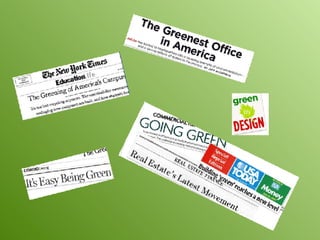
PERCEPTION
REALITY
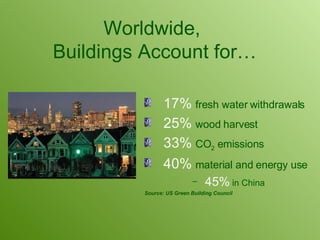
Worldwide,  Buildings Account for… 17%   fresh water withdrawals 25%   wood harvest 33%   CO 2  emissions 40%   material and energy use 45%   in China Source: US Green Building Council
 
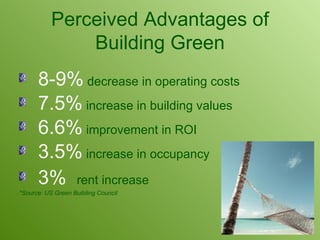
Perceived Advantages of Building Green 8-9%  decrease in operating costs 7.5%  increase in building values 6.6%  improvement in ROI 3.5%  increase in occupancy 3%   rent increase   *Source: US Green Building Council
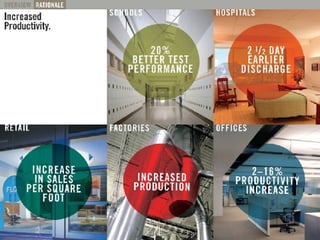
Increased productivity_5
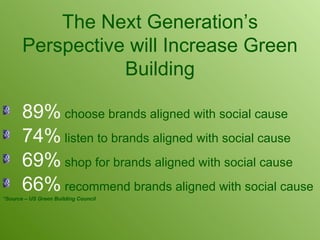
The Next Generation’s Perspective will Increase Green Building 89%  choose brands aligned with social cause 74%  listen to brands aligned with social cause 69%  shop for brands aligned with social cause 66%  recommend brands aligned with social cause *Source – US Green Building Council
The Methodology for Change Management By applying a psychological group dynamic process at cluster level Emiliano Duch President, Competitiveness [email_address] DEVELOPMENT AS CHANGE MANAGEMENT:  CATALYZING BEHAVIOR CHANGE AND UPGRADING AMONG FIRMS March 29, 2007 ATTITUDE BELIEF BEHAVIOR MOTIVATION
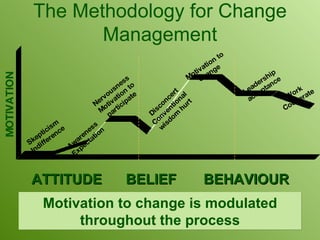
The Methodology for Change Management Motivation to change is modulated throughout the process MOTIVATION Skepticism Indifference Awareness Expectation Nervousness Motivation to participate Disconcert Conventional wisdom hurt Motivation to change Leadership acceptance Work Cooperate ATTITUDE BELIEF BEHAVIOUR
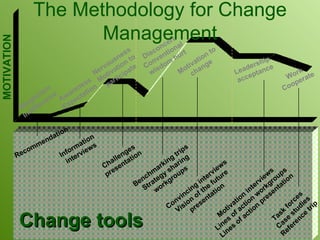
The Methodology for Change Management Recommendation MOTIVATION Skepticism Indifference Awareness Expectation Nervousness Motivation to participate Disconcert Conventional wisdom hurt Motivation to change Leadership acceptance Work Cooperate Information interviews Challenges presentation Benchmarking trips Strategy sharing workgroups Convincing interviews Vision of the future presentation Motivation interviews Lines of action workgroups Lines of action presentation Change tools Task forces Case studies Reference trip
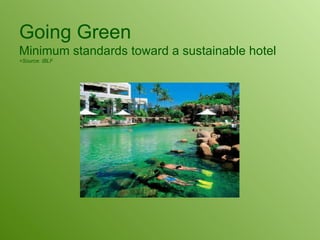
Going Green Minimum standards toward a sustainable hotel +Source: IBLF
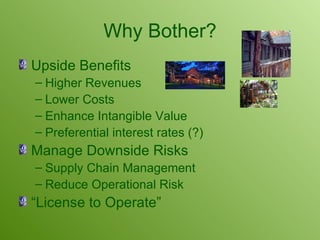
Why Bother? Upside Benefits Higher Revenues Lower Costs Enhance Intangible Value Preferential interest rates (?) Manage Downside Risks Supply Chain Management Reduce Operational Risk “License to Operate”
What does it mean to be a  sustainable  hotel?   +Source: IBLF While the term 'green' in business originally related to environmental issues, it has evolved to embrace all aspects of sustainability and corporate social responsibility (CSR). To be properly 'green', a company now needs to incorporate sustainable thinking in its decision-making at all levels throughout the organization.
In the past, corporate philanthropy, or 'giving back' to the community, used to be the way a company looked to enhance its reputation externally. Today, even the most basic level of acceptable business practice requires a more sophisticated approach. Companies are judged on their accountability, transparency, business ethics, socio-economic awareness and resource-efficiency as well as their financial results. Businesses today are under external scrutiny as never before. Shareholders, investors, employees, customers, environmental and ethical groups - and the general public - expect companies to be exemplary across the  'triple bottom line'  of economic, social and environmental management. If they are not, pressure groups and the media are willing and able to expose their weaknesses. As our understanding and knowledge grows about issues such as global warming, climate change, human rights injustices and the causes of poverty, the world looks as much to the business community as to governments to provide solutions.
These practical steps are intended to guide hotel managers toward a more sustainable operation. Policy and framework Staff training and awareness Environmental management Purchasing People and communities Destination protection
Policy and Framework Designate or appoint a senior member of staff responsible for environmental management. They should have the awareness, knowledge and skills to implement best practices to regional and international standards. Identify a person from each department who will be part of the hotel's environmental working group or 'green team'. Institute ways to measure your progress - for example through indicators such as water use in litres or cubic metres per guest per night, energy use in kWh per guest night and waste in kg per guest night. Draw up responsible business policy to which the entire operation can commit. You will need commitment from everyone, from the top down.
Launch a responsible business programme to staff and solicit feedback. Maintain staff awareness of the programme through regular meetings, posters and information on notice-boards etc. Encourage motivation through competitions, suggestion boxes and reward staff for successes each month Include a module on your responsible business policy and programme in all staff induction and refresher training. Communicate results to staff as you progress the programme. Staff Training and Awareness You will need commitment from everyone, from the top down.
Assess your current environmental impacts and determine potential primary, secondary and tertiary impacts and their significance. List possible mitigation and management alternatives and describe which ones will be used. (Much of the information on your resource use, waste and use of chemicals can be found in utility and purchasing bills.) Install meters for each department and for specific items of equipment that are high energy and water users. Measure and monitor your progress on a regular basis. This can be daily, weekly or monthly, depending on usage and your department  Set measurable short and long term targets for improvement and take corrective action when they are not met. Work with other hotels and local businesses to improve environmental standards in the local area or destination. Inform guests, vendors, and local stakeholders about your environmental policy, programmes and successes. Environmental Management Aim for the highest environmental standards in terms of biodiversity protection, hygiene, safety, indoor air quality and overall environmental management.
ENERGY Install meters in each department and fit sub-meters for high energy-consuming items.  Designate members of staff who will be responsible for collecting energy data Identify simple changes in routine that can be made to save energy (such as turning off lights and running equipment such as dishwashers and washing machines at full loads). Check and maintain all equipment regularly to ensure it is functioning efficiently.  Identify and implement low-cost measures such as using energy efficient light bulbs and motion detectors and improving insulation, etc.  Use bicycles and environmentally preferable vehicles around the resort (e.g. electric from renewable sources, hybrid or biofuels) and encourage guests to use greener vehicles. Calculate your energy usage and assess it against available industry benchmarks (e.g. benchmarkhotel) in terms of kWh per guest night or CO2 generated.  Monitor your performance continuously and set realistic reduction targets based on your results Identify the key areas of energy use and the fuel
WATER USE Identify the key areas of water use and how reductions can be achieved  Implement immediate water savings through changes in routine (e.g. reducing washing/ rinsing cycles in laundry).  Check regularly for leaks from cisterns, taps and pipes and that plugs in basins fit properly. Install sensors, low-flow and other water-saving fittings in kitchens, guest bathrooms and public washrooms.  Use opportunities to divert and capture rainwater for reuse.  Minimize water use by recycling grey water for gardening, washing floors, flushing toilets, etc.  Assess your water use against industry benchmarks (such as benchmarkhotel) if available. Monitor results continuously, report on progress and take corrective action as necessary.
WASTE Identify the different waste streams you create (e.g. glass, paper, plastic, aluminum and other metals, cooking oils, cardboard and organic waste), which departments are responsible for what, and how the waste is currently dealt with. Calculate the amount in weight for each waste stream and identify measures to reduce, reuse and/or recycle each one.  Draw up a waste management plan with specific reduction, reuse and recycling targets to be met by a specific time. waste reduction measures.  Ensure that effluent from wastewater treatment system complies with all relevant local, regional and international water quality standards. Monitor results continuously, report on progress and take corrective action as necessary.
Source products which are the most sustainable in their manufacture, use and disposal. Review all the products and services you purchase and identify where more sustainable alternatives are available  Examine how your suppliers select their suppliers so that you can help develop a fully sustainable supply chain. Integrate sustainable criteria into your purchasing policy and procedures. Encourage local businesses to cut down on transport energy by sourcing locally. Buy as much seasonal and local produce as possible  Buy products in bulk and reduce packaging where possible. Challenge suppliers and other business partners to improve their practices. Give preference to 'fair trade' products (such as coffee and tea) or eco-labeled goods where possible  Never purchase or sell items made from protected wildlife or illegally-traded species and inform your guests if there are any such items that may be offered for sale outside the hotel  Recognise suppliers' efforts through special events, promotion and longer-term contracts  Purchasing Work with your suppliers over time to green your supply chain.
Be fair, honest, open and transparent in all your dealings with customers, employees and suppliers and respect their human rights at all times.Integrate sustainable criteria into your purchasing policy and procedures. Be sensitive to the needs of those you employ and in the surrounding community such as respecting their local culture heritage and traditions. Identify ways in which the local community can benefit from the presence of your establishment.  Develop and support tourism-related businesses in partnership with the local community  Use locally provided services where possible  Train local workers and in order to phase them into management positions over time.  Employ local people where possible  Support local community development projects with money, time and under-utilized resources  Provide ways for guests to volunteer for local conservation or community development projects  People and Community Look at the world outside your hotel and how you can take a more responsible, leadership role.
Support conservation and cultural heritage preservation projects Use native plant species for landscaping and natural insect control measures  'Showcase' the local culture and heritage by using local produce, art and handicrafts  Contribute to habitat restoration efforts when possible  Utilize guidelines and training programs to improve behaviors and increase awareness with regard to recreational activities  Require the use of guides in sensitive areas. Provide guests with lists of products and souvenirs to avoid. Work with local people when developing cultural attractions  Educate guests and local people about different cultures and acceptable behaviours.  Design an interpretive guest education program with clear messages relating to local environmental and cultural issues. Respect locally determined limits on scale and activities in tourist interaction with local people  Choose transport, such as buses and trains to decrease energy consumption and emissions. Provide 'no vehicle' zones. Consider using non-motorized vehicles and electric motors to decrease pollution and noise. Train staff in the proper maintenance of vehicles and boats and mandate maximum speeds. Destination and Protection Maintain a 'sense of place' that supports the geographical character of a place—its environment, culture, heritage, aesthetics, and the well-being of its citizens.
Why Bother? Upside Benefits Higher Revenues Lower Costs Preferential interest rates (?) Enhance Intangible Value Manage Downside Risks Supply Chain Management Reduce Operational Risk “License to Operate”
Competitiveness Strategy Improve tourism experience Increase number of quality activities Protect environment that tourism depends on Reinforce linkages with local producers Increase number of tourist arrivals  Support for local tour operators Increase professionalism in service sub-industries Improve sanitation  Improve lodging options Site development Promotion Information collection and dissemination Improve access & response to end market demands National Monument status for Alley of Baobabs Support for Cellule Technique Baobab’s efforts Strengthen linkages to agricultural inputs Strengthen handicrafts production and promotion Strengthen linkages to seafood vendors Improve marketing Strengthening regional tourism office Improve access by air  Objectives : Strategies : Increased competitiveness of tourism sector  Decreased poverty through pro-poor economic growth Increased financing of biodiversity conservation through tourism activities Impact :
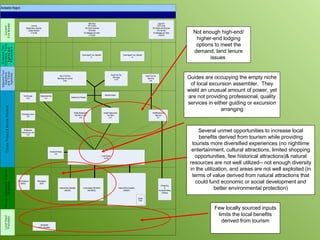
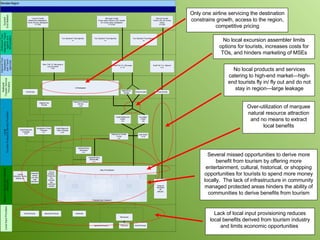
Not enough high-end/ higher-end lodging options to meet the demand, land tenure issues  Guides are occupying the empty niche of local excursion assembler.  They wield an unusual amount of power, yet are not providing professional, quality services in either guiding or excursion arranging Few locally sourced inputs limits the local benefits derived from tourism Several unmet opportunities to increase local benefits derived from tourism while providing tourists more diversified experiences (no nighttime entertainment, cultural attractions, limited shopping opportunities, few historical attractions)& natural resources are not well utilized-- not enough diversity in the utilization, and areas are not well exploited (in terms of value derived from natural attractions that could fund economic or social development and better environmental protection)
Only one airline servicing the destination constrains growth, access to the region, competitive pricing No local excursion assembler limits options for tourists, increases costs for TOs, and hinders marketing of MSEs No local products and services catering to high-end market—high-end tourists fly in/ fly out and do not stay in region—large leakage Over-utilization of marquee natural resource attraction and no means to extract local benefits Lack of local input provisioning reduces local benefits derived from tourism industry and limits economic opportunities  Several missed opportunities to derive more benefit from tourism by offering more entertainment, cultural, historical, or shopping opportunities for tourists to spend more money locally.  The lack of infrastructure in community managed protected areas hinders the ability of communities to derive benefits from tourism
What does the future hold? Expedia and Orbitz provide “green / sustainability” indicators for clients Preferential listings for “green” hotels International Tour Operators requiring benchmarks in contracting Major Hotel Groups announce integrated sustainability programs for entire project cycle National Green Hospitality Brand (Starwood?) LEED Standards for Hotels Municipalities and Countries REQUIRE Sustainability standards for businesses to operate
“Hotel of the Future”

Hospitality Sustainability Presentation at Cornell University Oct15 2007

  • 1.
    Stewardship in theHospitality Industry
  • 2.
  • 3.
  • 4.
    Worldwide, BuildingsAccount for… 17% fresh water withdrawals 25% wood harvest 33% CO 2 emissions 40% material and energy use 45% in China Source: US Green Building Council
  • 5.
  • 6.
    Perceived Advantages ofBuilding Green 8-9% decrease in operating costs 7.5% increase in building values 6.6% improvement in ROI 3.5% increase in occupancy 3% rent increase *Source: US Green Building Council
  • 7.
  • 8.
    The Next Generation’sPerspective will Increase Green Building 89% choose brands aligned with social cause 74% listen to brands aligned with social cause 69% shop for brands aligned with social cause 66% recommend brands aligned with social cause *Source – US Green Building Council
  • 9.
    The Methodology forChange Management By applying a psychological group dynamic process at cluster level Emiliano Duch President, Competitiveness [email_address] DEVELOPMENT AS CHANGE MANAGEMENT: CATALYZING BEHAVIOR CHANGE AND UPGRADING AMONG FIRMS March 29, 2007 ATTITUDE BELIEF BEHAVIOR MOTIVATION
  • 10.
    The Methodology forChange Management Motivation to change is modulated throughout the process MOTIVATION Skepticism Indifference Awareness Expectation Nervousness Motivation to participate Disconcert Conventional wisdom hurt Motivation to change Leadership acceptance Work Cooperate ATTITUDE BELIEF BEHAVIOUR
  • 11.
    The Methodology forChange Management Recommendation MOTIVATION Skepticism Indifference Awareness Expectation Nervousness Motivation to participate Disconcert Conventional wisdom hurt Motivation to change Leadership acceptance Work Cooperate Information interviews Challenges presentation Benchmarking trips Strategy sharing workgroups Convincing interviews Vision of the future presentation Motivation interviews Lines of action workgroups Lines of action presentation Change tools Task forces Case studies Reference trip
  • 12.
    Going Green Minimumstandards toward a sustainable hotel +Source: IBLF
  • 13.
    Why Bother? UpsideBenefits Higher Revenues Lower Costs Enhance Intangible Value Preferential interest rates (?) Manage Downside Risks Supply Chain Management Reduce Operational Risk “License to Operate”
  • 14.
    What does itmean to be a sustainable hotel? +Source: IBLF While the term 'green' in business originally related to environmental issues, it has evolved to embrace all aspects of sustainability and corporate social responsibility (CSR). To be properly 'green', a company now needs to incorporate sustainable thinking in its decision-making at all levels throughout the organization.
  • 15.
    In the past,corporate philanthropy, or 'giving back' to the community, used to be the way a company looked to enhance its reputation externally. Today, even the most basic level of acceptable business practice requires a more sophisticated approach. Companies are judged on their accountability, transparency, business ethics, socio-economic awareness and resource-efficiency as well as their financial results. Businesses today are under external scrutiny as never before. Shareholders, investors, employees, customers, environmental and ethical groups - and the general public - expect companies to be exemplary across the 'triple bottom line' of economic, social and environmental management. If they are not, pressure groups and the media are willing and able to expose their weaknesses. As our understanding and knowledge grows about issues such as global warming, climate change, human rights injustices and the causes of poverty, the world looks as much to the business community as to governments to provide solutions.
  • 16.
    These practical stepsare intended to guide hotel managers toward a more sustainable operation. Policy and framework Staff training and awareness Environmental management Purchasing People and communities Destination protection
  • 17.
    Policy and FrameworkDesignate or appoint a senior member of staff responsible for environmental management. They should have the awareness, knowledge and skills to implement best practices to regional and international standards. Identify a person from each department who will be part of the hotel's environmental working group or 'green team'. Institute ways to measure your progress - for example through indicators such as water use in litres or cubic metres per guest per night, energy use in kWh per guest night and waste in kg per guest night. Draw up responsible business policy to which the entire operation can commit. You will need commitment from everyone, from the top down.
  • 18.
    Launch a responsiblebusiness programme to staff and solicit feedback. Maintain staff awareness of the programme through regular meetings, posters and information on notice-boards etc. Encourage motivation through competitions, suggestion boxes and reward staff for successes each month Include a module on your responsible business policy and programme in all staff induction and refresher training. Communicate results to staff as you progress the programme. Staff Training and Awareness You will need commitment from everyone, from the top down.
  • 19.
    Assess your currentenvironmental impacts and determine potential primary, secondary and tertiary impacts and their significance. List possible mitigation and management alternatives and describe which ones will be used. (Much of the information on your resource use, waste and use of chemicals can be found in utility and purchasing bills.) Install meters for each department and for specific items of equipment that are high energy and water users. Measure and monitor your progress on a regular basis. This can be daily, weekly or monthly, depending on usage and your department Set measurable short and long term targets for improvement and take corrective action when they are not met. Work with other hotels and local businesses to improve environmental standards in the local area or destination. Inform guests, vendors, and local stakeholders about your environmental policy, programmes and successes. Environmental Management Aim for the highest environmental standards in terms of biodiversity protection, hygiene, safety, indoor air quality and overall environmental management.
  • 20.
    ENERGY Install metersin each department and fit sub-meters for high energy-consuming items. Designate members of staff who will be responsible for collecting energy data Identify simple changes in routine that can be made to save energy (such as turning off lights and running equipment such as dishwashers and washing machines at full loads). Check and maintain all equipment regularly to ensure it is functioning efficiently. Identify and implement low-cost measures such as using energy efficient light bulbs and motion detectors and improving insulation, etc. Use bicycles and environmentally preferable vehicles around the resort (e.g. electric from renewable sources, hybrid or biofuels) and encourage guests to use greener vehicles. Calculate your energy usage and assess it against available industry benchmarks (e.g. benchmarkhotel) in terms of kWh per guest night or CO2 generated. Monitor your performance continuously and set realistic reduction targets based on your results Identify the key areas of energy use and the fuel
  • 21.
    WATER USE Identifythe key areas of water use and how reductions can be achieved Implement immediate water savings through changes in routine (e.g. reducing washing/ rinsing cycles in laundry). Check regularly for leaks from cisterns, taps and pipes and that plugs in basins fit properly. Install sensors, low-flow and other water-saving fittings in kitchens, guest bathrooms and public washrooms. Use opportunities to divert and capture rainwater for reuse. Minimize water use by recycling grey water for gardening, washing floors, flushing toilets, etc. Assess your water use against industry benchmarks (such as benchmarkhotel) if available. Monitor results continuously, report on progress and take corrective action as necessary.
  • 22.
    WASTE Identify thedifferent waste streams you create (e.g. glass, paper, plastic, aluminum and other metals, cooking oils, cardboard and organic waste), which departments are responsible for what, and how the waste is currently dealt with. Calculate the amount in weight for each waste stream and identify measures to reduce, reuse and/or recycle each one. Draw up a waste management plan with specific reduction, reuse and recycling targets to be met by a specific time. waste reduction measures. Ensure that effluent from wastewater treatment system complies with all relevant local, regional and international water quality standards. Monitor results continuously, report on progress and take corrective action as necessary.
  • 23.
    Source products whichare the most sustainable in their manufacture, use and disposal. Review all the products and services you purchase and identify where more sustainable alternatives are available Examine how your suppliers select their suppliers so that you can help develop a fully sustainable supply chain. Integrate sustainable criteria into your purchasing policy and procedures. Encourage local businesses to cut down on transport energy by sourcing locally. Buy as much seasonal and local produce as possible Buy products in bulk and reduce packaging where possible. Challenge suppliers and other business partners to improve their practices. Give preference to 'fair trade' products (such as coffee and tea) or eco-labeled goods where possible Never purchase or sell items made from protected wildlife or illegally-traded species and inform your guests if there are any such items that may be offered for sale outside the hotel Recognise suppliers' efforts through special events, promotion and longer-term contracts Purchasing Work with your suppliers over time to green your supply chain.
  • 24.
    Be fair, honest,open and transparent in all your dealings with customers, employees and suppliers and respect their human rights at all times.Integrate sustainable criteria into your purchasing policy and procedures. Be sensitive to the needs of those you employ and in the surrounding community such as respecting their local culture heritage and traditions. Identify ways in which the local community can benefit from the presence of your establishment. Develop and support tourism-related businesses in partnership with the local community Use locally provided services where possible Train local workers and in order to phase them into management positions over time. Employ local people where possible Support local community development projects with money, time and under-utilized resources Provide ways for guests to volunteer for local conservation or community development projects People and Community Look at the world outside your hotel and how you can take a more responsible, leadership role.
  • 25.
    Support conservation andcultural heritage preservation projects Use native plant species for landscaping and natural insect control measures 'Showcase' the local culture and heritage by using local produce, art and handicrafts Contribute to habitat restoration efforts when possible Utilize guidelines and training programs to improve behaviors and increase awareness with regard to recreational activities Require the use of guides in sensitive areas. Provide guests with lists of products and souvenirs to avoid. Work with local people when developing cultural attractions Educate guests and local people about different cultures and acceptable behaviours. Design an interpretive guest education program with clear messages relating to local environmental and cultural issues. Respect locally determined limits on scale and activities in tourist interaction with local people Choose transport, such as buses and trains to decrease energy consumption and emissions. Provide 'no vehicle' zones. Consider using non-motorized vehicles and electric motors to decrease pollution and noise. Train staff in the proper maintenance of vehicles and boats and mandate maximum speeds. Destination and Protection Maintain a 'sense of place' that supports the geographical character of a place—its environment, culture, heritage, aesthetics, and the well-being of its citizens.
  • 26.
    Why Bother? UpsideBenefits Higher Revenues Lower Costs Preferential interest rates (?) Enhance Intangible Value Manage Downside Risks Supply Chain Management Reduce Operational Risk “License to Operate”
  • 27.
    Competitiveness Strategy Improvetourism experience Increase number of quality activities Protect environment that tourism depends on Reinforce linkages with local producers Increase number of tourist arrivals Support for local tour operators Increase professionalism in service sub-industries Improve sanitation Improve lodging options Site development Promotion Information collection and dissemination Improve access & response to end market demands National Monument status for Alley of Baobabs Support for Cellule Technique Baobab’s efforts Strengthen linkages to agricultural inputs Strengthen handicrafts production and promotion Strengthen linkages to seafood vendors Improve marketing Strengthening regional tourism office Improve access by air Objectives : Strategies : Increased competitiveness of tourism sector Decreased poverty through pro-poor economic growth Increased financing of biodiversity conservation through tourism activities Impact :
  • 28.
    Not enough high-end/higher-end lodging options to meet the demand, land tenure issues Guides are occupying the empty niche of local excursion assembler. They wield an unusual amount of power, yet are not providing professional, quality services in either guiding or excursion arranging Few locally sourced inputs limits the local benefits derived from tourism Several unmet opportunities to increase local benefits derived from tourism while providing tourists more diversified experiences (no nighttime entertainment, cultural attractions, limited shopping opportunities, few historical attractions)& natural resources are not well utilized-- not enough diversity in the utilization, and areas are not well exploited (in terms of value derived from natural attractions that could fund economic or social development and better environmental protection)
  • 29.
    Only one airlineservicing the destination constrains growth, access to the region, competitive pricing No local excursion assembler limits options for tourists, increases costs for TOs, and hinders marketing of MSEs No local products and services catering to high-end market—high-end tourists fly in/ fly out and do not stay in region—large leakage Over-utilization of marquee natural resource attraction and no means to extract local benefits Lack of local input provisioning reduces local benefits derived from tourism industry and limits economic opportunities Several missed opportunities to derive more benefit from tourism by offering more entertainment, cultural, historical, or shopping opportunities for tourists to spend more money locally. The lack of infrastructure in community managed protected areas hinders the ability of communities to derive benefits from tourism
  • 30.
    What does thefuture hold? Expedia and Orbitz provide “green / sustainability” indicators for clients Preferential listings for “green” hotels International Tour Operators requiring benchmarks in contracting Major Hotel Groups announce integrated sustainability programs for entire project cycle National Green Hospitality Brand (Starwood?) LEED Standards for Hotels Municipalities and Countries REQUIRE Sustainability standards for businesses to operate
  • 31.
    “Hotel of theFuture”