SUSTAINABLE TOURISM
         1


                      23/01/2010
Green Globe
                           2


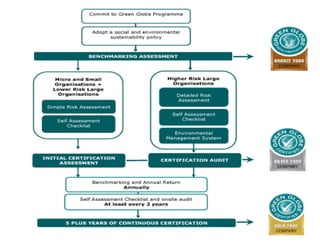
 Worldwide benchmarking and certification program;

 facilitates sustainable T&T since 1993

 Based on Agenda 21 principles for SD endorsed by

 182 governments at the UN Rio de Janeiro Earth
 Summit (1992) and supported by STCRC

 STCRC was established under the Autralian

 government research program for sustainable tourism
 industry                                      23/01/2010
Green Globe
                        3


 Premier international green brand

 Used mostly in T&T industry but now also

 expanded to other environmentally responsible
 businesses in a variety of market sectors


                                             23/01/2010
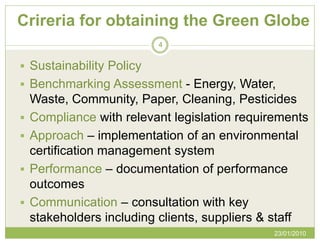
Crireria for obtaining the Green Globe
                          4


 Sustainability Policy
 Benchmarking Assessment - Energy, Water,
    Waste, Community, Paper, Cleaning, Pesticides
   Compliance with relevant legislation requirements
   Approach – implementation of an environmental
    certification management system
   Performance – documentation of performance
    outcomes
   Communication – consultation with key
    stakeholders including clients, suppliers & staff
                                               23/01/2010
5


    23/01/2010
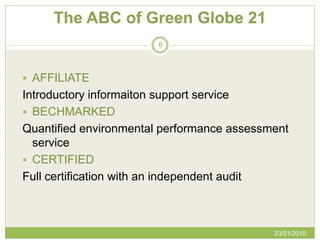
The ABC of Green Globe 21
                        6


 AFFILIATE
Introductory informaiton support service
 BECHMARKED
Quantified environmental performance assessment
  service
 CERTIFIED
Full certification with an independent audit


                                            23/01/2010
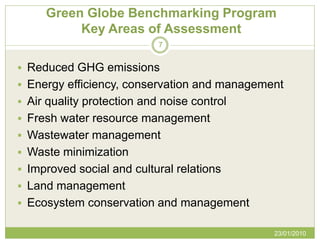
Green Globe Benchmarking Program
          Key Areas of Assessment
                            7


 Reduced GHG emissions
 Energy efficiency, conservation and management
 Air quality protection and noise control
 Fresh water resource management
 Wastewater management
 Waste minimization
 Improved social and cultural relations
 Land management
 Ecosystem conservation and management

                                              23/01/2010
Green Globe Benchmarking Earth Check
                Indicators
                           8

 Sustainability Policy
 Energy consumption
 Potable water consumption
 Salid waste production
 Social commitment
 Resource concervation (paper)
 Cleaning Chemicals Used
 To be able to use the GREEN GLOBE logo, all
 indicator measures must be maintained above the
 GREEN GLOBE Baseline level (BL)

                                             23/01/2010
Sustainability Policy
                           9


 Company’s written policy addressing all issues raised
  in the Green Globe 21 standards
 Sustainability policy statement
 Staff communication and training
 Information for the guests


                                                 23/01/2010
Energy consumption
                        10


 Minimize overall energy consumption
 Using energy from renewable resources (wind,
  hydro, solar)
 Indicator measure: Total energy consumption (MJ)
  pa / Guest nights pa or Area under roof (m2)


                                             23/01/2010
Water Consumption
                          11


 Minimize potable water consumption by lowering
  demand and recycling
 Indicator measure: Water consumed (kL) pa/ Guest
  nights pa or Area under roof (m2) Greenhouse gas
  reductions: Reduction in emissions from energy
  required for potable water treatment, distribution and
  disposal


                                                 23/01/2010
Solid waste production
                         12


 Reduce the amount of solid waste generated by
  recycling and less use of energy in waste
  disposal
 Indicator measure: Volume of waste landfilled
  (m3) pa / Guest nights pa or Area under roof
  (m2)


                                                  23/01/2010
Social commitment
                          13


 Positive impact on the local community by respecting
 local traditions, customs; purchasing local goods and
 services and participating in local committees

 Indicator measure: Employees with their primary
 address within 20 km of the operation / Total
 employees


                                                 23/01/2010
Resource conservation
                         14


 Reduce consumption of natural resources and the
  negative impact on biodiversity by using eco-friendly
  products
 Paper, wood
 Indicator measure : Ecolabel paper purchased (kg)
  pa / Total paper purchased (kg) pa


                                                23/01/2010
Cleaning chemicals used
                        15


 Reduce non-biodegradable chemicals (soap,
  detrgent, shampoos) discharged into the
  environment
 Reduce the artificial pesticide application and
  artificial fertilizers
  Indicator Measure: Biodegradable cleaning
  chemicals used / Total cleaning chemicals used


                                               23/01/2010
How Is the Green Globe Logo Used?
                           16


 All indicators must be assessed over a 12 month
  period
 They should be at, or above, their respective baseline
  level (BL)
 If an indicator cannot be measured or is measured
  below the BL, if evidences are provided by the
  company that it has started to improve, the indicator
  will be deemed as satisfactory


                                                  23/01/2010
Green Globe Properties
                           17


 The Caribbean leads the world in the number of Green
    Globe certified properties
   57 Certified Properties in the region:
   Sandals Antigua Resort & Spa (Antigua&Barbuda)
   Sandals Royal Bahamian Resort & Spa (Bahamas)
   Viva Wyndham Dominicus Beach (Dominican Republic)
   Beaches Negril (Jamaica)


                                                23/01/2010
Six Senses Resorts & Spa
                         18


 Established in 1995 by Sonu and Eva Shivdasani
 9 resorts, 14 spas, 2500 employees
 1995: the Soneva Fushi, Maldives
 $ 100 mln annual revenues, evaluated at $ 160 mln
 Headquater in Bangkok, Thailand
 3 distinct resort brands: Soneva, Evason Hideaways
 and Evason


                                              23/01/2010
Six Senses Resort & Spa
                          19

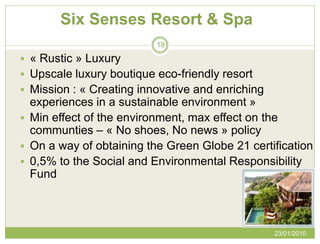
 « Rustic » Luxury
 Upscale luxury boutique eco-friendly resort
 Mission : « Creating innovative and enriching
  experiences in a sustainable environment »
 Min effect of the environment, max effect on the
  communties – « No shoes, No news » policy
 On a way of obtaining the Green Globe 21 certification
 0,5% to the Social and Environmental Responsibility
  Fund


                                                  23/01/2010
Six Senses
                          20

 Green commitment
 Six Senses Social and Environment
  Programme
- To create innovative and enlightening
  experiences that rejuvenate our
  guests’ love of SLOW LIFE*

 *SUSTAINABLE – LOCAL –
 ORGANIC –
 WHOLESOME LEARNING –
 INSPIRING – FUN – EXPERIENCES


                                          23/01/2010
EMS
                          21

 Conduct an environment review
 Establish an environment policy, objectives
 Implement EMS, EMS procedures in all departments
 Monitoring and data collection
 Internal environmental communication
 Environment-related comm to guests
 Conduct an EMS audit
 Compare actual performance / targets
 Review objectives
 Report to emplyees, customers, stakeholders
                                                23/01/2010
The origins of EMS
                         22


 Compliance audits since 1970s on environmental
 issues because of high fines

 Total quality management based on
 PLAN – DO – CHECK - ACT


                                              23/01/2010
EMS in the Hospitality Industry
                           23


 Reduce water use
 Reduce waste water output
 Reduce energy use
 Reduce waste
 Purchase environmentally-friendly products
 Imporve indoor air quality
 Reduce noise
 Monitor and document environment performance


                                               23/01/2010
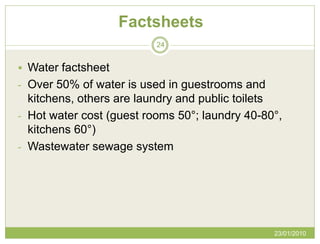
Factsheets
                          24


 Water factsheet
- Over 50% of water is used in guestrooms and
  kitchens, others are laundry and public toilets
- Hot water cost (guest rooms 50°; laundry 40-80°,
  kitchens 60°)
- Wastewater sewage system


                                                23/01/2010
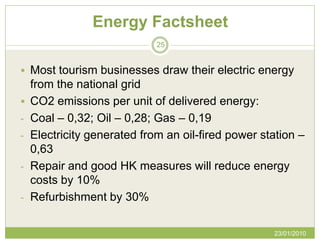
Energy Factsheet
                             25


 Most tourism businesses draw their electric energy
    from the national grid
   CO2 emissions per unit of delivered energy:
-   Coal – 0,32; Oil – 0,28; Gas – 0,19
-   Electricity generated from an oil-fired power station –
    0,63
-   Repair and good HK measures will reduce energy
    costs by 10%
-   Refurbishment by 30%

                                                    23/01/2010
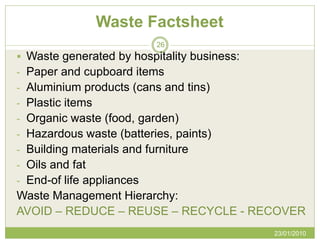
Waste Factsheet
                           26
 Waste generated by hospitality business:
- Paper and cupboard items
- Aluminium products (cans and tins)
- Plastic items
- Organic waste (food, garden)
- Hazardous waste (batteries, paints)
- Building materials and furniture
- Oils and fat
- End-of life appliances
Waste Management Hierarchy:
AVOID – REDUCE – REUSE – RECYCLE - RECOVER
                                             23/01/2010
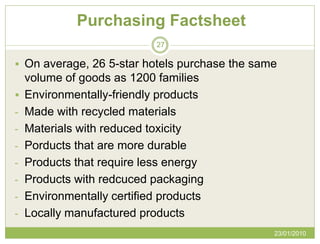
Purchasing Factsheet
                             27

 On average, 26 5-star hotels purchase the same
    volume of goods as 1200 families
   Environmentally-friendly products
-   Made with recycled materials
-   Materials with reduced toxicity
-   Porducts that are more durable
-   Products that require less energy
-   Products with redcuced packaging
-   Environmentally certified products
-   Locally manufactured products
                                               23/01/2010
Indoor Environment Factsheet
                            28


 Most people spend 90% of their time indoors
 Common sources of indoor air quality
    contamination:
-   Gases from stoves, boliers
-   Tobacco smoke
-   Vapours from cleaning paints, photocopy emissions
-   Dust; Carbons from fridges and AC
-   The « Sick Building Syndrome »


                                                 23/01/2010
Noise Factsheet
                           29


 Music, traffic, crowds, work-place related noise coming
  rom working machines
 Noise levels between 70-12dB can induce migranes,
  circulatory distrubances, high blood pressure and
  ulcers
 Noise levels b/n 10dB and 120 dB can cause loss of
  hearing
 Noise level above 130 dB can cause direct damage of
  hearing
  Most noisy places: meeting rooms, guestrooms,

                                                  23/01/2010
EMS Stages
                          30


 1. Environment status review (factsheets)
 2. Establishing an environmental policy
 3. Implementing the environment management
  program
- Objective – Action – Budget – Deadline – Department
  concerned


                                               23/01/2010
31


     23/01/2010

Green Globe Certification Ems 14 03 09

  • 1.
  • 2.
    Green Globe 2  Worldwide benchmarking and certification program; facilitates sustainable T&T since 1993  Based on Agenda 21 principles for SD endorsed by 182 governments at the UN Rio de Janeiro Earth Summit (1992) and supported by STCRC  STCRC was established under the Autralian government research program for sustainable tourism industry 23/01/2010
  • 3.
    Green Globe 3  Premier international green brand  Used mostly in T&T industry but now also expanded to other environmentally responsible businesses in a variety of market sectors 23/01/2010
  • 4.
    Crireria for obtainingthe Green Globe 4  Sustainability Policy  Benchmarking Assessment - Energy, Water, Waste, Community, Paper, Cleaning, Pesticides  Compliance with relevant legislation requirements  Approach – implementation of an environmental certification management system  Performance – documentation of performance outcomes  Communication – consultation with key stakeholders including clients, suppliers & staff 23/01/2010
  • 5.
    5 23/01/2010
  • 6.
    The ABC ofGreen Globe 21 6  AFFILIATE Introductory informaiton support service  BECHMARKED Quantified environmental performance assessment service  CERTIFIED Full certification with an independent audit 23/01/2010
  • 7.
    Green Globe BenchmarkingProgram Key Areas of Assessment 7  Reduced GHG emissions  Energy efficiency, conservation and management  Air quality protection and noise control  Fresh water resource management  Wastewater management  Waste minimization  Improved social and cultural relations  Land management  Ecosystem conservation and management 23/01/2010
  • 8.
    Green Globe BenchmarkingEarth Check Indicators 8  Sustainability Policy  Energy consumption  Potable water consumption  Salid waste production  Social commitment  Resource concervation (paper)  Cleaning Chemicals Used To be able to use the GREEN GLOBE logo, all indicator measures must be maintained above the GREEN GLOBE Baseline level (BL) 23/01/2010
  • 9.
    Sustainability Policy 9  Company’s written policy addressing all issues raised in the Green Globe 21 standards  Sustainability policy statement  Staff communication and training  Information for the guests 23/01/2010
  • 10.
    Energy consumption 10  Minimize overall energy consumption  Using energy from renewable resources (wind, hydro, solar)  Indicator measure: Total energy consumption (MJ) pa / Guest nights pa or Area under roof (m2) 23/01/2010
  • 11.
    Water Consumption 11  Minimize potable water consumption by lowering demand and recycling  Indicator measure: Water consumed (kL) pa/ Guest nights pa or Area under roof (m2) Greenhouse gas reductions: Reduction in emissions from energy required for potable water treatment, distribution and disposal 23/01/2010
  • 12.
    Solid waste production 12  Reduce the amount of solid waste generated by recycling and less use of energy in waste disposal  Indicator measure: Volume of waste landfilled (m3) pa / Guest nights pa or Area under roof (m2) 23/01/2010
  • 13.
    Social commitment 13  Positive impact on the local community by respecting local traditions, customs; purchasing local goods and services and participating in local committees  Indicator measure: Employees with their primary address within 20 km of the operation / Total employees 23/01/2010
  • 14.
    Resource conservation 14  Reduce consumption of natural resources and the negative impact on biodiversity by using eco-friendly products  Paper, wood  Indicator measure : Ecolabel paper purchased (kg) pa / Total paper purchased (kg) pa 23/01/2010
  • 15.
    Cleaning chemicals used 15  Reduce non-biodegradable chemicals (soap, detrgent, shampoos) discharged into the environment  Reduce the artificial pesticide application and artificial fertilizers Indicator Measure: Biodegradable cleaning chemicals used / Total cleaning chemicals used 23/01/2010
  • 16.
    How Is theGreen Globe Logo Used? 16  All indicators must be assessed over a 12 month period  They should be at, or above, their respective baseline level (BL)  If an indicator cannot be measured or is measured below the BL, if evidences are provided by the company that it has started to improve, the indicator will be deemed as satisfactory 23/01/2010
  • 17.
    Green Globe Properties 17  The Caribbean leads the world in the number of Green Globe certified properties  57 Certified Properties in the region:  Sandals Antigua Resort & Spa (Antigua&Barbuda)  Sandals Royal Bahamian Resort & Spa (Bahamas)  Viva Wyndham Dominicus Beach (Dominican Republic)  Beaches Negril (Jamaica) 23/01/2010
  • 18.
    Six Senses Resorts& Spa 18  Established in 1995 by Sonu and Eva Shivdasani  9 resorts, 14 spas, 2500 employees  1995: the Soneva Fushi, Maldives  $ 100 mln annual revenues, evaluated at $ 160 mln  Headquater in Bangkok, Thailand  3 distinct resort brands: Soneva, Evason Hideaways and Evason 23/01/2010
  • 19.
    Six Senses Resort& Spa 19  « Rustic » Luxury  Upscale luxury boutique eco-friendly resort  Mission : « Creating innovative and enriching experiences in a sustainable environment »  Min effect of the environment, max effect on the communties – « No shoes, No news » policy  On a way of obtaining the Green Globe 21 certification  0,5% to the Social and Environmental Responsibility Fund 23/01/2010
  • 20.
    Six Senses 20  Green commitment  Six Senses Social and Environment Programme - To create innovative and enlightening experiences that rejuvenate our guests’ love of SLOW LIFE* *SUSTAINABLE – LOCAL – ORGANIC – WHOLESOME LEARNING – INSPIRING – FUN – EXPERIENCES 23/01/2010
  • 21.
    EMS 21  Conduct an environment review  Establish an environment policy, objectives  Implement EMS, EMS procedures in all departments  Monitoring and data collection  Internal environmental communication  Environment-related comm to guests  Conduct an EMS audit  Compare actual performance / targets  Review objectives  Report to emplyees, customers, stakeholders 23/01/2010
  • 22.
    The origins ofEMS 22  Compliance audits since 1970s on environmental issues because of high fines  Total quality management based on PLAN – DO – CHECK - ACT 23/01/2010
  • 23.
    EMS in theHospitality Industry 23  Reduce water use  Reduce waste water output  Reduce energy use  Reduce waste  Purchase environmentally-friendly products  Imporve indoor air quality  Reduce noise  Monitor and document environment performance 23/01/2010
  • 24.
    Factsheets 24  Water factsheet - Over 50% of water is used in guestrooms and kitchens, others are laundry and public toilets - Hot water cost (guest rooms 50°; laundry 40-80°, kitchens 60°) - Wastewater sewage system 23/01/2010
  • 25.
    Energy Factsheet 25  Most tourism businesses draw their electric energy from the national grid  CO2 emissions per unit of delivered energy: - Coal – 0,32; Oil – 0,28; Gas – 0,19 - Electricity generated from an oil-fired power station – 0,63 - Repair and good HK measures will reduce energy costs by 10% - Refurbishment by 30% 23/01/2010
  • 26.
    Waste Factsheet 26  Waste generated by hospitality business: - Paper and cupboard items - Aluminium products (cans and tins) - Plastic items - Organic waste (food, garden) - Hazardous waste (batteries, paints) - Building materials and furniture - Oils and fat - End-of life appliances Waste Management Hierarchy: AVOID – REDUCE – REUSE – RECYCLE - RECOVER 23/01/2010
  • 27.
    Purchasing Factsheet 27  On average, 26 5-star hotels purchase the same volume of goods as 1200 families  Environmentally-friendly products - Made with recycled materials - Materials with reduced toxicity - Porducts that are more durable - Products that require less energy - Products with redcuced packaging - Environmentally certified products - Locally manufactured products 23/01/2010
  • 28.
    Indoor Environment Factsheet 28  Most people spend 90% of their time indoors  Common sources of indoor air quality contamination: - Gases from stoves, boliers - Tobacco smoke - Vapours from cleaning paints, photocopy emissions - Dust; Carbons from fridges and AC - The « Sick Building Syndrome » 23/01/2010
  • 29.
    Noise Factsheet 29  Music, traffic, crowds, work-place related noise coming rom working machines  Noise levels between 70-12dB can induce migranes, circulatory distrubances, high blood pressure and ulcers  Noise levels b/n 10dB and 120 dB can cause loss of hearing  Noise level above 130 dB can cause direct damage of hearing Most noisy places: meeting rooms, guestrooms, 23/01/2010
  • 30.
    EMS Stages 30  1. Environment status review (factsheets)  2. Establishing an environmental policy  3. Implementing the environment management program - Objective – Action – Budget – Deadline – Department concerned 23/01/2010
  • 31.
    31 23/01/2010