.
Presented by:
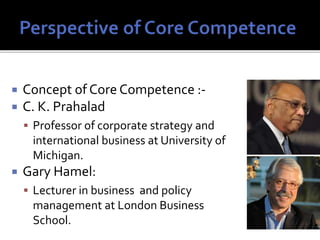
 Concept of Core Competence :-
 C. K. Prahalad
 Professor of corporate strategy and
international business at University of
Michigan.
 Gary Hamel:
 Lecturer in business and policy
management at London Business
School.
 Idea:The evolution of global management
and the emergence/importance of
Competency-minded management
 Rethinking the Corporation
 The Roots of Competitive Advantage
 Identifying Core Competencies – And Losing
Them
 TheTyranny of the SBU
 Developing Strategic Architecture
 What is Core Competence??
 a bundle of skills integrated to make a company
unique.
 the engine for new business development,
underlying component of a company’s
competitive advantage.
 created from the coordination, integration and
harmonization of diverse skills and multiple
streams of technologies.
 http://www.youtube.com/watch?v=WfP-
VICbLRA
 Build product for customers need but have not
yet even imagined.
 Requires radical change in the management of
major companies.
 Understand the changing basis for global
leadership.
 Strategic architecture: to exploit the
convergence of computing and
communicating(“C & C”).
 Acquired competencies in semiconductors.
 Used collaborative arrangements to multiply
internal resources.
 Now a world leader in consumer electronics
Image source: NEC
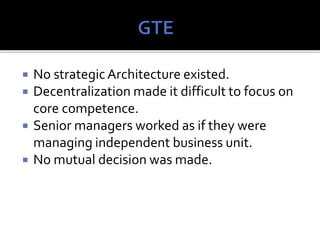
 No strategicArchitecture existed.
 Decentralization made it difficult to focus on
core competence.
 Senior managers worked as if they were
managing independent business unit.
 No mutual decision was made.
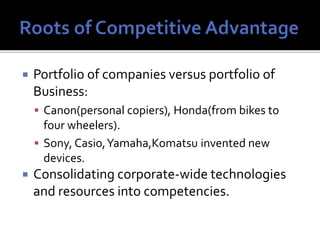
 Portfolio of companies versus portfolio of
Business:
 Canon(personal copiers), Honda(from bikes to
four wheelers).
 Sony, Casio,Yamaha,Komatsu invented new
devices.
 Consolidating corporate-wide technologies
and resources into competencies.
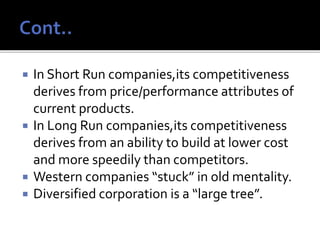
 In Short Run companies,its competitiveness
derives from price/performance attributes of
current products.
 In Long Run companies,its competitiveness
derives from an ability to build at lower cost
and more speedily than competitors.
 Western companies “stuck” in old mentality.
 Diversified corporation is a “large tree”.
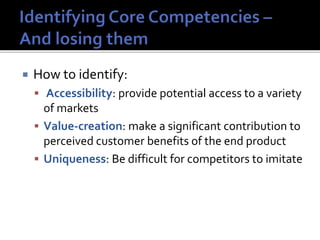
 How to identify:
 Accessibility: provide potential access to a variety
of markets
 Value-creation: make a significant contribution to
perceived customer benefits of the end product
 Uniqueness: Be difficult for competitors to imitate
 How to lose:
A Core Competency is lost:
 Through outsourcing/OEM-supply relationships
=> Example: Chrysler vs Honda
 Through giving up opportunities to establish
competencies that are evolving in existing
businesses
=> Example: television business
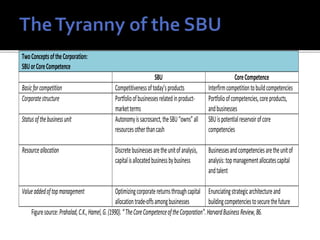
TwoConceptsoftheCorporation:
SBUorCoreCompetence
SBU CoreCompetence
Basicforcompetition Competitivenessoftoday’sproducts Interfirmcompetitiontobuildcompetencies
Corporatestructure Portfolioofbusinessesrelatedinproduct-
marketterms
Portfolioofcompetencies,coreproducts,
andbusinesses
Statusofthebusinessunit Autonomyissacrosanct,theSBU“owns”all
resourcesotherthancash
SBUispotentialreservoirofcore
competencies
Resourceallocation Discretebusinessesaretheunitofanalysis,
capitalisallocatedbusinessbybusiness
Businessesandcompetenciesaretheunitof
analysis:topmanagementallocatescapital
andtalent
Valueaddedoftopmanagement Optimizingcorporatereturnsthroughcapital
allocationtrade-offsamongbusinesses
Enunciatingstrategicarchitectureand
buildingcompetenciestosecurethefuture
Figuresource:Prahalad,C.K.,Hamel,G.(1990).“TheCoreCompetenceoftheCorporation”.HarvardBusinessReview,86.
 The ineffectiveness of SBU model:
 Underinvestment in Developing Core
Competencies and Core Products
 Imprisoned Resources
 Bounded Innovation
 A shift in management is inevitable.
 A strategic architecture:
 Establish objectives for competence building
 A road map of the future that identifies which core
competencies to build and related technologies
 Create a managerial culture, team work, a capacity to
change, and a willingness to share resources, to
protect proprietary skills, and to think long term
 Consistency of resource allocation, administrative
infrastructure
 Benefits of StrategicArchitecture
 Reduce the investment needed to secure future
market leadership
 Provide a logic for product and market
diversification
 Management duties:
To identify and commit to technical and production
linkages across SBUs that will provide a distinct
competitive advantage.
 Top management: make resource allocation
priority decision
 Lower level of management: understand and
maintain consistency with top management’s
decision and disciplines.
 SBUs should bid for core competencies in the
same way they did for capital.
 How to exploit:
 SBUs must defend why they need certain talents
 SBUs must sacrifice short term in return for long
term benefits
 Rotation
 The article is a radical breakthrough in
management.
 Strengths of the article:
 Timely, ground-breaking, forward-looking
 Weakness of the article:
 Difficult to read and understand fully

Core Competence

  • 1.
  • 2.
     Concept ofCore Competence :-  C. K. Prahalad  Professor of corporate strategy and international business at University of Michigan.  Gary Hamel:  Lecturer in business and policy management at London Business School.
  • 3.
     Idea:The evolutionof global management and the emergence/importance of Competency-minded management  Rethinking the Corporation  The Roots of Competitive Advantage  Identifying Core Competencies – And Losing Them  TheTyranny of the SBU  Developing Strategic Architecture
  • 4.
     What isCore Competence??
  • 5.
     a bundleof skills integrated to make a company unique.  the engine for new business development, underlying component of a company’s competitive advantage.  created from the coordination, integration and harmonization of diverse skills and multiple streams of technologies.
  • 6.
  • 7.
     Build productfor customers need but have not yet even imagined.  Requires radical change in the management of major companies.  Understand the changing basis for global leadership.
  • 8.
     Strategic architecture:to exploit the convergence of computing and communicating(“C & C”).  Acquired competencies in semiconductors.  Used collaborative arrangements to multiply internal resources.  Now a world leader in consumer electronics Image source: NEC
  • 9.
     No strategicArchitectureexisted.  Decentralization made it difficult to focus on core competence.  Senior managers worked as if they were managing independent business unit.  No mutual decision was made.
  • 10.
     Portfolio ofcompanies versus portfolio of Business:  Canon(personal copiers), Honda(from bikes to four wheelers).  Sony, Casio,Yamaha,Komatsu invented new devices.  Consolidating corporate-wide technologies and resources into competencies.
  • 11.
     In ShortRun companies,its competitiveness derives from price/performance attributes of current products.  In Long Run companies,its competitiveness derives from an ability to build at lower cost and more speedily than competitors.  Western companies “stuck” in old mentality.  Diversified corporation is a “large tree”.
  • 12.
     How toidentify:  Accessibility: provide potential access to a variety of markets  Value-creation: make a significant contribution to perceived customer benefits of the end product  Uniqueness: Be difficult for competitors to imitate
  • 13.
     How tolose: A Core Competency is lost:  Through outsourcing/OEM-supply relationships => Example: Chrysler vs Honda  Through giving up opportunities to establish competencies that are evolving in existing businesses => Example: television business
  • 14.
    TwoConceptsoftheCorporation: SBUorCoreCompetence SBU CoreCompetence Basicforcompetition Competitivenessoftoday’sproductsInterfirmcompetitiontobuildcompetencies Corporatestructure Portfolioofbusinessesrelatedinproduct- marketterms Portfolioofcompetencies,coreproducts, andbusinesses Statusofthebusinessunit Autonomyissacrosanct,theSBU“owns”all resourcesotherthancash SBUispotentialreservoirofcore competencies Resourceallocation Discretebusinessesaretheunitofanalysis, capitalisallocatedbusinessbybusiness Businessesandcompetenciesaretheunitof analysis:topmanagementallocatescapital andtalent Valueaddedoftopmanagement Optimizingcorporatereturnsthroughcapital allocationtrade-offsamongbusinesses Enunciatingstrategicarchitectureand buildingcompetenciestosecurethefuture Figuresource:Prahalad,C.K.,Hamel,G.(1990).“TheCoreCompetenceoftheCorporation”.HarvardBusinessReview,86.
  • 15.
     The ineffectivenessof SBU model:  Underinvestment in Developing Core Competencies and Core Products  Imprisoned Resources  Bounded Innovation  A shift in management is inevitable.
  • 16.
     A strategicarchitecture:  Establish objectives for competence building  A road map of the future that identifies which core competencies to build and related technologies  Create a managerial culture, team work, a capacity to change, and a willingness to share resources, to protect proprietary skills, and to think long term  Consistency of resource allocation, administrative infrastructure
  • 17.
     Benefits ofStrategicArchitecture  Reduce the investment needed to secure future market leadership  Provide a logic for product and market diversification
  • 18.
     Management duties: Toidentify and commit to technical and production linkages across SBUs that will provide a distinct competitive advantage.  Top management: make resource allocation priority decision  Lower level of management: understand and maintain consistency with top management’s decision and disciplines.
  • 20.
     SBUs shouldbid for core competencies in the same way they did for capital.  How to exploit:  SBUs must defend why they need certain talents  SBUs must sacrifice short term in return for long term benefits  Rotation
  • 21.
     The articleis a radical breakthrough in management.  Strengths of the article:  Timely, ground-breaking, forward-looking  Weakness of the article:  Difficult to read and understand fully