
Plastic Ground Cover
Mulches in High Tunnel
Settings
Jerry Untiedt
Untiedt’s Vegetable Farm, Inc.
Waverly, MN
jerry@untiedtswegrowforyou.com
Plasticulture: “The Future of
Farming”
How can you get 2-3x
more crop per acre
using half as much
water as conventional
farming methods?
NRCS Data Sheet
• If the government says it,
it must be true
• Short history of plastic
mulches
• Growth pattern of the
practice
• Where in the world the
growth has occurred
Plasticulture-That’s
How!
Why to consider
plastic
mulches?
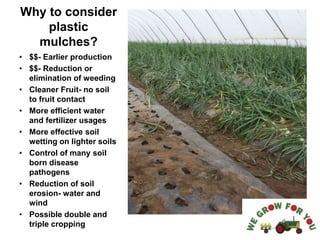
• $$- Earlier production
• $$- Reduction or
elimination of weeding
• Cleaner Fruit- no soil
to fruit contact
• More efficient water
and fertilizer usages
• More effective soil
wetting on lighter soils
• Control of many soil
born disease
pathogens
• Reduction of soil
erosion- water and
wind
• Possible double and
triple cropping
Polyethylene Mulches:
Considerations
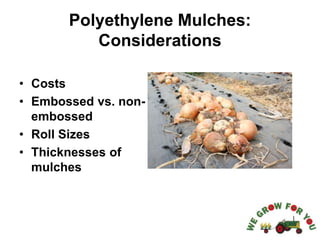
• Costs
• Embossed vs. non-
embossed
• Roll Sizes
• Thicknesses of
mulches
Personalities of Various Plastic
Films
• Clear Embossed Film
– First to arrive on the
production scene
– Warmest of all
mulches
– Poor weed barrier
– Least expensive
– Will present some
evaporation
• Black Embossed Film
– Second to arrive in the
industry
– Relatively low cost
– Excellent in blocking
weed growth
– Slows evaporation
substantially
– Does warm soil
Personalities of Various Plastic
Films
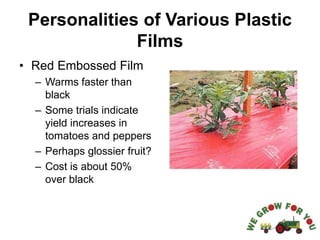
• Red Embossed Film
– Warms faster than
black
– Some trials indicate
yield increases in
tomatoes and peppers
– Perhaps glossier fruit?
– Cost is about 50%
over black
Personalities of Various Plastic
Films
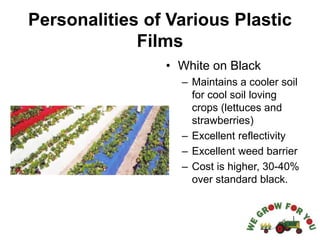
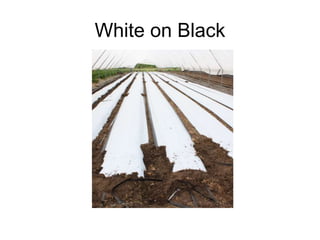
• White on Black
– Maintains a cooler soil
for cool soil loving
crops (lettuces and
strawberries)
– Excellent reflectivity
– Excellent weed barrier
– Cost is higher, 30-40%
over standard black.
White on Black
Personalities of Various Plastic
Films
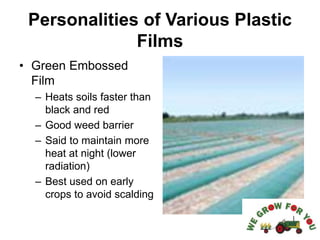
• Green Embossed
Film
– Heats soils faster than
black and red
– Good weed barrier
– Said to maintain more
heat at night (lower
radiation)
– Best used on early
crops to avoid scalding
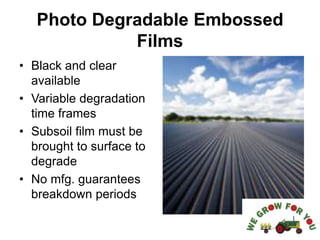
Photo Degradable Embossed
Films
• Black and clear
available
• Variable degradation
time frames
• Subsoil film must be
brought to surface to
degrade
• No mfg. guarantees
breakdown periods
Biodegradable Films
• Mostly available in
black
• Leaves no residues or
toxicities
• Substantial labor
savings as no lifting
and retrieval
• No recycling or landfill
dilemma
• Newer brand, “Bio
360” is both
biodegradable and
compostable
• Bio 360 approved by
USDA National
Organic Program
• Must be tilled into
soils to biodegrade
Groundcover Thoughts
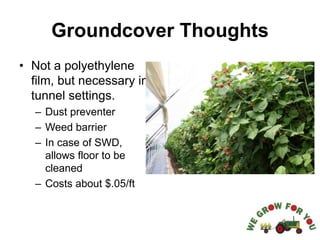
• Not a polyethylene
film, but necessary in
tunnel settings.
– Dust preventer
– Weed barrier
– In case of SWD,
allows floor to be
cleaned
– Costs about $.05/ft
Final Thoughts
• Recycling vs. Landfills • Growing is generally
more enjoyable than
selling- BE
CAREFUL!
QUESTIONS?

Plastic ground cover mulches in high tunnel settings, 2015

  • 1.
    Plastic Ground Cover Mulchesin High Tunnel Settings Jerry Untiedt Untiedt’s Vegetable Farm, Inc. Waverly, MN jerry@untiedtswegrowforyou.com
  • 2.
    Plasticulture: “The Futureof Farming” How can you get 2-3x more crop per acre using half as much water as conventional farming methods? NRCS Data Sheet • If the government says it, it must be true • Short history of plastic mulches • Growth pattern of the practice • Where in the world the growth has occurred Plasticulture-That’s How!
  • 8.
    Why to consider plastic mulches? •$$- Earlier production • $$- Reduction or elimination of weeding • Cleaner Fruit- no soil to fruit contact • More efficient water and fertilizer usages • More effective soil wetting on lighter soils • Control of many soil born disease pathogens • Reduction of soil erosion- water and wind • Possible double and triple cropping
  • 9.
    Polyethylene Mulches: Considerations • Costs •Embossed vs. non- embossed • Roll Sizes • Thicknesses of mulches
  • 10.
    Personalities of VariousPlastic Films • Clear Embossed Film – First to arrive on the production scene – Warmest of all mulches – Poor weed barrier – Least expensive – Will present some evaporation • Black Embossed Film – Second to arrive in the industry – Relatively low cost – Excellent in blocking weed growth – Slows evaporation substantially – Does warm soil
  • 11.
    Personalities of VariousPlastic Films • Red Embossed Film – Warms faster than black – Some trials indicate yield increases in tomatoes and peppers – Perhaps glossier fruit? – Cost is about 50% over black
  • 12.
    Personalities of VariousPlastic Films • White on Black – Maintains a cooler soil for cool soil loving crops (lettuces and strawberries) – Excellent reflectivity – Excellent weed barrier – Cost is higher, 30-40% over standard black.
  • 13.
  • 14.
    Personalities of VariousPlastic Films • Green Embossed Film – Heats soils faster than black and red – Good weed barrier – Said to maintain more heat at night (lower radiation) – Best used on early crops to avoid scalding
  • 15.
    Photo Degradable Embossed Films •Black and clear available • Variable degradation time frames • Subsoil film must be brought to surface to degrade • No mfg. guarantees breakdown periods
  • 16.
    Biodegradable Films • Mostlyavailable in black • Leaves no residues or toxicities • Substantial labor savings as no lifting and retrieval • No recycling or landfill dilemma • Newer brand, “Bio 360” is both biodegradable and compostable • Bio 360 approved by USDA National Organic Program • Must be tilled into soils to biodegrade
  • 17.
    Groundcover Thoughts • Nota polyethylene film, but necessary in tunnel settings. – Dust preventer – Weed barrier – In case of SWD, allows floor to be cleaned – Costs about $.05/ft
  • 18.
    Final Thoughts • Recyclingvs. Landfills • Growing is generally more enjoyable than selling- BE CAREFUL!
  • 20.