ONCE UPON A TIME…
A GREAT PERSONALITY BORN
WHO CHANGED THE THINKING.
AN INFLUENTIAL GLOBAL
BUSINESS THINKER.
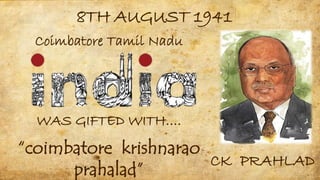
8TH AUGUST 1941
Coimbatore Tamil Nadu
WAS GIFTED WITH….
CK PRAHLAD
“coimbatore krishnarao
prahalad”
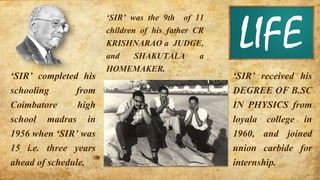
‘SIR’ was the 9th of 11
children of his father CR
KRISHNARAO a JUDGE,
and SHAKUTALA a
HOMEMAKER.
‘SIR’ completed his
schooling from
Coimbatore high
school madras in
1956 when ‘SIR’ was
15 i.e. three years
ahead of schedule.
‘SIR’ received his
DEGREE OF B.SC
IN PHYSICS from
loyala college in
1960, and joined
union carbide for
internship.
LIFE
‘SIR’ applied in IIM AHEMDABAD and was accepted in the
first class in 1964. ‘SIR’ meets there in AHEMDABAD with his
future wife gayatri.
‘SIR’ completed his post graduation in MBA in 1966 and leaves
to begin work at INDIAN PISTONS, a manufacturing firm.
‘SIR’ was promoted to manager in 1962 when he
was just 20 and was the youngest to ever achieve
this feat. ‘SIR’ use to work on assembly line with
union to create new procedures for production.
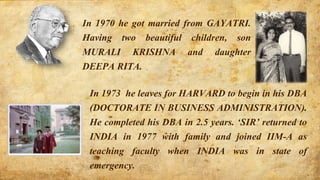
In 1970 he got married from GAYATRI.
Having two beautiful children, son
MURALI KRISHNA and daughter
DEEPA RITA.
In 1973 he leaves for HARVARD to begin in his DBA
(DOCTORATE IN BUSINESS ADMINISTRATION).
He completed his DBA in 2.5 years. ‘SIR’ returned to
INDIA in 1977 with family and joined IIM-A as
teaching faculty when INDIA was in state of
emergency.
In 1977, he was hired by the
University of Michigan's
School of Business Administration,
where he advanced to the top tenured
Appointment as a full professor.
In 2005, Dr. Prahalad earned the
university's highest distinction,
Distinguished University Professor.
CONTRIBUTION TO
MANAGEMENT
‘SIR’ made a name for himself by introducing the concept
of core competence to explain the superior performance
of Japanese organisations compared with the rest in the
world. This was acknowledged to be a dramatically new
way of understanding competitiveness of organisations.
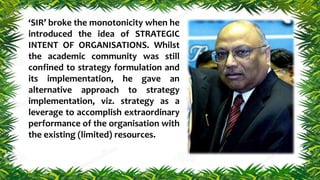
‘SIR’ broke the monotonicity when he
introduced the idea of STRATEGIC
INTENT OF ORGANISATIONS. Whilst
the academic community was still
confined to strategy formulation and
its implementation, he gave an
alternative approach to strategy
implementation, viz. strategy as a
leverage to accomplish extraordinary
performance of the organisation with
the existing (limited) resources.
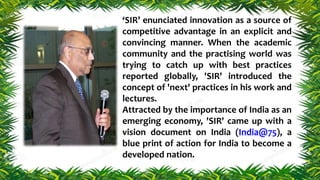
‘SIR’ enunciated innovation as a source of
competitive advantage in an explicit and
convincing manner. When the academic
community and the practising world was
trying to catch up with best practices
reported globally, 'SIR' introduced the
concept of 'next' practices in his work and
lectures.
Attracted by the importance of India as an
emerging economy, 'SIR' came up with a
vision document on India (India@75), a
blue print of action for India to become a
developed nation.
In the later part of his career, ‘SIR’ became fascinated by the
developing world. Therefore, he focused extensively on the issues
and problems relevant to the developing nations, with an objective
to develop a comprehensive managerial approach to resolve and
address challenges arising out of accomplishing inclusive growth.
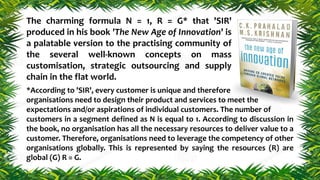
His latest book The New Age of Innovation with
M.S. Krishnan tactfully combines mass
customisation, strategic outsourcing, innovation
on global supply chains, usage of information
technology in reengineered business process,
interdependence of the firms at the global level,
etc.
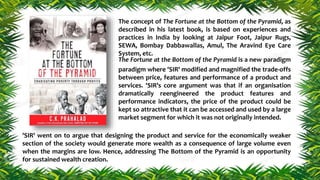
The concept of The Fortune at the Bottom of the Pyramid, as
described in his latest book, is based on experiences and
practices in India by looking at Jaipur Foot, Jaipur Rugs,
SEWA, Bombay Dabbawallas, Amul, The Aravind Eye Care
System, etc.
The Fortune at the Bottom of the Pyramid is a new paradigm
paradigm where 'SIR' modified and magnified the trade-offs
between price, features and performance of a product and
services. 'SIR's core argument was that if an organisation
dramatically reengineered the product features and
performance indicators, the price of the product could be
kept so attractive that it can be accessed and used by a large
market segment for which it was not originally intended.
'SIR' went on to argue that designing the product and service for the economically weaker
section of the society would generate more wealth as a consequence of large volume even
when the margins are low. Hence, addressing The Bottom of the Pyramid is an opportunity
for sustained wealth creation.
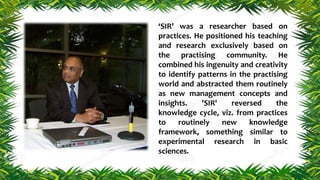
‘SIR’ was a researcher based on
practices. He positioned his teaching
and research exclusively based on
the practising community. He
combined his ingenuity and creativity
to identify patterns in the practising
world and abstracted them routinely
as new management concepts and
insights. 'SIR' reversed the
knowledge cycle, viz. from practices
to routinely new knowledge
framework, something similar to
experimental research in basic
sciences.
The charming formula N = 1, R = G* that 'SIR'
produced in his book 'The New Age of Innovation' is
a palatable version to the practising community of
the several well-known concepts on mass
customisation, strategic outsourcing and supply
chain in the flat world.
*According to 'SIR', every customer is unique and therefore
organisations need to design their product and services to meet the
expectations and/or aspirations of individual customers. The number of
customers in a segment defined as N is equal to 1. According to discussion in
the book, no organisation has all the necessary resources to deliver value to a
customer. Therefore, organisations need to leverage the competency of other
organisations globally. This is represented by saying the resources (R) are
global (G) R = G.
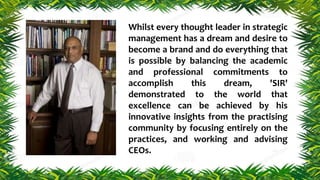
Whilst every thought leader in strategic
management has a dream and desire to
become a brand and do everything that
is possible by balancing the academic
and professional commitments to
accomplish this dream, 'SIR'
demonstrated to the world that
excellence can be achieved by his
innovative insights from the practising
community by focusing entirely on the
practices, and working and advising
CEOs.
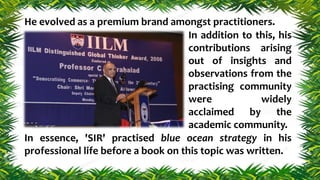
In addition to this, his
contributions arising
out of insights and
observations from the
practising community
were widely
acclaimed by the
academic community.
In essence, 'SIR' practised blue ocean strategy in his
professional life before a book on this topic was written.
He evolved as a premium brand amongst practitioners.
The essence of this book is to enable managers to see opportunities in
unchartered territories. Usually organisations tend to compete in well-
known and established clusters. Shareholders wealth can be maximised by
looking at new areas, which are not dominated by existing players.
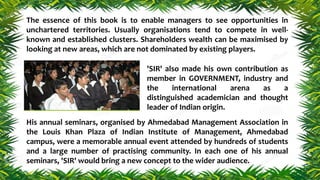
'SIR' also made his own contribution as
member in GOVERNMENT, industry and
the international arena as a
distinguished academician and thought
leader of Indian origin.
His annual seminars, organised by Ahmedabad Management Association in
the Louis Khan Plaza of Indian Institute of Management, Ahmedabad
campus, were a memorable annual event attended by hundreds of students
and a large number of practising community. In each one of his annual
seminars, 'SIR' would bring a new concept to the wider audience.
IMPORTANT FIELD WORKS OF
“SIR”
BOTTOM OF PYRAMID
VALUE CO-CREATION
DIVERSIFIED MULTINATIONAL CORPORATIONS
RESOURCE BASED VIEW, STRATEGIC
INTENT, DOMINANT LOGIC, CORE
COMPETENCIES
STRATEGY AND INFORMATION
TECHNOLOGY
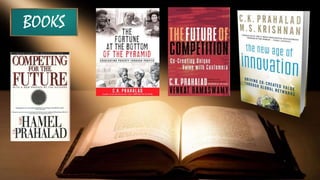
BOOKS
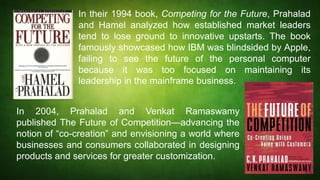
In their 1994 book, Competing for the Future, Prahalad
and Hamel analyzed how established market leaders
tend to lose ground to innovative upstarts. The book
famously showcased how IBM was blindsided by Apple,
failing to see the future of the personal computer
because it was too focused on maintaining its
leadership in the mainframe business.
In 2004, Prahalad and Venkat Ramaswamy
published The Future of Competition—advancing the
notion of “co-creation” and envisioning a world where
businesses and consumers collaborated in designing
products and services for greater customization.
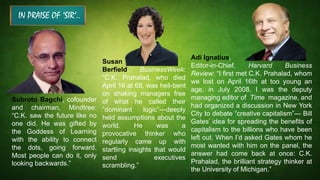
IN PRAISE OF ‘SIR’..
Subroto Bagchi, cofounder
and chairman, Mindtree:
“C.K. saw the future like no
one did. He was gifted by
the Goddess of Learning
with the ability to connect
the dots, going forward.
Most people can do it, only
looking backwards.”
Adi Ignatius,
Editor-in-Chief, Harvard Business
Review: “I first met C.K. Prahalad, whom
we lost on April 16th at too young an
age, in July 2008. I was the deputy
managing editor of Time magazine, and
had organized a discussion in New York
City to debate “creative capitalism”— Bill
Gates’ idea for spreading the benefits of
capitalism to the billions who have been
left out. When I’d asked Gates whom he
most wanted with him on the panel, the
answer had come back at once: C.K.
Prahalad, the brilliant strategy thinker at
the University of Michigan.”
Susan
Berfield, BusinessWeek:
“C.K. Prahalad, who died
April 16 at 68, was hell-bent
on shaking managers free
of what he called their
“dominant logic”—deeply
held assumptions about the
world. He was a
provocative thinker who
regularly came up with
startling insights that would
send executives
scrambling.”
Deepa Prahalad, Prahalad’s Daughter,
Drucker Forum Speech: “I remember a
conversation with my father as he was
refining the original paper that later
became the backbone of the book [The
Fortune at the Bottom of the Pyramid:
Eradicating Poverty Through Profits]. As
we debated some of the hard questions,
he simply smiled and said, “We’re sitting
in comfort and getting frustrated because
we can’t understand how to help. But
think of the people who are actually living
in poverty. How frustrated must they be?
But they haven’t given up—and neither
should we.”
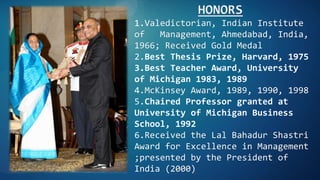
HONORS
1.Valedictorian, Indian Institute
of Management, Ahmedabad, India,
1966; Received Gold Medal
2.Best Thesis Prize, Harvard, 1975
3.Best Teacher Award, University
of Michigan 1983, 1989
4.McKinsey Award, 1989, 1990, 1998
5.Chaired Professor granted at
University of Michigan Business
School, 1992
6.Received the Lal Bahadur Shastri
Award for Excellence in Management
;presented by the President of
India (2000)
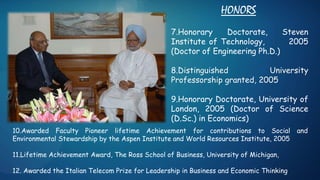
HONORS
7.Honorary Doctorate, Steven
Institute of Technology, 2005
(Doctor of Engineering Ph.D.)
8.Distinguished University
Professorship granted, 2005
9.Honorary Doctorate, University of
London, 2005 (Doctor of Science
(D.Sc.) in Economics)
10.Awarded Faculty Pioneer lifetime Achievement for contributions to Social and
Environmental Stewardship by the Aspen Institute and World Resources Institute, 2005
11.Lifetime Achievement Award, The Ross School of Business, University of Michigan,
12. Awarded the Italian Telecom Prize for Leadership in Business and Economic Thinking
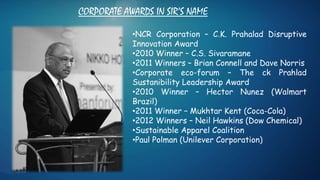
CORPORATE AWARDS IN SIR’S NAME
•NCR Corporation – C.K. Prahalad Disruptive
Innovation Award
•2010 Winner – C.S. Sivaramane
•2011 Winners – Brian Connell and Dave Norris
•Corporate eco-forum – The ck Prahlad
Sustanibility Leadership Award
•2010 Winner – Hector Nunez (Walmart
Brazil)
•2011 Winner – Mukhtar Kent (Coca-Cola)
•2012 Winners – Neil Hawkins (Dow Chemical)
•Sustainable Apparel Coalition
•Paul Polman (Unilever Corporation)
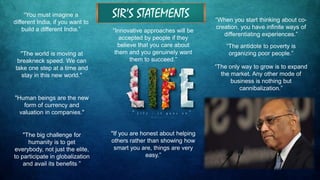
"The world is moving at
breakneck speed. We can
take one step at a time and
stay in this new world."
"Human beings are the new
form of currency and
valuation in companies."
"The big challenge for
humanity is to get
everybody, not just the elite,
to participate in globalization
and avail its benefits.”
“Innovative approaches will be
accepted by people if they
believe that you care about
them and you genuinely want
them to succeed.”
"If you are honest about helping
others rather than showing how
smart you are, things are very
easy.”
“When you start thinking about co-
creation, you have infinite ways of
differentiating experiences.”
“The antidote to poverty is
organizing poor people.”
“You must imagine a
different India, if you want to
build a different India.”
“The only way to grow is to expand
the market. Any other mode of
business is nothing but
cannibalization.”
SIR’S STATEMENTS
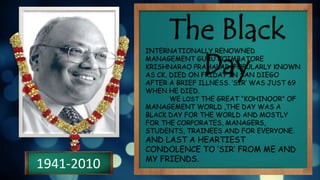
1941-2010
The Black
Day
INTERNATIONALLY RENOWNED
MANAGEMENT GURU COIMBATORE
KRISHNARAO PRAHALAD, POPULARLY KNOWN
AS CK, DIED ON FRIDAY IN SAN DIEGO
AFTER A BRIEF ILLNESS. ‘SIR’ WAS JUST 69
WHEN HE DIED.
WE LOST THE GREAT “KOHINOOR” OF
MANAGEMENT WORLD ,THE DAY WAS A
BLACK DAY FOR THE WORLD AND MOSTLY
FOR THE CORPORATES, MANAGERS,
STUDENTS, TRAINEES AND FOR EVERYONE.
AND LAST A HEARTIEST
CONDOLENCE TO ‘SIR’ FROM ME AND
MY FRIENDS.
THANK YOU
SUBMITTED TO,
BHADU SIR ..YASH..
ANY QUERIES

Ck prahlad

  • 2.
    ONCE UPON ATIME… A GREAT PERSONALITY BORN WHO CHANGED THE THINKING. AN INFLUENTIAL GLOBAL BUSINESS THINKER.
  • 3.
    8TH AUGUST 1941 CoimbatoreTamil Nadu WAS GIFTED WITH…. CK PRAHLAD “coimbatore krishnarao prahalad”
  • 4.
    ‘SIR’ was the9th of 11 children of his father CR KRISHNARAO a JUDGE, and SHAKUTALA a HOMEMAKER. ‘SIR’ completed his schooling from Coimbatore high school madras in 1956 when ‘SIR’ was 15 i.e. three years ahead of schedule. ‘SIR’ received his DEGREE OF B.SC IN PHYSICS from loyala college in 1960, and joined union carbide for internship. LIFE
  • 5.
    ‘SIR’ applied inIIM AHEMDABAD and was accepted in the first class in 1964. ‘SIR’ meets there in AHEMDABAD with his future wife gayatri. ‘SIR’ completed his post graduation in MBA in 1966 and leaves to begin work at INDIAN PISTONS, a manufacturing firm. ‘SIR’ was promoted to manager in 1962 when he was just 20 and was the youngest to ever achieve this feat. ‘SIR’ use to work on assembly line with union to create new procedures for production.
  • 6.
    In 1970 hegot married from GAYATRI. Having two beautiful children, son MURALI KRISHNA and daughter DEEPA RITA. In 1973 he leaves for HARVARD to begin in his DBA (DOCTORATE IN BUSINESS ADMINISTRATION). He completed his DBA in 2.5 years. ‘SIR’ returned to INDIA in 1977 with family and joined IIM-A as teaching faculty when INDIA was in state of emergency.
  • 7.
    In 1977, hewas hired by the University of Michigan's School of Business Administration, where he advanced to the top tenured Appointment as a full professor. In 2005, Dr. Prahalad earned the university's highest distinction, Distinguished University Professor.
  • 8.
    CONTRIBUTION TO MANAGEMENT ‘SIR’ madea name for himself by introducing the concept of core competence to explain the superior performance of Japanese organisations compared with the rest in the world. This was acknowledged to be a dramatically new way of understanding competitiveness of organisations.
  • 9.
    ‘SIR’ broke themonotonicity when he introduced the idea of STRATEGIC INTENT OF ORGANISATIONS. Whilst the academic community was still confined to strategy formulation and its implementation, he gave an alternative approach to strategy implementation, viz. strategy as a leverage to accomplish extraordinary performance of the organisation with the existing (limited) resources.
  • 10.
    ‘SIR’ enunciated innovationas a source of competitive advantage in an explicit and convincing manner. When the academic community and the practising world was trying to catch up with best practices reported globally, 'SIR' introduced the concept of 'next' practices in his work and lectures. Attracted by the importance of India as an emerging economy, 'SIR' came up with a vision document on India (India@75), a blue print of action for India to become a developed nation.
  • 11.
    In the laterpart of his career, ‘SIR’ became fascinated by the developing world. Therefore, he focused extensively on the issues and problems relevant to the developing nations, with an objective to develop a comprehensive managerial approach to resolve and address challenges arising out of accomplishing inclusive growth. His latest book The New Age of Innovation with M.S. Krishnan tactfully combines mass customisation, strategic outsourcing, innovation on global supply chains, usage of information technology in reengineered business process, interdependence of the firms at the global level, etc.
  • 12.
    The concept ofThe Fortune at the Bottom of the Pyramid, as described in his latest book, is based on experiences and practices in India by looking at Jaipur Foot, Jaipur Rugs, SEWA, Bombay Dabbawallas, Amul, The Aravind Eye Care System, etc. The Fortune at the Bottom of the Pyramid is a new paradigm paradigm where 'SIR' modified and magnified the trade-offs between price, features and performance of a product and services. 'SIR's core argument was that if an organisation dramatically reengineered the product features and performance indicators, the price of the product could be kept so attractive that it can be accessed and used by a large market segment for which it was not originally intended. 'SIR' went on to argue that designing the product and service for the economically weaker section of the society would generate more wealth as a consequence of large volume even when the margins are low. Hence, addressing The Bottom of the Pyramid is an opportunity for sustained wealth creation.
  • 13.
    ‘SIR’ was aresearcher based on practices. He positioned his teaching and research exclusively based on the practising community. He combined his ingenuity and creativity to identify patterns in the practising world and abstracted them routinely as new management concepts and insights. 'SIR' reversed the knowledge cycle, viz. from practices to routinely new knowledge framework, something similar to experimental research in basic sciences.
  • 14.
    The charming formulaN = 1, R = G* that 'SIR' produced in his book 'The New Age of Innovation' is a palatable version to the practising community of the several well-known concepts on mass customisation, strategic outsourcing and supply chain in the flat world. *According to 'SIR', every customer is unique and therefore organisations need to design their product and services to meet the expectations and/or aspirations of individual customers. The number of customers in a segment defined as N is equal to 1. According to discussion in the book, no organisation has all the necessary resources to deliver value to a customer. Therefore, organisations need to leverage the competency of other organisations globally. This is represented by saying the resources (R) are global (G) R = G.
  • 15.
    Whilst every thoughtleader in strategic management has a dream and desire to become a brand and do everything that is possible by balancing the academic and professional commitments to accomplish this dream, 'SIR' demonstrated to the world that excellence can be achieved by his innovative insights from the practising community by focusing entirely on the practices, and working and advising CEOs.
  • 16.
    In addition tothis, his contributions arising out of insights and observations from the practising community were widely acclaimed by the academic community. In essence, 'SIR' practised blue ocean strategy in his professional life before a book on this topic was written. He evolved as a premium brand amongst practitioners.
  • 17.
    The essence ofthis book is to enable managers to see opportunities in unchartered territories. Usually organisations tend to compete in well- known and established clusters. Shareholders wealth can be maximised by looking at new areas, which are not dominated by existing players. 'SIR' also made his own contribution as member in GOVERNMENT, industry and the international arena as a distinguished academician and thought leader of Indian origin. His annual seminars, organised by Ahmedabad Management Association in the Louis Khan Plaza of Indian Institute of Management, Ahmedabad campus, were a memorable annual event attended by hundreds of students and a large number of practising community. In each one of his annual seminars, 'SIR' would bring a new concept to the wider audience.
  • 18.
    IMPORTANT FIELD WORKSOF “SIR” BOTTOM OF PYRAMID VALUE CO-CREATION DIVERSIFIED MULTINATIONAL CORPORATIONS RESOURCE BASED VIEW, STRATEGIC INTENT, DOMINANT LOGIC, CORE COMPETENCIES STRATEGY AND INFORMATION TECHNOLOGY
  • 19.
  • 20.
    In their 1994book, Competing for the Future, Prahalad and Hamel analyzed how established market leaders tend to lose ground to innovative upstarts. The book famously showcased how IBM was blindsided by Apple, failing to see the future of the personal computer because it was too focused on maintaining its leadership in the mainframe business. In 2004, Prahalad and Venkat Ramaswamy published The Future of Competition—advancing the notion of “co-creation” and envisioning a world where businesses and consumers collaborated in designing products and services for greater customization.
  • 21.
    IN PRAISE OF‘SIR’.. Subroto Bagchi, cofounder and chairman, Mindtree: “C.K. saw the future like no one did. He was gifted by the Goddess of Learning with the ability to connect the dots, going forward. Most people can do it, only looking backwards.” Adi Ignatius, Editor-in-Chief, Harvard Business Review: “I first met C.K. Prahalad, whom we lost on April 16th at too young an age, in July 2008. I was the deputy managing editor of Time magazine, and had organized a discussion in New York City to debate “creative capitalism”— Bill Gates’ idea for spreading the benefits of capitalism to the billions who have been left out. When I’d asked Gates whom he most wanted with him on the panel, the answer had come back at once: C.K. Prahalad, the brilliant strategy thinker at the University of Michigan.” Susan Berfield, BusinessWeek: “C.K. Prahalad, who died April 16 at 68, was hell-bent on shaking managers free of what he called their “dominant logic”—deeply held assumptions about the world. He was a provocative thinker who regularly came up with startling insights that would send executives scrambling.”
  • 22.
    Deepa Prahalad, Prahalad’sDaughter, Drucker Forum Speech: “I remember a conversation with my father as he was refining the original paper that later became the backbone of the book [The Fortune at the Bottom of the Pyramid: Eradicating Poverty Through Profits]. As we debated some of the hard questions, he simply smiled and said, “We’re sitting in comfort and getting frustrated because we can’t understand how to help. But think of the people who are actually living in poverty. How frustrated must they be? But they haven’t given up—and neither should we.”
  • 23.
    HONORS 1.Valedictorian, Indian Institute ofManagement, Ahmedabad, India, 1966; Received Gold Medal 2.Best Thesis Prize, Harvard, 1975 3.Best Teacher Award, University of Michigan 1983, 1989 4.McKinsey Award, 1989, 1990, 1998 5.Chaired Professor granted at University of Michigan Business School, 1992 6.Received the Lal Bahadur Shastri Award for Excellence in Management ;presented by the President of India (2000)
  • 24.
    HONORS 7.Honorary Doctorate, Steven Instituteof Technology, 2005 (Doctor of Engineering Ph.D.) 8.Distinguished University Professorship granted, 2005 9.Honorary Doctorate, University of London, 2005 (Doctor of Science (D.Sc.) in Economics) 10.Awarded Faculty Pioneer lifetime Achievement for contributions to Social and Environmental Stewardship by the Aspen Institute and World Resources Institute, 2005 11.Lifetime Achievement Award, The Ross School of Business, University of Michigan, 12. Awarded the Italian Telecom Prize for Leadership in Business and Economic Thinking
  • 25.
    CORPORATE AWARDS INSIR’S NAME •NCR Corporation – C.K. Prahalad Disruptive Innovation Award •2010 Winner – C.S. Sivaramane •2011 Winners – Brian Connell and Dave Norris •Corporate eco-forum – The ck Prahlad Sustanibility Leadership Award •2010 Winner – Hector Nunez (Walmart Brazil) •2011 Winner – Mukhtar Kent (Coca-Cola) •2012 Winners – Neil Hawkins (Dow Chemical) •Sustainable Apparel Coalition •Paul Polman (Unilever Corporation)
  • 26.
    "The world ismoving at breakneck speed. We can take one step at a time and stay in this new world." "Human beings are the new form of currency and valuation in companies." "The big challenge for humanity is to get everybody, not just the elite, to participate in globalization and avail its benefits.” “Innovative approaches will be accepted by people if they believe that you care about them and you genuinely want them to succeed.” "If you are honest about helping others rather than showing how smart you are, things are very easy.” “When you start thinking about co- creation, you have infinite ways of differentiating experiences.” “The antidote to poverty is organizing poor people.” “You must imagine a different India, if you want to build a different India.” “The only way to grow is to expand the market. Any other mode of business is nothing but cannibalization.” SIR’S STATEMENTS
  • 28.
    1941-2010 The Black Day INTERNATIONALLY RENOWNED MANAGEMENTGURU COIMBATORE KRISHNARAO PRAHALAD, POPULARLY KNOWN AS CK, DIED ON FRIDAY IN SAN DIEGO AFTER A BRIEF ILLNESS. ‘SIR’ WAS JUST 69 WHEN HE DIED. WE LOST THE GREAT “KOHINOOR” OF MANAGEMENT WORLD ,THE DAY WAS A BLACK DAY FOR THE WORLD AND MOSTLY FOR THE CORPORATES, MANAGERS, STUDENTS, TRAINEES AND FOR EVERYONE. AND LAST A HEARTIEST CONDOLENCE TO ‘SIR’ FROM ME AND MY FRIENDS.
  • 29.
    THANK YOU SUBMITTED TO, BHADUSIR ..YASH.. ANY QUERIES