
Core Competencies Steven Forbes Marriott School November 2005
Agenda Competencies defined Brainstorming competencies The competitive diversified corporation Exercise: identifying competencies  Strategic architecture
What are core competencies? Core competencies are the skills, characteristics, and assets that set your company apart from competitors. They are the fuel for innovation and the roots of competitive advantage.
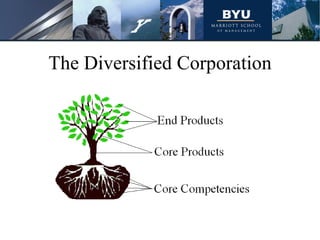
SBU’s Vs. Core Competencies The old concept of the diversified corporation is a portfolio of strategic business units (SBU’s) within a similar product or customer category. Each SBU’s goal is to put competitive products on the shelf  today . Today’s corporation must maintain competitiveness by developing core competencies. These competencies determine the strategic architecture of the firm. Competencies must translate into core products, which significantly contribute to the firm’s end products.
Competencies Do Not Mean:  Outspending competitors on research and development Cost sharing among SBU’s Vertical integration
Brainstorming Exercise What costs are involved in developing new products if your market requires constant innovation? The only company that might get away with a lack of innovation is one that manufactures electric chairs for government contracts. What if you could miniaturize anything? What then would it cost to develop new products? What products would you make?
The Diversified Corporation
Why Competencies? Even good marketing wont make a “me too” firm competitive in the long run. Competencies are enhanced with time. Make or buy decisions are simplified. Non-competencies can be supplemented with strategic alliances and licensing agreements.
Competencies to Core Products Core products are the tangible evidence of our core competencies. They are key contributors to the customer benefits received from the end product. Honda: Small gas engines Canon: Desktop laser printer engines 3M: Adhesives and substrates
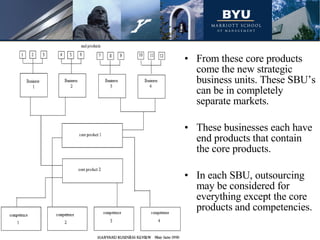
From these core products come the new strategic business units. These SBU’s can be in completely separate markets. These businesses each have end products that contain the core products. In each SBU, outsourcing may be considered for everything except the core products and competencies.
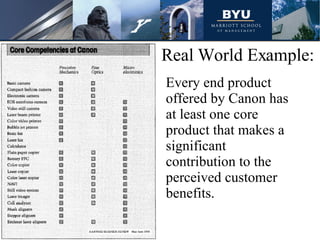
Real World Example: Every end product offered by Canon has at least one core product that makes a significant contribution to the perceived customer benefits.
Manufacturing Share With core products, the focus shifts from market share to manufacturing share. Matsushita owns Panasonic, JVC, and others. Their brand share for VCR’s is about 20%. Their world manufacturing share of VCR components is 45%.
Exercise: Identifying Your Core Competencies Compile a list of capabilities.  What do you excel at at?  Think of your most skilled employees. What products have been your past winners?
Be Realistic “ Few companies are likely to build world leadership in more than five or six fundamental competencies”  -  (HBR 1990)
Now the Test Does this competence provide potential access to a wide variety of markets? Does this competence make a significant contribution to the perceived customer benefits of the end product? Is this competence difficult for competitors to imitate?
Variety of Markets What do miniature card calculators, pocket TVs, and digital watches have in common? They are all the result of Casio’s know-how in miniaturization, microprocessor design, material science, and ultrathin precision casing.
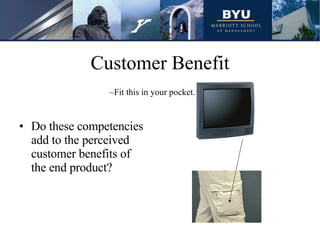
Customer Benefit Do these competencies add to the perceived customer benefits of the end product? Fit this in your pocket.
Easy to Imitate? Philips is a market leader in TVs. Have you ever seen a Philips mini TV? Miniaturization is not one of Philips competencies. They could put one on the market by outsourcing the design and production.  Would this give them any manufacturing share? Or just temporary market share?
So What? If you don’t know what your core competencies are, you may spin off a business unit that contains your most competitive skills, employees, or core products. Long term strategy involves constant innovation. Core competencies provide a market position that allows a company to influence what products will be available in the future.
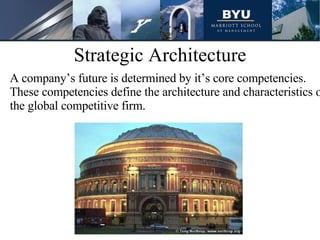
Strategic Architecture A company’s future is determined by it’s core competencies. These competencies define the architecture and characteristics of the global competitive firm.
Boundaryless Organization In the old diversified corporation, ideas and technologies are reluctantly shared from one SBU to the next, if at all. Boundaries seem transparent when SBU’s share core competencies and core products. These resources come from the firm.
Resource Allocation When core competencies are the roots of the firm, specialized employees and core products can be allocated to various SBU’s. At Canon, specialized employees move between camera and printer products regularly.
Innovation Using core competencies, new technologies can be developed without heavy R&D costs. Casio: Small-screen LCD TV Canon: Personal copier Komatsu: Underwater remote-controlled bulldozer Honda: Off-road buggy Sony: 8mm camcorder
Competence Building The focus of today’s global firm should be in competence building. Constantly improving competencies provides for new integrated technologies. Competencies provide focus for long-term goals.
Competitive Advantage Short-term market share can be won by anyone with a good idea. Race to get products on the shelf. Long-term success involves competency structured organizations, innovation, and market consistency. Same core products, integrated into new end products, creating new markets.
Summary Learn your competencies Develop your competencies Structure your organization around your competencies Involve core products in all end products Outsource non-competencies with strategic alliances and licensing.
Readings Gary Hamel and C. K. Prahalad, (1990) &quot;The Core Competence of the Corporation&quot;,  Harvard Business Review , vol. 68, no. 3, May-June 1990, pp 79-93.  Galunic, D.C. and Rodan, S. (1998). &quot;Resource recombinations in the firm: knowledge structures and the potential for Schumpeterian innovation&quot;.  Strategic Management Journal  vol 19. p. 1193-1201.  Mascarenhas, B., Baveja, A., and Jamil, M. (1998) &quot;Dynamics of Core Competencies in Leading Multinational Companies&quot;,  California Management Review , vol 40, no. 4, pp. 117-132.  &quot;Core Competencies.&quot;  QuickMBA . Internet Center for Management and Business      Administration, Inc. 18 Nov. 2005 <http://www.quickmba.com/strategy/      core-competencies/>.      Gamonal, Paula. &quot;Core Competencies Working Smarter, Not Harder.&quot;  Ravenwerks .      Ravenwerks. 21 Nov. 2005 <http://www.ravenwerks.com/leadership/      core_competencies.htm>.    &quot;strategy - core competencies.&quot;  Tutor2u . Tutor2u. 16 Nov. 2005      <http://www.tutor2u.net/business/strategy/core_competencies.htm>.

Core Competencies

  • 1.
    Core Competencies StevenForbes Marriott School November 2005
  • 2.
    Agenda Competencies definedBrainstorming competencies The competitive diversified corporation Exercise: identifying competencies Strategic architecture
  • 3.
    What are corecompetencies? Core competencies are the skills, characteristics, and assets that set your company apart from competitors. They are the fuel for innovation and the roots of competitive advantage.
  • 4.
    SBU’s Vs. CoreCompetencies The old concept of the diversified corporation is a portfolio of strategic business units (SBU’s) within a similar product or customer category. Each SBU’s goal is to put competitive products on the shelf today . Today’s corporation must maintain competitiveness by developing core competencies. These competencies determine the strategic architecture of the firm. Competencies must translate into core products, which significantly contribute to the firm’s end products.
  • 5.
    Competencies Do NotMean: Outspending competitors on research and development Cost sharing among SBU’s Vertical integration
  • 6.
    Brainstorming Exercise Whatcosts are involved in developing new products if your market requires constant innovation? The only company that might get away with a lack of innovation is one that manufactures electric chairs for government contracts. What if you could miniaturize anything? What then would it cost to develop new products? What products would you make?
  • 7.
  • 8.
    Why Competencies? Evengood marketing wont make a “me too” firm competitive in the long run. Competencies are enhanced with time. Make or buy decisions are simplified. Non-competencies can be supplemented with strategic alliances and licensing agreements.
  • 9.
    Competencies to CoreProducts Core products are the tangible evidence of our core competencies. They are key contributors to the customer benefits received from the end product. Honda: Small gas engines Canon: Desktop laser printer engines 3M: Adhesives and substrates
  • 10.
    From these coreproducts come the new strategic business units. These SBU’s can be in completely separate markets. These businesses each have end products that contain the core products. In each SBU, outsourcing may be considered for everything except the core products and competencies.
  • 11.
    Real World Example:Every end product offered by Canon has at least one core product that makes a significant contribution to the perceived customer benefits.
  • 12.
    Manufacturing Share Withcore products, the focus shifts from market share to manufacturing share. Matsushita owns Panasonic, JVC, and others. Their brand share for VCR’s is about 20%. Their world manufacturing share of VCR components is 45%.
  • 13.
    Exercise: Identifying YourCore Competencies Compile a list of capabilities. What do you excel at at? Think of your most skilled employees. What products have been your past winners?
  • 14.
    Be Realistic “Few companies are likely to build world leadership in more than five or six fundamental competencies” - (HBR 1990)
  • 15.
    Now the TestDoes this competence provide potential access to a wide variety of markets? Does this competence make a significant contribution to the perceived customer benefits of the end product? Is this competence difficult for competitors to imitate?
  • 16.
    Variety of MarketsWhat do miniature card calculators, pocket TVs, and digital watches have in common? They are all the result of Casio’s know-how in miniaturization, microprocessor design, material science, and ultrathin precision casing.
  • 17.
    Customer Benefit Dothese competencies add to the perceived customer benefits of the end product? Fit this in your pocket.
  • 18.
    Easy to Imitate?Philips is a market leader in TVs. Have you ever seen a Philips mini TV? Miniaturization is not one of Philips competencies. They could put one on the market by outsourcing the design and production. Would this give them any manufacturing share? Or just temporary market share?
  • 19.
    So What? Ifyou don’t know what your core competencies are, you may spin off a business unit that contains your most competitive skills, employees, or core products. Long term strategy involves constant innovation. Core competencies provide a market position that allows a company to influence what products will be available in the future.
  • 20.
    Strategic Architecture Acompany’s future is determined by it’s core competencies. These competencies define the architecture and characteristics of the global competitive firm.
  • 21.
    Boundaryless Organization Inthe old diversified corporation, ideas and technologies are reluctantly shared from one SBU to the next, if at all. Boundaries seem transparent when SBU’s share core competencies and core products. These resources come from the firm.
  • 22.
    Resource Allocation Whencore competencies are the roots of the firm, specialized employees and core products can be allocated to various SBU’s. At Canon, specialized employees move between camera and printer products regularly.
  • 23.
    Innovation Using corecompetencies, new technologies can be developed without heavy R&D costs. Casio: Small-screen LCD TV Canon: Personal copier Komatsu: Underwater remote-controlled bulldozer Honda: Off-road buggy Sony: 8mm camcorder
  • 24.
    Competence Building Thefocus of today’s global firm should be in competence building. Constantly improving competencies provides for new integrated technologies. Competencies provide focus for long-term goals.
  • 25.
    Competitive Advantage Short-termmarket share can be won by anyone with a good idea. Race to get products on the shelf. Long-term success involves competency structured organizations, innovation, and market consistency. Same core products, integrated into new end products, creating new markets.
  • 26.
    Summary Learn yourcompetencies Develop your competencies Structure your organization around your competencies Involve core products in all end products Outsource non-competencies with strategic alliances and licensing.
  • 27.
    Readings Gary Hameland C. K. Prahalad, (1990) &quot;The Core Competence of the Corporation&quot;, Harvard Business Review , vol. 68, no. 3, May-June 1990, pp 79-93. Galunic, D.C. and Rodan, S. (1998). &quot;Resource recombinations in the firm: knowledge structures and the potential for Schumpeterian innovation&quot;. Strategic Management Journal vol 19. p. 1193-1201. Mascarenhas, B., Baveja, A., and Jamil, M. (1998) &quot;Dynamics of Core Competencies in Leading Multinational Companies&quot;, California Management Review , vol 40, no. 4, pp. 117-132. &quot;Core Competencies.&quot; QuickMBA . Internet Center for Management and Business      Administration, Inc. 18 Nov. 2005 <http://www.quickmba.com/strategy/      core-competencies/>.   Gamonal, Paula. &quot;Core Competencies Working Smarter, Not Harder.&quot; Ravenwerks .      Ravenwerks. 21 Nov. 2005 <http://www.ravenwerks.com/leadership/      core_competencies.htm>.   &quot;strategy - core competencies.&quot; Tutor2u . Tutor2u. 16 Nov. 2005      <http://www.tutor2u.net/business/strategy/core_competencies.htm>.