The Core Competence of the
Corporation
P R A H A L A D , C . K . , G A R Y H A M E L ( 1 9 9 0 ) , “ T H E
C O R E C O M P E T E N C E O F T H E C O R P O R A T I O N , ”
H A R V A R D B U S I N E S S R E V I E W , M A Y - J U N E ,
7 9 - 9 1 .
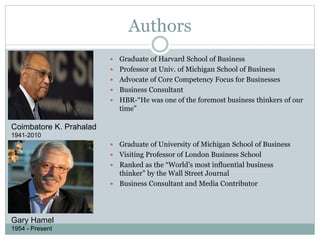
Authors
 Graduate of Harvard School of Business
 Professor at Univ. of Michigan School of Business
 Advocate of Core Competency Focus for Businesses
 Business Consultant
 HBR-“He was one of the foremost business thinkers of our
time”
 Graduate of University of Michigan School of Business
 Visiting Professor of London Business School
 Ranked as the “World’s most influential business
thinker” by the Wall Street Journal
 Business Consultant and Media Contributor
Gary Hamel
1954 - Present
Coimbatore K. Prahalad
1941-2010
Background
 A turbulent time:
 1987 – stock market crash
 1989 – Berlin Wall fell
 1990 – dissolution of the Soviet Union
 1970’s- 1980’s: unchecked growth in corporations
 Becoming large, inefficient conglomerates
 Acquired what they “needed”: strategic business units (SBUs)
 US Corporate (philosophical) Growth
 1980s- SBUs
 1990s-Core Competence
 2001-Networking
Outline of the Article
The article emphasizes the importance of core
competence of a corporation and asks management to
develop their organization based on core competence
 Rethinking the Corporation
 The Roots of Competitive Advantage
 How Not to Think of Competence
 Identifying Core Competencies – And Losing Them
 From Core Competencies to Core Products
 The Tyranny of the SBU
 Developing Strategic Architecture
 Redeploying to Exploit Competencies
Rethinking the Corporation
“The critical task for management is to create an
organization capable of infusing products with
irresistible functionality or, better yet, creating
products that customers but have not yet even
imagined.” (P&H-p.80)
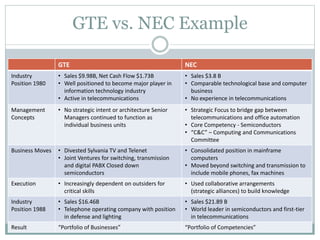
GTE vs. NEC Example
GTE NEC
Industry
Position 1980
• Sales $9.98B, Net Cash Flow $1.73B
• Well positioned to become major player in
information technology industry
• Active in telecommunications
• Sales $3.8 B
• Comparable technological base and computer
business
• No experience in telecommunications
Management
Concepts
• No strategic intent or architecture Senior
Managers continued to function as
individual business units
• Strategic Focus to bridge gap between
telecommunications and office automation
• Core Competency - Semiconductors
• “C&C” – Computing and Communications
Committee
Business Moves • Divested Sylvania TV and Telenet
• Joint Ventures for switching, transmission
and digital PABX Closed down
semiconductors
• Consolidated position in mainframe
computers
• Moved beyond switching and transmission to
include mobile phones, fax machines
Execution • Increasingly dependent on outsiders for
critical skills
• Used collaborative arrangements
(strategic alliances) to build knowledge
Industry
Position 1988
• Sales $16.46B
• Telephone operating company with position
in defense and lighting
• Sales $21.89 B
• World leader in semiconductors and first-tier
in telecommunications
Result “Portfolio of Businesses” “Portfolio of Competencies”
Roots of Competitive Advantage
 “The diversified corporation is a large tree.... The
root system that provides nourishment, sustenance,
and stability is the core competence.” (P&H-p. 82)
 Companies using competencies experience rapid
growth:
 Canon, Honda outpaced rivals
 Sony, Casio, Yamaha invented new devices
 Consolidating corporate-wide technologies and
resources into competencies is the key to success
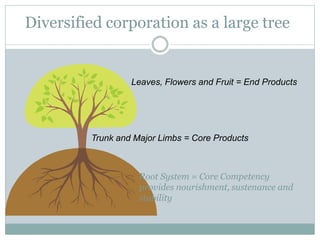
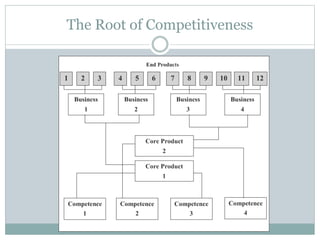
Diversified corporation as a large tree
Trunk and Major Limbs = Core Products
Leaves, Flowers and Fruit = End Products
Root System = Core Competency
provides nourishment, sustenance and
stability
The Root of Competitiveness
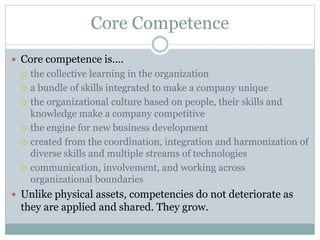
Core Competence
 Core competence is….
 the collective learning in the organization
 a bundle of skills integrated to make a company unique
 the organizational culture based on people, their skills and
knowledge make a company competitive
 the engine for new business development
 created from the coordination, integration and harmonization of
diverse skills and multiple streams of technologies
 communication, involvement, and working across
organizational boundaries
 Unlike physical assets, competencies do not deteriorate as
they are applied and shared. They grow.
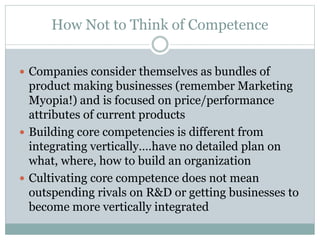
How Not to Think of Competence
 Companies consider themselves as bundles of
product making businesses (remember Marketing
Myopia!) and is focused on price/performance
attributes of current products
 Building core competencies is different from
integrating vertically….have no detailed plan on
what, where, how to build an organization
 Cultivating core competence does not mean
outspending rivals on R&D or getting businesses to
become more vertically integrated
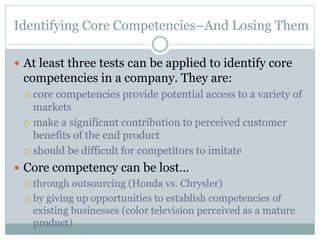
Identifying Core Competencies–And Losing Them
 At least three tests can be applied to identify core
competencies in a company. They are:
 core competencies provide potential access to a variety of
markets
 make a significant contribution to perceived customer
benefits of the end product
 should be difficult for competitors to imitate
 Core competency can be lost…
 through outsourcing (Honda vs. Chrysler)
 by giving up opportunities to establish competencies of
existing businesses (color television perceived as a mature
product)
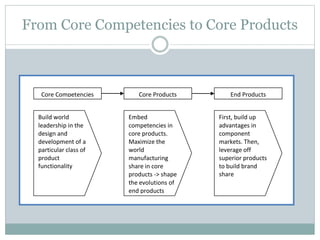
Core Competencies Core Products End Products
Build world
leadership in the
design and
development of a
particular class of
product
functionality
Embed
competencies in
core products.
Maximize the
world
manufacturing
share in core
products -> shape
the evolutions of
end products
First, build up
advantages in
component
markets. Then,
leverage off
superior products
to build brand
share
From Core Competencies to Core Products
End Products
Smartphones Laptops Gaming TV’s Cameras
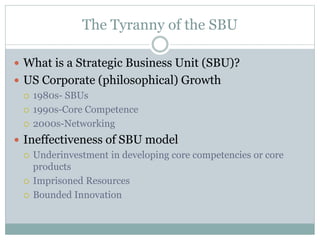
The Tyranny of the SBU
 What is a Strategic Business Unit (SBU)?
 US Corporate (philosophical) Growth
 1980s- SBUs
 1990s-Core Competence
 2000s-Networking
 Ineffectiveness of SBU model
 Underinvestment in developing core competencies or core
products
 Imprisoned Resources
 Bounded Innovation
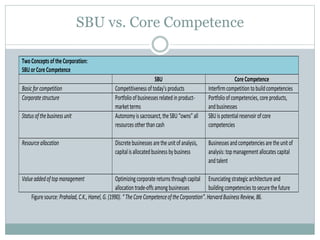
SBU vs. Core Competence
Two Conceptsof theCorporation:
SBUorCoreCompetence
SBU CoreCompetence
Basic forcompetition Competitiveness oftoday’s products Interfirmcompetitiontobuildcompetencies
Corporatestructure Portfolioofbusinesses relatedinproduct-
marketterms
Portfolioofcompetencies,coreproducts,
andbusinesses
Status ofthebusiness unit Autonomyis sacrosanct,theSBU “owns”all
resources otherthancash
SBU is potentialreservoirofcore
competencies
Resourceallocation Discretebusinesses aretheunitofanalysis,
capitalis allocatedbusiness bybusiness
Businesses andcompetencies aretheunitof
analysis:topmanagementallocates capital
andtalent
Valueaddedoftop management Optimizingcorporatereturns throughcapital
allocation trade-offs amongbusinesses
Enunciatingstrategicarchitectureand
buildingcompetencies tosecurethefuture
Figuresource: Prahalad,C.K.,Hamel,G. (1990).“TheCoreCompetenceoftheCorporation”.HarvardBusiness Review,86.
Developing Strategic Architecture
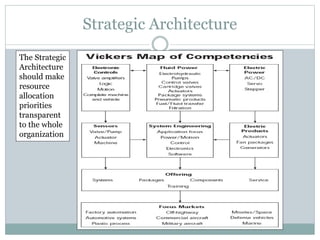
 A strategic architecture is a road map of the future that
identifies core competencies to build and their constituent
technologies. A strategic architecture should aim at
building competencies. Training helps.
 Creates a managerial culture of team work, capacity to
change, and willingness to share resources
 Protects proprietary skills, offers consistency in resource
allocation and allows us to think long term around that
 Reduces the investment needed to secure future market
leadership
 Provides logic for product and market diversification
Strategic Architecture
The Strategic
Architecture
should make
resource
allocation
priorities
transparent
to the whole
organization
Redeploying to Exploit Competencies
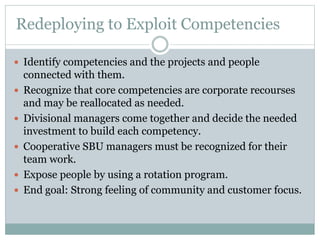
 Identify competencies and the projects and people
connected with them.
 Recognize that core competencies are corporate recourses
and may be reallocated as needed.
 Divisional managers come together and decide the needed
investment to build each competency.
 Cooperative SBU managers must be recognized for their
team work.
 Expose people by using a rotation program.
 End goal: Strong feeling of community and customer focus.
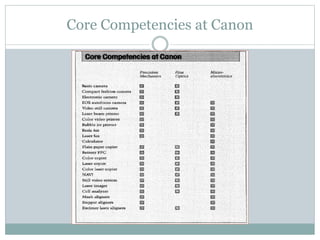
Core Competencies at Canon
Conclusion
 A very timely article, a radical breakthrough in
management thinking
 Sustaining core competence-what can be done
 Individual vs. national core competence-do we really
have any?
Discussion Questions
 What is a “core competence” of a corporation? Why
core competencies do not diminish in an
organization?
 What do the authors mean by “the tyranny of the
SBU?” In what ways the two concepts of the
corporation, SBU and core competence, differ?
Explain.
 What would be your (individual) core competence?
How would you relate that to your personal
development and goals in life?

nanopdf.com_prahalad-and-hammel-core-competence.pdf

  • 1.
    The Core Competenceof the Corporation P R A H A L A D , C . K . , G A R Y H A M E L ( 1 9 9 0 ) , “ T H E C O R E C O M P E T E N C E O F T H E C O R P O R A T I O N , ” H A R V A R D B U S I N E S S R E V I E W , M A Y - J U N E , 7 9 - 9 1 .
  • 2.
    Authors  Graduate ofHarvard School of Business  Professor at Univ. of Michigan School of Business  Advocate of Core Competency Focus for Businesses  Business Consultant  HBR-“He was one of the foremost business thinkers of our time”  Graduate of University of Michigan School of Business  Visiting Professor of London Business School  Ranked as the “World’s most influential business thinker” by the Wall Street Journal  Business Consultant and Media Contributor Gary Hamel 1954 - Present Coimbatore K. Prahalad 1941-2010
  • 3.
    Background  A turbulenttime:  1987 – stock market crash  1989 – Berlin Wall fell  1990 – dissolution of the Soviet Union  1970’s- 1980’s: unchecked growth in corporations  Becoming large, inefficient conglomerates  Acquired what they “needed”: strategic business units (SBUs)  US Corporate (philosophical) Growth  1980s- SBUs  1990s-Core Competence  2001-Networking
  • 4.
    Outline of theArticle The article emphasizes the importance of core competence of a corporation and asks management to develop their organization based on core competence  Rethinking the Corporation  The Roots of Competitive Advantage  How Not to Think of Competence  Identifying Core Competencies – And Losing Them  From Core Competencies to Core Products  The Tyranny of the SBU  Developing Strategic Architecture  Redeploying to Exploit Competencies
  • 5.
    Rethinking the Corporation “Thecritical task for management is to create an organization capable of infusing products with irresistible functionality or, better yet, creating products that customers but have not yet even imagined.” (P&H-p.80)
  • 6.
    GTE vs. NECExample GTE NEC Industry Position 1980 • Sales $9.98B, Net Cash Flow $1.73B • Well positioned to become major player in information technology industry • Active in telecommunications • Sales $3.8 B • Comparable technological base and computer business • No experience in telecommunications Management Concepts • No strategic intent or architecture Senior Managers continued to function as individual business units • Strategic Focus to bridge gap between telecommunications and office automation • Core Competency - Semiconductors • “C&C” – Computing and Communications Committee Business Moves • Divested Sylvania TV and Telenet • Joint Ventures for switching, transmission and digital PABX Closed down semiconductors • Consolidated position in mainframe computers • Moved beyond switching and transmission to include mobile phones, fax machines Execution • Increasingly dependent on outsiders for critical skills • Used collaborative arrangements (strategic alliances) to build knowledge Industry Position 1988 • Sales $16.46B • Telephone operating company with position in defense and lighting • Sales $21.89 B • World leader in semiconductors and first-tier in telecommunications Result “Portfolio of Businesses” “Portfolio of Competencies”
  • 7.
    Roots of CompetitiveAdvantage  “The diversified corporation is a large tree.... The root system that provides nourishment, sustenance, and stability is the core competence.” (P&H-p. 82)  Companies using competencies experience rapid growth:  Canon, Honda outpaced rivals  Sony, Casio, Yamaha invented new devices  Consolidating corporate-wide technologies and resources into competencies is the key to success
  • 8.
    Diversified corporation asa large tree Trunk and Major Limbs = Core Products Leaves, Flowers and Fruit = End Products Root System = Core Competency provides nourishment, sustenance and stability
  • 9.
    The Root ofCompetitiveness
  • 10.
    Core Competence  Corecompetence is….  the collective learning in the organization  a bundle of skills integrated to make a company unique  the organizational culture based on people, their skills and knowledge make a company competitive  the engine for new business development  created from the coordination, integration and harmonization of diverse skills and multiple streams of technologies  communication, involvement, and working across organizational boundaries  Unlike physical assets, competencies do not deteriorate as they are applied and shared. They grow.
  • 11.
    How Not toThink of Competence  Companies consider themselves as bundles of product making businesses (remember Marketing Myopia!) and is focused on price/performance attributes of current products  Building core competencies is different from integrating vertically….have no detailed plan on what, where, how to build an organization  Cultivating core competence does not mean outspending rivals on R&D or getting businesses to become more vertically integrated
  • 12.
    Identifying Core Competencies–AndLosing Them  At least three tests can be applied to identify core competencies in a company. They are:  core competencies provide potential access to a variety of markets  make a significant contribution to perceived customer benefits of the end product  should be difficult for competitors to imitate  Core competency can be lost…  through outsourcing (Honda vs. Chrysler)  by giving up opportunities to establish competencies of existing businesses (color television perceived as a mature product)
  • 13.
    Core Competencies CoreProducts End Products Build world leadership in the design and development of a particular class of product functionality Embed competencies in core products. Maximize the world manufacturing share in core products -> shape the evolutions of end products First, build up advantages in component markets. Then, leverage off superior products to build brand share From Core Competencies to Core Products
  • 14.
    End Products Smartphones LaptopsGaming TV’s Cameras
  • 15.
    The Tyranny ofthe SBU  What is a Strategic Business Unit (SBU)?  US Corporate (philosophical) Growth  1980s- SBUs  1990s-Core Competence  2000s-Networking  Ineffectiveness of SBU model  Underinvestment in developing core competencies or core products  Imprisoned Resources  Bounded Innovation
  • 16.
    SBU vs. CoreCompetence Two Conceptsof theCorporation: SBUorCoreCompetence SBU CoreCompetence Basic forcompetition Competitiveness oftoday’s products Interfirmcompetitiontobuildcompetencies Corporatestructure Portfolioofbusinesses relatedinproduct- marketterms Portfolioofcompetencies,coreproducts, andbusinesses Status ofthebusiness unit Autonomyis sacrosanct,theSBU “owns”all resources otherthancash SBU is potentialreservoirofcore competencies Resourceallocation Discretebusinesses aretheunitofanalysis, capitalis allocatedbusiness bybusiness Businesses andcompetencies aretheunitof analysis:topmanagementallocates capital andtalent Valueaddedoftop management Optimizingcorporatereturns throughcapital allocation trade-offs amongbusinesses Enunciatingstrategicarchitectureand buildingcompetencies tosecurethefuture Figuresource: Prahalad,C.K.,Hamel,G. (1990).“TheCoreCompetenceoftheCorporation”.HarvardBusiness Review,86.
  • 17.
    Developing Strategic Architecture A strategic architecture is a road map of the future that identifies core competencies to build and their constituent technologies. A strategic architecture should aim at building competencies. Training helps.  Creates a managerial culture of team work, capacity to change, and willingness to share resources  Protects proprietary skills, offers consistency in resource allocation and allows us to think long term around that  Reduces the investment needed to secure future market leadership  Provides logic for product and market diversification
  • 18.
    Strategic Architecture The Strategic Architecture shouldmake resource allocation priorities transparent to the whole organization
  • 19.
    Redeploying to ExploitCompetencies  Identify competencies and the projects and people connected with them.  Recognize that core competencies are corporate recourses and may be reallocated as needed.  Divisional managers come together and decide the needed investment to build each competency.  Cooperative SBU managers must be recognized for their team work.  Expose people by using a rotation program.  End goal: Strong feeling of community and customer focus.
  • 20.
  • 21.
    Conclusion  A verytimely article, a radical breakthrough in management thinking  Sustaining core competence-what can be done  Individual vs. national core competence-do we really have any?
  • 22.
    Discussion Questions  Whatis a “core competence” of a corporation? Why core competencies do not diminish in an organization?  What do the authors mean by “the tyranny of the SBU?” In what ways the two concepts of the corporation, SBU and core competence, differ? Explain.  What would be your (individual) core competence? How would you relate that to your personal development and goals in life?