Copyright & Fair Use A Student’s Guide
“ Copyright law promotes creativity and enables millions to work in creative fields in rewarding, high-paying jobs. Those who create and publish copyrighted works depend on the copyright law for their creative and financial success. All of us, as a society, benefit from the creation of those works.” Patrick Ross Copyright Alliance Education Foundation Chairman
The 6 Rights of Copyright Owners Reproduction Adaptation (Derivative Works) Distribution Public Performance Public Display Digital Transmission
Common Misconceptions Schools can use any copyright protected materials they wish because they are schools. Using materials is OK if you don’t make a profit. Promoting someone’s work by distributing copies is justification for free use. Materials used ‘for the good of kids’ absolves one of copyright liability. If there is no copyright notice, it’s free to use.
Section 107: Our ‘Loophole’ Section 107 of the U.S. Copyright Law explains the Fair Use exception that does give students and teachers leeway in their use of copyrighted works. There are 4 questions to consider when determining if Fair Use applies to what you want to do.
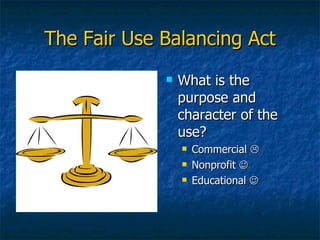
The Fair Use Balancing Act What is the purpose and character of the use? Commercial   Nonprofit   Educational  
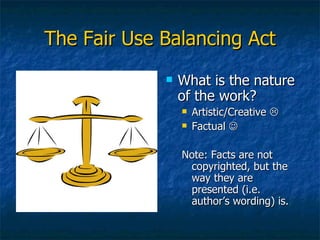
The Fair Use Balancing Act What is the nature of the work? Artistic/Creative   Factual   Note: Facts are not copyrighted, but the way they are presented (i.e. author’s wording) is.
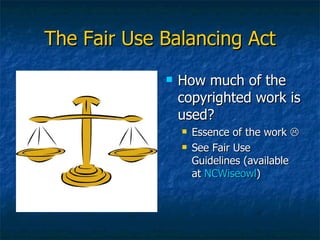
The Fair Use Balancing Act How much of the copyrighted work is used? Essence of the work   See Fair Use Guidelines (available at  NCWiseowl )
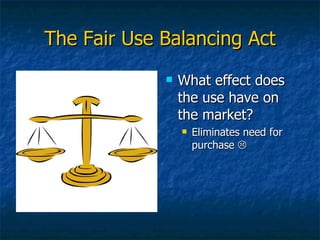
The Fair Use Balancing Act What effect does the use have on the market? Eliminates need for purchase  
Always, Always, Always… CITE YOUR SOURCES FOR ALL TEXT, IMAGES & OTHER MEDIA! It’s the responsible thing to do. Include a ‘Works Cited’ page/slide at the end of any assignment you do that requires research or the use of copyrighted material.
Alternatives to Copyrighted Works Create your own images, video, etc to use in school projects.  Copyright your own creative works.  Use content found in the  Public Domain .
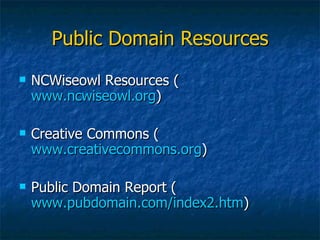
Public Domain Resources NCWiseowl Resources ( www.ncwiseowl.org ) Creative Commons ( www.creativecommons.org ) Public Domain Report ( www.pubdomain.com/index2.htm )

Copyright for Students

  • 1.
    Copyright & FairUse A Student’s Guide
  • 2.
    “ Copyright lawpromotes creativity and enables millions to work in creative fields in rewarding, high-paying jobs. Those who create and publish copyrighted works depend on the copyright law for their creative and financial success. All of us, as a society, benefit from the creation of those works.” Patrick Ross Copyright Alliance Education Foundation Chairman
  • 3.
    The 6 Rightsof Copyright Owners Reproduction Adaptation (Derivative Works) Distribution Public Performance Public Display Digital Transmission
  • 4.
    Common Misconceptions Schoolscan use any copyright protected materials they wish because they are schools. Using materials is OK if you don’t make a profit. Promoting someone’s work by distributing copies is justification for free use. Materials used ‘for the good of kids’ absolves one of copyright liability. If there is no copyright notice, it’s free to use.
  • 5.
    Section 107: Our‘Loophole’ Section 107 of the U.S. Copyright Law explains the Fair Use exception that does give students and teachers leeway in their use of copyrighted works. There are 4 questions to consider when determining if Fair Use applies to what you want to do.
  • 6.
    The Fair UseBalancing Act What is the purpose and character of the use? Commercial  Nonprofit  Educational 
  • 7.
    The Fair UseBalancing Act What is the nature of the work? Artistic/Creative  Factual  Note: Facts are not copyrighted, but the way they are presented (i.e. author’s wording) is.
  • 8.
    The Fair UseBalancing Act How much of the copyrighted work is used? Essence of the work  See Fair Use Guidelines (available at NCWiseowl )
  • 9.
    The Fair UseBalancing Act What effect does the use have on the market? Eliminates need for purchase 
  • 10.
    Always, Always, Always…CITE YOUR SOURCES FOR ALL TEXT, IMAGES & OTHER MEDIA! It’s the responsible thing to do. Include a ‘Works Cited’ page/slide at the end of any assignment you do that requires research or the use of copyrighted material.
  • 11.
    Alternatives to CopyrightedWorks Create your own images, video, etc to use in school projects. Copyright your own creative works. Use content found in the Public Domain .
  • 12.
    Public Domain ResourcesNCWiseowl Resources ( www.ncwiseowl.org ) Creative Commons ( www.creativecommons.org ) Public Domain Report ( www.pubdomain.com/index2.htm )