CopyrightFactsforeducators
Public Domain & Orphan WorksPublic Domain – a work that is free to the public because it has no copyright.
Orphan Works – the copyright owner is unidentifiableCopyright ActNonprofit organizations will not digitize orphan works because copyright owners have convinced legislators to lock up their works.
Overprotection of the work is just as destructive as under protectionUsing Materials from the Internet
Copyright InfringementA common assumption that is wrong
Everything on the Internet  is  part of the public domain.WRONG
Saving GracesLicensesImplied License
Express LicenseFair Use of Copyrighted Materials
What is Fair Use?According to the Merriam-Webster Dictionary “Fair use is when sections of copyrighted materials may be used without permission of the copyright owner provided the use is fair and reasonable, does not substantially impair the value of the materials, and does not curtail the profits reasonably expected by the owner.” LiabilityLiability for Infringement
A court can award up to $150,00 for each separate act of “willful infringement.”
“Willful infringement” is when  you know you were infringing on someone’s work.  Ignorance of the law is no excuse.Do you need permission to use a copyrighted work?Answer these 3 questions.Is the work protected?If the work is protected, has your campus already licensed right for you to use the work?Is the work available freely on the Internet, so it is covered by an implied license?
If the work is covered by an implied license --Has the owner of the work used a Creative Commons license to give the public the right to use the work in the way that you would like to use it?
If you don’t have express or implied rights, do you want to exercise one of the owner’s exclusive rights?
Is your use exempt or excused from liability for infringement?The  4 “Fair Use” factors.What is the character of the use?What is the nature of the work to be used?How much of the work will you use?What effect would this use have on the market for the original or for permissions if the use were widespread.
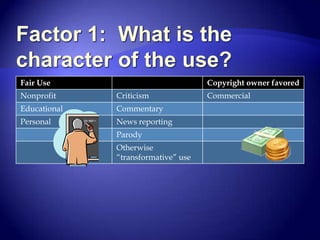
Factor 1:  What is the character of the use?
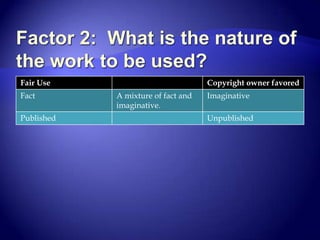
Factor 2:  What is the nature of the work to be used?
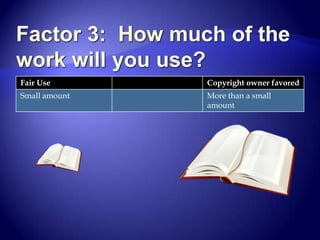
Factor 3:  How much of the work will you use?
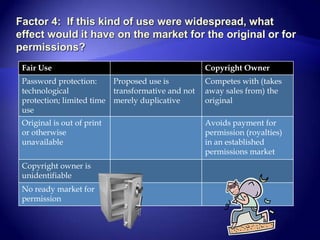
Factor 4If this kind of use were widespread, what effect would it have on the market for the original or for permissions?
Factor 4:  If this kind of use were widespread, what effect would it have on the market for the original or for permissions?
The TEACH ActBecame law in 2002.

Copyright Basics for Educators

  • 1.
  • 2.
    Public Domain &Orphan WorksPublic Domain – a work that is free to the public because it has no copyright.
  • 3.
    Orphan Works –the copyright owner is unidentifiableCopyright ActNonprofit organizations will not digitize orphan works because copyright owners have convinced legislators to lock up their works.
  • 4.
    Overprotection of thework is just as destructive as under protectionUsing Materials from the Internet
  • 5.
    Copyright InfringementA commonassumption that is wrong
  • 6.
    Everything on theInternet is part of the public domain.WRONG
  • 7.
  • 8.
    Express LicenseFair Useof Copyrighted Materials
  • 9.
    What is FairUse?According to the Merriam-Webster Dictionary “Fair use is when sections of copyrighted materials may be used without permission of the copyright owner provided the use is fair and reasonable, does not substantially impair the value of the materials, and does not curtail the profits reasonably expected by the owner.” LiabilityLiability for Infringement
  • 10.
    A court canaward up to $150,00 for each separate act of “willful infringement.”
  • 11.
    “Willful infringement” iswhen you know you were infringing on someone’s work. Ignorance of the law is no excuse.Do you need permission to use a copyrighted work?Answer these 3 questions.Is the work protected?If the work is protected, has your campus already licensed right for you to use the work?Is the work available freely on the Internet, so it is covered by an implied license?
  • 12.
    If the workis covered by an implied license --Has the owner of the work used a Creative Commons license to give the public the right to use the work in the way that you would like to use it?
  • 13.
    If you don’thave express or implied rights, do you want to exercise one of the owner’s exclusive rights?
  • 14.
    Is your useexempt or excused from liability for infringement?The 4 “Fair Use” factors.What is the character of the use?What is the nature of the work to be used?How much of the work will you use?What effect would this use have on the market for the original or for permissions if the use were widespread.
  • 15.
    Factor 1: What is the character of the use?
  • 16.
    Factor 2: What is the nature of the work to be used?
  • 17.
    Factor 3: How much of the work will you use?
  • 18.
    Factor 4If thiskind of use were widespread, what effect would it have on the market for the original or for permissions?
  • 19.
    Factor 4: If this kind of use were widespread, what effect would it have on the market for the original or for permissions?
  • 20.

Editor's Notes

  • #3 Orphan works [If the copyright owner is later found then that person can enforce their rights in the Copyright Act. The Copyright Act has so much power that most nonprofits stay away from orphan works.]
  • #6 Once an idea has been placed on a tangible medium it has automatic copyright protection.Once an idea has been placed on a tangible medium it has automatic copyright protection.
  • #7 Implied License - when an author posts anything on the Internet they must reasonably expect for their work to be read, downloaded, printed out, forwarded, and even used as the basis for other works.Express License – the copyright owner spells out in detail the rights an author wants readers, viewers, or listeners to have.
  • #9 Fair use is so hard to understand that it fails to provide effective guidance for the use of others’ work today.
  • #11 Copyright does not protect works that lack originality, works in the public domain, freeware, or U.S. govt. works.Any work published before Dec. 31, 1922 is now in public domain. --Works published between Jan. 1, 1923 – Dec. 31, 1978 are protected for 95 years with proper notice. If published between 1923 – 1963 the original term of protections (28 yrs) has expired unless renewed.
  • #12 Owner’s rights – electronically distribute
  • #14 Items in the middle add weight to a fair use claim. Especially when items in the left are used.